

Race Directors, Inc.
Amarathon has it all. There are records forged by elite and amateur athletes. There are cheaters such as Rosie Ruiz in the 1980 Boston Marathon. There are fantastic turns such as German Silva at the 1994 New York City Marathon where, as the leader, he followed a lead motorcycle right off the course at Central Park and had to turn back onto the roads (where he eventually won). There are miscalculations, like that seen most recently at the 2005 Lakeshore Marathon where an additional mile made that 42K in Chicago a 27.2-miler. And there are personal triumphs, new friendships, marriage proposals, weddings, and even deaths.
What is involved in the creation of any marathon is equally compelling and mind-boggling. Much like running one, organizing a marathon is not for the timid. It is a monumental struggle that never goes off without a problem, never runs as smoothly as desired, and never comes off without a great level of difficulty. Yet, the end result is always worth the expended energy, regardless of which side of the tape you find yourself on. And as the race directors of some randomly selected U.S. marathons can attest, this is often the case.
GREATEST FEARS There are many. Race directors’ fears run the gamut, of course. At the Honolulu Marathon, for instance, there was food poisoning at the 1987 carbo party and a heat wave in 1995. One year at the Walker North Country Marathon in Walker, Minnesota, miscommunication resulted in an experience that race director Lois Templin would rather not have had happen. But from it came great improvements. “
We have radios at every aid station so that volunteers can radio to the next aid station (two to three miles away) the numbers of the last runners through the stations so those ahead can know when it is OK to close down the station, as all runners have now passed by,” she explains. “Five years ago, there was a large gap [of a half mile] between the last and next-to-last runner, so the aid station at about mile 23 radioed to the next station the number of the last runner through.
Between the stations, the second-to-last runner got much slower, and the last runner actually caught up to her and passed her. When the runner who used to be last came through the last aid station, they closed up and started picking up the signs, leaving the other runner with no support for the last couple of miles.” As a result, the first-time marathoner wound up lost in Walker and ended up running an extra half mile to a mile. Needless to say, the runner was not happy. And it fell upon Templin, who was second in command at the time, to talk to her. “
She ranted and raved, and rightfully so, for quite some time,” Templin recalls. “Her boyfriend had found me just before she arrived and explained the situation and that she was livid now but would be fine later, he thought. I said she was in the right and agreed to let her unload on me. I apologized profusely and refunded her entry. I also wrote her a letter later, explaining that this was a major concern and topic for the committee, and our policies had changed because of it.”
Instead of the aid stations radioing each other at Walker, a person on a bike now rides the entire course behind the last runner, and it is that person who informs the stations. In addition, Templin incorporated a special award for the last finisher called the Red Lantern Award. “
As the last runner turns the corner to enter the last stretch to the finish, he/she is handed a red lantern with a plaque on it, naming our race. The lantern is lit, and that person carries it through the finish line and keeps the lantern as their own prize for their determination,” says Templin. “I offered another free entry to the woman who had been left behind and explained our new policy to make sure nothing like that ever happened again, but she never returned to our race. Can’t really blame her!”
RUNNERS’ HEALTH The utmost concern in a marathon, of course, is the health of the participants. Dallas White Rock Marathon Race Director Marcus Grunewald found himself one year literally face-to-face with a medical emergency. “
Having an elite runner suffer a heart attack right after crossing the finish line,” Grunewald says of the worst thing to ever occur at his race. “I basically caught him in my arms as he was on his way down.”
The runner, thankfully, survived. “And he went on to resume running, but at a much slower pace and [at] shorter distances,” Grunewald says. The Marine Corps Marathon in Washington, D.C., has had several deaths at its race, and the Under Armour Baltimore Running Festival, which features a marathon, half-marathon, team relay, 5K, and a kid’s fun run, has also experienced a fatality. “A woman died the first year of the event from a brain aneurism,” notes Baltimore Race Director Lee Corrigan. “There was nothing that we could have done.”
Don Connolly, race director of the Cincinnati Flying Pig Marathon, recalls a similar incident with a more upbeat ending. “A runner had a heart attack at the finish,” he notes. “Our medical team was immediately at his side administering lifesaving care. He was able to come back and run our race again.” Dr. Jim Barahal, president of the Honolulu Marathon Association, succinctly states what he looks forward to the least: “Ambulance sirens during the race.” And the best thing? “No ambulance sirens during the race.”
TECHNOLOGY
Courtesy of Paul Clerici
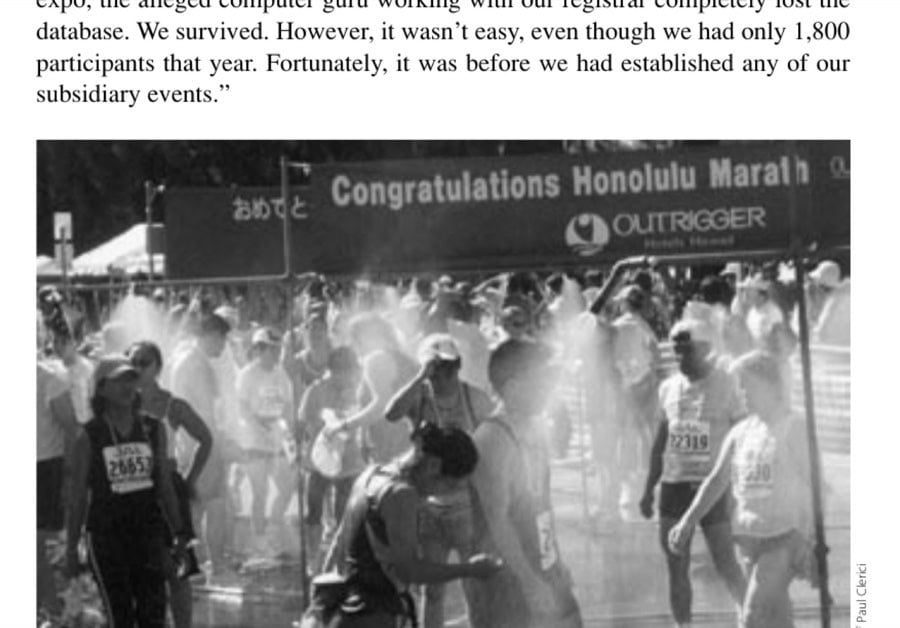
In 1983, the Portland Marathon in Oregon experienced not a life-threatening incident but a technological trauma. Organizationally, it was the worst thing that could have happened before a race. “It was the second year of our reorganization,” says Les Smith, event director. “We were still in the infancy of using computer technology for registration. The night before we were to start our then one-day, preevent registration miniexpo, the alleged computer guru working with our registrar completely lost the database. We survived. However, it wasn’t easy, even though we had only 1,800 participants that year. Fortunately, it was before we had established any of our subsidiary events.”
▲ After completing the Honolulu Marathon, runners can cool off by enjoying a quick shower, which is located close to the finish line.
9/11 ATTACK The tragedy of 9/11 also affected marathons throughout the country. Portland, for example, was scheduled just 19 days after the terrorist attack, and the organizers fielded questions about whether the race would be canceled. Smith remained steadfast in his determination to continue the race, as did Detroit Free Press/Flagstar Bank Marathon Race Director Patricia Ball, whose October course runs in both Canada and the United States. “
Nine-eleven was the worst thing that ever happened. It was a horrific tragedy for our country, something we will never get over,” she says. “But it closed down borders. We found ourselves with official notification some three weeks before our marathon that we would have to redesign our course, running solely on U.S. soil. We did it—and found our numbers peaked as runners came out in support of the event.”
WEATHER Regardless of how well a race director or marathoner prepares, the weather on any given day will always rule. If it’s going to rain or snow, it’s going to rain or snow. The 2005 editions of the Sugarloaf/USA Marathon in Maine and the Lake Placid Marathon in New York, for instance, both experienced unfavorable weather. The majority of Sugarloaf in June featured cold and rainy conditions, while very hot and humid temperatures baked runners at Lake Placid in July. “
Perfect weather and no incidents. A great day,” is what Sugarloaf/USA Marathon Race Director Sue Foster states is what she looks forward to the most. And the least? “The alternative.” Scott Keenan, race director for Grandma’s Marathon in Duluth, Minnesota, notes of his race, “I would have to say the scariest thing to happen was in 1986 when tornado-force winds whipped through our finish-line area. Most of our tents were wiped out, causing tens of thousands of [dollars of] damage. Very fortunately, not one person was hurt during this incident.” Connolly adds about the Flying Pig, “Our first race with rain and unexpected cold temperatures that tested all aspects of the organization.”
THE COURSE The story goes that for the first Boston Marathon in 1897, a race official dragged his heel across a dirt road in the town of Ashland, thus laying down the first starting line of the prestigious running event. Now, the lines are strikingly different, much larger and more colorful. And but for a few adjustments in the more than 100 years since, which include a different start and finish, Boston has basically stayed true with the same point-to-point course through the same local towns.
Keenan of Grandma’s says, “We have been extremely blessed with a great course that we have not had to make any drastic changes to in the past 29 years. When it comes to describing the Grandma’s Marathon course, [1976 Olympian and two-time Grandma’s winner] Garry Bjorklund said it best, ‘You start in the middle of the woods, run along the beautiful shores of Lake Superior, and finish at a pub. What more could you ask for?’” The course for the first New York City Marathon in 1970, for example, was primarily a four-loop trek around Central Park. In 1976, it was changed to its current course, from Staten Island to Central Park via the five boroughs of Staten Island, Brooklyn, Queens, the Bronx, and Manhattan.
According to Corrigan, there was also much planning involved with the design of the Baltimore course because of its overall effect on so many areas. “It is a big effort. You must take into consideration many things,” Corrigan states. “The runner—make it as flat as possible; the city—make it so it does not completely crush the traffic; the tourist runners and the local tourist administration—make it scenic so folks tell everyone how nice Baltimore is; hospitals and public transportation—make sure that it does not infringe on mandatory routes; [and] the police—make sure it is a safe route that the police can effectively control traffic flow for the safety of the runners. We deal with the following entities when considering a route: the police, the fire and rescue, the department of transportation, the department of public works, local churches, public transportation, and so on.”
The Walker North Country Marathon now provides runners with spectacular views of the national forest, through which the field of under 1,000 runs. The majority of the race surface is groomed gravel roads and grass and paved trails. “
The original course was designed 23 years ago,” notes Templin. “Three years ago, we decided to change the course to get as much of it as possible off the main highway, which has become substantially more busy in the last two decades. We wanted as much as possible to be in the Chippewa National Forest and as little as possible to be on paved roads [it is also noted that less than five miles is on paved roadways].” For Detroit, Ball has benefited from studying other marathon courses, relying on the expertise of Course Director Doug Kurtis and deciding what would be best to offer runners.
STRESS THE POSITIVE “I’ve come to the conclusion that if we are going to be around for at least another 28 years, we want to build our events around something that is sustainable over time,” Ball says. “So rather than looking at what we could bring into our city that we currently do not have to offer participants, I started looking at what Detroit does have to offer. This has helped tremendously in coming up with what I think is one of the most unique courses in the nation.
Courtesy of Paul Clerici
“We have the international borders, and we allow participants to cross at both borders—the Ambassador Bridge and the Detroit Windsor Tunnel,” Ball continues. “We’ve named the tunnel the only underwater international mile in the world. We have different neighborhoods, like Corktown (an old Irish settlement), Mexicantown, Greektown, and Indian Village. We have an island on the Detroit River—Belle Isle—that we use as part of the course. We start and finish near our new stadiums. Ford Field is the home of the 2006 Super Bowl, and participants will be finishing right on the floor of the stadium.”
In major cities, an obvious attraction is to have the course either start, finish, or travel through its center. A bonus would be all three. The San Francisco Marathon, for example, starts and finishes downtown near the Ferry Building and runs along the water through the Embarcadero and Presidio, twice over the Golden Gate Bridge, within Golden Gate Park, and through many colorful neighborhoods. “
City needs, topography, scenic course,” Peter Nantell, event producer of the San Francisco Marathon, notes some of the requirements. The Golden Gate Bridge was returned to the course in 2005, and Race Director Sophia Li sees that as one more reason her numbers will climb. “
With the addition of the bridge this past year, we are projecting continual growth for years to come,” she says. “This event has been run for 28 years. Various companies have produced the event. Four years ago, the start and finish lines were moved downtown. This is the basis of the current course. Since then,
▲ The author takes a moment on the Golden Gate Bridge during the San Francisco Marathon as the fog rolls in.
the race has increased each year, and in total, the race has increased by over 3.5 times the number of runners.” Dallas White Rock also takes advantage of its famous city landscape. “The main condition was to have the course avoid major traffic roadways and get the runners from downtown Dallas, out and around White Rock Lake, which is where the marathon was originally held, and back to the start/finish line downtown,” notes Grunewald. “Over the years, the course has been refined to include runner-friendly roads, more scenery, and less traffic.”
THE IDEAL? A CLOSED COURSE While a course closed to traffic is ideal, it is not always feasible, especially through major U.S. cities. The Boston Marathon, for one, has enjoyed tremendous support from the towns of Hopkinton, Ashland, Framingham, Natick, Wellesley, Newton, Brookline, and Boston, through which the course travels. Marathoners own the roads each Patriots’ Day in Massachusetts. Traffic was also a concern in Portland, Oregon, when that course was originally designed and then redesigned. “
Our course was designed in a very logical way by a committee member who I knew had the talent and enthusiasm for such a project,” says Smith. “In the process, he worked very well with the city, the police, and traffic engineering. His patience, plus his knack for understanding distances and the sense of where runners would enjoy running, made it easy. Of course, there were certain realities that needed to be taken into account when creating and staging the marathon, in other words, churches, hospitals, traffic patterns, and so on. “
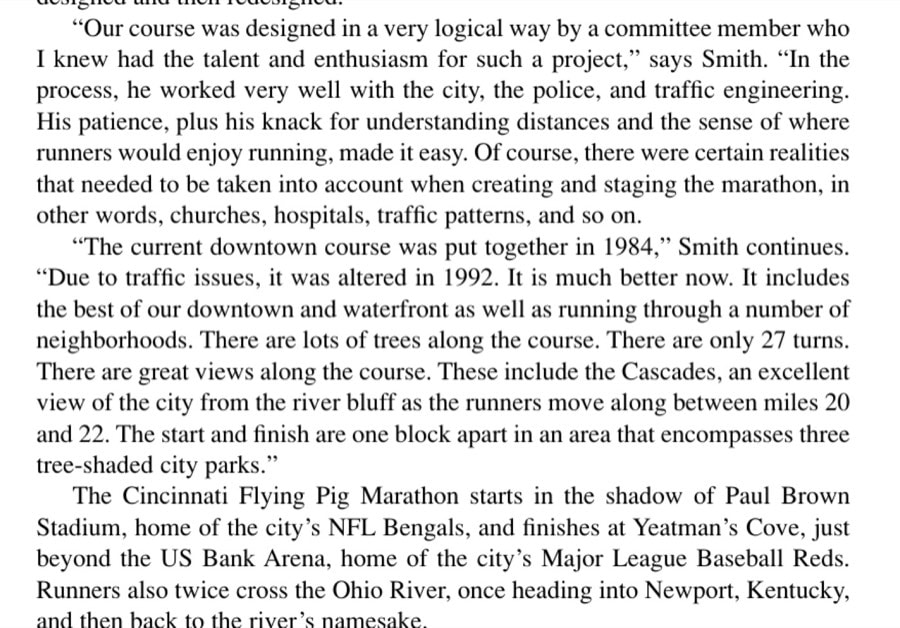
The current downtown course was put together in 1984,” Smith continues. “Due to traffic issues, it was altered in 1992. It is much better now. It includes the best of our downtown and waterfront as well as running through a number of neighborhoods. There are lots of trees along the course. There are only 27 turns. There are great views along the course. These include the Cascades, an excellent view of the city from the river bluff as the runners move along between miles 20 and 22. The start and finish are one block apart in an area that encompasses three tree-shaded city parks.”
The Cincinnati Flying Pig Marathon starts in the shadow of Paul Brown Stadium, home of the city’s NFL Bengals, and finishes at Yeatman’s Cove, just beyond the US Bank Arena, home of the city’s Major League Baseball Reds. Runners also twice cross the Ohio River, once heading into Newport, Kentucky, and then back to the river’s namesake. “[
You] have to keep in mind public access around your course on race day in cooperation with and input from police and city services,” notes Connolly of the Flying Pig. “A marathon needs to work shoulder to shoulder with police because of the impact the race has on the city and neighborhoods it goes through.”
Courtesy of Paul Clerici
▲ Runners cross over the Ohio River from Cincinnati into Kentucky during the Flying Pig Marathon. They will return to Ohio a few shorts miles later.
In addition, Connolly also looked “for a start close to parking and on a wide street; as much flatness on the course to make it as fast as possible; scenery and unique/historic aspects of the city that would add interest; vibrant neighborhoods to support the race with spectators; a starting time that would avoid interfering with Sunday church services; large areas for relay exchange zones, entertainment locations, fluid stations, and such; and a finish in the largest area possible [that would be] pleasing and fan accessible.”
The Sugarloaf/USA Marathon has an easy time with its course, which is composed of only the Maine Scenic Highway Route 27. The start is near Flagstaff Lake at the Cathedral Pines Campground, just north of Stratton, Maine. The first 10 miles or so allows runners to “wind through several 4,000-foot peaks of the Appalachian Mountains” and also pass the Sugarloaf/USA ski resort. The course then basically follows the Carrabassett River to the finish in Kingfield, Maine. “
There is one road in our community,” Foster of Sugarloaf points out. “We run it point to point, from northeast to southwest for the elevation loss.”
PLANNING “Picking the date,” notes Grandma’s Keenan of the ease in planning an event. “Just kidding. There is no easy way to host a quality event—there are no shortcuts. You have to work hard no matter what.”
Most runners don’t wake up on a Sunday and decide to run a marathon that morning; they plan ahead for months and even a year beforehand. And when they arrive on marathon weekend, everything is set up: tents, corrals, expos, volunteers, portable toilets, and more. It all seems to have just magically appeared out of nowhere.
For race directors and others involved, that magic usually begins the day after each year’s marathon. The race director’s job, whether paid or volunteer, is full-time. “The organization of a marathon is a year-round job,” says Grunewald of Dallas. “As soon as we finish one race, we meet and discuss any problems we encountered and the means to correct those problems, along with discussing feedback from the runners, spectators, sponsors, and others. We propose plans to address all those issues and also begin discussing new additions to the race to make it even better. At the same time, we begin meeting with existing sponsors to make sure they’re happy, and [we] canvass the marketplace for new sponsors. “
As much as you try to anticipate problems from the runners’ perspective, there’s always something that was either overlooked or not even imagined,” continues Grunewald, who himself has run Dallas 10 times. “The race director job is a voluntary position that I work on as time permits. My full-time job requires a steady 40 to 45 hours a week, so I squeeze in work on the marathon at all times throughout the day and night. It’s really amusing to be working on the marathon way past midnight and receive an e-mail or instant message from another volunteer who is putting in the same long hours as I am.”
Similarly, the Detroit Free Press/Flagstar Bank Marathon benefits from a yearlong schedule of meetings, events, and evaluations as well as the continued support from its host city. Ball, who has run her own marathon many times, seems to be a natural at building. She built herself up from a nonrunning smoker to a veteran marathoner whose finish times range from 3:19 to 4:20; she built herself up from a part-time hourly team relay coordinator and volunteer recruiter to race director; and she built up a small business with her former husband that reached sales of $4.5 million by the time she left. And she has built a solid group of people to organize Detroit each year.
STAFF EXPERTISE “Most of my core staff is built of runners or former runners,” Ball says. “They are also all professionals who each contributes a different level of expertise. One of the things I’ve learned from them and continue to learn is that I don’t need to be the one with the answers. I have to continually challenge myself to keep the vision and goals in focus for them—and then get out of their way and let them do the work. It’s not important what you can accomplish yourself as the race director but rather what you can bring out in others to accomplish.
“I think it is impossible to have a marathon without community involvement and ownership,” Ball continues. “The most difficult part of organizing a marathon is working to get your community/city to freely accept ownership. You need a solid foundation of supportive relationships with the right people within your community. You never know when you are going to need to call on someone to work the politics of a challenge you cannot overcome. We have another interesting challenge in Detroit [with] the international borders. Each year, we are faced with more and more challenges.” San Francisco fields a full marathon, a pair of half-marathons (first half and second half), a marathon relay, and a 5K. With so many events, it takes a great number of people to help it run smoothly. “
We begin planning the logistics more than six months in advance,” notes Li. “We grow to almost 300 staff and 1,000 volunteers [by] race weekend. The San Francisco Marathon is a year-round responsibility. Even before one race ends, we start our marketing plans for the next year.” No matter the size of the field, marathon planning is the same, whether it’s for thousands in San Francisco or hundreds at Sugarloaf. “
We begin immediately following the race each year by evaluating the event—how it came off, what sorts of new problems we encountered, how we could make it better,” notes Foster of the Maine race. “The actual entry form, Web site update, and planning of supplies and services don’t start until September (three months after, nine months before the next event). It is a one-person job until about two weeks before the event.”
VOLUNTEERS The most difficult aspect of planning, notes Templin of her Walker North Country Marathon, is finding volunteers who can spend the time throughout the year. But once she finds people, keeping them is easier because they usually want to return after the experience. “
Our event is held in September,” she says, “so after the event, we have a wrap-up meeting that allows us to take notes of any changes, concerns, or needs for the next event. Then we do not meet again until about February. We meet every month from February to July. In August, we meet two to three times and once in the beginning of September. Then it is crunch time for everyone to get everything done by the time we get together at the beginning of the week of the race to pull everything together. The day of the marathon and the evening registration before require about 200 to 250 volunteers for aid stations, starting line and finish line, awards ceremony, radio patrol, course patrol and sweepers, and so on.”
The Flying Pig employs two full-time employees: an executive director (Iris Simpson Bush, a board member for four years before assuming this post in May
2002) and an administrative director (Denise Hovey, who joined the Pig as a volunteer, then registrar, and then in this full-time position). “In 1998, I heard that a group was trying to put together a marathon,” says Simpson Bush, a native Cincinnatian who worked for the city’s ABC affiliate, “and I thought it would be great for our city and important that the station get involved. I had run a few marathons and knew how gratifying the experience could be personally and what an economic impact it could have on a community.”
The Flying Pig Marathon also has six part-time seasonal contracted employees with its race, logistics, and operation directors, along with the communications directors and an event specialist, Connolly points out. “
The race also has over 30 key volunteers that cover course monitors, zone captains, medical teams, and fluid stations,” Connolly says. “We have over 3,000 volunteers race weekend. [And] planning for the next year begins the day after the marathon.” “
The organization process is an ongoing year-round effort,” notes Corrigan of the Under Armour Baltimore Marathon. “Marketing and promotion are yearround; and operations and logistics are a constant year-round process as well that become the focal point of the company three months out,” Corrigan continues. “City politics and community relations are never ending as well. We must make everyone feel good about this event because it affects the entire city for a day.”
The easiest aspect for Corrigan? “Dealing with the running community, which is the lifeblood of our event and every event out there. If you do a good job, they will tell the world that you do a good job and that they had a pleasant experience. And conversely, if you don’t do a good job, they will let you and everyone else know as well. Of course, there are selfish complainers out there that always find silly things to bitch about, but as a whole, I find the community to be quite fair and reasonable.” And the most difficult aspect? “Making everyone happy, which is impossible,” says Corrigan. “But we truly try to listen to every runner, every sponsor, every community organization, every city entity, and make improvements each year based on their suggestions, requests, and demands. It is never going to be perfect for everyone.”
EVOLUTION A marathon continuously grows and evolves. It is a forever-changing body with many moving parts. As an example of growth, Boston fielded but 15 entrants its first year, and 10 finished. After a peak of 38,708 in its centennial year of 1996, it has averaged more than 20,000 since 2003. Dallas began in 1971 with 82 entrants (61 finishers) and reached 10,221 marathon, half-marathon, and marathon relay entrants in its 36th anniversary in
Courtesy of Paul Clerici
2005. Chicago began in 1977 as the Mayor Daley Marathon with 4,200 starters (2,128 finishers) and fielded 33,125 participants in 2004. New York had 127 starters in its inaugural 1970 run with 55 finishers. And Portland started with 173 entrants in 1972. “
In reorganizing the Portland Marathon in 1982, I used the NYC Marathon model,” notes Smith. “I put together a 15-person committee, which initially focused on having coordinators for various key functions within the event, such as logistics, medical, course, volunteers, and so on. Generally, the coordinators then found volunteers and created their own subcommittees. If necessary, they asked the volunteer coordinator for help. [In] the 1981 debacle event (when it started 25 minutes late, aid stations were not ready, mile markers were missing, etc.), there were 470 participants. In 1982, we grew to over 1,100. “
Over the years, with the growth of the event,” he notes, “we continued to grow the committee model. At the present time, we have over 20 key coordinators. They and other sublevel coordinators make up our 90-member marathon committee. We meet for business every Wednesday before the marathon for about five weeks. During the year, we usually have two full marathon working committee meetings. Otherwise, there are lots of subcommittee meetings that go on throughout the year.”
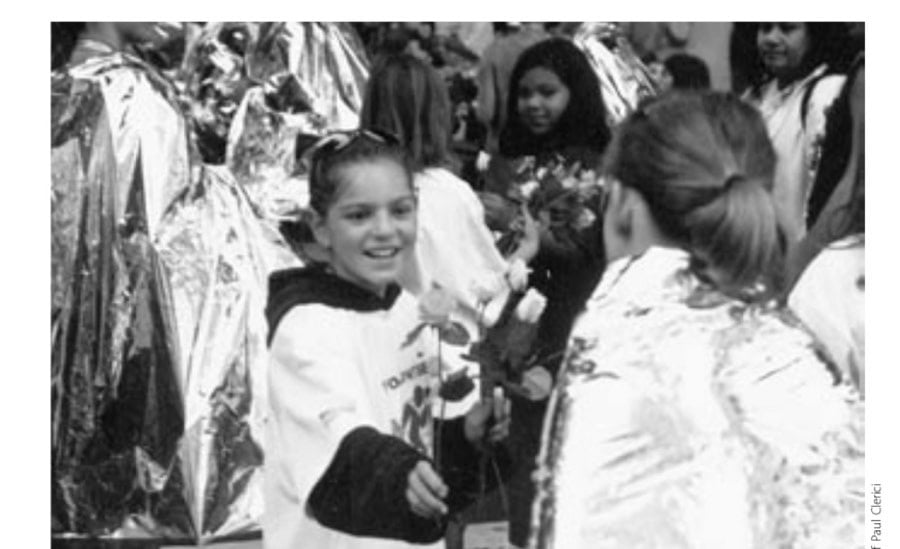
▲ At the Portland Marathon in Oregon, finishers are greeted with many gifts for their effort, including colorful roses.
While it will celebrate its 25th anniversary in 2006, the Sugarloaf/USA Marathon nearly became extinct before Foster arrived in 1999. “The first year I took over the race, it had been cast aside, doomed to extinction, and none of us knew,” she says. “Two months out, an area running club and I pulled it together, offered free entry with minimal support. We had 40 runners and gave away white pine seedlings for awards. We kept it going, but it was almost lost forever. Most of the race history was not kept, so I do not have that field size info from 1982. I am in my seventh year with the race, and our field has been consistently in the 400 to 500 registered-runner range. The 15K adds an additional 350 runners to the mix.”
THE ONLY RACE DIRECTOR From hosting smaller races and a 26-mile race as president of the North Shore Striders in Duluth, Minnesota, in the late 1970s, Keenan has been the race director of Grandma’s since its inception. “We made it our goal to organize an official marathon in 1977 along Old Scenic Highway 61,” he explains. “Our largest problem at the time was funding—the club only had $23 in the bank, so we approached many businesses in the area, and the first to offer financial assistance was Grandma’s Restaurants. The owners gave us $600, and we named the race after their restaurant. The first race took place on June 25, 1977, and I’ve been the race director ever since. “
We currently have six full-time employees,” he adds, “and we essentially work year-round to organize the marathon and supporting events, from promoting it, to holding registration, recruiting sponsors and volunteers, and actually doing the nuts-and-bolts work that needs to be done. I have to say that it is an ongoing process from one year to the next.” The first year of the Baltimore event in 2001 fielded approximately 9,000 total participants. That number dropped to around 6,000 the following year and has climbed back ever since. “I believe that the first year was so strong due to the fact that it was the inaugural event,” Corrigan says. “We have been growing at a 20 to 25 percent clip ever since. We had about 10,000 last year, and we expect over 12,000 this year.”
Hovey of the Flying Pig Marathon notes that the inaugural race in 1999 fielded 6,200 marathon and relay runners, a number it matched the following year. Add-on races such as a 10K, 5K, half-marathon, and four-person relay have boosted turnout each year since 2001. By 2005, the race fielded a peak of 13,282 entrants. “
From its inception, ‘the Pig,’ as it has become known, was dedicated to the premise of offering a premier event for runners of all abilities,” adds Executive Director Simpson Bush. “The organization is a not for profit [that] raises money
for over 50 local charities, now generating in excess of a million dollars annually, 100 percent of which goes to the participating charities. In addition, the Pig is all about fun and community celebration and in just seven short years is ranked in the top 20 marathons across the country, according to the rankings of Runner’s World magazine. It’s about exceeding expectations and treating participants, grunts (volunteers), and street squealers (spectators) all as VIPs (very important pigs). It is a vehicle for bringing many worthwhile groups together for a common cause, and most develop a real passion for the Pig and its mission. Again, we think this sentiment is an integral part of what makes the Pig run.”
Notes Pig Race Director Connolly, “I have runners pass me after the race, and they make a positive statement about the event, which is not something everyone gets when they leave work.”
WHY? There are as many reasons to run a marathon as there are to, well, run a marathon. In 1972, when just under 180 runners toed the line for the first Portland Marathon in Oregon, it was a club event, at the time run by the Oregon Road Runners Club (ORRC). The majority of the field was composed of teenage harriers, due in large part to the encouragement of local cross-country coaches. “The first event was held on Sauvie Island, which involved a flat two-loop run around an island next to the Columbia River,” explains Smith, a veteran runner of nearly 90 marathons with a background as a U.S. Army officer and president of the Multnomah Athletic Club, a 20,000-member organization with over 45 major committees and a number of minor committees. “I ran in the 1981 Portland Marathon, [and] unfortunately, the marathon that year was something of a disaster. It started 25 minutes late, aid stations were not ready, and mile markers were missing on the course, among other things. It was at that time that I decided that my principal agenda item (as ORRC president) would be to renovate and revive the Portland Marathon.”
A lot of race directors had previously held subordinate positions, and when the time presented itself, for better or for worse, one thing led to another. But the seed had already been planted when that time did arrive. “
I had been a triathlete for a number of years and just happened to be hanging around the wrong group of friends at the wrong time of the year,” deadpans Grunewald. “A few of my running buddies were involved with the Dallas White Rock Marathon, and one of them was the race director. One year I was injured and couldn’t run the marathon, so they recruited me to work in it. I started as a relay exchange captain, worked my way up to relay race director, and eventually became the overall race director.”
Explains Ball of Detroit, “I always say in [the] in-training clinics to sponsors [and] to community leaders that the person who begins to train for a marathon will not be the same person that crosses that finish line. His/her life will be forever changed—for the better—in positive ways. Running a marathon is a life-altering experience. Knowing that I somehow played a part in that for people is a true gift and joy in my life. How can a job get any better than that?”
A former athlete who has been involved with sports marketing and event management for 15 years, Corrigan notes the reason for a running festival in the Maryland city was because “we recognized a need and desire for the event in Baltimore, and [we] have nurtured it into a successful staple event. Once it starts, I feel great relief. All the hard work in preparation has come to fruition, and I feel at that point like it is a big old sled going down a big hill [and] there is nothing that is going to stop it, so we might as well all hold on and have a great time on the ride. And we usually do.”
PERSONAL REWARDS “Watching all the faces of the runners as they realize their goals and accomplishments,” states Nantell, as he observes the thousands of runners crossing the finish line on Jefferson Street in San Francisco with the Bay Bridge in the background.
That sentiment is often echoed by most race directors. After months of preparation and meetings and deadlines, it’s the simple sight of runners crossing the finish line that seems to bring the most happiness. “
I think the greatest joy for me is probably the same as it is for anybody—volunteers, staff, board members, sponsors, participants—who help organize and host this event: the rewarding feeling that you have when the race is going on and when it’s all over,” notes Keenan of Grandma’s. “It is wonderful to hear the positive comments, to see thousands of people having a great time, to see the triumphs at the finish line, and to know that you’ve played a role in hosting a successful event. “
And I have to say,” he adds, “seeing my grandchildren watching the race at the finish line. It means a lot to me to have them there each year.” Ball, whose athletic career has evolved from running in order not to gain weight after she stopped smoking, to becoming the first woman to backpack the 3,000-mile Continental Divide from Canada to Mexico (in a benefit hike), to having run several marathons, including a PR 3:19, seems to fully enjoy the entire race-director’s experience. “
There are many greatest joys,” she says. “I have three: (1) talking to the participants training to run a marathon or hearing from past participants about the difference running a marathon has made in their lives; (2) standing at the start on
race morning, looking out at the sea of people listening to the national anthem, taking it all in; (3) standing at the finish line as the participants come across. I’ve witnessed more tears of joy at the finish line than I have at weddings and births. Knowing that I work so hard all year to allow another person to accomplish one of the greatest challenges of a lifetime is awesome!”
FAMILIAR FACES Adds Templin of Walker, “Seeing the familiar racers, the ones who have come back year after year: that we know their history, know how hard they work, know what this means to them, and seeing them cross the finish line or win their age category or accomplish their goals. It feels like we have been there with them the whole way, and to see them accomplish what they have worked so hard for makes us all feel so proud that we were able to offer a venue for them to do those things. And they are always so grateful and appreciative that it makes us all forget how tired we are or the runner who just complained because he doesn’t like the color of our shirts this year.”
For a marathoner, rewards come in many forms. For an elite athlete, it could be prize money, stature, endorsements, or recognition. For average runners, it could be a medal, a T-shirt, a PR, a race photo, a hug from a family member, or their name in the newspaper. For a race director, personal rewards are equally varied and seldom self-centered. “
I love seeing the joy on the peoples’ faces as they complete the race,” notes Corrigan of Baltimore. “And the pride that we feel when we make the charity presentations with the mayor after the race is settled every year.”
The reward for Honolulu’s Baharal lasts all year long and appears all year long. “When I see thousands of people in town all year-round, wearing marathon volunteer shirts and hats and I don’t know who they are,” he says, “it makes me aware of the magnitude and impact of the event. And watching the slower runners finish and seeing the look on their face.”
Adds Dallas White Rock’s Grunewald, “Having runners congratulate you and the other volunteers for putting on a good event and having a first-time marathoner tell me that they loved it and can’t wait to run it again next year. And watching the start, and then standing near the finish line and watching as the first-time marathon runners cross the finish line. [Also] when we present a check to our beneficiary and I see the funds being used for good. “
And,” he notes, “when I could tell my kids admired me for doing what I do.”
This article originally appeared in Marathon & Beyond, Vol. 10, No. 3 (2006).
← Browse the full M&B ArchiveMore like this
1,000+ stories from 19 years of Marathon & Beyond
The complete archive of the legendary long-distance journal — digitized and free to read.
