

Racing Man
Joe Dudman spends as much on race fees as some people do on car payments. That’s because the 45-year-old from Portland, Oregon, likes to race . . . a lot. Asked once, at the end of a year in which he had logged 62 races, how many he had completed in his lifetime, he consulted his training logs, then pegged the figure at “about” 1,080.
For years, he has tried to run as many races as possible. One year he hit 83. A year later he upped the ante to 84. Quite a few times, his total has been in the 50s or 60s. Whatever the precise figure was on that particular December 31, it was different a few hours later. Some people toast in the New Year with champagne, but Dudman did it with a midnight 5K. Call it race number 1,081. At 11 a.m. the next morning, he lined up for a “hangover” 5K. Call that one race number 1,082. A 90-mile drive, and three hours later he was in yet another 5K. Such is the formula for Dudman’s dream of someday breaking his 84-race PR.
When asked whether such a goal might appear odd, he responds with the verbal equivalent of a shrug. How is it different, he asks, from doing an ultra? “I’m kind of amazed that people can keep going for such a long time without a break,” he says of ultrarunners. “Since I don’t have great stamina, for me the challenge is the quantity of races, rather than the distance of a single race.” If anything, he suggests, his type of megaracing is easier. “I’m getting a break. [My body] can recharge and get ready for another race pretty quickly, but I’m not good at keeping up a hard effort for a long time.”
No jogging here One way to run so many races would be to jog them. But Dudman goes all out. One weekend in 2006, he ran 10Ks on Saturday and Sunday. Both were downhill, with comparable elevation drops. His times: 32:34 and 32:35. Hitting two race times that close together is largely luck. But unless he is injured, Dudman is remarkably steady. “I can’t think of another runner in the
Portland area whose results have been so consistent, season to season and year to year,” says fellow Portland runner David Hatfield. Hatfield, a freelance computer programmer who enjoys analyzing sports data, has often used Dudman’s times as a gauge of whether a course is “fast,” “slow,” or improperly measured. Once, he even used a “Dudman factor” to rescore finishing places in a race series in which attendance had varied substantially from race to race (meaning that nth place didn’t always reflect the same performance). “Some people might not have run head to head, but they had both run against Joe,” Hatfield says. “I ended up averaging people’s performances relative to Joe.”
Dudman is fast enough to have won more races than most people enter in a lifetime. On his New Year’s triptych, he was second in the masters division in the first race, won it in the second, and won overall in the third. His 5K PR is 15:35, his marathon (not his best distance) 2:49. At age 42, he ran his best-ever five-miler on a hilly road course, finishing in 26:26 (5:17 per mile).
He has even won a national championship. It came at the USA Track & Field masters outdoor track championships, a meet he attended with the plan of adding to his race count (he has run as many as five events in a single meet) and maybe scoring a medal. “Any color,” he says. “A national championship wasn’t on my radar.”
In the first race, he got his medal: bronze in the 5,000. Two days later, he won his division in the 10,000. It wasn’t a PR, but it was gratifying because he won tactically, in a come-from-behind finish. The next day he tried again, this time in the 1,500. But even Dudman needs more time than that to recover. “I had pretty much nothing left,” he remembers. “But I didn’t care, because I’d had my good race.”
▲
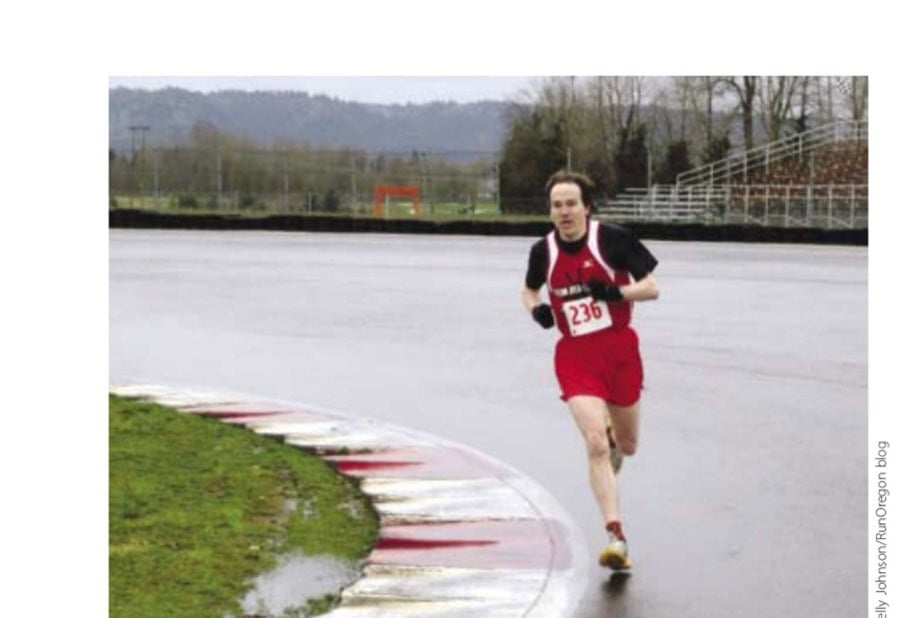
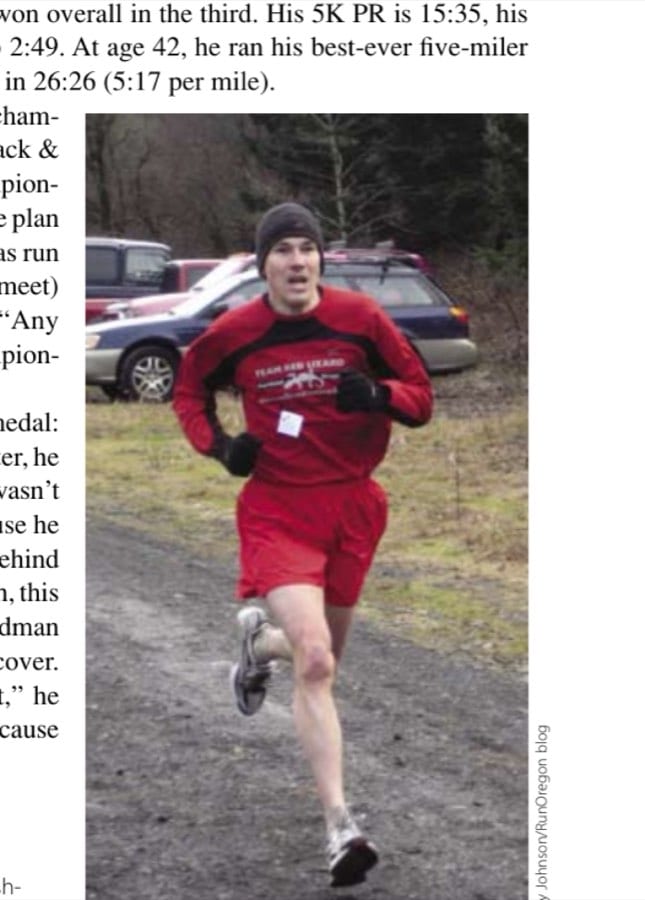
Joe Dudman cruises in the 2009 Groundhog Hustle in Stevenson, Washington.
Kelly Johnson/RunOregon blog
And then there are the race wins
Maybe some rest might help? Coaches have suggested that he might be even faster if he ran fewer races. Dudman shrugs it off. He is never going to the Olympics, and he does what he does because he can. And it’s fun. “Fun” is a word he uses a lot when talking about racing.
But there was one time during his 84-race year when he went to a track meet well rested, focusing on a single event. The meet was the Drake Relays, held each April in Iowa. Twenty years before, in 1986, he had been there as a college senior, on a 4 x 1 mile relay team. Now he was back, for the masters mile.
Among college runners, the Drake Relays is a major meet, but just a meet. For masters runners, getting invited is one of the sport’s holy grails. In 2006, the field was particularly stacked—enough that the race director was hyping it as “the finest field ever to run a masters mile on U.S. soil.” Race-day conditions, unfortunately, were less than optimum, and the expected superfast times failed to materialize. “Raining and howling” was how one running Web site described the weather, with 20-mile-per-hour gusts and 50-degree temperatures.
Dudman was one of the lower-seeded entrants, but he finished fifth. His time: an extremely respectable 4:39, roughly comparable to a youngster’s 4:19.
Mr. Unassuming As is the case with many good runners, nothing about him telegraphs his talent. Quiet spoken, an environmental research assistant in daily life, Dudman is given away only by his runner’s frame: 5 feet, 9 inches tall by 135 pounds wide, the classic ectomorph.
Football—at least American football—is obviously not his sport, though he is good at soccer, which he has played since fourth grade and continues to play in coed leagues. Growing up, he spent a year in England, where he not only honed his soccer skills but first learned to run. At the end of PE class, the kids would finish with a run across the school grounds. “Almost always, it was a race between me and another guy,” he says. Then one day, when Dudman was 12, everyone in the school was required to take part in a cross-country race.
He didn’t win. He wasn’t even second. “Maybe 13th,” he says. What he remembers is that he lost a shoe . . . twice. The first time, it caught in the planks of a wooden bridge. Then, a few steps later, it was sucked off by thick mud.
Meanwhile, other kids were streaming by. It was one of those small moments that can change a life. “When I finally got my shoe back on,” he says, “I took off, really fast. [I] started passing people, and gained back my original place. I think that had a lot to do with honing my competitive spirit in running: wanting to get that place back.”
An active spectator
Kelly Johnson/RunOregon blog
Thirty-two years later, Dudman was again watching runners stream by. Only this time, he was a spectator, standing in a raw January breeze a few miles outside of Salem, Oregon. Earlier, he had won the masters division in a 10K. Now, he was watching the middle of the half-marathon pack, foregoing his own award ceremony to cheer in clubmates several minutes per mile slower than him.
The sense of club is something that’s important to him. For years, he had been unaffiliated—Portland’s hottest free agent—turning down sponsored teams because he didn’t want to be wedded to any one brand of shoe.
Then, totally out of the blue, he joined Portland’s Team Red Lizard, a 300member all-comers’ club, where he served a two-year term as vice-president and continues as self-designated cheerleader. Between races, he uses software designed by another club member to comb race results worldwide, comparing them to the club’s membership roster. Whether you’re a 2:35 marathoner or a 5:32 marathoner—whether you ran on the other side of town or across the Atlantic—if you’re a club member, the software will find you and post a congratulatory note on the club’s Web site.
Once, he drove to the Oregon Coast to a marathon he had no intention of running. Waiting for his clubmates to reach the finish, Dudman and another Red Lizard, Carin Moonin, headed out for a 14-mile trainer. “We were running about
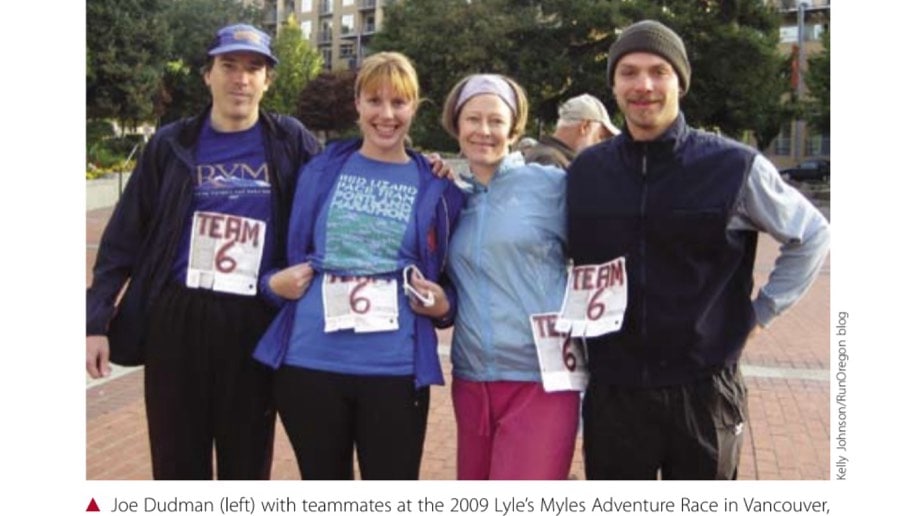
▲ Joe Dudman (left) with teammates at the 2009 Lyle’s Myles Adventure Race in Vancouver, Washington.
9:00 pace,” Moonin remembers. “And while I knew that was like walking speed for him, Joe never made me feel like I should be apologizing for my pace.” Halfway through their run, Dudman and Moonin met fellow Red Lizard Kelly Johnson and paced her through the last seven miles of the race, where she finished in 4:27. “This was nowhere near as fast as his times,” Johnson recalls, “yet he was as proud of me as if I’d run a 3:00.”
Adds Moonin: “What I like about Joe is that he is willing to run with anyone, anytime, no matter what the pace. He’s this interesting mix of competitive and easygoing, if that makes any sense. He is both, at the right times. You can’t help but root for him because he’s such a mensch.”
Defining race If you’re trying to run as many races as possible, one question you eventually have to ask yourself is: What’s a race? Clearly, that first all-school race was different from chasing his rival across the school grounds at the end of PE class. But where exactly is the boundary between “race” and “not quite a race”?
It doesn’t lie in the type of event, Dudman has decided. Cross-country, track, roads, trails . . . he has raced them all. He counts “predicts” (in which runners estimate their times, then run without watches to see who can get closest to their stated goals), and cross-country ski races (a sport at which he most emphatically does not excel, fighting to avoid last, rather than dueling for the win).
A “race,” he has decided, has to meet two basic qualifications: it has to be timed, and it has to have results. Awards aren’t necessary, nor is formal publication of the results. “But it does have to have results of some kind.”
He developed these rules a few years ago, after running a fund-raiser for the Multiple Sclerosis Society in a small, outlying community. When he got to the end, there was a big clock, but nobody was recording times. He went home, thought about it, and scratched that race off his tally. Any competitive pursuit, even for a private goal, has to have rules. Otherwise, he could just run any day, any place, and call it a race.
Making up for raceless weekends Eighty-plus races in a year is one every four-and-a-half days—and even runnerfriendly Portland doesn’t have races every weekend. But he compensates for the slow weeks with times like New Year’s Day or the Fourth of July, when a bit of driving can garner several races in rapid succession. One of the things Dudman enjoys is poring over race listings, looking for possible double- or triple-headers. “The logistics is another big part of the challenge,” he says. “It’s kind of fun figuring out how to do it.”
He particularly likes pulling off rapid-fire race strings that make his friends’ jaws drop. In one notable sequence in 2007, he ran a 2:49:19 marathon on July 4. Three days later, he ran a 1,500 on the track, in 4:21. The following day he ran 10K on the roads in 33:44.
Another time, he started a weekend with a Saturday trail race. On Sunday, he led off with a cross-country meet in which he entered both the masters and the open races (both 5Ks). Then he drove across town for another cross-country race, this one in the early afternoon. The tally: four races in one weekend, three in one day. “That was fun,” he says.
His friends have suggested that the only way he could do this is by cloning himself. “It’s not humanly possible to race as often, with such fast times, as Joe does,” says Johnson, who is coauthor of a running blog with him on oregonlive. com, the Web site of the (Portland) Oregonian newspaper. “The only logical explanation is that he sends his clones to some races. It makes us mere humans feel better.”
Dudman likes the idea—enough that one Halloween he dressed as one of his clones. On his running club’s message board, he’s known as “Joe D,” so, for the party, he presented himself as “Joe E,” a geeky dude in clunky sunglasses and a
ad
Kelly Johnson/RunOregon blog
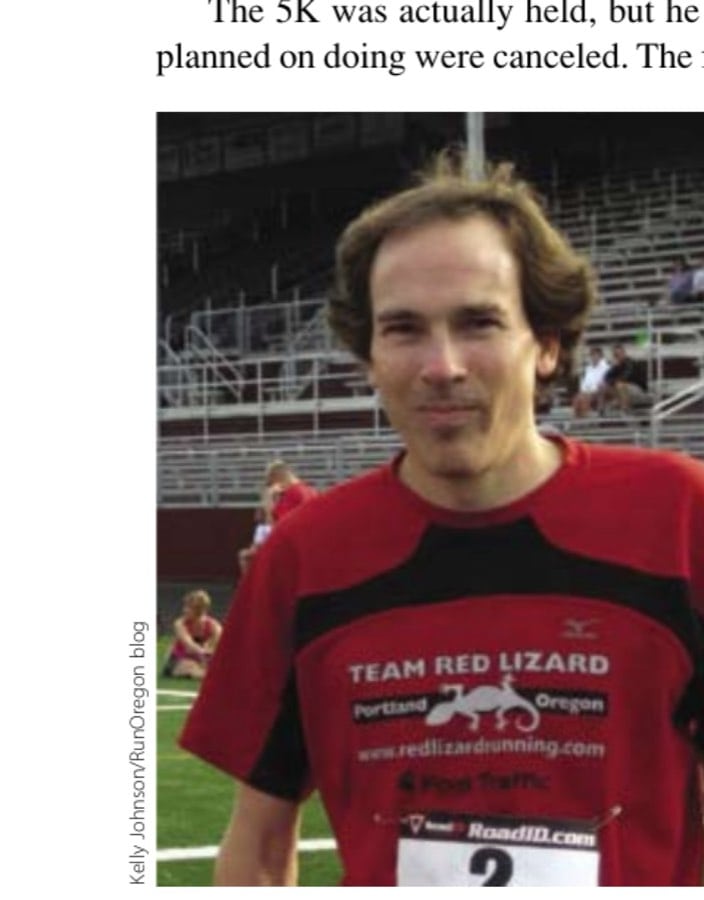
▲ Joe Dudman competes in the Rotary Run-Around 2-Miler in February 2010 in Portland, Oregon.
racing uniform that didn’t quite match the club’s norm. Joe D, the clone explained, couldn’t be there because he was off running a race.
The start of the madness In high school and college, Dudman was a fairly typical competitor (he ran for Carleton College, in Northfield, Minnesota). His pursuit of the race count began in 1995, when the Oregon Road Runners Club (ORRC) put on a race series in which runners got points not only for finishing high in the standings but for completing as many series races as they could.
The previous year, Dudman had been laid up much of the time by illness (endocarditis, an infection of the heart valves). What better way, he figured, to celebrate his return to health than to rack up completion points in the race series? Soon enough, he was also counting races that had nothing to do with the ORRC series.
But it wasn’t until a few years later that he took it to the next level. The inspiration came when the race calendar served up 5Ks in three rural Willamette Valley towns, only a few minutes’ drive apart. Most runners would choose one and forgo the others. But that wasn’t necessary, he realized. He could hit one
at 7 a.m., drive to the next town, race at 9 a.m., drive to the third, and race again at noon. He was already running dozens of races a year, but this had the appeal of being a new idea. The clones would come later. At the time, all he thought was that it would be a good opportunity to do something unique—and fun.
Somehow avoiding injury Another question he is frequently asked is how he can run so many races and not be perpetually hurt. Partly, the answer is that he is gifted with a body that can tolerate what he likes to do. But there is another factor, surprisingly simple. Dudman may be a high-frequency racer, but he is a low-mileage trainer. Credit his longevity, in part, to good biomechanics tempered by low training mileage. Except when he is training for a marathon (he has done five), he runs only 35 to 40 miles a week, less than half of what most of his competitors do and a third of what the pros log. Nor does he run seven days a week. “I usually take Monday off, and if I have a major race on Saturday, I’ll take Friday off, too,” he says.
On the other days, his training log often shows a hard track workout on Tuesdays, a very slow six-mile recovery run on Wednesdays, and either an hour at marathon pace on Thursdays or a half-dozen 70-second hill repeats. On weekends he either races or runs about 70 minutes at an easy pace.
To date, he has had only five injury layoffs, and the first three didn’t have anything to do with running. One came from tendinitis in his knee from playing hacky sack. Another time he strained his back while lifting boxes. The third was a sore Achilles tendon from “working at the computer with my foot in a funny position.” None of these cost him more than a couple of weeks.
Some injuries are traumatic Then he decided to run the Timberline Marathon, which runs downhill on the Pacific Crest Trail, starting at the 6,000-foot level on Oregon’s Mount Hood. He had already done 60 races that year, but the injury had nothing to do with overuse. Rather, about halfway through, starting to tire from the long descent, he lost concentration, tripped on one stone, and bashed his knee on another. Looking down, he saw “something white and shiny,” which, happily, soon disappeared in blood.
The nearest aid station was two miles away, so he started walking. Then he tried jogging. “When I got to the aid station, there were just these two high school guys with a table of water,” he remembers. “We were kind of far from civilization and I didn’t really hurt much, so I decided to keep going.” Besides, he wanted his finisher’s shirt.
When he fell, he had been leading the race. By the time he finished, he was still, amazingly, in fourth. He had run 3:30, on trail, on what turned out to be a broken kneecap. It cost him a two-and-a-half-month layoff. Some runners might have gone nuts. Others would have been cross-training like fiends. Dudman figured he would simply wait it out. His advice: don’t get too obsessive, even when pursuing obsessive-sounding goals. And, of course, “Don’t trip.”
Recently, though, he has been suffering from his first genuine overuse injury. It’s a problem he has noticed, off and on, for years, but it never rose beyond the nuisance level until April 2008, during a 10-mile race.
The injury is a neuroma, a painful (read that, extremely painful) inflammation of a nerve in his foot. “I think what happened was that I was wearing slightly too-old racing flats in too long a race,” he says. Then he compounded the error by running the Boston Marathon a week later. (“Not in racing flats,” he is quick to note.) A subsequent cortisone shot kept the pain in check and allowed the foot to gradually improve, but the lingering injury dulled his interest in longer races. He still plans to run a lot of races in 2010, but he has designated it as the year of the 5K. If that allows the foot to fully recover, he will go for a new race-count record in 2011.
Goals missed and rescheduled The foot wasn’t the reason he missed his goal in 2008. Yes, it cost him a few races—he took two full weeks off after Boston and later skipped some races he had intended to run—but by early December he had logged 78 events. He had every intention of finishing with a bang. The bang would begin in Spokane, Washington, on December 13. At stake was the USATF cross-country club nationals, where he planned to contest three
Kelly Johnson/RunOregon blog
▲
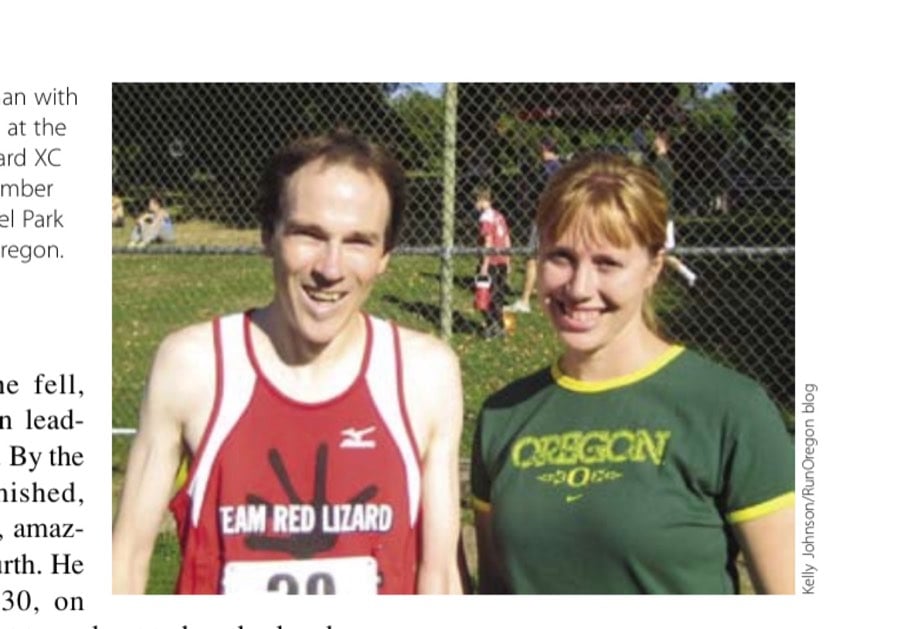
Joe Dudman with Kelly Johnson at the Team Red Lizard XC Race in September 2009 at Gabriel Park in Portland, Oregon.
events: an all-comers’ 6K “community” race, the masters division 10K, and the open-class 10K (in which masters runners can compete if they wish). The first started at 9:30 a.m., the last at 1:30 p.m. After that, he would drive back to Portland
for a 5K the following day: four races in 24 hours, bringing his total to 82. Three more in the next 17 days, and he would have his goal. Then it snowed. Or more precisely, blizzarded. There wasn’t really that much snow on the ground, but the temperature was in
the 20s and dropping. Worse, there was wind. “In most races, there comes a point where I’m pushing my limits and think there’s no way I can keep running this fast,” Dudman says. Usually, he hits that point about two-thirds of the way through. In
Spokane, it came within the first few hundred meters. “I was seriously wondering whether I could continue running at all,” he says. “I had no momentum.” Dudman may be fast but he’s not afraid of finishing low in the standings. “As
long as I think I’ve [done] my best, it doesn’t matter if people beat me,” he says. But frostbite and hypothermia are different matters, and the wind was so strong that later that day some of the women would be blown off their feet. Dudman hung
on to finish the 6K (ninth in a minuscule 11-runner field) but couldn’t imagine braving the wind again, especially in longer races. He was now two races behind plan, with the Northwest swirling into its worst
cold snap in decades. For two weeks, Portland would be virtually paralyzed by unaccustomed snow. The 5K was actually held, but he couldn’t get to it. Two other races he had planned on doing were canceled. The fourth was a hundred miles away on the far
side of the Coast Ranges. “I decided I’d better not try to get to it,” he says. By then, there was no point in even trying to find races to make up for the ones he had lost—if they even existed. The final tally: 79 races totaling 405.79 miles.
A race in every county
▲
Kelly Johnson/RunOregon blog
If Dudman ever manages to run 85 races in a year, he will immediately set his sights on 86. But that’s not his only goal. Another is to race in each of Mega-racer Joe Dudman ran 84 races in one year. Here he is at the 2009 CATnip Friday 5K in Sherwood, Oregon.
Oregon’s 36 counties. So far, he has collected 32. When he’s finished, he might try for neighboring Washington, though that might be a bigger challenge, partly because Washington has more counties (39) but also because he is not sure they all have events meeting his definition of a race. “Some of the northeastern counties are pretty rural,” he says. “I’ve at least heard of one race in every county in Oregon.”
He got the idea a decade ago, when he ran a race along the crest of Steens Mountain, a little-known 9,700-foot range in southeastern Oregon. A week later he ran a race along the rim of Crater Lake. “I realized that those were the only races I’d run in those counties,” he says. So, when he got back, he combed his running logs to see how many counties he had already collected.
One of the benefits of the project is the travel. “It’s allowed me to visit corners of the state I probably never would have been to, otherwise,” he says. And he enjoys the goal’s unconventionality. “It’s just another uncommon running goal that [is] fun to pursue.”
An even more exotic goal centers on the Hood-to-Coast Relay, in which teams of 12 run nearly 200 miles from Mount Hood to the Pacific Ocean. Dudman has done it 14 times. Now, he wants to be on two teams . . . simultaneously.
There is nothing in the rules to prohibit that. “I don’t think it would give either team much of an advantage,” he notes. Part of the challenge would be racing six legs, totaling about 33 miles, within 24 hours—or less, depending on the teams he chooses. But an even bigger challenge would be figuring out how to do it. “You’d have to find two teams that are pretty close to the same pace, so the legs for each team wouldn’t get too close or too far apart,” he says, “and try to figure out how to shuttle between teams during the race. The running itself would be a challenge, but [so would] the transportation.”
Keep it in perspective The questions Dudman faces for the future are no different than those any masters runner faces. Will the body hold up for decades to come, or will tendinitis, bursitis, or some other -itis decree that your best years are behind you? Will Dudman someday hit a hundred races in a year, or will 84 prove to be his lifetime best?
What Dudman knows is that for most of us, running is a sport, a hobby. It’s a lifestyle, not a career or a taskmaster to which we must answer any call. “I think the main point is to have fun and find out through experience how you can best maximize your potential,” he says. “Runners should find what they enjoy and figure out what works best for them. “
I’m not a student of running,” he adds. “I just know what works for me. It took me a long time to find out what I was good at and how I can train most effectively.”
This article originally appeared in Marathon & Beyond, Vol. 14, No. 3 (2010).
← Browse the full M&B ArchiveMore like this
1,000+ stories from 19 years of Marathon & Beyond
The complete archive of the legendary long-distance journal — digitized and free to read.
