

Really International Marathon
Running the World
A Really International Marathon Team USA/Fort Wayne goes to Gera, Germany, to take on the world in the Elstertal Marathon. by Brett Hess
There are international marathons, and then there is the Elstertal Marathon. Our little group from Fort Wayne, Indiana, could have traveled to Paris or London or, more appropriately in this case, Berlin. Instead, we journeyed 5,000 miles to compete against 200 runners.
Why do this? Since when did less become more in the world of marathoning? What about the exhilaration of the masses and the photo ops of urban landmarks? To this question, Team Fort Wayne—no, make that Team USA—replied, “Give us Gera! And bring on the Russians. And the Finns. And throw those East Germans into the race, too!”
As you may have guessed by now, the Elstertal Marathon in Gera, Germany, in August 2007 was anything but a typical international marathon experience for our group. The field was small and the host city was tiny, but this race had a certain resemblance to another marathon hosted by Germany in 1972.
Team: together everyone achieves . . . aw! Just forget it We were an odd group, our team of runners from Fort Wayne—not exactly the “A” team, more like the “D” team. Or maybe the “F” team, as in “fun.” But, well, we were the best our city could muster for this trip.
Fort Wayne and Gera are sister cities. We share much, our little towns. With roots in industrial production and farming, we hooked up shortly after the reunification of Germany. Since that time, representatives have traveled across the Atlantic each year to experience each other’s way of life. For Hoosiers, it’s an excuse to drink German beer in Germany. For Gera’s citizens visiting Fort Wayne, it’s an annual excuse for us—you guessed it—to drink German beer with Germans.
Gera’s leaders take its sister-city program seriously. They were so happy when the Berlin Wall fell that they quickly signed up with nearly a dozen cities across the globe. Gera even has a sister city in Germany (Bitburg), albeit from former West Germany.
During the summer of 2007, the organizers thought they would invite teams of runners from all of Gera’s sister cities to compete in the Elstertal Marathon. It would be a friendly contest, to be sure, with each city’s first three finishers figuring in the scoring, lowest total time to win.
Phil Suelzer, Fort Wayne’s coordinator, began recruiting for this event well in advance. Unfortunately, none of our city’s finest (runners, that is) signed up. But what we got was an appropriate blend of our town: injured and healthy, young and old, experienced and inexperienced.
Headlining our team was yours truly, a 41-year-old 15-time marathoner, including the last seven Bostons. But a recurrent illness stemming from this year’s Boston and a career change over the summer greatly reduced my training. I was running simply for fun—and that aforementioned German beer.
We also had a 50-year-old grizzled ultramarathoner named Brad Compton. I found it interesting that Brad told us on the flight over that, three weeks earlier, he had finished a 100-mile trail race. So I was thinking, He’s not gonna go too fast.
Next was 69-year-old attorney Bill Harris. He has run many marathons in his lifetime, but none of them fast. In fact, his stated goal for this race was to “not embarrass my city.” Oh boy, we’re 0-for-3 so far.
We also had 22-year-old Garrett Bradtmuller, a soon-to-be-senior crosscountry runner for Indiana University-Purdue University Fort Wayne. He would be making his marathon debut. What he lacked in experience, he more than made up in enthusiasm. Of course, everyone has enthusiasm until he reaches mile 23 for the first time.
Finally, our hammer: Suelzer. Phil might be in his 50s and recently retired as a school psychologist, but he is by far the most decorated athlete of our group. An accomplished marathoner (sub-2:30 back in the day) and triathlete (a participant in the early days of the Hawaii Ironman), Phil was going to get it done for us— that is, until he tore his meniscus shortly before our trip. In the end, “Coach” Phil was a great video-photographer.
International intrigue Team USA met its rivals the night before at a feast with an interesting menu. Instead of pasta, we were treated to a dish that consisted of pork roast encased in a potato paste. A side of sauerkraut topped it off. The wine and beer flowed, and I started to feel good about our chances and said so to anyone who would listen. By noon the next day, I realized it was just the beer talking.
I sat with the team from Kuopio, Finland. The team didn’t look so tough: middle aged, happy to drink beer and wine. We compared our training regimens. All five team members (four men and one woman) were triathletes. They made it clear that they were here for a party and that the marathon would just be a three-hour interruption.
Their ace, Ismo Kotijarvi, was the superintendent of the city’s sports facilities. “He’s in great shape because he gets to run and swim while at work,” said Jukka Vanhanen in broken English. Vanhanen managed a liquor store, which didn’t give him the same advantage as Ismo but certainly didn’t hurt. “
You have a saying in America: Don’t take your work home with you. Right?” Vanhanen asked me. I answered affirmatively. “Well, my wife always calls and says bring home some wine. So, I bring my work home with me!”
Kuopio’s best athlete was the woman, Imke Hofling. She was nationally ranked in the triathlon and was training for the national championships. In very good English, Hofling said she would be taking it easy in the marathon.
Hofling, an orthopedic surgeon, was a native of Germany. Along with Finnish, German, and English, she also spoke Italian, French, and Russian. I wondered, but didn’t ask, what language she cursed in when she developed cramps late in a marathon.
Next to our table was seated the latearriving team from Rostov, Russia. Its 36hour bus ride must have been an ordeal, but within a few beers, the team members began ▲
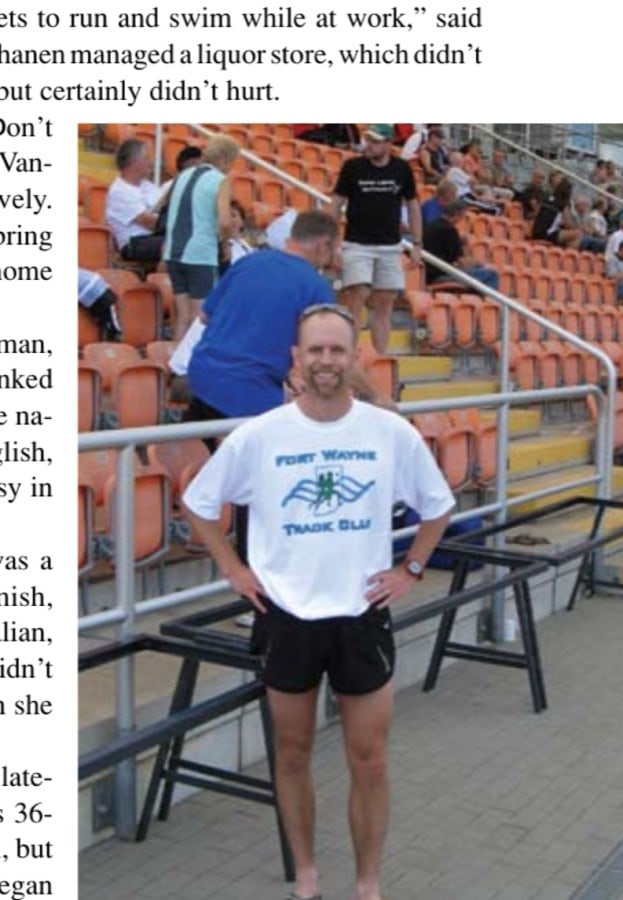
Author Brett Hess relaxes inside Gera Stadium.
to laugh and joke to their interpreter. They were a rough bunch, with a rather hard edge about them. Their top runners were a 20-something and two men in their late 50s. I imagined them running through snowstorms in Siberia and then drinking vodka afterward in the same volume that I consumed Propel. Hmm. I wonder how vodka mixes with Propel?
Also in attendance were the teams from Skiernewice, Poland, and Pskov, Russia. I fretted about not spending time with everyone, but the Finns were good company. We talked about Paavo Nurmi and Lasse Viren and Bill Rodgers and Frank Shorter. It was clear that they didn’t train like Paavo or Lasse, and I made it clear that I was no Bill or Frank.
The Finns told us tales of the woodlands and forests that Paavo trained in and how they haven’t changed much. After 30 minutes, I was ready to visit Kuopio.
Everything you would want in a course On race morning my host, Henry Hafner, and I walked to the start. One thing to keep in mind about Gera and most German towns: you walk everywhere and don’t bat an eye about it. It was only two kilometers to the start from Henry’s apartment, and I figured that despite carrying all my gear, the walk would serve as a good warm-up.
The Elstertal Marathon would start and finish in Gera Stadium, a beautiful facility that seats over 15,000 people for professional soccer and European track meets. I couldn’t help but think of Shorter as I stood at the starting line. I was an American marathoner at the Ziel, or finish of an international marathon in Germany. The stadium wasn’t full, but there was plenty of excitement in the air.
Shorter’s victory in Munich in 1972 was my first Olympic memory. I had turned 7 years old that month, and learning about a man who could run an incomprehensible distance intrigued me. I remember asking my mother to time me as I ran around our block in central Fort Wayne. It was just over a quarter of a mile, and I don’t remember my time, but I couldn’t imagine running that loop 100 times.
Now here I was, standing among Russians and Poles and Finns and Germans. I was wearing the Stars and Stripes, racing against runners from around the world. The race began with 300 meters on the track before heading out onto Gera’s version of a greenway. Not only was it a running and cycling path around town, but it connected towns.
The course has two separate out-and-backs. We headed west eight kilometers to the village of Bad Köstritz, famous for Köstritzer Beer. You beer connoisseurs might be aware of this dark lager. If not, then familiarize yourself with it. After running back past the stadium near the 16K mark, the course heads east toward the village of Wünschendorf. There, at 29K, is the final turn-around.
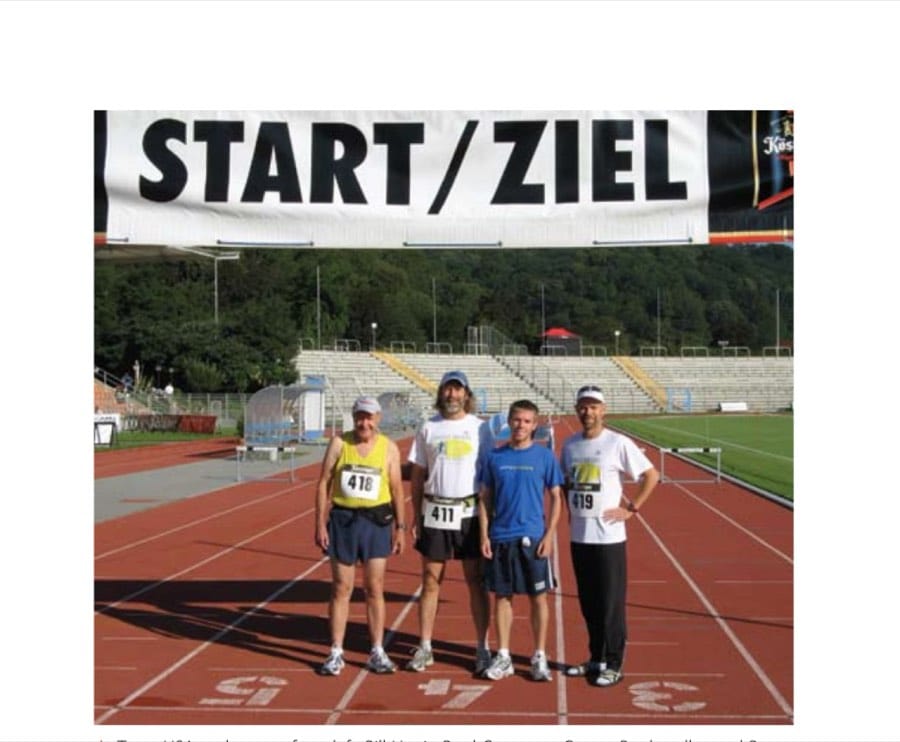
▲ Team USA at the start, from left: Bill Harris, Brad Compton, Garrett Bradtmuller, and Brett Hess.
Henry was a 42-year-old paramedic who was training for a triathlon and was in good shape. We had become friends two years before when he was part of a contingent from Gera visiting Fort Wayne. He was there to run the Sunburst Marathon in South Bend, Indiana, a race that finishes at the 50-yard line of Notre Dame Stadium. It was there that Henry recorded his personal best: 3:31. He was hoping to better his mark in his hometown marathon.
Henry and I hit it off, to say the least, when he visited Fort Wayne. He has been embraced by my family. The following year we hosted Henry’s daughter, Isabelle, as an exchange student. I was finally following through on a commitment to visit Henry and let him return the favor.
Too much excitement at the start After an excitement-induced first 5K of 22:30, we settle into a more reasonable pace. There are no mile markers, of course, and the first aid station comes at 5K. It is manned by very excitable volunteers who are more than happy to offer warm
water and hot tea. I ask for a sports drink and get a puzzled look in return. I don’t get much help from Henry, who says there were sports drinks at his previous marathons in Berlin and Dresden. Maybe at 10K, he offers?
Henry cautions me to slow down. At a very relaxed pace, we do the next 5K in 24:55. With a 60-second bathroom break for Henry, we hit the next 5K in 25:30, and I’m not feeling too well. Too much variance in pace, I think to myself. Or maybe jet lag, or perhaps no sports drink? Or, most likely, too much Köstritzer the two days before!
As for Team USA, well, we’re not doing too badly. Because of the turnarounds, I can see the Finns are doing well, followed by the Poles and Germans. But our young gun, Bradtmuller, is in fifth and looking comfortable. Compton and I don’t look too bad, either. Maybe a fourth-place finish for the team is possible? That’s not gold, silver, or bronze, but certainly worth raising a Köstritzer. We are now on our way to Wünschendorf, and I am finally feeling good. This relaxed pace is quite comfortable. Henry and I compromise our paces by running 7:45 miles but walking through the aid stations every 5K. (It takes a little longer to choke down warm water.) We continue to click off 5Ks in 25 minutes, and I begin to enjoy the scenery. We leave the urban setting of Gera and the greenway for the dirt trails of a meadow. It’s so beautiful and peaceful that I don’t mind the single-file running and dangerous footing.
From the meadow to a string of small villages, we make our way to our turnaround. Wünschendorf is a village complete with a covered bridge, cobblestone streets, and very, very supportive citizens. For the three to four kilometers that we are in the village, there is a never-ending offering of homemade aid stations. Most have tables with buckets of water that runners are stopping to splash themselves with. Some have buckets of water on the ground, and runners are even taking their shoes off and soaking their feet.
It is then that I begin to recognize that it is hot. It is nearing the mid-to-upper 70s by now with no cloud cover. This is quite warm for the region. As for me, it’s very bad news. After a dangerous dehydration situation at Boston, I have yet to feel comfortable in warmer weather. My response has been to skip warm Indiana summer days altogether and in moderate weather run late in the evenings. My Germany gamble was that it would be in the 60s for the Elstertal Marathon. No such luck.
Henry and I begin our march back to Gera. He is suffering, asking for slower walk breaks at the aid stations. Our 5K splits start to exceed 25 minutes. Finally, near 30K, he lets out a yell and grabs his hamstring. You don’t need a translator to understand what he is saying. I yell at him, exhorting him to keep moving. To stop, I tell him, will allow his cramp to become a serious problem. He responds and is soon running along in his steady, strong shuffle.
How many 35K lines are in this race? The new problem, though, is that several minutes later we cross another 30K mark, and then a minute or so later, yet another. So what was our true last 5K split? Maybe it wasn’t 25 minutes, as I had thought. I had figured that we were somewhere near the 33K mark by now. I try to block this from my mind.
For the next 5K, I am constantly turning back and jogging, pleading with him to not give up on his sub-3:30 goal. We are in reach, I tell him. I have imported four sports gels, a luxury Henry has never seen. After taking the first one around mile 15, I let Henry try one. At that point, he is certainly in more need of them than I. Not surprisingly, he takes a real liking to the taste, and within moments, the effects of this wonder are apparent. So it was no surprise that after his hamstring cramp near the 30K mark, he has asked for another gel.
Then, again at the 35K mark, I give Henry the last gel. It’s a miracle cure for him and Henry is emboldened. His stride begins to lengthen, and it’s almost as if all my strength has been transferred to him. “
I am a new man,” Henry exclaims! “Come on, Brett. We must go. We are strong men!” But I am done, especially when I see yet another 35K mark. I’m not sure where I am at this point, other than that I’m somewhere in Germany. I tell Henry he must go if he wants to accomplish his goal of a sub-3:30.
Henry presses on but encounters another set of problems (foot cramps) around the 40K mark and finishes in 3:33:32. As for me, my mind wanders as I near the stadium. I’m running for fun, remember? I take in the sights of the town’s festival. People recognize my jersey and shout to this tired American. I near the stadium and hear the crowd, which is cheering for its countryman, Henry Hafner.
I stride onto the track, and there is no confusion between me and Frank Shorter. I stride very comfortably the final 250 meters. Down the homestretch, I begin
ad
▲
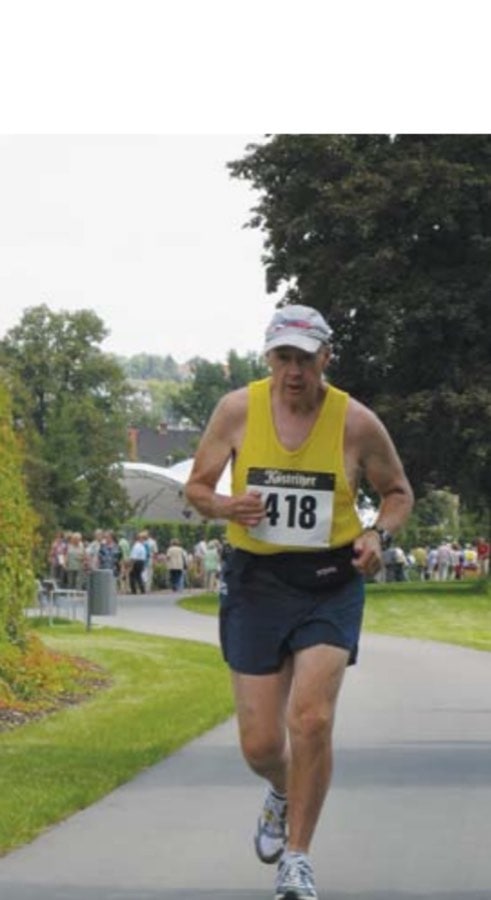
Team USA runner, 69-year-old Bill Harris, cruises toward the stadium and the final 400 meters.
to wave at the crowd as the announcer calls my name and home city. I cross the finish line in 3 hours, 35 minutes, and 24 seconds. I bask in the glory of a successful marathon finish. My new Finnish friends are there and applaud my finish, as does Henry. He offers a Köstritzer, and who am I to decline and in so doing potentially endanger international relations? I didn’t come 5,000 miles to drink no sissy sports drink, right?
USA . . . USA . . . USA In the end—and in a marathon, that’s all that matters, right?—Team USA didn’t fare too well. Oh, but we had fun. Bradtmuller ran, then shuffled, to a 3:22:42. And Compton enjoyed himself
for 4 hours and 7 minutes. As for Harris? We all relaxed at the stadium with our never-ending Köstritzers while awaiting his return. Finally, the venerable man approached. With much celebration, Harris finished in 5:22:29.
Our combined efforts were good for seventh place in a nine-team field; we had a three-man total time of 11:05:33. The Finns won in a solid 9:17:34, a 10minute victory over Rostov, one of the two Russian teams.
Our times were spectacular, just not on our wristwatches. We all had our favorite moments, those indescribable feelings that as marathoners we try to describe anyway. You can run a marathon in a U.S. city anytime you want, but to take the leap of running a tiny international event is a real risk. “
That was tough,” Bradtmuller said. “I have a greater appreciation for the marathon than I thought I would. It’s an accomplishment.” Bradtmuller, of course, doesn’t have the luxury of comparing this marathon with any others. I told him that he will never run a tougher one, all things considered. Without jet lag, crazy kilometer markings, odd drink choices, and strange footing, his next marathon will seem boring.
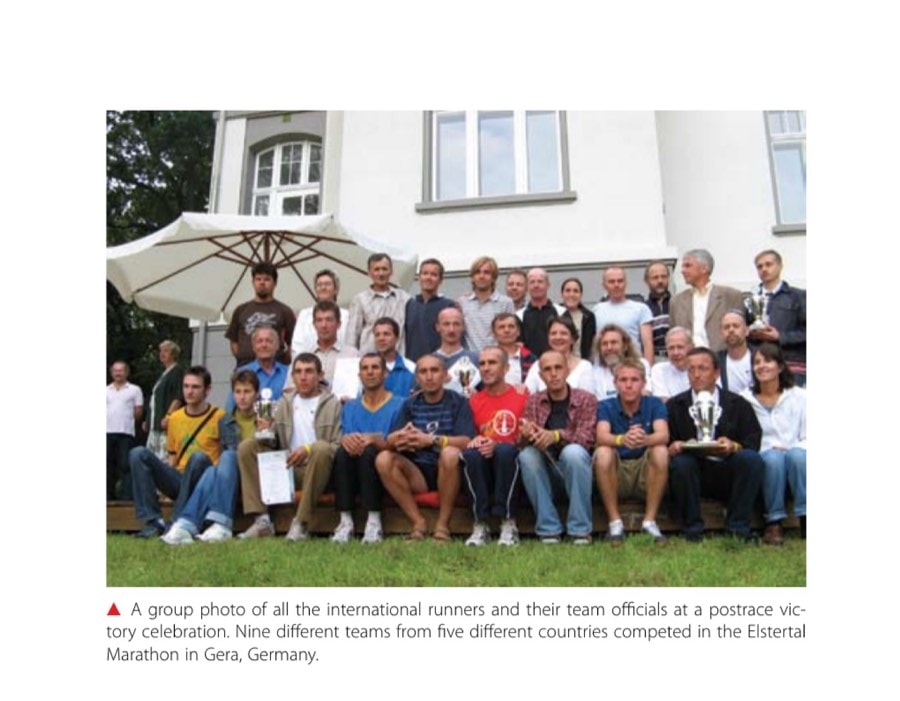
▲ A group photo of all the international runners and their team officials at a postrace victory celebration. Nine different teams from five different countries competed in the Elstertal Marathon in Gera, Germany.
For the rest of our more experienced marathoners, this was, well, quite an experience. “My time was horrible, and I didn’t even care,” Compton said. “The variety of scenery was amazing: urban, rural, small villages, the farm animals, running along a river. And the people were so nice, so encouraging. I’ll take this over a big-city marathon any time.”
Compton is from a small rural community (Spencerville) known for a centuryold covered bridge. He got a taste of home when he ran through Wünschendorf’s bridge. “I had to smile,” Compton said. “I had to come all the way to Germany to run through another covered bridge.”
As for Harris, his favorite moment came at the end. “As I entered the stadium and heard the rhythmic clapping and cheering, it was truly electrifying,” Harris said. “It gave me goose bumps. I knew I had arrived. And then hearing my name and the cheering by all the other runners who had finished made it all worthwhile.”
Running the World
This article originally appeared in Marathon & Beyond, Vol. 13, No. 1 (2009).
← Browse the full M&B ArchiveMore like this
1,000+ stories from 19 years of Marathon & Beyond
The complete archive of the legendary long-distance journal — digitized and free to read.
