

Rebuilding New Orleans One Stride At a Time
My younger brother, Andy, and his wife, Marion, live in Metairie, Louisiana. From August to December 2005, they lived in a condominium in Houston, Texas, because of the evacuation of New Orleans. Their four children were scattered over three schools, and the six of them squeezed into two bedrooms.
As soon as they could, they moved back to Louisiana. Only recently has the process of meeting with insurance adjusters, obtaining estimates, hiring contractors, and doing restoration work run its course. I decided to run the 2007 Mardi Gras Marathon because the proceeds are given to hurricane relief. Moreover, New Orleans needs tourists to bring dollars to the economy.
My hope, when I signed up for the marathon, was that Andy would be able to run with me. Unfortunately, Andy’s 80 year-old knees on his 44 year-old body did not cooperate. The only marathon we had run together was New York in 2002. In the words of people from New Orleans, that marathon was “BK”—Before Katrina.
The day before the marathon, Marion drove my daughter, Molly, my niece, Nancy, and me on a tour of Lakeview, Chalmette, and the Ninth Ward. The scope of the devastation was unparalleled in my experience: block after block of ruin. Interspersed with the flood and wind damage was destruction from fire. Apparently, when the power was initially restored, shorts in the system, downed power lines, and gas leaks caused infernos despite the ubiquitous water.
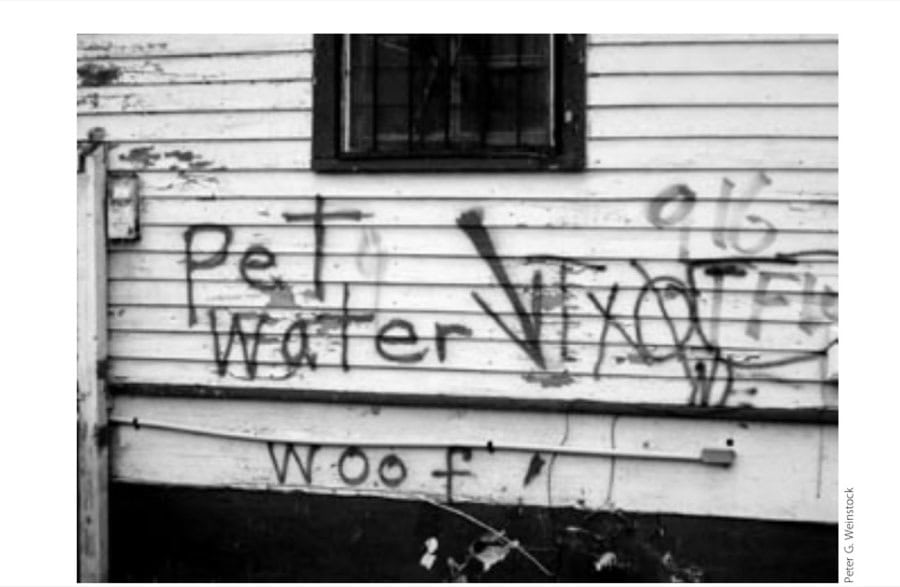
Most shocking were the markings painted on the outside of each house. Searchers who looked for survivors did so on a house-by-house basis. They communicated whether a house had been searched and the results by spray painting the information on the outside of the house. In places like the Ninth Ward, the houses tell the story of whether there were survivors.
REBUILDING SUPPORT FROM THE GRASS ROOTS
Peter G. Weinstock
Rome was not built in a day. I will be surprised if some parts of New Orleans are restored in a decade, if ever. Eighteen months after Hurricane Katrina, New Orleans showed much of the good and bad that is the United States today. The American people have a tremendous capacity to care and to give. Among the numerous charitable groups, perhaps no group was more prevalent than Habitat for Humanity.
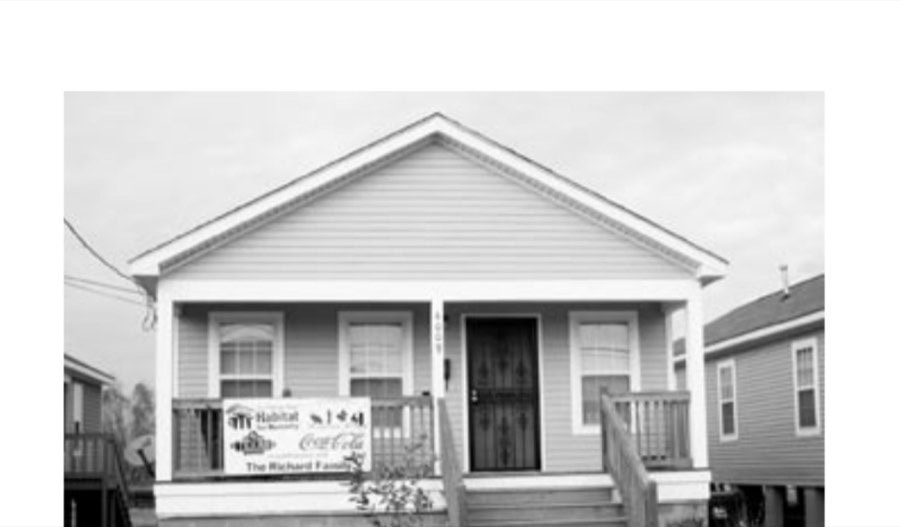
Harry Connick Jr., the musician, was concerned that New Orleans might lose its jazz heritage and its culture because there was no affordable housing for musicians after the storm. He worked with Habitat for Humanity to construct two-bedroom homes for this key component of the New Orleans community. The result is the Musicians’ Village. Dozens of these houses, each painted a distinct and vibrant color, are rising from the midst of the devastation. Houses surrounding the Musicians’ Village are also being restored by their owners. It seems that everyone to whom I spoke has volunteered with Habitat for Humanity or plans to.
In light of the scarcity of resources, charter schools have popped up in Orleans Parish. A charter school is a public school that is operated by a nonprofit corporation by agreement with the local school board. For instance, Tulane University has adopted the former Fortier High School campus, which was closed after Katrina,
▲ Searchers identify a dog’s remains in New Orleans.
Peter G. Weinstock
▲ The bright colors of the Musicians’ Village are helping to restore vibrancy to the Big Easy.
and opened the new Lusher Charter Middle and High School. These partnerships free the schools from many of the historic ineptitudes of the New Orleans School Board. There are now 31 charter schools, up from eight before the storm. Thus, there is renewed optimism for education in an area that previously had some of the lowest test scores in the nation. On the flip side, the litigious nature of our society, coupled with the unwillingness of politicians to take a far-sighted, unpopular stand, is also evident.
Eighteen months after the storm, New Orleans had no strategic plan for rebuilding itself. At first, the politicians said that some low-level areas would not be rebuilt because of the risk of flooding. In the face of protests, they reversed themselves. This process of decision, followed by protests, followed by reversal, has occurred time and time again.
Litigation is a big part of the New Orleans economy. Several communities initially required that damaged homes be rehabilitated, gutted, or demolished within one year of the hurricane. The result was a rash of lawsuits claiming that such rules constituted an unjust taking of property without due compensation. The insurance companies and the policyholders are in litigation over whether the damage was the result of flooding (not covered by standard insurance) or wind or fire (which generally is covered). Others who have suffered damage have sued
levee districts and barge owners on the premise that it was not Katrina—an act of God—that caused their damage but instead was somehow the negligence of others. March 1, 2007, was the deadline to file claims against the Army Corps of Engineers. The drive-through line was several miles long. Hiring lawyers to shift the costs of rebuilding from Katrina is a growth industry. Almost from the moment the winds stopped howling, the fingers started pointing. The politicians may have the most keen survival instinct of anyone. In addition to the cyclonic winds, Katrina has given birth to unrelenting media spin.
THE MARATHON MUST GO ON The Mardi Gras Marathon happily fits nicely within the category of “the best that people have to offer.” The 2006 marathon was in doubt. Speculation was rampant about whether runners would need to wear masks to avoid breathing toxins. Only through the Herculean efforts of volunteers was New Orleans able to pull off the marathon. The organizers dedicated the 2006 marathon to Katrina relief. The slogan was “Rebuilding New Orleans One Stride at a Time.”
In light of the ongoing struggle to recover from Katrina, the organizers of the 2007 Mardi Gras Marathon continued to dedicate the proceeds to relief efforts. The 2007 slogan was “Recover, Rebuild, and Renew.”
The Mardi Gras Marathon, like the city of New Orleans, is trying to find its way after the disaster. In 2006, the marathon had about 3,000 participants, down from 6,000 in pre-Katrina days. The field for the 2007 marathon and half-marathon was up by approximately 1,000 over the year before. Approximately two-thirds of the runners came from outside of New Orleans. Like New Orleans, there are signs of some life in the marathon, but it has a ways to go to reach its prestorm size.
The smaller number was evident at the marathon expo, which was jammed into three rooms at the downtown Four Seasons Hotel. There was no food or drink at the expo and only a handful of booths. Unlike other marathons, there were no speakers. The marathon apparel was lifeless. In fact, the best T-shirt option was a holdover from 2006. Thus, with an uninspiring expo and premarathon predictions of highs in the 60s to low 70s, I had low expectations for the race.
My worst fears seemed realized when Andy dropped me off at the Superdome on Sunday. The organizers did not have either coffee or bagels. The carnival atmosphere of other marathons was not evident. Yet the race itself turned out to be a joy.
A couple of years ago, I decided to try to run a marathon in all 50 states. I realized, however, that my recovery time from marathons was not conducive to doing so before Social Security kicked in. To address my need for extended recovery time from a marathon, I decided to do some marathons as training runs. In other words, I would run 18 to 20 miles of a marathon and walk to the finish line. I used this approach in the Seafair Marathon in Bellevue, Washington, in
July 2006 and was still able to finish in 4 hours, 45 minutes. As long as I can post a time that is faster than Al Gore’s one effort, I can live with it. New Orleans was going to be my next training-run marathon, in preparation for Grandma’s Marathon in June. Consequently, I decided to experiment. In the weeks leading up to New Orleans, I ran with my friend Steve Howard. Steve was planning to run the Austin Marathon the week before New Orleans. I was running 13- to 17-mile long runs with Steve at an 8:15 or 8:20 pace. This was significantly faster than I typically ran my long runs.
UNIQUE CARBOLOADING I dramatically increased my prerace carboloading. Instead of pasta two or three nights before the race and maybe during lunch the day or two before the race, I telescoped an immense amount of carbs into the three days before the race. I ate carbs at every meal. I also polished off a big bag of pretzels each of the three days before the race. As my mom says, “Too much of a good thing is not a good thing.” I felt like I was up to my eyeballs in noodles.
I was also about 3 pounds lighter than I had been in December when I ran the California International Marathon in Sacramento. My two biggest changes involved ibuprofen and electrolytes (I used Endurolytes). My friend and coworker Stephanie Dreyer is a perennial Boston qualifier who also runs ultras. Stephanie swears by taking an ibuprofen before a marathon to “take the edge off” the pain. She also takes three electrolyte tablets every hour during a marathon. Because New Orleans was a training run, I decided to add these to my regimen. I also listened to one of Stuart Woods’s Stone Barrington novels on my iPod.
I was going to run New Orleans as Patti Catalano Dillon would do it. In other words, I was going to go out strong and run as strong as I could for as long as I could. The marathon started in front of the Superdome. We quickly made our way through the Central Business District, and we were on to seemingly every pretty part of New Orleans. We ran down Esplanade. Fans were lined up outside Café du Monde drinking coffee and eating beignets. The beautiful old buildings of the French Quarter were mostly untouched by Katrina. The magnificence of such buildings was a welcome respite from the devastation I had seen the day before. The race continued down Esplanade Ridge.
Next was the lush and green Bayou St. John, where we climbed a small overpass for about a tenth of a mile. This tiny overpass provided the only hill during the marathon. At mile nine, I decided to walk up the backside of the overpass and check my watch. I was amazed to see that I was running an 8:15 pace. I thought there was no way I could keep this up, but I felt great. I decided to just keep running strongly, and if I had to walk more than six miles at the end, I would just do that.
We ran through the Garden District. The wide medians and two-story houses were lovely. Katrina may have knocked over some trees, but what was left provided ample shade. In fact, the weather was wonderful. The temperatures at the start were in the low 50s with a light breeze. Best of all was cloud cover without New Orleans’ famous humidity.
I do not know whether it was the placebo effect, but it seemed that the electrolyte tablets were helping. The marathon course looped us back to the Superdome where those running the half-marathon turned left to the finish line. I tore up the first half of the course in less than 1 hour, 47 minutes. My time was only about three minutes slower than my half-marathon PR! As we turned to the right to head around the Superdome and back out through the side of the Central Business District on toward Audubon Park, I again took inventory.
THE PLAN TO CUT IT SHORT, MAYBE I was going to run only 20 miles, so I decided to continue my pace. A quick calculation led me to conclude that I needed to do so for only about an hour. I soon lost myself in the charm of the course. Once we were out of the business district, the shade provided by magnificent old trees returned. There weren’t many spectators, but they were hilarious. I passed one house that had signs for “cocktails, cigarettes and ‘water.’” The aid stations were no less entertaining. The Hash House Harriers and Team Spot-Tees, local running groups, pulled out all the stops with New Orleans flair. Some water stops also offered beer, and one had small martinis. At a third, the volunteers were all wearing red dresses—the men included. My favorite was a guy who looked very comfortable in a red dress and a blue wig. I wondered whether he had bought the dress just for the event or had owned it for some time.
We ran down Prytania Street to Audubon Park. Katrina stole none of the park’s beauty. The Team Spot-Tees’ volunteers were wearing New Orleans Saints football jerseys at the water stop in Audubon Park. They had signs up saying “geaux runners.”
I had run 19 miles, and I still felt very good. I knew I just had to run back to the Superdome, and the race was over. I decided to run for just two more miles and then walk in. Really, I was playing mind games with myself. I knew I was on pace for a PR. Even if I walked from mile 20 on, I still would beat four hours. At mile 21, I still felt good, but I knew that I had been slowing down considerably. Nonetheless, I kept running.
The only stops I had made were to add Vaseline to my feet. I had changed orthotics four weeks before, and the combination of older shoes and newer orthotics was causing blisters. My wife, Hilarie, is training for the Susan G. Komen 3-day walk. She had told me just the week before that our friend Janet Finegold carries
Moleskin with her and puts it on whenever she starts to feel a hot spot. I mockingly said, “You should never get blisters because blisters are a sign that your shoes do not fit correctly.” Here I was at the end of a marathon suffering from blisters.
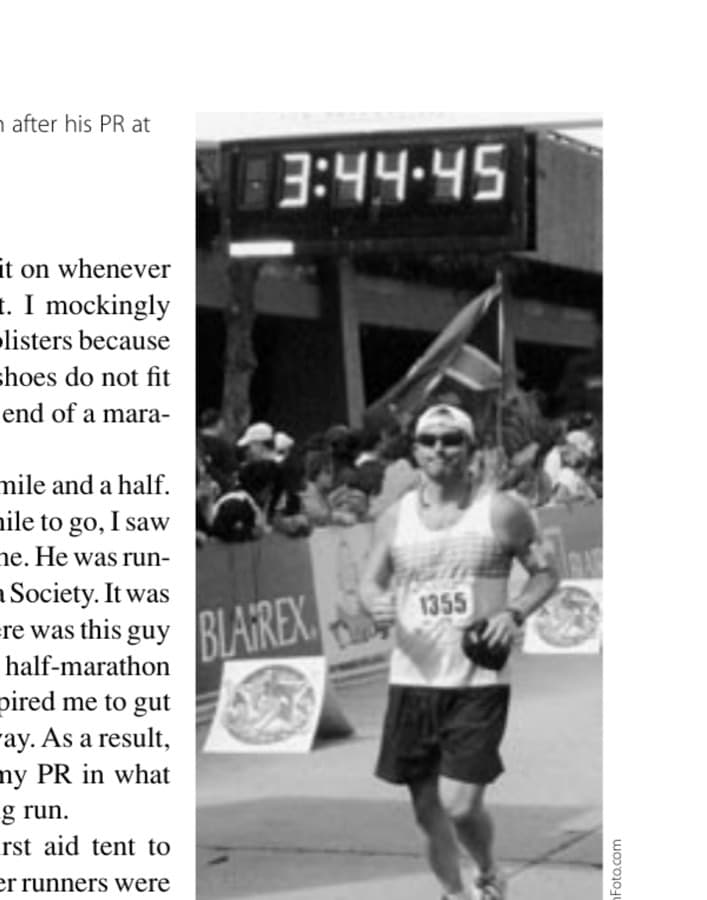
I ran and walked the last mile and a half. With about four-tenths of a mile to go, I saw a heavy guy jogging toward me. He was running the race for the Leukemia Society. It was getting to be quite hot, and here was this guy running all by himself with a half-marathon still to go. His toughness inspired me to gut it up and run the rest of the way. As a result, I ran under 3:45, breaking my PR in what was supposed to be a training run. I went straight to the first aid tent to have my blisters lanced. Other runners were coming in complaining of dehydration or to get cleaned up from falls. The volunteers looked after each one of us with the care of mother hens. They bandaged me up and loaned me a cell phone so I could call my brother to tell him where to pick me up. In the meantime, I had red beans and rice and a Subway sandwich.
An hour later, Andy showed up with Nancy and Molly. It turned out that they had gone to watch me on the course, but I had never seen them. They went where I should have been. They were at mile 20 at the three-hour mark, but I had already passed. They waited half an hour and then went to mile 24, but I had passed there as well. My daughter greeted me with a big smile at the finish and asked, “Daddy, what was your time?” I proudly said that I had broken 3 hours, 45 minutes. Molly said, “What happened to your training run?” Indeed. I ran the first half of the marathon at 8:15 pace. The second half, slowed by the last four or five miles, was a still respectable 8:58 pace. I have never run a negative split. By using Patti Catalano Dillon’s strategy, I had banked enough time to break my PR.
When I got home from the marathon, there was the registration card from Grandma’s Marathon. What do I do now? Another training run?
www.MarathonFoto.com
▲
The author’s self-satisfied grin after his PR at the Mardi Gras Marathon.
This article originally appeared in Marathon & Beyond, Vol. 11, No. 6 (2007).
← Browse the full M&B ArchiveMore like this
1,000+ stories from 19 years of Marathon & Beyond
The complete archive of the legendary long-distance journal — digitized and free to read.
