

Redemption
In 2003, I dropped out of God’s Country Marathon at 16 miles. My failure to finish was painful, and I knew that the pain wouldn’t completely disappear until I once again reached the finish line in downtown Coudersport, Pennsylvania.
My DNF hurt, but I can’t say that I spent the ensuing year in deep, dark depression. Redemption was important, but I can’t say that I spent the next year focused on nothing else. I can’t say that I moved to Kenya and lived a monastic existence. I can’t say that I trained slavishly. I am happy and relieved to say that I finished the race in 2004.
I didn’t tame the mountain. I didn’t win my age group. I didn’t kick the course’s butt. I finished, and that’s enough. Perhaps someday I’ll try to run a marathon fast enough to qualify again for Boston, but for now I’m happy to have earned the right to wear my 2004 God’s Country Marathon T-shirt. I really liked the 2003 shirt, but I’ve never been able to bring myself to wear it.
Finishing wasn’t easy. At God’s Country, it never is. First, there’s that little mountain known as Denton Hill, which shows up at the 15-mile mark. Its elevation of 2,424 feet may not be overly impressive, but the course begins at 1,300 feet, so it’s a significant and a very steep climb.
A bigger concern than the course was my legs. Two weeks before the race, I did my final tune-up. It was a basically flat 15-miler at a very comfortable pace, but the next day my legs hurt all over. Calves, knees, backs of knees, and other assorted parts hurt. It wasn’t a comforting feeling just a few days before the race.
So I hardly ran those last two weeks. I wasn’t exactly a hard body as I arrived at the starting line. My face looked properly gaunt, but I didn’t have that finely honed feeling that we all like to take into a race.
MIND OVER MOUNTAIN My biggest concern, however, was my mind. Had I become too soft to run God’s Country? Had I reached a point at which dropping out was an acceptable option? I didn’t know. I wouldn’t know until the going became difficult. Before the race began, I joked that any running that I did would be a bonus on my walk from
Galeton to Coudersport. Was I preparing myself to fail again? Only miles would tell. The first good sign on race day was the weather. Despite a forecast of rain, the day was ideal for running, especially in June—50s and cloudy, no wind.
The next good sign was the effortless 6:15 first mile. Well, I know that it was nowhere near a mile, but that was what the paint on the road said. Most important was that I got through the first few miles with no pain or discomfort in my legs. I reached four miles in 32 minutes and felt good about the world.
At that point, I allowed myself to relax and enjoy it. I said a little prayer of thanks. I didn’t pray to finish or to run a good time. I just said thanks for having the body and the mental outlook that allow me to be a part of a celebration of life as wonderful as a marathon.
Slowly and steadily, I headed toward the mountain. I stopped at every water stop. I took my replacement drinks and gels. I tried to do something that I had rarely done before: run a smart race. And it seemed to be working. At 15, the real climb begins. Denton Hill offers almost three miles of nonstop climbing. I put my head down and began to shuffle up. I talked a little with a runner who was enjoying the mountain for the first time. He hadn’t known what awaited him when he left Galeton.
A half hour later, I reached the summit. I took a drink and a gel and enjoyed a brief moment of celebration. After climbing that mountain, I knew that I would finish. A brief feeling of exhilaration coursed through me, and I headed down the mountain.
GRAVITY WORKS TWO WAYS, BOTH UP AND DOWN The downhill lasted a few miles. Gravity did the work for a while, so I was past 20 when I had to start running again. When I did, I felt decent. Time was no concern. I knew that I wouldn’t be last, although being last would have been just fine. After all, even in a race with the 100 best marathoners in the world, somebody has to finish last.
I reached 21 in 3:01, a time that made me chuckle, because in 1981 I ran the entire race in 3:01. So, with the pressure of a PR out of the way, I settled back into my comfort zone. Forty-eight minutes later, I crossed the finish line—3:49. Redemption. Relief. Tears. Realization. Streak.
The tears are tough to explain. Certainly, they had nothing to do with sadness, so I guess they were tears of joy. Perhaps they were just a release of all the emotions that build up over the course of 26 miles. As I gathered myself, I saw another runner having a similar moment of emotion, so I know that the tears aren’t exclusive to me.
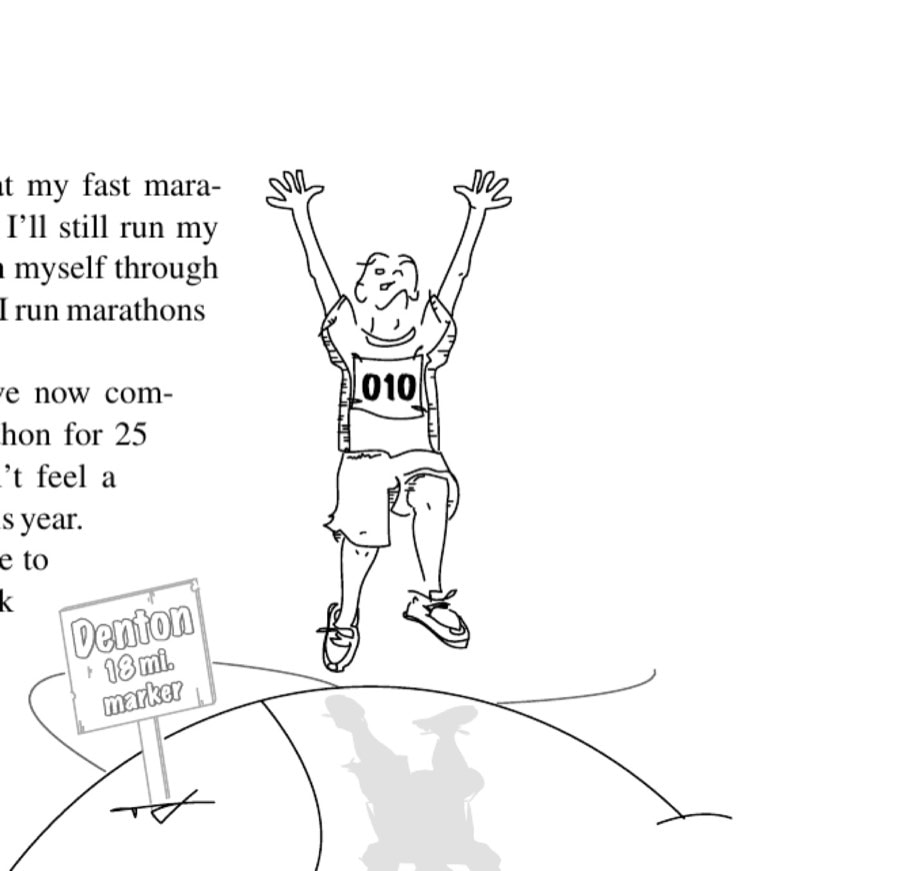
The realization is that my fast marathons are far behind me. I’ll still run my guts out in a 5K. I’ll push myself through a half-marathon, but now I run marathons just for fun. The streak is that I’ve now completed at least one marathon for 25 consecutive years. I don’t feel a need to run another one this year. I think I’ll take some time to harden my body with track work and weight work. I’m looking for a different challenge, and I’m thinking of trying to throw the javelin.
Finishing God’s Country, earning my redemption, and takTed Veatch ing my streak to 25 years have given me the freedom to think this way. Of course, I know that any hiatus won’t last too long. Running a marathon isn’t always a wonderful way to spend a day, but crossing that finish line is an exhilarating and addictive feeling. God’s Country 2005 sounds like a good idea.
Why You Might Like the God’s Country Marathon You will find more spectators on some blocks in Boston than Potter County, Pennsylvania, has human residents. The deer population is large, and the bear population is growing. Trees also do well. God’s Country is a rural race. Potter County, located on Pennsylvania’s northern border, has about 20,000 residents scattered over 1,000 square miles. The land is mountainous and so is the racecourse. It begins in Galeton (elevation 1,300 feet) and follows U.S. Route 6 to Coudersport (elevation 1,740 feet). That rise of 440 feet, however, is highly deceptive.
It’s deceptive because Coudersport is not the high point on the course. That distinction belongs to Denton Hill Summit (elevation 2,424 feet), the spine of the Allegheny Mountains and the Eastern Continental Divide. Spill your replacement drink on the eastern side of the mountain, and it will wind up in the Atlantic. Spill it on the western side, and it will makes its way to the Gulf of Mexico. Denton Hill stands near the 18-mile mark on the course, and it’s hard to imagine that a tougher climb is a part of any road marathon. It’s also hard to figure out why this mountain is called a hill. One hundred miles to the south, this mountain played a major role in American history. At Altoona, it loomed as a barrier to the westward expansion of the railroad. The engineering marvel known as Horseshoe Curve carried the trains over the mountain and opened up the West to mass settlement. Runners in
God’s Country Marathon would probably welcome a train to carry them over the mountain. For the first 15 miles, the course is a gradual climb. It goes up and up and up from the start to mile 15. Then it gets serious—very serious. At the entrance to Denton Hill Ski Area, runners shift into granny gear. The really good runners may be able to bound over the mountain. The rest of us struggle. Fortunately for runners’ peace of mind, the mountain isn’t a straight climb. It turns several times, so the top isn’t visible from the bottom. In its friendly way, the top of the mountain is the first of two finish lines in this race. It’s common for runners to think of dropping out as they work their way up the mountain. Once they reach the summit, however, they get a surge of adrenaline and a nice downhill. After the summit, the next two miles are a free ride, and only one small rise remains on the course. It comes around mile 24, and that location makes it seem worse than it really is. Then the race winds through residential streets and finishes in the heart of downtown Coudersport. A spotter relays runners’ numbers from a block away, and an announcer at the finish line calls the runners’ names and how many times they have run God’s Country. Runners finish to the ringing cheers of dozens of spectators. This is really a runner’s race. If you run because you love to run, because you love to challenge yourself, you’ll love God’s Country. If you need crowds of runners and hordes of screaming fans, this isn’t your race. The only similarity between God’s Country and races such as Boston and New York is 26 miles, 385 yards. The only similarity between Potter County and Boston and New York is their location on planet earth. Potter County offers a pleasant rural retreat. Coudersport is a scenic little town with a Victorian look. Mountains loom all around, and outdoor activities are a big part of the local economy. Many Pennsylvania residents have cabins in
Ted Veatch

the area. The race is on the first Saturday in June, so you will have to arrive on Friday or earlier. When you do come, you may even win some money. In 2004, the winning time was 2:47, and a woman was third overall in 3:01. Prize money in 2004 was $500, $250, and $200 for the first three places for each sex. The 2005 edition of God’s Country Marathon will be number 31. I’ve finished 11 of them, and I believe that I’ll be back for number 12 next year. Hope to see you there. For information: Potter County Visitors Association P.O. Box 245, Coudersport, PA 16915 1-888-POTTER2 potter@penn.com www.godscountrymarathon.com
This article originally appeared in Marathon & Beyond, Vol. 9, No. 1 (2005).
← Browse the full M&B ArchiveMore like this
1,000+ stories from 19 years of Marathon & Beyond
The complete archive of the legendary long-distance journal — digitized and free to read.
