

Renaissance Running
When you make up your destination marathon bucket list, Florence should be right near the top. Set in the heart of Italy’s Tuscany region, the flat and fast Florence (Firenze) Marathon is set against a backdrop of art, history, and beauty that few other courses can match.
Florence This is one of the world’s handsomest cities. It is situated on both sides of the quiet Arno River and surrounded by beautiful hills full of villas and vineyards. Not much is known of the ancient history of Florence, but in Roman times, thanks to its location on the route from Rome to northern Italy and Germany, the town grew rapidly. The Roman Empire fell, and the Middle Ages began in 476 AD. Huns, Visigoths, and other toughs made life difficult in Europe for about the next 1,000 years.
The modern era, or the Renaissance (rebirth), is generally agreed to have started in Florence. In the 13th century, a combination of economic and cultural circumstances created an explosion of commerce, art, science, literature, and philosophy.
The making of textiles had turned Florence into one of Europe’s most prosperous cities. Florentine bankers created many innovations: bills of exchange, checks, credit, and life insurance. Also, they minted Europe’s first single currency—the gold florin.
The most powerful of these banking families was the Medicis. Fortunately for posterity, the Medicis were great patrons of the arts and architecture and ruled for generations.
The explosion of art When money is made and food, shelter, and safety are secure, the arts can blossom. With the loosening of religious severity, more humanist interests took the
forefront. The recovery of Latin and ancient Greek texts added to an unquenchable thirst for knowledge. Painters Cimabue and Giotto began taking a more secular approach to the human form. They loosened up and animated the stiff, flat Byzantine style that had so long dominated. Later artists took the reins and topped each other in their pursuit of beauty and perfection. Donatello, Fra Angelico, Botticelli, and a host of others added to the masterpieces of Florence. A little later, the artists who would be nicknamed “Renaissance men” would make their names: Leonardo da Vinci, Michelangelo, and Raphael advanced art to its acme. These heavyweights did it all, from painting and sculpture to engineering, architecture, and poetry.
In literature, Boccaccio had delivered The Decameron and Petrarch his poems and Dante had given the world his masterpiece, The Divine Comedy. Science saw the rise of Galileo championing the idea of a heliocentric universe with the sun, rather than earth, at the center. In political science, Niccolo Machiavelli published his seminal work, The Prince.
Today Florence today stands almost untouched and unaltered by the passing of time. The Duomo crowned with Brunelleschi’s dome, Giotto’s Campanile (bell tower), and the bronze doors of the Baptistery designed by Ghiberti stand as they did over 600 years ago.
Churches abound, and in each can be found masterpieces by Duccio, Massacio, and Ghirlandaio. The Uffizi is Florence’s premier museum of art, so popular in fact that it is a good idea to get tickets ahead of time online. The Pitti Palace and the Bargello are must-sees as well. In the Gallerie dell’Accademia, Michelangelo’s masterpiece, David, stands 16 majestic feet high.
The city is more than museums and churches, though. Florence is one of Italy’s fashion capitals. Shopping is spectacular, with street after street featuring top fashion designers. Gucci, Ferragamo, and Emilio Pucci are just a few. Jewelry, shoes, and leatherwear abound. This is a city of good taste and high quality. No Florentines would be caught on the street looking less than their best. Florence is known for its cafés. The dolce far niente (the art of doing nothing) is practiced here to perfection. Cappuccinos, lattes, and a myriad of desserts are available day and night. And, oh, those Tuscan wines.
Restaurants offer locally grown fruits and vegetables, hearty soups, and seasonal delights like truffles and porcini mushrooms. More robust eaters might want to try bistecca alla fiorentina—the hearty man-size steak dish.
If there is still room, take a stroll to one of the many gelaterias that make fresh gelatos in endless flavors. And it all tastes so much better after finishing the marathon.
Race history The race was established in 1984 with just 462 runners. Increasing ever since, the 27th edition, in 2010, started with an international field of runners of over 10,000. While Italians make up the bulk of the field, runners from France, Germany, and the UK are the next largest groups. Ninety-four competitors made the trip from the United States, and in all, 62 countries were represented. Florence is now the second largest marathon in Italy after Rome. Race directors tweaked the course to make it even flatter and faster. It has a net elevation drop of about 270 feet. As many as 2,000 volunteers were on hand to make things go smoothly.
Current record holders are James Kutto of Kenya, who set the men’s record of 2:08:41 in 2006, and Helena Javornik of Slovenia, who set the women’s of 2:28:15 in 2002.
Expo The expo opens 9:30 a.m. on Friday and is located at the Luigi Ridolfi athletic stadium. The location is northwest of the center of town. There are two ways of getting there: by cab, which can get pricey, or by a short bus trip on the number 10 from Santa Novella Train Station or the number 20 from Piazza San Marco. If the bus isn’t filled with other marathoners, it’s recommended to ask locals and the driver where to get off. There are lots of turns on the way, and it can become disorienting.
Once there, number pickup is easy. There are plenty of volunteers to direct you, and most speak at least some English. Like most European marathons, a note from a doctor as proof of passing a physical is required to run. This can be faxed ahead, but it is good to have a copy with you as well. The timing system, supplied by TDS Winning Time System, uses a transponder device—a small rectangle about the size a handheld pencil sharpener that is attached to the race number. This must stay on the number throughout the race and be turned in at the finish line.
Once the chip is checked and activated, runners pick up their race packet filled with goodies and proceed into the expo proper. Shirts weren’t given out in 2010. Instead, each runner received bright blue and red, three-quarter-length running tights from the marathon’s main sponsor, Asics. The Asics Official Merchandise Store offered shoes, T-shirts, sweatshirts, gloves, and more.
Over 70 vendors offer information on other races, nutrition samples, accessories, and apparel. It’s a good idea to stop by the Enervit booth to sample the energy-replacement drink offered on the course. Enervit has a flavor that is less sweet and a little saltier than Gatorade.
All day Friday and Saturday, speakers make presentations on an array of topics. But, alas, it’s all in Italian. A very nice feature is a large video screen showing
the new, faster course. Along the top of the screen is also shown the new, lower elevation superimposed over the old.
The course The flowing course is a labyrinth with the start and finish areas conveniently located near each other. Runners come from all directions in the morning and meet at an area on the Arno just east of the famous Ponte Vecchio (bridge) and the Uffizi. This spot is just a short walk from the finish line, which is in front of the Church of Santa Croce. Runners are greeted by the sight of “cloakrooms”—platforms built with four curtained walls for changing. Once changed, competitors place their race bags in a trailer with the corresponding race numbers on the side. Portapotties were in abundance here with one very novel innovation—they flushed! Talk amongst yourselves.
Then it is a short walk farther east to the shuttle-bus pickup. Bus after bus takes runners to the start across the Arno and up to the Piazzale Michelangelo. The distance is short enough that many locals opted to walk. On this hill is a huge square that commands a magnificent panoramic view of the city—and the entire marathon course. It is so huge, in fact, that it held the 10,000 participants comfortably with room to spare.
In the center of the square is a monument dedicated to Michelangelo, with copies of some of his most famous sculptures. A copy of the David cast in bronze
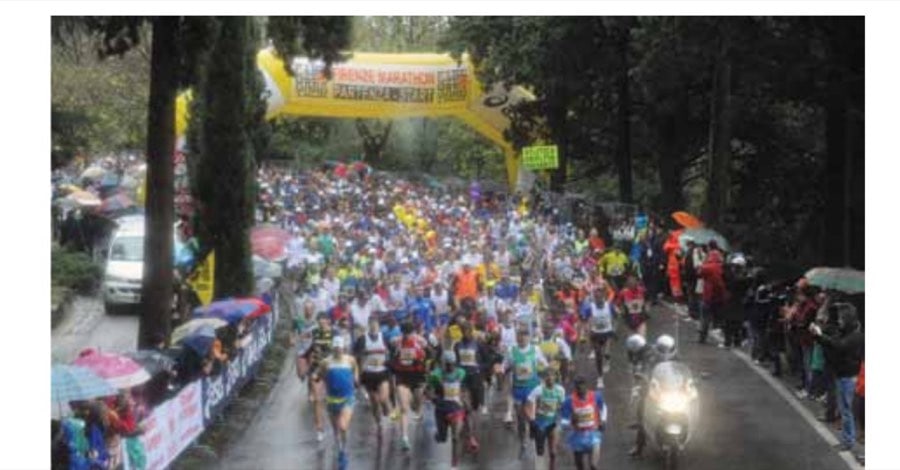
▲ And they’re off! Runners begin the marathon with a fast, curving downhill from Piazzale Michelangelo.
stands in the middle, and around it are copies of the four statues that adorn the Medici tombs in the Church of San Lorenzo. This 2010 event was marred by bad weather: cold temperatures that reached only the low 40s, accompanied by rain and wind. The marathon organization did its best to offset the discomfort by having hot tea with lemon and rain ponchos at the start. Indeed, many runners wore their ponchos for the entire event. Runners made their way into the five starting corrals and prayed for the starting gun as sleet and rain pelted down. No such luck. The three-hour live television broadcast on channel Rai Sport 1 was not ready to broadcast and held up the 9:00 o’clock start for 28 minutes.
The race begins with a curving downhill start through lush woods and passes large country houses and gardens. Around another curve, and the first crossing of the Arno is in sight. Like the other three bridges that will be used to cross the river, the Ponte San Niccolo is flat and only about 1,000 yards across. Now runners find themselves on a flat, wide, paved boulevard and can settle down to business.
Aid stations, called “ristoros,” come every 5K in the race. And remember, European marathons are laid out in kilometers and not miles, although Florence places signposts for 10, 20, and 25 miles. Aid-station signs take a little interpretation: “Salts” for the aforementioned Enervit electrolyte-replacement drink, “Acqua” for water, and “Te”’ for hot tea, which is like manna in the wilderness in this cold weather. Also available are lemon wedges, pretzels, and banana slices.
The Fortezza da Basso looms in the near distance. This splendid fortress, built in 1534, is a massive bastion with turrets, parapets, and secret passages. As it was never attacked, it stands intact today. To the left is the Piazza della Stazione, where Florence’s main train station and the Church of Santa Maria Novella share the square. The building of this Gothic-style church was begun in 1246, making it the first of the great basilicas in the city. Inside are works by Duccio, Botticelli, Bronzino, and Masaccio, among others.
At about the 7K mark, runners enter the Parco delle Cascine, this city’s Central Park, where about five miles of flat, broad streets and lush, peaceful surroundings await them. Exiting the park, the road leads to the next crossing of the river at Ponte della Vittoria. A short rise here of about 100 yards is the closest thing to a hill to be found on the course.
Back on the south side of the Arno, the course makes an immediate left, running along the Lungarno Guicciardini, and then turns right on Via dei Serragli to the Porta Romana. A word of caution here: in ancient-city marathons, cobblestones can make up a part of the route. In the older parts of Florence, runners must pay special attention to their footing, as stones can be uneven. Here too, streets get much narrower and thus more crowded. At the same time, though, fans are a lot closer, and the cheers bouncing off the buildings with shops flying by create a distinctive “wormhole effect.” Competitors have commented that they feel energized and “pulled along” at these points.
ad
At the Porta Romana, which is one of the many remaining gates to the oncefortified old Florence, runners make a tight left and head back along the Via Romana. On this avenue, the mighty Pitti Palace is seen looming on the right. This most monumental of the city’s palazzi was designed by Brunelleschi in the middle of the 15th century. Now an art museum, it was then built for one of Florence’s leading citizens, Luca Pitti. Behind it is the famous Boboli Gardens spreading across the hillside with its marble fountains, ponds, cypresses, and statuary.
Arriving back on the Arno again, runners make a right and, in 2K, hit the halfway mark as they cross the river once again at the Ponte San Niccolo. Instead of heading straight again, a right is made off the bridge this time, and flat, smooth, broad boulevards take the field out toward the Stadium Luigi Ridolfi, where the expo was held, and its neighbor, the Stadium Artemio Franchi. In this stadium, the city’s soccer team ACF Fiorentina has played its home games since 1931.
The course then heads back to the center of the city. The visuals along the way are too many to list, but the most stunning part of the course comes after the 30K mark. Runners make a right onto the Via Ricasoli, and looming off in the distance is the first glimpse of the Cathedral of Santa Maria del Fiore (Saint Mary of the Flower), also known as The Duomo. When construction began in 1296, the order was “to raise the loftiest, most sumptuous, and most magnificent edifice that human invention could devise.” The Duomo is the centerpiece of the city and has
become its virtual emblem. Under the orange dome designed by Brunelleschi, the walls are colored in intricate green-and-white marble. The cathedral was the largest in Italy when it was finished in 1436. The marble is also used on Giotto’s Campanile and on the Baptistery facing the cathedral.
The Baptistery is probably the oldest building in Florence. Archeologists consider it to have been built in the seventh or eighth century. The octagonal building is famous for its three sets of bronze doors, one set designed by Andrea Pisano and the other two by Lorenzo Ghiberti. The east pair of doors was dubbed “The Gates of Paradise” by Michelangelo because of their unsurpassed beauty. The doors feature biblical scenes in high relief and are leafed in gold. It’s this set that runners see upon entering the Piazza del Duomo. With the Duomo and bell tower on one side and Ghiberti’s doors on the other, cobblestones underneath and a crush of fans cheering, this is the most exhilarating point in the race. Fortunately, the race directors have runners pass it again a little later on.
From here on, it’s the old center of the city all the way. A right turn onto the Via degli Strozzi takes competitors through the Piazza della Repubblica and out to the 35K point. The course then turns around to run along the river before crossing the Ponte Santa Trinita. A short jaunt on the left bank, and runners cross the Arno for the last time. This bridge is the famous Ponte Vecchio. This, the city’s oldest bridge, was built of wood in 972 and was rebuilt in stone after a flood severely damaged it in 1333. Shops adorn both sides of the structure and are rented by goldsmiths and jewelers.
▲ Crossing the Arno River with the famous Ponte Vecchio bridge, built in 1333, looming in the distance.
The medal Florence Marathon directors have a tradition of featuring a different work of art on the medal each year. In 2010, they featured an artist for the first time. The high-quality medal of the 27th Florence Marathon was dedicated to Dante Alighieri, the aforementioned author of the epic poem known as The Divine Comedy. After receiving their medal, drinks, and Mylar blanket, runners have a short walk down the block to pick up their race bags where they left them at the start of the day. With the cloakrooms right there, it is easy to change into warm clothes and head for a cappuccino at the nearest café.
Cool-down The race officials have results up on the Internet almost immediately. Video of your marathon performance is taken at quite a few locations along the route and is available for purchase a few days after the event. Florentines embrace the marathon, as is evidenced by the fact that the whole city stops on marathon day. It has to, as the course uses every quarter of the town. Even in 2010’s unfortunate weather, fans were present and enthusiastic. The race hasn’t reached a cap number, but with numbers topping 10,000, it’s best to sign up early. The website is convenient and comprehensive and offers a list of highquality hotels: www.firenzemarathon.it.
Courtesy of the Firenze Marathon
Once across, the route takes a quick right and opens onto the Piazza della Signoria. This is Florence’s most famous and beautiful square. It is dominated on one side by the Palazzo Vecchio, the “town hall” with its bell tower. This was the seat of government of the Republic of Florence, where historical and political events took place over the centuries. Here too is the Loggia dei Lanzi, where a host of famous statues is displayed. Among them are the Perseus by Benvenuto Cellini and Giambologna’s Rape of the Sabine Women.
Continuing on to the Via dei Calzaiuoli, one of ▲ The unique, high-quality Florence’s classiest shopping thoroughfares, the run- medal features a different Florentine artist on the back ners arrive again for the second time at the Piazza del
each year. The poet Dante was Duomo. Then it is around the back of the cathedral featured in 2010. and past the 40K signpost. Another right, and the race allows a last look at the Arno. After a few hundred yards on this section, a right turn allows runners to see the spire of the Church of Santa Croce and lets them know they are close enough to begin their kick to the red-carpeted finish line.
This article originally appeared in Marathon & Beyond, Vol. 17, No. 2 (2013).
← Browse the full M&B ArchiveMore like this
1,000+ stories from 19 years of Marathon & Beyond
The complete archive of the legendary long-distance journal — digitized and free to read.
