

Return From Burnout
ACourtesy of Cascades Lake Relay
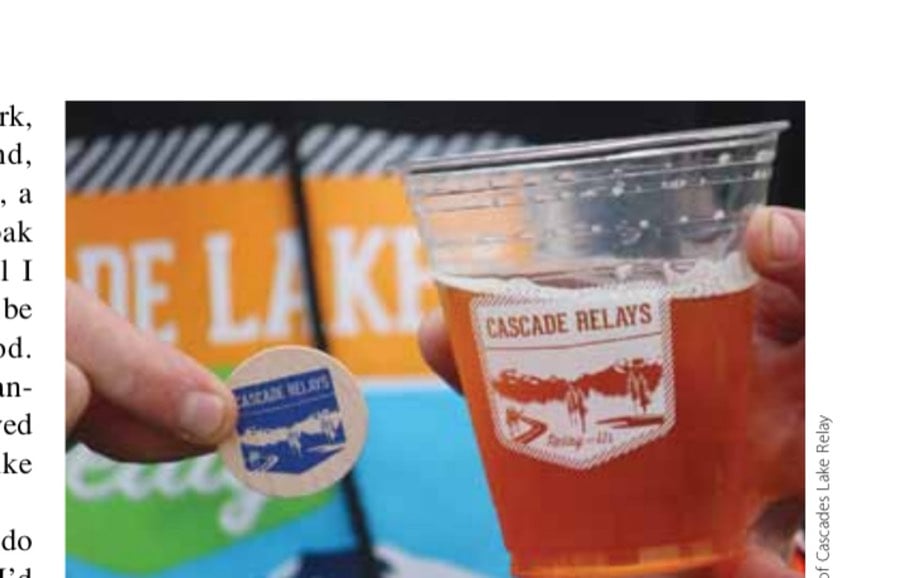
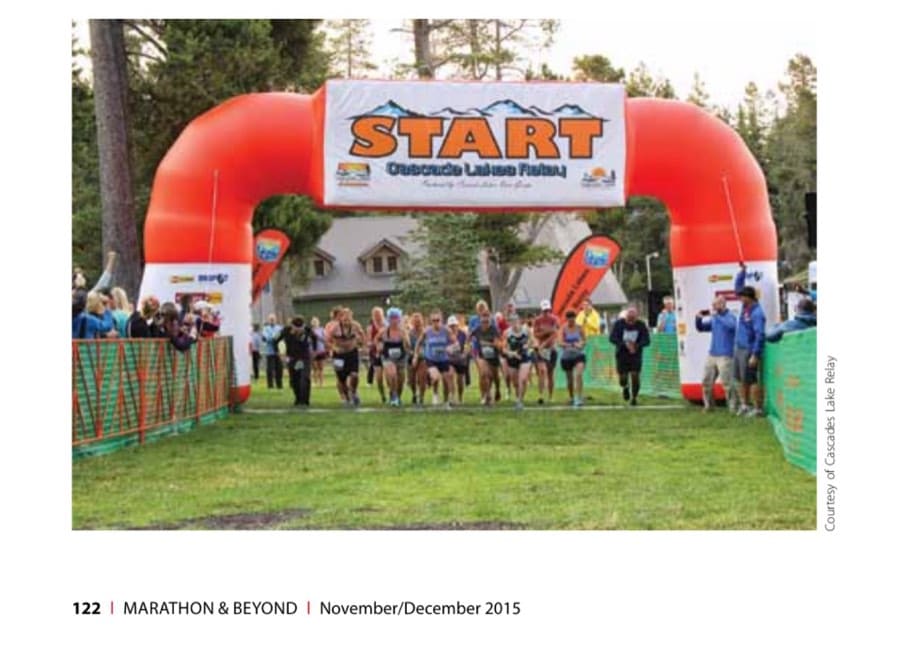
s I barreled down the highway toward Bend, I thought I’d fallen out of love permanently. I was on my third and final 6.02-mile leg of the Cascade Lakes Relay and dying a slow, agonizing death, convinced I’d never lace up again. We were neck and neck with a rival team and I’d run the previous two legs at my 5K race pace, this one even faster. I’d dreaded this leg the way I’d dreaded, back in college, a bungee ride I knew I’d regret halfway up (sure enough, I’d started to panic as the gears hauled me up nearly 15 stories above the pavement). I’d told my team to check on me every half mile (stomach cramps had already set in) and if I gave the thumbs up or an affirmative grunt, I was good to go, my legs numbly churning through what felt like mud, the only place in the world that mattered dancing like a carrot just a few excruciating miles down the road: the finish line, a country to which I’d forever pledge my allegiance, along with a party that in-
Courtesy of Cascades Lake Relay
cluded BBQ pork, microbrew, and, most important, a well-earned soak in the river. All I wanted was to be done. For good. This kind of anguish was reserved for miracles like childbirth. All I had to do was finish what I’d started. All I had ahead of me was this final, brutal task and I could go home. But at some point, doubt trumped my resolve. I willed back tears. The van pulled up and I heard a voice, a familiar refrain: “How you doing?”
I shook my head: “Bad. Really bad.” Then I heard my husband’s voice, a shout out the window: “Someone else can take over.” It was all I needed. Permission to quit, to throw in the towel, to raise the white flag and forfeit my struggle for the comfort of a seat and an ice-cold Coke. “How much farther?” I chuffed, my eyes glued to the road, desperate—and determined yet. “
Less than a mile,” someone said. “I can do it.” “You sure?” “Yep.” I could do anything for a mile. A mile was nothing. But it was the longest mile of my life, when seconds on a Timex tick down with agonizing slowness: check and you have only a little while, check again and it’s still a forever, stomachchurning, heart-pounding kind of impatience, a can’t-wait-another-minute hurt. When I finally caught sight of the van, it was parked, waiting for me. This was the end, brake lights and gravel my finish line. There was a Coke and a seat waiting, the comfort of conversation, radio blasting, along with the knowledge that I was, at long last, done. There’d be a celebration, war stories traded, and, of course, pride. When I looked at my final split, I was prouder than I’d ever been of any race I’d run: I’d covered the final 6.04 miles in 33:09, 5:29 per mile (it was downhill). I’d run the race of my life and I was finally content, settled on the fact that I’d run as well as I ever would, the emotional push of competing on a team just the thing I needed to run my very best.
There’s a distinct peace that comes with deciding you’re as good as you’ll ever be, when, creekside, you sit under an awning, riffled by the wind, the sun on your arm, a beer in your hand, and your comrades at your side, laughing and exchanging wild stories, too many Hawaiian sweet rolls and not enough water and the hubris that can cause little annoyances to turn into huge tribulations when you’re running three 10Ks in 24 hours. The seam in your sock becomes a piece of gravel and the string cheese you ate between legs 2 and 3 has you thinking that you should’ve brought along an adult diaper. Running in the middle of the night is a novelty all its own, headlamps bobbing through the fog, a 2 a.m. race an exercise in faith; despite the potholes, you somehow manage not to turn your ankle. Like running a marathon, relays can bring out the best and the worst in your body, and both can kill that spark.
I didn’t run regularly for over a year after. I was spent, burned out, and ruined for a while. I liked the idea of two- and three-mile runs and I did them here and there. Then I went for weeks not running at all. I had extra time to catch up on dishes, laundry, or miscellaneous tasks I rarely did, like tending our modest backyard. We planted sunflowers, tomatoes, and a pumpkin. I went for walks, truly seeing a few quiet neighborhoods I didn’t know existed in the small town I’d spent nearly a decade in. The world opened up and nonrunning thoughts took over. For a while, the part of me that loved to run seemed to pass away. I was convinced as the weeks and months went by that I would never get back into it.
And there was always a reason not to. Winter brought early dusk and I didn’t like running in the cold or the dark. I relished sleeping in, my body still seemingly recovering from what I’d considered my last and best race. I liked to walk, regularly making the loop around my son’s school, passing a field with horses, goats, and crickets, the wind in my hair and the sun on my face. These were sensations I hadn’t noticed, not when I ran. When I ran, I noticed my heart, my feet, my dream that I could always be better. I noticed my breath, my stride, the best of myself, but the sun was always an afterthought. I liked this other world, this let-happen kind of world rife with spontaneity. Before I’d always led a have-to kind of life—have to get in a run, no matter what, even if it’s dark, even if it’s late.
Now there were gems at every turn, spontaneous trips to the lake, walks around Lithia Park and the Plaza at dusk for spur-of-the-moment cups of cocoa. There was so much more time. But how could a little thing like running seem to leave a hole a life could fit into? It was an hour a day, after all, just an hour a day. Only it wasn’t, not really. I was spending a lot of time just thinking about running and that was the thing I didn’t miss, being beholden, obsessed in a sense, or just very much in love. But there were so many other things I loved more, like going to the Plaza for a cup of hot cocoa with my son. There were only so many hours in the day and so many days in a life and I was spending too many of them thinking about running.
So I didn’t run. Fall turned into winter and spring turned into summer. Everyone was asking when my next race was, and my simple answer was that I didn’t know. There was nothing on the horizon. No plans at all. “I’m taking a break,” I’d say. “A hiatus,” was the word I used. But what was a hiatus, exactly? In my mind, it was a forever kind of thing.
Then late summer blossomed. The sky was smoky from nearby fires. It was hot, not ideal running weather, but I nonetheless jogged (rather than walked) the mile home. I could tell I was out of shape, breathing hard despite the fact that I was moving slowly—but there was something I hadn’t felt in a very long time, a glimmer, a familiar longing in that feeling I got when I ran, the hard pump in my chest, the feeling of work, of breathing hard. I loved it, missed it, and wanted it back.
Little by little, I started running again, a mile at a time, then two. Eventually, I had a three-mile loop, then a five-mile loop. Like building a castle a brick at a time, I laid down my aerobic base with the intention that, someday, I’d do something with it. I couldn’t imagine not having a plan, something to aim my hard work at. My running was willy-nilly, five miles here and seven miles there, but by October, I felt fit enough to enter a local 5K. The result wasn’t spectacular, but it was a good place to start, to dream again. But of what, exactly?
I knew friends who were training for the California International Marathon, and I wondered if I’d ever do another (I’d run only one). Ultimately, I decided I wasn’t ready for that kind of commitment. Instead, I’d keep it vague, gradually building my mileage as I felt my body getting stronger, fitter, faster, my excitement growing as I dreamed, once again, of what could be. I was shocked at the newness of running, despite the fact that I’d been doing it for years. I’d never have guessed that it would ever be like it was in the beginning, those first short runs, adventures I thought were gone.
I began doing long runs and throwing in a double here and there (something I’d never previously done). I fell in love with going out that second time, November caught in the swirl of dusk and the brightly colored leaves that seemed to glow. I loved the rain and the fog, fall settling in the sweep of mist and drizzle that dampened my face. I was amazed at the ease with which my body remembered, after all of the time off, the combination of novelty and fluency thrilling. I knew how to run the way I knew how to breathe, but this was uncharted territory; never in my life had I ever done doubles with any consistency, and it didn’t take long for me to feel the difference in my strength.
The only thing I needed to do, then, was to set my sights on something, and it couldn’t be in the spring, couldn’t be some ethereal, faraway goal I hoped to achieve after months of base. I hadn’t done any speed work and my base was recent, but I wanted to race, to test my mettle on the course, even if it was cold, even if it was dark. The Holiday Hustle, a 5K in Central Point, was December 13th this year and the money raised from race entry fees was used to give hungry
children backpacks full of food over the weekend when school-subsidized meals aren’t available. My husband and dad had done it before. It would start at 5 p.m., at that in-between time where day meets night, a beautiful time to run.
I didn’t know what to expect. Nor had my new dreams coalesced into any discernible goal. All I knew was that I wanted to run—and to race—with what joy I knew when I began, an undeniable sense of adventure.
December 13th was sunny and cold. Jacksonville, a little historic town about half an hour from Ashland, was buzzing with the holiday festivities that had become tradition for us—a wagon ride around town, two 25-year-old Belgian draft horses (each 2,200 pounds) with sleigh bells pulling us, our whole group waving at the cars coming down the street and cheerful waves back. There was the hot cider we sipped out of paper cups, courtesy of the woman on the corner of E. California and 3rd in nineteenth-century dress. There were carolers singing “Jingle Bells” and people carrying brightly colored shopping bags as they came out of boutiques in 100-plus-year-old buildings. Above, yellows and reds still dotted the hillside. “
It’s a perfect day,” I told Mom, and it was. By 3:30, it was time to get to Twin Creeks Park in Central Point. The race was at 5:00, but we needed to park, pick up our packets, scout out the bathrooms, and warm up. The park was distinctive, set in the middle of an open bedroom community with three bronze elk statues (a bull, cow, and calf) flanking the shelter. Dad, dressed as an elf (runners were given the option to wear costumes), began his warm-up and I joined him, trotting around the park as kids and their dads played ball. Rune, my 8-year-old son, was already racing a little girl (also dressed as an elf) across the green. The bone-chilling cold that comes with the dark pricked along my neck, the glow of late afternoon fading into evening. “
It’s going to be cold,” I told Dad, and I began feeling that old trepidation, the kind of prerace anticipation I liken to wanting to tear off a Band-Aid or pop a blister. “I want to get this over with,” I heard myself say. Then I reminded myself of the magic I’d felt at getting back into running, the passion I’d had when planning a race, a way to test my mettle, and the good cause this was all about. It wouldn’t be like tearing off a Band-Aid, not this time.
We lined up at the base of the park, heading north initially, the sun setting. “Good luck,” I told Dad. He gave me a hug. “Good luck,” he said back. A red line had been drawn across the road and we stepped up to it. There was a countdown and we were off. It got dark as we ran. When we started, I could see faces, but they vanished into the night and all I heard were voices: This way, they said, with a vague sweep of an arm, a shadow in the dark. We wound our way through the community streets of Central Point, Christmas lights showcased through living room windows. Somewhere, from behind me, I heard the jingle of someone’s costume and the competitor inside me didn’t want to let that jingle get too close.
Courtesy of Holly Hight
▲ Me and Dad at Twin Creeks Park before the race.
I turned it on, putting as much distance between me and the sound as I could, and it occurred to me that this would make for an interesting nightmare, being chased through winding, darkened streets by an elf.
The thought pushed me for a while, but by the last mile of the race, I was struggling. The cold air was wreaking havoc on my lungs and my legs were tight (cold-weather racing has never been my forte). At each turn, I asked a volunteer if I was going the right way, paranoid that I’d lose myself in the dark, but soon enough, the lights of Twin Creeks Park, along with that bronze family of elk and the sounds of cheers, buoyed me as I came around the final loop on the sidewalk, tracing my way toward the finish chute. Mom and Rune waited, cheering: “Go, Holly!” I came through the line and glanced at my watch, the judgment instant (old habits die hard): not great but not bad. The three of us walked over to a table set with all kinds of goodies, mini cupcakes, cookies, and best of all, hot coffee. As Mom and I sipped our coffee and Rune nibbled on a sugar cookie, we waited for Dad. When he came in (elf costume visible from 100 meters, even in the dark), we cheered, and the thought rushed through me all at once: This is racing, the best part. The part burnout can’t touch.
This article originally appeared in Marathon & Beyond, Vol. 19, No. 6 (2015).
← Browse the full M&B ArchiveMore like this
1,000+ stories from 19 years of Marathon & Beyond
The complete archive of the legendary long-distance journal — digitized and free to read.
