

Returning To The Renaissance
For the past many years, most of the medals awarded to marathon finishers have been manufactured overseas, usually in China. Recently, there has been a trend to bring some of the manufacturing back to the United States. In this article, we look at some U.S.-made medals, some of which made it into this year’s top 25.—Editor * * * It wasn’t a typical October day for Chris Nicholas in Portland, Maine, as he prepared for his morning run. His goal was to finish in Portland, but not on the East Coast; instead, he wanted to finish in Portland, Oregon—three time zones away! Surely his thoughts must have been, What was I thinking? Once is crazy enough, but twice! Five months later, his trip ended in Balmorhea, Texas, due to a knee injury during his attempt to reach the Pacific Ocean two times in one year. He exceeded the East-to-West-Coast driving distance by 1,000 miles. Not even Forrest Gump could have achieved that! No act of God (Hurricane Sandy hitting New York City just as he arrived) nor human frailty (his left knee at the 1,000-mile mark) would stop “never-say-die Nicholas,” who simply jumped on a bicycle to continue his journey another 3,000 miles.
Nicholas, who carried a U.S. flag every mile of his one-man road show, lives in Wellston, Michigan, north of Grand Rapids, where an empty General Motors plant reminds him of the need to help the local economy. His heart for his community fuels his remarkable drive, as does his desire to give to charity by traveling across this great country for the Wounded Warrior Project, the Make-A-Wish Foundation, and the St. Jude Children’s Research Hospital. Between his mad dashes, Nicholas directed the North Country Trail Marathon and focused some of his boundless energy into discontinuing its overseas-produced medal and turning it into an American-made work of art. Much like venturing cross-country in the winter, you really don’t realize what you’re getting into until you actually do it.
Pixels to easels The predawn ambiance absorbed Lisa Fine as she prepared for Chris Nicholas’s North Country Trail Marathon (NCTM). For two years now, she has traveled the 410 miles from Columbus, Ohio, to challenge the hilly Michigan trails. She had completed the 50-miler the year before, and yet she came back for more. Fine kept thinking, Only half as far this time; I can do this, as she started running on race morning. Trails tend to cause the pack to break up, and before she knew it, she was left alone with her thoughts as her only companion. Though she was sacrificing a couple of extra minutes per mile by not running on paved roads, feeling continuously connected to herself in the solitude of God’s country was ultimately worth it to her.
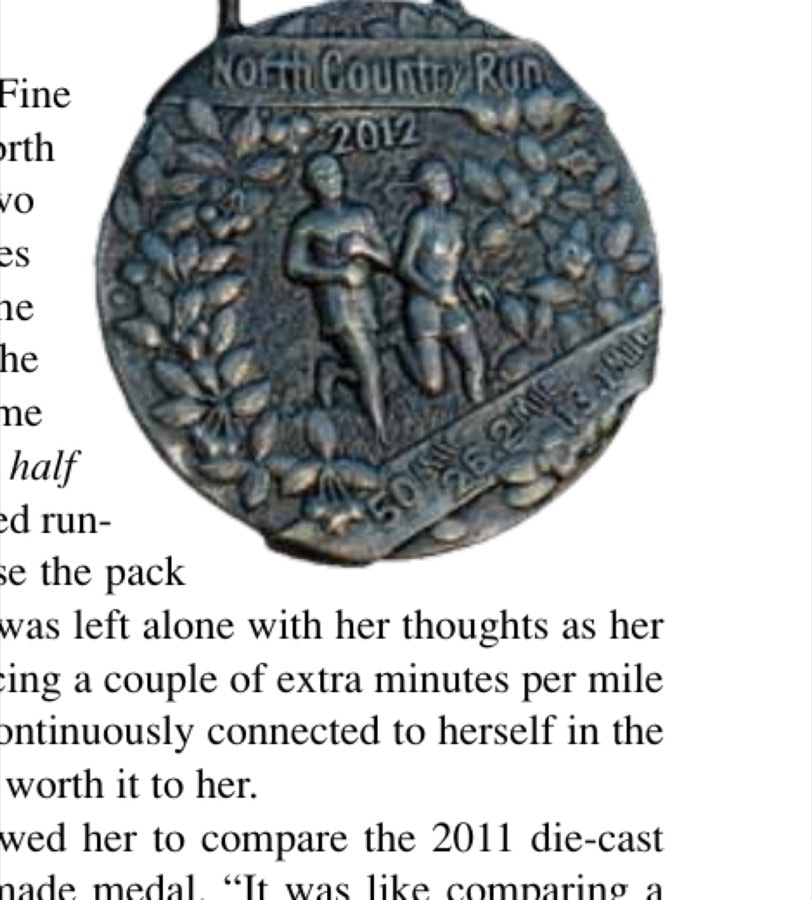
Finishing the marathon that day allowed her to compare the 2011 die-cast finisher medal and the 2012 American-made medal. “It was like comparing a 21st-century digital picture to a Van Gogh,” she said. Actually, she wasn’t far from the truth on how the 2012 North Country medal was crafted. Reinventing the manufacturing wheel from scratch seems as crazy as running a marathon with very little training. Die casting in factories overseas is generally the most cost-effective way to manufacture finisher medals, as most US companies are not normally set up solely for marathon medals and would lose big money with a small 500-medal run. So NCTM chose to go with sand casting (a metal-casting process that uses sand as the mold material), which seemed the least expensive and most logical alternative for a US metal-based medal.
The first step for NCTM’s Chris Nicholas was to create a computer-generated design so that New York artist Robert Eccleston could render his sketch into a clay mold. Eccleston painstakingly hand-carved the mold for one full week, knowing that one small mistake could cost money and extra time to correct during the sand-casting phase, which was achieved in a two-week period by Patriot Foundry in Franklin, New Hampshire.
After receiving the medals back in Michigan, Nicholas decided to refine the raw medals to have them stand out a bit more for the finishers. This was not discouraging to Nicholas, who saw it as part of the learning process for the future. Working with Knape Industries in Rockford, the company used antiquing spray on each medal and then baked them for 10 minutes. The fun came next as race volunteers, wearing goggles and gloves, had to polish every medal for 90 seconds with a wire drill—not quite as easy as pointing which direction a marathoner should run, eh?
It was an experience, no doubt, but being more involved was important to NCTM to truly achieve “made-in-America” finisher medals. The edges may not have ended up perfectly smooth, but runners applauded its creation from US resources. Lisa Fine echoed the masses: “Their medal harkened back to the days of the old blacksmith, who hand-forged horseshoes in fire. You can almost hear the clink of the hammer on the medal!”
New sheriffs in town The old-West town of Winthrop, Washington, is the perfect backdrop for a race in the mountains, thought Carrie Webber from Kalamazoo, Michigan, as she enjoyed the scenic views from her school-bus window while traveling to the starting line that peaceful June morning. The day before, she had driven four hours from Seattle and was amazed by the breathtaking mountain views and cascading waterfalls of the great Northwest. She anticipated more of the same on her run into downtown Winthrop that day, looking forward to what she described as an “outdoor-lover’s paradise.”
As predicted, it was a scenic and inspiring run, but as she neared the finish line, she felt that she had somehow entered a time warp. Or maybe she had stumbled upon the movie set of Back to the Future III, complete with wooden sidewalks and classic façade buildings. Race director James Varner explained: “Our town was founded in the 1800s by miners, like a lot of towns in the old West; folks came to the mountains in search of riches. Runners still flock to Winthrop for the riches that the mountains here offer; it’s just a different kind of jackpot now with endless miles of trails and quiet rural roads, a serenity that only comes from being far off the beaten path.”
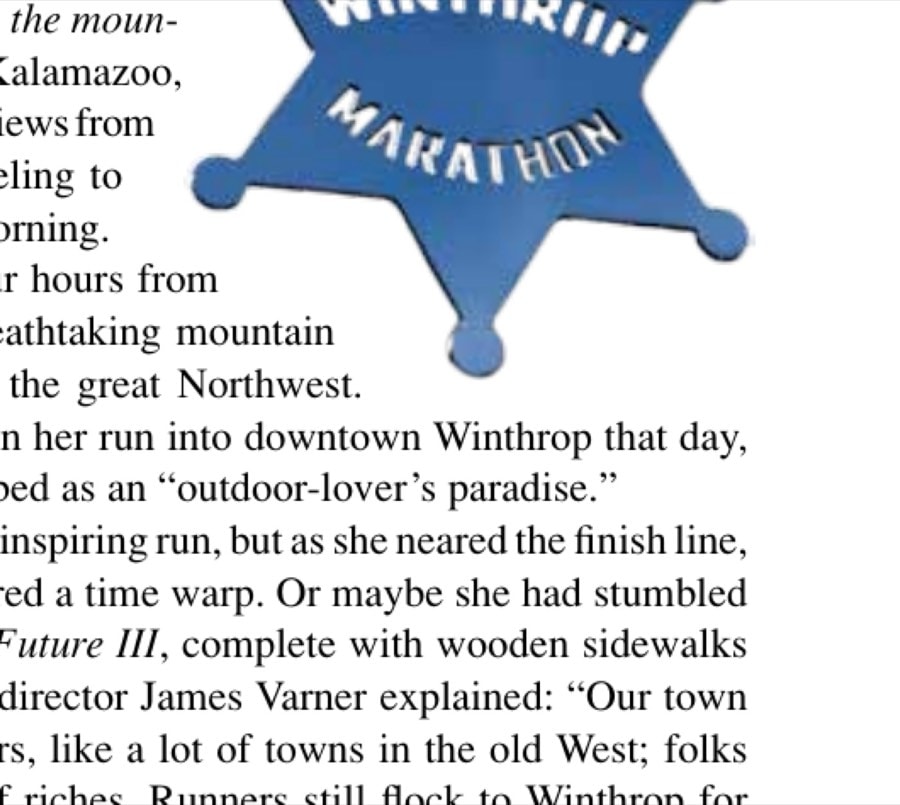
Receiving sheriff’s-badge medals at the finish line surely made everyone feel like Wyatt Earp that day. Webber had seen a 2011 picture of the medal, persuading her to run Winthrop. “The badge may be simple, but it certainly complements the feel of the town,” she remarked. The race committee wanted authentic-looking medals that mirrored the 1800s. Area marathoner Brad Nelson of Medalhangers. com manufactured the badges at Allied Steel Fabricators in Redmond, keeping the money fairly local.
Blacksmiths in the 1800s didn’t have laser cutting machines or mild steel in bulk, nor could they chrome-plate their badges, but Winthrop’s final results looked antique. It wasn’t really cheating to use newer technology to create Old West-like badges; even Wild Bill Hickok would have killed to run marathons in running shoes instead of spurred boots! Winthrop has nearly 100 finishers each year, not quite
a gold rush yet, but this popular, mostly downhill race is not destined to become a marathon ghost town, either. Every finisher moseyed out of town much richer than a bank robber that day while proudly sporting a unique badge of courage.
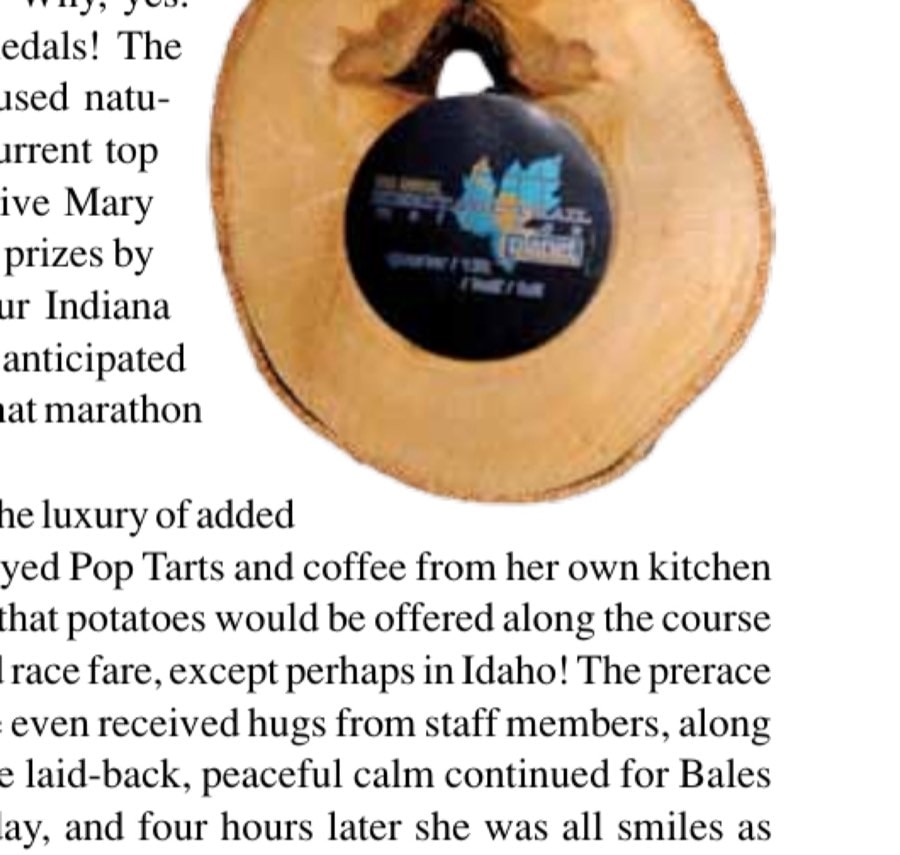
Echoes in time If a tree falls in the forest and no one is around to hear it, does it make a sound? Why, yes: it cries out to become finisher medals! The Heritage Trail Marathon (HTM) used naturally fallen timber to cut out its current top 25 tree medal. West Lafayette native Mary Bales had already seen the finisher prizes by Planet Adventure (directors of four Indiana long-distance events) and highly anticipated earning her own when she awoke that marathon morning.
Living in the race city gave her the luxury of added rest before the start, while she enjoyed Pop Tarts and coffee from her own kitchen table. Bales ate a bit less, knowing that potatoes would be offered along the course at Heritage—certainly not standard race fare, except perhaps in Idaho! The prerace atmosphere was so relaxed that she even received hugs from staff members, along with fellow marathoners. The same laid-back, peaceful calm continued for Bales while running that beautiful fall day, and four hours later she was all smiles as she received her handmade prize. She added, “No two medals are the same, and each one is incredibly meaningful and unique. Planet Adventure’s medals are the only ones I do not give away after the race as they’re made with obvious care!”
But how were these medals created? Were they chopped out by Paul Bunyan’s trusty axe? Not quite. Each year HTM gathers fallen trees from the Heritage Trail, but if adequate timber can’t be found, native wood from nearby Spencer is used instead. The trees are cut into 5-inch to 6-inch slabs with a heavy-duty chop saw. Then hand drills are used to punch holes through the thick wooden medals for the orange suede ribbons. The last step is gluing on locally made metal plates with the race logo and date etched on each award.
Event director Matt Jourdan elaborates: “The medals need to be cut and dried several months before HTM to allow adequate time for the adhesive to permanently adhere the metal plate to the wood. One time, we had a batch of medals that were still damp from a recently fallen tree, and all of the plates fell off. My garage floor was covered with wooden medallions, along with a bunch of fans blowing on them day and night for a week, but thank goodness, they were all permanently attached just before the event.”
Most refer to the trail as the “Wabash Heritage Trail” because it runs along the Wabash River. Running amid the Southern Indiana autumn foliage and crossing the Davis Ferry Bridge gives marathoners a beautiful glimpse into nature that will never fade away. Fur traders used the trail when they traveled from Fort Ouiatenon to Battleground. Thus, finishers not only retrace those footsteps in time, but they also receive truly historic medals. Tree rings date the medals back to when the “iron horse” came along with its railroads carefully laid down to preserve the path. These tracks have since gathered moss, but if you listen closely, you may hear the faint whistle of the Wabash Cannonball while you’re running around the bend.
The potter of Vermont The Shires of Vermont Marathon begins in Bennington and ends in Manchester. The term “shire” originated in England and is defined as a division of land that is now called a county. This gorgeous, historic landscape beckoned to Manhattan resident Cecily Dexter to run the shire, along with the challenge of running the heightened elevation along the unpaved back roads.
The morning mist felt as sweet as Vermont maple syrup to Dexter during her marathon that inaugural morning. There were no New York City stoplights to worry about that day while she ran the Green Acres rural tour that wound through the villages of North Bennington, Shaftsbury, and Arlington before she finished just under 4:30. Being the sister-in-law of race director David Durfee gave her an advance peek at the finisher medal, so she wanted one of her own. She said: “The locally hand-crafted medals go hand in hand with the rustic charm of the Vermont countryside.”
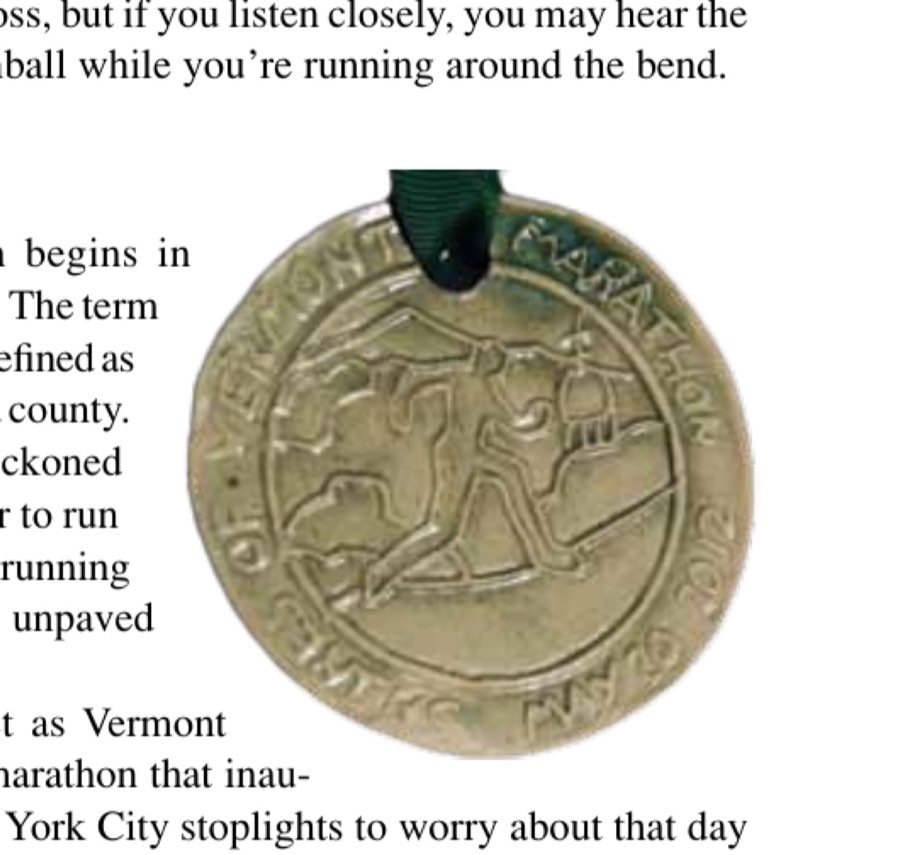
Ceramic artist Jessica Phillips used her expertise in this ancient craft to create medals that reflected Vermont’s heritage. She began by sketching the medals based on the marathon logo and then carved the design into clay. Phillips next had to make several master stamps, explaining that they were so delicate that they tended to break. She then pressed the stamps onto sheets of soft clay. Finally, she cut out the clay medals, carved out the hole for the ribbon, and cleaned up all the rough edges.
After the ceramic medals dried for nearly four weeks, they were “bisque” fired and coated with a green transparent glaze, which gave them their lovely color and finish. Next step was placing them into a kiln (a furnace that reaches 2,100 degrees) for an 18-hour glaze firing. Phillips used raw materials from Vermont, and the entire process took her 10 weeks. It concluded with the hand painting
of her signature onto the back of each medal with iron oxide, fusing her etching onto the clay. This classy touch is reminiscent of Renaissance artists who signed their treasured paintings.
Chasing rainbows Living 25 minutes from the Park City Marathon starting line was convenient for two-time finisher Sue Mantyla. Why not make this a yearly event? she thought while driving that sunny 49-degree marathon morning. Upon arrival, she chatted with some first-timer BYU track club ladies who asked, “How many marathons have you run? Fifty?” She responded “To be exact, yes!” Most runners are happy with one marathon finish and would consider 50 an unobtainable goal. Not Mantyla, though.
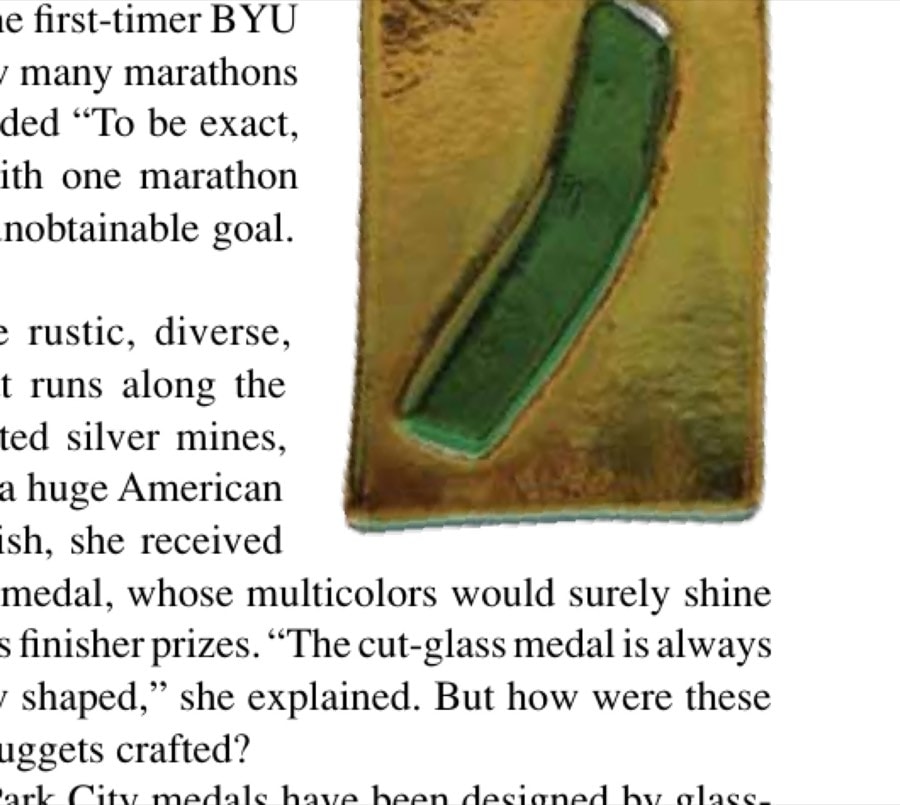
Mantyla enjoyed running the rustic, diverse, and landmark-riddled course that runs along the Deer Valley Ski resort, the deserted silver mines, and the McPolin Barn, which has a huge American flag draped over it. Upon her finish, she received Park City’s signature sun-catcher medal, whose multicolors would surely shine brightly among her four-dozen-plus finisher prizes. “The cut-glass medal is always an interesting design and uniquely shaped,” she explained. But how were these end-of-the-rainbow, pot-of-gold nuggets crafted?
For seven consecutive years, Park City medals have been designed by glassand-metal sculptor extraordinaire Morag Totten, who each year acquires local sheet glass and US-made wire material to craft the sun-catchers. Utah’s natural beauty always provides inspiration to her during this challenging process. Every medal is cut freehand with a diamond wheel tool so that she can break off the glass around the design. This year’s medal had two separate pieces that needed to be layered together before being placed in the kiln for fire polishing. This fuses the two pieces together and softens the edges of the glass, leaving the medal a smooth surface.
Next step was the annealing process (dropping the temperature from 1,375 degrees) so that the glass could slowly cool to avoid stress areas that could potentially cause them to crack later. Then Totten used a wire cutter and a pair of needle-nose pliers for curling, shaping, and wrapping the wire design onto the piece of glass. In previous years, Totten has collaborated with a local artisan who used a water-jet machine to cut out various leaf shapes. It takes marathonlike determination to create these sparkly porch hangers, but it proved to be well worth her effort in 2012, as Park City was in our top 25.
Stone bridges Running 52 marathons in one year isn’t normal or even close to sane, but veteran marathoner Julie Weiss (www.marathongoddess.com) completed that challenge, wanting to do her part for charity, plus spreading awareness about pancreatic cancer. The Big Sur International Marathon (BSIM) was stop number four for the Santa Monica, California, native, who was well aware of its fabled reputation and lustrous views. Running this self-induced marathon blur meant another plane flight, another hotel, and yet another bus ride to the start line, but this time her trip was in the dark of night. She huddled in the cold that morning as she watched the sun come up. Mostly, her thoughts were on the breathtaking views that lay ahead, always positive and looking forward.
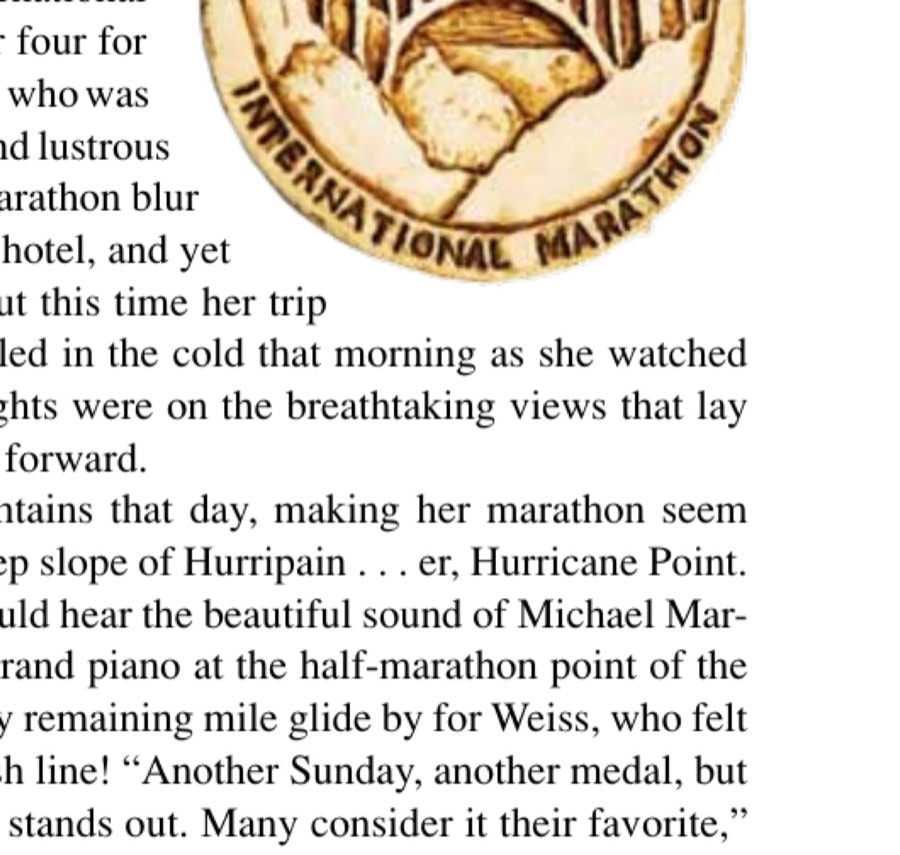
Heavy fog permeated the mountains that day, making her marathon seem mysterious as she started up the steep slope of Hurripain . . . er, Hurricane Point. As Weiss ascended the crest, she could hear the beautiful sound of Michael Martinez’s music emanating from his grand piano at the half-marathon point of the course. The ocean views made every remaining mile glide by for Weiss, who felt almost disappointed hitting the finish line! “Another Sunday, another medal, but not just any typical medal; this one stands out. Many consider it their favorite,” quipped Weiss. She also received the Boston 2 Big Sur challenge medal by finishing Boston 12 days previously. She added, “Ceramic medals are fragile, and, of course, I dropped it, breaking it into a million pieces, thus also breaking my heart. But they were kind enough to replace it with a new one.”
Forged from the wilderness in 1937 was Big Sur’s spectacular Highway 1 marathon course, and so it seemed fitting for BSIM’s medal to be carved out of clay in a similar manner. Kathleen Kelly has hand-crafted its medallions since BSIM’s inception in 1986. A quarter century later, the 18,000 various pieces for the Big Sur events have become a year-round project. Kelly sculpted the original design from clay with the Bixby Creek Bridge as the main theme and then carefully poured a casting mixture into 24 pieces at a time. These sculpture molds were made from a flexible mold material that allowed every detail of the original to be reproduced.
After they hardened, she carefully extracted the pieces from the mold, handcarved out the holes for the cord ribbon, and smoothed out any rough surfaces. But she wasn’t finished yet; the medallions were placed in an oven to cure and then stain was applied to accent the design. Finally, she painted the current top
10 cast-stone medals with high-gloss enamel and inspected each one a final time before hand-delivering them to Monterey from San Diego. This type of tender, loving care defines BSIM, a no-brainer must-run for every marathoner.
Once the paint dries So what is the cost of a medal forged in the US compared with assembly lineproduced medals? Generally, it’s cheaper to go locally made, but with such comes much more hands-on involvement and networking. Three of the marathons in this article spent a couple of bucks less than the average medal price, two were spot-on identical, and one marathon spent more than double the industry average.
Giving out historic and artistic finisher medals directly reflects the cities and towns whose local resources are used, both for the medal and its marathon. Along with Big Sur, Park City, and Heritage Trails, our panel selected the homegrown glass medals from Newport and Wineglass, First Light’s wooden medal, and St. George’s native-stone gem to our top 25. This isn’t an anomaly; six of these marathons have been in our gallery several times in previous years, so the extra effort it takes to provide an American-made medal does not go unnoticed.
It’s all a matter of choice, or of a hundred little choices, whether to produce medals here or overseas. Race directors do their best to provide the highest-quality medals they can. Any crafting method that provides excellent keepsakes will get a thumbs-up from finishers, no matter how they were created. Advancements in technology and competitive manufacturing pricing have made overseas medal production a popular choice for many marathons. Those who choose to keep business in North America do so for a lot of different reasons, and price is not always the major consideration. Regardless of their origin, the ultimate goal for marathons should be creating medals that finishers proudly hang on their walls, much like priceless masterpieces.
This article originally appeared in Marathon & Beyond, Vol. 17, No. 3 (2013).
← Browse the full M&B ArchiveMore like this
1,000+ stories from 19 years of Marathon & Beyond
The complete archive of the legendary long-distance journal — digitized and free to read.
