

Road Runner To Trail Runner (Batteries Required)
“My advice. Just keep movin’ straight ahead. Every now and then you will find yourself in a different place.”— George Carlin
SQUAW VALLEY, CALIFORNIA 11:00 A.M., June 25, 2004
This is it; finally I am at the race registration for tomorrow’s Western States 100Mile Endurance Run. At my first table stop, a bright yellow, sort of wide for my taste, hospital-type wristband is attached to my right wrist and two volunteers quickly hand me two T-shirts. The next volunteer delivers to me a bright red, genuine North Face backpack—so far this is easy and fun. A quick body-fat test and blood drawing must be payment for the T-shirts and backpack. Blood pressure is next, and the last stop is my prerace weight—all of this information is recorded on my wristband with a Sharpie pen. The wristband has now become me for the next two days.
Much of what all this fuss really meant was just now starting to sink in; by tomorrow at this time, we would be running a remote 100-mile trail, start to finish, in California’s Sierra Nevada, and it would take most of us all day and all night. The race would start in the dark at 5:00 A.M., and we would get to see the sun come up over Lake Tahoe; after running all day and then all night, we would see the sun come up again as we closed in on the finish line in Auburn. Perhaps that explains the abnormal generosity of two T-shirts. Not much about tomorrow’s race was going to be normal.
Tim Twietmeyer is behind me at the weigh-in. He has finished this race over 20 times. I wait until he is done and ask if I can have my picture taken with him. He graciously agrees. This picture will be my only chance to see him from the front when we are in the same race.
Courtesy of Mike Pastore
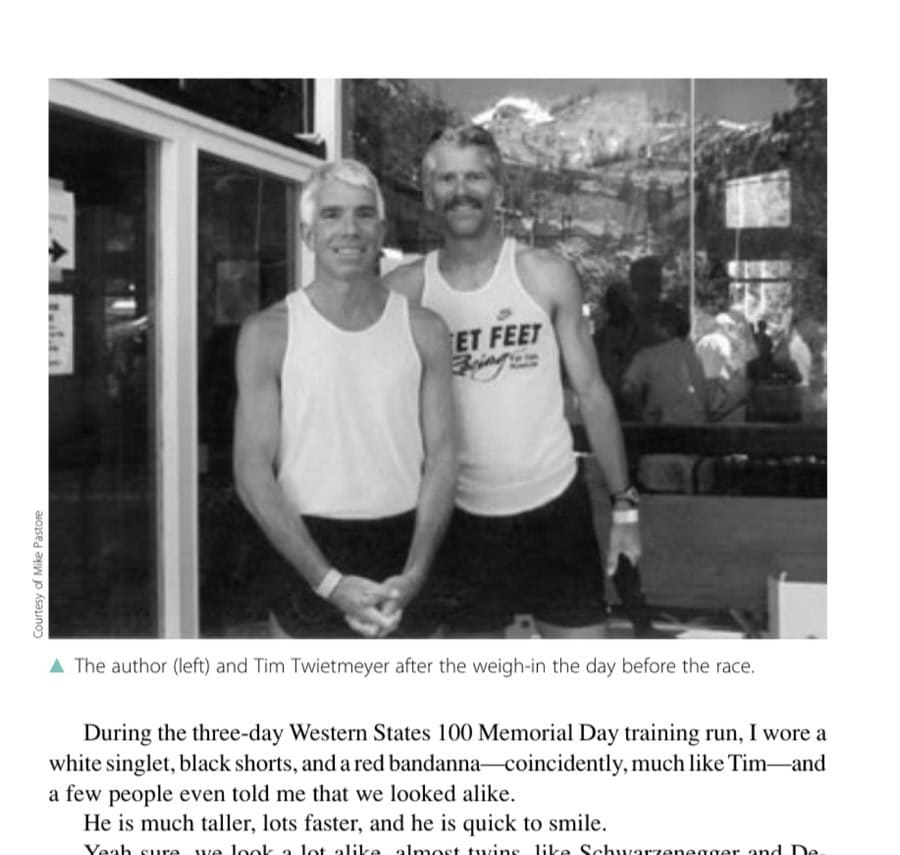
▲ The author (left) and Tim Twietmeyer after the weigh-in the day before the race.
During the three-day Western States 100 Memorial Day training run, I wore a white singlet, black shorts, and a red bandanna—coincidently, much like Tim—and a few people even told me that we looked alike. He is much taller, lots faster, and he is quick to smile. Yeah sure, we look a lot alike, almost twins, like Schwarzenegger and DeVito.
GREENVILLE, SOUTH CAROLINA Saturday Afternoon, December 13, 2003 “What are you looking for on the computer?” my wife, Kelly, asked. “Nothing really, just looking at the Kiawah Island Marathon Web site to see
if the race results and times are up yet,” was my somewhat lame reply. The truth was I was waiting for the lottery results for the Western States 100 to be posted on the Web. But I was only halfway checking the Web site for the lottery results, because
I was tired, and I knew my chances of getting into this race, the “Boston Marathon of ultras,” was less than 50/50. Besides, my desk chair felt really good after running the marathon this morning and the four-hour drive back from Kiawah Island, just south of Charleston, South Carolina.
Today’s marathon was my third in as many months; two of the three would qualify me for Boston, not counting that lame trail marathon in October. My multimarathon logic was that if I can do this many marathons, I could run a 100-mile race.
Let’s face it; most marathon road runners do not follow ultras, so most do not know much about WS100, especially those of us on the “right coast.” Only Denis, Sandy, and a handful of the folks I run with on Saturday even knew I had applied for the WS100 lottery. It was not on Kelly’s radar, but that was about to change.
After I had spent 25 minutes hitting the refresh key, the lottery results finally came up on the screen. There was my name. I started to laugh. Kelly wanted to know what was so funny. I called her over to show her my name on the screen and quickly gave her a synopsis of the race. She listened without saying a word. When I finished she said, “Are you sure you really want to do that? You know how hard Comrades is, and that is almost twice as far. You had really better think about it.” She was right, of course. Now what was I going to do?
SQUAW VALLEY Early Friday Morning, June 25, 2004 “OK, I’ll go to Starbucks, but you will both need to write down what you want me to get or I’ll get it wrong,” I told a bleary-eyed Kelly and Rachel. Not one to miss an opening even at this hour, Rachel said, “Wait a minute, you have memorized all 24 aid stations and distance between them for the race, and you can’t remember two orders for coffee?” “
Starbucks is completely foreign to me. Coffee costing more than $4 a cup is just not normal. McDonald’s has great coffee for just 50 cents, but if you are both sure that is what you want, write it down.” I wrote down the order and picked up my wallet, making sure I had plenty of cash and a charge card.
Stepping outside the back door of the Squaw Valley Lodge, I was shocked at how cold it was. Looking up the mountain at the trail we would be running in less than 24 hours, I suddenly felt much colder. A chill ran up my back.
DUPONT NATIONAL STATE FOREST NEAR HENDERSONVILLE, NORTH CAROLINA Early Sunday Morning, October 19, 2003 Right away I knew this was going to be different from a real marathon, aka a road marathon.
Just like a normal marathon, there were lots of chatter and prerace jumping up and down to stay warm, but the sock colors were very wrong and we had all started out running the race so slowly. This was the start of the inaugural running of the DuPont Forest Trail Marathon; it was also my first trail marathon and only my second trail run. The 30-plus marathons I had run before today had all been on nice, smooth, paved roads. Even my four Comrades ultras were all on pavement. Running on the road, well, it was all I knew.
A bib number, four safety pins, a starter’s horn, and anybody who looked faster than me simply meant that this was a race, and all I had to do for the next three-plus hours was run as fast as I could. I was wrong. The relatively smooth fire road, even with the steepish hills, was still somewhat fast, but that soon gave way to a heavily wooded trail that was not as smooth or as fast.
I was running closely behind a guy who knew the trail because this is where he ran every weekend, I learned as we ran and he talked. It was time to pass him—but there was no room on either side. At some point during our running and talking, the trail had mysteriously narrowed down around us.
So this is what they mean by single track. “Trail right or trail left?” he asked. That was new for me—so I said “trail left”—picked it up a bit, and passed him as he quickly moved to the right. As I turned to say thanks, a tree root reached up, grabbed my foot, and unceremoniously pulled me down on the rocky trail. “
Are you OK?” he asked as he ran around and jumped over me all at once. “Sure—thanks,” was the automatic reply, not really knowing whether I was or not. He quickly ran out of sight as I took inventory of the red clay on my knees, hip, and hands. Well, as long as I had come to a grinding halt I might as well take advantage of my unplanned stop and pee. At least finding a place to do that on a trail run was simpler than on the road—fewer people running, no one watching, and trees were a dime a dozen. “
Single track, trail left, trail right” were all new phrases to me. Lessons learned: always look where you are running and pee downhill. Lots of trail lessons and only 15 miles to the finish.
SQUAW VALLEY 4:50 A.M., Saturday, June 26, 2004 We were cold and we were scared. OK, most of us were cold and scared. There were 370 of us here in the dark, at the start line—the perfect number, we would later be told.
▲
The author reaches the top of famed Cougar Rock.
Courtesy of Mike Pastore
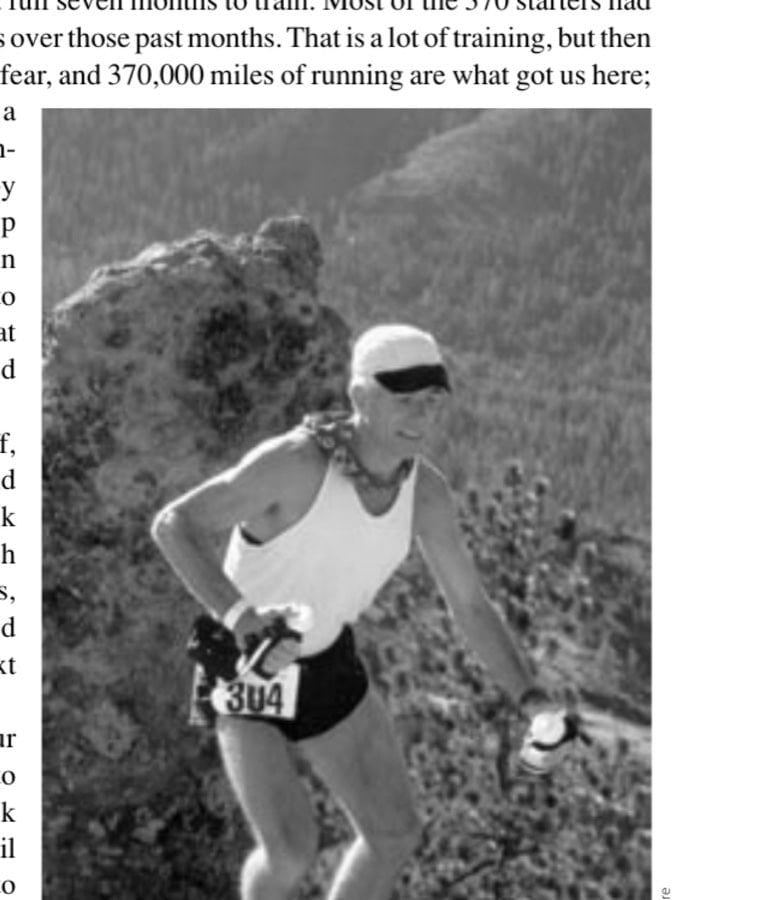
Here was the base of a double black-diamond ski slope used in the 1960 Winter Olympics, which is now the starting line for the Western States 100-Mile Endurance Run. Forty-four years ago, the world’s top skiers flew down this steep slope hoping to finish a few hundredths of a second faster than another skier.
This morning we will run or slog up to the top, and it might take us a full hour. Only the elite 20 or so top competitors will actually run up the 4.5-mile-long hill that climbs 2,800 feet to Escarpment Pass. But, like the skiers in those Olympic Games, they are very different people from you and me.
After running a qualifying ultra during the previous eight months and filling out a very long race application, we are allowed in the lottery for this race. The lottery is held in early December. Those of us lucky enough to be chosen—this year there was a 42 percent chance I would get in, based on the number of applications—would have a full seven months to train. Most of the 370 starters had logged at least 1,000 miles over those past months. That is a lot of training, but then this is a lot of race. Pride, fear, and 370,000 miles of running are what got us here; that number is based on a typical seven-month training program multiplied by the 370 runners lined up for this race. I have put in the miles to earn my way to this start line, but will that be enough? I feel honored just to be here.
The shotgun goes off, and the clock that has held us in check starts to tick away the seconds, which quickly turn into minutes, changing to hours, and inevitably on to the next day. Just halfway into our first climb of the many to come, that very same clock and this steep mountain trail have already conspired to spread out our tightknit
group. We have been transformed into a snakelike line stretching as far as I can see into the predawn darkness. No matter, really; at long last we are running, and I am not cold or scared anymore. Sometime today, or early tomorrow at the latest, I would know for sure if I could really call myself a trail runner.
DUPONT STATE FOREST Midmorning, October 19, 2003 My first and perhaps only trail marathon is now complete. It was a very slow marathon time for me, although I felt as though I had run hard. I fell down. I got up. I fell down again; the sections of the trail that were single track were really only a ditch in the woods. I had to watch every step; in fact, some parts were so bad that I was forced to walk! Some runners got lost, virtually everyone had taken at least one fall, and this is supposed to be fun? Running on the road is just faster, but I must admit, the sock colors are very cool.
RED STAR, AID STATION NUMBER THREE MILE 17, WESTERN STATES 100 10:00 A.M., Saturday, June 26, 2004 My kidneys are working overtime, but my head is not. Two days of steady drinking before the race and a major league case of nerves have sent me off the trail to the bathroom at least 10 times during the first 17 miles of the race. Sadly, it was a very necessary waste of time. A nagging headache, which is something entirely new for me, is not helping matters.
The sign at this aid station tells me where I am; it also has listed the 24-hour pace time and 30-hour cutoff times. I am only five minutes under the 30-hour cutoff at this early juncture. Damn—that is scary—I thought I had been running well.
The Memorial Day WS100 training run had been a large dose of reality in considering what was realistically possible for me. After running 70-plus miles of the actual trail over those three days, I knew that much-sought-after, under24-hour silver belt buckle was not really in the cards. But I had been pretty sure that an under-30-hour run was at least possible, although at times I did have my doubts about even running at that pace. Now, here I am, not even 20 miles into the race, and I’m worrying about staying ahead of that 30-hour cutoff. Worrying about staying ahead of the clock was just not part of the plan.
I have been running above 6,700 feet for the last 17 miles, and my splitting headache is nagging, ample evidence that I am a sea-level person, for which I am
now suffering the consequences. Logic tells me the only way to fix this problem is to run as hard as I can to Robinson Flat, where I will at least start to run back into real air as I descend into the dreaded sunbaked canyons, just in time for the real heat of the day. Being from South Carolina by way of Virginia, I am accustomed to the southern heat and high humidity but not the lack of air pressure. My logic seems sound, so I speed up.
UWHARRIE TRAIL RUN, NEAR ASHEBORO, NORTH CAROLINA About 9:00 A.M., February 7, 2004 “This trail looks like it was laid out by a scared rabbit on LSD. Hell, you won’t be able to run more than 20 steps without changing directions. This is a technical trail run.” Now, more than two hours into the run, I understood what “technical trail run” meant: you get to use your hands to pull yourself up the next hill or out of the endless creeks that crisscross the trail.
That had been my advice from two Uwharrie race veterans, Jim and Paul, at the prerace dinner last night. At the time, I was pretty sure they were just having fun at my expense. Only the trail was worse than they had said. Three days prior to the race had seen rain, sleet, and snow. The trail, or what was left of it, was just a muddy ditch full of rocks and roots.
I had lost count of the number of times I had fallen—not just slipped or stumbled, but fallen hard, face first, side first, butt first. My left shoe had been sucked off my foot twice in the deep, slick mud. Gravity was working well here today.
Today’s run was quickly turning into a 40-mile suffer-fest mess, and I was already questioning my luck in being chosen as a participant in this year’s WS100. I signed up for this race just to get some time in on real trails before I traveled over 2,600 miles to run 100 miles on trails. But that June race is not where my mind is just now. The temperature is hovering just above 40 degrees, the clouds are heavy and gray, everything is dripping wet, I am covered with mud, and my right foot is throbbing from a twisting fall running down the last hill. Now I know that real running is simply out of the question, so I adjust my aspirations a bit. Where is the next aid station?
Looking on the Web page at last year’s Uwharrie’s abysmally slow finishing times, I had driven up to this race planning on finishing in at least the top 20 percent of those crossing the finish line. How could it possibly take anyone who had run the Boston Marathon a number of times 10 minutes to run a mile?
How could I have known those guys at dinner were not just having fun with me? Today’s race would turn into a long, frustrating, and painful nine-plus-hour lesson in real trail running.
BETWEEN LAST CHANCE AID STATION, MILE 43, AND DEVIL’S THUMB AID STATION, MILE 47, WESTERN STATES 100 About 3:30 P.M., Saturday, June 26 My headache had disappeared at some point. The air was back to normal; it was hot and getting hotter by the minute, but at least that was a familiar problem. The trail is all rocks, roots, and moon dust. But the footing is good—I have new standards about what is defined as good footing—but still I have to watch every single step, which is also more difficult with sweat stinging my eyes. My ice-filled cooling bandanna was saving my butt at this point in the race. The bandanna was a last-minute purchase, specifically for this run, that flagrantly broke the rule about never running a race with anything new.
Luckily for me, I had met Mo Livermore through my pacer, Rachel Toor. Mo, besides being lovely and gracious, is a founder of the Western States Endurance Run—and she has run this race in under 24 hours. Most important for many of us first-timers, she was able to remember what had helped her finish the race, and she told us. She knew what it would be like for us during the very long race day ahead. She told us the kind of stuff they never put in the race program; the cooling bandanna was part of that stuff.
Gregarious Rachel has never met a stranger. Although she had just met Mo, they were talking like old friends as a few of us politely listened in for anything that would help us. During a rare pause in the conversation, I asked Mo whether those cooling bandannas really work. Her firsthand knowledge was simple: buy one, you will be glad you did.
She was right, it worked. It is in the mid-90s, and I am pushing up the hill as hard as I can. It always seems to be up and to yet another turn. The trail map showed 36 switchbacks on the way to the top of aptly named Devil’s Thumb. This is a two-mile climb of 2,700 feet—making this a 25 percent grade. Even during the training run, this climb was just unreal. Today, after over 45 miles of hard running just to get to the beginning of this killer climb, it seems almost impossible. I try to count the switchbacks to have some idea where I am relative to reaching the top. My counting skills have diminished somewhat, but I count anyway; the goal is to spend as little time on this hill as possible. I am not really running, but I am not walking either. My heels never touch the ground all the way to the top.
Sunlight is falling from the leaves on the trees all the way to the top of the mountain. These same leaves are the jumping-off point for the millions of Western States mosquitoes that are lying in wait. This must seem like a slow-moving Thanksgiving feast for these bugs. The more aggressive, faster-moving female mosquitoes have already filled up on the lead runners. But the CO2 those fast runners left behind on the trail has just fired up the slower-moving bugs, and there were lots of them, plenty fast enough to catch me!
My earlier training run had taught me that bug spray would be a must for the race. My drop bag at Robinson Flat contained refills of Jolly Rancher candy, salt tabs, sunscreen, and a small can of bug spray.
NASCAR pit crews could learn from these course volunteers. About a quarter mile from the aid station, a volunteer uses a radio and calls my number in to the aid station ahead. As I entered the aid station, my water bottles were taken by one volunteer and refilled while I was weighed by two more volunteers. Yet another volunteer held my drop bag for me as I stepped off the scale. More important, she wanted to know whether I needed any help with anything in the bag.
I did, with sunscreen and bug spray. She covered my back and neck with sunscreen; she even made sure to get the top of my ears! When she saw the bug spray, she laughed and said, “You have been here before!” She sprayed me all over.
But during the three-plus-hour trip from Robinson Flat to the climb up Devil’s Thumb, I guess a lot of the bug spray had worn off. South Carolina or Northern California, bugs are bugs, and these mosquitoes took advantage of every opening. So I had yet another reason to run faster.
I needed to get to Foresthill School as fast as I could. All during my training, I had promised myself that if I got to that point I would finish, no matter what. Foresthill School was still 15 miles away.
UWHARRIE TRAIL RUN, MILE 32 February 7, 2004 There are four people ahead of me just standing on the trail. One of them I recognized as Jim, from Florida, but they are just standing and talking next to a hard-surface road that we did not cross on the way out! Although not a real trail runner, I knew that on this 40-mile, out-and-back course, that hard-surface road meant I—now we—were lost.
I was cold, tired, and mad. How could I have possibly gotten lost? Now that the sun had dropped behind the mountains, it was quickly getting colder and darker. My mood matched the sky, and I grumbled about every hill and rock. Unbelievably, all five of us got lost together: two groups of two and me equaled five off the trail. It turned out we were about 2 1/2 miles off course, for a total of five extra miles tacked on to an already very miserable day.
My left foot was throbbing, so I had a feeling something was badly wrong down there. The creeks I had made every effort to jump early in the race were now very welcome natural cold packs. When I came to a flowing creek, I just walked in and stood there for an extra few seconds—it felt good on the swollen foot.
Jim, who had talked to me about the course last night at dinner, became the unofficial leader of the lost five. He got us back to the trail, and he laughed while he was doing it.
This was not funny. He kept talking and he kept running. I was just mad. I was not sure why I was mad or at whom I should be mad, but the only way to get back was to run. It was almost dark when I finally crossed the finish line and got in the car. I was covered with mud, cold, wet, and angry. By now my left foot felt as if it had a heartbeat all its own. Adding insult to injury, trying to find my way back to the interstate and home, I got lost for the second time today, even with a full-color, talking-lady GPS in the car. I cussed some more, but just like earlier out on the trail, it did not help.
At least today’s adventure made my decision about the June race easy—so much for my brief foray into trail running. How could I expect to run a 100-mile trail in the remote California mountains? What in the hell was I thinking when I sent in that Western States application?
FORESTHILL SCHOOL AID STATION, MILE 62 WESTERN STATES 100 7:11 P.M., Hour 14, Saturday, June 26, 2004 I made it, and only 10 minutes over the elusive 24-hour pace, so it was still possible. A smiling volunteer came running up in a grass skirt and took my water bottles to refill as she guided me over to the weigh-in area. Surprisingly, I was up to 155, a full pound over my starting weight.
Rachel was close behind the volunteer, ready and eager to assume her pacing duties. She came running up to take me over to Kelly, a fresh pair of socks, and some chicken soup with lots of noodles. My food mainstay, salt-covered boiled potatoes, had become impossible for me to swallow. The new fuel of choice was chicken soup with added noodles.
After my socks were changed, I had a time-consuming problem adjusting my water-bottle belt, which I was picking up here. Carrying a water bottle in each hand would not work for night running. I needed a free hand for a flashlight, even with my newly acquired headlamp.
Ian, a new friend from England by way of New York, came running up to me and told me with absolutely no sympathy, in that noble English accent, “You have been in here far too long. Get out of here—now!” He was right.
Off we ran. Rachel was already telling me about her adventures during the day. It was great to have somebody to listen to, and more important, we were actually running. Honestly, I did not really feel like running, but I told myself, “This is Western States 100. Auburn is only 38 miles away.” I ran, if only to keep up with Rachel.
GREENVILLE, SOUTH CAROLINA Late February 2004 As I sat in my car outside of the doctor’s office with a large envelope of X-rays lying next to me in the passenger seat, I knew that was not a good sign. The orthopedic surgeon was sending me for an MRI on my Uwharrie foot, which I quickly calculated would cost more than 10 pairs of new Montrail Masai trail shoes. I was not sure why I needed an MRI; even I could read the evidence on the good, old-fashioned X-ray: that was a broken bone in my foot.
As bones go, the cuboid bone in the middle of your foot is really not very big, but mine was fractured and it hurt—so at least I had a quasi-legitimate reason for just standing in the cold creeks during the Uwharrie Trail Run.
I sat in the car for another minute trying to think about what to tell Kelly. She had persuaded me to go to the doctor, and I could tell she was not really all that keen on my going to California for “that crazy 100-mile run.” As I reached for the car phone to confirm her “I told you it was broken” suspicions, I noticed my unmailed race application for the upcoming Umstead 100-Mile Endurance Run peeking out from under the envelope containing my X-rays. The Umstead race, which is run in Raleigh, North Carolina, would be my first attempt at running 100 miles. I felt it was necessary to run this race before heading to the mountains in
ad
California to run a distance I had never run before on trails. As I dialed the phone and laughed out loud, it sounded a little like Jack Nicholson in The Shining.
FORD’S BAR AID STATION, MILE 73, WESTERN STATES 100 June 26, 2004 Impossible as it seemed, the dust was worse at night; with the headlamps on, dust seemed to float in front of you. You could see it moving toward your face, each single particle was just floating. It was like scuba diving with a partner who lacked diving etiquette, which says you should not kick up silt—but here it was, rushing by with every step.
Rachel and I had been running for hours in the dark by now, and we were close to crossing the middle fork of the American River, which we weren’t looking forward to. She asked me about the batteries for her slowly dimming headlamp. I told her that I thought they were in my drop bag with our dry shoes, on the other side of the river, but I thought to myself that I really wasn’t sure.
How could I even think about batteries now? My sense of time and place was very pitiful at this point. I honestly did not know where we were; I was just following her, and I had no idea what time it was or how long I had been running. So I just ran.
UMSTEAD 100, RALEIGH, NORTH CAROLINA, MILE 60 April 3, 2004 “Aren’t you Rachel Toor?” I asked as I handed off my water bottle to the volunteer at the main aid station. “Yes, I am. How do you know me? Are you running in this race? What mile are you on?” was her all-in-one-breath, multiquestion, rapid-fire reply. I would come to learn over the next few months that this is just Rachel’s way of getting as much information out as quickly as possible. I did not want to be rude, but after all, this was a race. I told her I loved her stories, and I kept running down the hill to finish up the loop. This was the end of my sixth loop of 10. Each loop was 10 miles. I picked my water bottle up on the return up the hill, and as I passed back by her I had to stop to answer her questions. Quickly I told her I had read all of her articles in Marathon & Beyond and Running Times.
She smiled and said, “Do you have a pacer?” I told her I had two pacers, but they were not here yet and I was sure they would be. “I can’t find my guy that I came to pace; do you want me to run with you?” she asked. “
Sure.” Off we ran, exchanging all the normal running data on each other.
Courtesy of Mike Pastore
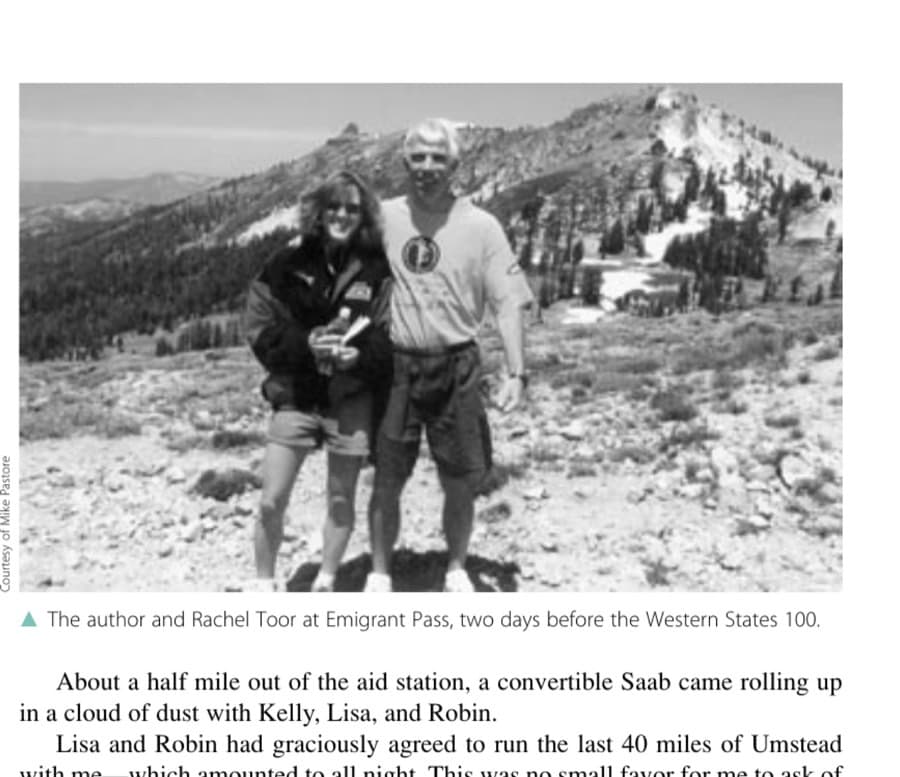
▲ The author and Rachel Toor at Emigrant Pass, two days before the Western States 100.
About a half mile out of the aid station, a convertible Saab came rolling up in a cloud of dust with Kelly, Lisa, and Robin. Lisa and Robin had graciously agreed to run the last 40 miles of Umstead with me—which amounted to all night. This was no small favor for me to ask of
them, but here they were, smiling and ready to go. Kelly looked a little worried but was happy to see me still standing. They went to park, and Robin said she would catch up. Rachel and I took off again. I told her about my ultimate goal—to run West
ern States 100—and that her article in M&B had inspired me to find a pacer as good as she had been with her own runner in that article. [See “Lust in the Dust,” March/April 2004.] One question led to another, and finally I just came out and
asked, “Do you want to pace me the last 38 miles of Western States?” “Sure, that would be great!” she said without hesitation. I asked the question again, to make sure there had been no misunderstanding.
There was not; she was really going to do it. I was so elated that I actually sped up for a few steps. Robin caught us within 15 minutes. She is fast, a strong runner, and best of all a good friend. At that point, Rachel spotted the runner whom she had come to
pace and hooked up with him. Robin and I fell into a steady rhythm. She talked; I listened. It got dark; we ran. Lisa and Kelly were waiting for me to start mile 80. Kelly still looked worried. I was not sure why, but Lisa was ready to run, so off we went, into a perfect night
for running: cool, light breeze and a moon so full that flashlights were just an
afterthought. About four miles into the loop, one of my shoes suddenly felt very wet and my foot was burning. All I could do was yell out for Lisa to stop. Lisa came back for me and asked what was wrong. I told her. We took off the shoe and pulled the sock down a bit, but the skin was now a part of the sock, so back on it went. A very large blister, as I would see later, now covered the entire ball of my foot, and it had broken. The pain of fresh, red skin rubbing inside my shoe had brought me to a dead stop. My shoe was retied, and I just bent over and held on to my knees, rocking back and forth—it really hurt. “
Let’s get going, Mike,” Lisa said. “Nobody has ever died from blisters.” Her husband was a Navy SEAL, so no pity here. I had chosen my pacers wisely. We ran.
RUCKY CHUCKY FAR (AFTER CROSSING THE RIVER), MILE 78 WESTERN STATES 100 12:15 A.M., Sunday, June 27, 2004 I forgot the batteries. I forgot the damn batteries. Everything was in this bag: dry shoes, fresh socks, candy, spare flashlights, gum, Advil, a light jacket—plus all of Rachel’s stuff—it was all in there. I had remembered everything, except the batteries for her headlamp. This was not too good.
Not too good also described how my feet looked when I took off my wet shoes and socks. A lovely lady volunteer, also a physical therapist, put pads on the worst parts and added lots of tape to keep everything in place for the rest of the night. The tape came with a very kind but firm warning: “You will like the tape and me for now, but you won’t like the tape or me in the morning; this will really hurt when it has to come off!” There were not a lot of choices here; it was a chance I was willing to take.
While Rachel was putting her dry shoes on, the expert tape lady helped me put my dry socks and shoes on—she even tied them! All I could do was keep thanking her profusely; she smiled and went on to the next lucky runner.
Standing up was a real effort. This was only the second (and last) time I would sit during the run. It was just past midnight, so now it was Sunday. I had been running 19 hours at this point, and we still had the better part of a standard marathon to run.
Off we ran. Five minutes out of the aid station, I got cold, and I had foolishly left my jacket in the drop bag. No questions asked, Rachel ran back to the river crossing to get the jacket. By the time she got back, I was about one-third of the way up to Green Gate. This is a two-plus-mile, very steep, very hard climb, especially at this juncture in the race. I was warm by now because of the exertion; I never used the jacket.
Rachel and I were both quiet now. Nothing was really wrong, but I was 20 hours into this run and exceptionally weary. Rachel had been up since 4:00 A.M., too; additionally, with no batteries for her headlamp, she was running blind. I forgot the batteries.
I ran in front for a while; she ran in front for a while. She would get a good lead and ask, “Have you got to pee?” “No, not really,” was my standard reply—and I really didn’t. She was worried about that extra pound I had picked up since the Foresthill aid station. “
Try anyway,” she said, as she waited up ahead and unwrapped yet another Jolly Rancher candy; but peeing was difficult, as I had a water bottle in one hand and a flashlight in the other, and my general dexterity was questionable at this point.
If she heard water hit the ground, she would say “Great!” If there was nothing but silence, she would say, “OK, we’ll try again later; let’s get going.” She always waited for me to run by her. As I slowly ran by, she stuck the new candy into my mouth. Now I know what baby birds feel like.
The dim moon had long since gone behind the mountains; it was perfectly dark, extraordinarily quiet, and piercingly beautiful. We still had a long way to go, so we just ran.
UMSTEAD 100, RALEIGH, NORTH CAROLINA About 4:00 A.M., April 4, 2004 My first 100-mile trail run was now finished. It had taken me just over 22 hours and some odd minutes but less than 24 hours. Robin and Kelly were waiting for Lisa and me as we came up the last hill and crossed the finish line. This was a very different finish line from my road marathons. There were no cheering crowds at 4:00 A.M. in this North Carolina state park, no one to take off the nonexistent timing chip, no shiny foil blanket to wrap myself in, and no massive food stations, like at Chicago, Boston, Big Sur, or even Comrades.
Instead, I was congratulated and handed a belt buckle that said “100 Miles—One Day.” I had a new SMO—a term I had just picked up from Rachel. It stood for “shiny metal object.” I held on very tightly to my new SMO and hobbled to the car.
Back at the hotel, lying in bed, surprisingly, I could not go to sleep. I was still excited. I was happy about what I had just done. The trail itself had been relatively easy terrain compared with Uwharrie, but nevertheless, I had run 100 miles, I had run all night and not broken down. I had carried two 20-ounce water bottles most of the day, along with my flashlight. I managed to eat. I had run, even when I felt like stopping, and I ran when it hurt, now knowing that blisters never killed anybody. I managed to keep my sense of humor, start to finish, and I even found the perfect pacer for the big race.
Yet, most of my excitement came from what was ahead: finishing the Western States 100-Mile Endurance Run now seemed possible.
NO HANDS BRIDGE AID STATION, MILE 96.8 WESTERN STATES 100 Sunday, June 27, 2004 We had 3.4 miles left to run, and it was starting to get light. There were only two volunteers at this, the final aid station before the finish. But by this point in the race, those of us still running were so spread out over the remaining distance that a self-service aid station would have been acceptable. No chance of that—not with these two guys taking care of this aid station. No different from the previous 97 miles, my single water bottle was taken and refilled, but I couldn’t care less what they put in it. Both guys congratulated me and encouraged me as if I were in first place. It helped, and I ran for the first time in hours. Rachel actually had to run to stay up with me!
We could see small groups of runners ahead of us; the groups consisted of the runner, the pacer, and any number of family members. During this point in the race, family and friends are allowed to join in until we came to the finish. I wanted to pass them all, but that meant I had to run. So I ran. Not a survivor shuffle like the previous few miles, but a pace with a measurable cadence.
I still had a race number pinned on me someplace, and I vaguely remembered a gun going off sometime yesterday that signaled the start of a race. The final hills leading into town to the finish line are as steep as any we had run in the last 98 miles. We actually passed people; in fact, we passed everyone we could see. We were really running!
FORESTHILL, CALIFORNIA, MEMORIAL DAY WEEKEND TRAINING RUN Friday Night, May 28, 2004 Everyone was talking so loud during dinner that you could hardly hear the person next to you. We had run over 30 miles today. It was the most technical, steepest up, steepest down, hottest running I had ever done. We had run from near Robinson Flat to Foresthill. This was just the end of day one of three full days of training on the trail that we would run next month. As a first-timer, I was still in awe of what I had seen during the day; no disrespect intended, but these were not the foothills of the Blue Ridge Mountains.
Rachel had advised me to carry two handheld water bottles during the training run, which I initially resisted. Those two bottles were 20 ounces each! I am the guy who weighs his new marathon shoes on the postal scales at the office to make sure the shoe ads did not lie about the weight.
“You will get used to them, and besides, when you fall they will keep you from cutting up your hands!” she had added. My knees were skinned up at dinner that night; my hands were not. Point well made. The postdinner briefing by Greg Southerland, the race director, and Tim Twietmeyer kept all of us first-timers hanging on every word. They reviewed the next day’s run, section by section: which sections were runable, which were not, where to expect lots of heat or difficult footing. It was clear they knew every single foot of the 100.2-mile course. Neither of them referred to notes; when a slide came up on the screen, they knew precisely where it was on the trail. Almost as remarkable is how much we remembered and used during the next day’s run; it was a tremendous help. Their commentary with the pictures and the next day’s run made it seem as if we had run the course twice before the actual race—a big advantage for us first-timers.
They closed the talk with some sage advice, or perhaps it was a warning: “The first 50 miles of this race you will get from all of your hard training. The next 20 miles you will get as a bonus for your hard training. The final 30 miles you will cover with either your talent as a runner or on guts.”
It got real quiet. Most of us knew we were not talented. I had a hard time falling asleep that night.
ROBIE POINT TO PLACER HIGH SCHOOL, FINISH LINE MILE 100.2, WESTERN STATES 100 6:28 A.M., Sunday, June 27, 2004 I was getting ready to turn onto the track at Placer High School. There were no more hills on the course. I knew this part of the trail because we had finished up here on the last day of our training run during the Memorial Day weekend, but I had not gone on the track or crossed the finish line during the training run. I saved that for today. Now here it was.
I ran by a spotter posted just outside the entrance to the track; he used his radio and called ahead my race number to someplace I had been trying to reach for the last full day—the finish line. My name came over the loudspeaker as I rounded the track, there was no one in front of me, and I could not see anyone behind me.
Kelly was running on my left, trying to take pictures as she ran along beside me; Rachel was on my right side, smiling slightly, still pulling me forward to the finish line. I had run the Western States 100-Mile Endurance Run, and I had finished—in 25:28:25.
Courtesy of Mike Pastore
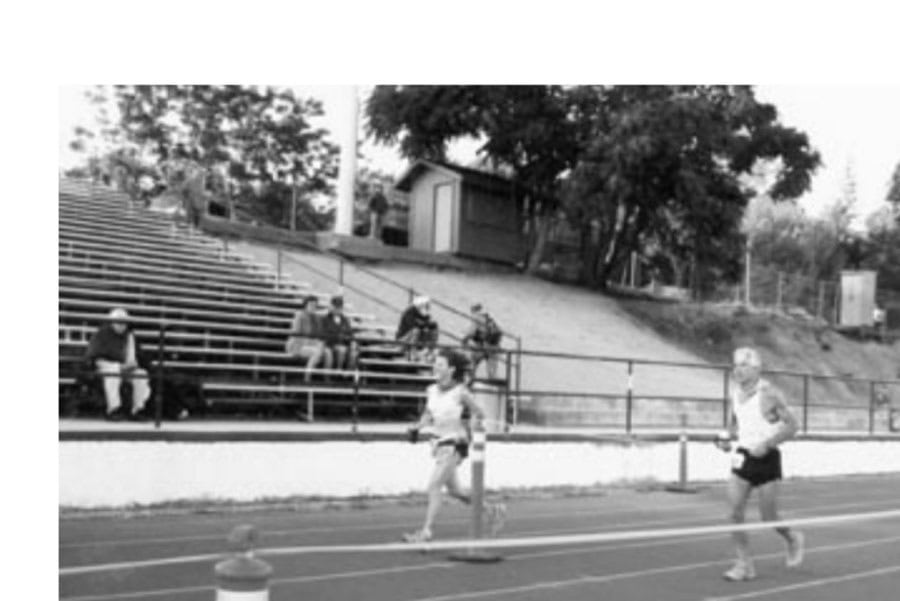
▲ Rachel Toor and the author approach the finish line at Auburn.
Many days later, the finish line pictures would show me smiling as Greg placed the finisher’s medal around my neck and me not looking very good as they took blood samples; but I don’t really remember that part or anything much about the drive back to the hotel. Back at the hotel, I climbed in the tub and took my shoes off; sadly, the nice lady who had taped my feet after crossing the river was a prophet. My socks, the tape, and lots of skin all came off at the same time. It did not matter; blisters have never killed anybody, did they?
GREENVILLE, SOUTH CAROLINA Early October 2004 Many of my running friends ask, “What did it feel like to get where you have been?” The answer is not what they want to hear. I can tell that by the disappointed looks on their faces when they hear me say, “I was pretty happy to be finished, very tired, and now I think I am actually a trail runner.” The WS100 belt buckle is still in the box on top of my desk at home next to my radio. Taped to my radio is a little fortune cookie quote by Robin Williams: “You are only given a little spark of madness. You mustn’t lose it.” My application for the next running of the Western States 100 is already in the lottery pile on a desk someplace in California.
This article originally appeared in Marathon & Beyond, Vol. 11, No. 3 (2007).
← Browse the full M&B ArchiveMore like this
1,000+ stories from 19 years of Marathon & Beyond
The complete archive of the legendary long-distance journal — digitized and free to read.
