

Road Warriors Of Volstate
Sweat, pain, pit bulls, and shotguns— welcome to Gary Cantrell’s old-school ultra. by Susan Reynolds
Heavy clouds hung low in the sky over Hickman, Kentucky. Seventeen runners gathering for the 2009 Last Annual VolState Road Race greeted one another in good humor, their nerves betrayed only by frequently witnessed fidgets: tugging at compression-shorts hemlines or unpacking and repacking small items in a waist pack. For most, the adventure began on Tuesday, July 14, 2009, when they drove their cars through the cornfields to a clearing in the woods at the edge of Castle Rock, Georgia. The cars would stand as monuments to the hopes of those preparing to run 314 miles to reclaim them. Vehicle keys were among the items being packed into those little packs that were zipped and unzipped numerous times as their owners waited for the ferry to Dorena Landing, Missouri.
From Castle Rock, they had ridden in staff members’ cars, sometimes speaking animatedly to newly made friends, sometimes making note of landmarks that would guide their way through 14 town squares. The first night they stayed at a motel in Shelbyville, Tennessee, not far from race director Gary Cantrell’s home.
On Wednesday, July 15, they were driven farther north and west to Union City, Tennessee—the closest place to Hickman with accommodations. Conversations were a little softer as the runners witnessed the miles they would soon cover on foot. It was hot, uncomfortably sticky. They gathered that night at a local restaurant for the “Last Supper,” the prerace buffet meal where they received final instructions, each others’ cell phone numbers, and some affectionate verbal abuse from Gary. Among their number were three kings, men who had run VolState before and had triumphed to win the title “King of the Road”—Dan Thompson (one of the original kings), DeWayne Satterfield (king two times previously, now with a goal that pitted him against the clock), and Carl Laniak (the youngest of the three, now an active member of the race staff).
They ate, they laughed, and they took photos of one another. One, the 18th, had not yet arrived. John A. Price of Virginia Beach, Virginia, was running a double. He had parked at Castle Rock on Saturday, July 11, to run from there to Hickman with the hope of joining the rest for the official start. They had seen John and had stopped to speak with him during the drive to Union City earlier that same day. He was happy for their company, though it was brief. His eagerness for conversation betrayed the loneliness that exists for the solo runner crossing so many miles. Staring out the windows of the restaurant to see the ominous black skies pour forth a torrential rain, some commented on John’s location, speculating on his well-being or lack of same. They could not know that even as they listened to the thunder, John had stopped the first half of his double during that very storm. He found shelter in Parsons, Tennessee, but went no farther on foot that night because a tornado touched down in the very town providing him sanctuary.
Race director Smokin’ Gary stresses not
© Susan Reynolds
John was not among them when early word came that the ferry to Dorena Landing was not running. Gary Cantrell, director of the Strolling Jim and the infamous Barkley runs, is well known for starting his races with the sometimes-unobserved lighting of a cigarette. Nervous glances kept Gary under scrutiny. As would happen more than once in the 10 days allotted for VolState, there was a change of plans. Then the ferry’s crew spotted the crowd in the parking lot and brought the boat to dock. “Are you the runners? We love you guys!”
Many were veterans. Some of those were successful finishers from years before. Four had returned to prove their worth after the road, weather, and their own bodies had defeated them in earlier efforts. Their eyes, perhaps even more than those new to the
▲
Race director Gary Cantrell expounds on the sport of multiday running to listeners at the finish line.
© Susan Reynolds
event, revealed both apprehension and deep determination. When Mike O’Melia (Alabama) dropped at 130 miles in ’08, he was taunted by Cantrell, “All these miles you’ve covered, you’re just going to have to do them again next year when you come back to finish.” Not having to return to face the same miles again was a major motivator for Byron Backer (South Carolina). He had covered 82 miles in ’08 before painful neuromas in both feet took him out.
Cyndi Graves (Texas) had also fallen short in ’08. After 190 miles, one of her legs had swollen to a point where she could have suffered long-term injury. Her failure to complete the course ate at her throughout the intermittent months. Her goal, “I would just like to finish . . . it doesn’t matter to me how long it takes. I’m not racing it. That’s for the others to do. I want to enjoy every minute.” Her words were lighthearted and discounted her competitive nature.
The last of those returning to face an earlier failure was Rich Limacher (Illinois). He managed to make it until late in day two in 2002. The ferry arrived in Missouri, the crowd walked from ferry to land, and then without mention: the cigarette was lit at Dorena Landing at 7:47 a.m. Nervous runners boarded the ferry for the return crossing. The 2009 Last Annual VolState Road Race had officially begun. It was raining.
▲ Mike O’Melia (left) and Byron Backer, having suffered failed attempts at VolState in 2008, knew what was ahead of them as they waited for the ferry.
The rules—Yes! There are rules. Sort of. VolState is a multiday event. It is not a stage race; it is an old-fashioned go-asyou-please race. Runners run or walk as far as they choose on any given day. They stop and resume their runs as they choose. There is no formal registration, though bandits are not allowed. There is no fee. Cantrell is the creator and director of the event, but he refers to it as “the runners’ race—they make the rules and define the event.”
Officially, there are three categories of entrants: aided—the runner has crew providing support; unaided—the runner has no crew; and relay team—two or more runners covering the miles in individual segments (distance of the segments designated by the team members as they go).
There is basically one rule for aided runners: Cover the miles under your own power and on your feet. Aided runners are allowed to ride in their support vehicle to restaurants, stores, and motels, but they must return to start again at the point they accepted the ride when their running stopped for whatever reason. In other words, run or walk the entire course.
Unaided runners have an extra rule or two. They are not allowed to get into or be on any vehicle. The exception is a vehicle belonging to law enforcement. If a runner is requested to accompany a law enforcement officer somewhere, going along with the officer will not result in the runner’s disqualification from VolState. The runner must, however, return to resume running from the point where he or she was first picked up by the law.
Unaided runners may accept food, beverage, and other items from complete strangers, but not from family members, friends, or race staff. One innocent staffer new to the event dared to ask what she should do if she came upon a runner in a thunderstorm. Could the runner take shelter in the staffer’s car? Her instructions from the race director were to, “Laugh her *** off” and definitely not let any unaided runner in her car.
Relay teams sort out their own rules when there is more than one relay team in any given year. In 2009, there was just one team. Patrick Binienda and Peter Emmons (both of the Atlanta area) were hoping to make VolState history by being the first two-man team to finish the event. Previous relay-team success belonged only to teams of four.
All runners are required to call in their locations to Cantrell each morning, usually by 8:30 a.m. Failure to do so might result in a disqualification and at the least would get them in big trouble with the race director. He and other staff members spend the majority of their waking hours in the early days of the race driving up and down the road spotting runners and checking on their progress.
All runners must reach Castle Rock in 10 days, or a full 240 hours. When asked whether any runner had ever run the 10 days and failed to reach the finish
© Susan Reynolds
▲ Together on the ferry, the runners would soon be running with as many as 150 miles of road between them.
line before the clock, Cantrell replied, “No. They either make it or they drop out well before the clock runs [out].” The concept of this race being defined and maintained by the runners brings forth a strict sense of responsibility to the rules. When discussion of the rules came up in an online forum before the race, John Price made it clear that he was running unaided and would therefore decline the offer of homemade cookies throughout his double, both the unofficial run from finish to start and the official run back. His standard was clear: once he started running, his race was on and he would accept no food from any staff member. John showed no timidity in asking the staffer baking the cookies to hold one for him until the finish. The rules are the rules.
The ’Bama boys There they were, standing or sitting in the rain on the deck of the ferry, wondering what the next few days would hold. DeWayne Satterfield (Alabama) already held two titles. His first VolState was in 2002. The course was 270 miles then. He won the title in 4 days, 16 hours, and some odd minutes, the lone finisher that year. He took an entire day off his finish time in 2004 but finished second. By the time he won the crown back in 2006, the course had been expanded to its current 314 miles. His finish time that year was 4:08:39:44.
DeWayne was back in ’09 looking not only to finish first but also to finish under four days. He is a well-spoken man, a mathematician by trade, a runner with a slight frame and an easy wide grin. It has been DeWayne’s habit to run VolState in the even years. He has told Cantrell that it takes him that long to recover. DeWayne was there in 2008, but a kidney stone forced him from the race after 110 miles. He credits the miles run with progressing the stone along.
He was the only one among the racers who had ever won the title. DeWayne gave words of encouragement to others like Mike O’Melia, the other ’Bama boy. Mike was on the four-man relay team in 2007 that finished in 2 days, 19 hours. Mike had returned in 2008 to run solo unaided. He was not successful. His failure haunted him. When he returned home in 2008, without a word to anyone, he tagged his online signature with, “Castle Rock, GA 2009.”
His tag helped him focus for the last 12 months. During a phone conversation on Monday, July 13, O’Melia confessed, “I’m really stressed. I have to stay focused. I have to finish.” With so many exhibiting increasing nerves as the ferry skimmed across the dark, wide Mississippi, DeWayne Satterfield stepped to the center and was introduced by Gary Cantrell, “DeWayne’s got something to share.” With apologies to William Shakespeare, and in a soft Alabama accent, Satterfield began:
This story shall the good man teach his son; And VolState Run shall ne’er go by, From this day to the ending of the world, But we in it shall be remember’d; We few, we happy few, we band of brothers;
For he today that sheds his blood with me Shall be my brother; be he ne’er so vile, This day shall gentle his condition: And ultrarunners across the land Shall think themselves accursed they were not here,
And hold their manhoods cheap whiles any speaks That fought with us in the VolState Run. Silence from the crowd. O’Melia stood with mouth agape, caught by the words and the voice that was both gentle and strong. His friend, his coworker, his king had spoken. The crowd stirred, the ferry landed, and the runners ran.
Dogs and dangers Stories swirl about the VolState of the beasts of the road. Snarling, snapping, charging, the dogs of Tennessee have been immortalized as terrors of the night by those who have run the race. No telling of the event can be complete without
▲
Joe Ninke pulled his supplies behind him in “the thing.”
© Susan Reynolds
dog stories. Before the race even began, some were making preparations. They purchased pepper spray, one carried a pellet gun, and Abi Meadows (North Carolina) mentally practiced “staying calm, crouching down, and delivering a heel strike to the nose.”
The ’09 event was not to disappoint. By the time Joe Ninke reached the finish line (5:21:37:22), the usually taciturn doctor was ready to talk. For the majority of his race, he had pulled his supplies in a Styrofoam cooler bound to a three-wheeled skateboard. The contraption was connected to Joe by a lengthy pole resembling a broom handle and a wide soft-fabric waist belt. It wasn’t enough that Joe was asked by an older lady at a convenience store, “Are you a college boy?” He was also asked for his ID by a local sheriff’s deputy. Apparently there had been calls about a shirtless guy and some “thing” he was dragging behind him.
The “thing” didn’t seem to slow him the first 24 hours. Joe ended day one in the lead with 97 miles. DeWayne Satterfield was somewhat disheartened to find himself second with just 92 miles covered. It would be on day three that DeWayne would pull decisively ahead. Joe’s rig would begin to pull at him, slowing his pace. Joe was the only runner to move with walking poles.
The poles were not in his hands when he was approached by a group of what he thought were cute little puppies. “There must have been a dozen of them. I was tired and bent down to give one a pat on the head. Turned out they were small, vicious terriers. They surrounded me. I was trying to get my poles out to swing around and drive them off, when one charged in and actually bit me on the leg. It didn’t break the skin, but still.”
Mike O’Melia learned in ’08 about the Tennessee dogs. He had a small bottle of pepper spray on his belt. On his second
day, in the vicinity of the McKenzie dog food factory, a pit bull came running at him. “I whipped the mace off my belt and turned to face the dog. When he got close enough, I sprayed him. Had no choice. He was coming in for the kill. No doubt. It got him good. However, the wind was blowing into my face. So it got me good, too. Never had that happen before. Both the dog and I were howling in the middle of the street. Neither could see. My eyes and face burned like hell. Sweating only made it worse. Took several hours for it to wear off.”
Cyndi Graves and her husband encountered the same pit bull. David Graves was Cyndi’s crew. Rather than follow her from some distance in a vehicle, David rode behind Cyndi on a bicycle. Their supplies were pulled in a wheeled baby carrier behind the bike. They had gone far enough the year before to know about the pit bull near the dog food factory. David carried a CO2-powered pellet pistol. “
A small fox terrier was sitting at the edge of the yard barking. Harmless enough, I thought, as we crossed nearly the length of the entire yard without Cujo making his appearance. About that time, I heard it coming around from the backyard and running at full speed toward Cyndi on the other side of the road. I stopped, pulled out the pistol and waited for the monster to touch the pavement. When he did, I let him have several shots. At least three of the first five hit the beast, and he turned slightly in the middle of the road, exposing his flank, which I promptly hit twice more before he retreated back to his side of the road.”
Growing up in Texas apparently had Cyndi very comfortable with guns. When she realized what was happening, she yelled out, “Get him, Honey, get him!” Hatred dripped from every word. “That was a satisfying moment.”
Patrick Binienda of the relay team opted to throw high-pitched “girly” screams at the same pit bull shortly after Cyndi and David’s encounter with the dog. Patrick escaped unscathed. Not all the dogs in Tennessee are vicious. Several runners reported being followed from one town to another by one or more dogs. Keith Woodall (Tennessee) was adopted by two strays outside Hohenwald. They followed him all the way to Columbia (30 to 35 miles). “At first I tried to shoo them off, but when it got dark and late, they were a comfort to me. When I sat or lay down, they would curl right up beside me.” The race happened to occur during a cool spell by Tennessee summer standards. Several runners mentioned that they suffered from the cold nights. At the finish line, Keith gave credit to those dogs for helping him stay warm while sleeping next to them.
Competing with traffic for safe space Many of the runners complained of the traffic. Huge tractor-trailers barreled down the stretch between Huntingdon and Lexington, not more than a few feet from the runners crowding the outer edge of the road’s shoulder. While some felt female
drivers were the worst, Rich Limacher had his own description of the danger presented by the road: “People driving and coming right at you, not really paying attention. Then they wake up and steer into you. Traffic can be scary. The truckers are pretty good. They move over if they can—at least they slow down.”
Most of the people the runners met were generous and concerned for the runners’ well-being. Runner after runner recounted best moments from their time on the road, and those moments usually included kind acts from strangers. Runners were given food and water, watermelon, and even a blanket for one.
Mike O’Melia was spotted leaving a property, a large sandwich gripped in each hand. It was an inviting place with rocking chairs on the front porch. “Some folks exited the place with trash cans as I came by. Always seemed to work out that way for me. I asked (from the road) if they had water and they invited me in. It was then that I discovered the place was more than an office. They had chairs and tables, a small kitchen. They cook dinner for folks during peak travel seasons. That’s how I ended up with sandwiches. They just offered to make them for me. I paid them $5 for all of it, including water and all the Coke I could drink!”
Unfortunately for Mike, not all his human encounters were so positive. He had foot pain the entire race. At mile marker 22 between Parsons and Linden, Mike spied a large, flat rock that had shallow, clear water flowing over it. The source of that inviting water was Coon Creek. Mike went to the rock and the creek to take his socks and shoes off to soak his feet in the cool water for a bit. His feet were luxuriating in the soothing flow of the creek when he “just got a feeling.” Mike quickly put his footwear back on and headed down the road. The feeling was still strong, and he turned to look back at where he had been. There stood a “huge hairy gorilla of a man.” The man was standing exactly where Mike had been sitting just brief moments before.
Mike was shocked as the man turned and fired a shotgun over Mike’s head. The man screamed, “Yeah, that’s right! I’m talking to you!” With that, Mike ran. He spoke later to a deputy about the legality of the circumstances, wanting to make sure he had broken no laws by sitting in that location and soaking his feet. Mike had not. There is no accounting for some people. The deputy said he would look into the situation. Mike moved on.
Running across history Over the years the VolState route has migrated many times. The original run was in 1986 and was from Kentucky to Alabama, while 2009 was the third year for the route from Dorena Landing to Castle Rock. Like most races, statistics and records have accrued with the years. The course record for the fastest solo finish was 4:08:39:44. It was held by DeWayne. The record for the slowest finish was held by Rita Barnes (Ohio), who recovered
from a serious bonk on day four in 2007 to be the second woman ever to finish VolState. Rita’s time: 9 days, 2 hours, and the odd minutes. Gary told the crowd at the Last Supper his prediction that both those records would fall.
This was the year that history could be made. There were 16 solo participants taking the start in July and the two runners for the relay team. John Price was not at Dorena Landing, but the tornado of the night before convinced him that finishing the double before the clock stopped was now impossible. After the rest of the field was moving across the eight miles from the ferry landing at Hickman to the next town of Union City and beyond, Gary drove south and then east to Parsons to retrieve John. The runner was driven to Hickman, where he officially began his run of VolState ’09. John, ever the stickler for the rules, started eight hours behind the rest of the field but held himself accountable to the official race clock. He ran determined to best his previous time and to finish in good standing in spite of the eight-hour delay.
With 16 solo runners, the ’09 field matched the largest field the event had seen in the recent past. It was back in the late ’80s that 16 others took the start. It wasn’t until 2002 that Cynthia Ibarra became the first woman to finish VS. With knowledge of DeWayne’s ambition to beat a four-day finish, there were whisperings of “history in the making.”
Fitting into that same category were Patrick and Peter, the two men of the relay team. There is no clear reason why other two-man teams had failed in the past, but speculation was that since one had to crew while the other was running, team members simply couldn’t get enough rest when there were just two of them.
As historic as the ’09 VolState had the opportunity to be, the roads themselves took the runners through areas rich in history. It’s hard to drive down a road that connects towns in Tennessee and not see a historical marker. They provide information on many aspects of history—famous citizens, important events, the reasons for different counties’ names.
Newcomer Richard Burrell (Florida) took the opportunity to read as many markers as possible. During a rest break, he wandered through a small cemetery to discover the gravestone of a young man born in 1841, deceased 1864, a son of the South likely claimed by the Civil War.
The road between Huntingdon and Lexington has four driving lanes and a turn lane. Traffic is heavy, the landscape uninspiring for the most part, and it’s loud, very loud. Just before the VS route crosses Interstate 40 is Parker’s Crossroads. If the runners happened to glance to their left as they ran through the area, they might have been surprised to see a cannon sitting on the green. Parker’s Crossroads was home to a battle during the Civil War.
The gist of the battle: the Confederates were whopping the Union soldiers, and surrender was being negotiated. Unknown to the generals, a full brigade of Ohioans arrived from the north. The signboards at the site refer to the “fake surrender,”
but history bears out that the fellas from Ohio arrived with no warning and no notice even to the Yankees who were giving up. The result: the Confederate troops suffered heavy losses and discovered themselves between two Union brigades. The Confederate general in command exclaimed, “Charge in both directions!” That general from over a century ago knew what he was exhorting his men to do—whatever was necessary to get the job done. It could have become the motto for those battling it out on the modern roads.
The man who would be king By the third day, VolState 2009 saw its first casualty. Marv Skagerberg (Colorado, 71 years old) dropped just shy of Huntingdon. He was suffering from blisters and even more from back pain caused by his pack. Marv summed up his experience, “It’s an adventure run. My best moment was that first night was when I figured out how to relieve the back problems by laying down on the ground for 15 minutes every so often. I loved being alone and running at night. It’s a heck of a race. I’ll be back next year, but aided.”
Early in the fourth day, Abi Meadows and Frederick Davis III were both gone. New to VS, Abi started unaided, but her mother arrived to give support on Saturday. Sometime on Sunday, Abi, who had been the leading female runner, suffered an injury and was forced to abandon the race. Frederick was doing well. He covered over 70 miles in the first 24 hours, but he had a plane to catch on Monday and simply ran out of time.
Three were gone. In the meantime, at least 150 miles ahead of the last runner still on the course, DeWayne was moving hard and fast. He was now painfully aware of the clock, pushing to finish inside that fourth day. Runners sleep where and when they want to. James Morris, DeWayne’s friend and crew, was keeping close watch on his runner. Somewhere early in the run, DeWayne slept a few hours in a motel bed. Then he ran with only 15-minute power naps to sustain him. James, acting from experience and a deep desire to see DeWayne meet his goal, felt it a mercy when they reached the railroad crossing at Wartrace to find a train stopped on the tracks blocking the road. James persuaded DeWayne to sleep in the car. After three hours, DeWayne was up and running once more.
He was a focused man. He ran listening to music on his MP3 player. Sometimes he ran without manmade music but soaked up the soul music provided by the katydids and the deep-throated bullfrogs. He ran to make history, and he ran to the mountain where he was raised.
Born to teenage parents, DeWayne was delivered to his grandmother and grandfather for raising when he was 16 months old. “My grandparents never ‘told’ me I was their real child. I always knew they were my grandparents . . . I also was smart enough to know they were really my parents. They were quiet,
unassuming, uneducated, brilliant, peaceful, poor, stoic, reverent, hardworking, subtle, unashamed, hard, fair, but above all dripped with unconditional love and acceptance.” They raised him on their acre farm on Sand Mountain, the same mountain that is home to Castle Rock, Georgia.
From Wartrace down the Walking Horse Parkway through Manchester and Pelham he ran. It was in the 2006 race that he ran until he was “stumbling along toward the small town of Culleoka (around 190 miles) . . . exhausted and mentally drained, I stopped to let a car pull out before crossing the driveway in which he was sitting. I waved the driver on, and he just looked at me. I waved him on again, somewhat frustrated. After standing there for a minute, I walked in front of him half-expecting to be run over. As I passed in front, I noticed the For Sale sign stuck in the windshield. Although I knew I had seen the guy, I was actually in a standoff with an empty vehicle.”
That was in ’06. It was three years later, and DeWayne was now pushing himself.
Down but not quite out DeWayne crested the mountain at Monteagle and started the agonizing descent into Jasper. He was painful to watch, weaving and wobbling down the hill with the glazed look of a man with nothing left. His legs spent, he crumpled into the fetal position at the edge of a church’s parking lot on the outside of Jasper. DeWayne just missing cracking his head on one of the boulders decoratively placed to define that lot. He eventually rolled to his back and propped his feet on the rock. James hurried between the runner and the car, bringing DeWayne whatever he needed to help him keep going. Nutrition would soon be in order, so while DeWayne collected himself and got back on his feet, James drove down the road to Kimball to scout fast-food joints. A list of places available would be recited to DeWayne so that he would have time to ponder a while before deciding what would best suit his tastes and his needs when the time came to eat.
Not very long after his collapse, DeWayne was able to down a burger and a bowl of chili. He crossed the Tennessee River just outside South Pittsburgh and headed toward the familiar climb up Sand Mountain. The mountain greeted the man, and the man who had wobbled into Jasper ran up the mountain. He was running into his past and into the record books. He arrived at Castle Rock, where Gary and Carl waited on the rock (a finish time is called after the runner touches the rock). It was important they were there; a step beyond the rock is a step into open air with a 300-foot drop below. DeWayne arrived and sat a spell, then was helped from the rock. It was well past midnight, but it was still in the fourth day from the beginning. He finished in 3:17:42:12. A course record had been set.
© Susan Reynolds
▲ DeWayne Satterfield, just hours away from a record-breaking finish, first had to recover from his collapse in Jasper.
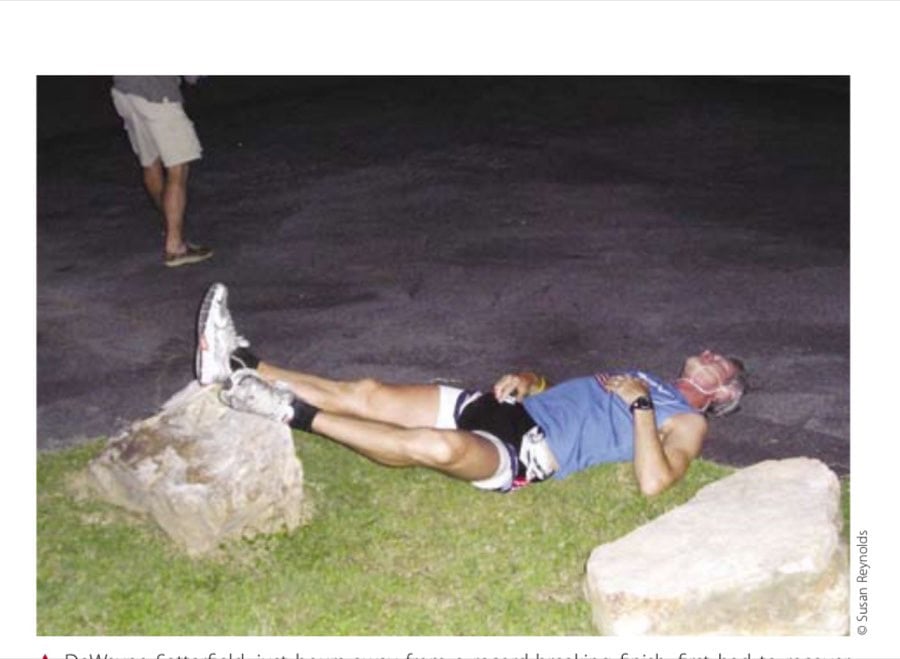
To those gazing at him with admiration, he looked pretty whipped. James described DeWayne’s appearance as something of a “science experiment.” Relieved to be done, the king who once had been a pauper related tales from the road. “
I left a small town heading up a steady climb when a vacant-eyed, stringyhaired lady with brittle-looking teeth pulled her dilapidated car beside me. I’m not saying that she had a problem which would require an intervention, but I did recognize a few telling signs. Perhaps she saw a kindred soul . . . here I was, gaunt, smelly, strolling down the side of a road for no apparent reason. She smiled and said, ‘Hey, you walkin’ fer fun or do you want a ride?’raising her eyebrows at the end of the question. I smiled back and sheepishly told her I was walking for fun. ‘OK then.’ She shrugged her shoulders and drove away.”
Those assembled around the tired runner listened for close to an hour. Then James stepped in and claimed his runner. It was time to return home, where a shower, family, and a bed awaited him.
They came to the rock It would be two days before the next finish. Runners battled traffic, fatigue, pain, injury, the need for nutrition and hydration, and even loneliness. David Graves was approached by some teenage boys in a car who offered him their half-eaten
chicken nachos. They had assumed that David was homeless and needed the food more than they did. Byron Backer experienced his lowest moment between Columbia and Lewisburg. He simply “ran the tank completely empty.” He struggled through the bonk brought on by lack of nutrition and took 16 hours to cover six miles. He walked through the night. “I finally staggered up to the Huddle House. I just stood there in a daze, too confused to know whether I was supposed to go in or what I was supposed to do. The place was empty, but a man and a lady (cook and waitress) saw me outside and walked over to the door. They seemed to be beckoning me to go inside. Thankfully, there were laminated pictures of food on the table, and I managed to point at what I wanted (everything). While I waited for the meal, I staggered over to the restroom. Looking in the mirror, I had one of the biggest shocks of my life. ‘Is that really me?’ Then I noticed that I was wearing two large trash bags. It was freezing that night.”
Time and miles rolled by. By the sixth day, there was another casualty. Richard Burrell suffered a foot injury serious enough for him to drop out. He arrived at the finish line with Gary, helping mark the route through the cornfields and the woods. Richard was disappointed but also practical. His decision to stop was a moment “when my brain had to override my heart.” He, like Marv a few days earlier, felt that the best way to approach VolState would be to “come crewed.”
Different people have vastly different priorities Though many resembled walking wounded, they never lost their competitive spirit. New goals surfaced and strategies came into play. Keith Woodall had temporarily dropped a few days before. He was suffering from pain just above his ankle as well as the blisters that plagued so many of the others. At a low point when he had no cell service to call home, Keith asked for a ride to the next town so he could call home to say he was pulling out. Keith spoke with his wife, Tish, and then asked to be taken back down the route to find Donald Brown, who was crewing for
Don Winkley (Texas). Keith lost a water bottle somewhere along the way, Donald found it, and Keith wanted to retrieve it while waiting for Tish to pick him up. Veteran road warrior Don Winkley took one look at Keith’s ankle and shin and pronounced them “classic shin splints.” He told Keith that if Keith would keep at it, they would feel better in three days. Don forgot to mention that the three days would start after the event, but Don’s words—coupled with the call home and several text messages from friends encouraging Keith forward—were enough to give Keith a change of mind. He called Gary and announced that he would return to the race at the spot where he had accepted the ride. It is not against the rules to change from unaided to aided, and so Keith Woodall was back in the race in a new category.
Not only was he back, but he was racing his way to the finish line. Tish and one of their boys, Josh, arrived to provide support. Keith’s competitive nature and his cunning surprised Cantrell. Keith knew DeWayne had already finished, so Keith determined to finish second and under six days. He knew Dan Fox (Ohio) was not far behind him, so Tish was sent up and down the road regularly to scout other runners’ locations.
One very early morning in what was actually the dark of night, Tish was driving Keith to his drop-off point. Keith was stunned to see Dan running smoothly down the road. Keith had hoped to start the day’s miles slowly, walking until he had a handle on the pain in his leg. They had just passed Dan when Tish announced they were at the place Keith needed to leave the car and start moving on his own; it was less than half a mile from where Dan was running.
Keith asked Tish to not use any turn signals and to turn off the vehicle lights when they pulled over. He didn’t want Dan to realize a runner was just ahead of him. Keith also wished Tish and their car complete anonymity. He knew Dan
© Susan Reynolds
▲
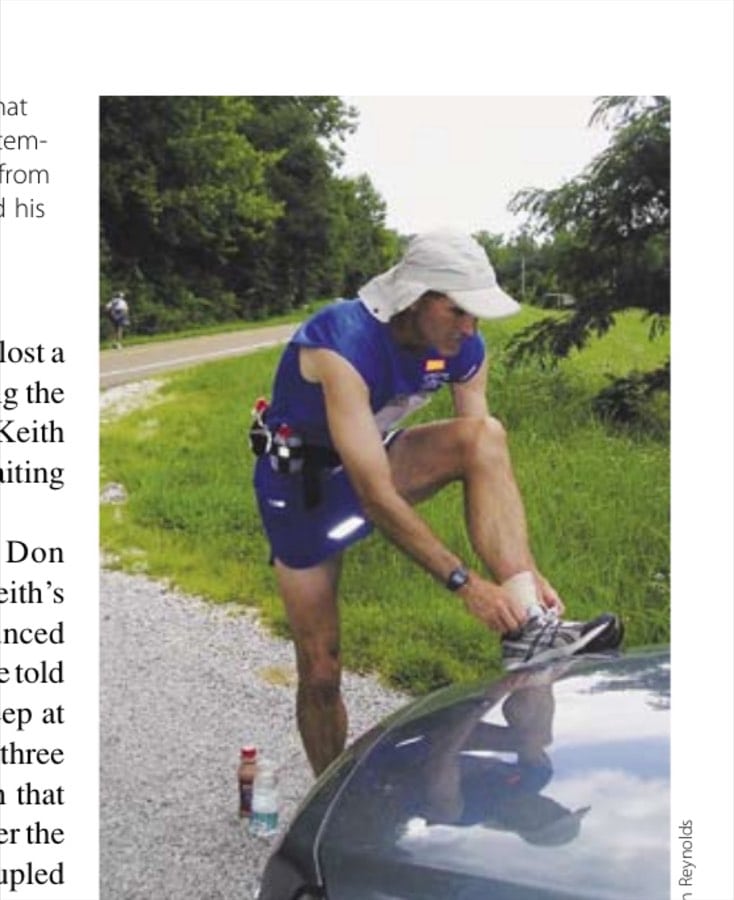
Overcoming painful injuries that led him to drop out of the race temporarily, Keith Woodall changed from unaided to aided and strategized his way to Castle Rock.
was serious competition, and the best way for Keith to finish ahead of Dan was to do so with stealth and with speed. He left the vehicle and ran for hours. The strategy worked. Keith Woodall, in his first attempt at VolState and at such a distance, finished second with a time of 5:11:22:14. He had blistered feet, shin splints, and a trashed quad from the downhill miles out of Monteagle, but he came in under his own power. As he sat and mused on the experience, he defined VolState as “a 314mile experiment in pain management.”
Cantrell, on hearing the story of Keith’s slipping past Dan, said, “For a first-timer, he was very smart.” Dan (another first-timer to VolState) arrived less than an hour later (5:12:19:11). He set a course record for an unaided finish. His words at the finish: “That hill at Monteagle—I don’t want to do that anymore.”
The day didn’t end there. Keith and Dan finished on the edge of twilight. The night was soon dark. When the two competitors left, the staff settled into sleeping bags on the ground or in vehicles to nap until the next runners arrived. Around 1:00 a.m., a flash of light stirred them; a headlamp was shining through the trees.
Children of the corn—and the cookies It was Byron Backer. He had missed a turn inside the gate to the farm at Castle Rock and had been wandering, making tracks through the cornfields. The wrong turn nearly cost him his race against John Price, who arrived 10 minutes to the second behind Byron. There was no mistaking John’s arrival. He had slipped in a deep mud puddle in the woods and came in cussing mad. After touching the rock, John plopped onto the ground next to Byron and without a greeting asked, “Where’s my cookie?” The last two cookies, by now somewhat dry, were handed over and consumed without further comment. Both men finished under the previous course record for unaided runners (5:16:35:20 and 5:16:45:20). Two slight differences: John started on the official clock eight hours behind everyone else, and his mileage totaled 521. He had added a couple hundred miles or so at the front end of his week with the attempt at the double.
© Susan Reynolds
▲
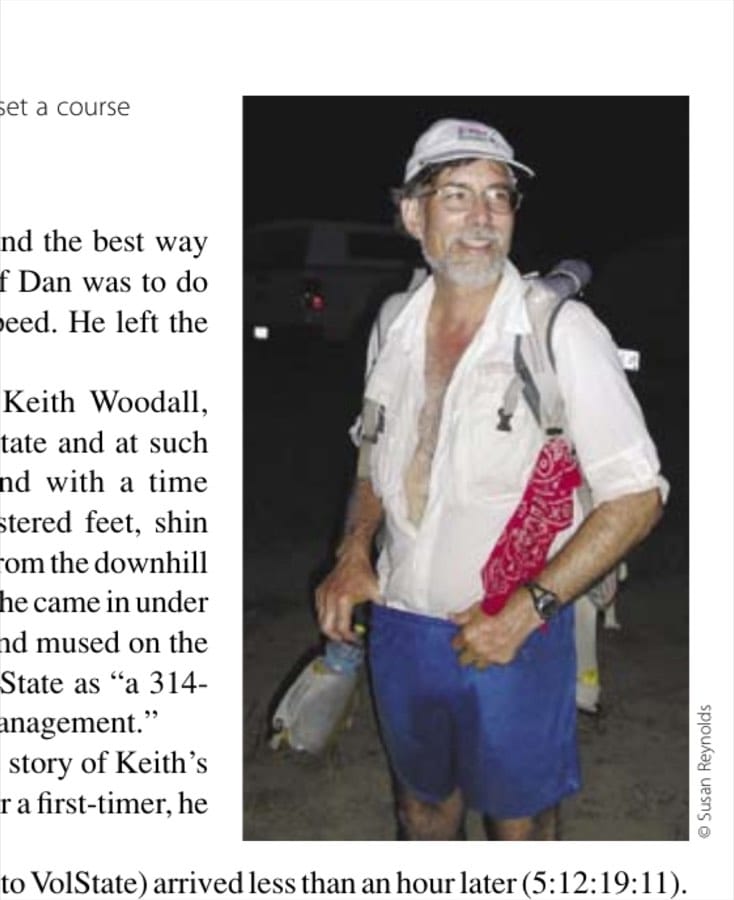
VolState first-timer Dan Fox set a course record for an unaided finish.
John eventually headed back down to a motel in Kimball, Byron tried to sleep in his truck but suffered from the inability to find a comfortable position, and the staff settled in for another nap. Joe Ninke was on the way. Joe arrived in the early hours of morning. He had long since abandoned his Styrofoam cooler and skateboard rig. When Byron arrived at the finish, he spoke of seeing one of the wheels conspicuously placed so all who came past would notice it. Joe admitted placing the wheel, hoping to distract those behind him for even a few moments. He also destroyed the rig so no one could salvage it for whatever purpose.
Joe’s arrival (5:21:37:32) ended what was close to a 24-hour run for him. He had left Manchester around 5:00 a.m. the previous day. Dropping the cart helped his legs improve significantly. Joe sat and entertained the staff with various stories of the road, but he refused to remove his shoes. They stank way too strongly for even Joe to endure. One of his secrets for survival: to buy all the Benzocaine he could find along the way. That way he had it all in his possession and none was left for anyone else. He also found it expedient to squeeze pain ointment onto his feet through his shoes so that he didn’t waste time—thus the pungent aroma wafting forth from his footwear.
On Wednesday, July 22, the first two-man relay team to ever finish VolState arrived together. Their time: 6:03:21:47. Their plan had worked. Patrick covered about two-thirds of the miles and Peter the other third. They had run steadily with the goal of finishing rather than pressing against the clock. They spent time with other runners and staff, ate well, slept well, and were basically without injury. One of Patrick’s knees was covered in what looked to be poison sumac or poison oak, the result of a visit to the woods when nature called. The two friends were quick to give credit to the other. “My fighter doesn’t sit between rounds,” Peter summarized. Patrick thoughtfully spoke, “I can’t imagine being totally alone, not having contact, if I had to say, ‘It’ll be 12 more miles before I see that convenience store, and hopefully it’ll be open.’”
The pair visited with those gathered and then turned to walk back through the woods and between the cornfields to their car. Even before the cigarette was lit, there had been friendly debate about strategy and endurance in a multiday event. The underlying question was an effort to determine which is harder: running all out and finishing as quickly as possible (as DeWayne did) or moving slower and enduring more days on the road? Having listened to the discussions, Gary finally interjected, “They’re both worse. Multiday ultras are the only sport where going slower doesn’t mean less pain.”
And then there were the ladies—and the ice cream Four days remained, and records had already been set, history made. Those “still out there” continued to struggle on. Don Winkley and Scott Maxwell (Florida)
▲
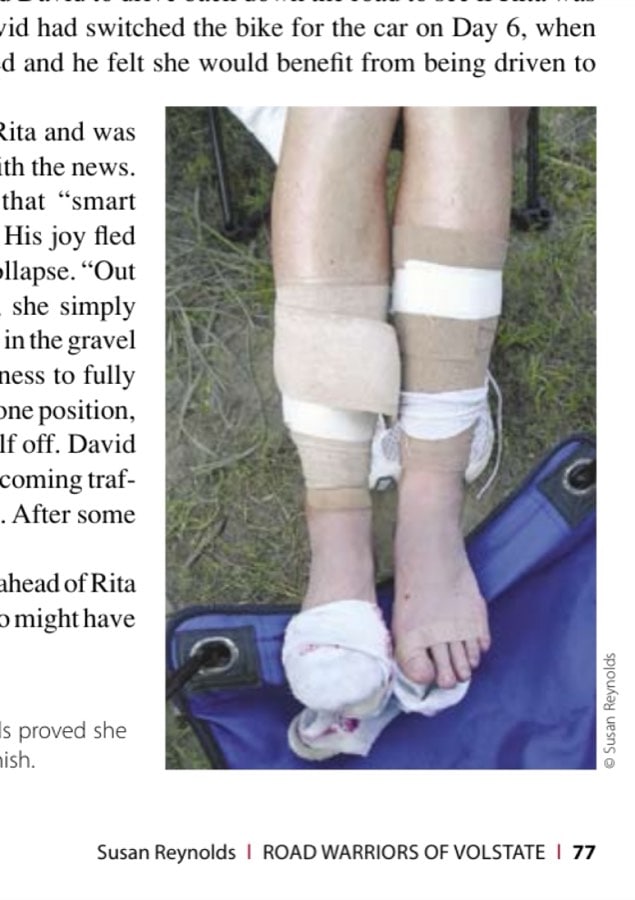
Cyndi Graves’s battle wounds proved she did what had to be done to finish.
© Susan Reynolds
finished without drama or incident. Others fought to finish. The battle of the ladies paralleled the Battle of Parker’s Crossroads—they did what they had to do. Cyndi Graves had been in agony for days. Both legs wrapped in Ace bandages, suffering blisters and covered in heat rash, her pace had slowed over the previous days. Behind her, veteran finisher Rita Barnes was steadily approaching. When Cyndi went to bed in the evening of Day 6, she asked David to set the alarm for 2:30 a.m. It was when he bandaged her legs in preparation for the day’s miles that he realized her intentions. “She was prepared to go the final 40 miles to the finish that day. I had secretly wished that with four full days left, she would slow her pace and protect herself, finishing with a respectable time and all of her appendages intact. These proved to be false hopes as there was never any ‘coast to the finish’ within her.”
Cyndi descended the steep, 3-mile curving road down the mountain from Tracy City. She was forced to make three-quarter turns from left to right and right to left regularly to relieve the stress on her shins. She had been primarily walking for days. Hobbling forward, the three miles into Jasper took more than an hour.
Her pace picked up some. She made it through Jasper, then Kimball, then across the bridge, and finally Sand Mountain loomed before her. Worried about Rita’s location, Cyndi asked David to drive back down the road to see if Rita was about to overtake her. (David had switched the bike for the car on Day 6, when Cyndi’s condition worsened and he felt she would benefit from being driven to food and lodging.)
David couldn’t locate Rita and was happy to return to Cyndi with the news. He had admitted earlier that “smart money would be on Rita.” His joy fled at the sight of Cyndi near collapse. “Out of water and nourishment, she simply wanted to sit beside the road in the gravel and wait for her consciousness to fully return.” Cyndi slid into a prone position, half on the shoulder and half off. David stood in the road waving oncoming traffic around his downed wife. After some moments, she rallied.
She finished 43 minutes ahead of Rita Barnes (Ohio, unaided), who might have
taken Cyndi on Sand Mountain if Rita had not suffered a wrong turn in Jasper and landed at a Dairy Queen. She simply could not resist the call of ice cream at D.Q. Both ladies finished in under seven and a half days.
DeWayne, now recovering, was undeniably king. The other ’Bama boy, Mike O’Melia, was still on the road. He was inching his way forward, moving at such a pace that Carl Laniak coined a new word to describe his movement. To “omeliate” is to move forward under your own power as slowly as humanly possible and still progress.
Those waiting at the finish line for Mike on day nine heard from someone newly arrived that “Mike is at the bridge.” Nearly a half hour later, word came in, “Mike is just beyond the bridge.” Yet another 30 minutes and “Mike’s a bit past the bridge.” At one point, he was walking and his feet were clad only in flip-flops. His last 11 miles took 4 hours, 35 minutes to complete.
When Mike did emerge from the trees and touched the rock, he turned to Gary and said, “I’m never going to do this again. I will never put myself through this again.” Then Mike sat and words poured forth: “It took everything I had to get past everything that was wrong, which was a lot—mainly my feet.”
Cantrell replied, “Just wait for when the feeling comes back; it’ll feel great!” Mike said, “Oh, there’s plenty of feeling . . .” Mike’s best moments were visiting with people along the way. He laughed about the old codgers in some cafe or convenience store who last year were embattled (50/50 split) over national politics. One of them vaguely recognized Mike when he reentered their midst and joined in their conversation. He reminded them of their political debates of ’08 and was much amused in that now they were united (100 percent) in their opinion of the new administration. Times are hard in Tennessee.
Mike meets the folks He spoke gently of the older lady who had a produce stand that also sold an odd variety of things, something of a permanent garage sale. A little girl was fluttering about the place. She was introduced to Mike. “Her real name is Haley, but she calls herself Hay-Hay.” Little Hay-Hay’s birth parents were or are both meth addicts. They abandoned her some time ago. Mike took the time to be introduced to her animals, “Big Dog” and “Little Dog.”
Mike spoke of dogs, he spoke of shotguns, he spoke of sandwiches and kind people, and then he spoke of chafe. Apparently he had not expected the extreme discomfort he experienced in the early days of his run.
Then he discussed injuries. The man did not hold back. When asked whether the pain was comparable between this year and last, some 10 minutes later the
answer was still unclear, but those listening knew everything that was hurting Mike, all about the hole in his foot from ’08, what he had learned to do differently for his feet, and why he wore flip-flops for several miles.
Mike continued with a vivid, wildly funny description of what happens to inner-thigh and nether-region hairs when caught in miles and miles of rubbing. The visuals went from knotted little twists to ones gripping each other from opposite thighs so that each step caused intense pulling of hairs on both legs. “When I stopped to inspect and study the basic anatomy down there, I found braided pigtails; all that was missing was the bow.”
He shaved. Everything. He was not hesitant to tell his audience. When he started his race, he wore compression shorts under regular running shorts. Once the chafe started, he tossed the compression shorts. He was forced to eventually tear out or cut away the liner of his running shorts. Carl interjected, “Ah, a ballswinging VolState run.”
But it didn’t end there. Apparently Compeed bandages available at Walmart come in 2-by-3-inch size. Once the liner of his shorts was gone, Mike built a little bridge of Compeeds (three stuck end to end). He simply slapped one on the inside of one thigh, tucked the middle right up under, and stuck the other end on the opposite thigh. Oh, the pride on his face when he said, “Now that is the trick . . . works great!”
Mike acknowledged that losing the compression shorts and the liner of his other shorts enhanced his ability to stand and read his maps while peeing by the side of the road. You should be able to figure this one out without further explanation.
The end of the road Gary Cantrell’s prerace predictions that both the fastest and the slowest finish times would
fall in ’09 proved to be correct. Where DeWayne set the standard high for those who come with speed, Rich Limacher was the last to arrive at the rock with just over 11 hours to spare. He took 229 hours, 47 minutes, and 18 seconds to finish his race. The thing is, he finished.
They came to run in a race that is of the runners, for the runners, and by the runners. In a time when most are hard pressed financially, this is an event where the runner has control over how much it costs. There is no entrance fee. Don Winkley donated small American flags that were worn instead of bib numbers. In most regards, the race is a “fat ass” event. Aid stations are whatever source of nutrition and beverage the runners can find. Joe Ninke pulled his supplies behind him on a skateboard. Others were crewed from vehicles, and runners like Byron Backer walked through the night to survive long enough to refuel.
The route was chosen so that accommodations would not be unrealistically far apart. Many came prepared to sleep in the woods. Church yards and cemeteries are recommended as good places to rest. The latter, especially, because according to Cantrell, “There’s usually a wall to offer some privacy, and there’s usually no one around to bother you.”
They were all beautiful when they finished, though they each looked like a science experiment. They suffered, they laughed, and they endured. Some came in order to finish where before they had failed. Others came to see if they could do it. Fears were faced and conquered.
James Morris, DeWayne’s crew, said, “DeWayne has the same demons as everyone else. He just keeps ’em backed better.” They all pushed back those demons. They returned to their homes, to their families and friends, to be pieced back together. It is no slight task to help those returning from so long on the road to recover. Tish Woodall said, “The least favorite part of the race for me was the recovery. First chance I get, I’m throwing out all tubes of muscle rub, for that smell is getting quite annoying. You open any door in our house, and you can smell it in every inch. A tub for foot soaking and a heating pad seem like permanent fixtures to our couch. I look forward to reclaiming my largest stock pot for food rather than feet.”
The answers to why and how they do it may best be found in David Graves’s comment: “I hope to never again witness my wife drive herself to the brink, being torn, wanting to yell for her to stop, but knowing she would not, could not, stop herself . . . I was indeed the über enabler—allowing, encouraging, pushing, and protecting my addict through to the end . . . for now.”
There are those among them already making plans for their return next year. Mike O’Melia is one: “Don’t tell my wife, but I am already formulating a 6-day run for next year. I am one sick person.”
This article originally appeared in Marathon & Beyond, Vol. 14, No. 4 (2010).
← Browse the full M&B ArchiveMore like this
1,000+ stories from 19 years of Marathon & Beyond
The complete archive of the legendary long-distance journal — digitized and free to read.
