

Run Long, Walk Short,
At the 2004 Napa Valley Marathon, where I was part of the marathon college, a day-long series of seminars and round table discussions staffed by marathoning VIPs, Dick Beardsley and I discussed our current training regimens. Dick had been interested in my training method and had kept up with my running achievements. He suggested that I might share my way of staying fit and injury free with our running brothers and sisters, especially those who cannot sustain high-mileage training.
Dick, of the famed “Duel in the Sun” with Alberto Salazar at Boston in 1982, had made a comeback in recent years from a terrible farm accident and addiction to painkillers. He knew also that I had come back to racing well from a broken hip (the result of a bicycle accident) in October 1997, which required a pin, plate, and screws that are still in place in my hip. The Napa Valley Marathon, on March 7, was celebrating its
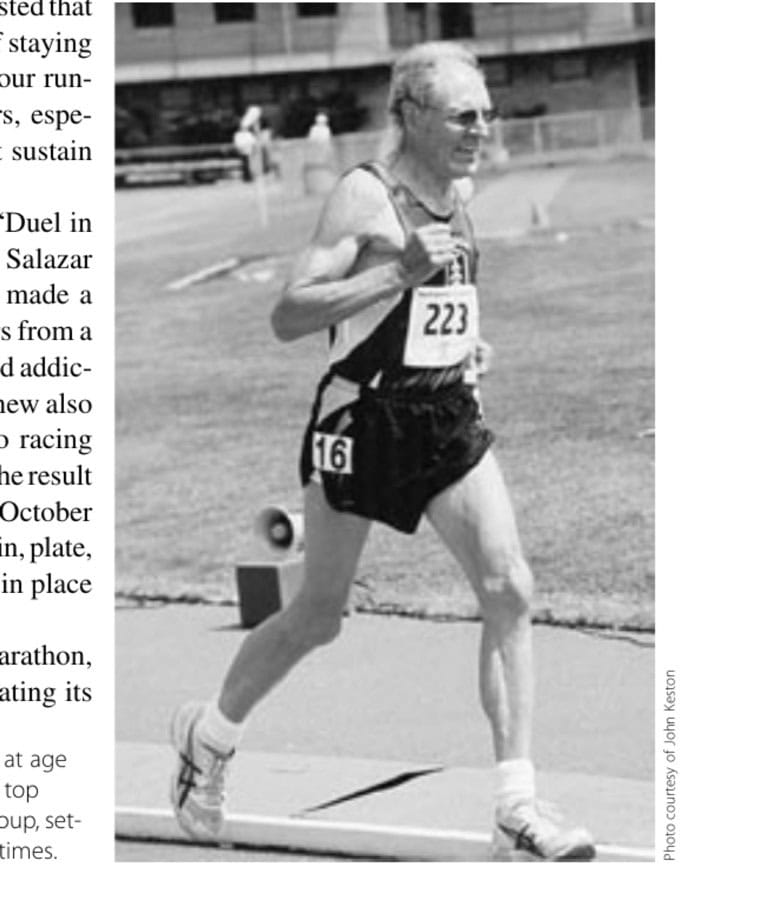
Since taking up running at age 55, John Keston has been a top ranked runner in his age group, setting many record and best times.
Photo courtesy of John Keston
A26th year and had opened the field to 2,200 entrants. There was a full complement of runners. Many attended the seminars offered by famous runners and writers in the marathon college on Saturday, the day before the race, where they heard experts propound training methods, tips on completing the course, and the various dos and don’ts.
The predominant recommendations were go out slowly, hydrate (but don’t overdo the water), stay relaxed, and hook up with someone attempting a similar finishing time. Camaraderie is helpful along the way.
At the seminars, at chance meetings, or at the marathon expo, various race officials and seminar participants asked whether I was planning to run the race. My reply each time had been: “Well, I’m not in shape at this point to run a marathon, but I’ll see how I feel tomorrow.” I was truthful in my explanation that I was not marathon race ready, but I had that always-optimistic runner’s sense that I could do it.
FOLLOWING MY OWN ADVICE My running base had been established years ago. All I would have to do is what our panel (including myself) had prescribed for the runners of this year’s race: go out slowly, pick it up easily, hydrate, and stay relaxed.
I would have to be at the start line anyway because I was to sing the national anthem just before the start of the race. I had now done this seven years in a row. Rich Benyo, the president of the board of the race, had assured me that I did not have to run the race. “Whatever you do, John—run it or not—is OK with us. You’re here to have a fun weekend.” Late Saturday evening, I did tell Rich and a few others that I would try to run the race the next day and went to bed early wondering about my fitness. I had run a 15-miler one week before Napa, my longest run in six months.
Sunday morning, race day, I rode the bus to the start in Calistoga. I walked, jogged out along the course about a mile total, mainly to warm up my singing voice, warbling scales as I went along and out of earshot of the gathering racers.
At 6:55 A.M., I sang “The Star-Spangled Banner,” then made my way to the start line, four rows back. When the starting siren went off, I set off with the others. I started at a pace that was very slow for me—about a 9:00-minute pace—and then gradually picked it up. At 79 years of age, I finished in 3:43:50, a new singleage world-best time, beating the previous best of 3:49:28 held since 1987 by Ed Benham. I was delighted with my time and record, as were all of my dear friends and the organizers of the race. I had accomplished a similar feat the year before at Napa, running at 78 years old a single-age best of 3:36:41. At 77, I had run the Bend Marathon in 3:19:01, to be the oldest runner ever to break 3:20; and the
year before that, at the Portland Marathon, I had become the oldest runner to go under 3:30, running 3:22:59. All these races I had run with no injuries, using the new training regimen that I had devised for myself. I had not told any of the runners at
the Napa Valley Marathon seminar about my current training methods because the subject was not on the agenda. What Dick Beardsley suggested was that an article about my training might be an interesting discussion for readers of Marathon & Beyond.
Training plans are published in every running magazine just about every month, and the emphasis is usually on how to be faster and achieve or better one’s goal. My training premise is to enable continued strength, fitness, and pleasure in running forever.
MODIFYING AN ELITE RUNNER’S PROGRAM I used to read and take for gospel everything anyone ever wrote in Runner’s World when I took up running at the age of 55. I got the occasional injury because I was mostly running workouts for runners of the elite age group. The most devastating running injury and longest to heal was a groin evulsion that occurred during a 10-kilometer race after I had run several marathons, all under three hours, in the 60-64 age group.
It was intense to say the least. A piece of bone was torn from the pelvis by supertight ligaments, and even though I got back to running in about seven months, I was not pain free in that area until three or four years had passed and I was racing well again.
Subsequent years, from 65 on, I became top ranked in my age group and ran many record and best times. In my 70s, a year before the bicycle accident, I had modified my training to running long one day and jogging short the next. Long runs were from eight to 16 miles (although I would do only one really long run during the week) and my jogs were done in two sessions of three or four miles in the A.M. and two or three in the P.M., making my jogging days six miles total.
I maintained 45 to 55 miles a week with this regimen. Race weekends, I would modify the previous training days so that I would not do a hard workout two days before any event. With this regimen, I felt that I was merely plodding and not being as dynamically race fit as I had expected. I hated running slowly and had always taken umbrage when any nonrunner would ask, “Oh, you’re a jogger?”
But here I was, jogging to improve my running. The bicycle accident necessitated a totally different approach to running and competing. I wanted to be in the sport for the rest of my life like some of the veterans 90 and older: Paul Spangler, Ed Benham, and others. Paul and Ed are since deceased, but their running feats are legendary.
Getting to the point of this treatise: “We can run into extreme old age.” With body-saving training techniques you can keep cardiovascular, musculature, and skeletal components in tiptop working condition and remain injury free while racing dynamically and attaining personal bests through and into each new age group. My idea to achieve this begins with an explanation of my current training method developed from an enlightening discussion I had with my son Philip in January 1998.
He had been a water-skier with the British team. Something he explained to me made a lot of sense, especially since I was recovering from the broken-hip surgery of late October 1997. We were talking about superathletes of all disciplines, and Philip had asked me about my routines. I told him that I ran every day and that I did speed work twice a week. Some days were easy and some hard. I was following those old Runner’s World workouts still but on a less-intense scale.
APPLYING BODYBUILDING THEORIES Philip told me that to be strong and to sustain the strength and flexibility he needed to accomplish water-skiing speed jumps off the ramps, where skiers leap 100-plus feet, landing upright at 30-plus miles per hour, he had to work out with weights. He further explained that bodybuilders and all serious weightlifters never work the same muscle hard, except every 72 hours, because that muscle or group of muscles should have time to heal from the exertion and stress, repairing microtears and adding new muscle fibers.
I knew about the premise, but I had never associated it with my running. All of a sudden I found myself thinking clinically and analyzing the regimens that had been my norm for years. Because of the successes I had had collecting several age-group records and always finishing first in my age group at races in the United States and abroad, I had considered my training methods effective. But I was discounting the inevitable consequences of getting longer in the tooth and the ravages of running 2,400 miles and racing as many as 40 times a year.
Successful hip surgery now allowed me to consider a continued athletic future. The professional prognosis was that I could definitely run and even compete again, but I was advised to come back slowly.
I probably wasn’t as patient as I had promised myself I would be, because two months after surgery I was mountain climbing with my son Michael in Scotland, using a walking cane and gradually running short distances.
After 4 1/2 months, I ran my first postinjury race, the Shamrock Run 5K in Portland, Oregon. My finish time was 26:55—an 8:39 pace. Six months later, over the same distance, this time in Corvallis, Oregon, in the Fall Festival Race at Oregon State University, I brought my time down to
20:29—an improvement of 6 1/2 minutes. I was pretty well healed now, and the hardware was working for me with no further harm done by coming back so quickly. But I was getting too intense again, and I had not yet adopted the program that I thought would keep me running fit forever.
Toward the end of racing season in Oregon, in November 1998, I was aware that although I had improved all year from the surgery, the older regimen of a long run one day, the short, easy jog the next was giving me only 48 hours respite between hard runs. (I consider a long run of eight or more miles a hard run.)
When I ran long using this program, I was finding that I came into each long running session tired. I was not doing what the weightlifters did in allowing 72 hours between working the same muscles hard. I felt tentative and afraid to use the training I had devised after talking to Philip because there was the nagging sense that I might lose speed and endurance.
IT TAKES COURAGE TO CHANGE It was almost a year since I had figured the workouts for myself, but I hadn’t yet had the courage to try them out. It was a big struggle for me to give up a program that had been working reasonably well during the healing of my left femur and hip. To try out a program that had not been devised and proven by an expert was a radical step to take, and no one that I knew had done anything like this before.
Printer: Insert Athens Marathon ad
I had figured that if I ran long one day, eight to 16 miles, then walked the next two days, six miles each day, broken into a morning and evening session, I might come into my races with fresher legs.
The 72-hour respite predicated on the bodybuilder’s regime seemed sensible enough, but I was still scared to give it a try. The day came when, after a 13-miler at 8:30 pace, I was by evening time stiffer than usual, so I resolved to just walk the next day. I woke the next morning still feeling quite stiff, so I went for a walk at 16-minutes-per-mile pace downhill from my home to a turnaround point and then back up the hill at 18-minute miles to complete four miles.
Later that afternoon, I walked another two miles, one downhill and the other up. The stiffness of the morning was considerably less, and by late evening I was feeling comfortable. Next day, I was ready to run again but decided that now was the time to experiment with the 72-hour-respite regime. I walked again, just three miles in the morning and two miles in the afternoon. That evening I was totally loose, free of pain, and looking forward to running the next day.
Next morning, I completed the 72-hour respite and so set out to run eight miles. I felt very fluid and comfortable, and after running three miles at 8:30 pace, I kicked in four bursters of 90 seconds, with three minutes of easy running between each one. Finishing the run marginally less fresh than when I started, I got back home; and after an easy 10 minutes on my exercise bicycle, I stretched my lower limbs gently. I was feeling energized and content. The question was What should I do tomorrow—jog or walk? Courageously, I decided I would walk.
Make no mistake about it, it takes courage to change a program radically when the result as yet is uncertain. I made the day after that one a second walking day. At 9:00 A.M., I had made up my mind. This was my second walking day, and I was committed to the new training regime of Day 1—walk Day 2—walk
Day 3—run eight to 16 miles Repeat cycle over and over for at least one month. Racing season was not yet in full swing, so I hunkered down and stuck to the program. After the one-month trial period, in which I found my body much less physically stressed, I concluded that this would become my new mode of training. It was now early 1999. For me, 1998 had been a year of recovery from the femur fracture, and with my regimen initiated, I was resolved to continue it.
GOOD RESEARCH WITH MORE WEIGHT WORK Because at 79 years of age, with 80 fast approaching, I had noticed a loss of muscle in my upper body and arms, I concluded that I should make weights a part
of my running program. I decided that it was necessary to work those parts of my body on a regular basis on the walking days. After the first walking day, I work my lower legs with weights by doing leg extensions, hamstrings, calves, and groin exercises. Then on the second walking day, I lift weights for my upper body. As a result, my lower limbs are stronger, and I am benefiting by developing more erect running in my upper body.
There is no doubt that this program works for this aging person, and I expect to continue racing well and getting more single-age and age-group records in the future, especially after December 5, when I go into the 80-84 age category.
For any aging, or even young, runner who might find running every day too wearing, it might be worthwhile to consider a more restful and body-saving training routine like old John Keston uses. I have stayed injury free since I adopted my own program. I modify the training to accommodate weekend racing. If the distance is 10K or longer, I will make sure that there are two walking days preceding the race. For lesser distances, I might do a short run, with some fast intervals two days before the event; but the next day I will be sure to only walk two miles in the morning and another two in the afternoon.
To be specific about the success I enjoy with this program, on August 14, 2004, I ran a 5K race in 22:12. The World Association of Masters Athletes’ (WAMA) age-graded table for a 79-year-old computes my time of 22:12 as the equivalent of 14:25—a 4:39 pace per mile—for a young elite racer. I would have won the race overall with that time (age graded), since the winning time was 17:30. It was a low-key event with age groups through 60 plus in which I won first place. There
Photo courtesy of John Keston
With the success of his new training regimen, Keston looks forward to December when he enters the 80-84 age division. More single-age and agegroup records no doubt await him.
were two other runners over 70 whose age-graded times were in the 16-minute range. The 22:12 is a single-age world best for 79 year olds. Recapping my program simply, with which one can race well and remain injury free, ensuring longevity in the sport: Day 1: Walk six miles at one time, or break it into two sessions of three miles each or four plus two. Day 2: As day 1. Day 3: Run eight to 16 miles, with some pullouts (faster intervals) after 20 minutes. Day 4: As day 1. Day 5: As day 1, but this can be cut short, depending on next day’s race distance.
RACE-DAY REGIMENS Day 6: Race. Arrive one hour before the race in order to register or pick up your bib number, hobnob with other racers, and warm up easily. Warm up about two miles at 2 1/2 to three minutes slower than expected race pace. Stretch the lower limbs very, very gently for 10 minutes or so. Ballet dancers spend an hour warming up by stretching in the slowest way I’ve ever seen to avoid risking the slightest pull of any muscle before making those explosive leaps in performance.
After the race, cool down for about 15 minutes at the warm-up pace, and then put on your fleece warm-ups for the lower limbs (even in summer), keeping them toasty while waiting for the awards. You’ll be protecting your legs as do the ballet dancers who, every time they come offstage for more than three minutes, don their woolen leg warmers to keep their muscles in top working order for their next dynamic entrance.
Day 7: If a race day, do as day 6. It will probably be necessary to juggle the routine, as I do, to accommodate race weekends; but the essential thing is to work the program so that you go into races with fresh legs.
If you are training for a marathon, run and walk only 45 miles three weeks before race day. Two weeks before, cut back to about 25 miles; and then, seven days before the marathon, run a very slow 12- to 15-miler at 2 1/2 to three minutes slower than intended marathon pace. On following days, jog or walk only moderate distances to keep the limbs supple and stretched out, doing no more than three miles of walking either of the two days prior to the event. This program serves me well in racing from 1,500 meters through all intermediate distances, road or track, to ultras of up to 50K. It provides 40 to 50 or more miles of hard/easy training per week with the security of injury-free continuity and provides the base to race most distances.
This article originally appeared in Marathon & Beyond, Vol. 8, No. 6 (2004).
← Browse the full M&B ArchiveMore like this
1,000+ stories from 19 years of Marathon & Beyond
The complete archive of the legendary long-distance journal — digitized and free to read.
