

Run to Salvation
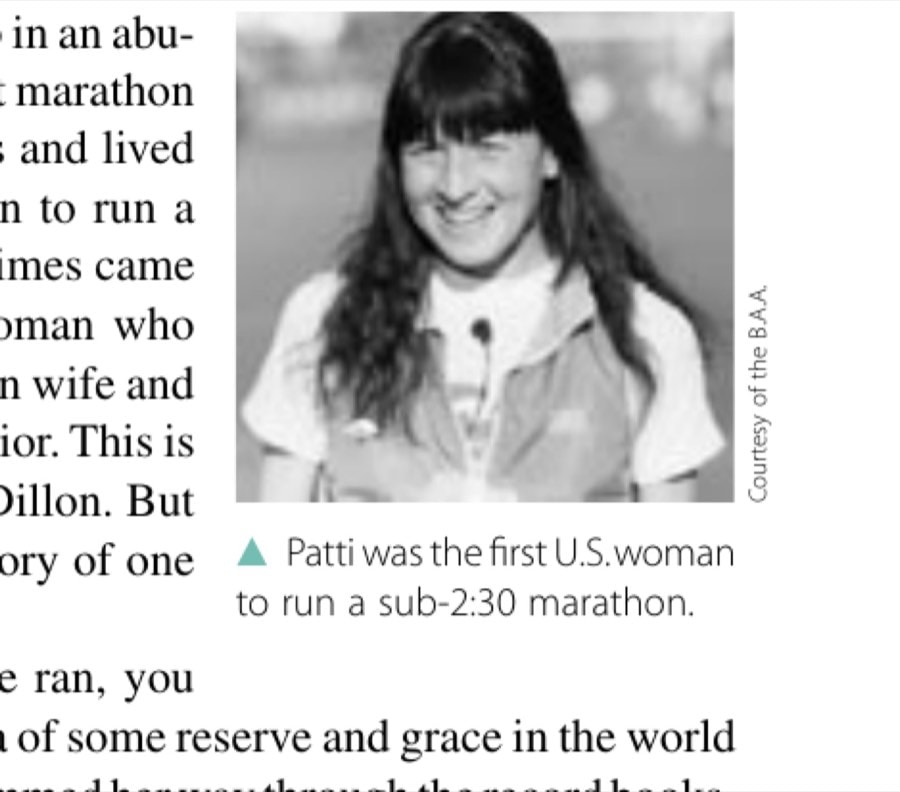
Courtesy of the B.A.A.
This is a story of a woman who grew up in an abusive home; a woman who won the first marathon she entered; a woman who was homeless and lived out of her car; the first American woman to run a sub-2:30 marathon; a woman who three times came in second in the Boston Marathon; a woman who battled bulimia; and a born-again Christian wife and mother who lives with the Lord as her Savior. This is a story of Lyons, LaTora, Catalano, and Dillon. But it isn’t the story of a law firm. It is the story of one Patti was the first U.S. woman to run a sub-2:30 marathon. woman, and her name is Patti.
No matter under which last name she ran, you could always see that it was Patti. In an era of some reserve and grace in the world of women’s running, she broke out and slammed her way through the record books. Her ferocious training, athletic charges, clenched fists, and energetic expressions shattered the seemingly tame field of female runners. “
Patti was just tenacious. I mean, tenacious. Scary tenacious,” recalls fellow competitor Lorraine Moller, the four-time New Zealand Olympian in the marathon and 1984 Boston Marathon champion. “That’s what I remember—just a fierce competitor. Women were catching up pacewise, so it was kind of like you could go out there and not run too hard and kick it at the end and have a good race. And that was considered good. But when you get somebody who’s just running hard all the time, then it causes everybody to run harder and then the times start coming down. Patti’s an important part of the history of women’s running.”
The four-time Honolulu Marathon course-record champion thought nothing of running several races over a weekend or even four or five marathons in a year. In fact, from April 1980 to April 1981, Patti ran 48 races and won all but four. She lost only to Jacqueline Gareau (1980 Boston), Allison Roe (1981 Boston), and Grete Waitz (1980 New York City Marathon and L’eggs Mini-Marathon).
A further testament to her ability was her two world records, five American records, and four course records during this span. An apex occurred over the
Courtesy of the Honolulu Marathon
weekend of March 14-15, 1981, when Patti won the River Run 15K in an AR 49:33 in Jacksonville, Florida, and then a WR victory the very next day in Boston at the Shamrock Classic 5-Miler (25:48). “There’s Kathrine Switzer, Bobbi Gibb, Jacqueline Hansen, and Nina Kusc
sik—the list goes on and on—Mikki Gorman—but Patti really went after it,” notes Joan Benoit Samuelson, two-time Boston Marathon winner (1979, 1983) and inaugural women’s Olympic marathon champion (1984). “Not to take anything
from these other women pioneers, because I wouldn’t be here if it hadn’t been for them, but Patti mixed it up and made it a very competitive event for women. She really made it a true competition amongst the women.”
The Massachusetts native would simply attack a race, be it 5K or 42K. To her, the distance didn’t matter; what did matter was the racing. Patti loved to run and she loved to race. Rarely would she set out in a marathon for a specific time.
Her philosophy was to run as hard as she could, and the time would simply sort itself out in the end. “Patti and I were alike,” notes U.S. Olympian Bill Rodgers, four-time winner of Boston and New York. “We were less reserved, sort of, and I think it cost us
both. It cost us both because we sort of couldn’t control our exuberance and our love for the sport. We used to go wild in races. We went wild! So, sometimes
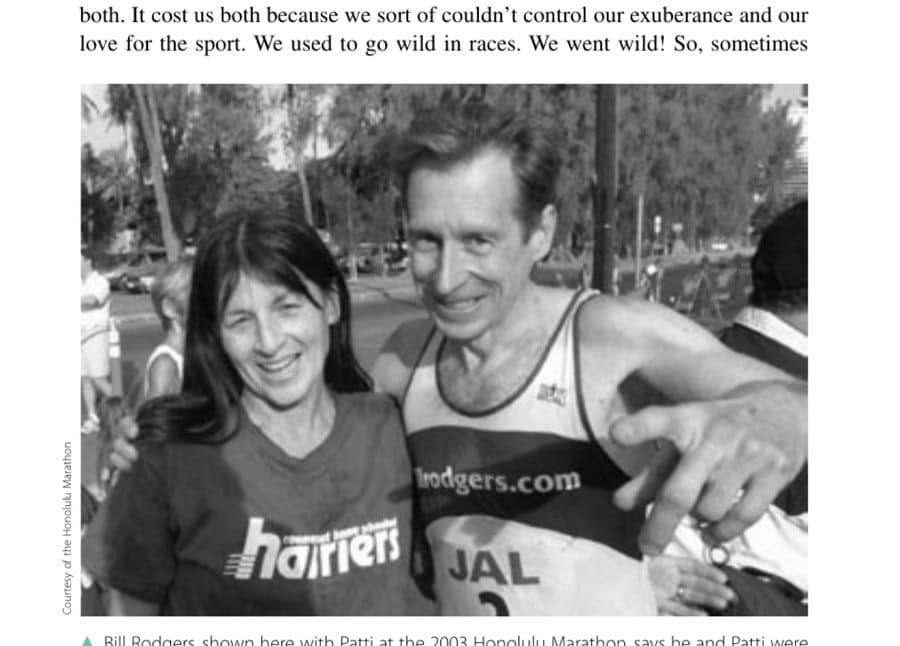
Bill Rodgers, shown here with Patti at the 2003 Honolulu Marathon, says he and Patti were alike in their exuberance and love of the sport.
when she did get injured—when she won Honolulu, she went bodysurfing [and broke her coccyx]—there’s that sort of feeling like you can do anything when you win these races. “And I think Joanie and (Olympic marathon gold medalist) Frank Shorter are very alike in that they were real peakers. Didn’t race a lot,” continues Rodgers. “Patti and I? Oh, yeah. Bring it on! We’ll race everybody. Can we race? When can we race? We were a little off the top. We were a little out of it. But we had fun; we had great fun. We didn’t collect any gold medals, but we had fun,” he laughs.
THE SUB-2:30 Then along came 2:30. During the late 1970s and early 1980s, a sub-2:30 marathon was a huge goal for women. Norway’s Waitz, whom Patti always seemed to be chasing, ran 2:27:33 at the 1979 New York. (Eight of her nine New York wins were under 2:30.) But Patti decided she wanted to be the first American female to dip under that plateau.
At the Montreal Marathon in September 1980, Patti came within 38 seconds when she beat Canadian Jacqueline Gareau to win. That seemed to fuel her even more, and Patti had been running competitively for less than three years. “
I came back from Montreal mad because I didn’t break 2:30, and that was my goal,” Patti states. “I had a time goal and I was capable of doing a 2:28. That’s what I had trained for. That’s what all the indications were. That’s what I was going for. And I was going to do it in negative splits. It just didn’t happen. I was very happy the way things came out, though.”
Her disappointment at not achieving a sub-2:30 needed exorcising. Seemingly possessed, she ran several races hard within the weeks after Montreal, and at the invitation of Waitz, she ran three cross-country races in Norway, Denmark, and Sweden, including a 33:03 second place at the Norgeslopet 13K. And one month after Montreal, she won Boston’s women-only Bonne Belle Mini-Marathon 10K at 32:24 for an AR and CR.
She not only won the Belle in a field that featured U.S. Olympian Judi St. Hilaire (four top-three finishes) and Gillian Adams, but Patti’s time dominated so much that the margin of victory steadily grew until Adams came in second more than two minutes later. The 2:17 gap still stands as the race’s largest margin of victory. “
I’m glad that I was persistent in saying that I wanted to do it,” Patti says of her drive to run the Belle. “It was a great feeling. And it was the first time in my running career that I felt loved by other women. I didn’t know the impact. I didn’t know if they even knew me. But that was very exciting.”
The Belle finish boosted Patti’s confidence in her sub-2:30 march. She turned her eyes toward the next available marathon she could find—New York City—which was 32 days after the Belle and less than two months after Montreal. The year
Photo by Rick Levy
before at New York, she came in fourth at 2:40:19. But as much as Patti wanted to run it, her then-coach and husband Joe Catalano didn’t want her to. “I’m thinking, I missed it in Montreal [with the minimal spectator support] and
New York is crowded,” she explains. “New York has people. They have crowds, and it will carry me. It will take some of the slack for me. I can do this. But then they have the hills in the park. So I walked around the house, drumming it up,
weighing it. And I said, ‘I’m doing it.’ And when I say ‘I’m doing it,’ it’s not just to run the race. I’m breaking 2:30. So for that time in the house, don’t come near Patti. Patti’s on a mission!” she laughs.
After four years of running, eight marathon wins, and numerous records, Patti began to feel that she belonged. She felt welcomed at New York and believed she was one of the elite women. She had arrived. Yet with all of the acceptance
came a greater spotlight. “I almost didn’t do it. I was really struggling. It was heady. It was the first time I was treated as a top contender going in, challenging Grete. In my heart, I didn’t think I would beat her. But I knew that I was going to be in the race. I
wasn’t afraid of her. That was the biggest thing. I wasn’t afraid of her anymore,” she points out. “The cameras were right there on you. It’s a big thing. I could say hi to the foreign runners now. It was just nice to be in all of that. It was very exciting.”
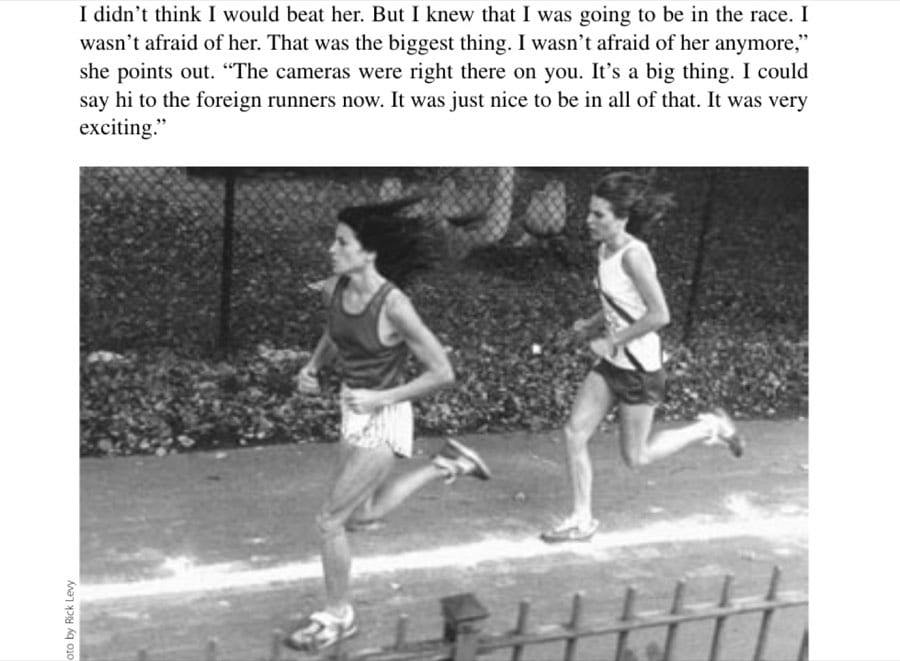
Patti, with Lynn Jennings in hot pursuit, in the first Bonne Bell Mini-Marathon 10K in Boston (1980).
Patti started out with Waitz and Ingrid Kristiansen but backed off at five miles because she thought her 27:49 split sounded too fast to continue with 5:34 miles. “I felt fine—and I still kick myself for [slowing]—and Ingrid and Grete kept on going and I thought, ‘I did something wrong.’ But I didn’t pay any more attention to it because I knew what I wanted to do and I didn’t want to blow up,” she explains. “It paid off well because I passed Ingrid again at 10 with just tempo. I went by her and I could feel her look at me. And I was a machine. I just kept going. I came up on Grete at 16 and we were running together and then,” Patti continues with a chuckle, “she did her race. She just went home! What I do to other people she did to me. What do you do? You just stay right where you can. “
I was struggling around 24, 25,” she continues. “I’m in the park and my legs are feeling stingy, like somebody slapped them. And I’m running and I see [Greater Boston Track Club Coach Bill] Squires, and he’s like, ‘Oh, oh, oh! C’mon, honey! You can do it! You gotta do a 6:30. You can break 2:30!’ It inspired me. And I’m running and running. And I can’t see because of the sweat, or I’m crying or something. I can’t see. And all of a sudden, I see the clock and it’s 2:29 and I have room. I’m not going to see it change to 2:29:58. I have room. And I did it! I did it! It was the best. It’s my favorite photo. I did it! I did a 2:30.”
Patti’s 2:29:33 was sandwiched between Waitz’s winning PR 2:25:41 and Kristiansen’s third-place 2:34:24, which was nearly five minutes behind Patti. Thus, on November 2, 1980, the Massachusetts native became the first American woman to crack 2:30. “
I wasn’t surprised,” says Rodgers of her feat. “I knew what Patti was doing. I saw how hard she was training.”
THE SEARCH FOR PEACE What first put Patti on the roads back in 1976 was as seemingly simple a reason then as it is today: she smoked, was overweight, and wanted a new direction in her life. “I’m in a crisis, meaning that it’s a week before my 23rd birthday and I’m thinking what am I going to do with my life?” she recalls. “Here I am almost 23 years old, everybody I went to school with graduated from college, they have all these beautiful jobs—you know, my mind’s racing away. And here I am a nurse’s aide and I live alone in my basement apartment. I’m not going anywhere. I’m in this dead end. I was very unhappy and I wanted to do something. And the first thing I wanted to do was get rid of my thighs.”
But what kept her on the roads and fueled her fire to win was an unconventional impetus, an incentive unlike most, if not all, of the other top runners of her time. In a way, she was obsessed, and running was the perfect vehicle.
“All I wanted when I started running was to have peace,” Patti says. “All I wanted to do was be able to breathe. It didn’t have to be running; it just actualized itself as running. You’re talking to somebody who grew up in a violent house. I was always told I was stupid. I would never do anything. I was never good enough. Everything I did was no good. And I went to school. They told me, ‘Don’t go to college. You’ll never make it. Nobody would want you.’ I mean, what a thing to say? And I believed this.”
The eldest of nine children, with 16 years separating her from the youngest sibling, Patti was born in 1953 on a ship in Boston Harbor. Her father was a second-generation Irishman from Dorchester in the U.S. Navy and her mother a Micmac Indian from Nova Scotia who had run away from her Canadian reservation at the age of 11.
The family home in the Houghs Neck neighborhood of Quincy, Massachusetts, did not feature the warmth and love found in most households. In fact, it was dangerous. “It was just a violent, raging house,” Patti says. “My father and my mother were always at each other. My mother was a battered woman. He used to abuse us, just smash us around. You’re talking to somebody who didn’t have strong family roots. My grandparents ostracized my parents; therefore, I saw my grandmothers once or twice. I remember seeing my grandmother one time, and she pulled down the shade. We didn’t have cousins and family running around.”
Couple that with her full-time 3:00 to 11:00 P.M. shift as a nurse’s aide from 10th grade to age 23, and you get someone who had very little time to find herself. She dug for clams, picked potatoes, blueberries—anything. She basically raised her brothers and sisters while her father, who died when she was 19, and her mother, who passed away many years ago, were neglecting the children. “
I used to scrub floors, and I think that’s what gave me a strong back,” Patti says with delight. “I just remember working hard, making sure we had a clean house. I loved being called a good worker. [As a kid] I used to love how shiny my floors were. I still do.”
During extremely difficult years, Patti and her father would find migrant work in Bangor, Maine, where they picked potatoes and blueberries, the latter with a rake that would remove the berries from the low bushes and fill buckets that had to be carried over their shoulders to a blower that would clear away leaves and twigs. “
It’s a crate, and you get 75 cents for all that work [to fill a] bushel or crate. If you didn’t make it, it didn’t count,” explains Patti. “So you tried to pick really good. I was one of the older kids, like 12.”
She and her cousin would make the breakfast each morning for the family, something in which Patti took great pride. “I remember making the French toast and oatmeal in the big black kettles over an open fire, and I was appalled the first couple of days there because the black flies
are huge and they’re all over the butter and the French toast, and nobody flipped them off because they’re so used to it because they’re just talking,” she laughs, partly because she also enjoyed being with kin. “It was so nice to be around my mother’s family because they all talked Indian. And their teeth are gone, they’re hard workers, they’re smoking. It was just something to see,” she laughs again.
This journey through childhood and adolescence laid the framework for a special intensity, a trigger, that propelled this little girl. As she began to recognize this, a need developed, and it just happened to be the exercise of running that provided her with an outlet. “
She had her demons,” comments noted author, coach, and former nationalclass runner Tom Derderian. “Her background did not give her much else going in her life. When she got into running, this was something, for the first time in her life, her signature. She was not a prominent student, she wasn’t a student-athlete, she wasn’t an artist—she had nothing until running to hang her hat on. And when that came to her, it was such a delicate thing because it could be removed with an ankle in a pothole. So, with Patti’s running, there was an element of desperation to it that was a direct consequence of her background, which was unlike so many others who were college students who had a college degree to fall back on.”
FORAY INTO RUNNING Patti left home as a teenager at the request of her mother, who sensed that her children favored Patti, especially after Patti seemed to have brought them up. For the next four years, Patti became more and more dissatisfied with herself: the weight, smoking, living alone.
The nearby Quincy YMCA became her refuge and inspiration. It offered an opening into another world. She can remember the exact date of her first run—March 28, 1976—when she ran the one-mile loop around Mount Wollaston Cemetery and back to the Y seven times in her Earth Shoes. It was foolish, painful, invigorating, and it was love at first stride. “
I thought I was gonna die,” Patti exclaimed. “I was soaked. I went in the shower, and it just felt so good. And I’ve never had that feeling before. And I actually cried. Now, you have to understand, I’m not a crier. And I wept. It felt so good, and I’d never had that feeling my whole life and it’s what I wanted. It was the breath I was looking for. It was the most incredible feeling I’ve ever had my whole life. And it was what I wanted, what I was looking for, and thought it was the answer. It was very empowering.”
After two to three weeks of recovery, she was back on the roads. But this time, she jumped in with some Quincy Y runners who—unbeknownst to her—were training for the April 1976 Boston Marathon. She had no idea they were preparing for a 26.2-mile race. But the support she received from them was immeasurable.
“I was on a hunt. I was on a pursuit for peace, happiness, striving, excellence, feeling, perfection, challenge, go for it,” she explains. Patti improved with each run and began to hear the stories and tales of this footrace called Boston. Despite the fact that the finish line was a mere nine miles from her hometown, she had never heard of the race, nor had she ever fathomed running such a long distance. But the support was still there. “
My whole life changed. It was a life-changing experience, and it was enough for me to pursue it,” Patti notes of her running. “I was encouraged immediately by surrounding people, older people who had run marathons before and had run Boston before.”
Patti married a fellow YMCA runner named LaTora and decided to run the next Boston. She turned her attention to qualifying at the October 1976 Ocean State Marathon in Newport, Rhode Island, after just seven months of running.
Needing to run only 3:30 to qualify for Boston, the 23-year-old Patti LaTora won with a new CR time of 2:53:40. “I don’t know what a split is. I don’t know what time is,” she explains of her state at the time. “All I know when I go to the race is that as soon as it starts hurting, I’m gonna run harder. That’s all I did because I had been doing it in practice trying to chase these guys. Physically, I knew I could handle anything. I didn’t care what happened to me. I really didn’t care. I didn’t care if I had a heart attack or I died after I crossed the finish line—never before. I was always prepared. But I was growing emotionally, mentally, spiritually. There was so much growth. And I was excited. And I can get excited and charged and stay on energy for a while. I can ride things and milk it. And that’s what I was doing. I was feeding off of this stuff—the racing. It was huge.”
An example of this energy occurred when Patti finished 40 seconds behind her then-husband at Ocean State. In a moment of unchecked exuberance in the finish chute when she noticed him slightly ahead, she remarked that she would have beaten him had she known he was so close. But that was Patti.
She was still smoking and still overweight, but her new life had begun. It would take a few more choices along the way for her to fully embrace it, such as a divorce, a commitment to stop smoking, and a new direction. But she was on her way to peace.
One of those forces came in Joe Catalano, a coach and former B.A.A. runner who became her coach and, in May 1980, her husband. While she possessed the talent and drive, he provided the guidance and training. “
I was really fortunate to have somebody like Joe coach me,” Patti observes, “but prior to that, I’m glad that I did two marathons and an American record on my own. That’s for me, personally. But it was the first time that somebody had ever harnessed the talent and said, ‘Let’s do something here.’ I really wasn’t going to continue to run, because I left my first husband and I didn’t know what to do.”
ad page
Having decided to stop running and return to work at Quincy City Hospital, Patti went to her coach (Joe) to discuss the matter. Surprised at the decision, he tried to impress upon her the talent she possessed and what lay before her if she continued to run. “I didn’t see it as a thing,” Patti recalls. “And he was like, ‘No. You really have to think about this.’ And so, I really thought about it. I really liked running. I really loved running. And I was already calling in sick so I could get doubles [double workouts] in. And then I thought, ‘I just built myself up. I am going to do it. I’m gonna quit.’ Not [quit] smoking,” she laughs. “Quit the job!”
It was nearly three years after her first Ocean State Marathon before Patti ran Boston. After each CR qualifying win in Rhode Island (2:53:40 in 1976; 2:47:20 in 1977; 2:44:11 in 1978), injuries prevented her from running Boston—that is, until 1979 when she finally made it to the Hopkinton start.
But unlike her first Ocean State, where she came out of nowhere to win, Patti was no longer a secret by the time she toed the line for Boston. She had won the 1978 Honolulu Marathon in December (CR 2:43:10) and the 1979 Bermuda Marathon in January in another CR.
One year after she watched the 1978 Boston Marathon, Patti was the favorite in a field that included Joan Benoit of Bowdoin College, Susan Krenn of California, and 1976 Boston winner Kim Merritt of Wisconsin.
Benoit Samuelson, a fellow New Englander from Maine, notes, “When I came to run Boston in ’79, I knew she was running. It was going to be Patti’s race. I was looking more to participate, not to beat Patti, because I knew she was training for this event and I was sort of doing it as a result of having had pretty good luck in Bermuda a couple of months earlier, not intending to run the marathon there. [She was] tenacious. She was focused; she was trained. This was her event.”
But Patti, as the favorite, had not yet accepted her role as a known top runner. Mentally, she was not at that place yet, even though she had five marathon CR wins under her belt. And it troubled her.
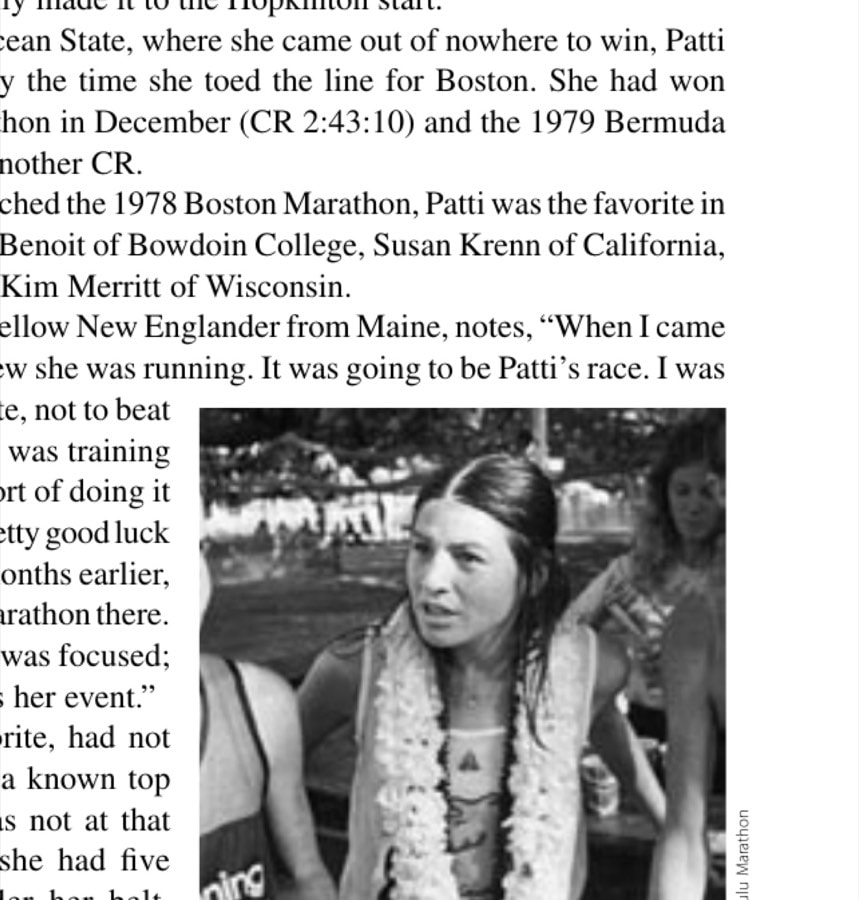
Patti after her 1978 Honolulu Marathon win.
Courtesy of the Honolulu Marathon
HER FIRST BOSTON
“I didn’t expect to be picked to win Boston,” she says. “It was very upsetting to me because I wasn’t even thinking of winning or placing. I was just thinking of running. Just run! And then to have the reporter pick me as a favorite, which was very flattering, too, I mean, the guy’s trying to throw me this thing on a silver platter. And I was like, ‘Me? Me?’ I was just panic-stricken. I was so nervous. It was awful, just awful. I didn’t like the whole feeling. “
And I thought it was a pain in the neck that it started at noon,” she continues of her thoughts in 1979. “It ruined my whole day. I had to sit on a stinky, old bus. It was cold. I was cramped. You had to get up there so early. I was annoyed,” she laughs now. “I hated it. Noon? This is crazy.”
But once on the course, once in her element, Patti shone and turned in a PR 2:38:22 for second place behind Benoit’s AR 2:35:15. Krenn was third at 2:38:50. They all broke the CR. Merritt was sixth (2:44:28). “
I was running hurt and I was just running my race. Just running,” recalls Patti. “When I finished second, I was just glad the darned thing was over and I wanted to go home. My foot was sore, and I wanted to go home. I didn’t care. That was the funny thing. I didn’t care. I was just bringing it in. And I thank God that I finished second, that I saved face. And the recovery? I remember going to [B.A.A. trainer] Jock Semple’s office the next day. I had a hurt foot and I was so incredibly sore. I had never felt that kind of pain before in my life over the next two days.”
BLOSSOMING Following Boston, Patti took some time off to regroup and recover. During the ensuing year that led to the 1980 Boston, Patti grew stronger, more mature, and hungrier. In the latter months of 1979, she again won Ocean State (2:40:28) and Honolulu (2:40:07) once again in CR times.
She incorporated more high-level racing, became a stronger hill runner, increased her determination, and worked even harder. And if she felt like running before a workout, she did. “I got a handle on stuff,” she admits of this transition. “The hard work was paying off. I got feisty. I got daring. I got ornery. I got all those things. I would test things. I just liked to run. Joe was my coach. Joe gave me the training. But also, I have an authority issue,” she laughs. “If it was a nice day and I felt good, I was going to run [before a workout].”
1980 BOSTON For Patti, 1980 brought great promise—and results—with highlights of marathon wins in Montreal (2:30:58) and Honolulu (2:35:26); a WR and AR 1:08:36 at the Elby’s 20K; ARs at the Bobby Crim 10-Miler (53:40), Montreal and New York marathons; and CRs at Montreal, Bonne Belle (32:24), and Honolulu.
“In 1980, I tried to get in as many races as I could. I chased down competition. If they ducked me, I went to their territory,” she laughs. “I chased them down. I went everywhere, anywhere. You don’t know what the edge is until you went, ‘Woops.’ How far can I go? Where’s the edge? What can I do? What was my mental point? In a race, in a workout, there was always more. I wanted it yesterday.”
The top female runners for the 1980 Boston Marathon included defending champion Benoit, Ellison Goodall, Gareau, Julie Shea, and of course Patti, the previous year’s runner-up. With such a stellar field, Patti recalls that Gareau was the one who stuck in her mind. “
I’d read about Jackie in the paper, that she won the Yukon Jack Snowshoe—it’s a three-day competition—and I knew I had it cut out. A crazy woman!” she laughs. “I had done a Boston and I was in better shape [than last year]. I’m ready for it.”
During the latter stages of the race, Patti passed Goodall, the only woman she saw ahead of her. While comfortably covering the last few miles on Beacon Street, Patti knew nothing of Gareau out front. As far as Patti was concerned, this was her race and she was winning Boston, that is, until she was informed there was another woman in the lead. Patti was in second. Again. “
I looked back at him and I said, ‘Where?’ And he went, ‘Yellow shorts.’ And I just looked. ‘Yellow shorts.’ And I was pounding,” Patti describes of the race. “By the time I saw her she was already on the little hill over the Mass Pike at Kenmore Square [with one mile to go]. It’s the worst hill, but I didn’t feel it that year. That crazy Canadian, that woman,” she laughs. “She had just gone out really hard. That was her style. But I’ll tell ya, I was like gangbusters. But she was gangbusters, too, because she’s leading. She’s just riding the thunderous cheering. I beelined and I just ran out of room.”
Gareau’s 2:34:28 bested Patti by 40 seconds (2:35:08), but both women beat the previous course record. And Patti did eventually catch up with Gareau—after the race. “I caught a hold of her in the [Prudential] garage, and I grabbed her and I said, ‘Oh! You!’ And she looked at me and she had this horror look on her face, and I said, ‘You won!’ And she said, ‘No.’ I said, ‘You didn’t win? What do you mean you didn’t win?’ I’m shocked. ‘Somebody beat you?’ And it was that Rosie Ruiz thing,” explains Patti.
Ruiz was given a finish time of 2:31:56, which was the third fastest time up to that point in the history of women’s running. The problem was that there was growing doubt as to the honesty of her run. The Boston Athletic Association later determined that Ruiz had jumped onto the course within a mile or two of the finish.
Immediately after the podium ceremony, Patti became a focal point for the skeptical media. “I was hurt. I was incensed. I was mad,” she recalls. “It was just terrible. And I wasn’t cool enough. I got a lot of publicity around me because Jackie couldn’t
speak good English. I went on the news [instead of Gareau]. And everywhere you went, that’s all I heard—Rosie, Rosie, Rosie! I think we all cried the next day in Jock’s office. It was just sad. Jackie ran a national record and nobody knew. And nobody knew that I was on the hunt, the chase. There was a drama happening.”
One result of the Boston mess was the creation of the Montreal Marathon in the fall of 1980 that pitted Gareau against Patti. The field was less than a hundred, with less than 10 elite women, but the matchup between the two marquee female runners was nevertheless fierce. After consciously starting relaxed and slow, and even in last place, Patti beat the Canadian in an AR and (obvious) CR.
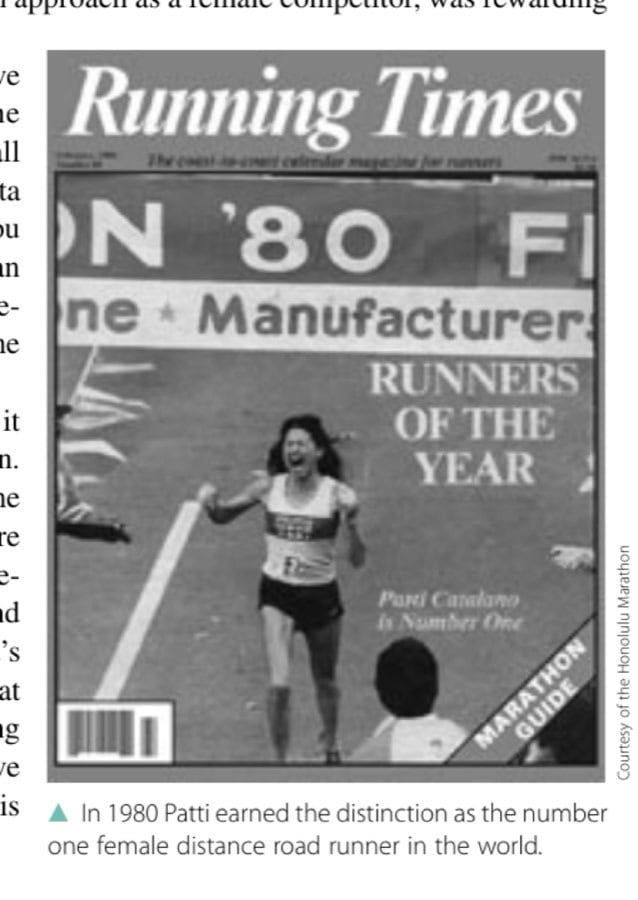
After being ranked in 1978 as the number three and in 1979 as the number two female in the American and world rankings, Patti earned the distinction in 1980 as the number one female distance road runner in the world and the Runner’s World U.S. road race rankings leader.
Much as the late Steve Prefontaine did on the track, Patti, on the roads, attacked her races. She would push herself and grind out wins, records, and races. And this new attitude, this fresh approach as a female competitor, was rewarding and gaining notice. “
Patti didn’t necessarily have a kick,” recalls Moller. “She would just drive herself hard all the way. To beat Patti, you’ve gotta be within striking distance. You know you’re not going to have an easy run. But I think [with] somebody like that, they really raise the whole level of running.”
Echoes Rodgers, “She gave it everything. Patti ran with abandon. When you really admire someone in distance running, I say they’re Kenyanesque—the way the Kenyans run with great power and psychological strength. And that’s the way Patti was. Patti had a great quote. She said, ‘If you’re going to beat me, you’re going to have to spit blood,’” he laughs. “This In 1980 Patti earned the distinction as the number is a great line. I loved that.” one female distance road runner in the world.
Courtesy of the Honolulu Marathon
ADVANCING WOMEN’S RUNNING
Her attitude and execution in training were paying off not only for her, but they were also advancing women’s running in a way it had not seen before. She included Nautilus in her workouts as the result of rehabbing an injury and was up to a thousand sit-ups a day. And this was in addition to her regular push-ups, burning runs, and the use of a weight boot.
Race analyst Larry Rawson, a Distance Running Hall of Fame Advisory Board member and former New England mile record holder, recalls witnessing firsthand Patti’s amazing workouts. “I was at Boston College one night and she was on the track,” he says. “It went from sunset to dusk to darkness and she was there running repeat quarter miles, 400 meters on the track, and she was hammering them. She must have run 25 or 30 of them—fast. I was down there and left the track for a workout, came back and finished up my workout, and stayed and watched her just from afar, and was impressed with the dedication. She did it alone. There was nobody there working with her. “
It just gave me insight into the tenacity, along with everything else that I had learned about her at the time, and the miles she put in,” he continues. “To achieve what she did in three to five years is just extraordinary, rarely ever done by anyone. She burst on the scene without the benefit of high school and college success and was very late to the sport. What struck me was the enormous capability I felt that she had. She was wiry, strong, had speed, had discipline and dedication, and I was struck with how hard she worked.”
Ironically, Patti thought everyone was doing this kind of training and possessed this kind of drive. She didn’t give it a second thought. But the women’s running world had yet to catch up. In February 1981, Patti set a new WR at the Ohme-Hochi 30K in Ohme, Japan, with a winning time of 1:44:25. It was such a tremendous record that it stood for more than 22 years. “
I remember going to Japan to run that 30K, and there was Patti going through the airport, carrying her weights with her!” recalls Rodgers. “She brought her weights to Japan because she was so focused on her routine and training. Patti was tough. It’s not like today. It was different, a little bit, from the era of Kathrine Switzer, Roberta Gibb, and Sara Mae Berman. They were great because they had the guts to make the move and crack the barrier, but they didn’t train like Patti trained. That’s what people don’t understand. Patti trained like Kenyans train today. She was one of those kinds of pioneers. She went to the whole professional level.”
1981 BOSTON By the 1981 Boston Marathon, it had been five years since she had taken those initial steps out of the Quincy Y and ran her first miles. Among her achievements
were seven marathon titles, seven marathon course records, and a half-marathon world record at the Maple Leaf (1:14:03) in Vermont seven months before Boston. She was ready. What she didn’t expect was a run-in, literally, that has become something of Boston Marathon folklore. At around Cleveland Circle with less than four miles remaining, Patti was in the lead. At that time, crowd control was minimal at best, and spectators from nearby Boston College and area watering holes poured onto the streets, choking it to a width barely enough for the runners. “
There was only enough room for one person to go by,” explains Patti. “You waste so much time saying, ‘Excuse me, please. Excuse me, please.’ Really! They did a terrible job [of crowd control].” Derderian, who found himself running alongside the lead women’s vehicle in 1981 and finished just ahead of eventual winner Allison Roe at 2:26, recalls the unfolding events. “
Crowd control was not good, so when we got to Cleveland Circle—I wasn’t really running next to Patti—but the crowds narrowed everything and there was no place else to go,” he describes. “Then there was this [police] horse stumbling on the railroad tracks from the slipperiness from the horse’s shoes on the rails. And it stumbled. And there was no place else to run. Patti runs into the horse’s ass and bounces off into me. I just held her up, as you would, reflexively, because if she fell, I would have fallen and cascaded trampling. “
Then there was the next step, and the next step, and everything was fine and the race resumed,” Derderian continues. “At that point, Allison Roe was approaching. But Patti was getting tired, so I don’t think the horse had much to do with the race itself. It was just an incident, but it didn’t affect the outcome because Patti, in fact, didn’t fall.”
Adds Patti of the impact, “It was a shock! A total shock. I didn’t even see the thing. I was bruised. I got bruised from Tommy grabbing me, but it hurt my whole right side. I went to the chiropractor the next day—it threw my whole right side out.”
Despite the collision and finishing 65 seconds behind Rowe, Patti turned in her PR 2:27:51, broke her own AR, and came in second for the third straight year. “I look back, and you can only do what you can do,” she philosophizes. “I always ran my hardest. I always got my PRs at Boston. And every race was preparing me on one level—emotion, mental, preparing me for whatever—to get ready for Boston. You just race Boston. You don’t run for time in Boston. You just run. You never know what you’re gonna get. You want to run for time? You go elsewhere. You want to be ranked? You want to be competitive? You want to run against the best? You run Boston.”
Shortly after Boston—five days, in fact—Patti joined fellow number one– ranked runner Herb Lindsey to run the Trevira Twosome 10-Miler, a couple’s race
in New York with combined times as results. (Her future husband, Dan Dillon, had previously won with St. Hilaire). “I knew I could run faster, and I had stuff in me that had to come out. I was angry. I was raging, really,” explains Patti. “We get to the starting line and I’m geared. I’m on a mission. Get out of my way! If looks could kill. I looked at Herb Lindsey, and I said, ‘I’ll do my part, you make sure you do yours.’ And he said, ‘Patti, Patti. You just did the marathon. Take it easy.’ I said it again. And he said, ‘OK.’ “
First mile—4:48. Boom! Like, a 9:45 two mile. Boom! I just slug it out,” she describes. “You’re gonna come with me? You’re going to have to fight me. I’m not giving it up. I feel good; get out of my way. I’m just slugging it out. All is fine until the eight-mile mark. All of a sudden, the earth opens up and swallows me. I’m absolute mush. It’s hilly, it’s a dead spot, and there aren’t any people. But my juice ran out. Wow! If somebody came up on me they could have humiliated me. I never wanted to feel humiliated.”
Patti won in a time of 53:42, just two seconds off the AR she had set at Bobby Crim. But the race held more significance for her. “That was the end,” she notes. “That was the last major effort, other than Honolulu. I was on the spiral going down.”
Vulnerable and tired after finishing Trevira, Patti was forced to find a friend in the crowd for some assistance because Joe had decided to return to their room. He did not accompany Patti to the awards ceremony. “Emotionally and mentally, the marriage was over,” she says.
STARTING TO CRUMBLE After a superb 1981 when she was the number one–ranked female runner, things started to take their toll. Injuries began to mount, undiagnosed bulimia continued, and her second marriage ended. In addition, she recalls a moment while running the Crescent City Classic 10K in Louisiana just prior to the 1981 Boston that shed some light on her direction in life, or lack thereof. “
I wanted to run a sub-32 and it was very hot,” she says. “I get to the fourmile mark and I’m toast. Joe’s there and he says, ‘Just bring it in.’ And I’m like, ‘Yeah. OK.’ Those last two miles, I feel like I’m thinking, ‘Why am I doing this?’ I cross the line and I do another American record,” she says of her 32:08. “You think I’d be jumping up and down for joy. But I think, ‘That’s it. Is that all there is? That’s all there is. I’m chasing the wind.’ And then Boston happened, and then Trevira happened, and then my marriage was over. Everything I was struggling for, striving for—to be loved, to be hugged—was over. And to be able to run the fastest time in the country, the second fastest time in the world, and to still feel like dirt—there was something drastically wrong with my thinking.
ad page
“I still felt like I did sitting on that bar stool in Quincy—terribly dissatisfied,” she continues. “I had to fix it. But I just didn’t know what to do. Why I started running, even though it was looking for peace and happiness and it was exciting and it was busy, I still hadn’t caught on to the peace and happiness. I got busy. It was exciting. It was heady. But it doesn’t mean it was peace and happiness. It was surreal. But I still hadn’t found it. I was still on a mission. It brought me right back to five years ago why I started running in the first place.”
To close out 1981, Patti won her fourth consecutive Honolulu (CR 2:33:24), but the very next day while bodysurfing, she broke her coccyx bone at the base of her spinal column. The following years of injuries took Patti to physical and emotional places she had never before experienced, from a hip and hamstring injury to a ruptured tendon in her foot, a stress fracture in the same foot, bulimia, and depression. “
That [coccyx injury] was really a blessing. It really helped stop things and I had to get a grip. It solved a lot of my problems,” Patti observes, “but created new problems. But I was on the hunt again of why I started running in the first place—to be at peace, to breathe.”
From those depths, things began to look better in 1984. She addressed her bulimia and trained in an effort to qualify for the Olympic marathon. And she and Joe divorced. “When we got married,” she says, “there was a time in our relationship as coach/athlete and husband/wife that it just does not fly [and] that I would not have made it without him. But I was in deep throes of bulimia, too, at the time, and I was going to die. I knew what I had and I knew I had to stop, but I just didn’t know how,” she continues of this period in her life around 1983 and 1984. “So I summed myself up [to make a change].”
At the Houston Marathon in January 1984, Patti qualified for the first U.S. Olympic Marathon Trials, which were held four months later in Olympia, Washington. At the women’s Olympic qualifier, she came in 16th at 2:36:13, more than five minutes behind Benoit, who won the Trials (2:31:04) and later the inaugural women’s Olympic marathon at the Los Angeles Games. “
I wanted to be a part of women’s history. I didn’t think that I would ever make the team. I never had any dreams of making the team—the Olympic team. But I wanted to be a part of it,” says Patti, who at the time was also trying to gain the emotional and mental strength to leave her husband/coach.
The battle with bulimia, which she estimates having for six or seven years, gradually crept up on her until she was forced to look inward and beat it herself. After having unsuccessfully sought professional help, Patti ended up relying on prayer and her own attitude changes as the solution. In addition to crediting prayer, she also had a friend who listened and offered her the one thing she previously failed to find.
“She said the perfect thing, ‘If you ever need help, I’ll help you,’” Patti recalls. “Bulimia develops very innocently and very easily. It’s not so much a food disorder. I don’t look at it as a food disorder. It’s a spiritual void disorder. It’s an emptiness, and you want to fill it up. And it’s also part of denial. Here I am, I was denying myself the goodness of things. ‘I didn’t deserve this house. I didn’t deserve this car.’ It’s not so much punishing myself. It’s beyond that. That’s a thought process. It’s a beyond-a-thought process. You have to understand, with my coach, if I ever got my period, he would be upset, that like when women get their period, we’re not training hard enough. There’s this mind-set, and so you struggle with quite a few things. And then you’re in denial with food. ‘You can’t have this because it’ll slow you down’ or ‘It’s junk food.’ So then you end up not eating any of it. Well, how long can you go without eating a chocolate chip cookie? Let’s be real here,” she laughs, adding that her coach was also at the time trying to teach her body how to feed off its fat. “
I’d go out and do a two-hour run and not eat anything for a few hours, the complete opposite of what you’re supposed to do,” she explaines, “and I wouldn’t even drink anything for a few hours after running for two hours. Well, as soon as I could eat, vroom! Then, ‘Oh, my gosh! What did I just do?’ I was so hungry. Well, let’s get rid of it. It starts so innocently—maybe once a month, then once a week, then twice a week. But it goes back to everything’s in moderation, and you’re talking to an extremist who didn’t know boundaries. I was creating new boundaries. I didn’t know I was. But I was just primed for that lifestyle with my upbringing, my attitudes, my belief system.”
A year after the Olympic Trials, Patti won the 1985 Rio de Janeiro Marathon in 2:38:44. She had a health food store, then a restaurant, and she planned on training for the 1988 Seoul Olympics. And she married for the third time.
But in the closing years of the 1980s, Patti’s life crumbled and degenerated to even deeper depths. She retired as a professional runner, divorced again, sold her health food store/restaurant, lost her position as a job-training specialist at a
Courtesy of the Honolulu Marathon
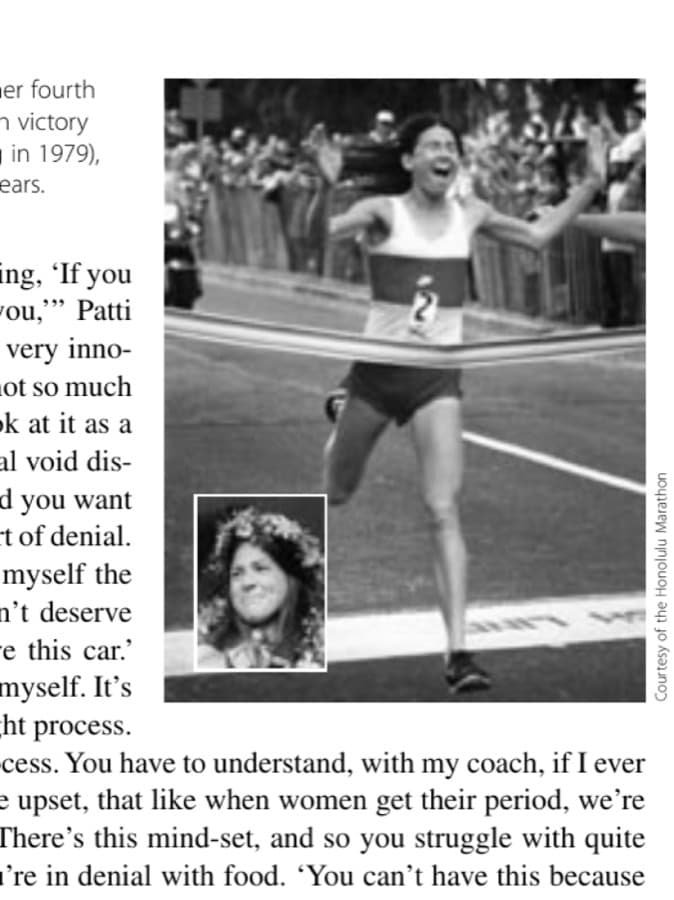
Patti closed out 1981 with her fourth consecutive Honolulu Marathon victory (inset shows Patti after winning in 1979), but injuries plagued her next years.
local American Indian center, and found herself living out of her 1983 Saab in the streets of Boston. Not long before, she had had a Nike sponsorship; was happily married; ran 150-mile weeks; regularly turned in CR, AR, and WR times; and enjoyed celebrity status. “
I felt confused [because I felt] that I should have had the peace because I had the so-called trappings of success,” she explains of that period in her life. “I had built my own house. I was the first amateur roadrunner to sign a pro contract. It was exciting. But I got off track. That (third) marriage didn’t last very long. And I ended up homeless, and I prayed my way out of that one, too. What did I get out of prayer? I got peace. God helped me. God did help me. I have a good relationship now with Him, not like I did before, which was hot and cold—‘OK, I need you now.’ I just prayed so differently. I prayed out of desperation because He was my last resort. ‘I’ve got no one else.’”
BORN AGAIN TO A NEW LIFE Patti thought she had a good relationship with God—that is, until she felt He had abandoned her during her times of need. But the more she looked into it, the more she thought about it, the more she prayed, and the more she read about other religions and kept seeing God mentioned, she began to come to a realization. “
I thought God forgot all about me because I was in so much trouble,” she explains. “But God saved me as a kid. When my father was beating my mother or my father was beating me, I’d be in a corner and I would be, like, I could step out of it and he wouldn’t hurt me. He could never hurt me. But he could just hurt this [body] and it just didn’t hurt me. And so God saved me because I would cry out to God. I’m a parochial-school kid, so I had a good relationship with God, I thought at the time. I only called out to Him when I was in trouble, which I was quite a bit as a kid, a teenager. How’d He help me? I would read things and I would ask questions and I would try. And I was always searching for the answer.”
From that little scared girl, cowering in the corner, to the thrice-married championship runner who was still lost as an adult, Patti never stopped her search. She was admittedly sidetracked, sure, but that yearning remained, and that God. That God she kept reading about in all those new-age books and religious materials. She wondered who was this God?
In the early 1990s, Patti began to take hold of her life in a way she had never before attempted. She was healing herself. And with the help of a macrobiotic diet, her hair was growing back, food urges returned, her cycle came back, her skin tone changed. “
I got life back into me. I was healthy,” she explains. “And I wanted to know who was this God? Who is God? I was trying. And I wanted to come home. And home is ‘through God is through Jesus.’ And that was all I was looking for. That’s
what it was. I knew this, but I never put the two together. I knew about Jesus. I knew there was a God. But I didn’t believe that Jesus was the way to God. The Holy Trinity—I never connected the dots. Until Danny and I got together,” she says of her current husband, Dan Dillon. “Prior to that, I knew that I wasn’t completely healed.”
Prior to Dan, Patti was still attracted to people who were harming her—whom she would allow to harm her. But she finally recognized that as well. “Poor Danny,” she laughs while sitting beside him. “I had to put him through so much.”
Dan Dillon, a two-time All-American cross-country runner at Providence College, had made several U.S. national cross-country teams and also qualified for all the Olympic Trials in the 1980s. He was the TAC chairman for the 1992 World Cross-Country Championships in Boston, and in the 1985 Boston Marathon came in eighth at 2:23:50. He and Patti married in 1992. “
Patti and I have both been spiritual people,” he says. “We prayed a lot. She had these little prayer books. There are people who write these beautiful prayers. And we would just pull over when we were driving out to Colorado or whatever; and we’d find some mountain pass, and we’d stop and sit there and read these prayers. We’d pray to God, but we didn’t really feel like we could be connected, really, with Him. God’s way up there and we’re down here and God must really be disappointed with us. “
We had both been around a lot of Catholics who said, ‘All those born-again people—don’t become one of these born agains,’” recalls Dan, whose parents were born again in 1980. “It was such a negative, negative thing. And we said, ‘No, we’d never be one of those.’”
The vehicle through which they were saved in the fall of 1996 was their 3-year-old son, Aaron. Over time, Patti had talked to Aaron about Jesus and how He was the son of God, how He died on the cross for “our sins,”
Paul Clerici
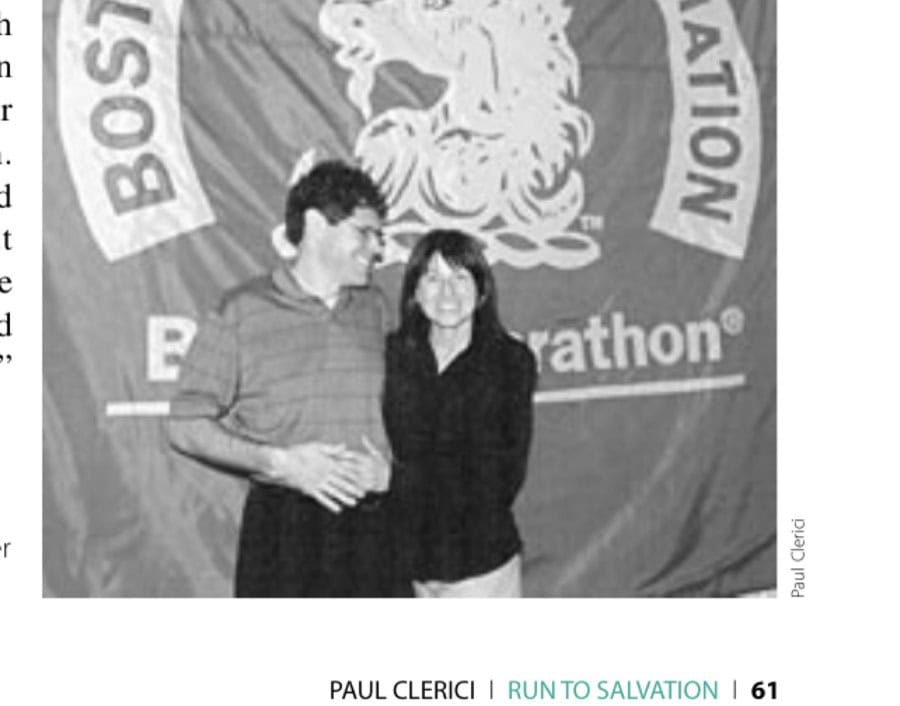
Patti, shown with husband, Dan Dillon, at the 2004 Boston Marathon, credits him with helping her “completely heal.”
and how the cross was made out of a tree. She was explaining these things to her son as she knew them, despite not consciously realizing where her belief lay. “I was running with Aaron, on my second loop, and Aaron bursts out crying,” she describes of that precise moment of when she was pushing the double baby jogger that contained their two children. “I stopped the carriage and said, ‘What?’ And he’s crying. And he’s like, ‘I’m so sorry.’ And I said, ‘What?’ He said, ‘He died.’ ‘Who died?’ He said, ‘Jesus died on the cross for my sins.’” There was a pause before Patti responded. “I said, ‘Oh. It’s OK.’ I’m thinking I have to tell Danny because we haven’t fully discussed how we were going to raise the children.”
Between Patti, who didn’t want a religion because she felt every one in which she was involved had let her down, and Dan, who as a Providence College graduate had studied the Bible because grads were required to have a minor in religion and philosophy, the search was still ongoing. But when Aaron’s words sank in, Patti and Dan began to see the light. “
We just started reading the Word—Genesis 1:1,” Patti says. “And then it went on from there. I was accepting at a very nice spot. It’s a whole new life once you’re born again. Once you accept the Lord as your Savior, Jesus as your Savior, the Holy Spirit goes to work in you. This is not a fairytale. This is not a folktale.”
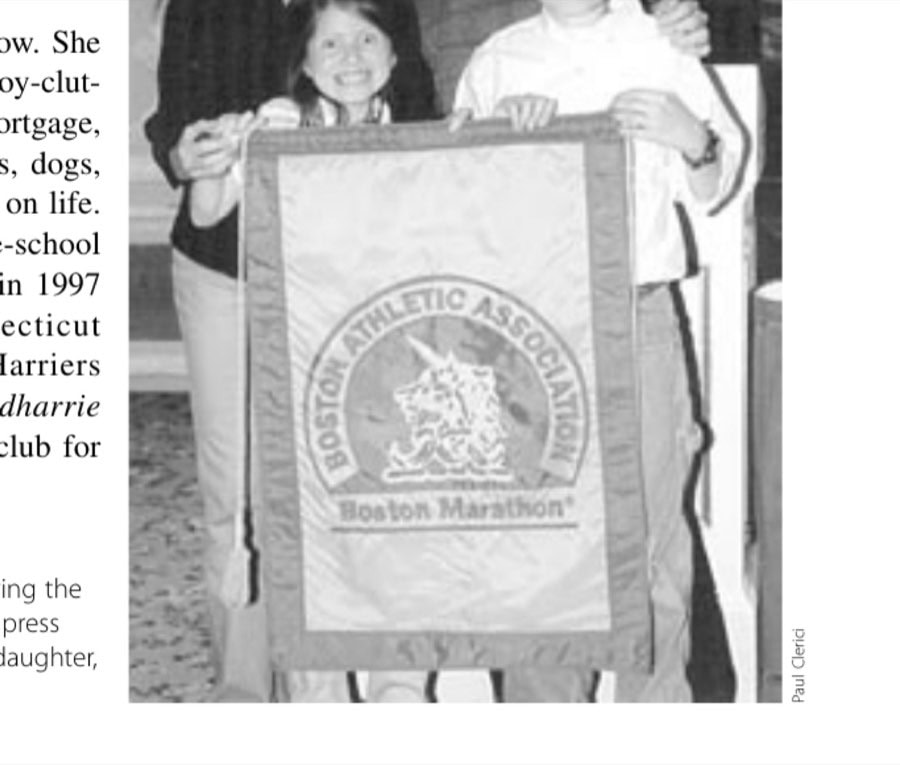
Patti is happy now. She has a warm home, a toy-cluttered backyard, a mortgage, a husband, two kids, dogs, and a fresh outlook on life. She and Dan home-school their children, and in 1997 created the Connecticut Home Schooled Harriers (www.homeschooledharrie rs.com), a running club for kids ages 6 to 16.
Paul Clerici
The Dillon family during the 2004 Boston Marathon press conference: Patti, Dan, daughter, Raven, and son, Aaron.
ad page
“Their daily fitness routine can and should be fun,” notes Dan, who adds that they also stress that the kids can work hard at their gift or ability. “We teach them that this does not just apply to their running but their schoolwork, family relationships, and everything else in life, too.”
PATTI’S LEGACY “The tough thing about Patti is there’s this great sadness, I think, athletically, because she won Honolulu, she won Ocean State, but she came in second in New York, second in Boston. And she set all these world records and American records,” Rodgers points out. “I was lucky. I didn’t get an Olympic medal, but because I was able to win here [Boston], people think of me like Joan [who won Boston and Olympic gold]. Maybe I’m not, really, though. But Patti deserves much more respect. If you’re in this sport deep, you know what she really did. All the American and world records she set. There’s Joan Benoit Samuelson, there’s Patti Dillon, and Francie Larrieu Smith, in true distance running in the marathon. They are the big three of all time, three great women marathoners. Now there’s Deena [Drossin] Kastor. But I don’t think people would put Patti in the same breath as Joan. If you look at Patti’s history, she was fierce.”
Within the last few years, more than a decade and a half after she retired, Patti is beginning to receive the recognition for the trailblazer and champion she is. In 2002, she was inducted into the Road Runners Club of America (RRCA) American Long Distance Running Hall of Fame, which was followed by the Honolulu Marathon Hall of Fame in 2002, and being named an Institute for International Sport (IIS) Sports Ethics Fellow in 2004.
At the 2004 Boston Marathon, the B.A.A. honored Patti for her contribution to the race. It was the 25th anniversary of the first of her three runner-up finishes there. “I think it’s wonderful,” comments Rodgers. “I saw her at Honolulu and they honored her there. That was great, that was just fantastic. But this [Boston] is where she’s from. She helped put the marathon into the modern era, world class, because it did struggle those two years. But she kept it real strong and duked it out when there were the Grete Waitzes and Allison Roes and those top foreign competitors there.”
At the 2004 ceremony, she was joined by such Boston legends as Moller, three-time champ Uta Pippig, and 1983 winner Greg Meyer. “Isn’t it nice?” remarked Moller after the ceremony. “It’s a hard transition when runners leave running to find something that is fulfilling. Like me, going through such a life transition, going from being the competitive athlete to being the family person. To see Patti with her children here, I’m sure that tenacity carries through into other areas of her life.”
Paul Clerici
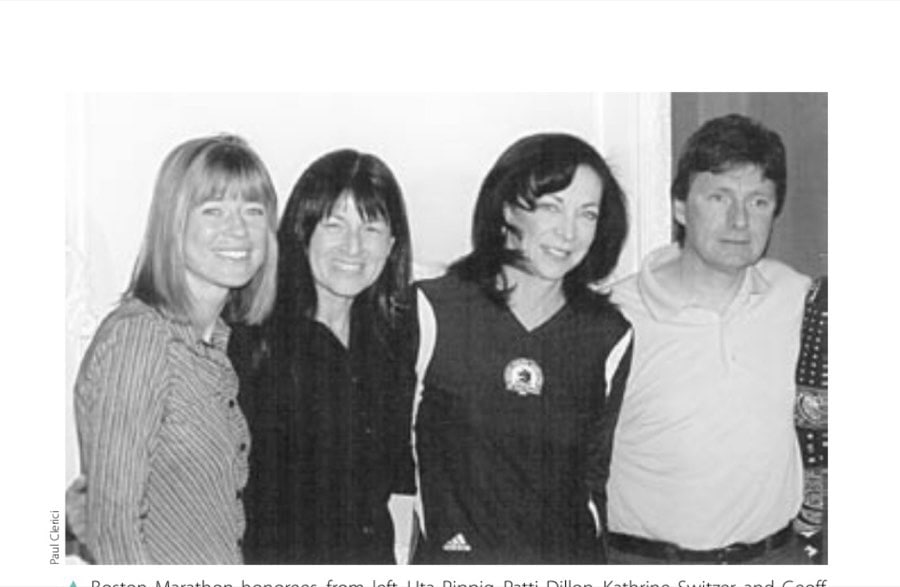
Boston Marathon honorees, from left, Uta Pippig, Patti Dillon, Kathrine Switzer, and Geoff Smith, during the 2004 press conference.
The 2005 race marks the 25th anniversary of Patti’s Boston battle with Gareau as well as her historic sub-2:30 achievement in New York. “We consider Patti a champion,” states Boston Marathon executive director
Guy Morse. “She really represents a lot of the values that we hold dear about the marathon in terms of persistence and strength and recovery. She’s considered one of the champions in a lot of ways and someone who’s been very special to
our event ever since she ran, and now to be back as a guest. She certainly does exemplify much more than [being] just an athlete, and she’s always been much more than just an athlete. She’s always been a very decent human being, and that
has shown through throughout her life.” Although marathons are no longer in her future, Patti still runs. Bill Squires, who has coached the likes of Rodgers, Alberto Salazar, Dick Beardsley, and Dan Dillon at the GBTC, has worked with Patti for her return to competitive running.
They had teamed up for her to run Honolulu when she was inducted into its hall, but an injury prevented it. “When I first met her, I could see her enthusiasm and love,” Squires notes. “She’s a very aggressive person. The one thing is, it was very hard for her to put
the reins on it. The thing is, you have to control her. She has a good day? She’s flying. You have to pull her back. But she has one of the most coachable and logical guys in her husband, Dan. “But she’s got a story that can actually be so much better than the athletes that
came out of a great high school or college program and then have professional
Courtesy of the Honolulu Marathon
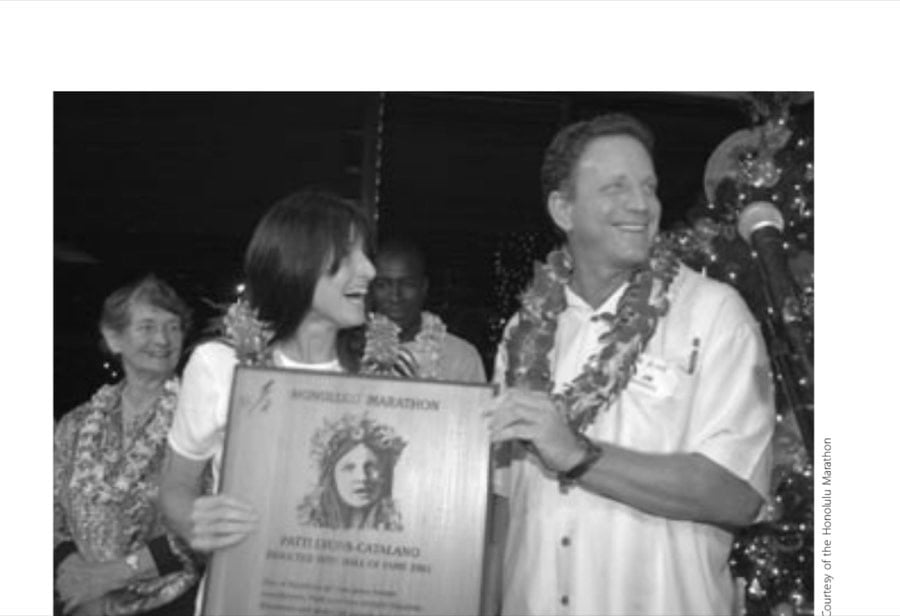
Honolulu Marathon Association president Jim Barahal presents Patti with her Hall of Fame plaque in 2002.
coaches,” he adds. “She is the spokesperson for the middle-of-the-packers. They don’t identify with the champions. She just came from the back of the pack to the middle of the pack, and then finally she’s up on top of the pack. Runners can relate to her more.” Although she understands that her life—any life—will never be complete, Patti has found peace. She can now breathe. “I always looked for peace, looked for happiness,” she says. “It didn’t really matter how much money I made. Sometimes you make money, sometimes you don’t. But I’m at peace.”
Back Issues of M&B Back issues of M&B are available. They are $5.00 each, plus shipping. U.S. shipping: $2 for 1 issue; $4 for 2-6 issues; $6 for 7-12 issues; $9 for 13-18 issues; $12 for 19+ issues. Foreign/Canada shipping: $5 for 1-2 issues; $10 for 3-6 issues; $15 for 7-11 issues; $24 for 12-18 issues; $30 for $19+ issues. Consult our Web site for a complete table of contents of every issue: www.marathonand beyond.com. To order, phone: 217/359-9345 (toll-free 877/972-4230); fax: 217/359-4731; or order via our secure Web Site.
This article originally appeared in Marathon & Beyond, Vol. 9, No. 2 (2005).
← Browse the full M&B ArchiveMore like this
1,000+ stories from 19 years of Marathon & Beyond
The complete archive of the legendary long-distance journal — digitized and free to read.
