

Run To the Temple Of Doom
INTRODUCTION
Not everyone can be an Indiana Jones when running in Australia. But in the Indian Himalayas, it is possible every day. Here the intrepid athletes must overcome the short-breath effect of high altitude, be constantly alert for local buses that swing rapidly around blind hairpin bends, and watch their footing as they cross landslides brought down by earthquakes. They must also avoid forest fires and be sure not to lose their concentration as they gaze at the beautiful snowcapped Himalayas, as one false step can mean certain death on the steep mountain trails. Not only are there these natural elements to deal with, but everywhere there is a hint of religious forces at work. Yes, running in the Himalayas is exhilarating, exciting—and dangerous.
Australian marathoner Peter Lane took on the challenge of the highest mountain range in the world while living in the hill station Mussoorie in north India for six months. His daughter, Joanne Lane, reports on his experiences. * * * “
Allah-hu-Akbar. Allah-hu-Akbar.” The mullah at the Muslim mosque faces west toward Mecca as the dawn breaks. With fingers in his ears, he cries out in wailing, sonorous notes to call the faithful to prayer. “God is great. God is great.”
The prayer call also awakens 59-year-old Brisbane marathoner Peter Lane. As he runs off in the early morning from his home in Mussoorie in north India, he wonders whether the mournful cry is prophetic. He certainly receives no encouragement from the first person he sees: an Indian man sitting outside the house laughing and muttering to himself. “
I felt doomed from the start,” says Peter, “with the prayer call, the crazy man, and then 10 minutes later when two very fierce-looking buffalo with huge horns blocked my running track. I carefully jogged around them. Then the next minute the bag carrying my water and food broke! So I did some hurried repairs.”
Personal fact file Peter Lane, age 59; born in Northampton, England; lives in Toowong, Brisbane, and Mussoorie, India; trains with InTraining, Brisbane. Best ultramarathon time (68K): 8:30 (May 28, 1999, Mussoorie, India). Best marathon time: 3:07 Brisbane, 1997. Best half-marathon time: 1:28. Noosa, 1998. Best 10K time: 44 minutes. Number of marathons: five. Most recent endurance run: 34K in atrocious conditions, Chennai, India, October 2005.
Not a good start to an ultramarathon—a round trip of 68 kilometers to Surkhanda Devi, a Hindu temple on the Tehri Road in the Himalayan foothills, the highest mountain range in the world. According to Hindu mythology, Surkhanda Devi is the mythological site where the head of Shiva’s consort fell when it was cut off to stop his tantric, cosmic dance, which was rocking the universe. Thousands of Hindu pilgrims visit the temple each year. The temple constitutes the highest point in the vicinity of Mussoorie (2,000 meters or 6,500 feet).
The temple reaches up to the gods at a height of 3,048 meters (10,000 feet), far higher than Australia’s biggest mountain, Mount Kosciusko at 2,228 meters (7,310 feet). So for Australian-based Peter, it’s definitely new terrain. From the hilltop the temple is supposed to offer peace of mind and a fantastic view of 200 miles of snowcapped Himalayas.
A FIRST ULTRAMARATHON Peter had contemplated the challenges of this 68K run: “I had never run an ultramarathon before, there would be no backup for me, and I had to carry all my water. I couldn’t help but call this the ‘Temple of Doom Run.’”
He also had to climb over 2,000 feet in altitude to reach the temple, and the thin mountain air would not be conducive to running. The first few kilometers did nothing to relieve his feelings of doom as he passed through the charred, smoldering, blackened remains of fir trees that littered the hillside from recent fires. Their smoke, combined with the fires from villages and mountain-stream mist, filled the valley, blocking out the early morning sun. “Out of this haze at 8K emerged my first water stop: a chai [tea] stall perched perilously on the mountain range where I bought two liters of water for 36 rupees (USD $0.80). The problem was that what I didn’t drink I would have to carry. The next minute I narrowly avoided running into the local milk van—a herd of buffalo that with bells tingling and huge hips swaying, gracefully ambled past.”
Even after a short distance out on the Tehri Road, civilization was sparse. Mountain ranges soared above, while valleys plunged below into unknown depths, with the holy Ganges River winding into the plains thousands of feet down. Until now shops selling chai, water, and goods had appeared every few kilometers. But soon after, the road plunged around a corner and ascended 7K to the top of the range (18K). There was little promise of human or plant life.
Suddenly a tourist bus appeared from nowhere with horn blaring, belching black diesel, and covered Peter in dust. Choking and coughing, he looked up to see some tourists hanging out of the overcrowded vehicle laughing at him. Others looked astounded to see anyone running—especially on a mountain road. For even in India, the land of bewildering contrast, some things are unusual.
Even the monkeys in the trees had stopped chattering to look in wide-eyed wonder as Peter wound his way up here. Now a local dog, neither intimidated nor impressed by his presence, came snarling at him. But a well-aimed stone sent it scurrying away.
ATOP THE RIDGE
© Joanne Lane
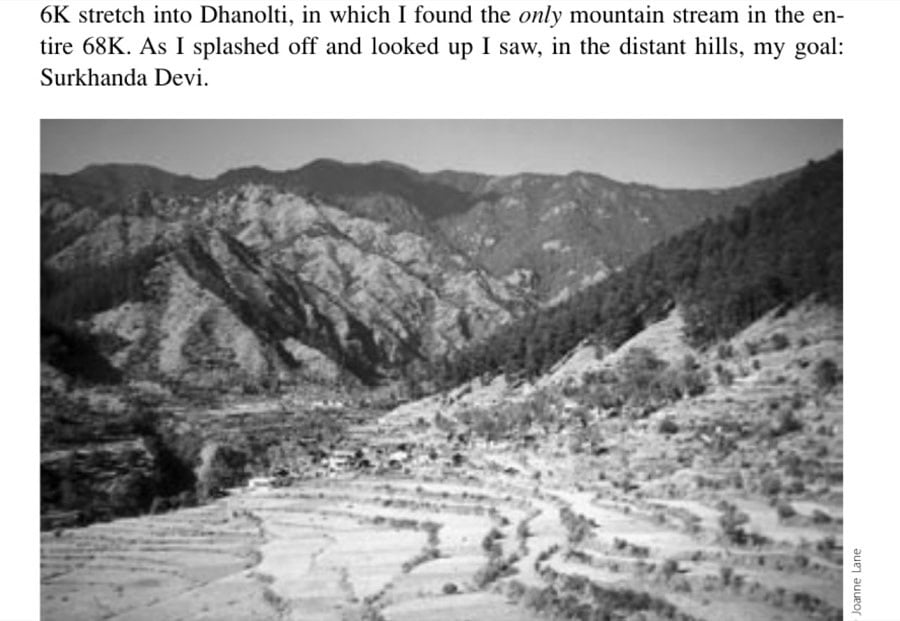
After 1½ hours and 18K, a relieved Peter reached the top of the range: “I was relieved that I got there on time: about 7:00 A.M. Next was a gradual downhill 6K stretch into Dhanolti, in which I found the only mountain stream in the entire 68K. As I splashed off and looked up I saw, in the distant hills, my goal: Surkhanda Devi.
▲ Typical landscape on the road to Surkhanda Devi.
© Joanne Lane
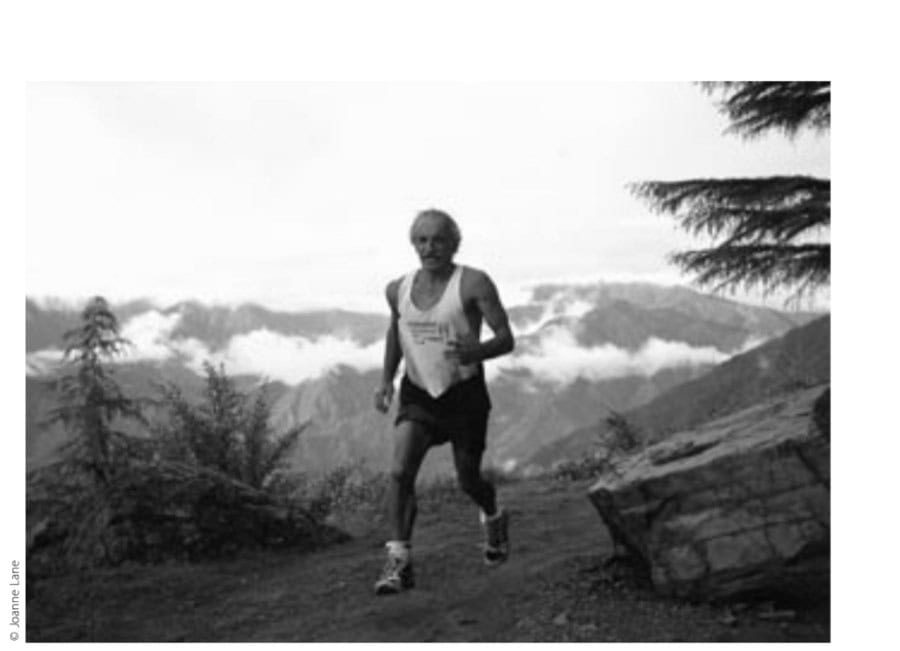
▲ Peter Lane running….need to add more to this caption.
“Below me in the valley, I saw a vulture ominously soaring around looking for food. I didn’t spend too much time looking at it, as I had to jog cautiously over a landslide brought down in a recent earthquake, which blocked the narrow road.
One slip and I would have fallen hundreds of feet to be the entree on the vulture’s menu. Hundreds of feet above me the pine-covered foothills of the Himalayas rose up, and on the horizon were the spectacular snow-covered mountains.”
Peter reached Dhanolti (22K) around 7:30 A.M. Surkhanda Devi was now only a tiring 12K uphill stretch. He spent 20 minutes atop the windswept area that housed the temple. The views of the peaks were spectacular, but he was too
tired to enjoy them. “It was not so much the temple was so great but that the run was great and I was tired. The temple was 1,000 feet above the road on a steep 3K path that took me 30 minutes to walk. It was only 8:30 A.M. when I reached the top, so there were
few pilgrims or tourists. I had a quick breakfast of beans and rice outside. “There was evidence of worshipers there with dead flowers, incense packets, and, of course, rubbish. It was a typical Hindu temple with white sterile tiles yet
it was open to the elements, which was unusual.” At 9:30 A.M., after 34K, he started back toward Dhanolti, the 44K mark, which he reached by 10:30 A.M. Now it was time to see whether he really could do an ultramarathon.
“In five marathons, my best time was three hours and seven minutes in Brisbane in 1997,” he said. “Yet I was confident that I was ready for an ultra. Arriving in Mussoorie in March, I quickly realized how challenging running and even walking in the hills at 7,000 feet was.”
A ROAD TOO FAR?
© Joanne Lane
Peter had prepared well for the ultra with numerous runs and hikes where he had coped well physically carrying only a minimum of food and water. A 40-year-old American teacher at a local school had completed the run in 7:30, and to beat his time Peter had to run 10K an hour, which allowed time for breaks.
But coming out of Dhanolti was a 6K uphill stretch, and he was desperately drained: “I felt as if I’d done two marathons. At the stream, I splashed my face and started to walk. I realized that every hour—to relieve the sheer mental and physical tiredness and pounding on the road—that I would walk for 10 minutes and also eat and drink.”
At the top of the range (50K), he again stopped for water and tea. A young boy kindly gave him water to splash on his face. By noon he was ready for the 7K descent of the range. But the struggle was not over.
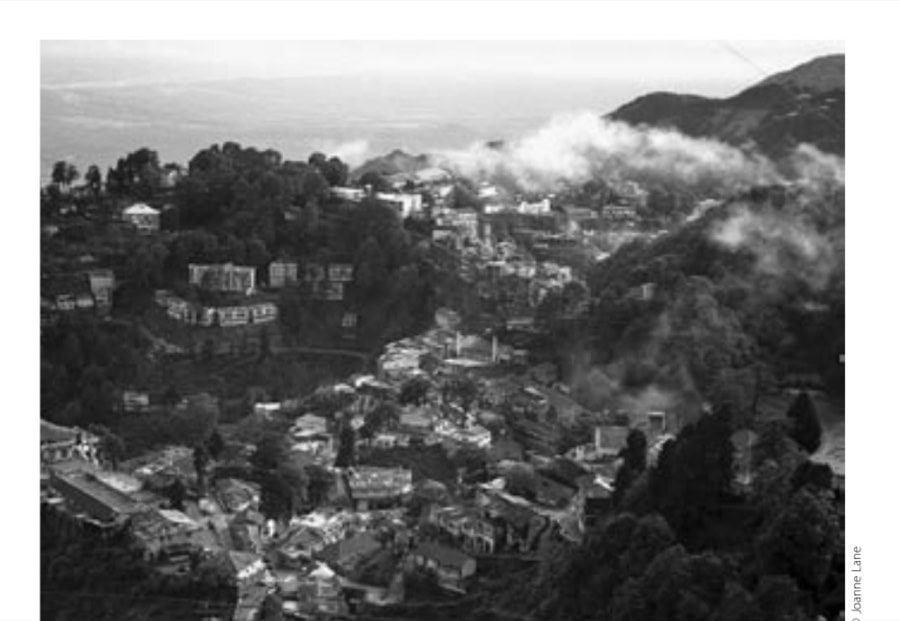
▲ A view of Mussoorie from the Tehri Road.
© Joanne Lane
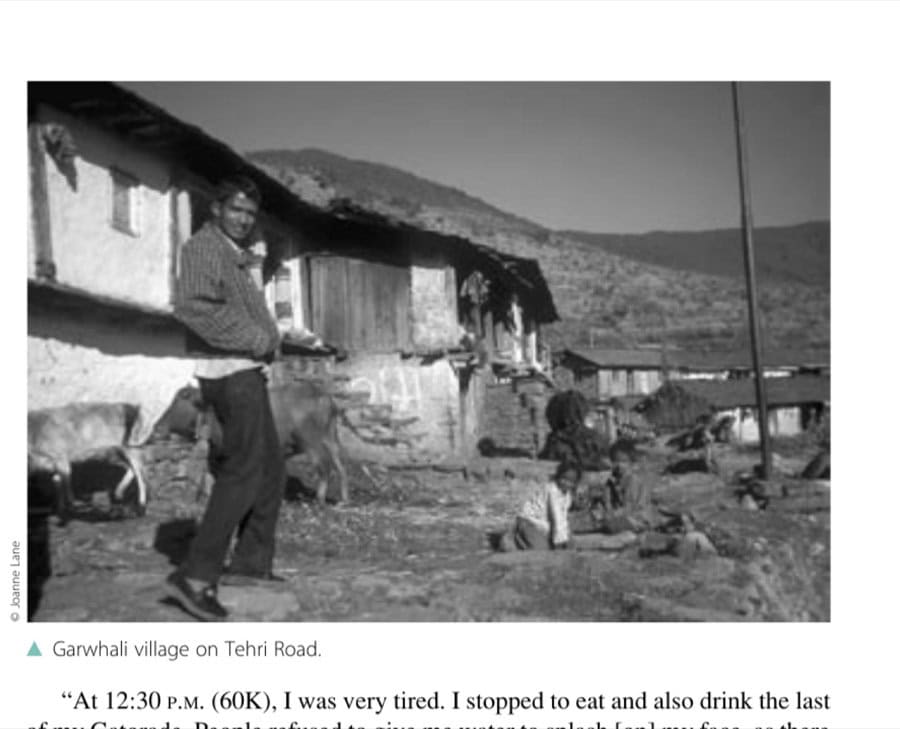
▲ Garwhali village on Tehri Road.
“At 12:30 P.M. (60K), I was very tired. I stopped to eat and also drink the last of my Gatorade. People refused to give me water to splash [on] my face, as there was a drought in the hills and no water to spare for anything, let alone a crazy
sahib [man] on a run. Drinking water is brought in by lorries for those who can afford it or by local village women who walk hours to get water. Only a hungry dog, with whom I shared some of my food, was friendly.”
When he started running again, young truck drivers drove past waving and smiling, and Peter was motivated for the final 8K stretch. “As I came down the hill into a village at 1:20 P.M. (67K), there was hope of
water when I saw a 200-liter water tank outside a chai shop. But it was empty. I only got two drops of water, and I almost burst into tears out of frustration and tiredness. Yet I was only 1K away from as much water as I needed. Tired but elated, I finished at 1:30 P.M. The time of the last man was 7:30, so I was pretty
pleased at my age with my time of 8:30.” But the hills in India are merciless, and after 68K Peter still had to walk 3K uphill to reach his home 500 feet above the road. That night, tired but fulfilled,
Peter gazed down from the heights of Mussoorie to the mighty Ganges River flowing through the Doon Valley. The lights from the holy religious cities built along the Ganges were flashing, beckoning and challenging him to run down to
the Doon Valley and along to those cities. Perhaps another day. Part 2 of this three-part series will run in our next issue.
This article originally appeared in Marathon & Beyond, Vol. 10, No. 1 (2006).
← Browse the full M&B ArchiveMore like this
1,000+ stories from 19 years of Marathon & Beyond
The complete archive of the legendary long-distance journal — digitized and free to read.
