

Running A Marathon Is Never Easy
Running a marathon is never easy. T hen there is running a marathon after you’ve just swum 2.4 miles in the ocean and biked 112 miles in battering wind—which is what athletes at the Ironman World Championship do every October in Kailua-Kona, Hawaii. Just getting a slot in the race requires a top finish at a qualifying Ironman or half-Ironman, and the final 26.2 miles of the race aren’t easy for them, either. Not even for the pros.
Gary Gurgold of Novi, Michigan, had been racing as a pro since 2006 and had won a prestigious Kona slot in 2008. (Pros have to win qualifying races just like mere mortals.) “It was amazing to be in the presence of some of the top Ironman athletes in the world,” the 35-year-old rehabilitation specialist said. “It would have been pretty cool if I had managed to stay close to some of them. “
In 2008 the winds on the bike were the worst I had ever been in. Surprisingly, I felt better once I started the run. But then at mile 15 to 16, things started getting sketchy and my legs started to fold. I ended up doing 10-minute miles and was never so glad to see a finish line.”
Ironman week transforms the quiet seaside town of Kailua-Kona into coffee shops brimming with 1,800 buff bodies. Coming from 50 countries and 46 states in 2008, athletes accustomed to winning everything at home know it won’t happen here. Some hometown heroes barely make it to the finish line.
Denise Everitt, a 55-year-old teacher from Rochester, New York, was hoping to do well in her new age division. “I fought my inner enemy (demon) all day long, you know, the one that wanted you to quit in the middle of the swim. I fought that all day, especially on the bike. By the time I got to the run, my side was losing.”
Everitt, who is the only woman to complete the 27-mile swim around Grand Island above Niagara Falls, kept going. “I had to assess if I had anything left to fight with. Once I realized that I didn’t, I knew I would finish because I would never quit. I thought about what it would be like to come in at midnight . . . people would clap and stuff, but I knew that would be wrong and that I still had to do the best I could, and so I did.” Everitt finished ninth in her age division with a time of 13:21:23.
Making the best of a bad day
▲
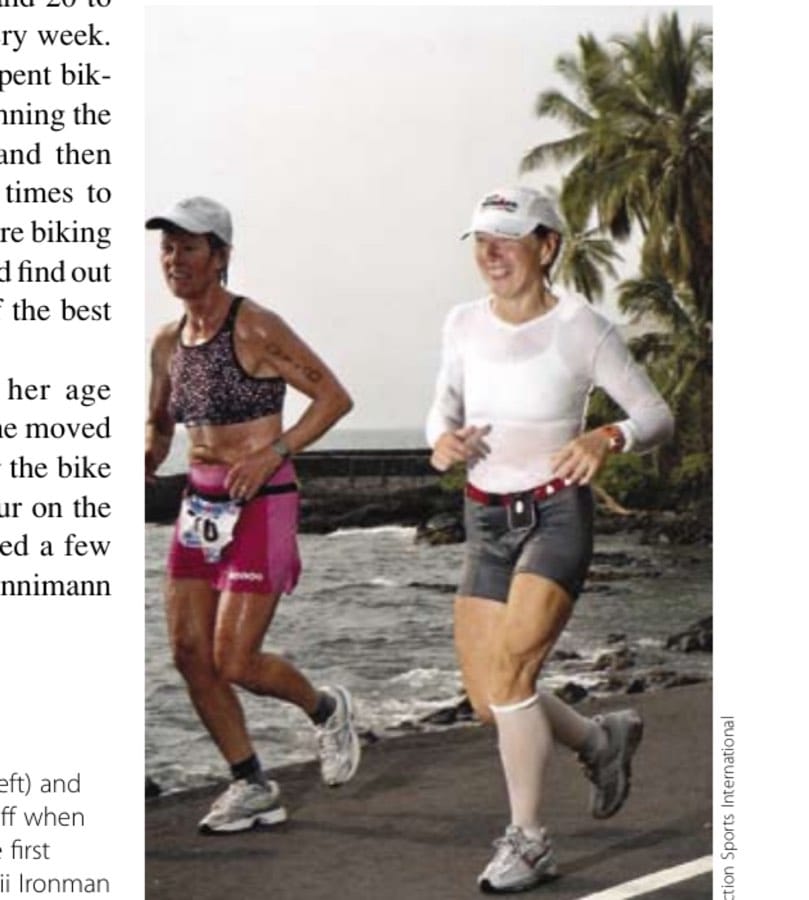
Author Cathy Tibbetts (left) and Denise Everitt (right) hit it off when they met each other for the first time during the 2008 Hawaii Ironman marathon.
© Action Sports International
“At the finish line I started to cry, because this was the hardest day that I have had in a long time,” Everitt said. “I was glad I was done but sorry that I had done so poorly and sad that my mom died the week before and embarrassed that my daughter saw me do so badly. I want to be happy at the end some day and hold my arms up in victory, but that will have to wait until another day/race/Ironman.”
Carol Hassell was another 55-year-old taking advantage of aging up. She hired a coach and trained hard for months, averaging 10,000 yards of swimming, five to 10 hours of biking, and 20 to 40 miles of running every week. Many weekends were spent biking 20 miles to a 5K, running the race for speed work, and then running it a few more times to rack up some miles before biking home. In Kona she would find out whether she was one of the best in the world.
Finishing sixth in her age division on the swim, she moved up to second place after the bike and into first at mile four on the run. Then she was passed a few miles later by Hilly Bronnimann of Switzerland.
“I stayed behind her and watched her for a while. Then I lost sight of her when it got dark. I assumed she motored off,” the nurse from West Palm Beach, Florida, said. “Out of the blue she passed me in the last quarter mile and beat me by 40 seconds. I was pissed. Instead of throwing my hands in the air at the finish line, I put them on my hips.”
Hassell’s second-place finishing time of 11:52:50 landed her on the podium— during a torrential downpour. “I felt like it was raining on my parade. Finally I got something right, and the awards ceremony wasn’t a whole lot of fun.”
Something she did get right was a Boston Marathon qualifying time of 4:14:49. “I was afraid the course wouldn’t be certified, but thankfully it was,” she said. When 1,800 athletes line up for the 2.4-mile swim, the start is like dropping an Alka-Seltzer into a glass of water. Bob Whitmore of North Palm Beach, Florida, had never swum that far before. He had never biked 112 miles, either. For that matter, he had never run a marathon. He was one of 205 lucky athletes drawn out of 7,127 who had entered the annual Ironman Lottery.
When Ironman founders John and Judy Collins turned the race over to a local health club, the agreement was that there would always be slots open to ordinary athletes. The race organization has honored that every year—it’s tradition. Once drawn, athletes need to complete a half-Ironman distance (70.3 miles) to secure their slot.
Competing for a cause “I lost my best friend from high school, John Shanard, to leukemia,” Whitmore said. “And I told myself that if my name got drawn, I’d raise money for the Leukemia & Lymphoma Society. “
Right before the lottery, I told a friend I had a feeling they’d draw my name. He thought I was crazy. And then he saw my name on the list even before I did.” Whitmore got through the swim, which was a PR since he had never gone that far before. He also got through the bike ride, another PR for the same reason. “
The cramping was so bad off the bike I was limping through the change area. When I finally started the run, the volunteers grabbed me under the arm and helped me out of my chair,” the 53-year-old advertising executive said. “Then I got out on the course and there were so many people . . . the adrenaline rush was such a high. It really helped. People were cheering the whole 10 miles through town. “
But then I got out on the Queen K highway, and there was no cheering. There was nobody. It got so dark you couldn’t even see the other runners. Then I met an angel. We were running at about the same speed. I don’t even remember how we started talking, but soon I was telling her my life story.
“She had had a rough time on the bike, and I was having a rough time on the run. I started having some bathroom issues and told my new buddy to have a great race, but I had to stop. She smiled and said good luck, and off I went. After my stop, I was off running again and caught up with her. I asked if she was waiting for me, and she said yes, she knew this was my first Ironman and thought she would keep me company. How nice is that? At the end of a long day, someone I just met is hanging around to help me out on the run. I had to stop four or five more times, and she ran slowly so I could catch up. “
As we entered the home stretch a mile or so from the finish, she encouraged me to take off so I could run down ‘the chute’ and cross the finish line by myself. This was her third or fourth time in Kona, and she wanted me to have the experience of the finish line. I said my friend John would want us both to finish this thing together! As we ran toward the finish line with people cheering, yelling, screaming . . . everything suddenly got quiet in my brain. I thought of my old friend John and my new buddy, Cathy. This is what it is all about. Giving without expecting anything in return.”
A much-appreciated welcome
© Mark Hassell
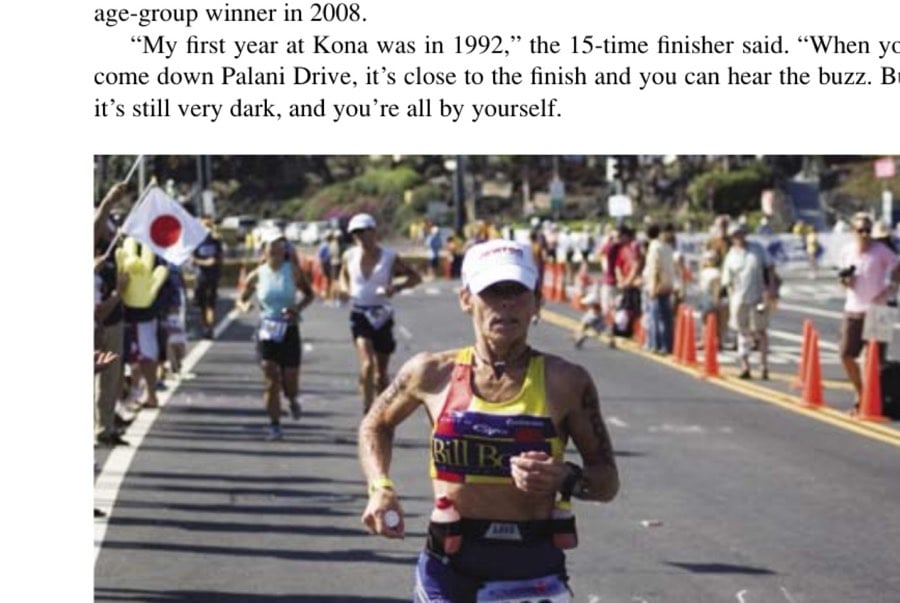
The finish line also has a special meaning for Cherie Gruenfeld, the 60-64 women’s age-group winner in 2008. “My first year at Kona was in 1992,” the 15-time finisher said. “When you come down Palani Drive, it’s close to the finish and you can hear the buzz. But it’s still very dark, and you’re all by yourself.
▲ Carol Hassell during the first mile of the 2007 Hawaii Ironman marathon.
• • • •
Kona entry fee: $550 Airplane ticket to Kona: $1,200 Making small talk with competition during a race: stupid Getting second place in my category in Kona: priceless!
© Action Sports International
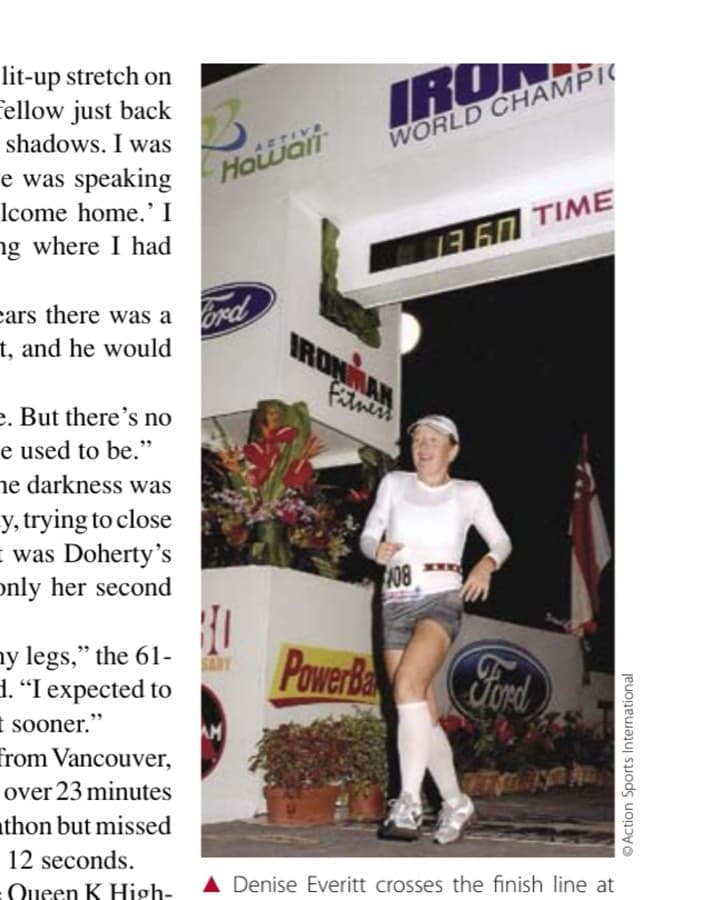
“Just before the final lit-up stretch on Alii Drive, there was a fellow just back from the sidewalk in the shadows. I was the only one there, so he was speaking to me, and he said ‘Welcome home.’ I almost cried, considering where I had been and where I was. “For the next few years there was a shadow in the same spot, and he would always say it. “He’s no longer there. But there’s no doubt in my mind that he used to be.” Another shadow in the darkness was 61-year-old Mary Doherty, trying to close the gap on Gruenfeld. It was Doherty’s first time in Kona and only her second Ironman. “I could really feel my legs,” the 61year-old psychiatrist said. “I expected to see the turnarounds a lot sooner.” The Ironman newbie from Vancouver, British Columbia, gained over 23 minutes on Gruenfeld on the marathon but missed first place by 4 minutes, 12 seconds. “Coming back on the Queen K High- ▲ Denise Everitt crosses the finish line at the 2008 Hawaii Ironman World Championway, it was so dark, but I could start to hear ship. the finish line, and that was exciting “Then turning the last corner onto Alii Drive, the number of people kept getting greater and greater, and it was all lit up with so much screaming. Coming in felt really neat, and I couldn’t believe I had done it.” Doherty took second in her age division and qualified for Boston as well, finishing her 13:15:22 Ironman with a marathon time of 4:24:16. R
unning a marathon is never easy, even though athletes at the Ironman World Championship might make it look that way. All who cross the finish line have their own struggles. You just would never know it from the smiles. As Carol Hassell summed it all up:
Core Versus Skin Temperatures in Marathon Runners The concern of runners competing in high-temperature races is justified. by John Cuddy and Brent Ruby
The inaugural Missoula Marathon, organized by Run Wild Missoula, took place July 15, 2007. Our research team from the Montana Center for Work Physiology and Exercise Metabolism (MT WPEM) at the University of Montana was asked to help out in the medical tent to provide blood-work analysis with our i-STAT blood analyzer and provide core-temperature monitoring for those who might suffer from heat-related issues. As the morning progressed, the ambient temperature quickly rose into the 90s (degrees Fahrenheit), with road temperatures in the 110- to 120-degree Fahrenheit range. Several runners suffered heat-related injuries, with one runner having a rectal temperature of 107 degrees Fahrenheit, requiring immediate emergency medical care. This individual was hospitalized for a few days but survived with no adverse consequences. After such a hot day the race director, Jennifer Straughan, contacted our research team and asked us to design a project to assess and evaluate the thermoregulatory responses of marathoners completing the race so they could better determine the specific medical and support needs for future events.
Historically, core body temperature has received much attention in the scientific literature with respect to heat-related injuries. Although normal resting body temperature for humans ranges from 36.1 to 37.8 degrees Celsius [97 to 100°F], during exercise body temperatures can reach temperatures of 40 to 41 degrees Celsius [104 to 105.8°F] and be sustained for up to two hours. Forty degrees Celsius has been consistently considered a critical core body temperature at which negative feedback from the brain will cause an individual to self-select a slower pace to mitigate any further rise in core body temperature. However, the concept
This article originally appeared in Marathon & Beyond, Vol. 14, No. 6 (2010).
← Browse the full M&B ArchiveMore like this
1,000+ stories from 19 years of Marathon & Beyond
The complete archive of the legendary long-distance journal — digitized and free to read.
