

Running In A Small Desert Town
The following incidents are true. Only the names have been changed to protect the innocent. Remember the Nike ad in which a group of college-age runners is seen going up and down the streets of what appears to be a dusty Mexican town? Finally, they stop and ask an impassive local woman the way back to Los Estados Unidos. She points north. I wish she had been there to help me.
What some might call “lost,” runners call “overdistance.” In the late 1980s, I lived for a while in the southwestern desert. OK, it was New Mexico, but I won’t name the exact location. Now, I want to make it clear that I enjoyed much of the time I spent there and regret only the mistakes that I will relate. Since what follows will not always seem entirely complimentary, the name of the town must remain my secret. I’ll call it River Valley. My reason for going to River Valley was that my work sent me there.
I have to say that I’m originally from the East Coast and was brought up in a big-city environment, so even though I have traveled widely since, I’m not a cowboy or a redneck by nature, and I don’t wear pointy-toe boots. I have, however, learned to enjoy chili peppers.
My first hint of things to come occurred at the car-rental desk in the Albuquerque airport. The pleasant and typically cosmopolitan young woman asked me where I was headed, and when I said “River Valley,” she froze for a moment. Looking me fixedly in the eye, she said, “There are some bad hombres in River Valley.” Hello? Was this the message the chamber of commerce wanted me to hear?
It would be an exaggeration to say that the maps show the area around River Valley as white space, indicating unexplored Indian country. Much of it is, however, Indian country, or more correctly, reservation land.
A good highway took me there. The town was identified as such by the sign at the side of the road and had a gas station, a motel, a diner, and not much else.
In previous times, you might have needed to stop there to water the horses or even get gas, but these reasons for the town to exist had largely become passé. Unfortunately, for many townspeople, there really wasn’t much life’s-work opportunity, and many young people had to leave to pursue their own lives.
What the Area Offered What the area might have lacked in sophistication, it made up for in a rich history, wonderful weather, and majestic views. Native Americans and Spanish explorers probably feuded in years past. The Spaniards had long since departed, but some present-day descendants still professed their ties to the king and rejected federal or state rights of governance. Land that the king had granted to early settlers and that had passed from father to eldest son to eldest son, since long before the events of 1776, need not be blessed by any bureaucrats from the East.
We outsiders were often regaled with stories of how wild and undisciplined the locals could be. In truth, most were great people, trying to make it in a somewhat limited environment. Embellishing their heritage was part of their fun.
A primary aspiration of some of the locals was to have a lowrider. I had heard of such things but had never seen one with my own eyes. A lowrider was either a car that had had its suspension system altered so that it barely cleared
the ground, or the proud guy driving it. Some lowriders could also jump up and down on powered shocks. When the movers, dispatched from the city, were unloading my small pile of belongings, one joked, “You know why River Valley has speed bumps at each end of town? So the lowriders can’t get out! Har! Har!”
A good example of the quaintness of River Valley was the time a coworker of mine stopped at the bank ATM to deposit his paycheck. He said that he heard a bell ringing but didn’t see anything going on or anyone in the area. When he realized that it was the bank’s own alarm that was ringing, he departed quickly before Barney Fife might show up.
Another incident occurred at the local supermarket. Early one evening, the manager was asking everyone to leave, declaring it closing time. Another coworker of mine asked whether it was too early. Wasn’t closing time 8:00 p.m.? The manager admitted that he was right but explained that there were just too many drunks and disorderlies that evening to make it worthwhile to stay open.
The elevation of River Valley was about 5,000 feet. It was a valley because the Rio Grande passed through, and higher elevations were evident all around. Part of the delight of the area was that you could hop in a car, easily drive to 7,500 feet, and then run in the mountains to 10,000 feet. The forests and dry mountain air made it a pleasure.
As a long-time runner, I didn’t notice this first 5,000 feet, although some of the outsiders I worked with claimed to be out of breath from their daily activities. I will admit that when I ran a 10K race in a nearby ski town, I felt like I had a bear on my back the entire way. There is a big difference between running at altitude at a casual trail-running pace and running at road race pace.
My apartment in town was small but provided all I needed. It had formerly been a two-car garage. The house was rented to others; I rented the garage. In addition to the bath, my apartment had a second interior wall, and I could actually walk from one room to another. The only significant compromise I had to put up with was the heating and cooling system. Because the apartment was so small, when the roof-mounted, house-sized fan came on, it practically levitated me off the floor.
Quick Thaw, Then Rethaw Similarly, when the heater came on, it quickly raised the temperature to 70 degrees, and when it went off, the apartment just as quickly dropped back to whatever the temperature was outside. I learned simply to do without the benefit of either, for the most part. I would joke that to warm up on a cold morning, I would open the refrigerator door and bask in the glow of the light. With a map of town, it didn’t take long to drive around and get familiar with the immediate area. There was a main paved road and other, mostly unpaved
roads. This was one location where a four-wheel-drive vehicle really made sense, because many of the secondary roads included stream crossings or were subject to rutting and erosion. In one instance, a friend with a heavy pickup had to tow my car out to the pavement after it got stuck, but I still had to remove all four wheels and scrape the mud off the underbody to prevent the car from rattling itself to death.
A church in the area was originally an adobe Spanish mission. It had been rebuilt over the years but was still in its original adobe and rough timber appearance. The area that I used for most of my running was an open space behind the high school. It was easy to get to on a paved road, and a car could be left there without appearing to be abandoned. The first time I went there, I met a young man just returning from a run; as we approached, we exchanged a few words, and he dropped the rocks he had been holding in each hand. He matter-of-factly said, “Rattlesnakes.”
I chose to take his remark lightly. I never saw him again, nor did I ever see any snakes. I did know enough to scan the trail ahead and avoid areas where footing might be obscured. Also, I never was any good at throwing rocks.
The area was great for running. The temperature was never too hot, because the humidity was low. Rain was predictable and could be avoided easily. The winter temperature could drop to single digits at night but warmed up quickly with the coming of the sun.
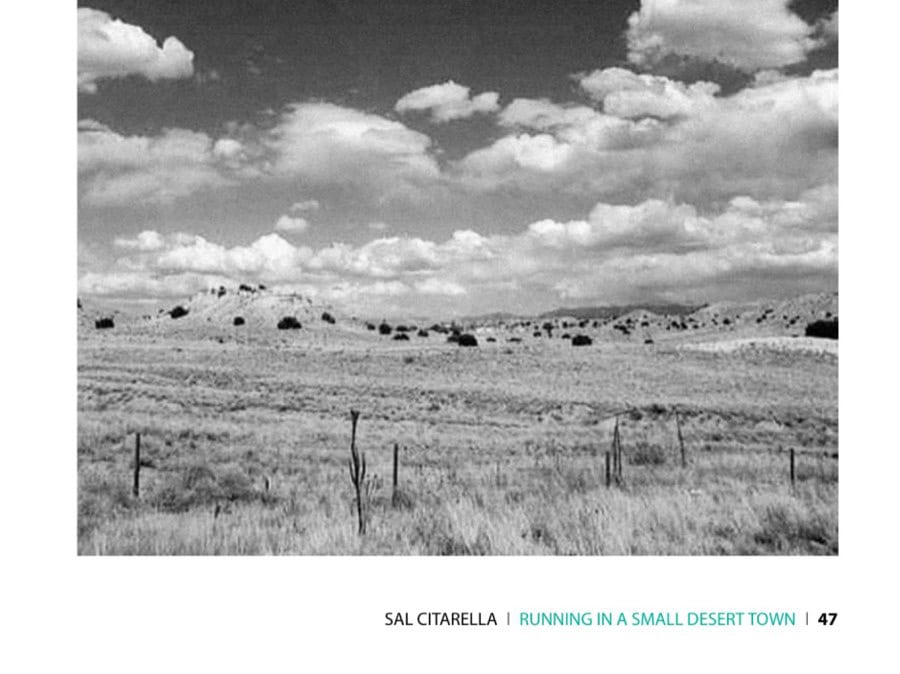
The desert surface was primarily hard-packed cemented sand and rubble rock. Trails existed from storm-water flows, the tires of off-road vehicles, or the hooves of horses. Even though it was obvious that others had used these trails, I don’t recall ever seeing anyone. Perhaps tracks, once made, simply remained until a storm came to wash them out.
Deserts were nothing new to me. I had run in Saudi Arabia for several years, baking my head, charging up dunes, and running on the firm sand at the water’s edge. But I had never experienced the convoluted landscape that predominated around River Valley.
The terrain consisted of modest hills and canyons, which lay in no pattern that I could ever decipher. As my familiarity with this area increased, I ran farther and explored additional routes. I saw wild dogs, so I avoided going too deeply into any canyon that might bring me face to muzzle with a nervous momma dog.
I entered a 10-mile mountain run in a nearby community. It began at about 7,500 feet and finished at 10,000 at a ski area, from which we would be bused back to the start. However, I didn’t start. Thanks to the salad bar at the River Valley Pizza Hut, I got food poisoning and spent my race effort in the bathroom the night before. A few weeks later, I went back and ran a round trip of the course for a highly enjoyable and scenic 20-miler.
A Kindred Soul, a Lost Soul Before long, I met another runner. He was an easygoing local guy who drove long distances to make a living but liked the small-town life. We were grateful for each other’s company. Late one afternoon after work, we met and went running in the same area behind the school. We got lost. It was frustrating because we knew we were close to the road; we just couldn’t find it in the endless, winding canyons. It was quickly becoming too dark to run safely. Should we capitulate and walk? Which way? Should we sit and talk until dawn?
Saved! There was the road right in front of us. I became confident running trails I thought I knew, crossing dry streambeds, seeing my own footprints. On one occasion, all was great for perhaps an hour, and it was time to head back. So I retraced my steps. I knew I was in trouble when I found my own prints going in both directions! I no longer knew how I had come in or how to get out.
So there I was, basically a city kid, lost in the desert with no one around, no one who would come looking, and no idea of what lay in any direction. From the top of a rise, I might spot something—the flash of a metal roof or the glint of asphalt—but when I tried to run toward it, I would inevitably get turned around, and the same point would now be in a different direction. I had begun my run in midafternoon, and the thought that at some point the sun would start to go down added urgency to my situation.
I really did not know the dimensions of the area I was in. In my mind, I considered it maybe five miles in any direction to “civilization.” However, I couldn’t seem to run in any one direction. So, finally, I just ran. Eventually, I came out on a paved road. A car was pulling into a house just as I came up, so I asked the man if he would be able to give me a lift back toward River Valley. Unfortunately, he had to decline, but he pointed me the right way and wished me luck.
I started down the road, and it wasn’t too long before a lowrider came along and stopped for me. Now, let your imagination conjure up its worst stereotype of rural hill people. (The sound of banjo strings comes to mind.) Two men were in the car, dressed in the most casual sort of wear, with straggly chin beards and widebrim hats, and they were drinking beer. But they did stop for me. Their English was better than my Spanish, but I doubt they really believed that I was just out running for fun. I’m sure I offended them by not taking a swig from the beer that was handed to me. I knew they would be familiar with the mission church, so I asked them to drop me there. Since I wouldn’t drink beer and asked to be taken to the church, one of them questioned me guardedly: “You a priest?”
I assured them I was not, just that I needed to have something to eat before I could relax with a beer. I finally reached my car about 3 1/2 hours after I had left it. This experience really scared me, and I thought long and hard about what I might have done differently. I studied what maps I could find, considered carrying a compass, and finally decided I just had to be much more careful in the future.
That worked, right up until the day I got lost a second time in the same area and again had to run myself to safety, this time in 4 1/2 hours. It proved to me, finally, that I had no business running alone in that desert.
I left River Valley shortly after that incident and never pushed my luck in quite that way again. Small towns and deserts have left me with many, many memories— memories from both ends of the spectrum.
This article originally appeared in Marathon & Beyond, Vol. 12, No. 6 (2008).
← Browse the full M&B ArchiveMore like this
1,000+ stories from 19 years of Marathon & Beyond
The complete archive of the legendary long-distance journal — digitized and free to read.
