

When Running Literature Goes Long in the Novel, the Competition Really Heats Up. Part 5 of 5
Parts 1 through 4 of Roger’s series appeared in our last four issues.
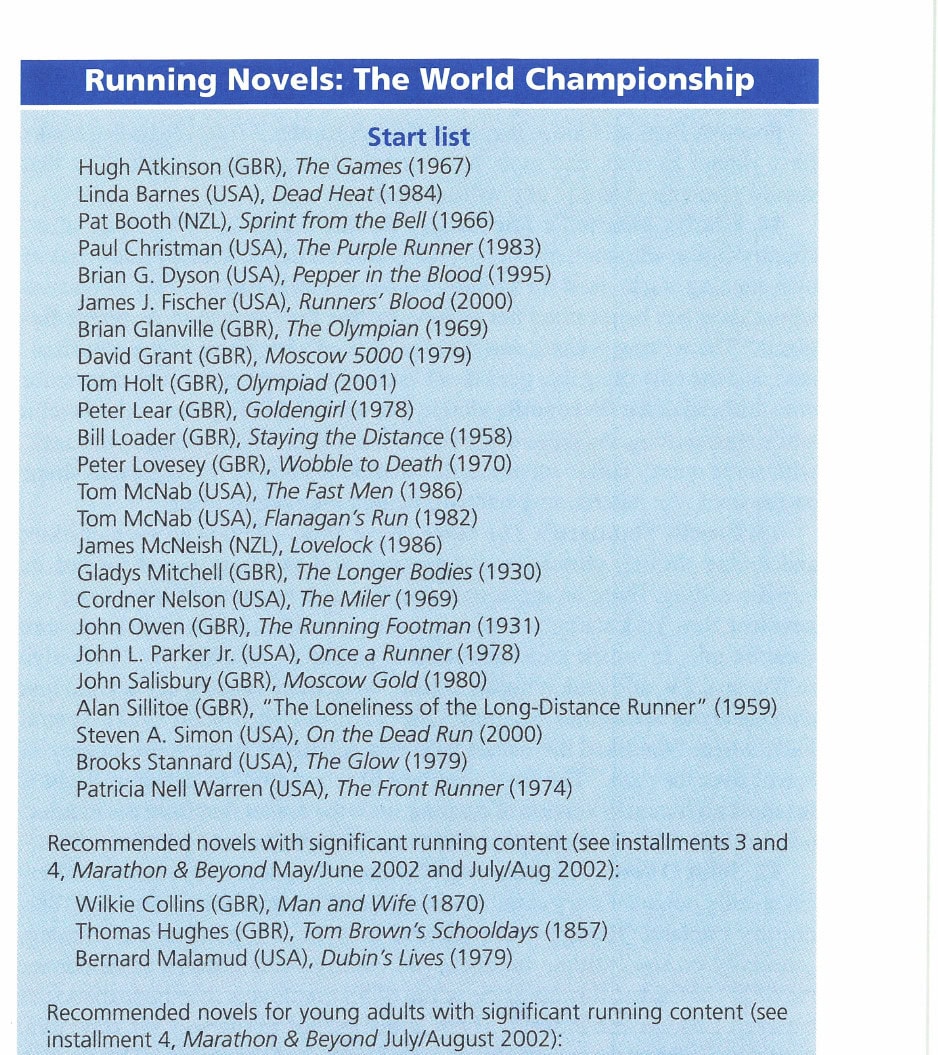
26. Running Novels: the World Championship1
So far, with a little help from my friends2, I have tracked down and read 24 running novels. That is more than I suspected, though still fewer than a great sport like ours deserves. (I will be happy to hear of more: mail to rogerrobinson61@hotmail.com.)
I have covered mainly America, Great Britain, and New Zealand but not yet Africa, Australia, or Canada (other than through libraries where I regularly work). Titles from these countries would be especially appreciated. This survey is limited to works of fiction above short-story length, for adults, and in English. Nonfiction is not included. There are several running biographies, histories, and books of essays of high literary merit, some with the narrative interest of a good novel, but they are quite often discussed elsewhere. To have included them here would have become unmanageable. Stories for children were also excluded, as that is a vast and specialist literary field.
The only other rule is that for this survey the novel or novella must be significantly about running as a central subject, not a passing episode or reference, as in most of the texts I have considered in installments 1 through 4. The Iliad and Tom Brown’s Schooldays are not eligible here (though I wavered over Wilkie Collins’s Man and Wife, see installment 3). Hence, no books earlier than 1930 have been found. Sport simply was not important enough to be the subject of a novel.
The kind of running is not limited. These novels cover sprinters and ultrarunners, sporting amateurs and hired domestic couriers, and everything in between. If your tastes are entirely specialized, choose from the short descriptions provided, but you will miss some pleasures since all runners have much to share. Two or three of the books are available only in research libraries, but most are accessible with a little interloan or Internet effort.
As for how to judge a contest among novels, go for a road run in a pair of plastic sandals. You will cover the ground, but every step is a dull, jarring thunk. Now do the same course in your best racing flats. Spring and float and vary the pace with the finest control. Your running is alive. That’s what I looked for in novels about running. It’s not a matter only of story or accurate detail. The best novels give running and runners life in the imagination. Others may cover similar ground, but it all goes thunk-thunk.
Having often been a judge of literary awards and competitions, I know that the safe thing here would be to not rank the novels. That way I would escape charges of being subjective and keep more friends. But runners like a race, so I’ll risk it.
Ten books are eliminated in the semifinals, for the usual reason—lack of space in the final. Some are well worth a runner’s time, though limited in literary skills; some go mainly thunk-thunk; and some are merely commercial products. The last group includes the “sex, spies, and finishing-tape” blockbusters; ersatz Olympic epics; and beat-up revelations about drugs, IOC corruption, nasty coaches (always German or eastern European), money, and masochism. They may give the usual quick-fix pleasure if you enjoy thrillers. Personally I remain unthrilled by writing like, “He was running in a hot, white light of agony” (Hugh Atkinson). Serves him right.
Here are the semifinalists that didn’t make it through, alphabetically by author: Hugh Atkinson, The Games (1967), lurid exploitation; Linda Barnes, Dead Heat (1984), a Boston Marathon thriller; Brian G. Dyson, Pepper in the Blood (1995), pepper-blooded heroine overcomes manipulative Eastern European coach to win at Atlanta; James J. Fischer, Runners’ Blood, medically expert; David Grant, Moscow 5000 (1979), best of the “Olympic thrillers,” top nonqualifier; Tom Holt, Olympiad (2001), laborious tour through ancient Greece; Peter Lear, Goldengirl (1978), disappointingly formulaic, which is perhaps why a genuine track expert like Peter Lovesey wrote under a pen name; Cordner Nelson, The Miler (1969), though aimed at “young people,” is good enough on the track to list here and not bad on the training/relationships conflict; John Salisbury, Moscow Gold (1980): “Viren summoned from the depths of his being the supreme, lynching effort of mind and body to forge ahead of his rivals to the tape.” (Thunk.) And Steven A. Simon, On the Dead Run (2000), a well-informed cops-and-runners political thriller set in
Washington, D.C.’s trail-running community, often enjoyable, and unremittingly detailed in reproducing that scene.
Fourteen finalists follow, in reverse finishing order. All are rewarding books for a runner to read, and most have imaginative and literary qualities that should give enjoyment to any willing reader.
14. Gladys Mitchell’s The Longer Bodies (London, 1930) is an adroit country-house whodunit murder mystery. This particular country house has its own running track, used for training by an eccentric English cast of cousins whose aunt has bequeathed her fortune to “the first chosen to represent England.” The writing is sharp and concise (a relief after many of the semifinalists), and the only thing that goes thunk is the shot put dropped from the terrace onto the head of the first murder victim. The second dies impaled with a javelin while shot-putting. As these suggest, it’s more than slightly tongue in cheek, with some quirky comic scenes as the unathletic cousins try to get into shape on the track. An entertaining oddball, though long out of print.
13. Brooks Stannard’s The Glow (New York, 1979) is an even quirkier and darker thriller, professionally narrated and skillfully paced toward its horrific ending. From an innocuous opening as a warm and fuzzy about benevolent New York seniors exercising to stay youthful, it turns into a macabre vampire tale, in which their obsession becomes a metaphor for destructive selfishness. I would rank it higher if there were more running scenes and less chitchat about Manhattan shopping. One or two passages nicely evoke Central Park, where “she liked the muted light that splattered through the canopy of leaves over the path.” The final sequence of terror-stricken delirious flight is the most nightmarish version of running since the reader fled from the murderous footfalls of H.G. Wells’s invisible man (in installment 3 of this series).
12. John Owen’s The Running Footman (London, 1931) is very different, a sadly poignant story about one of the humble household couriers of 18th-century England. Though overmannered in style, it is good on the running, especially on the extreme tiredness the worthy John endures as he carries messages or fetches flowers at the whim of his employers over huge distances between London and Suffolk. There is real pathos in the way his superiors, even the governess he secretly loves, take his efforts for granted. “The running footman ran on” becomes a refrain, in writing that at its best is sorrowfully poetic. A good story, too—he dies at the end. Long out of print but could make a tearful movie.
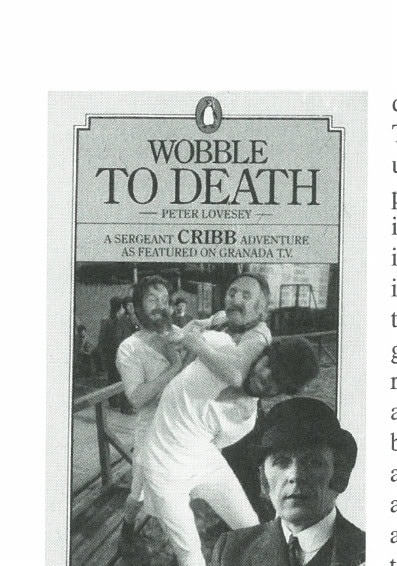
11. Peter Lovesey’s Wobble to Death (London, 1970) was serialized in Marathon & Beyond, January/February 2000 through May/June 2001. Peter Lovesey was already an established track writer and historian, working on his classic Centennial History of the AAA, when he devised this original combination of early sports history, period atmosphere, and murder mystery. It is a detective story set at a six-day race in 1879. The strange world of late-19th-century ultrarunning is brilliantly evoked, with its potent mix of courage, cruelty, commercialism, and colorful personalities. Equally good is the atmosphere of Victorian London, with its jostling foggy streets and dingy gaslit interiors, especially the vast grimy iron and glass Islington Agricultural Hall where the runners shuffle and limp their eight-lap miles among half-dried animal droppings. Their blisters and cramps, their primitive sleeping arrangements and strychnine-laced “bracers” are vividly detailed. The peds themselves are a credible and characterful bunch, and the tactical moves and verbal exchanges among the patrician Captain Chadwick, the fussy diminutive Dr. Mostyn-Smith, and the Irish lout (but resolute competitor) Feargus O’Flaherty ring true to anyone who knows and loves the oddly mixed world of distance runners. I find the detective story less interesting, possibly because in the end it’s not one of the runners who did it. But Sergeant Cribb and his large-booted assistant Constable Thackeray went on to win many fans in later Lovesey murder mysteries. Come to think, it’s a pity they don’t appear in the author’s Goldengirl (see semifinals) to bring a little common sense to that fantasy.
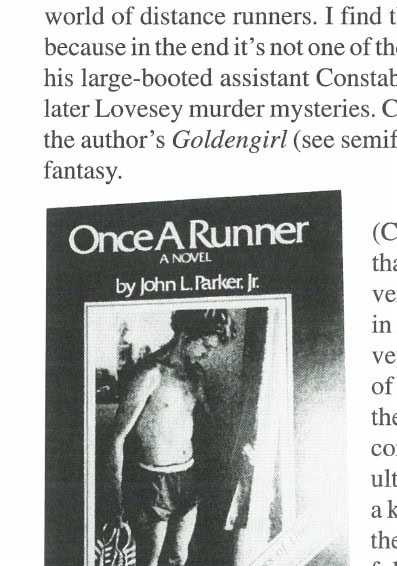
10. John L. Parker Jr’s. Once a Runner (Cedar Mountain, N.C., 1978). “Bliss was it in that dawn to be alive,/But to be young was very heaven!” wrote Wordsworth about living in revolutionary France, and John Parker conveys the same blissful feeling about being part of the epoch-making Florida running scene at the turn of the 1970s. The novel draws its considerable energy from the sense that he was ultimately only a minor part so that it reads as a kind of fantasy of frustrated aspiration. With the attractiveness and the vanities of its youthfulness, it has (like early Wordsworth again) something of the “egotistical sublime.” It is powerful on the runner’s passionate, unapologetic hermitlike commitment, and, if that makes the later action seem like wish fulfillment, that too is psychologically accurate to such single-minded self-preoccupation. There are excellent running sequences, including one of the classic passages of the genre, the 60 × 400 interval session that extends into moonlight and catches the runner’s stream of consciousness under such a self-imposed ordeal better than it has ever been done. Yet there are also tiresome self-congratulatory student prank scenes, facile caricatures of college officers, and snide swipes at other running novels. (And is it pedantic to think that an aspiring world-class miler should trouble to spell Herb Elliott’s name right?) The writing at its best has an energy that fuses with the running it describes: “Cassidy raced along to a night rhythm, pocketa pocketa, a steady tattoo of pleasant solo effort which starred him under many streetlights.” But then it can slide into freshman pomposity. “He was a shaded meteor plumbing a twinkling universe.” The story is slight (evil college officers exclude worthy runner who defies them disguised as a Finn to outkick world record holder to ecstatic applause), but the book’s commitment, its vitality, its self-belief are all in showing how it is to live as a runner—the labor, the loneliness, the agonies, and the bliss and very heaven of it.
9. Bill Loader’s Staying the Distance (London, 1958) tells with concise clarity how a working-class English runner overcomes self-doubt and a social inferiority complex to finally “stay the distance” and win an international 5,000 meters. It is especially good on the dingy track and field scene of industrial northern England of the 1950s and quite good (with limitations) on how the runner’s personal anxieties intersect with his running. An ordinary man in everything but his aspiration to be a great runner, Tigger Dobson gets screwed up by his sullen resentment against the Oxford-educated “Golden Boy” who beats him on the track and (it seems) steals his girl. His failure in a big trial race is convincing and painful to share. “Disappointment was a poison, corroding his body and mind. If he couldn’t be first, he didn’t care where else he came.” As things improve it gets less believable—Golden Boy turns into a jolly decent chap; the forgiving girl shows up before the big race to kiss him good luck; and the description of the climactic race is done entirely from the outside, movie style, through commentators, crowd, girl in admiring tears, mum hiding her face, and so on. It keeps a good, solid literary pace but lacks a top gear.
8. Paul Christman’s The Purple Runner (Boulder, Colo., 1983) makes a story of wonders and romance emerge from a credible setting, as good fantasy should. It has strengths unusual in this field. Better than any other novel here (except the special case of Flanagan’s Run), it brings to life a full running community, a varied cross section of interesting people behind the cast of five main characters, all training and seeing each other train and running together by arrangement or accident or romantic opportunism on London’s Hampstead Heath. That community sense is an important part of running experience in many places, and Christman captures it affectionately. He also gets closer to the ordinary realities of running than most other novels, not just the extreme workouts or heroic finish line victories, but the routine and rewards of daily running, the feel of different surfaces and gradients under your feet, the rain in your face and the roots that catch your toes, the feel of dried clay on the back of your legs, the unconscious picking up of speed as you pass some friend by chance in training, the unspoken pressure when the friend joins you, and just how it feels to be ordinarily tired. Also unique to this novel, it affirms the value of running as enriching life for runners of any level of ability. Off the subject of running, especially in the early pages, the writing tries too hard to be literary and overreaches, like an anxious runner early in the race, and gets into polysyllabic-adjectival oxygen debt, also choking on several participles that go down the wrong way. But it settles down later into a more modest, effective stride. The five main characters represent distinct and credible attitudes to running—an American seeking to make the most of limited talent, another too insouciant to use the many talents he has, an unwashed but canny and resilient Scot still good for a 2:30 marathon at age 53, an attractive young New Zealand star seeking a relationship with the same purpose and success she finds in running, and the mystery “purple runner” usually glimpsed only at a distance running across the heath at amazing speeds. All point toward the London Marathon that provides an inspiring conclusion. For Christman takes the risk of stepping from realism into fantasy. His facially scarred recluse who emerges from his cavernous underground hideaway only to run prodigious interval sessions (10 × 1 mile in 4:15) or play masterly pub chess is a romantic running Phantom of the Heath, with echoes of the Lone Ranger and, for English readers, of the Famous Wilson from the 1940s boys’ magazine The Wizard, still cult reading in some English running circles. The possibility that he is Steve Prefontaine (like Wilson, a phoenix reborn) is teasingly sustained. And his climactic sub-two-hour marathon is pure Broadway in its energy and send ’em home happy uplift. Why not? There is no rule against fantasy in fiction, and Christman handles it with boyish zest; and anyway, he is only being more open about it than the heroics of Parker, Loader, Warren, or McNab.
7. Pat Booth’s Sprint from the Bell (London & Auckland, 1966) gives another convincing picture of the preprofessional era, this time in New Zealand. The story is of Steve Barlow, an ex-seminarian whose fervor is transferred under an inspiring coach into a quest to be the first under 3:50 for the mile. It’s better than Loader or Parker on the personal stresses of such dedication, on his marriage in this case. It also deals well with the pressures of celebrity, an intense problem in a small society, as Steve is lured into ambiguous shamateur employment as a front man for a pharmaceuticals company. Booth is a vastly experienced writer, a top journalist and investigative reporter, who has also
written a novel about an astronaut and a biography of Edmund Hillary, always focusing on the intersection of ordinary people with mythic moments in history. Though never elaborate, his writing has a range and versatility beyond most of these books (only Glanville can match it). Above all, it often takes us inside the runners’ heads without distracting from the mythic import of the moment and the scene. “He felt his muscles at full compression, and his mouth was open, sucking in air. Two hundred yards to go, and that figure was still fifteen yards clear, beginning to move without any slackening of pace into the bright light which began on the bend and continued to the tape down that avenue of sound.” The story avoids the usual heroic victory, too, as the first sub-3:50 goes not to the hero but prophetically to a shock finish by a powerful young New Zealander whose initials are J.W.
6. James McNeish’s Lovelock (Auckland, 1986) is a skilled, highly professional biofiction on the life and inner perplexities of Jack Lovelock, the New Zealander who won the 1,500 meters at the Berlin Olympics in 1936 in world record time. Often seen as one of the most perfect tactical victories in track history, it was described by Lovelock himself in his journal as “an artistic creation.” McNeish set out to probe the mystery and define the myth of the intensely private man who achieved such public brilliance. He draws extensively on Lovelock’s journals, as well as research into his life in New Zealand, England, and postwar America, and adroitly cobbles in other documentary material like some classic 1930s sports writing by E. A. Montague and others, and Harold Abrahams’s famous “Come on, Jack!” commentary for BBC radio. The background is deftly and vividly done, particularly 1930s Oxford, the hype of the “Mile of the Century” races in America, and the sinister scenes of Nazi Berlin (though these are overheated in places). Lovelock’s death by an accidental fall under a New York subway train at age 39 makes an infallibly poignant ending, even though McNeish weakens it by untenably suggesting suicide. But his research into Lovelock’s married life and medical career in London and New York is turned into telling narrative. His version of Lovelock’s confused inner consciousness (as he presents it) is compelling. Anyone who knows the journals and the facts will have doubts, but it works well as fiction. By cunningly blurring the distinction between documentary and invented material, McNeish has made a runner’s life into a strong psychological as well as sporting drama.
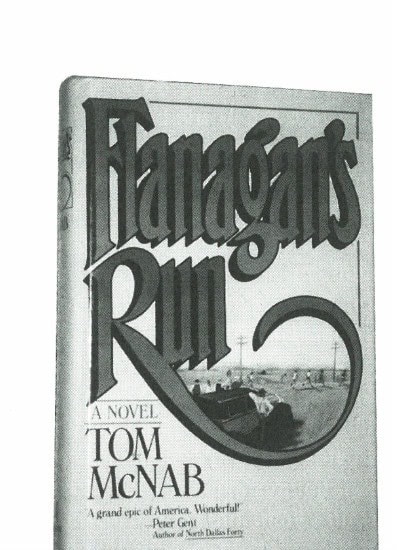
5. Tom McNab’s Flanagan’s Run (London & New York, 1982) is an energetic and engrossing tale of an imagined coast-to-coast footrace across America in 1931. McNab makes fascinating use of a compendious knowledge of running history, as well as the social background of that fraught period. So an artisan Glasgow Scot races alongside an American ex-pug steelworker unionist, an English lord socially displaced by his father’s trade origins, an
ardent team of blond Nazi Germans seeking a propaganda victory, and innumerable ill-prepared hopefuls desperate to elude the Depression. An ex-showgirl adds love interest and leads the women’s running cause. Period flavor is enhanced by encounters along the way with celebrities like Douglas Fairbanks, Al Capone, J. Edgar Hoover, and a thinly disguised Avery Brundage. It has genuine insight into the psychology and the practicalities of ultrarunning, the runners ever torn between their dauntless courage and their fallible tendons. It’s so good on the running, in fact, that it would have been a better novel if less anxious to spice itself up for the general reader with interludes of boxing; man-against-horse racing; Chicago gangsters; and the contrived marathon, which makes a less than convincing climax. The same trade-off limits the characters. They are OK and credible, but any depth is sacrificed to packing the action with more incident and invention. But it romps across the continent with as much resourceful gusto as its own irrepressible Flanagan.
4. Patricia Nell Warren’s The Front Runner (New York, 1974) is running’s best love story. The passionate gay love between an outwardly militaristic college track coach and his star athlete is interwoven with Billy’s rise to the Olympic 10,000-meters title, with some vivid and fully human insights into gay culture and lifestyle, and with the whole complex of phobias and exclusion tactics provoked by successful gays in sports at that era. Many of these running novels make their main characters marginalized outsiders overcoming a hostile establishment, but this one brings in the whole dimension of a 1970s activist movement on behalf of the gays and its conformist opposition. Its idealism is very early ’70s, but it has a political and moral reach beyond most other books here. The running tends also to be idealized, as there is never any real sense of how hard training and racing are at this elite level; but the race sequences are succinctly dramatic, and there are fine lyrical descriptions of training runs through the hills and woods. Any flower-power pastoralism, however, is countered by some utterly authentic running locations. Painful scenes in the “outing” of the gays come at the weekly New York track writers’ lunch in an Italian restaurant and over steamy tea and sandwiches after a rainy RRCA 15K cross-country at Van Cortlandt Park. The narrative of athletes on the no-expenses fringe of international class traveling cheap from track meet to track meet around Europe is also certainly true to that era. Don’t read this one if you’re averse to sexually forthright love scenes, especially gay ones, or prefer to keep any illusions about movie audiences in parts of Greenwich Village. But for giving runners a real and significant emotional life and a place in a developing, morally conscious society, with running always an important part of their lives, this is one of the best.
3. Alan Sillitoe’s “The Loneliness of the Long-Distance Runner” (novella in a short-story collection of the same title, London, 1959) is a small masterpiece of confessional, stream of consciousness fiction. It is difficult to rank here because more than half its 50 pages are about the 17-year-old narrator’s miserable and emotionally crippling home life and his consequent relish for petty crime. Yet in perhaps 20 pages of free-floating thoughts about his early morning training runs and the final cross-country race, it says more about the experience and inner meaning of running than almost any other book. Through running the narrator finds a full and complex identity that has been denied by a dysfunctional family and a society that addresses him only impersonally as “Smith.” He discovers and develops his running talent while serving time for burglary at a Borstal (boys’ reformatory home); but when the governor wants “Smith” to win the national cup for their team, he stops short of the line while well ahead and waits for the next runner to pass him and take the title. Thus Smith and his story defy every expectation of society, sport, and the heroic literature of running (every other book on this list) in one eloquent, outrageous, deeply disturbing gesture of negation. To understand the complex force of the ending, you have to know what his running means to him, and here Sillitoe’s writing is many layered and poignant. Running makes Smith feel free of the crowded pressures of society (the 300 other boys still asleep in the dormitory) and free of the squalid misery of home. Running makes him feel like “the first man ever to be dropped into the world,” giving him contact with the earth yet utter detachment, “turning at lane or footpath corners without knowing I’m turning, leaping brooks without knowing they’re there.” It lets him think and yet be free of thought. In running he can relive the horror of watching his father die of throat cancer—”now that I see my bloody dad behind each grass-blade in my barmy runner-brain I’m not so sure I like to think”—and work out his anger and revenge, and “curse the Borstal-builders and their athletics—flappityflap, slop-slop, crunchslap—crunchslap—crunchslap.” Through running he defies them all and forges his own new being for himself, “a long-distance runner, crossing country all on my own no matter how bad it feels.” All this is so complex and deeply felt that as he waits at the end of the race for his rival to struggle past him he is not gloating but weeping—”something bloody-well made me cry”—for the grief, the loss of freedom, and “out of gladness that I’d got them beat at last.” The deepest irony is that the governor told him society wants him to be “honest,” and Smith as runner finds and expresses honesty beyond society’s comprehension. “I knew what the loneliness of the long-distance runner running across country felt like, realizing that as far as I was concerned this feeling was the only honesty and realness there was in the world and knowing it would be no different ever, no matter what I felt at odd times and no matter what anybody else tried to tell me.” Every runner has known something of that profound honesty. You don’t have to be a burglar to appreciate that Sillitoe gave running literature more than its most perfect title.
2. Brian Glanville’s The Olympian (London & New York, 1969) tells a story that is basically simple and familiar, almost archetypal. A suburban London club quarter-miler of no distinction as a runner and little attraction as a person is recognized as a potential world-class miler by a near-weirdo coach and transformed into an Olympic 1,500-meter contender. That outline of mere physical endeavor is enriched, however, with such invention of narration and intelligence of comment that it becomes resonant with emotional, moral, spiritual, and aesthetic significance. Literature has been doing this for war and love for centuries but has barely begun on the task of doing it for sport—our sport, anyway. Hence this series. As the narrative itself says early on about ordinary runners at a local track meet, they “have style, for the most part, only in movement.” A novel cannot actually show that movement, only describe it; but through language and narrated action it can give verbal form to the significance within the runners’ “suburban gaucheness,” the inner depths of courage or combativeness that very occasionally lets the luckiest of them “turn into lions and roar in the arena.” So Glanville charts Ike’s progress and problems not through a single lens but through shifting multiple perspectives. Sometimes we are inside Ike’s head, sharing his limited verbal responses to running, racing, and life—and often we come to understand more than he does. Sometimes an astute and much more articulate observer analyzes what we are shown and comments on its significance. News reports in authentic tabloid journalese (once a women’s magazine) emphasize the topicality of events, or the technique of film script denotes detailed visual effects that frame tight authentic dialogue. Many of a runner’s experiences are given verbal form, from crude caveman competitiveness (“he’ll fade on the second and third—then use Burke and bang again at the bell”) to the tumbling complexities of a guilty sleepless night. No book better catches the physical feeling and emotional trauma of sudden injury: “the agony of a man abandoned by his closest friend” (his leg). It’s good on power-mad officials, shamateurism, the mixed camaraderie and hostility of the international elite, the sexual electricity of a Games village, the disloyalties that disappointment can provoke, and much more. It risks a central character whose conduct is far from admirable, yet keeps us with him—just. Not quite all the way, however. When it asserts, “The athlete passes through
the Valley of the Shadow of Death, through the pain barrier, and is born again in the holy spirit,” the reader is being subjected to a borrowed resonance. There’s a dimension missing, which perhaps is best called sympathy, such as Sillitoe supremely evokes, or Warren, or McNeish. Though The Olympian has all the skills and subtleties that could make a winner, it finally falls a stride short of the sheer vitality, the throbbing brio of a book that has less range of accomplishment but more imaginative life, more passion, and more truth.
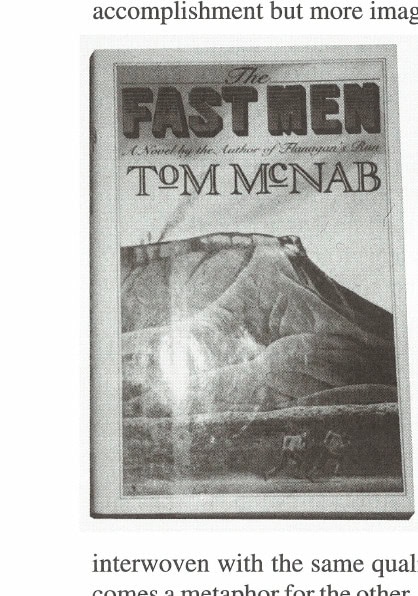
1. Tom McNab’s The Fast Men (London & New York, 1986), like all big-race winners, succeeds because its foundations are as good as its finish. Its success is built on two inspired and original story ideas. First, it is—unlikely as it seems—a story about runners set in the American Wild West. This is not the Hollywood version, though there are fights and violent deaths and Indians and Custer’s cavalry and Marshal Boone, but a historically authentic, raw, pulsating, and unstable society spread thinly over the vast continent, from the early Civil War to after the Little Bighorn. Second, the central characters are not only runners but actors. The rambunctious, inventive, entrepreneurial, combative energy of premodern sport is interwoven with the same qualities in early modern theater so that each becomes a metaphor for the other. Running and acting are performance arts, this acutely intelligent novel demonstrates, both seeming to exist only for an audience that pays the box office or the bookmaker. Both therefore have considerable elements of showmanship, sometimes falseness. Yet both at heart, it even more forcefully shows, are utterly genuine, demanding the highest degree of technical craft and artistic commitment, and rewarding their spectators by revealing the very best in human capability. “When you were at your best, on the boards or on the running-path,” muses Moriarty the distance runner/actor/manager, “there was a feeling of power, energy flowing through body and mind. You were above the performance—it was performing you.” McNab thus, in giving imaginative life to running, returns it to one of its important origins. In his ramshackle frontier towns of planks and tents, the running course stands where it does in the carved marble stones of Delphi—next to the theater. The spectators at both feel what McNab here calls “this [strange] release, this joy, that men (and, dare I say it, women) gain from the witnessing of sport at its best.”
The novel is deeply informative about both running and theater, impressive in historical detail (though willing to modify it), and even more impressive in its sensitivity to the emotional and personal demands of doing both to a high level at any time in history. It is as good on the actor’s sense of lost rapport with the audience as it is on the athlete’s despair when injured, “feeling the injury buried deep, like a cancer—he felt himself a nothing, incapable of beating a matron of seventy.” Yet these insights and reflections make it no loitering meditation. It’s a story of jostling jampacked incident, crowded with characters, restive and always in motion. Superficially it is an on-the-road novel but has the extra dimension of being thoughtfully shaped and adroitly crafted. The brilliant opening scene, where a young Sioux is found spying in astonishment on a pair of White Eyes, one running uphill intervals, the other doing repetition sprints, is recurred to 200 pages later when runners (one of them the same sprinter) are captured scavenging for gold in the Black Hills a few weeks before Little Bighorn and forced to compete for their lives in the sacrificial Sioux ritual of “the Run of the Arrow.”
This pleasing sense of structure anchors all the book’s immense variety of action. A theatrical tour of England in 1861–1862 goes in parallel with the racing campaign there of Louis “Deerfoot” Bennett. Once we have witnessed the origins of Moriarty in the famine-stricken Scottish Highlands after enclosure and the starving boy’s trek with his farmer-runner father, they never leave our mind, nor his. Through all its nomadic opportunistic travel, the book thoughtfully threads the progress of three marriages and makes its women, all actors, as energetic and active as their men, though also wiser. A few episodes seem included for their short-term effect and so weaken the book—a gunfight that simply fails to ring true, a final sequence that is stagy rather than dramatic, a sexy-squaw scene lifted from the movie Little Big Man. But not much is extraneous or inorganic, and that’s a good test of a novel.
As for the running, since that’s our main business, there’s more or less anything you fancy, short of ultras or Death Valley (it’s a wonder he didn’t think of that). True to history, the main frontier-town gambling events are sprints, but variety is provided in setting, competitors, handicap, and innovation (we supposedly witness the first spiked shoes and the first crouch start). There are Highland Games and a Cumberland fell race, Josiah Headley the coal miner quarter-miler and Deerfoot’s world record one-hour run, ride and tie, man against horse in sprint and high jump, Sioux religious running customs and song of the man who ran like the hawk, the world’s first sub-4:30 mile and first sub-two-minute 880, and much else. With splendid impudence, the author ends the book by claiming that his fictitious main character was the first to think of reviving the Olympics and gave the idea to a visiting Frenchman. Uniting all this, grounding its exuberant inventiveness in real human feeling, is the quality that captivates a young German American (who goes on to be one of the main characters) when he first sees sprinters in action. “It was the totality of effort that attracted him—the perfect, utter commitment to cover short distances in a blaze of speed, without hint of reserve. From the moment he first saw sprinters, he knew that was what he wanted to be.”
Omit the words “short” and “blaze,” replace “sprinters” with “runners,” and that is the truth of every book on this list and for every reader of this magazine. The Fast Men is a novel of vivid imagination and passionate truth about running.
Endnotes
1. Readers who run marathons may have noticed that this 5-part series on running in literature somehow fell into 26 sections and that the last section was by far the longest.
2. My thanks especially to Jonathan Beverly, Rich Benyo, Len Francis, Greg Vitiello, and Ray Wallis for suggesting and in some cases lending me books; to Steven Simon for a presentation copy; to my wife, Kathrine Switzer, for the use of others from her collection, some presented to her by their authors; and to the British Library for holding some otherwise vanished titles.
MIGRATORY BIRDS and whales rely on stored fat to fuel their long, strenuous journeys. Developing your fat engine will increase the amount of energy you can generate, reduce the amount of carbohydrates you use, and stretch out the glycogen supply during long runs. Added together, you have a more stable and enduring energy supply, better endurance, and faster finish times.
To illustrate, let’s consider Shane. Shane is a computer engineer in his late 30s who has stayed active over the years with yard work, occasional football games with his kids, and sporadic attempts to weight train. In short, he was not aerobically fit. Inspired by the fortitude and tenacity of his wife, who just ran her first marathon, he decided to train for a marathon.
He was determined to be informed and methodical about the process. Many of the books he read recommended training with a heart rate monitor. The books said that most people run marathons at 75 to 80 percent of maximum heart rate, so he decided to do a test. He consulted a chart to find his heart rate at a more manageable effort of 65 percent and set off running. After only 90 minutes on the road, he felt nauseated and fatigued. His legs felt like bricks, and finally he was forced to stop. In other words, he bonked well short of the distance he would need to cover to finish the marathon.
Due to his low level of fitness, most of Shane’s energy was coming from the limited carbohydrate stores in his liver and muscles. He simply ran to the end of his carbohydrate supply. Carbohydrates are necessary to maintain exercise at any intensity. An excessively high rate of usage combined with low carbohydrate stores reduced his endurance, even at relatively easy running speeds. Had he eaten GU or drunk Gatorade, he still would not have been able to continue for much longer. A training program that focused on switching to fat for fuel would change that.

This article originally appeared in Marathon & Beyond, Vol. 6, No. 5 (2002).
← Browse the full M&B ArchiveMore like this
1,000+ stories from 19 years of Marathon & Beyond
The complete archive of the legendary long-distance journal — digitized and free to read.
