

Running in Literature: Coming Into the Modern Age, the Literature Sprints Ahead. Part 4 of 5
18. The Unforgiving Minute: Into the Modern Age
Running is about intense and committed effort. Running is also about free and joyful movement. The first surely is best expressed in Kipling’s unforgettable lines in “If”:
If you can fill the unforgiving minute
With sixty seconds worth of distance run . . .
Kipling’s poem as a whole is about growing up and learning the responsibilities of life. But those lines say something special about running. I saw the poem recently on the back of a door in Arthur Lydiard’s home near Auckland, New Zealand. No one I have ever met fills every minute with more distance than the great coach, even at age 84, and seeing the words there reminded me how well Kipling in two short lines has captured the special intensity and purpose of competitive running.
For running free, the best short expression I know came in an unexpected place, Saul Bellow’s novel Henderson the Rain King (1959). A rich and complex story about Africa, and power, and the yearning for self-knowledge, it ends with a magical image of running as an expression of freedom and life. The last scene is of a refueling airplane on a snowy field in Newfoundland and of the narrator running:
Laps and laps I galloped around the shining and riveted body of the plane, behind the fuel trucks. Dark faces were looking from within . . . I guess I felt it was my turn now to move, and so went running—leaping, leaping, pounding, and tingling over the pure white lining of the gray Arctic silence.
Running is like music, capable of infinite varieties of mood. We can run in zestful joy or in somber melancholy (as many of us ran on September 11, 2001). We can run intent and purposeful or leap along in tingling freedom. Kipling and Bellow show something of that range of possibilities.
Running in the modern era has developed its own literature, although for a major sport and important social movement it is a less extensive and distinguished literature than might be expected. Baseball, boxing, cricket, fishing, horse racing, and soccer have all generated far more good literary celebrations or analyses than track and field or running. Yet ours is growing slowly. This fourth article, and the fifth (on running novels), will look at a selection of recent literature that includes running. My basic principle is still as I stated in the first article: I have looked “for words that express, evoke, reimagine, narrate, celebrate, or make memorable or vivid some aspect of the experience of running.”
The quickest way to find literary running writing is in the anthologies of sports literature that turn up occasionally. Garth Battista’s The Runner’s Literary Companion (1994) is the only anthology so far devoted to running literature and offers a very good selection of fiction and poetry, mainly from the later 20th century. Some of its best poems also may be found in the excellent American Sports Poems, edited by R. R. Knudson and May Swenson (1988). Another enjoyable verse anthology is Sprints and Distances: Sport in Poetry and the Poetry of Sport, edited by Lilian Morrison (New York, 1965), which covers all sports, not just track, and has some refreshingly unusual choices. The earliest sports anthology was The Game’s Afoot!, edited by Bernard Darwin (London, 1926). It contains no writing about running, though there are things in the sections on “Walking and Mountaineering” and “Open Air” that have some relevance. It’s an old-style “gentleman amateur” collection, based on the criterion that “The best writing on games and sports is always cheerful and spirited and full of the joy of life.”
The best British selection is Sporting Literature. An Anthology, chosen by Vernon Scannell (Oxford, 1987). For sports poetry, The Poetry of Motion, edited by Alan Bold (1990), has several good running poems, including some in vigorous Scots dialect verse that I didn’t know. Here is an extract about a shrewdly tactical runner. (Practice motorcycle imitations before reading.)
At running races, short or lang,
I wat ye couldna come him wrang:
When to the hill wi’ furious thrang
They swat an fyked,
The first half-mile he let them gang
As fast’s they liked—
But fleetly hameward on the track,
When little headway they could mak’,
He led the whazzlin’ stragglers back
In proud career,
Fu’ fleetly springing and as swack
As ony deer.
(James Kennedy 1848–1922, from “Elegy on the death of James Fleming, the Scottish athlete”)
“Furious thrang” is a wonderful phrase for the frenzy of a mass start, and “swat an fyked” is perfect for what goes on in the jostling effort of the pack. And what could better describe the gasping struggling tailenders than “whazzlin’ stragglers” or better describe a runaway winner than “swack” (lithe and springy)? As an aging runner, I seem to whazzle more often than I’m swack these days.
19. “We Run Because We Like It”: “The Song of the Ungirt Runners”
The three poems most often quoted in connection with running and included in all the sports anthologies are Kipling’s “If,” A. E. Housman’s “To an Athlete Dying Young” (see installment 3 and section 24 following), and “The Song of the Ungirt Runners,” by Charles Hamilton Sorley. I first discovered Sorley’s haunting poem through the two lines from it that Roger Bannister used as one of his well-chosen chapter headings in First Four Minutes. (Since I’m not supposed to be dealing with nonfiction running books, I take this opportunity to sneak in a mention of one of the best):
And we run because we like it
Through the broad bright land
The lines stayed with me, and the whole poem appears in several anthologies. But I know of no account of it, nothing that gives any guidance about what it means, how it came to be written, or why it is so evocative. So I decided to try. Here is the poem in full:
The Song of the Ungirt Runners
We swing ungirded hips,
And lighten’d are our eyes,
The rain is on our lips,
We do not run for prize.
We know not whom to trust
Nor whitherward we fare,
But we run because we must
Through the great wide air.
The waters of the sea
Are troubled as by storm.
The tempest strips the trees
And does not leave them warm.
Does the tearing tempest pause?
Do the tree-tops ask it why?
So we run without a cause
‘Neath the big bare sky.
The rain is on our lips,
We do not run for prize.
But the storm the water whips
And the wave howls to the skies.
The winds arise and strike it
And scatter it like sand,
And we run because we like it
Through the broad bright land.
There are two short biographies of Sorley, one called The Ungirt Runner, but they give only passing reference to this poem. He had the briefest of literary careers. He wrote a few poems at high school, a few in the short interval between leaving school and joining up as a British officer for World War I in August 1914, and a final few during training as a junior officer and action on the Belgian Front. He was killed by a sniper’s bullet in October 1915, aged 20. A short posthumous volume of his poems was published in 1916. Showing remarkable poetic talent for such a beginner, it had a deserved success.
“Song of the Ungirt Runners” was then selected for the revised Oxford Book of English Verse and thus gained wider familiarity. No doubt that is where Roger Bannister found it. More recent editions of the Oxford Book have dropped it, however. Sorley is now little known, except as a minor member of that sad generation of English war poets. His best-known war poem is a bitter
condemnation of the slaughter in the trenches that begins, “When you see millions of the mouthless dead/Across your dreams in pale battalions go. . . .” It was found in draft in his pack after his death.
“Song of the Ungirt Runners” is not directly a war poem but it is full of the tumult of catastrophe, as you might expect at that terrible time:
The waters of the sea
Are troubled as by storm.
The tempest strips the trees
And does not leave them warm.
It was written, I discovered, during his period of military training in early 1915. Read in that light, it catches perfectly the sense of unease and disorientation of that troubled generation of young men who came to adulthood between the sinking of the Titanic in 1912 and marching up the line to death in the trenches:
We know not whom to trust
Nor whitherward we fare . . .
There is the nagging sense of anxiety and doom: “the storm the water whips/And the wave howls to the skies.” Yet through the storm and stress of the external world the swinging rhythm of the runners pulses onward. They run forward through the tearing tempest lightly, determinedly, and almost joyfully, without purpose other than the compulsion to run. Running is an act of nature and like other acts of nature needs no motive or explanation:
Does the tearing tempest pause?
Do the tree-tops ask it why?
So we run without a cause
‘Neath the big bare sky.
By running, these unnamed runners find freedom, release from that world of strife and loss, and some personal pleasure through a time of imposed control:
We swing ungirded hips,
And lighten’d are our eyes;
The rain is on our lips,
We do not run for prize
. . . But we run because we must
Through the great wide air.
This reading is supported by the biographical context. Charles Sorley had been a good runner and vigorous long-distance walker during his high school years at Marlborough College, England. He was good at sports, especially rugby football, but most of all loved the opportunity to run or walk across the Wiltshire Downs. Sunday walks were compulsory at the school in summer (known as “distance calls” because the students were checked at some landmark distant from the school), and in winter there were cross-country runs (called “sweats”) whenever the weather was too wet for football and field hockey. Some of the young poet’s other verses from his school days, now virtually unknown, are about these long runs or “sweats.” The weather, as in “Ungirt Runners,” is always wet and windy. For example, “Rain” (written while he was at school) begins:
When the rain is coming down,
And all Court is still and bare,
And the leaves fall wrinkled, brown,
Through the kindly winter air,
And in tattered flannels I
“Sweat” beneath a tearful sky,
And the sky is dim and grey,
And the rain is coming down,
And I wander far away
From the little red-capped town.
It’s a decent piece of “mood” writing for a 16- or 17-year-old, and the subject is relevant to “Ungirt Runners.” By escaping to the heights of the surrounding hills, “Rain” suggests, he finds freedom from “All this land of time and rules,” just as by running ungirded and “lighten’d” the runners in the earlier poem escape regimentation, survive the storm, and elude official purpose (“We do not run for prize”). There’s another schoolboy poem on the same idea, a scathing satire against the rigid school discipline he so disliked:
O come and see, it’s such a sight,
So many boys all doing right:
To see them underneath the yoke,
Blindfolded by the elder folk.
Just before a war in which Europe’s older generation in effect massacred its own young, these poems are more pertinent than merely a schoolboy writing about the constraints of school and the fun of running.
“Song of the Ungirt Runners” has been thought of, if at all, as a rather vague vision of runners, perhaps in ancient Greece. But there is nothing vague or antique about its young runners battling the wind with rain on their faces as they run on the seashore between the storm-tossed trees and the flying surf. Sorley was almost certainly running regularly again, I found, when he wrote the poem in early 1915. In the nine-month period of combat training he spent as a lieutenant with the Suffolk Regiment on England’s south coast, the troops were encouraged to play sports. Running was important for developing basic fitness. Sorley, knowing about running, helped train his Suffolk men, mostly farm workers. He prepared them, especially for a divisional championship against other regiments, including a Royal Fusiliers team that contained (he wrote in a letter) several experienced cross-country competitors (“ex-harriers”). After the big race he reported with glee that on “a heavy course over the rich Kentish soil . . . The Suffolks came in an easy first.”
It’s good to know that a poem that has been taken to be about running in a remote and idealized way in fact derived from real training for a particular race, when his guys got up and beat the favorites. It is no stretch to think that a 19-year-old officer who loved running so much and who was well liked by his men would run with them in training instead of just holding the watch. If so, it gives even more cogency to my reading of the poem as being about the freedom that running brings from constraint and anxiety. Running “ungirt” out in the wind and rain and purely for the natural pleasure of it, the runners can live more fully, move more freely, enjoy some personal choice, and gain some reprieve from that year’s prevalent sense of doom.
The word “ungirt” is worth thinking about. In part it refers to the Greek ideal of running naked, but there was a closer significance. The British army then wore coarse heavy khaki, encumbered with belts and cross straps, and the soldiers bound their legs in tight wraparound “puttees.” No wonder a runner longed for freedom from such binding. From the war zone in France a few weeks later, Sorley wrote to his old school principal, “O for a pair of shorts and my longloose coloured jersey . . . once again.” The poem expresses the defiant joy of being able to move “ungirt” among the natural elements in freedom, “run without a cause,” instead of marching all day in step to somebody else’s commands. The opening sequence of the film Chariots of Fire, with the young men loping among the wind and spray, looks to me to have been inspired by Sorley’s evocative poem.
It’s some consolation that a brilliant young man about to meet a heartless death found some pleasure in his last weeks by running and was able to put that pleasure into life-affirming words of memorable simplicity:
And we run because we like it
Through the broad bright land.
20. “The Passion of the Elect”: W. H. Auden, “Runner”
W. H. Auden was one of the two or three most highly regarded poets in English of the twentieth century. Though he had no special interest in sport, he once wrote about running. It came in 1962 by a commission from the Canadian National Film Board to write the voice-over for a documentary film called Runner. The film honored the outstanding Canadian track runner Bruce Kidd, focusing on an invitation two-mile race that he won at Toronto. Auden, British-born, though then living in New York, was experienced in film script, having written some major British documentary films in the 1930s. He always wrote with a deep intelligence, but his best poems tend to the melancholic and are about suffering or loss (like his elegy “Stop all the clocks” that took the world by storm in the movie Four Weddings and a Funeral). He seems to be out of his element with the positive cut-and-thrust vitality of a top two-mile track race. But readers will want to form their own views of a poem about running by such an important poet.
Auden knew his literature and opens and closes the poem in Pindaric style (see installment 1), relating sport in a general and elevated way to life:
Excellence is a gift: among mankind
To one is assigned a ready wit,
To another swiftness of eye or foot.
Art which raises Nature to perfection
Itself demands the passion of the elect
Who expect to win.
This is a bit refined and preachy for my taste, but I like the idea of the “passion” of those “who expect to win,” and the comparison between athlete and artist. Auden then mentions Pindar and praises Kidd in formal Grecian style as “fleet-footed”—one to whom “swiftness” has been “assigned.” (Kidd is also highly intelligent and educated, but it doesn’t occur to Auden, typical of many poets, that a man might be assigned both wit and swiftness.) Then comes the best thing in the poem, an extended passage that takes track running as a metaphor for the mobility and symmetry of life. It begins:
All visible visibly
Moving things
Spin or swing,
One of the two,
Move, as the limbs
Of a runner do . . .
Morrison and Battista quote this section in their anthologies (see section 18). Each extracts two passages from the full work. There are some good lines that they leave out about the “long learning” by the mind and body that goes into good distance running:
Speed is inborn in sprinter’s muscle,
But long learning alone can build
Stamina and strength.
By instruction only
Can limbs learn to live their movements
Without thinking.
There is also some pretty pretentious stuff. No writer who had ever been to more than one track meet would take seriously statements like the painfully obvious “Fate forbids/Mortals to be at their best always” or “the cold stopwatch/ Tells the truth.” Kipling’s “unforgiving minute” said it infinitely better.
Auden valued the poem, however. He included it in his Collected Poems (1976) at a time when he was rejecting some of his earlier work. None of the main scholarly studies of his work even mention it, however, so we are on our own. It has good lines, but in my view it’s patchy and lacks insight into its subject. The end of the poem (also quoted in Battista) becomes inflated and only loosely connected with running. It’s about the inner life of the human mind and the story we each make of our lives. It begins:
The camera’s eye
Does not lie,
But it cannot show
The life within,
The life of a runner,
Or yours or mine . . .
It then moves into images of music, “the flowing of Time,” and finally abstractions of “Fate,” “Freedom,” “Grace,” and “Surprise.” All that is a long way from Bruce Kidd outkicking Laszlo Tabori and Max Truex. Indeed, Auden, always the professional poet, recycled this section for another poem nine years later. In 1971 he was commissioned to write a hymn for the United Nations and needed an ending. So he reused the last nine lines of “Runner” (“The camera’s eye” and so forth). I think this confirms that it is all-purpose poetry about the movement of life, not about running in any inward or relevant way.
21. A Portrait of the Artist As a Young Runner
James Joyce’s A Portrait of the Artist as a Young Man (1914) is one of the classic novels of the modern era and one of the most intensely studied. The sensitive, intellectual, guilt-ridden central character is closely but not exactly modeled on Joyce’s own restless youth in pre-independence Ireland. His name, Stephen Dedalus, refers to the Greek myth of Daedalus the archetypal craftsman-artist, who made wings of feathers and wax to fly out of imprisonment on Crete and whose son Icarus (the “young man”) flew too high so that the sun melted the wax and he fell and drowned. Scholars and students for nearly 100 years have teased out every image of flight and fall from Joyce’s masterpiece. But none has noticed that Stephen also often runs. (There’s something to be said for being an obsessive.)
His first appearance after babyhood is on the school playing fields, a frail nearsighted little boy who is shirking the violence of football and “feigning to run now and then.” He is drawn, however, to running, particularly to the “cinderpath,” the school track used for running and bicycle races. It is there that he is knocked down by a cycle “sprinter” and his glasses broken. Unfairly punished for being unable to write, he complains to the Rector, is believed, and in triumph “broke into a run” for the first time in the story “and running quicker and quicker, ran across the cinderpath and reached the third line playground, panting. The fellows had seen him running . . . they hoisted him up among them and carried him along.” He ends the book’s first chapter a hero, feeling “happy and free.”
The novel is built on repeated up-and-down movements from one chapter to the next. The freedom Stephen has found by “running quicker and quicker” is soon constrained and distorted. In chapter 2 he is first seen, a little older now and a promising runner, training in the local park, under the supervision of an old-fashioned, worn-out, tobacco-stained running coach, who insists on a cramped and artificial running action:
Stephen ran round the track in the style Mike Flynn favoured, his head lifted high, his knees well lifted and his hands held straight down by his sides.
It sounds even worse than Walt Whitman’s runner who “leans forward as he runs.” Later we learn that Stephen’s legs “sag,” as even running becomes another form of entrapment, another “net” that he must “fly by” to become an artist.
Joyce knew what he was about. He, too, had shown promise as a runner, a little-noticed biographical detail. His brother reported that, although too small at school for football, “In running he had a turn for both speed and endurance” and brought home “a sideboard full of cups . . . that he had won in the school hurdles and walking events.” He was an outstanding hurdler, a good cross-country runner, and “an indefatigable walker.” The young Joyce caught the eye of Pat Harding, the Irish hurdles champion, who offered to coach him to international standard. This offer was not taken up, and we don’t know whether the sessions with the “flabby stubblecovered” Mike Flynn are drawn from reality, but the scene sounds authentic to me. Just look at any coaching book of the time (and much later) for the fuss they made about “proper style.”
Joyce also writes from experience when he shows how Stephen’s running experience stays in his mind. At bad moments Stephen fears the future with “the same foreknowledge which had sickened his heart and made his legs sag suddenly as he raced round the park.” At other moments memories of his running days provide a new source of imagery for the aspiring young writer. Traveling by express mail train at night, he watches “the little glimmering stations . . . flung by the mail behind her and twinkling for a moment in the darkness like fiery grains flung backwards by a runner.” Readers old enough to have raced on cinder tracks will recognize that fine sprinkle of tiny dry grains of ash that used to flip up at you from the spikes of the leading runners. It’s only a glimpse, a passing impression, but that’s how the mind works. It’s drawn from real experience, and no other writer I know has captured it so deftly and inwardly.
At Stephen’s moments of fulfillment and hope, he walks fast—striding through the Dublin streets after he has been to confession. Or he runs. After his famous moment of revelation on the beach, when he realizes that his vocation lies in literature, not the priesthood, he goes striding “On and on and on and on” and then “ran towards the shore, running up the sloping beach, reckless of the sharp shingle . . .” And even that once-possible life as an international hurdler lingers in his mind. Dirty and bohemian as a university student, he imagines how his old girlfriend “could have loved some clean athlete who washed himself every morning to the waist and had black hair on his chest. Let her.” He has made other choices.
Running is only one strand in the intricate weaving of Joyce’s novel but it is one worth noticing. He thoughtfully wove that part of his own experience into the book. I don’t want to overstate it, but if pushed to define the significance of the references I have noted, I might suggest that some of Stephen’s best moments are expressed through running or walking, fast and free. Once he is out of Mike Flynn’s clutches, running is a way of moving to his own sense of purpose. His worst times are when he tries to go from running into flying. Then he overreaches and like Icarus plummets again.
22. Dubin’s Runs
There is even more falling in Bernard Malamud’s Dubin’s Lives (1979), a downbeat comedy of midlife angst. William Dubin is an award-winning Jewish literary biographer in his late fifties, who in the course of the novel writes a book called Passion of D. H. Lawrence: A Life and suffers his own confusions of passion and sex in an on-and-off affair with a feisty young woman that he tries to combine with keeping alive a good marriage that is losing its fire. He holds his life together by his literary work and his daily long walk-run. Every day he walks and runs an hour and a half circuit around the woods, fields, and highways of upstate New York (near the Vermont border, and clearly near Bennington, where Malamud taught for many years). The exercise helps him shake the “existential gloom” he is prone to, puts him in contact with the environment and the seasons, provides a number of adventures and encounters, and helps—like the affair—to keep age at bay.
The walk-runs provide an important part of the novel’s structure. Through them and some terrific descriptive writing, Malamud keeps us in touch with the terrain and the extremes of the area’s weather. With Dubin we get to know the trees, the birds, the winds, and the shifting shades of the farmland. These parts are a tribute to an area that Malamud obviously knew and loved with the intimacy of someone who did indeed traverse its earth every day. The seasonal writing is memorable and always related to the runner’s movement:
He was running. As the road dipped the hills rose. In spring light-green foliage raced up the rumpled hills and by June covered the scabrous shoulders of the mountains.
And the winter scenes are surely done by someone who has willed himself out the door in such conditions:
The cold struck him like the blow of a fist. His face tightened; he could tell every stroke he had shaved . . . Dubin, as he ran, heard branches creak in the cold; once on an icy day a dead tree exploded. . . . It took him a half hour to turn the shivery clinging cold in his clothes to warmth gained in running. He pushed on in winter silence, every step striding against the force of nothing. . . . He plodded breathlessly up the road, conscious of the weight of ascent, dismal cold, the unhappy task he had set himself.
Ravenous for summer, for an end to the barren season, he hurried on thinking of the next rise or bend . . . if he overslept he ran faster.
Malamud is good, too—better than any other writer I know, outside some of the best specialist running writers—on the meaning of a runner’s training routine:
The long walk-run was still routine. He had fitted himself for the task: you did it daily and therefore could do it. The experience proved you could. . . . If you stopped for a single day, much you had accomplished—at last got used to—you had to accomplish again.
His will is “insatiable.” His run is a “routine,” a “creation,” and a “trial.” As with Portrait of the Artist, running also enters the novel’s language and becomes an image for other parts of life. When a dog is shot Dubin sees it lie “threshing its legs as though running a race it had long ago lost.” When the young lover breaks it off, “Dubin felt . . . their affair had run its course,” and “He trotted all the way home but had to walk back for the car.” And the novel even ends with him running, shuttling yet one more time between lover and wife.
I have to say that I found the walk-run sections of this novel more convincing, more inwardly written, and more interesting than the endless agonizing over the marriage, the affair, and his declining sexual potency. Dubin’s responses to the natural world and his own movement as he runs have a complexity, sensitivity, and energy that his feelings in the bedroom never attain. I admire Malamud for his wry tragicomic take on weltschmerz, people’s follies, and their struggles to understand their own feelings. But I suspect that when he wrote this novel (about eight years before his death in 1986) his heart was elsewhere, in the running. He should have entered Dubin in a couple of good hard half-marathons.
23. “Like the Shadows That Eagles Cast”: Running Messengers
The intrepid running messengers in various cultures that I touched on in installments 1 to 3 still trot into sight sometimes in modern historical fiction. The best glimpse of them is in a Willa Cather novel of the American Southwest, Death Comes for the Archbishop (1926):
North of Laguna two Zuni runners sped by them, going somewhere east on “Indian business.” . . . They coursed over the sand with the fleetness of young antelope, their bodies disappearing and reappearing among the sand dunes, like the shadows that eagles cast in their strong, unhurried flight. (Book 7, chapter 4)
That exquisite simile links the image of the runners to a passage just before about the Native Americans’ empathy with the land, how they never want to “master” or change nature but can “pass through a country without disturbing anything . . . like fish through the water, or birds through the air.” I think of this passage every time I find yet another stretch of woodland has had a concrete trail put through, in America’s unflinching national resolve to pave over the entire continent.
Another courier in Cather’s novel is the Indian boy whom one of the priests keeps “as a runner to the distant missions.” He fetches cloth or tools from vast distances, but Cather wryly notes that his main function is to bring Friar Baltazar “a wineskin full of grape brandy” and various food delicacies, like a pair of rabbits “for the spit.”
Three excellent stories for young adults about Native American runners deserve mention. All are deeply informative about tribal rituals and beliefs, including running customs. Donna Preble’s Yamino-Kwiti: Boy Runner of Siba (1940) is about a boy, in the 1760s in what is now California, who wants to follow his father’s footsteps as a tribal courier, trains hard (in a convincing chapter), and ends the story ambiguously by joining the newly arrived Spaniards as a messenger. D’Arcy McNickle’s Runner in the Sun (1954), set centuries before Columbus, has a strong structure, the adventurous running journey of the boy hero from the Rockies into Mexico and back to fetch a stronger variety of corn seed for his people. R. R. Knudson’s Fox Running (1975) brings Native American running culture, embodied in the young Apache heroine, into contact with the modern sport as she learns to compete in college track, national trials, and the Olympic Games. All three stories are told with a skill not always evident in adult running novels.
John Masters in Nightrunners of Bengal (1951) gives a suggestive glimpse of India’s running messengers and the part they played in the 1857 uprising: “The flickering took form, and he saw a man running under the trees, running with an easy lope, passing from moonlight into blackness and out again.” And further back, set at the time of the Battle of Marathon, Olympic Runner: A Story of the Great Days of Ancient Greece (1956), by I.O. Evans, is an earnest, schoolmasterly fiction for young adults about an Athenian athlete and courier. Though it sets out to be educational, it blithely combines the two Pheidippides stories (see installment 2) as historical fact and fancifully makes Pheidippides a former Olympic champion. The hero himself wins at Olympia by “using his arms like wings.” But even that unlikely running style is better than the writing in a more recent British novel of ancient Greece, Olympiad, by Tom Holt (2001). For a first-rate historical sports novel that has a little running in it and a glimpse of the great Captain Barclay (see “Pedestrianism,” installment 2), read George MacDonald Fraser’s bruisingly authentic story of bare-knuckle boxing, Black Ajax (1997).
24. “The Sound of Anxious Breathing, Amplified”: Running in the Theater
It’s not easy to run convincingly in the narrow confines of a stage. I may hold the world record, in fact, for running at full speed as part of a stage production, back in my student days when I was an extra in an open-air Richard III. After carrying numerous messages on and off, I finally fought on both sides in the battle of Bosworth. I got pursued offstage, as a member of the King’s defeated army; ran a hard 300 meters every performance round the College Dining Hall, while the King cried, “My kingdom for a horse”; grabbed a new flag; and dashed back on stage, as a victorious rebel. We were short of extras. And the director accurately judged that I was better at running than acting.
On the very rare occasions when running occurs in theater productions, it tends to be rendered as a sort of stylized slow-motion ballet. The best idea was by New York playwright and runner Israel Horowitz, who has written two plays about running, Sunday Runners in the Rain and The Great Labor Day Classic (1979). The latter is a one-act play about a New England road race. The stage directions specify that the six competitors run “in place,” moving very slowly, changing positions, and altering the angle from time to time to indicate a change of direction on the course. Banners, mile markers, and drinks tables “float” past the runners on ropes or moving platforms to indicate their speed and progress. As they talk “their breathing is strained; conversation difficult.” The total effect is that “the race is danced in rhythm to the sound of the breathing and the musical underscore.” That’s the kind of imaginative concept you get from a first-rate writer who is also a good runner.
Horowitz’s play, without wanting to oversimplify it, is a kind of Harold Pinter road race—conversations that are apparently inconsequential, filled with breaks and pauses, add up to drama that has a disturbing power greater than the sum of its parts. As the six speakers shuffle positions in the lead pack of the race and get to know each other, we become witness to their histories,
aspirations, and problems; the bonds or tensions between them; and finally a tragedy, all within a credible competitive story as they race each other. Horowitz understands how ordinary people can lift themselves above the ordinary when they race. The sequence near the end, when each is driving to the finish (“Legs . . . achin’ . . . quads . . . gone . . . kick . . . kick . . . kick”), makes poetic drama from an experience that runners put themselves through weekly.
I’ve seen two plays about the doom-laden 1936 Olympics. The first was Spiele 36, by the black American playwright Steve Carter, about the ugly episode when two Jewish-American sprinters, Marty Glickman and Sam Stoller, were dropped from the relay team to appease the racial preferences of the German hosts (and sections of the U.S. Olympic management). The production I saw was in 1991, at George Mason University in Fairfax, Virginia, where Carter was resident playwright. Those long, red and black Nazi banners made an ominous backdrop, and the play had strengths, especially with the Jesse Owens character; but the most dramatic moment came in the men’s room. I had invited Marty Glickman and his wife, Marge, good friends then in their seventies, down from New York to join me in the audience.
Marty was intrigued since the existence of the play was news to him; the author had not contacted him at all before writing about that traumatic incident in his life. In the rest room at intermission, we found the playwright, whom I recognized from the program. So when we had all washed our hands, I—not altogether innocently, I confess—introduced Marty to him. The human face is a marvelously expressive thing. In a half second Steve Carter’s registered every emotion, from pleasure at being recognized to panic-stricken guilt at being confronted with his own dramatic subject. Imagine if Shakespeare had found himself peeing next to the real Richard III in the backstage privy on the opening night of that play. But after an awkward beginning, both men on this occasion carried it off with grace. Steve recovered himself and invited us to meet the cast after the performance, and Marty (skilled talker and broadcaster that he was, as well as a man of great warmth) scored the hit of the evening with the young actors.
It was fortunate that Jack Lovelock did not show up for the other Berlin Olympics play, a witty but factually shaky New Zealand work called Lovelock’s Dream Run, by David Geary (1993). Even its main hypotheses, that Lovelock was a Nazi sympathizer, a gay, and a suicide (all totally unfounded), could not completely undermine the drama inherent in Lovelock’s 1,500-meter world record victory at Berlin nor the pathos of his accidental early death. (He fell under a New York subway train in 1949.) The play is good on the problem of being a hero in a small society like New Zealand, but a writer who understood running would have made more from the sublime 3:47.8 that gave Lovelock his place in Olympic legend.
Lovelock was a great runner. At the other extreme is the paunchy schoolteacher who is the main character in Roger Hall’s classic satire on the middle-aged middle class, Middle Age Spread (1976), a New Zealand play that had a successful run in London’s West End. In his midlife crisis the teacher ingeniously uses the slow pace of his jogging excursions as cover for an adulterous affair. The film version had a very funny sequence, where he is puffing uphill and being overtaken by a gang of cheery Maori garbage collectors, each carrying a huge sack into which they upend the refuse cans at every gatepost (as in those days they did in New Zealand). The joke is a good but old one, going back to a Greek poem about the runner Charmus who finished seventh out of a field of six because one supporter wearing a heavy coat passed him:
And with four more for company,
He would have been eleventh.
(—English version by Edwin Arlington Robinson)
More seriously, Tom Stoppard’s The Invention of Love (1997), one of the best plays of the last decade, is partly about a runner, or rather about the poet A. E. Housman’s sadly suppressed passion for a leading middle-distance runner, Moses Jackson. The first act ends with “Jackson seen as a runner running towards us from the dark, getting no closer,” as the scholarly Housman tries to console himself with Latin poetry. The tragic tension in the play comes from the handsome hearty runner’s obliviousness to the poet’s lifelong love for him and, as a science scholar, his lack of interest in all the cultured classical learning that Housman uses to try to understand his own feelings. At the height of the Oscar Wilde scandal, such love could not be spoken and barely admitted even by Housman to himself. So Stoppard weaves into the play many references to the Greek attitude to sport and love, and a poem of love for a runner by the Latin poet Horace, all contrasting with the cruelly rigid late-Victorian ethos.
There are also, being Stoppard, many witty lines. In one scene where Housman and some other equally nonsporty friends are watching Jackson race (offstage), Housman asks whether the runners are lining up for the quarter mile or the half and gets the reply, “There’s no way of telling at the start, it all depends on where they stop.” Stoppard also borrows a mischievously enigmatic remark that Oscar Wilde made (though it was actually about a different Oxford University athlete, Stevenson the three-miler): “His left leg is a Greek poem.”
Moses Jackson went to work overseas and returned to England only briefly, and to get married. He died in Vancouver. Housman’s adoration, as the play poignantly shows, could be expressed only obliquely, through the poems of lost love and youthful death in his collection A Shropshire Lad. One of these is the famous “To an Athlete Dying Young” (“Now you will not swell the rout/ Of lads that wore their honour out”; see installment 3; the poem is read exquisitely by Meryl Streep in Out of Africa). Here is the best place for me to comment on this haunting lament, the finest poem ever written for a runner. Its emotional charge is drawn from all that suppressed power of love and loss. The deeply loved and admired runner, who “won the town the race,” has left home, only to die and be brought back for burial:
Today, the road all runners come,
Shoulder-high we bring you home,
And set you at your threshold down,
Townsman of a stiller town.
Running is even more central to another successful recent play, Marathon, by Edoardo Erba. Originally written in Italian (Maratona di New York, 1993), this puts two male friends on stage together for a little over an hour, talking as they train for the New York Marathon. There have been productions so far in Italy, Spain, Argentina, England, and New Zealand. The stage directions do not specify how the running is to be done, but the production by Circa Theatre in Wellington, with true Kiwi rigor, had the two actors genuinely running for the whole hour, on side-by-side treadmills. They needed to run convincingly for that time as well as speak the lines and act. It’s a great idea, as conversations on training runs are often some of the most interesting and intimate you’ll ever get. This script is revealing and powerful, it makes the relationship between the two men a complex one, and at the end it packs an unexpected surprise.
25. A New Running Poem
Literature, like running, never stands still. To recognize that running literature will continue to grow, I end this survey of running in 20th- and 21st-century literature with a new poem.
Brian Turner won the Commonwealth Poetry Prize in 1978 and the New Zealand Book Award for Poetry in 1992. He has published seven volumes of poetry, the most recent Taking Off (2001), as well as short fiction and plays, and is a leading writer on landscape, environmentalism, and sport. From a famous sporting family, he was a national-class field hockey player and a good cricketer, mountaineer, and marathon runner, and is still, at 58, a competitive
cyclist as well as a fisherman and yachtsman. Unequalled among contemporary New Zealand writers in his unvarnished yet sensitive understanding of the awesome mountain landscape, he often writes of the way his various sporting experiences put him in contact with the land and the elements, as in the poem that follows. It is about running, the effort of movement in rugged land, and the interaction with the terrain that effort brings. But then, unexpectedly, it turns into a love poem. As in Ovid’s Atalanta, or his Apollo in pursuit of Daphne, or Wilkie Collins’s Mrs. Glendarm, or Hardy’s Elfride (see installments 1 and 3), running becomes here a metaphor for loving, physical passion. This is the poem’s first publication.
On Flagstaff Hill
Nothing surpasses the clarity
of a blue, late autumn day.
Running up the hill
on a winding track
my body clashes with the light
darting among wet stones
and slick leaves
where native bush
fills the gullies
like a flickering swamp
of sludgy green. And my body
responding to the lean
and curve of the hill, is
waiting to be moulded,
entwined by chamferred
ridges and bulging knolls.
And above, all the oblivious
sky soaring and arching
over me. It should be
your body that I rise
towards, brushing
through sheeny tussocks,
breathing easily, both
of us running out of our minds . . .
Roger Robinson’s “Running in Literature” will conclude in the next issue with “The Twelve Top Running Novels: The World Championship Final.”
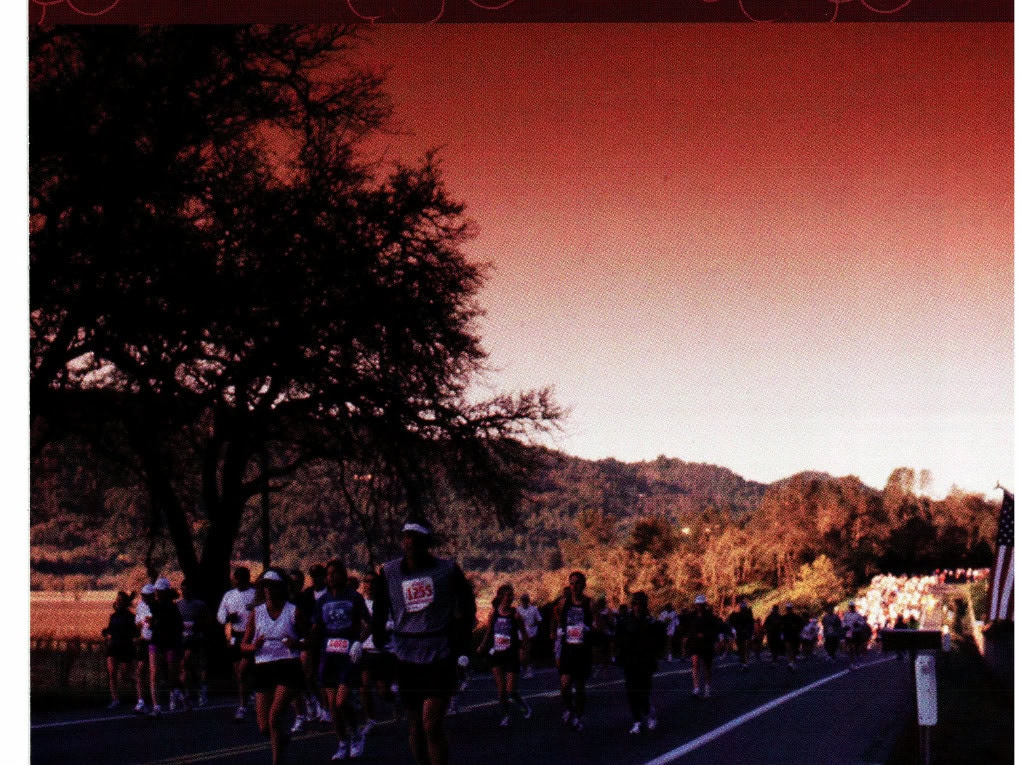
25th Annual Running
Napa Valley Marathon
March 2, 2003
RRCA National Championships
www.napa-marathon.com
This article originally appeared in Marathon & Beyond, Vol. 6, No. 4 (2002).
← Browse the full M&B ArchiveMore like this
1,000+ stories from 19 years of Marathon & Beyond
The complete archive of the legendary long-distance journal — digitized and free to read.
