

Running in Literature
Part I of Roger Robinson’s series on Running in Literature appeared in our January/February 2002 issue.
7. Oral Cultures and the Bible
Oral cultures often include stories of great runners or feats of running.
They range around the world from stories of the great Welsh shepherd-runner Guto Nythbran Morgan, who fell dead at the end of his mightiest race in the Rhondda Valley, to the Maori legend of Te Houtaewa, who ran with giant strides the length of New Zealand’s Ninety-Mile Beach to fetch his mother some gourmet seafood from under the very nose of a hostile tribe.
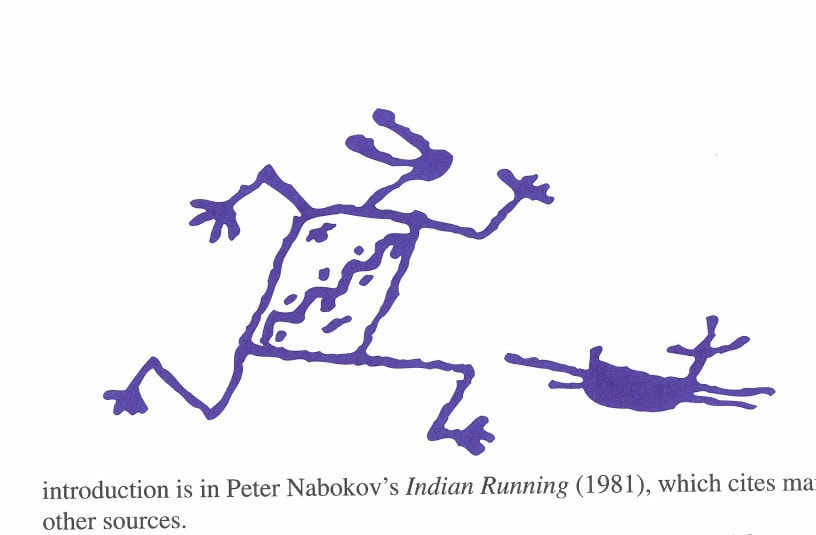
The myths and legends of the Native Americans are probably the richest body of such stories. In their creation myths, running contests often decide the status, characteristics, and territory of various animals. “World around” runs at Taos preserve the mythic race when Turquoise Boy beat Deer and gave human hunters supremacy over game animals. Other myths explain geography or the cosmos. The Sacramento River arose in the wake of a runner racing inland. In California, darkness came when the Sun lost a race to Coyote. The Milky Way is the dust raised by a race between the coyote and the wildcat at the beginning of time, or the tracks left by deer and antelope in a prehistory ultra race.
Together with moral fables about running and stories of instruction in the skills of running or hunting, mythic narratives like these have been found over most of the two American continents, an important body of verbal culture, contiguous to my subject of running as it has appeared in literature. The best introduction is in Peter Nabokov’s Indian Running (1981), which cites many other sources.
In other parts of the world, heroic running legends have passed from oral into various literary forms. In Ireland, The Book of Leinster (c. 1150) records the ancient Lugnas, or Tailteann Games, which may have predated the Greek Olympics, as well as retelling legendary sagas. Written in Middle Irish, it is recognized as key in the history of track as an organized activity.
More accessibly, the Old Testament gives a written and translated form to some running stories, notably the military running messenger, the “man of Benjamin.” After a battle in which “Israel was smitten, [he] ran out of the army, and came to Shiloh the same day, with his clothes rent, and with earth upon his head” (1 Samuel 4, verse 12; Authorized Version).
Messages to King David
The Bible gives literary form to running in some other interesting ways. 2 Samuel 18 tells of two runners who separately carry news from the battle zone to King David after the death of his rebellious son, Absalom. The drama of the story comes from their different running speeds. One overtakes the other, who started first, and reports to David in a way that tries to soften and delay the blow. But then Cushi, the slower runner, arrives and reports more directly so that the king lapses into his famous lament, “O Absalom, my son, my son!”
Another interesting running detail is that the palace watchman is able to recognize the messengers from their running action: “And the watchman said, Me thinketh the running of the foremost is like the running of Ahimaaz the son of Zadok” (2 Samuel 18, verse 27). That is a skill runners learn, and the verse should be the sacred text of all of us who have labored as TV commentators to identify a tight pack of runners on a fuzzy outdoors monitor screen on a sunny day.
The best running writer in the Bible is Saint Paul. I discovered that we shared an interest in running many years ago, when I did some school teaching. Every time I was due to travel to a major race, the colleague responsible for morning prayers chose 1 Corinthians 9 for the day’s lesson, and I would have to listen nervously again to “You know (do you not?) that at the sports all the runners run the race, though only one wins the prize. Like them, run to win!” Saint Paul goes on to develop the link between life and competitive running: “Every athlete goes into strict training. They do it to win a fading wreath; we, a wreath that never fades. For my part, I run with a clear goal before me . . . I bruise my own body and make it know its master” (1 Corinthians 9, verses 24–27; New English Bible).
I noticed that Saint Paul turns to sporting comparisons on other occasions, including the idea hallowed by all marathon runners, that life is like a big race, challenging you to complete the distance to the best of your ability. “I have run the great race, I have finished my course, I have kept the faith” (2 Timothy 4, verse 7). Living a godly life, he says, is like being in full training: “Keep yourself in training for the practice of religion” (“exercise themselves unto godliness” in the Authorized Version; 1 Timothy 4, verse 7).
H. A. Harris, in a fascinating discussion in Greek Athletes and Athletics (1964), goes deeper than these references. Saint Paul, he shows from the Greek, habitually uses runners’ and boxers’ slang, terms for instance for being an also-ran, or competing within the rules, or being disqualified.
Harris suggests (and I’d like to believe him) that Saint Paul could easily have acquired this way of thought as a youthful competitor, or as a spectator, since Tarsus had its own stadium where important meets were held in Roman times, and some Jews did apparently take part in athletics. Certainly the Epistles are enriched by the vigor of metaphors drawn from running, and they seem to come from someone who understands the demands of training and stress of competition. But since Saint Paul exhorts us to “finish the race and complete the task” (Acts 20, verse 24), I must move on.
8. Knights, Footmen, and Fiends: Literature to 1700
I took a dislike of horses at the age of 15 when one tried to kick me off the English footpath where I was innocently running. I still give a wide berth to their four sharp corners. I also blame them for the total lack of good running writing in the first few centuries of English literature. Those were the years when the horse was the ultimate status symbol, and equestrian skills were the basis of moral as well as military codes. The very word “chivalry” means riding on horseback.
Supposedly, running was part of the education and training of upper-class males. Sir Thomas Elyot in The Book of the Governor (1531) says, “rennying is bothe a good exercise and a laudable solace,” and Joseph Strutt, in The Sports and Pastimes of the People of England (1801), says that the accomplishments of a knight included “to run with swiftness.” But “to ride well” and the associated sports of hawking and hunting got far more attention in the courtly Renaissance.
Through the great works of Chaucer, Malory, Spenser, and even Shakespeare, plenty of fine people have “many a dainty horse in stable,” or “ride a mighty wallop,” or come “pricking on the plaine” on their steeds and palfreys, but I can’t for the life of me find any decent runners.
There are odd lines in Shakespeare like, “Now bid me run, and I will strive with things impossible” (Julius Caesar); or Falstaff’s “I could give a thousand pounds I could run as fast as thou canst”; or Richard III’s “What needst thou run so many miles about?” But those three are spoken by an assassin, a drunken coward, and a mass murderer, so I prefer not to push the point. The one safe line from Shakespeare is “Though I look old, yet am I strong and lusty” (As You Like It), which isn’t about running but always goes down well at masters running clinics.
Messengers run in and out, of course, and Hamlet plays fox and hounds, the old running game, with the Elsinore security guards (“Hide, fox, and all after!”). But the nearest Shakespeare comes to a description of running is in his early Henry VI Part 3, when the Earl of Warwick takes a break after a battle with the lines:
Forspent with toil, as runners with a race,
I lay me down a little while to breathe.
(II 3)
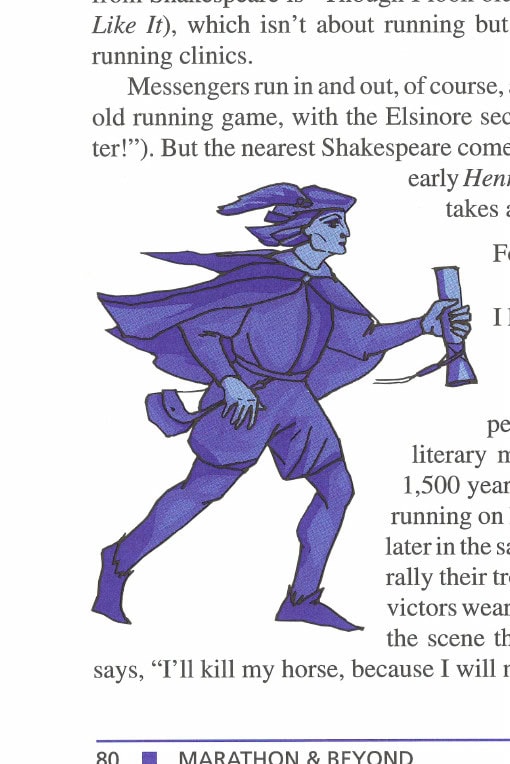
It’s not much, but it’s the first appearance of competitive running as a literary metaphor since Saint Paul’s Epistles 1,500 years earlier. Shakespeare may have had running on his mind for some reason that day, as later in the same scene the Yorkist princes agree to rally their troops by promising “such rewards/As victors wear the Olympian games.” But the line in the scene that I still like best is when Warwick says, “I’ll kill my horse, because I will not fly.”
An unexpected bonus came in the plays of John Webster (c1580-1603), writing a little after Shakespeare. The young Webster appears as the stage-struck and bloodthirsty boy in the movie Shakespeare in Love, but he also must have been interested in the new sport of races between “running footmen” (see Roger Robinson, “The Running Footmen,” Marathon & Beyond, Vol. 3, No. 1, Jan/Feb 1999). Webster’s little-known Roman play, Appius and Virginia (c1620), has a politician saying that those who aspire to high office should beforehand “load themselves with excuse and faint denial,” so they can then leap to power all the faster, and he draws an analogy with resistance training for a big race:
I have heard of cunning footmen that have worn
Shoes made of lead some ten days ‘fore a race
To give them nimble and more active feet (I, 1, 55-7)
And in his comedy A Cure for a Cuckold (printed 1661), Webster again uses “footman” to mean a competitive runner, this time as a simile for how fast your money goes on lawyers: “Your purse must run by like a footman then.” This prompts a response that implies that a litigant’s open purse is like a gasping runner, spending everything and on the edge of exhaustion: “My purse shall run open-mouth’d at thee.” Quite likely some big race had just been run in London that the actors could ham up as they spoke the lines. These references in two plays, brief though they are, sketch training in the one and racing in the other with some credibility.
John Bunyan’s The Pilgrim’s Progress (1678) takes a long journey on foot as an allegory of life, in a way all distance runners, including Saint Paul, will relate to; and Christian does occasionally include a little running, as when he climbs the Hill of Difficulty and falls “from running to going [i.e., walking], and from going to clambering upon his hands and knees, because of the steepness of the place.”
John Milton’s great epic of the Creation, Paradise Lost (1667), is modeled on Homer’s The Iliad, so it has to include some games, as one of the basic conventions of the epic form (see “Running in Literature,” installment 1, section 2). A story set mostly in the Garden of Eden presents limited opportunity for a track meet, and anyway Milton, as a Puritan, disapproved of competitive sports. So he put the required games in the most appropriate place he could think of: Hell. The competitors are the demons, fallen angels who have been hurled headlong flaming down to Hell after their unsuccessful rebellion against God. When Satan goes off to work his wickedness in the Garden of Eden, the rest of the fiends pass the time with races, both running and flying (as angels they have the necessary equipment):
Part on the plain, or in the air sublime
Upon the wing, or in swift race contend,
As at th’ Olympian games or Pythian fields.
(Book 2, 528-30)
(The Pythian games were those held at Delphi.) The rest of the demons are feeling more aggressive, and they hold fierce chariot races, jousts, and mock battles, while some in rage “Rend up both rocks and hills, and ride the air/In whirlwind.” Ripping up hills could enliven the average track meet, but runners are rarely that violent. Milton does score a hit against some runners I know, however, when he says that some of the demons retire into a valley to sing, with angelical notes on their harps of “their own heroic deeds.” I thought of the talkative occasional member of our running group whom we call “My Brilliant Career.”
9. “Unclog the wheels of life”: The 18th Century
The last of the great epic poems on the Greek model in English was Alexander Pope’s The Dunciad (1728-43). Pope shows mastery of the conventions of the epic, then literature’s most revered form, but mocks and degrades them into a vicious but brilliant attack on the literary world of his time. So he includes the required games but turns them into scatological black comedy. The “dunces,” his literary enemies and rivals, hold a pissing championship and a diving contest into an open sewer, as well as an absurd footrace. There the leaders are two publishers and booksellers, Edmund Curll, who specialized in pornography and sedition, and Bernard Lintott, a notoriously uncouth man who had published some of Pope’s earlier works.
“Dauntless Curll” races away as fast as a poet escaping from the bailiffs. Pope then gives a cruelly comic picture of sheer bad running by the overweight and uncoordinated Lintott:
As when a dab-chick waddles through the copse,
On feet and wings, and flies, and wades, and hops;
So laboring on, with shoulders, hands and head,
Wide as a windmill all his figure spread,
With legs expanded Bernard urged the race,
And seem’d to emulate great Jacob’s pace . . .
(Book 2, 53-64)
Pope was not a nice man, but few poets could conjure ungainly movement in such skillfully gawky verse.
Pope was also a learned classicist, so those who read my discussion of the races in Greek and Latin epics in installment 1 will not be surprised that, as is standard for the race leader in epic verse, Curll falls into a deep pool, this time of sewage:
But vig’rous he rises; from th’effluvia strong
Imbibes new life, and scours and stinks along,
Re-passes Lintott, vindicates his race,
Nor heeds the brown dishonours of his face.
(97-100)
Fortunately, this is the lowest point ever reached in the literary history of running, unless you count the episode in Fanny Burney’s novel Evelina (1778), where the gambling-mad gentry stage a race between two old women “proved to be more than eighty years of age.” “Feeble and frightened,” they hobble, stumble, and fall “with their whole weight upon the gravel,” provoking “unmanly rage” from one of the backers, as Burney exposes the brutal and exploitative side of the betting craze.
There is a more comic literary race in Tobias Smollett’s novel Humphry Clinker (1771), where a skinny poet races against a fat publisher, first borrowing his boots to act as a handicap. It’s soon over, as the poet takes off halfway through with the boots, and the story turns into just one of a series of ingenious con tricks by which the poet lives (Vol. 2, June 10). The fine ending of the novel is more relevant to runners, especially older ones. The hypochondriac squire, Matthew Bramble, who started the story constipated and irritable, learns from his year’s travel and adventure to value movement and exercise. “I have put myself on the superannuated list too soon, and absurdly sought for health in the retreat of laziness. . . . We should sometimes increase the motion of the machine, to unclog the wheels of life.” It’s a marvelous affirmation of what all runners believe and one of my favorite quotations.
Henry Fielding’s high-spirited hero in Tom Jones (1749) keeps the wheels of life well unclogged, and on one occasion, when obliged to go home on foot, “this he did so expeditiously that he ran upwards of three miles within the half-hour” (IV, 11). Since we have been told that Mr. Allworthy’s house is up on a hill, and especially if we know that it is Ralph Allen’s Prior Park high above Bath, that’s good running.
Another athletic feat in a novel of that era is in Henry Brooke’s The Fool of Quality (1765-70), when the noble young Harry joins in a village sport, clears a five-foot high jump “with a standing hop,” and then wins the pole vault, on a wooden pole, with an incredible 10 feet, “a new-risen phoenix, suspended and glittering in the air, and then alighting, as winged, on the other side.” It’s not running, but I include it for those interested in the wider literature of track and field since it has never been previously noted. More remarkable, it was Harry’s wedding day. I wouldn’t have risked it.
Not often feeling like a new-risen phoenix, I relate better to the glimpse of running given by the subtlest poet of the age, Thomas Gray, when he describes schoolboys riskily running out of bounds in his “Ode on a Distant Prospect of Eton College” (1742):
. . . And unknown regions dare descry:
Still as they run they look behind,
They hear a voice in every wind,
And snatch a fearful joy.
We often see great runners on TV “snatch a fearful joy” near the finish of a marathon—the phrase is perfect for that moment when you are leading and the finish line comes in sight—but you know there’s somebody close behind you.
10. Pedestrians: The Early 1880s
The early races among running footmen mentioned by Webster slowly developed into the sport of pedestrianism, running and walking contests, usually long-distance match races or solo time trials against some target time.
The sport produced its first book in 1813, Walter Thom’s historical survey and coaching guide, Pedestrianism, which contains “An essay on training” taken mainly from the methods of the greatest ultra man of the era, Robert Barclay Allardice, Esquire, of Ury. It’s a major book historically. The legendary Captain Barclay is thought of as an ultra-distance walker, but Thom gives details of some fast shorter races, including a 56-second 440.
He accomplished “extraordinary feats of Pedestrianism” and also showed “intuitive judgment in training men to succeed in foot-races and pugilistic contests.” I take those phrases from a book that is more important from the literary viewpoint, the second volume of Sporting Anecdotes by Pierce Egan (1822), a collection of entertaining writings by the first significant sports journalist. (Egan’s Life in London, 1821, gave us two sports enthusiasts called Tom and Jerry, whose famous names have since been used elsewhere.)
Egan’s Anecdotes are amusing and varied, offering everything from a profile of the greatest hunting horsewoman of the time to a detailed account of a boa constrictor swallowing a goat—only marginally a sports event by our standards.
Those relating to running include an “Account of Highland Sports,” with a five-mile race over rough tracks and a comical report of a race for high betting stakes between one man running 200 yards and another covering 100 yards in a sack, in which “Almost directly the man in the sack fell down, and the other by some accident tumbled over him.” After much scrambling, the man in the sack wins the wager. The “bucks” and “Corinthians” of that time (sporty young gents) would bet on anything, even, another Egan anecdote shows, on two drops of water trickling down a windowpane. (The two drops merged into one, and all bets were off.)
ANTIQUE SPORTS REPORTING
One important section of Egan’s Anecdotes is given to a history of great walker/runners like Foster Powell and to a vintage series of longer track and road runs, from January to June 1818. These ranged from the “fastest running of a mile ever recorded,” four minutes 46 seconds on January 20 at Stratford, Essex, to some great solo and two-man road runs over 9 to 12 miles. Since I believe that good journalism is fully entitled to be called literature, here is one sample of the then wholly new form of sports reporting:
Wednesday afternoon, June 24, 1818, the Essex road was one continued scene of bustle and gaiety. . . . Rayner, whose fame as a runner was considered perfectly established, had undertaken to give Blumsell the extraordinary advantage of two minutes and a half at starting. . . . The capabilities of Blumsell the sporting world were no strangers to, from his having recently run nine miles through the streets of London and up Highgate Hill, also against the bad weather, in four minutes less than the hour. Still the speed of Rayner was so much valued as to overcome every other consideration. At half past seven o’clock, Blumsell appeared at the 5th mile stone, with only a very short pair of drawers on, and light half-boots, and started. Rayner was lightly clad, and when the two minutes and a half had elapsed, he set out to overtake Blumsell. . . . Instead of improving upon his adversary, Rayner had lost 46 seconds in the first 8 miles; shortly after this he turned giddy and fell in a ditch; but continued the contest. He, however, soon gave up the race. It is impossible to describe the long faces; the club [i.e., gamblers] was completely dished. Rayner appeared too fat; he perspired profusely, and his wind was rather touched. Blumsell was in the first order; he started with the swiftness of a greyhound, never flagged, and came in with the fleetness of a deer, amidst the shouts and applause of the spectators, having run 10 miles in 58 mins 56 secs. Blumsell was so little fatigued that he appeared at the Castle Tavern in the evening (Sporting Anecdotes, Vol. 2, 1822; slightly edited).
“Pedestrianism” covered competitive running and walking, but there were also increasing numbers of people walking for exercise and pleasure in Britain and America through the 19th century, including several major writers.
When John Clare, William Cowper, William Wordsworth, Samuel T. Coleridge, or Walt Whitman used a walk as the basis for a poem about their thoughts or things they encountered, they were doing something close to modern essays on the subject of, for instance, “my most unforgettable marathon.”
WHEN THE LADIES WALK
When Jane Austen shows that heroines like Elizabeth Bennet or Anne Elliot are willing to take an energetic walk, even over bad going, and to get healthily tired, she is establishing their personal superiority over those who are languidly obsessed by their own comfort or appearance, in a way entirely similar to the moral testing imposed by racing a marathon or in a book like Flanagan’s Run.
Walking is similarly a moral measure in George Eliot’s Middlemarch (1871–2) and George Meredith’s The Egoist (1879). For Whitman, it is a source of freedom and independence: “I inhale great draughts of space,/The east and the west are mine, and the north and the south are mine.”
It is also an important expression of women’s growing desire for the same freedom and independence, in Kate Chopin’s novel The Awakening (1899), Elizabeth Barrett Browning’s poem Aurora Leigh (1857), and in the Bronte sisters’ novels. There is even talk of women running when Caroline Helstone shows female rivalry in Charlotte Bronte’s Shirley (1849) by saying, “Do not fear that I shall not have breath to run as fast as you can possibly run, Shirley.”
Wordsworth wandering lonely as a cloud may not sound much like a runner, but he does when he writes of turning your steps “Up the tumultuous brook of Green-head Gill” and finding “in such bold ascent/The pastoral mountains front you, face to face” (“Michael”). He was estimated to have covered over 175,000 miles/280,000 kilometers, mostly over rough hilly terrain, in his lifetime’s walking, and is not to be underestimated.
In prose, William Hazlitt, Charles Dickens, Henry David Thoreau, Robert Louis Stevenson, and Leslie Stephen all wrote fine essays about walking that could equally apply to running. Stevenson, for instance, described “that fine intoxication that comes of much motion in the open air,” “the sense of physical wellbeing,” and the “delicious pains” of the tired body in the evening after a long outing (R.L. Stevenson, “Walking Tours,” 1881). Here, too, is the American nature writer John Burroughs writing about being a walker:
His pores are all open, his circulation is active, his digestion good. He is the only real traveler. He is not isolated but is at one with things. He knows the ground is alive; he feels the pulses of the wind, and reads the mute language of things. His senses are continually reporting messages to his mind. Wind, frost, rain, heat, cold are something to him. He is not merely a spectator of the panorama of nature, but a participator in it. He experiences the country he passes through—tastes it, feels it, absorbs it; the traveler in his fine carriage sees it merely (“The Exhilarations of the Road,” 1872; somewhat edited).
I once wrote about running in similar terms: “seizing the earth with your stride and the air with your lungs, processing those elements, and heat and water, too, into mastery of this most elemental motion—I know of no way to be more totally alive, more intimately in touch with the world.” I hadn’t heard of Burroughs then, and I was writing about fast cross-country running, but we were on the same lines.
Many of the 19th-century walkers would in our age have been running marathons and ultras. Dickens would have been sub-2:30 for sure—he regularly walked over 20 miles at night, at speeds none of his friends could stay with. Women’s running pioneers would have included hard walkers like Emily Bronte, Kate Chopin, Olive Schreiner, and Sarah Grand, one of whose women characters (in The Heavenly Twins, 1893) does exhausting speed-walks that were called “bursts.”
Not every writer was wholly serious about hard exercise, of course. Mark Twain/Samuel Clemens liked to disconcert journalists by insisting that they interview him during workouts. The New Zealand Herald reported breathlessly in 1895 that the famous visitor “took walking exercise while conversing.” But it was partly for show. When he staged a PR coup in 1874 by announcing that he was walking from Hartford, Connecticut, to Boston to deliver the manuscript of his first Mississippi narratives to the editor of The Atlantic, he didn’t actually make it. Sore and hobbling after walking 28 miles the first day, the resourceful Clemens cabled, “We have made thirty-five miles in less than five days. This demonstrates the thing can be done. Shall now finish by rail.” And he took the train.
11. The Strange Literary Story of the Marathon
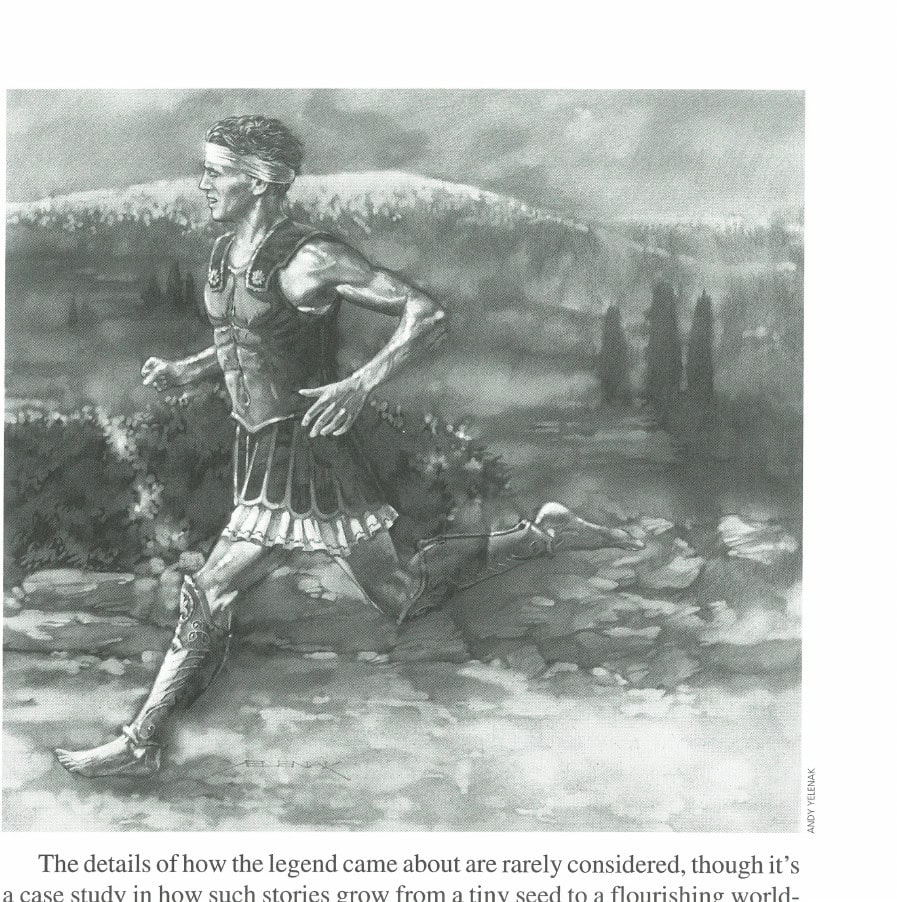
“According to legend . . .” are the first words of almost every history of the marathon, leading to a usually vague version of the story of Pheidippides and his fatal run from the battlefield of Marathon to Athens with the news of victory.
The details of how the legend came about are rarely considered, though it’s a case study in how such stories grow from a tiny seed to a flourishing worldwide belief.
The marathon is also without parallel in being a major sports event that has entirely literary origins (just as the Baltimore Ravens are the world’s only major sport team to be named after a poem). The evidence of those origins is so sparse, fragmentary, and broken up by gaps and irrelevancies that reconstructing it is like trying to follow NBC’s coverage of an Olympic long-distance track final; but here, as plainly as I can put it, is the strange story.
It begins with the earliest major work of Greek prose, by a much-traveled writer known in English as Herodotus. His “Researches” or “Histories,” as he titled them on the outside of the roll of papyrus, tell of the rise of the Persian Empire and its wars with Greece between 500 BC and 479 BC and have earned him the title of the “Father of History.”
Herodotus was not born until after the Battle of Marathon in 490 BC and was writing over 40 years later, so he collected information mainly from ex-soldiers, mostly the more junior ones who were still alive. His account of the Battle of Marathon is embellished by things like a story of how the Greek general’s father had won a chariot race at Olympia, or the Greek defector who had a lurid dream the night before the battle, or the meeting between the running messenger Pheidippides and the god Pan, who complained that the Athenians were neglecting their worship of him. This is not, in other words, a work of rigorously documented fact, which makes it like much of our own history and journalism.
After overwhelming the Greek island of Eretria, a large Persian invasion force landed at Marathon, ready to attack Athens, 25 miles/40 kilometers away. Here are the extracts from Herodotus’s account relevant to the running messenger story. This translation keeps the familiar form “Pheidippides,” though some prefer “Philippides” or “Filippides” as transliteration of the Greek:
Before they left the city, the Athenian generals sent off a message to Sparta. The messenger was an Athenian named Pheidippides, a professional long-distance running messenger. According to the account he gave the Athenians on his return, Pheidippides met the god Pan on Mount Parthenium, above Tegea. Pan, he said, called him by name and told him to ask the Athenians why they paid him no attention, in spite of his friendliness toward them. . . . Pheidippides reached Sparta the day after he left Athens and delivered his message to the Spartan government. . . . The Spartans were willing to help . . . but said they could not take the field until the moon was full. . . (The Histories, Book 6, trans. Aubrey de Selincourt, 1954, Penguin, 1972).
RESULTS OF THE BATTLE
Then comes Hippias’s dream, a fairly detailed account of the battle and the casualty figures, almost certainly spin-doctored by the Athens Pentagon: 6,400 Persians killed, 192 Athenians.
That’s it.
Pheidippides ran 150 miles/240 kilometers over rough hilly ground from Athens to Sparta in probably around 30 hours, which is very good running but not impossible. He then ran back, reporting how he met Pan, as well as delivering the Spartans’ response to Athens’s request for help. There is no indication that he fought in the battle, no exhausted messenger carrying joyful news of victory to Athens, no heroic death. Instead, Herodotus says the whole Athenian army marched back “with all possible speed” because the Persian fleet “was on its way round Cape Sunium,” hoping to catch the city unprotected.
The rest is speculation. For my money, the Pan story was to boost the troops’ morale when the news spread that the Spartans would not be there to help and provide some of the divine justification that is standard pre-battle issue for all armies.
To Herodotus, and to most people at the time, it was more impressive that the god Pan called to Pheidippides by name than that he ran to Sparta. As a “professional long-distance running messenger,” that was just his job (hemerodromos literally means “day runner”—someone who ran for a whole day). As for the run to Athens, a message would almost certainly be sent to warn the government that the angry enemy was on its way by sea, but a man tired from just running 300 miles is most unlikely to be chosen when they had a whole corps of messengers.
We have to wait 600 years for that part of the story to appear, in a different culture (Rome) and language (Latin), at a time when the past greatness of Greece was being romanticized. The earliest surviving Latin reference, in the Natural History by Pliny the Elder (died 79 BC), is straightforward, mentioning Pheidippides’s run to Sparta as “a remarkable feat.”
REPORTS OF A DEATH
Then, about AD 110, comes the first mention of a run from Marathon to Athens and the messenger’s dramatic death, in the Moral Essays of Plutarch. Citing sources that have disappeared, Plutarch says that one historian attributed the run to Thersippus of Eroeadae but that “most historians” say it was Eucles “who ran in full armor, hot from the battle, and, bursting in at the doors of the first men of the State, could only say, ‘Hail! We are victorious’ and straightaway expired” (trans. Frank Cole Babbit, 1962). Suddenly we are in the realm of lurid fiction (“hot from battle,” “bursting in at the doors”) that the human mind finds much more enjoyable than facts. Translation can heighten these effects. Another version has Eucles “with his wounds reeking from the fight, and falling through the door.”
Thersippus or Eucles? Wounded or just exhausted? Bursting in or falling through the door? Authentic oral history passed down over 600 years or the work of some Roman romancer or PR agent for Greek tourism? Did someone die as he delivered the message, or are these stories as historically reliable as Shakespeare in Love and Braveheart? We shall never know, but the heavy odds are that it’s all invented.
And then matters get worse.
Another 60 or 70 years later, the satirical prose writer Lucian (who died about AD 200) was discussing a point of language, the use of “Rejoice!” as a greeting, and cited “the anecdote of the runner Pheidippides, who announced
the victory at Marathon . . . in these words: ‘Rejoice! We are victorious!’ And no sooner had he uttered them than he fell down dead . . .” (“Apology for a Mistake in Salutation”). It was just an example he thought of in passing. Lucian was obviously mixing up the two running stories from the Battle of Marathon and put Pheidippides into the “dropping dead” incident instead of Eucles or Thersippus. It happens all the time. My American father-in-law, with an excellent memory for history, used to talk about “King Alfred and the spider.” I didn’t have the heart to tell him he was mixing up Alfred of Wessex and the cakes with Robert Bruce of Scotland and the spider. He might have questioned my belief that Abraham Lincoln was shot in the back while crossing the Delaware River.
Returning close to fact, one last reference in the classical era came in a tourist travel book called Description of Greece, by Pausanius, about the same date as the Lucian. It retold the original run-to-Sparta story as found in Herodotus, with no hint of anybody running to Athens or dropping dead. But the seed was planted.
1,700 YEARS LATER
The seed lay dormant for another 1,700 years. In all the innumerable versions in English literature of Greek and Roman legends and history, from the revival of classical learning around 1400 until 1879, I know of no mention of either of the stories about Pheidippides. Herodotus, Plutarch, and Lucian were all well-known and influential, of course, at a time when study of the classics was the basis of education, and in 1819 Lord Byron put into inspirational English poetry the Greeks’ view of their victory at Marathon as a symbol of liberty, at a time when Greece was under Turkish control:
The mountains look on Marathon
And Marathon looks on the sea;
And musing there an hour alone,
I dream’d that Greece might still be free. . .
(Don Juan, 1819-24)
“Marathon became a magic word,” Byron wrote in another poem (Childe Harold’s Pilgrimage, 1812-18), but outside Greece, he helped to make it one.
In 1878, the English poet Robert Browning was working on a book of short stories in verse drawn from various sources, called Dramatic Idyls (1879). A largely self-taught man of wide and diverse but not always thorough knowledge, Browning knew the Herodotus and the Lucian passages, and probably Plutarch, and decided to retell the story, or stories, of Pheidippides in dramatic, romantic style.
He “is apparently the first writer to combine the two stories,” says the best scholarly edition of Browning’s poems (edited by John Pettigrew). All the good details are there, often made more colorful than in his sources—the anxious message to Sparta, the leering Spartans looking for excuses, the meeting with “majestical Pan,” with the inventive addition that the goat-god promises to help the Athenian army in the battle.
Browning’s hero insists on fighting, too, “with our foremost” (for which there is no previous source); he runs to Athens, delivers the message in the English words that have become standard, “Rejoice, we conquer!” and drops dead. “Joy in his blood bursting his heart, he died—the bliss!”
And Browning was a good Victorian romantic, although his beloved wife Elizabeth Barrett was now dead. So, just as Maid Marian was turned into a romantic companion for Robin Hood at about this date, Browning gives Pheidippides the extra motive of hoping to “Marry a certain maid.” It’s not a great poem, with its Hollywood emotions and Browning’s odd, self-conscious mix of archaic and modern language, but it works well as a historical romance.
It works especially for our niche market. It is terrific as a running poem. I don’t know if Browning went to any “pedestrian” meets in the 1870s, or watched one of the early paper chases of Thames Hare and Hounds, or if he just ran up and down stairs every morning before he started writing, but he got it right.
The poetry has so much power and pace that it is difficult to grasp at first reading—it is urgent and breathless, it hurries and gasps, its pulsing, panting, almost syncopated rhythms catch the anxiety and onward speed of all the running.
Pheidippides runs as fast as fire running through a stubble field, and such images of burning and blazing recur and are built into the very movement of the verse. Words are left out, the sense is compressed, the grammar lurches. The lines, fragmented by colons and dashes and exclamation points, can sound broken-backed in their breathless lack of polish, but it’s almost what another poet of the time was calling “sprung rhythm,” breaking away from regular lines and rhymes to get the real dynamic of urgent movement. Metrically, it’s original and exciting work, and it’s a pity the poem has had so little attention from Browning scholars. (It almost never appears in selections of his work.) If it doesn’t work for you, run a hard 400 meters round the block and then try again.
SOME BREATHLESS POETRY
The whole poem is only four pages long, 120 lines, but here, to get you breathing hard, are some extracts:
“Run, Pheidippides, run and race, reach Sparta for aid!
Persia has come, we are here, where is She?” Your command
I obeyed,
Ran and raced like stubble, some field which a fire
runs through,
Was the space between city and city: two days, two
nights did I burn
Over the hills, under the dales, down pits and up peaks.
Into their midst I broke: breath served but for “Persia
has come!”. . .
Answer me quick, what help, what hand do you stretch
o’er destruction’s brink?
How,—when? No care for my limbs!—there’s lightning in
all and some. . .
[The Spartans claim they cannot help yet.]
That sent a blaze through my blood; off, off and away
was I back,
—Not one word to waste, one look to lose on the false
and the vile!
Yet “O Gods of my land!” I cried, as each hillock and plain,
Wood and stream, I knew, I named, rushing past them again,
“Have ye kept faith, proved mindful of honours we paid
you erewhile?”
Such my cry as, rapid, I ran over Parnes’ ridge;
Gully and gap I clambered and cleared till, sudden, a bar
Jutted, a stoppage of stone against me, blocking the way. . .
[There, “in the cool of a cleft,” waits Pan, who promises to help Athens.]
. . . If I ran hitherto—
Be sure that, the rest of my journey, I ran no longer,
but flew.
Parnes to Athens—earth no more, the air was my road:
Here I am back. Praise Pan, we stand no more on the
razor’s edge. . .
[Offered any reward, Pheidippides asks to “fight . . . foremost. . . /Pound
Persia to dust,” and then “Marry a certain maid, I know keeps faith to the
brave.”]
Unforeseeing one! Yes, he fought on the Marathon day:
So, when Persia was dust, all cried, “To Akropolis!
Run, Pheidippides, one race more! The meed is thy due!
‘Athens is saved, thank Pan,’ go shout!” He flung down
his shield,
Ran like fire once more: and the space ‘twixt the
Fennel-field
And Athens was stubble again, a field which a fire runs
through,
Till in he broke: “Rejoice, we conquer!” Like wine
through the clay,
Joy in his blood bursting his heart, he died—the bliss!
It is Browning who deserves credit for the story in its combined and heightened form. It is his version of the runner’s dying words that has survived—”Rejoice, we conquer!” rather than, say, “Hail! We are victorious.”
Presumably, it was Browning’s poem that Professor Michel Bréal had in mind when he wrote to the Athens Olympic committee in 1894 to propose “a race from Marathon” on the route of “the Greek warrior.” If Browning drew the story in this form from some 19th-century book of classical legends retold, nobody knows about it. I have searched so far without success. It’s still possible. Tales from Shakespeare by Charles and Mary Lamb was published in 1807, and similar simplified versions of classical stories were around, some for the new children’s market. It’s also possible that Bréal knew the story from a French version, though as a professor of languages and linguistics, his reading was international.
If Browning was truly the first to make a full story out of Lucian’s lapse of memory, he can have had no idea of the impact his poem would have. It transformed a sport (long-distance running) that in his day was little more than a seedy gambling activity. It gave a focus to an idealistic movement for international unity that had not yet been born (the revived Olympics). It led in time to one of the best expressions of the culture of the 20th- and 21st-century city, the big-city street race. It impacted for the good on many other things, from tourism to Greek nationalism to cardiology to outside broadcast technology to the status of women in East Africa, as well as millions of individual lives. Not many poems achieve as much.
SECONDARY SOURCES AND ACKNOWLEDGMENTS
- H.A. Harris, Greek Athletes and Athletics (London, 1964).
- John G. Kennedy, Tarahumara of the Sierra Madre (2nd ed., Pacific Grove, CA, 1996).
- Peter Lovesey and Tom McNab, The Guide to British Track and Field Literature (London, 1969).
- John Lucas, “A History of the Marathon Race,” in Journal of Sports History.
- Peter Nabokov, Indian Running: Native American History and Tradition (Santa Fe, 1981).
Montague Shearman, Athletics and Football (in later editions Athletics) (London, 1887).
Walter Thom, Pedestrianism: or, an account of the performances of celebrated pedestrians during the last and present century (Aberdeen, 1813).
Anne D. Wallace, Walking, Literature, and English Culture. The Origins and Uses of Peripatetic in the Nineteenth Century (Oxford, 1993).
Personal advice is warmly acknowledged from Professor David Carnegie on Webster and Professor David Norton on the English Bible; both are my colleagues at Victoria University in Wellington, New Zealand, and international experts in those fields. Some material in earlier form was used in my script for the television documentary A Hero’s Journey: The Story of the Marathon (Cultural Horizons, Athens & Wellington, 1992).
This article originally appeared in Marathon & Beyond, Vol. 6, No. 2 (2002).
← Browse the full M&B ArchiveMore like this
1,000+ stories from 19 years of Marathon & Beyond
The complete archive of the legendary long-distance journal — digitized and free to read.
