

Running In The Eye Of Thetire
* * * Two years ago, I had run across the United States, and though in retrospect these two odyssey runs were somewhat dissimilar, the US run is ultimately what had opened the door and pushed me down the path of running the Tour de France. One cold morning a year after completing the run across the USA, I was driving to work, thinking about selling my soul to the gym (for the low cost of $20 a month) to help get me through my first Maine winter as a runner, and I realized, quickly and inexplicably, that the run had become a blessing and a curse. It was the best thing I had ever done, but now, on the other side, it had left me with a new set of expectations and standards for myself and for the world around me, and I didn’t know how to reach them in a more grounded setting.
Although it’s cause for celebrating, returning to our previous life after we’ve reached such an enormous goal, after we’ve done something that has elementally changed us and rearranged our values, can be disorienting and off kilter. It can feel, in a word, flat. We return from such an odyssey a changed person, and what we want to assume is that everything has changed with us: that we’ll get back home and our apartment will look different and our friends will be different and our job will be changed and even our clothes will fit differently. But when we finally do get back, we discover that it’s just us who have changed and everything is even more itself than it was before and we don’t know what to do with everything we’ve learned. For me that sensation was both isolating and empowering. On the best days I walked around ignited with the vigor of knowing that I had experienced things in a way few others can genuinely understand. On the bad days I stumbled along wondering if my journey had actually happened at all; and on those rare worst days I wondered: even if it did actually happen, what significance does it have outside of itself? How do you apply the lessons learned from the road into a normal, everyday life?
I tried to take what I had gained: the importance of perseverance, the value of discovering ourselves and our landscapes through physical activities out-ofdoors, and the power of a daily discipline and determination, and apply it to my postrun endeavors. The next year brought a gradual series of events and obstacles and conversations that led me down the path toward deciding to run the Tour de France. I missed the daily challenges I had encountered on the US run and the feeling that I was running to support a charitable cause greater than myself and greater than the sport of running. I missed the continued discovery that there was much more out there in our world and the appreciation that I was a tiny part of something grand and wonderful.
After a rush of brainstorming with my boyfriend, Alex, I decided I wanted to try to run the entire route of the Tour de France—it seemed like a worthy followup to a run across the United States, mostly because it seemed much harder. When Alex and I settled on that decision, all we knew was that the Tour was the
© Alexander Kreher
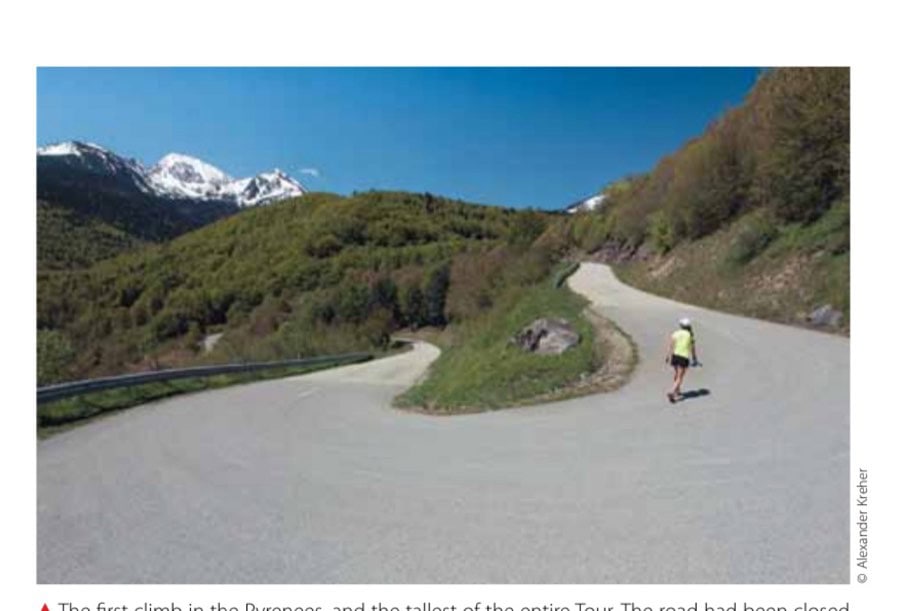
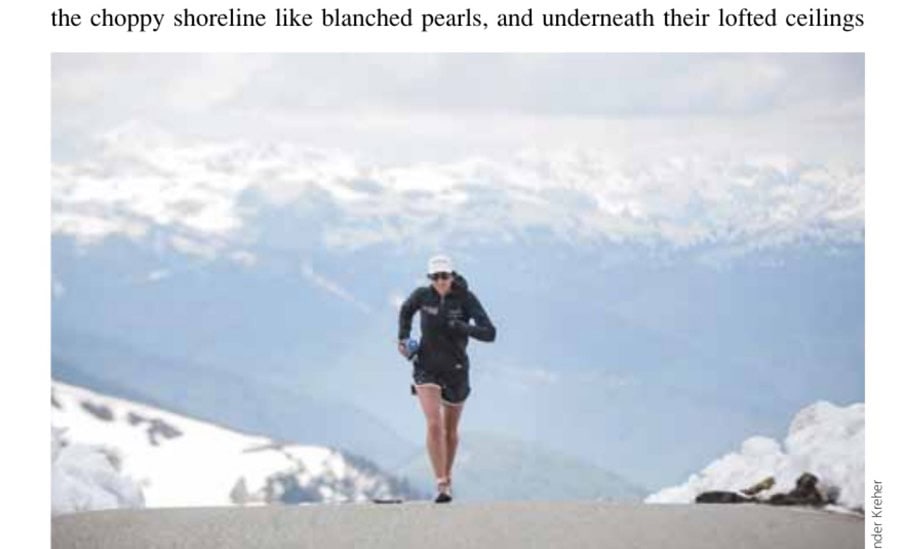
▲ The first climb in the Pyrenees, and the tallest of the entire Tour. The road had been closed due to snowstorms and was just reopened that morning.
world’s favorite and most difficult cycling race, that it was roughly 2,000 miles, and that it had a reported three-and-a-half Mount Everest’s worth of elevation gain. Females didn’t compete in it, and in its 100-year reign nobody had ever run the entire course. I was afraid to try it, but more afraid not to.
This was in January 2013. I counted backward to calculate that if I trained for five months I could start the Tour at 30 miles a day in mid-May, finish the entire mainland route a day ahead of the cyclists in Paris, watch their grand finale, and then wrap up my journey with the three stages in Corsica. It seemed like a good idea. * * * On May 13, 2013, the day before I turn 26 and the day before we fly to France, I do not sleep a wink. I creep out of bed, retrieve my training journals from my desk, and take them out to our porch. Huddled under a blanket, I scour the journals, checking and double-checking the workouts, looking for answers in the numbers. I know what running 30 miles in Richmond feels like; after five months of training here I could run the roads and trails with my eyes closed. But what will 30 miles a day in France feel like?
I wake up early that Saturday, the morning of my starting line, the first day of running the Tour de France. Outside, the sky is gray, ominous, threatening to burst. I throw on shoes and duck outside our temporary apartment in Nice and around the corner to the patisserie to pick up three croissants and a miniloaf of pain sportif, a hearty dark bread full of raisins and nuts and my favorite part of
© Alexander Kreher
breakfast in France. I wake Alex, mix two strong mugs of Nescafe, and we take turns smothering our croissants and pain sportif in Nutella and blackberry jam, going over the day’s route one final time. Outside, a light rain starts to fall.
Our luggage has been delayed four days, and so I am getting dressed now in unfamiliar rain clothes, a jacket and pants and cap that we hastily bought yesterday after checking the weather. The running stores in Nice are comically French; they split their space between practical running must-haves and trendy athletic couture—we purchased our rain gear from the practical side of a store called Run & Style in Nice’s Vieux Port yesterday. We drive 20 minutes to the start of the stage in the town of Cagnes-sur-Mer, and when I hop out of the car it is raining in earnest; big, full drops gather in the crevices of my clothes and soak me straight to the bone through the inky polyester of my shiny new raincoat.
After three miles I’m lost inside an extensive dockside hotel and yachting community, literally trapped behind their mammoth walls, and I have to go into the elegant lobby, dripping a path of dirty rainwater across the marble floor, and ask in French how do I find my way out, s’il vous plaît. Twelve miles later I run through the famous Cannes Film Festival, taking place that weekend. My soggy jacket weighs me down and my dark brown hair, now soaked a raven black, whips wildly behind me in a long stringy ponytail. My baggy rain pants stick close to my legs, sodden and gluey like papier-mâché. Next to me, elegant white tents line the choppy shoreline like blanched pearls, and underneath their lofted ceilings
▲ I made it to the top of my first official Tour de France Col! The first climb at the eastern edge of the Pyrenees, the view opens up onto the rest of the range over the western slope.
are chandeliers and bubbling bottles of Moët and Chandon champagne. On the promenade, people scurry all around me, dressed in suits and floor-length dresses, carrying chic umbrellas. This contrast has got to be one of the most awkward and gratifying experiences of being a runner. Yes, I look crazy, but I look a liberated kind of crazy; the others look caged under the canvas of their tents and the sheen of their silks. I’m free to stay and free to go.
A vivid, crisp sun blinks awake the following day and installs itself above me for the rest of the week. My first rest day falls in Aix-en-Provence, where the wind never stops blowing and the sky is a toasted cerulean blue. I stay horizontal all day long, eating pain chocolate and napping. Two days later, the rain arrives with a cold and permanent thud.
After eight drenched days and getting lost amid cold mountaintop fog, I finish the third stage in Albi, soaked in sweat and water, cheeks flushed scarlet with fever and my nose running more than my legs. This stage has been exasperating; I am ready to be done with it and drive to the start of the next stage in Castres, where we’ll take a rest day tomorrow. Friends and family have sent kind notes of encouragement to help me get through a tough patch, and we get news that our supporters have helped us to a milestone, raising $60,000 for the World Pediatric Project, which is enough to send three entire teams of doctors on three separate countrywide medical trips.
At the end of the following stage, I enter the Pyrenees, via a 15.3-kilometer climb up the Col de Pailhères, which, at 2,001 meters, is the highest mountain pass of the entire Tour by exactly one meter. We stay in the valley village of Loudenvielle with our host Mat, a kindred spirit who recently biked tandem with his twin brother from his village in the Pyrenees all the way to Estonia, and his mom, who manages a local ski resort. Appetizers at Mat’s are cold beers and chips, and the meal is a hearty vegetarian stew of potatoes and thick salty broth; salad and cheeses come last, and dessert is chocolate pudding.
John Boyes, a former international marathoner hailing from England, joins me on three of the four most demanding days in the Pyrenees. He lives at the base of the mountains and has retired from running professionally into operating a modest running camp and holiday retreat, where he has hosted countless elite athletes, runners, cyclists, and Ironman competitors. While we kill ourselves plodding 13 kilometers up to the Col de Peyresourde at a 7 percent grade, John captivates me with anecdotes of his guests’ postworkout dinner feasts and their quirky routines and the time his running club challenged—and beat—the university rugby team in a footrace. He is the exact opposite of me and we make perfect company; I am happy to listen, and he is happy to entertain.
Together we finish the stage in a drizzly, drawn-out descent, 30 downhill kilometers into Bagnères-de-Bigorre, a spa town John calls the Greece of the Pyrenees. This was the first real test of the Tour, and I have passed without injury.
© Alexander Kreher
This is unexpected. Alex and I eat berry tarts and drink hot chocolate with our socks off and feet open and free, sprawled across the cobblestone in the town center, oblivious in our contentment. The next two weeks pass by uneventfully: we drive to the northwest of France and I knock off two sopping stages in Brittany where the local joke is that it only rains there twice a week: the first time for three days and the second time for four. I lumber diagonally across the middle of France, passing underneath ancient turrets of royal castles in the Loire River Valley Region, their moats fat and gardens heavy with the unending rain. Under the canopy of clouds, I am slowly losing my mind. I have not seen the sun for weeks now, and I am calmly, listlessly breaking apart, until, three weeks after I ate berry tarts in the Greece of the Pyrenees, I crack open.
The day I crack open is the day I am hunched over in our white rental car, scratching my feet raw and crying behind sunglasses. My resolve is splintering, breaking, imploded, because this day, today, by the numbers, should be easy. I’ve just run across the Pyrenees—an entire mountain range, for goodness’ sake. Today I’ve barely slogged through 15 colorless miles on tediously flat terrain, and it should be easier than any day I’ve had so far.
But it’s not easy. My whole body hurts. My calf is sprained or torn or strained or simply in a lot of pain. With every step it threatens to snap straight in half. I’m
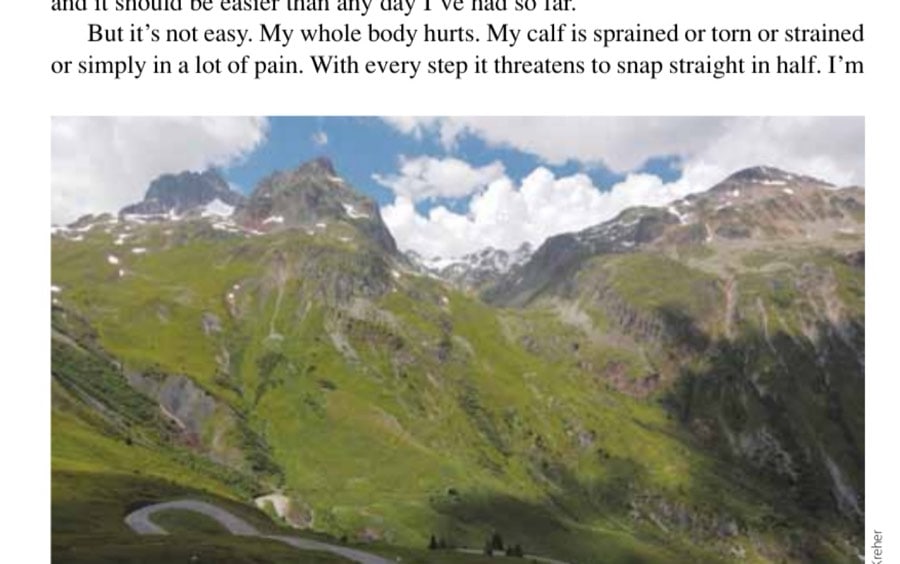
▲ Running up was harder mentally, but running down might’ve been harder physically. The road down stretches out 13 miles here from the top of the Col de la Madeleine in the Alps, one of my favorite Cols of the whole course.
running 11-minute miles. I have one CEP compression sock pulled all the way up on my right leg where my calf is strained and one pulled partway up on my left, where the tendon just above my ankle is sore. I’m eating two jelly beans, half a Chia Bar, and half of an ElectroFuse electrolyte drop, convincing myself that some sort of magical alchemy of all three things will make me a runner again. In my old life I loved running because it made me feel free, much freer than any other activity, just the simple motion of moving from one place to another under my own power and discovering so much in between those spaces. But right now I feel the opposite of free. Right now I feel like I’ve simply gotten very adept at enduring pain and shuffling forward. Does that still make me a runner?
I decide to quit for the day, and I’ve also decided privately that maybe my calf injury is enough to earn me a weeklong break, or, even worse (or is this better?), it’s enough to halt this entire journey. I can always come back next year.
Alex and I find a hotel to sleep in nearby, and I wrap my legs in ice and then in Physicool recovery bandages. I use The Stick and a foam roller and I take three ibuprofen and lie 20 minutes with my legs above my head on the wall and do every other thing I can think of to fix the pain. My mom calls and she tells me I must be “hitting the Wall.” Ha! Hitting the Wall! I’m 1,100 miles into a 2,000-mile-long journey! I don’t think that’s called a wall, I’m telling her. I think it’s a big gaping hole in the ground into which I am going to quietly fall and give up and hope nobody sees it happen.
The next morning, I wake up to a sky grayer than yesterday’s. As we head to breakfast, the hoteliers, Jean-Pierre and Anna, husband and wife, greet us to tell us they’ve spent the whole night reading our blog and would like to donate the night in support of our project. When we leave, Jean-Pierre and Anna send us off with a lunchbox full of cherries from the farm stand where I decided to quit yesterday and fresh bread, croissants, and yogurts. We walk outside together and from there on the front lawn we can see a resplendent thing happening in the horizon—the sun is actually coming out.
For all of that, I decide that I can at least go one more day before deciding to stop. Over the course of the day I find 30 euros on the ground, meet traveling Germans who are awe-struck by our project, and run through fields of lavender so fragrant that I snatch a bunch to stow in my handheld water bottle to scent my entire day’s run. I finish the day 30 miles wiser, 30 euros richer, and monumentally surprised that I actually almost quit 24 hours ago.
Finally, four days later, I reach windy Mont Ventoux, the first of many summits standing between me and Paris. At 21 kilometers, Ventoux is one of the longest climbs of the Tour, and I’m tackling it as the tail end of a 34-mile day. Ventoux is unique in that while a lush coniferous forest blankets the majority of the mountain, the top half mile is a completely bare limestone, white and chalky, giving the impression of a bald patch sticking out atop a head ringed by
healthy hair. It is intimidating in its solidarity, as it belongs to no mountain range and there are no other peaks around it to distort the view or underemphasize its size. It rises drastically from the verdant Rhone Valley below, part of the greater Drôme Provençale area, where I’ve spent the last week running through lavender fields in full bloom, alongside plump rows of grapes that will one day become the renowned Côtes du Rhône wine, and orchards of ripe apricots and cherries. Perfumed fields of wildflowers carpet the region in warm hues of deep golden yellows and the soaked-red streaks of poppies and poignant blues and purples of the wild lupines.
At the base of Ventoux, I slurp greedily on a Calippo popsicle, a frosty, rainbowstriped stick of ice and sugar that melts before I’ve had time to finish it. Today is the first real hot day since the first week, and Alex surprises me with a present he purchased at a farming-supply store: an industrial-sized green spray bottle with various levels of spray pressure. He diligently pours water in and sprays me at every opportunity, although the liquid becomes warm almost immediately after it settles in the bottle.
Four hours later, the sun squats low in the sky and I am stumbling above its rays as I reel in the final kilometer of the climb. Cyclists are swooshing by, their wheels and Lycra emphasizing the divide between my endeavor and theirs, but our eyes share the same intensity of purpose. From where I finally, finally end, more than a half-marathon from where I started in the town down below, I can see for miles and miles in every direction. Since Ventoux is a lonely summit, lacking any neighboring mountains of similar heights, we have an unobstructed view from the top, all the way out across Provence to the Mediterranean Sea to the south and Drôme to the northwest. On the northeastern side, opposite where we’ve come from, the view opens up onto the Alps, and just like that the challenge that has been at the back of my mind for six months is now right in front of my eyes. The land splits and drops in a staggering display of geography; narrow, jagged summits shoot out like incisors from massive gullies, while larger, wider swaths of land ringing the exterior rise gently upward to form the broad edge of the massif.
There at the top, with the next two weeks of my trip laid out before me so simply, so artistically, I remember why I set out on this adventure in the first place. Sure, we can’t run up mountains every day, but what we see up there, and what we learn on the way up, that’s what will get us through the flat muck of the less-poignant running. I understand now why I could chew up cols and barrel down descents in the Pyrenees but couldn’t churn out 25 miles on roads that have been flat for the past two weeks. Mountains are the ultimate in-your-face challenge. They don’t give a damn about how you are feeling that day or what you had for breakfast or what your pace chart looks like. They are always tall and always steep and always whirling with thinner oxygen at the top. But they test you. They give you a tangible example of why you are a runner and why you are
doing this to your body because it feels so good to be atop a mountain summit and understand that you actually ran there on your own two feet and are going to continue doing so until you’ve made it to the end of the range. They are a big, grand, scary goal, and when you achieve them you are at ease with your doubts and alive with your accomplishments.
The middle span of France, the part that was supposed to be easy, has been the complete opposite of the Pyrenees. It has been that quiet calm in the middle of the mountain storm, the space between two challenges, and its monotony and rain clouds nearly dissolved my spirit over the past several weeks.
We drive down the backside of Ventoux and beg our way into a scant 10-euro discount at a hotel nearby where we eat our standard grocery-store dinner: baguette, canned tuna and fresh avocado, fruit and Nutella for dessert. I fall asleep feeling more relieved and assured than I had in a month: the Alps are just beginning, but I know enough by now to know that beginning is often more exciting than ending. * * * The day I reach the top of Mont Semnoz, summiting perkily above the city of Annecy, in the region of Haute-Savoie, I am stupid happy. Here I am, 60 days into the run, and I have just made it across the Alps on my own two feet. They haven’t broken me, and they won’t because Semnoz is the last of them.
Before I left for France, my friends’ favorite pastime was to cite statistics at me: “You do know those roads are like, at a 10 percent grade, right?” Or, “But how will you run the downhills? That’s 12-mile stretches of downhill pounding—your legs will be trashed. Are you aware of the elevation differences?” I actually wasn’t. So I researched each and every climb, indicated on the Tour de France website as a “col,” which translates as “mountain pass.” I wrote down the 15 hardest ascents, with distances ranging from seven to 21.6 kilometers, average grades from 5 percent to 8.9 percent and altitudes from 1,000 to 2,001 meters. One by one, I simulated the conditions as best I could, running in the Blue Ridge Mountains or on the treadmill with the incline kicked way up. I did these simulations once or twice a week in addition to my base training, which was built around a methodical system of endurance and recovery, building on each week’s mileage by a 10 percent increase of distance in the following week. Every fourth week I took a recovery week. I had maintained a religious dedication to quick core workouts and lengthy nightly stretching sessions, two components that stuck with me from preparation to every day on the road. By the time I got to the Alps, I understood that every single thing I had done in training had been worth it—but I also realized that there was nothing I could have done to prepare myself 100 percent for every single challenge that would come my way.
What most people rightly perceive about the Tour de France is that its organizers deliberately design it to be as difficult as possible. This is true. But what I discovered, here in the Alps especially, is that it’s also devised to drive you mad,
ad
to burrow into participants’ mental tenacity and to try, very persistently, to get us to lose our heads. The first stage in the Alps, leaving from Vaison-la-Romaine, weaving alongside baby mountains in the shadow of Ventoux until finally finishing in Gap, had ended with a gradual ascent and then a dramatic plunge down into the city limits and a jaunt through the sticky, congested streets. But the Tour organizers (how clever they are!) had decided not to simply stop it there, upon the first arrival into Gap. Instead, the course cuts across town and proceeds on a 9.5-kilometer clamber up to the Col de Manse and down around the backside of the mountain to come back into Gap. The next stage starts out of Gap, and guess where it goes? Up that very same mountain pass.
The stage continues farther into the Alps, summiting and plunging and flatlining until it passes through the valley town of Bourg d’Oisans and finishes atop the Alpe d’Huez. When I trained for this run, just seeing the words Alpe d’Huez on paper filled me with an anxious doubt. Everyone knows the Alpe d’Huez as the hardest, most heartbreaking climb of the Tour, and this year the Tour organizers have played into the fury of the masses by deciding to include two identical ascents as a special nod to the Tour’s 100th anniversary. (So clever!) The twin ascents are not quite back to back, because that would be too easy. Instead, after
© Alexander Kreher
▲
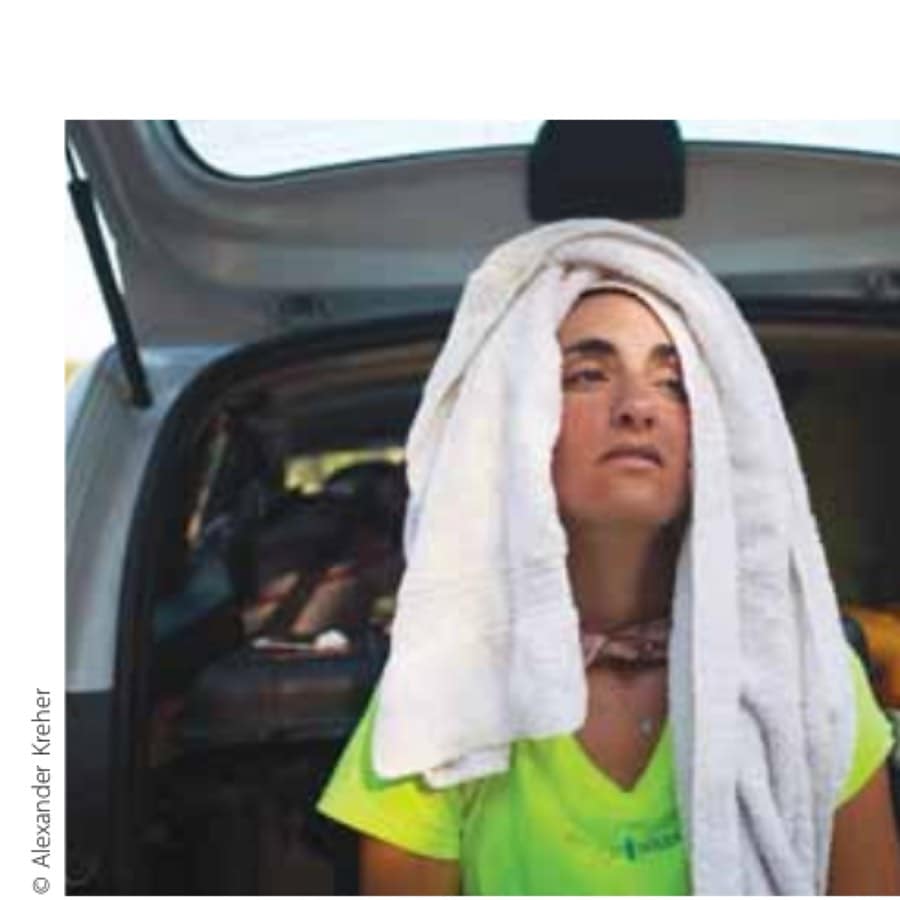
At the end of another hot day in Corsica, where shade was impossible to come by and daytime temps never dropped below 90 F. This is the day I discovered the magic of putting ice cubes in my drinks.
the first haul up the mountain, the road drops briefly down the backside, where the land opens up into a broad, pastoral pad of peaks and hollows and continues up to another mountain pass, the Col de Sarenne, and then back down into the valley
surrounding Bourg d’Oisans, before finally proceeding up the 21 switchbacks of Alpe d’Huez for the second and final time. But today, atop Semnoz, my last Alpine climb and steepest of the whole Tour, I have made it through all that and there’s nothing to do but sit in the sunshine at
the top and eat ice cream with Alex and the rest of the tourists, as if we are just here, in this spot, at this time, to enjoy the view and share a sundae. A few days later we arrive in crowded, frenetic Paris in a dreamy haze of
humidity and culture shock. My brother and sister and sister-in-law meet me there, and we run the last day into Paris together. I’ve dreamed so long of this day, of this afternoon, that it’s funny to find ourselves proceeding slowly in fits
and starts, barely making progress amid the sea of languid tourists and shoppers swarming the Champs-Elysées. The run comes to its anticlimax when the French police standing guard under the Arc de Triomphe grab Alex’s camera and delete
all the footage of me running under the Arc and ask us for our papers. When it’s clear we don’t have papers on us (do the Tour cyclists carry their passports, Monsieur?), they ask us to please clear the area.
The incident does nothing to dampen our spirits, however, and that night I dress in my cleanest running shorts and polyester tee, and we all go out to a cafe on Rue Oberkampf and order bières as big as our faces. It’s a brief and brilliant
celebration because although the Tour cyclists will finish here tomorrow at dusk, Alex and I have left the Tour’s first three stages in Corsica to do as our last three stages, which means I have 320 miles more to cover over the next 10 days. * * *
© Alexander Kreher
Corsica is the birthplace of Napoleon Bonaparte and also a reported favorite training spot for the French Foreign Legion. My first day, the thermometer held steady at 110 degrees Fahrenheit and hovered there all week. The parched eastern flank of the island is flat, dusty, and barren, and the western coast is unspeakably beautiful—mountainous coves roll in and around picture-perfect seaside villages and the rocks glow orange with the sun’s blaze. Smacked in between the coasts is a baffling mountain range with rocky altitudes reaching 2,700 meters—a fact I was stupidly unprepared for when I had to cut diagonally across the island in the second stage and discovered I had four unexpected cols to log. * * * Just after midnight on August 1, my alarm went off for the very last time in France. We rolled easily out of bed; neither of us had really been asleep. I had decided to run the last stage, 90 miles, in one go. By this time I understood that I couldn’t possibly end the run in the same exact way I had started and sustained it—where is the fun in ending with a 30-mile day when that’s the exact same thing you’ve been doing for 10 weeks? We packed up our bags in the dark, found instant coffee at a gas-station machine, and drove to the start in Ajaccio. Just outside the city, I passed an outdoor sports complex, where at least 40 children were playing
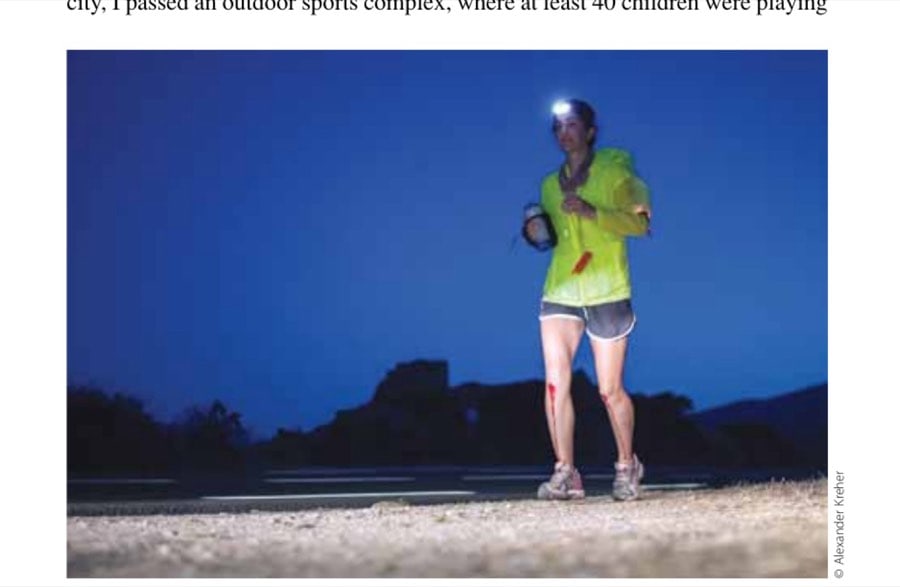
▲ Just before dawn on my very last day. I started at midnight and ran the last stage, 90 miles, in one go. Like an idiot I took off my headlamp too early in the pre-dawn darkness and fell down hard on some rocks by the beach. I put the headlamp back on but still managed to repeat the feat a mile later.
soccer, wide-awake despite the silent slumber of the city. In the first five miles I had seen three pairs of neon eyes in the bushes, counted 10 roadside memorials, and climbed 1,800 feet, although I hardly noticed much except for the palm-sized grasshoppers and spiders that dotted the pavement.
I had decided to set my Garmin for three 30-milers, to trick my mind into thinking today was like any other, and just after sunrise I logged my first 30 after falling down twice in the dawn twilight and cutting both knees open. The road snaked along the western coastline and now that the sun was awake and blaring its brilliant light down upon us, I could finally enjoy the view. The water on the west coast of Corsica is a perfect, startling cobalt blue. As the pavement wound in and out of bays and up and down the coastal mountains, the sun boiled and simmered in a spotless sky. By late afternoon, large swaths of small red bumps covered my arms and legs, the fiercely itchy signs of sun poisoning in bloom.
Around 5:00 p.m., I completed my second set of 30 miles. Mild nausea had set in around midday, and I hadn’t been able to eat more than a handful of pistachios and some fruit. Earlier in the day, the road had clambered up and over two emerald-green mountain passes, through scorched gorges of warm, pumpkincolored rocks, and passed briefly back down along the placid coast. The road had been beautiful, then merely tolerable; it was now miserable. It crusted endlessly midmountain along the coastal mountain range, neither descending to enjoy the ocean breeze nor ascending to gain the view from the summit. It wove in and around itself, curlicueing along inlets, bays, and gullies, following the endless, haphazard curves of the ocean, as if it had forgotten its purpose as a road to eventually lead people somewhere. The road dallied, and I did not care to dally with it. There were no road signs, no mile markers. No cell reception. There were no turnoffs nor villages nor indications to reassure us that we had not somehow mistakenly crossed over into a world between worlds.
With 15 miles to go, the road finally began its descent, which offered a harassing relief: I wanted to get off the mountain, but I knew I had one more col to climb, and so the more I went down, the more I knew I would have to go up. Two minutes later, I ran into a wild boar, chomping away in the dusk forest surrounding the road. Stunned, I blew into my whistle as hard as I could—a tactic I had heard might work but which in fact did nothing but irritate the boar into stomping closer to me. I was frustrated and humbled because this exact scenario had occurred my very first week, and now here I was, a seasoned Tour de France runner, encountering the same obstacles that had plagued me as a rookie 10 weeks before, and I reacted now as I had then: I sprinted away, back up the mountain, and slumped over the side of the road, shaking and yelling Alex’s name, trying not to consider the probability that there were boars in all directions.
I stayed that way for four, five, 10 minutes, until enough time had passed for Alex to wonder where I was and to drive back up to check on me. For the
© Alexander Kreher
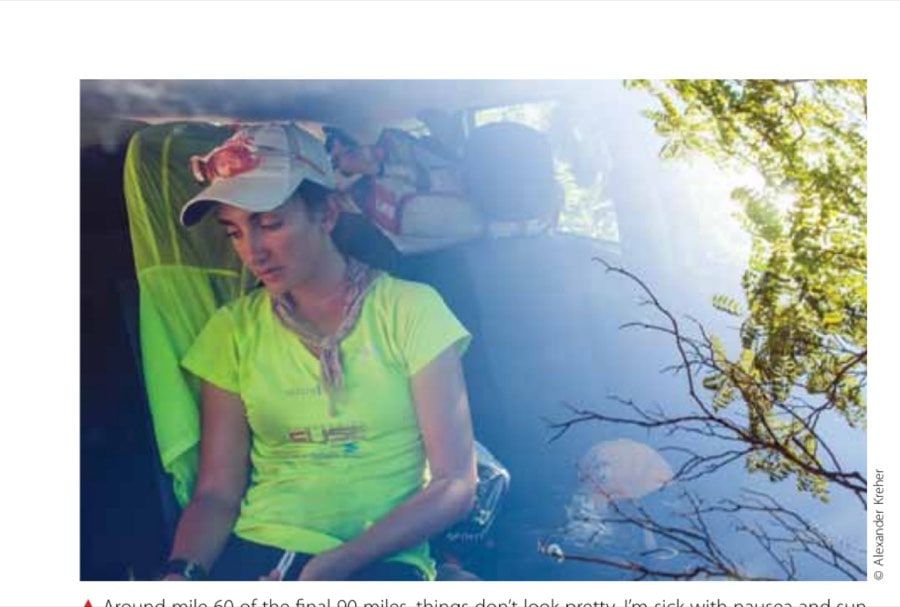
▲ Around mile 60 of the final 90 miles, things don’t look pretty. I’m sick with nausea and sun poisoning, with average temps that day around 110 F.
remainder of the night, I had him drive directly behind or alongside me. The final eight miles were the worst and hardest thing I’ve ever done. I was exhausted, I was sun poisoned, and I was monumentally frustrated that anything should be so hard. I couldn’t keep any liquids in, my head was flushed from fever, and my entire body was a dizzying sway of nausea.
Alex rolled down the windows and told me stories about our friends and family, about all the things we would eat and do back home. I cried. I puked. My parents called and I couldn’t talk to them. The road pitched endlessly forward into the ink-black nothingness of Corsican countryside. There was a mountain up ahead, but I couldn’t see it, and while the road curled slowly upward, I kept getting to the point where I thought the official Tour de France climb started, only to keep discovering that there was more distance to cover before I even formally started going up, according to the TDF website. I would look up and see a car’s headlights far ahead and impossibly high and understand that that’s where I needed to get to, that I still somehow had that many feet to climb and that much distance to slog over. I repeated to myself: I can’t go home unless I finish, I can’t go home unless I finish, again and again and again.
Around 12:30 a.m. on August 2, I finally reached the top of that miserable mountain. There was no official black “col” sign to mark my progress, a small, serrated blade of a fact that disgusted me more than the five-mile climb had. No summit view in the pitch-black night, no sign, no glory. I passed quietly from one
© Alexander Kreher
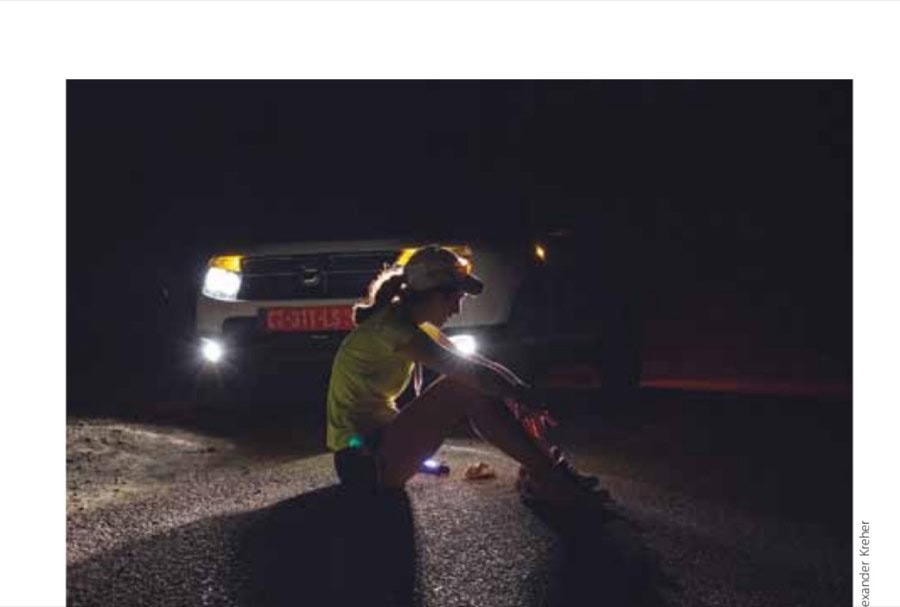
▲ The quiet finish. Just after midnight I finished the final 90 miles, on an empty street in Calvi, Corsica, just Alex and me. A very surreal moment.
side of the mountain to the other, and down I went. Gravity compacted me against the road and the pavement throttled apart my hips and my knees and the quad muscles that I never wanted to use again. I wondered if this is what the limit feels like and how you are supposed to know once you get there and if vincible was the opposite of invincible. I was a runner; am a runner; I wanted to keep running all my life. I didn’t want to do irreparable damage to my body, all for this stupid, vain idea to try to finish the hardest thing I’ve ever done with an even harder thing.
Half an hour later I finished, alone with Alex on the silent streets of Calvi, just the two of us, the same way we started. I sat down on the pavement, head in my hands. For the first time in my life, I felt truly that I could not have gone one single step farther. My knees were bloodied and bruised, my ankles swollen red, my skin pickled red with sun damage, and my whole body on fire. I looked like hell. But finally, I was satisfied. Finally, I looked the way I felt: as though I had been through something—something real and raw and elementally human. Every doubt and obstacle and fear and accomplishment had forced me to persevere, had forced me to learn what the human spirit and body are capable of. I had made it. Two thousand miles and so many mountain climbs and all those times I had my doubts and my fears and here I was on the other side of it all, a changed person: exhausted, stunned, happy. Finally, I could go home.
This article originally appeared in Marathon & Beyond, Vol. 18, No. 1 (2014).
← Browse the full M&B ArchiveMore like this
1,000+ stories from 19 years of Marathon & Beyond
The complete archive of the legendary long-distance journal — digitized and free to read.
