

Running On Mars: Outer Space Or Spaced Out?
“M
ars Rover One, come in, this is Mission Control. We have a problem, over.” “Mission Control, this is First Officer Weendog. What can we do for you, over?” “Our sensors indicate you are not alone out there. Can you confirm the number of extremophiles running around your present location in the Atacama Desert, over?” “
Control, I don’t think we can call these life forms ‘extremophiles,’ over.” “Rover One, you are breaking up. Please repeat your last transmission, over.” “Control, these organisms are not extremophiles. They are more specialized than extremophiles. We know microorganisms called extremophiles have unique biology that allows them to live in deep-sea volcanic thermal vents, nuclear waste, rocks, ice, and even boiling geothermal geysers. They survive on radiation, chemicals, and conditions that would kill most organisms. However, these runner life forms are surviving in a part of the Atacama Desert that is so hostile to life that even extremophiles would die. The acidic and barren soil here is totally devoid of all life. There are no microbes, bacteria, spores—nothing—over.” “
Rover One, how is this possible, over?” “Control, it appears they must be getting help from an unknown source. We will calibrate our instruments to measure all known variables. The geography of this rocky desert plateau of Chile bordering South America’s Andes Mountains is quite similar to places on Mars and very difficult to explore. We are doing our best. I’m sure NASA will be quite interested in testing exploration strategies for Mars in this remote area. Our research confirms the Atacama is 15 million years old and 50 times more arid than California’s Death Valley. [Memo to Captain Benyo: Is Badwater really that bad? I read your book.] There are places here where rain has never been recorded, because the area lies in a double rain shadow, blocked from moisture on both sides by the coastal mountains and the Andes Mountains. The
area is virtually sterile, without a trace of life except for the occasional runner seen in the distance. It is possible our researchers will be able to refine their techniques to detect extraterrestrial life. New ways to detect the chemical signatures of life are becoming more sophisticated, over.” “Rover One, we don’t have time for a biology and geography lesson here. What is going on with this extreme-runner activity that has interrupted our Mars simulation and rover testing, over?” “Control, we will investigate the situation fully and have a complete report for you on our return to base. Over and out.”
NASA According to NASA, if the Viking probe had landed in the Atacama Desert, it would have concluded that earth was a dead planet. Quoting from the official handbook of the Atacama Crossing, “In 2003, a team of researchers published a report in Science Magazine titled ‘Mars-like Soils in the Atacama Desert, Chile, and the Dry Limit of Microbial Life’ in which they duplicated the tests used by the Viking 1 and Viking 2 Mars landers to detect life and were unable to detect any signs in the Atacama soil.”
HOME ON THE RANGE “Good God, Weigner,” one of my nonenlightened running buddies exclaimed in disbelief as we ran along Headquarters Trail in Medicine Bow National Forest, near my home in Cheyenne, Wyoming. “Why would anyone want to run 150 miles across the desert wearing a backpack?”
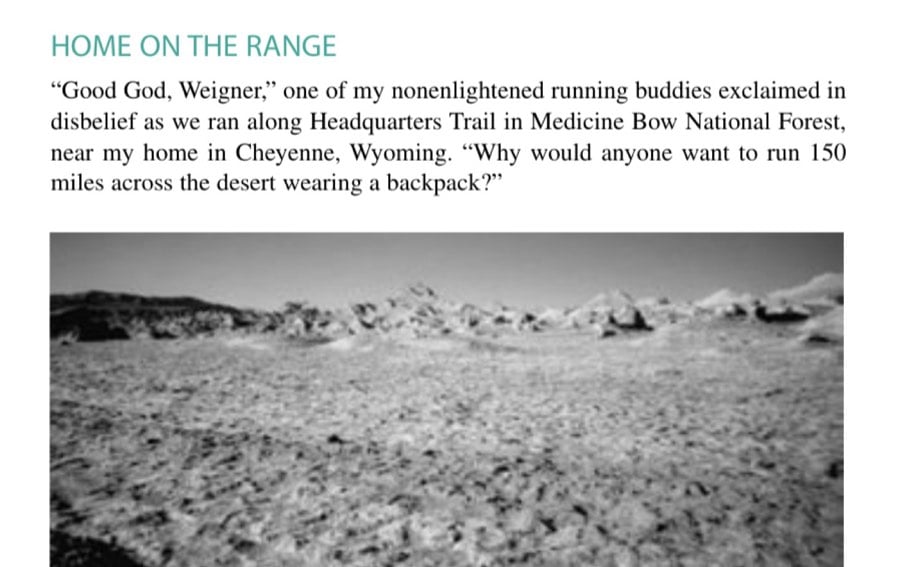
According to NASA, if the Viking probe had landed in the Atacama Desert, Chile, where the Atacama Crossing takes place, it would have concluded that earth was a dead planet.
“Because I can,” came my smartass reply. After all, it wasn’t just any desert. It was the driest desert on earth and the closest experience to running on Mars you could have without leaving the planet. I’m sure my friend was just trying to strike up a conversation as we started our long weekend training run. My motivation for running the Atacama Crossing was a curious topic for conversation as the miles passed beneath our weary legs. A little philosophy on a long run often leads to moments of insight and understanding. Man has a desire to qualify and quantify all of life’s experiences. This need creates in us a notion that we can fully comprehend the reasons behind our motives to challenge ourselves and test our abilities. We can’t. Personally, I don’t claim to fully understand the reasons behind my running expeditions, and I certainly don’t believe it is necessary to justify or explain why I run. Some people think the fact that I am a three-time cancer survivor has created a profound need in me to live a life of extreme adventures. Helen Keller once said, “Life is a daring adventure or nothing at all.” Perhaps. Whatever the reasons for this latest adventure, it is always great fun to retell race stories. I especially enjoy sharing the adventures with my seventh grade geography students at McCormick Junior High School.
WHAT IS THE APPEAL? Recently, a magazine editor asked me, “What is the appeal of multiday adventure races and why does the number of races continue to grow?” Not an easy question to address. I think the appeal of adventure races is the fact that a vast majority of participants are looking for something more authentic and challenging than simply road or trail ultras. Runners looking for these races have evolved and progressed to the next level of racing. The ability to cover 150 miles through exotic landscapes with everything you need to survive for a week on your back intrigues people from the developed countries of the modern world. It is hard to explain the reasons for the siren song of these races, but there is a tremendous feeling of empowerment to finish such a race.
The ancients understood the attraction and the power of the land. They respected and revered certain geographical landmarks such as mountains, caves, and other natural features. Perhaps something rooted deep within us that originated from our primal past forces us to bond with the land in an intimate sort of way. Most of these events also have a strong cultural connection with the local inhabitants, which allows the athletes to learn about another culture. In the final analysis, it is not just about the race. The event is a total experience, a kind of complete immersion that eventually imprints every fiber in the body. The experience affects your values in a visceral manner. You develop a reverence for the earth and realize that man is not in charge. Control is an illusion. Something primitive, instinctual, and sometimes frightening becomes visible, if only for a moment. It reduces life to the simplest of terms—survival on a very basic level.
These self-sufficient events require the competitors to carry everything they will need to survive for a week while racing daily distances up to and exceeding 50 miles. Race organizers typically provide a marked course, a map, water, tents, and medical aid. However, there are no guarantees. This latter fact would later haunt my memory of the Atacama Crossing.
BACKGROUND INFORMATION Mary Gadams, organizer of the Atacama Crossing, was one of my tent mates during the 2000 Marathon des Sables in Morocco. That event served as my introduction to multiday desert adventure racing. I still vividly remember “dune day,” when approximately 100 competitors dropped out of the race—the greatest one-day attrition rate in the history of the event—when temperatures soared to 126 degrees Fahrenheit. Mary, who had completed the race numerous times, and defending women’s champion Lisa Smith-Batchen were among the casualties. I was fortunate enough to finish my first adventure race in a respectable time. Mary, with vast experience in desert running and the business world, went on to found the 4 Deserts series in 2002 and is currently president and CEO of Racing the Planet. Me, I’m still roaming the planet looking for that perfect race. As Steve McQueen once said, “Racing is life. Anything that happens before or after is just waiting.” So I am waiting for the next race while I write this tale of running adventures in the shadow of the world’s longest mountain range, the mighty Andes. Let’s just hope the wait is not too long. After all, enticing events are rising, like a new moon, over the horizon.
BLASTOFF TO MARS Thursday, July 1 Cheyenne, Wyoming My wife, Sue, and I left our home in Cheyenne, Wyoming, on July 1, 2004, for the two-hour drive to Denver International Airport. Not to risk lost luggage, I made sure my kit (pack, food, and all my race gear) was secure in my carry-on luggage. After clearing security, we caught United Flight 458 to Miami and arrived 3 hours and 56 minutes later. We relaxed in the LAN Chile Business Lounge until our flight left at 10:00 P.M. We arrived in Santiago, Chile, at 6:25 the next morning.
Friday, July 2 Santiago, Chile As U.S. citizens, we needed only our passports to enter Chile. No visas were required. However, we did have to pay a $100 arrival fee, which was good for the life of the passport. Our next flight to Calama was scheduled for 3:20 in the afternoon,
so we spent the day touring Santiago with Anita Allen, a fellow competitor and an environmental specialist for Broward County, Florida. Anita was knocking off running events on all seven continents for the second time around.
Compared with other cities in Latin America, Santiago, Chile’s capital city of nearly 5 million people, feels distinctly European. Santiago winters can feel chilly because of the high humidity and close proximity to the ocean. Smog was present because temperature inversions are common as the Andes Mountains to the east trap the coastal air. This creates a pollution problem not unlike conditions found in other large metropolitan areas located on coasts next to mountain ranges.
After enjoying coffee at a downtown hotel, we took a taxi tour around the city before eventually departing for Calama and the Park Hotel. Calama is a mining town and not a particularly interesting city, as life revolves around one of the world’s largest open-pit copper mines. However, for travelers and runners, it is the gateway to San Pedro de Atacama, the finish line of the Atacama Crossing. Before dinner, several runners mingled around the bar for one last beer before departing for our first desert camp the next morning. I met Jeff and Tim, Drug Enforcement Agency special agents assigned to the U.S. Embassy in Lima, Peru. Their duties quite often took them to the Amazon jungle. The Atacama Crossing would be their first multiday race. I told the “drug dudes” they were in for a special treat and wished them good luck. After dinner, race director Ian Adamson, of Eco Challenge fame, briefed us. He informed everybody the race would probably be between Gobi March finishers Charlie Engle and Kevin Lin. Even if Ian had studied all the runner’s biographies, it was his opinion. I considered his prejudicial statement a slap in the face to any other serious competitors in the race. Race directors have a responsibility to be objective and treat all competitors without bias or favoritism. His comments created the impression that previous Racing the Planet competitors might get preferential treatment. A fellow competitor, Boyd Matson, presented a video of the 2003 Gobi March in China, which he helped produce for the National Geographic Channel.
Saturday, July 3 Calama, Chile After breakfast, we began the check-in process. Two race numbers were issued to each competitor and more forms had to be signed by the runners. I pinned number 104 to the outside rear of my backpack and the other number 104 to the front of my kangaroo pouch attachment. Both numbers remained pinned there for the entire duration of the race. The staff inspected and weighed runners’ mandatory gear and performed medical reviews of each competitor. We were issued passports to be carried during the race. Arrival and departure times at each checkpoint would be recorded in the passport. Race rules required us to carry a minimum of 7 pounds
(14,000 calories) of food. I was carrying approximately 16,000 calories of food. My pack, without water, weighed 18 pounds (see page 24 for more details). I packed light compared with many of my fellow runners. Other items some runners carried included hiking poles, cameras, MP3 players, sleeping pads (I used discarded cardboard from staff supplies), pillows, books, navigational instruments, and other personal items. My back, shoulders, and body frame don’t do well with backpack running loads over 15 to 20 pounds. If I’m running while pulling a sled over snow and ice, I can comfortably carry two to three times that much weight. Some of the packs were gigantic, 30 or more pounds, and I winced at the thought of running with such a thing on my back for 150 miles.
In the afternoon, we departed for our first campsite at Rio San Pedro, situated at an elevation of 2,400 meters, about 7,900 feet. The camp was located near huge sandstone rock formations in the fertile agricultural valley of the San Pedro River. I was assigned to tent number one along with my four new brothers in running: Guy Baxter from South Africa, Patrick Griggs from Texas, James Pethigal from Washington State, and Mark “Mr. GQ” Spangler from Minnesota. We teased him because he insisted on shaving every day. Mark had previously finished the Hardrock 100 Mile, probably the toughest 100-mile trail race in the world. Our “last supper,” complete with tablecloths, was catered by the Cafe Adobe from San Pedro de Atacama. Seated at the table next to us was a guy wearing a do-rag, as
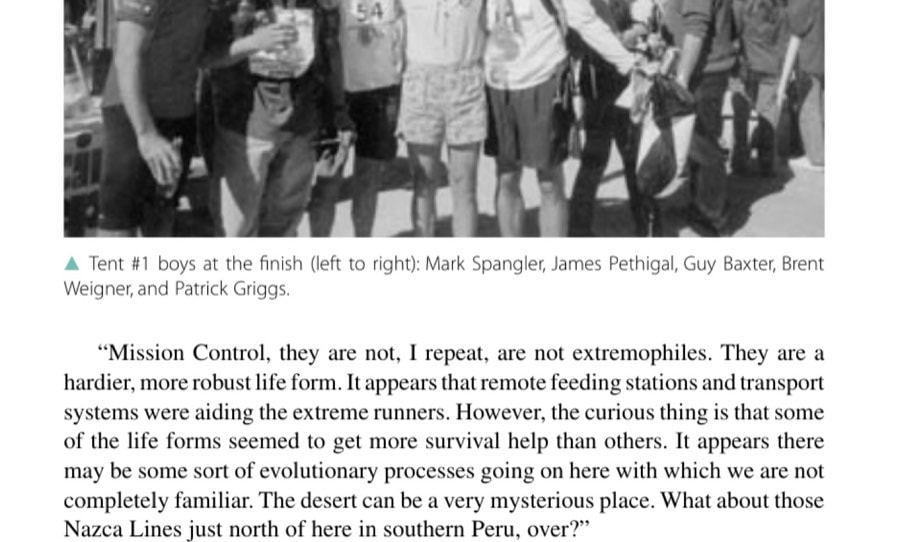
Tent #1 mates (left to right): Brent Weigner, Mark Spangler, Patrick Griggs, Guy Baxter, and James Pethigal.
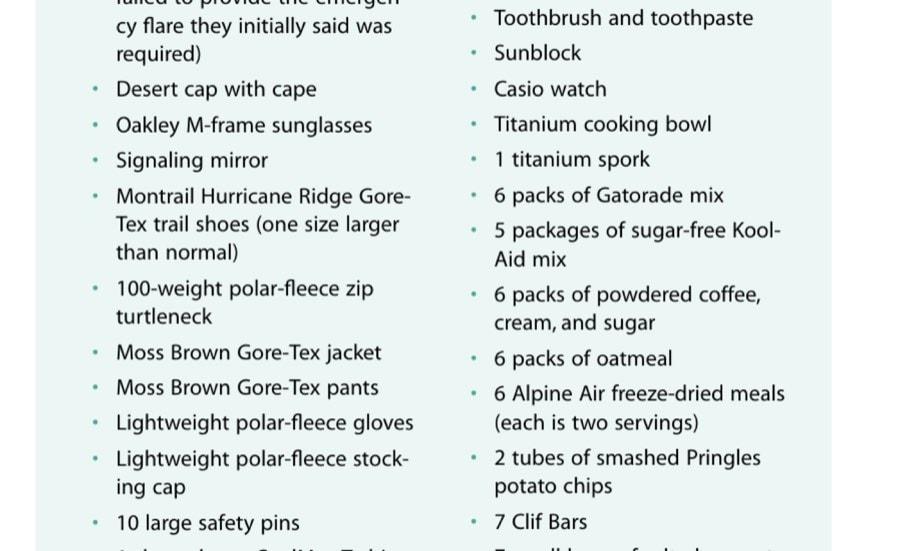
LISTED BELOW ARE THE ITEMS I WORE OR CARRIED DURING THE RACE: • Moletracks II backpack with front pouch and water bottle compartments • 1 widemouthed water bottle
• 5 pairs of SmartWool socks • 1 buff • 1 pair of mini gaiters
• North Face sleeping bag rated to 32 degrees Fahrenheit
• 1 pair of flip-flops made from shoe insoles and 2 scrunchies to hold them on my feet
• Petzl Tikka headlamp with extra batteries
• Lip ointment
• REI mini compass • Small Swiss pocketknife • Whistle • Aluminum survival blanket • 1 glow stick (race organizers failed to provide the emergency flare they initially said was required)
• Eye drops • 6 small packages of Kleenex • 12 wet wipes • Compeed blister patches • 4 Ziploc plastic bags • Ibuprofen • Toothbrush and toothpaste • Sunblock
• Desert cap with cape
• Casio watch
• Oakley M-frame sunglasses
• Titanium cooking bowl
• Signaling mirror
• 1 titanium spork
• Montrail Hurricane Ridge GoreTex trail shoes (one size larger than normal)
• 6 packs of Gatorade mix
• 100-weight polar-fleece zip turtleneck
• 6 packs of powdered coffee, cream, and sugar
• Moss Brown Gore-Tex jacket
• 6 packs of oatmeal
• Moss Brown Gore-Tex pants • Lightweight polar-fleece gloves
• 6 Alpine Air freeze-dried meals (each is two servings)
• Lightweight polar-fleece stocking cap
• 2 tubes of smashed Pringles potato chips
• 10 large safety pins
• 7 Clif Bars
• 1 short-sleeve CoolMax T-shirt
• 7 small bags of salted peanuts
• 1 long-sleeve CoolMax T-shirt
• 14 packages of GU
• RaceReady running shorts with pockets
• 1 bag of trail mix with raisins and M&M’s
• 2 pairs of CoolMax undershorts
• 5 packages of sugar-free KoolAid mix
in hairdo, and drinking a beer. I thought to myself, here is a guy who really likes his beer, since the caterers weren’t providing any alcoholic beverages. I found out later Bill was a two-time winner of the Badwater Ultra.
Once the sun dipped below the horizon and the reddish orange glow on the sandstone rocks disappeared, the temperature dropped considerably. It didn’t take long for most of us to settle into our sleeping bags. However, sleeping was a problem because of the noise provided by several locals and others who partied into the night. It was Saturday night, Catholic mass was concluded, and tomorrow the work would begin in earnest. I couldn’t be too angry. Anyway, somebody once told me that lying still was 60 percent as restful as sleep.
Sunday, July 4 Stage One: 32 Kilometers, High Pass Near Machuca to San Bartolo, 3,600-Foot Descent. After an early wake-up and breakfast in the dark, we departed from Camp One to the starting line. Snowcapped volcanoes of the Andes Mountains loomed in the distance as we drove from our camp at Rio San Pedro northeast of the oasis town of San Pedro de Atacama. I wondered whether we would see snow at the starting line. The race would actually begin at a 13,500-foot pass located above the town of Machuca in the Altiplano region of the Andes Mountains. We were south of the equator, and that meant it was winter at this time of year. Of course, it can snow in the high mountains at any time of year.
Sure enough, a few flakes or pellets of snow and ice fell on and off as we made last-minute gear adjustments and checked our kits. Having become intimate with my Moletracks II backpack during the Marathon des Sables seemed to give me a feeling of confidence and help calm my prerace nerves. After all, I told myself, I wasn’t racing. My goal was simply to finish and enjoy the journey. I was just going along for a leisurely adventure run in northern Chile so my wife, Sue, could visit South America. She was also a member of the staff medical team (she is a nurse), and it was her first trip to South America. It was my ninth trip to South America. Down deep, however, I was very concerned because I had done only two training runs over an hour since pulling my left hamstring at the Ice Age Trail 50K on May 8 in Wisconsin. One of those runs was the Big Horn 50K outside of Dayton, Wyoming, on June 19. In any case, I thought it would be ill advised and very arrogant of me to assume I could race this event since I had not paid my dues and trained properly. The ego would have to be retired for this event.
Subsequently, I was very pleased when a local shaman, called a yatiri, showed up to bless the event. I knew we could use all the help we could get. After the prayer, a local band played lively music to signal the ceremonial start of the race. Approximately 75 competitors headed down the hill with designated runners
Indian blessing at the start at Machuca, 13,500 feet.
carrying the flags of the 21 countries represented in the race. Four kilometers later we arrived in Machuca for the restart of the race. From Machuca (elevation 4,000 meters), we descended down a deep valley through a few patches of snow and ice along the Sendero de Chile, the Inca Trail. It was an incredible feeling to be running past ancient Incan ruins and pre-Columbian pueblos. Midway through the stage we encountered a huge hill climb. Unfortunately, several runners missed a turn and cut off a substantial portion of the climb. Were these runners suffering from altitude sickness that affected their judgment, or perhaps poor course markings had confused them? Whatever the reason, I hoped it was not a sign of things to come.
The altitude seemed to affect me more than usual. Living at 6,300 feet and racing at elevations above 14,000 feet, I wondered what my problem was. I remember sitting on a rock at the top of a particularly steep section and watching runners cut through the valley below. My pack seemed much heavier than the 18 pounds that race officials recorded prior to the race. Undoubtedly the real problem was I had trained with the pack only three times the week before leaving for Chile. Always the optimist, I discovered the situation created a great way to make new friends, because I couldn’t go very fast. It was during this section of the race that the youngest runner in the field caught me. I had dined with 17-year-old Canadian Jodi Bloomer and her dad, Wade, at dinner the first night in Calama. Jodi and I ran together for a few miles before she disappeared into the distance. I finally arrived at Camp Two in San Bartolo, finishing the first stage in 27th place with a time of 6:29:15.
Monday, July 5 Stage Two: 40-47 Kilometers, from San Bartolo to Laguna de Cejas, 3,000 Meters to 2,500 Meters. I love slot canyons—you know, those extremely narrow and deep cuts into the earth’s crust with vertical walls on each side. Standing in one is very dramatic and creates awe and wonder in the viewer. In a sense, you are trapped in a colorful maze and hoping it doesn’t rain. The concern is genuine and the fear can be very real. When I finished the Desert Cup in Jordan, we ran through the slot canyons of Petra, made famous by the 1989 movie, Indiana Jones and the Last Crusade. In Israel, we hiked one of the slot canyons between Jerusalem and the Dead Sea. One of my favorites, and possibly the most famous slot canyon in the United States, is Antelope Canyon. It is located on Navajo Nation land just outside the Glen Canyon National Recreation Area near the city of Page in northern Arizona. Just north across the Utah border is Lake Powell.
Antelope Canyon was the site of 11 deaths in August 1997 when a 50-foot wall of water swept through the canyon. A thunderstorm five miles away was the cause. An unwary group of Boy Scouts found themselves in the wrong place at the wrong time as the flash flood destroyed everything in its path. Lower Antelope Canyon was closed for nine months. Slot canyons are dangerous. If water doesn’t kill you, it might be another widow maker (natural hazard) such as loose rocks that does. Just ask Aron Ralston, who recently finished the Leadville Trail 100 Mile race, how he lost his arm in Utah’s Bluejohn Canyon near Canyonlands National Park.
You can imagine my delight and the anxiety that I faced on the second day as we descended from Camp Two in San Bartolo down the San Pedro River through a spectacular sandstone canyon. What if the race organizers had miscalculated the risks? At first we were just bushwhacking back and forth across the river and climbing some small cliffs, not really canyoneering, as we had no ropes and climbing gear. Eventually we were faced with nothing but sheer cliffs on each side as the canyon narrowed to less than 20 feet across and nowhere to go but into the river. Plunging into the ice water actually felt good on the feet and legs. However, after about a mile of running through the ice-cold waters of the San Pedro River, my feet were starting to turn numb. Fortunately the terrain quickly changed and I was back on land, at least temporarily, as we encountered multiple water crossings for several miles. I congratulated myself on my river-reading skills because I never got in over my waist. What a hoot! I finished this stage in 20th place with a time of 7:53:20.
After my dismal performance on the first day, I was encouraged and started to think about the possibility of actually competing. It was probably a dumb idea, but my legs were feeling good and my pack was getting lighter. The day’s run would
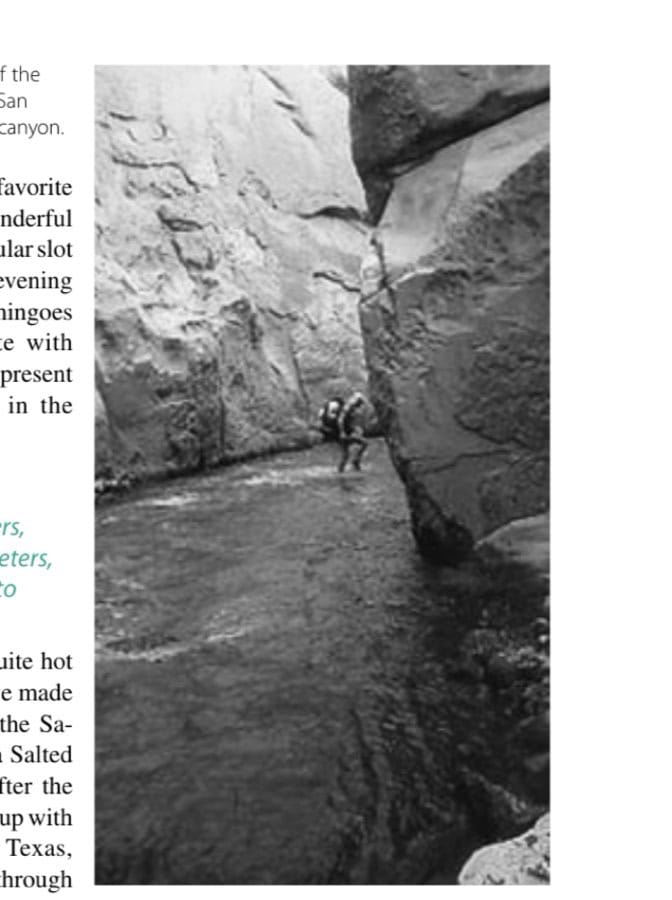
The author’s favorite day of the multistage race: running the San Pedro River through the slot canyon.
later turn out to be my favorite stage because of the wonderful geography of that spectacular slot canyon and river. That evening we witnessed several flamingoes flying over the campsite with the backdrop of the ever-present snowcapped volcanoes in the distance. Life is good.
Tuesday, July 6 Stage Three: 34 Kilometers, 2,500 Meters to 2,400 Meters, Camp Laguna de Cejas to Camp Tambillo Forest. Today turned out to be quite hot (25 degrees Celsius) as we made our way across parts of the Salar de Atacama (Atacama Salted Lake) and salt plains. After the first checkpoint, I teamed up with Brad Youngblood from Texas, and we helped each other through the remainder of the stage. Brad is a senior research assistant at the University of North Texas Health Sciences Center. Being from Cheyenne, Wyoming, I was interested to find out that Brad had American Indian ancestry. His ancestors were from the Cheyenne Tribe. Despite the tough section through the salt flats, Brad and I had a fantastic run. We finished together tying for eighth place with a time of 5:36:00 and in front of all the teams except Team Commonwealth.
Wednesday, July 7 Stage Four: 46 Kilometers From Camp Tambillo Forest to Laguna Tebinquiche. This stage included the worst terrain of the entire seven-day race. The first portion of the stage included a 500-foot climb over six miles through alluvial fans spilling out of the Andes Mountains. After climbing and descending a huge sand dune, we picked our way through the small oasis village of Tocanao (2,485 meters). Several
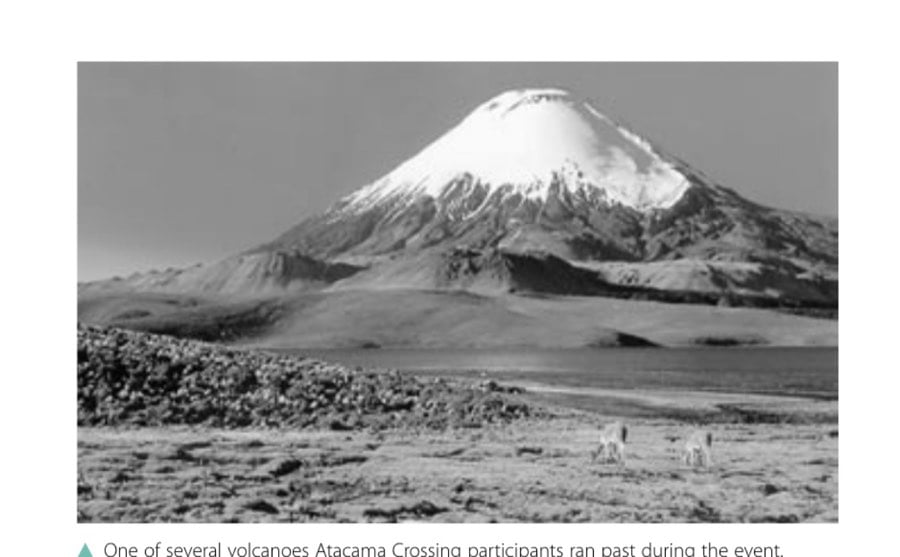
One of several volcanoes Atacama Crossing participants ran past during the event.
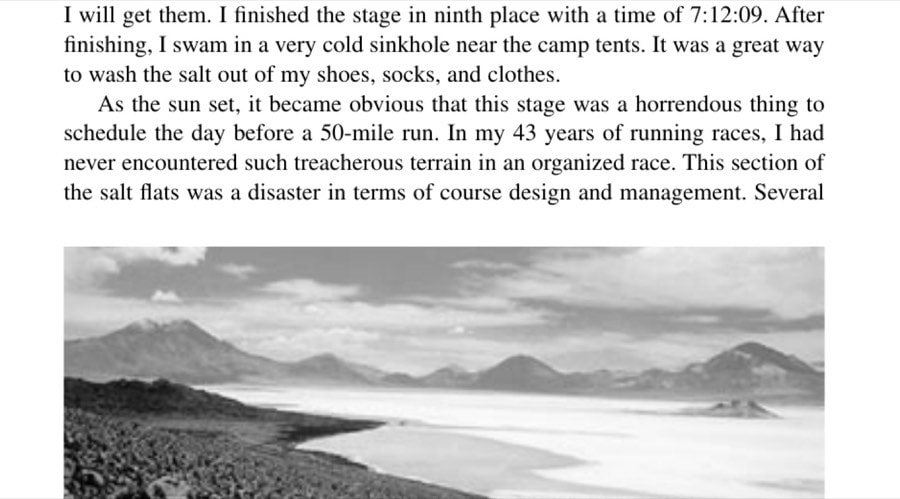
runners stopped by stores to buy drinks. This questionable practice was probably not legal; however, nobody was around to enforce the rules. Some of the colonial buildings had been constructed with rocks of volcanic origin. After meandering through the canyon and past the oasis, we descended back to the valley floor and the desolation of the salt flats. The final 32 kilometers of this stage included approximately 15 kilometers of nightmarish terrain. Most competitors were able to run only about 400 meters of this 15-kilometer section. The salt flats (salar) included ankle-to-waist-high vegetation capable of cutting your legs to shreds.
The salt formations ranged from a few inches high to a foot or more in places. The formations were angular, crusted over, and definite ankle breakers for speed demons, the careless, and the reckless. The only safe and sane way to navigate this horrendous terrain was by taking knee-high steps and zigzagging through the mess. Of course, if I had worn my Wyoming chaps, I could have plowed straight ahead through the nasty vegetation. To make matters worse, occasionally you would break through the crust into the salt bog underneath. At one point, I went in over my knees and was continuing to sink before I was able to scramble to firmer ground.
According to event organizer Mary Gadams, “There was absolutely no way out of this, and many racers became hostile, demoralized and angry, throwing insults at God, Ian Adamson (course designer), and themselves for even signing up for the race in the first place.” The hellacious terrain taught me the value of trekking poles on difficult courses. Chuck Walker from California overtook me and offered to lend one of his two trekking poles. I accepted his offer, and the pole
helped stabilize my balance through the tricky terrain as I navigated the not-so-flat salt flats. Chuck was a former United States Marine and was currently a deputy sheriff working felony warrant service with San Joaquin County. He was one of those tough guys you didn’t want to be around when he was angry, and everybody was angry that day. He finished about four minutes ahead of me.
The day had been billed as the first crossing by foot of the Salar de Atacama. By the end of the day, everyone understood why. I overtook and sprinted pass Team Chile about 10 meters from the finish. Later, Dr. Mike Stroud, of polar fame and a consultant with the BBC camera crew that was filming a documentary on Team Direct Line, told me he enjoyed my kick down the home stretch. Dr. Stroud is best known for his record-breaking expeditions with Sir Ranulph Fiennes. In 1992-1993, they broke several records when they completed the first unaided walk across the continent of Antarctica. I enjoyed his compliment and relished my little victory over the Chilean military team. Once again, only Team Commonwealth managed to elude me. I thought to myself that maybe tomorrow on the long stage I will get them. I finished the stage in ninth place with a time of 7:12:09. After finishing, I swam in a very cold sinkhole near the camp tents. It was a great way to wash the salt out of my shoes, socks, and clothes.
As the sun set, it became obvious that this stage was a horrendous thing to schedule the day before a 50-mile run. In my 43 years of running races, I had never encountered such treacherous terrain in an organized race. This section of the salt flats was a disaster in terms of course design and management. Several
Stage four brought the most difficult terrain: desolated salt flats, which included ankle-towaist-high vegetation capable of cutting participants’ legs to shreds.
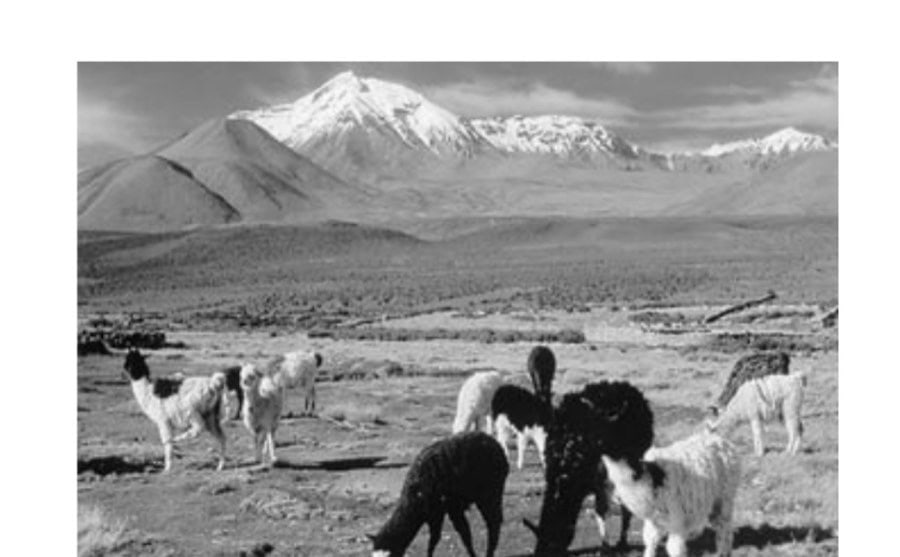
Llama spectators in a plush area of the course.
folks were evacuated from the course. The last runners finished around midnight. The rider and two horses that served as the sweep each day and were responsible for following the last runner to the finish were unable to finish the stage. Sadly, the horses became stuck up to their flanks in the salars. There was concern the animals might not survive the night. A truck was sent out to help with the rescue, and it also became entrenched in the salt bog. Water and hay were delivered to feed the horses, and the owner stayed with the animals through the night. Eventually, as the nighttime temperatures dropped below freezing, the bog firmed up and the horses were able to step out of their salty trap.
As I drifted off to sleep, I wondered about the appropriateness of the stage four course. Because this was an amateur race and most of the runners were recreational athletes with modest qualifications, should the risks have been so great? Was the course designer negligent, incompetent, or just unlucky in delegating his responsibilities to others? It was a cruel stage and a terrible ordeal to put folks through the day before a 50-miler.
Thursday, July 8 Stage Five: 80 Kilometers, Laguna Tebinquiche to Valley de la Morte (Valley of Death). Because of the problems last night, the 50-mile start was postponed until 9:00 A.M. Despite a lack of sleep, I felt rested and strong and decided to force my pace early
in the day when it was still relatively cool. My strategy worked, as I would not see Team Commonwealth until well after dark when all the runners became lost. Team Direct Line also decided to run strong early on while the temperatures were cool. Shortly after the 20K mark, I passed them and not long afterward I caught Team Chile. I passed the 30K and 40K checkpoints running in third place behind Kevin Lin and Charlie Engle. Little did I know that they had become lost after the 30K checkpoint and Gadams had tracked them down and given them a ride back to the correct course. (When John Szymanski and I became lost on the final stage, we did not have the luxury of a ride back to the course.) Scott Smith caught me around the 40K checkpoint. The day had become quite hot as John Szymanski eventually caught up and kept me company for a few miles. The 21year-old Szymanski was a pharmacy student at the University of Connecticut. John eventually pulled ahead of me after the 50K checkpoint.
The next 10K of the course was basically flat and boring on rocky gravel and dirt roads that eventually turned to pavement a few miles before the 60K checkpoint. You had better not wander off the road in this section of the desert because the Chilean military had placed landmines throughout the area several years ago. Big signs warned motorists and others of the danger. By 60K, I could not see anybody behind me and was approximately 30 minutes ahead of the next competitor. My wife, Sue, was working the 60K checkpoint.
It was beginning to turn dusk at 5:30 P.M. as I checked my watch to confirm that I had been running for 8.5 hours. With 20K to go, I figured the worst-case scenario would place me in camp by 8:30 P.M. (11.5 hours running time). I found out later that Charlie and Kevin were the only ones allowed to finish the stage, and it took them roughly 12 hours. I didn’t know what the night had in store for the rest of us as I put on my headlamp and tied a glow stick to my backpack. After kissing Sue good-bye, I hurried up the canyon while it was still twilight. As it grew increasingly dark, it became difficult and then impossible to see the flags.
My heart sank as it became evident there were no glow sticks. I was all by myself in the middle of a dark desert, feeling strong but unable to run because of an unmarked course. All of a sudden, a furry figure appeared out of the dark. It was Arturo, the dog we had befriended several days earlier. “Praise the Lord!” I yelled out loud. Arturo would pick up the other runners’ scents and I could just follow him. Unfortunately, the dog had other ideas. After two hours of wandering around in the dark, I met up with John Szymanski at the bottom of a large sand dune. Like me, he was lost.
Some time later Team Commonwealth, Team Illinois, Gunnar Fehn (a medical doctor and anesthesiologist from Norway), and a few others joined our group. Eventually there were about a dozen of us who finally realized we were screwed and unable to navigate the correct course. We hunkered down on a ridge, got in our sleeping bags, watched the stars, and waited for rescue or sunlight. Andrew
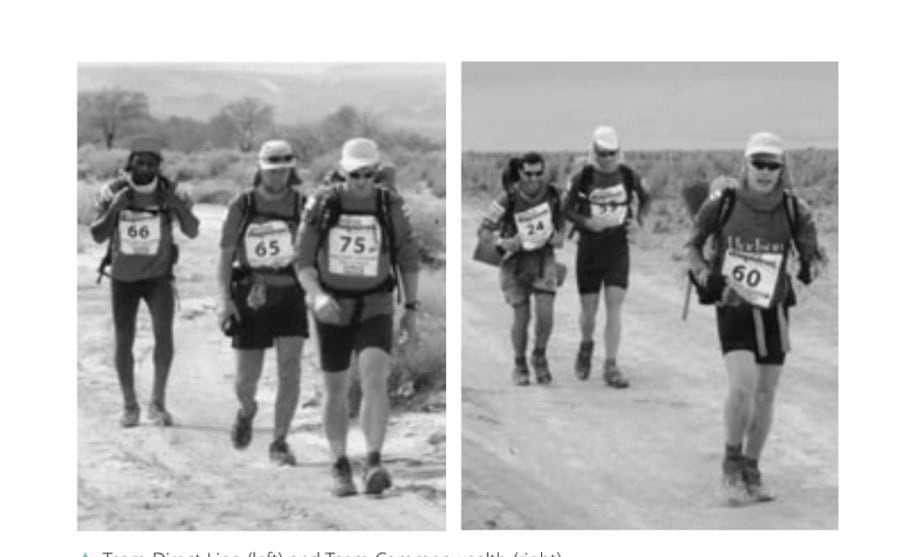
Team Direct Line (left) and Team Commonwealth (right).
from the BBC film team joined us on a four-wheeler and radioed for help. After much time and confusion, one small truck arrived for evacuation. There was not enough room for everybody in the truck, so Gunnar and I and a few others followed the truck’s taillights to the 70K checkpoint. At that point, we were not allowed to run the last 10K of the course because it was not marked. I was disappointed but not surprised. It appeared that race officials would have to use the places and times from the 60K checkpoint to determine standings.
Team Direct Line was particularly upset, as it had passed Team Chile just after the 60K checkpoint to become the leading team. Ian informed several of us that we could do the last 10K the next day, just for fun. Many of us were simply furious at such incompetent course marking but vowed to finish the course the next day. I am always curious to continue the adventure and experience new terrain.
Friday, July 9 (Down Day) Valley of Death. After the outrageous events of the night, our tent finally got to bed around 2:00 A.M. However, it was hard sleeping not knowing the fate of my wife, Sue, and some of the other competitors. Unfortunately, Sue and several competitors were forced to spend the night at checkpoint 22 (70K). Later that morning around the campfire, Ian tried to explain the screwups on marking the course. However, he did not apologize, which appeared to bother several of the runners. We were extremely lucky that no one was seriously injured during the shortened 50-mile stage.
The decision to end the stage at the 60K checkpoint was finalized. Sue was in tears when she eventually showed up at our tent. Nurses always want to make the pain go away and make the hurt better. Her ordeal had been emotionally trying, and I comforted her by reassuring her everybody was OK. I took an inventory of my gear and food, cleaned up the tent, and prepared to hike the last 10K of the botched stage five course. My tent mate James and others were driven out to complete the sections of the course leading up to checkpoint 21 (60K). Most folks relaxed and just lazed around camp.
Several people from the nearby town of San Pedro de Atacama came out to surf the big sand dunes located above our camp. Late in the afternoon, Ian showed up and took a few of us out to finish the last 10K of the 80K stage. It was a beautiful leg through sandstone canyons and across huge sand dunes. Ian was picking up yellow pieces of his clothing that he had hastily cut up the day before to mark the course. Not one flag or glow stick had been used on the last 10K. Only small, yellow pieces of cloth, weighted down by rocks, marked the course. We arrived back in the Valley of Death just as the sun was going down.
Saturday, July 10 Stage Six: 15 Kilometers, Valley of Death to San Pedro de Atacama. Rising just before sunup around 6:30 A.M., I found my last packets of oatmeal, coffee, creamer, and sugar and made my way to the campfire. Charlie Engle and I were the only ones around the campfire for a short time. After visiting for a while, I found out his marathon personal best was around 2:47 and realized that prior to becoming chronologically gifted, I would have given him a run for his money. Today’s final stage was supposed to be a short 15K into the town of San Pedro de Atacama. Kevin and Charlie took off from the gun with John Szymanski and me in close pursuit. They opened up a 500-meter lead after the first few miles. John and I lost sight of them on the river as we rolled into town. I told John to keep his eyes open, as I was now paranoid that we would miss a turn. Despite our best efforts, we ended up lost in the middle of town. Once again, we fell victim to the lack of adequate course markings. We eventually wound up at the finish line before Kevin and Charlie, and Ian told us to go back down to the river to find the course, which by then was marked with other runners. According to my watch, the unintentional detour added approximately 11 to 12 minutes to our times. Additionally, the incident cost me three places in the overall standings. I tried to be philosophical and amused myself by remembering how Forrest Gump’s fictional run across the United States inspired the bumper sticker, “&*#% Happens.” Despite my dismay, I was later pleased when I found out that I had won the men’s 50-and-over category.
Not bad, I thought, considering that my original intent was to complete a leisurely adventure run—further proof that it is hard to change the spots on a leop34 l MARATHON & BEYOND l JULY/AUG 2005
ard. Other runners readily accepted the race organizer’s explanation for the trials and tribulations of the course. According to Mary Gadams, “In a perfect world, everything smoothly unfolds, schedules are unfailingly kept, and, alas, courses are always perfectly marked. Welcome to the world of adventure racing, where, frankly, anything can happen.” Unfortunately, this explanation was a source of disappointment and anger for some runners. My advice: “Hey, get over it. Time to move on. If you really can’t stomach it, don’t sign up for the next one. If you want eight all-weather lanes, stay on the track.”
TOUCHDOWN “Mission Control, come in. This is first officer Weendog on Mars Rover One, over.” “Rover One, this is Mission Control. What is the status of your operation, over?” “Mission Control, we are returning to base with all instruments and data intact, over.” “Rover One, what about the status of those extremophiles? How were those life forms able to survive the Atacama? Did you determine the unknown source helping them survive, over?”
ad
Tent #1 boys at the finish (left to right): Mark Spangler, James Pethigal, Guy Baxter, Brent Weigner, and Patrick Griggs.
“Mission Control, they are not, I repeat, are not extremophiles. They are a hardier, more robust life form. It appears that remote feeding stations and transport systems were aiding the extreme runners. However, the curious thing is that some of the life forms seemed to get more survival help than others. It appears there may be some sort of evolutionary processes going on here with which we are not completely familiar. The desert can be a very mysterious place. What about those Nazca Lines just north of here in southern Peru, over?” “
Mars Rover One, we haven’t time to indulge your fanciful imagination. That will be all. Return to base immediately. We look forward to reading your entire report when you are safely back at base. Over and out.” Note: General photo credits go to RacingThePlanet, Robin Postell, James Pethigal, Mark Spangler, and Brent Weigner.
Are You Moving? Please let us know when you move so there is no interruption in your subscription. Send address changes to Marathon & Beyond, 206 N. Randolph St., Suite 502, Champaign, IL 61820; or via e-mail to jan@marathonandbeyond.com. Put “Address Change” in the subject line.
This article originally appeared in Marathon & Beyond, Vol. 9, No. 4 (2005).
← Browse the full M&B ArchiveMore like this
1,000+ stories from 19 years of Marathon & Beyond
The complete archive of the legendary long-distance journal — digitized and free to read.
