

Running on the Moon
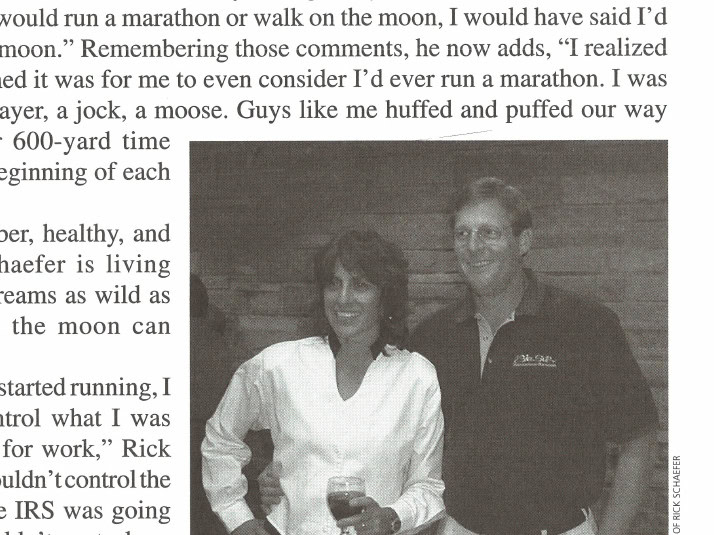
After that, Rick entered several other local races, each time running faster and finding more enjoyment. In celebration of his achievements, he wrote an essay for the Clydesdale group called “From Drafthorse to Thoroughbred.” Little did he know that this piece of Internet verse would be the key to his meeting his current wife, Karen. “She sent me an ‘Ah shucks’ e-mail, and the rest is history.”
At this point, running and his running friends had become a big part of Rick’s life. Running was more than just a way to stay fit—it was part of his lifestyle. Accordingly, the natural next step for Rick was training for a marathon. He set his sights on the Long Beach Marathon.
DOCTOR KNOWS BEST
“This was when fate took a seemingly cruel turn,” Rick reveals. “I had decided to share my new-found love of running with my cardiologist. I wanted him to give me a medical blessing. So I scheduled an appointment for a full treadmill test. I hammered the treadmill, and the doc asked me a lot of questions about why I wanted to run a marathon. Did I know about hydration and how to avoid overexertion? I thought, ‘This is a slam dunk! I’m a heart rate monitor maven, and I’ll carry my own water.’ But the doc dropped a bomb. Red light and no blessing. He had concerns about the effects of accumulated fatigue. He said, ‘If anything ever happened to you, and another doctor saw your chart, they would have my head!’ The world caved in. I stumbled from his office, as disappointed as I have ever felt. I knew I could run the distance, and here it was being taken from me. My dream was shattered.”
Sometimes a setback can be a great motivator, though, and in this case all it took was finding a loophole in the doctor’s warnings. “Karen took me to watch a 50-kilometer [32-mile] ultrarace, and I discovered that people walk lots during ultras. Hey, guess what? My doctor told me he didn’t want me running continuously for four hours, but if I rested, he didn’t care if I ran eight hours in a day.”
The solution was simple. Rick figured he could do his marathon if he took walk breaks. Following a strangely bent sort of logic, he signed up for a very difficult, hilly trail marathon on Catalina Island. His reasoning? “Of course, I’d walk the uphills. Of course, I’d listen to my heart rate monitor. Heck, I’ll even set it low! See the doctor? Why? I’ll be doing what he told me was okay . . . kind of,” Rick laughs.
The Catalina race started a chain reaction. “That was my first,” he relates. “Once I had that under my belt, I thought I’d try running a road marathon slow. The key to all my long runs is heart rate. If it goes up, I slow the pace down, even if it means walking.”
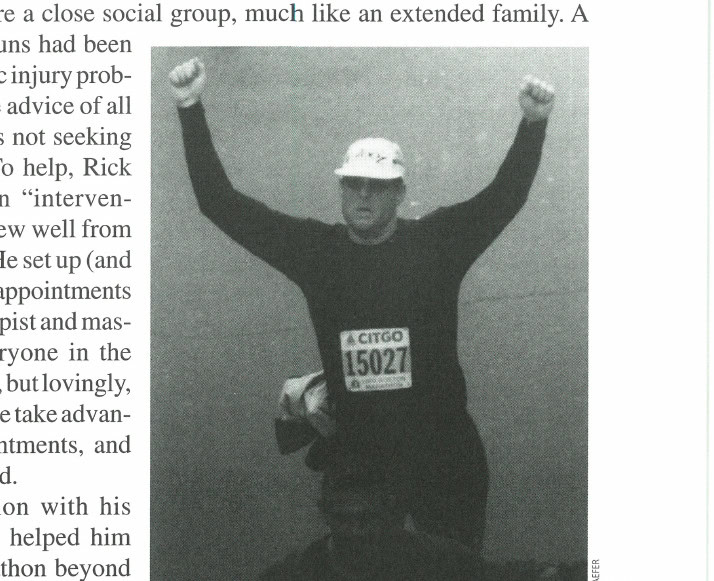
The Clydesdale Internet group has remained a big motivator for Rick. He estimates he has run with members of that group in 25 different states. Another group that keeps him going is known as the “Satruns”: a group of Boulder runners who get up early every Saturday morning to put in a long run in preparation for their next long run. The camaraderie of this group extends beyond running, and they are a close social group, much like an extended family. A member of the Satruns had been experiencing chronic injury problems, but despite the advice of all in the group, he was not seeking professional help. To help, Rick decided to stage an “intervention”—a term he knew well from the “bad old days.” He set up (and paid for) his friend’s appointments with a physical therapist and massage therapist. Everyone in the group insisted firmly, but lovingly, that their injured mate take advantage of these appointments, and he naturally accepted.
Rick’s association with his running groups has helped him succeed in the marathon beyond his wildest dreams. He has now run in the Chicago, Twin Cities, Big Sur, Boston, New York, Marine Corps, and Boulder Backroads marathons, along with two return trips to Catalina.
MAKING TIME TO RUN
Rebuilding his business career, Rick is now vice president of a successful computer-related business firm. He has homes in Colorado and California and travels a great deal for his company. His time is precious. When asked how he has time to run, he laughs and says, “I don’t have time to run. I do it anyway!
“I fly between 75,000 and 100,000 miles a year, and the only way to run is to schedule runs into my Daytimer in advance. I have changed many appointments around to accommodate my daily run. I run in all sorts of weather, and when necessary, I run in airports, sometimes in the wee hours of the morning.”
In five years of training, Rick has missed only 7 days of running and once had a streak of 1,178 consecutive days without a miss. The streak came to an end when he and his Boulder running buddies decided to take a short cut on a Sunday run. Everyone was especially tired that day, so they jumped a fence to cut the distance. Rick came down hard on his foot, and the streak and his foot snapped at the same time.
“Running daily is a commitment,” Rick advises, “and it doesn’t happen all by itself. Sometimes, I’ve started the run only for a streak’s sake, but I’ve rarely been let down by a run. Usually, it turns out to be the best ‘play time’ of the day for me.”
Is Rick’s running really “play,” or is it a new addiction to replace the self-destructive addictions of his past? When pressed on this question by his running friends, Rick can only laugh about his compulsive personality. “I’ll take this addiction over my old ones any time!”
Right after his first Catalina Marathon, Rick summed up his total change in lifestyle and outlook on life. “Ten years ago, if you asked me if it was more likely that I would run a marathon or walk on the moon, I would have said I’d walk on the moon.” Remembering those comments, he now adds, “I realized how farfetched it was for me to even consider I’d ever run a marathon. I was a football player, a jock, a moose. Guys like me huffed and puffed our way through our 600-yard time trial at the beginning of each season.”
But a sober, healthy, and fit Rick Schaefer is living proof that dreams as wild as walking on the moon can come true.
“When I started running, I couldn’t control what I was going to do for work,” Rick reflects. “I couldn’t control the next shot the IRS was going to take. I couldn’t control my girlfriend’s actions. I couldn’t control lots of things. The one thing I could take total control of was dragging my fat body out of bed and running over to Waneka Lake. So, if you ask me what running has given me, I would truly have to answer everything!”
FROM WHAT I’ve seen so far, it’s a pretty strange world. Some people repeatedly drink ’til they puke. A few actually believe what politicians have to say. Hundreds of thousands read the National Enquirer. Then there are those in my state of Colorado who still have Denver Nuggets season tickets—and they aren’t corporate ticket holders, either.
Yes, people can be darn weird. But if you think about it, maybe the strangest people of all are those of us who run marathons. Are you thinking about it? Well, let me help: First off, we get hornswoggled into running our initial marathon because our training buddy, whom we’ve always known to be a little off center, wants to try one and convinces us that all runners should run at least one.
We attempt the first marathon with the hope of “just finishing.” Then we run a second one so we can shoot for a better time. Then we want to take our first trip to Seattle and . . . well, whatta ya know, they just happen to have a marathon there at a convenient time of the year: Thanksgiving. Then we want to qualify for Boston because it’s “the big one.” So we run Vegas because we’ve heard it’s a fast course that might help us qualify for that trip to Beantown. Then we start thinking about running a marathon in all 50 states. And so on and so forth. The pain means nothing and is usually quickly forgotten—like as soon as the soreness wears off. Out of pain, out of mind.
WHY DO WE DO IT?
It’s funny—if you’ve ever fallen into a cactus, you sure are going to be careful not to let that happen again. If you’ve ever been bitten by a dog, you become wary of petting strange dogs. If you play a sport on skates where you lose teeth and routinely get hip-checked face first into the boards . . . well, okay, I guess the money’s pretty good, so there are some exceptions to the pain rule.
But unlike having to go to the dentist, we don’t have to keep running marathons. We could easily, and rationally, stick with shorter distances that don’t require such sacrifice, commitment, and, yes, pain. So why do we?
I ask this question because the following conversation really occurred, although I’m not sure if it was in real life. It might have been in a dream. Or maybe I heard it when I was alone typing this. Whatever the case, this was the conversation:
Susie: “Hey, Jim, why do you run marathons, anyway?”
Jim: “I don’t know, Susie. I think because they’re there.”
Susie: “What’s there?”
Jim: “The roads. If they build them, I will run.”
There’s Reason #1 why we run marathons: Because there are roads. The suckers are everywhere. It follows—logically, I’m sure—that if there are lots of roads and we are runners, then we have to pack on the miles just to try to cover all the roads in our respective towns. It’s probably a territorial thing. If we live in a big metropolitan area, this can get just a tad difficult and require running tons of miles. And since we’re running tons of miles anyway, why not just train for and run marathons? Especially if we have a training partner who thinks it would be a good idea.
Reason #2: Our training partners are persuasive. Here’s a typical scenario:
John (during a 10-mile training run with Fred): “What would you think about running St. George? I hear it’s downhill all the way and a PR is virtually guaranteed.”
Fred: “Where’s St. George?”
John: “I think it’s real close to Big Sur, and you know how gorgeous that course looks in the magazine ads.”
Fred: “Cool! Let’s do it.”
Who could resist the chance to run a marathon along the ocean coast in St. George, Utah?
Reason #3: We get to buy new running shoes. It stands to reason that when we’re running tons of miles, we quickly wear out our running shoes. This means we get to experience possibly the greatest, yet little-mentioned, pleasure of being a runner—buying new running shoes. Does anything compare with the pleasure we get from seeing, feeling, and smelling a new pair of running shoes? Okay, so maybe there are one or two things. But a new pair of running shoes has substance. New shoes motivate and inspire us, while evoking a flood of treasured memories from our innocent childhood years. Go ahead and try it—take a big whiff of a brand-new shoe and see what memories come. Why, it’s almost enough to make you run on concrete to wear your shoes out faster.
This article originally appeared in Marathon & Beyond, Vol. 5, No. 5 (2001).
← Browse the full M&B ArchiveMore like this
1,000+ stories from 19 years of Marathon & Beyond
The complete archive of the legendary long-distance journal — digitized and free to read.
