

Running, Racing, And Death
It was a regular Wednesday night. It was another routine dinner after a regular day at work and a long, boring drive home. It was three days after the Rock ’n’ Roll Half-Marathon in Raleigh, North Carolina, where unfortunately two deaths occurred. It was three weeks since a teenage runner had died at the Shamrock Marathon. It was these tragic events that set off a chain of events that out of the blue had my cell phone ringing.
My first response: who could be calling me? No one calls me, I thought, as I located my phone. On the illuminated screen, the incoming caller was identified as my father. It’s a long story, but I had not talked to my father in a month. Before that it had been three months, when I called for his birthday. But tonight he’s calling me. Answering the phone, I was glad to hear his voice. Within moments I could tell that he was genuinely stressed and worried about something. Over the next 15 minutes of uneasy conversations, I found out just how concerned. “
Brian, this is your dad.” “Yeah, Dad, I know, how are you doing? It’s been a long time, way too long of a time without talking. It’s good to hear your voice.” I paused. “I’m sorry it has been so long,” I said.
My father replied, “I heard the news over the weekend of people, runners, dying at a marathon in North Carolina. I was so concerned.” “Dad, I’m OK. Don’t worry about me.” I tried to calm him down. Just days before, another runner had died at the London Marathon. These current events and the tragic happening at Boston the year before worried him.
I could tell by the tone of his voice he was shaken. During the Boston Marathon bombing in 2013, my cell phone went crazy shortly after 2:49 p.m. I was at work and had set my DVR to record the race, wanting to watch it without spoiling the outcome. In the meantime, I avoided all contact with the outside world until after I had a chance to watch the race as if it were live. When my phone kept ringing for the better part of an hour, I figured something on a national scale was going
on. Out of concern, my friends and family were trying to reach me, wondering if I was caught up in the terrorism. It was humbling knowing that that many people were worried about me. My father was one of those trying to reach me.
During the conversation with my father, I began to tell him that I was OK and that, yes, I had heard about the deaths in Raleigh and days before in London. I also tried to ease his fears by telling him that a very low percentage of runners ever have serious health problems during a marathon. Marathons and other running events are a very safe form of competition. My father is 75 years old, and I fear as we grow older the realization that we did not have the best of relationships is weighing on him. I also think that as we both get older, he fears the last day for either of us. Hearing about the deaths during a marathon and knowing the kind of running that I do worries him.
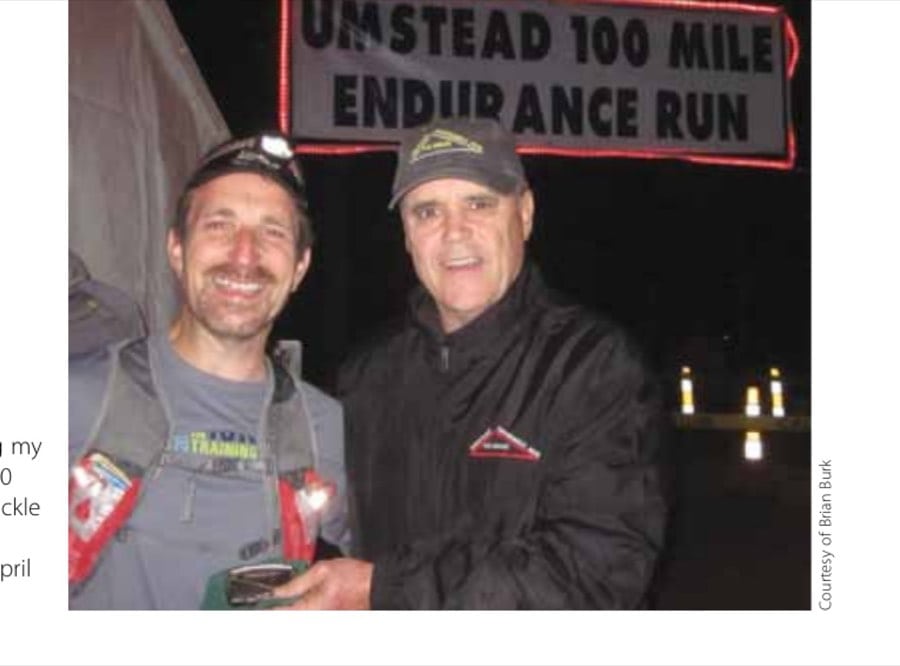
Defeat from victory It was 10 days after my sub-23-hour finish at the Umstead 100 Mile Endurance Run. My father knew about my plans for the 100-miler, and weeks before he told me I should not run this race. During our discussion concerning the deaths at Raleigh and London, I told him of my success at Umstead. I hoped this news would make him proud and reassure him, but it had the opposite effect. Hearing that I had completed the 100-mile race, my father lost it. He was on the other end of the phone, very emotional and crying uncontrollably. You have to understand that even with our strained relationship, my father always has my
Courtesy of Brian Burk
▲
Receiving my Umstead 100 Mile belt buckle from Blake Norwood, April 2014.
respect and love. The life that was handed to him was not ideal; he has lived a tough life. Many of our problems are carried over from his challenging upbringing. His father abandoned the family when he was very young. After the dust of this traumatic event cleared, just a few years later, my father lost his older brother to cancer. Since then he has always had a hard time dealing with loss. All of that said, my father is a strong and proud man. My running and racing extreme distances obviously concerned him. It was hard to make out some of the words he was saying. I was able to understand what was at the core of his worry. “I don’t want to lose you.” I tried to explain to him that I was doing what I loved, that running was part of my life. I tried to explain that if I perished, if I left this world while running or racing, then that would be according to God’s plan and that I was at peace with that. Our conversation that night made me think about how I wanted to live my running life and how I would choose my life to end if given the opportunity.
How I want to live my running life While I continued to talk with my father, part of our conversation revolved around how I wanted to live. I explained to him that at age 50 (I would turn 50 in the fall), I did not want to live in fear of what tomorrow might bring. Yes, it’s scary and very sad to think about those who have lost their lives during our running events. It’s hard to imagine going to a local race or a major marathon and not returning home to our families. It’s hard on the ones left behind, even if they understand our pursuit of the sport we love. It’s hard on the community as we mourn the loss of one of our own. And it’s hard on the sport as we face the judgment of outsiders who only read the headlines “Runners Die at Marathon” and somehow come to the conclusion that running is bad for you. Somehow the full story—a life dedicated to goals, a life that inspired others, and a life that was lived to the fullest—is often lost in the headlines.
While living my life, I do not want to pursue only goals that are safe or easy. I told my father that I valued a life that was active, alive, and moving forward. I want to set the example for my children that life is here for our enjoyment. I wanted them to see someone who was getting the most out of his time here, not someone who was afraid to live, experience, train, and compete. After our conversation reached its conclusion, we hung up, and the call ended. Afterward, I thought deeply about what we talked about and what I had said.
I told my father that I wanted to live my life being active. Many people are happy being still, and there’s nothing wrong with that. People enjoy stillness and love an easy day. They enjoy sitting on the beach with their toes in the sand or a day filled relaxing while reading and swinging from a hammock. Truth be told, I do as well. But I want the stillness of relaxing to be after I’ve completed my run. I
Courtesy of Brian Burk
want to have spent my morning hours on a trail. I want my legs to be tired and sore from an afternoon spent on a mountain path. Or I desire to have my feet remind me of the miles I covered exploring the streets of a new city or the familiarity of my hometown routes. I want my body to enjoy the stillness as it recovers from a speed session at a local track or a set of hill repeats or after a long run. I want my days to be active so that I have earned the stillness. Compared with stillness, being active will reaffirm that I’m still alive.
I want my life, and my running life, to be alive. Running keeps my body moving, fights off the effects of aging, and helps keep me alive mentally. An old proverb that says “A rolling stone gathers no moss” anchors my belief that as long as I stay moving, my life will not gather the moss that may hasten the grave before my time. I also believe that it is the “stillness” that kills us. Motion reminds me that I’m still living. Stillness, slowing down, or giving in to Father Time takes away our life. I might not be as fast, as strong, or as able to run the same distances at the same pace, but as long as I keep moving and keep running, my body and my mind are still alive and pressing forward.
Life is about moving forward, not backward. I want my life and especially my running to move forward. I want to accept new challenges and new distances and to reach for new goals. When I started on this running adventure, a 10K race seemed overwhelming and nearly impossible. Once I finished the race, my next goal became a half and then a full marathon—they seemed nearly unachievable. It took me a few years to finally run my first marathon, and that led me to my first ultramarathon. I don’t want my life to settle for the easy, the common, or the average. Later I was approached about running a 100-mile race. At the time I could not get my mind around running 100 miles—it was crazy, it was scary, it was for someone else. Then I finally accepted that if others could do it, then I could as well. One hundred miles is a long way; I finished in 22 hours,
▲
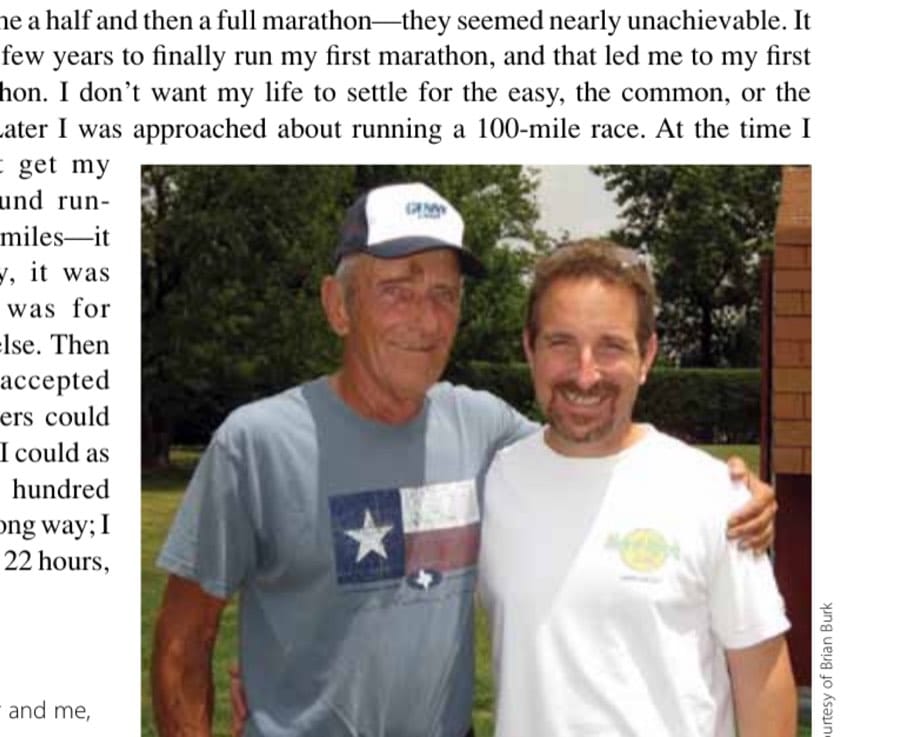
My father and me, 2012.
51 minutes. When we choose to stop reaching for new goals, new distances, and new accomplishments, our active lives begin to perish.
How I would choose my life to end if given the opportunity After trying to talk with my father and later with my wife, I explained that if I died while running a race or out on a training run, they should know that I would be sorry to leave this life, and my family, behind. But in leaving this world in this fashion, I would be happy to pass doing what I felt called to do. Dying while out on a run is not ideal, but it would be a good second choice for my ending.
If I had to draw up the script for my last day, it would go something like this: I would have a final dinner with all of my family, a pepperoni pizza. It would be great to have them all together to tell stories of our favorite times as a family, to hear about their dreams for their lives and to hear that I did a good job as a father. I would tell them all how proud I was and how they filled my life with joy and love. It would be great to tell my grandkids about my experiences, the lessons I had learned, and what I could tell them about being good, respectable citizens of our planet. I would also like to tell my family about my faith in the creator, God, and his son, Jesus. At the end of the dinner, it would be great if we could all settle down to watch a movie.
The most important thing about my last night would be to tell my wife about my love for her, that she treated me better than I needed to be treated and that although I used a lot of my energy pursuing my goals, the greatest payoff of succeeding was hearing her say she was proud of me. And last, I would tell her that I had always loved her. The remainder of the night, I would like to spend cuddling with my wife and our family dog. And if God chose to take me then, I would die fulfilled.
Second to that, I want to die while running, training, or racing. I know it sounds crazy. I just know that if I go early, if I don’t perish of old age or natural causes, I don’t want to die of a disease the doctors can’t cure. I don’t want to die as a result of my stupid actions. I don’t want to perish in a wreckage of twisted metal and broken glass along some lonely road. I don’t want my life to end as the result of a drunk driver. Mostly I don’t want to spend my last days wasting away in a nursing home, a burden to my family or a financial drain to the economy. I don’t want to sit around watching my body decay or with my mind lost in a haze of confusion where I can’t remember who I am. I don’t want to pass waiting on the end. I would rather be running toward it.
Nobody gets out alive We are all going to pass from this life. It has been said that no one gets out alive. I want to die with my heart pounding through my chest, my lungs expanding and
contracting as they strive to meet the demands of my muscles powering my legs up a mountain climb. I want to die with my forehead covered in beads of sweat, straining to get everything I can out of my muscles. I want to die as my legs are fatigued by the latest grueling workout, after a tremendous mountain climb, or as they propel me at light speed downhill or across the finish line, no matter what place I finish. I want to die wringing this body out. I want to meet my maker with my nerves twitching to get every ounce of speed and endurance out of the abilities he gave me. I want to have my final days running on the course he set in front of me.
If I perish at the start of a race, standing still in the corral before even crossing the starting line, I would feel a bit ripped off. I might feel that I still had a race to run but thankful just the same. If God were to call me home in the middle of a race, I would be forever grateful. I would be surrounded by friends, the running community, by others who understand what I’m doing. I would be in the middle of what I love to do and those surrounding me, a running family, who would understand I passed doing what I loved and felt compelled to do. If I were to die as I crossed the finish line or as I attempted to recover in the finishing area, I would feel content and thankful that my last day, my last act, my last moments on this earth were spent going all-out pursing my goals and reaching for perfection in my life.
Death is part of life, and running is part of my life. My wife and kids get it; after our conversation, I hope my father understands.
This article originally appeared in Marathon & Beyond, Vol. 19, No. 4 (2015).
← Browse the full M&B ArchiveMore like this
1,000+ stories from 19 years of Marathon & Beyond
The complete archive of the legendary long-distance journal — digitized and free to read.
