

Running Reykjavik
“They come from the land of the ice and snow, of the midnight sun where the hot springs flow.”* by Jeff Knapp
August 2013 marked the 30th anniversary of the Islandsbanki Reykjavik Marathon, and it was celebrated in style by a record number of 14,272 participants in all the day’s events with more than 1,600 runners from abroad.
It’s no wonder this AIMS International Marathon keeps on growing. Competitors breathe some of the freshest air on Earth and drink pure glacier water while running on smooth roads and bicycle paths along the ocean in a unique, picturesque, and charming small city.
And if that’s not enough, the marathon coincides with Reykjavik’s “Culture Night,” the country’s famous music and arts festival. It attracts 100,000 people from Iceland and abroad to Reykjavik to enjoy outdoor concerts, art exhibits, Icelandic dance, guided tours, food, and fireworks. The excitement and celebration start early in the day and go on until the wee hours of the morning.
A brief history of Iceland Iceland is about the same size as the state of Kentucky. Norsemen created the first settlement on this island country in about AD 874. Over the centuries more and more Norsemen came and with them their Gaelic serfs. From around 1200 to 1918, Iceland was under Norwegian and then Danish rule. The country became independent after 1918.
Reykjavik, which loosely translated means “Bay of Smoke,” is the capital and the largest city. It sits on the southwestern part of the island and is home to fully two-thirds of the country’s population. It is also the world’s northernmost capital, sitting at about 64 degrees latitude, just outside the Arctic Circle.
It is among the cleanest, greenest, and safest cities in the world. Homes and buildings are painted in bright, cheerful colors. The people are beautiful, genuine, and friendly. Although Icelandic is the county’s official language, it seems that English is spoken by nearly everyone in Reykjavik.
Race history
© Árni Torfason Andri Thorstensen
The Reykjavik Marathon didn’t start out as a running marathon at all! Knutur Oskarsson, one of the race’s founders, worked at a travel agency and was trying to come up with ideas to increase tourism. Originally, he tried to establish a Nordic ski marathon called the Lava Loppet in 1981-82. This event failed to materialize.
Oskarsson was visiting Gothenburg, Sweden, one day in 1983 when the Gothenburg Half-Marathon was taking place. The thousands of people running and still more cheering gave him the idea to do something similar in Iceland. He told the idea to his boss, Steinn Larusson, who was impressed, and the two got to work.
With the help of the Icelandic Athletic Federation, Icelandair, and the Reykjavik City Sport and Recreation Council, the race became a reality. Oskarsson had the foresight to contact Horst Milde, the race director of the Berlin Marathon, which had been going strong for 10 years. Milde offered advice and council that was eagerly taken in order to make the race first-rate.
So on August 24, 1984, 281 runners lined up for the inaugural Reykjavik Marathon. Running was such a novelty in Iceland (only a couple of other road races were available in the whole country) that it was decided that three distances—a marathon, a half-marathon, and a fun run—would be offered to attract as many participants as possible. Now six distances are available. In addition to the marathon and the half there are a relay race, a 10K, a 3K fun run, and a children’s run. More than 1,000 runners take part in the marathon and more than 2,000 in the half-marathon.
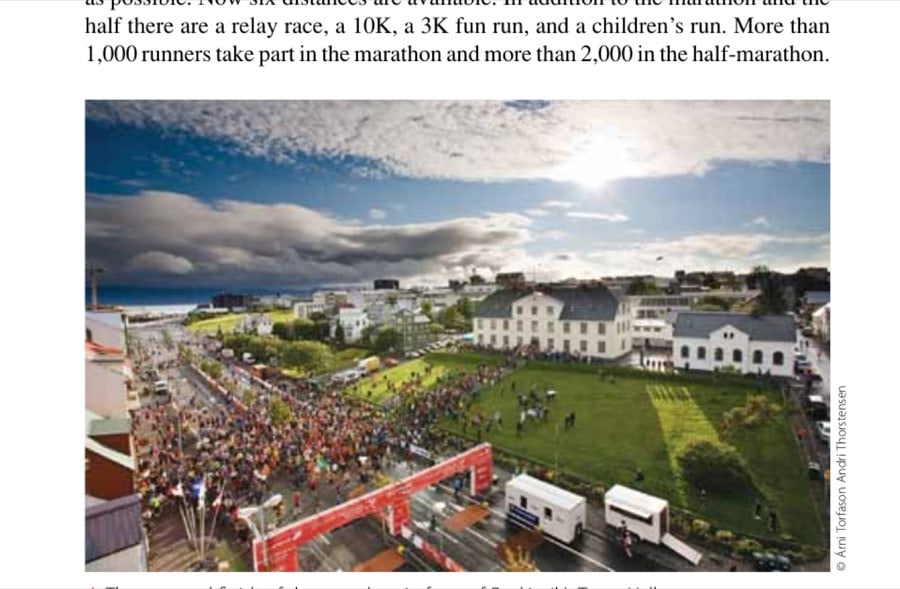
▲ The start and finish of the marathon in front of Reykjavik’s Town Hall.
“Reykjavik is proud that they turned on to running early in the sport,” says race director Svava Oddny Asgeirsdottir. “And with only 300,000 people in Iceland, having over 14,000 runners is quite an amazing percentage. I don’t think you can find that anywhere else. I like to say that we run in Iceland because it’s too cold to stand still!”
But the fact is that Iceland’s temperature in late August is from the upper 40s to the upper 50s. It’s perfect for running a marathon, though weather can be unpredictable. Svava says there is a saying in Iceland, “If you don’t like the weather outside, wait 45 minutes and you’ll have something different.” The Gulf Stream keeps Iceland more temperate than you might think. The winters are not as bad as, say, Chicago or New York, but spring through fall is cooler. Wind is always a factor, though, so much so that using an umbrella is difficult because umbrellas are quickly blown inside out. Savvy locals wear all-weather jackets with hoods instead.
The registration fee is one of the lowest to be found: 65 euros, or about $85. Included in the fee are a high-quality tech T-shirt, a pasta party, a great finisher’s medal, and a pass to the city’s geothermal pools. After the rigors of racing a marathon, participants have the option of taking a dip in any of Reykjavik’s seven pools, complete with saunas and steam baths.
The Reykjavik Marathon is also proud of its involvement with and promotion of charity organizations. In 2014, more than $696,000 was raised for various causes. Another source of pride is that fact that the races are almost 50 percent men and women.
Among the internationally known runners who have taken part in the marathon are Grete Waitz, Frank Shorter, Stefano Baldini, and New York City Marathon founder Fred Lebow.
The course “On we sweep with threshing oar, our only goal will be the Western shore.” * The 8:40 a.m. start of the Reykjavik Marathon is on the Laekjargata, an avenue in the center of the city that is easily accessible from area hotels. Runners line up with the City Hall on the left and the tranquil Reykjavik Pond just ahead on the right. Pace groups are available for both the full and half-marathon.
The course sweeps westward through the town, and before long runners find themselves with stunning views of the Atlantic Ocean. Soon the runners can look across the bay at Mount Esja. Esja is not a single mountain but a group of several snow-capped volcanic mountains formed by glacial activity. Now the race moves to smooth bike paths along the water, and schools of dolphins and the occasional whale may be seen. The Snaefellsjokull Glacier appears off in the distance. This mountain was made famous in the Jules Verne novel Journey to the Center of the
© Hrund ®‚órsdóttir
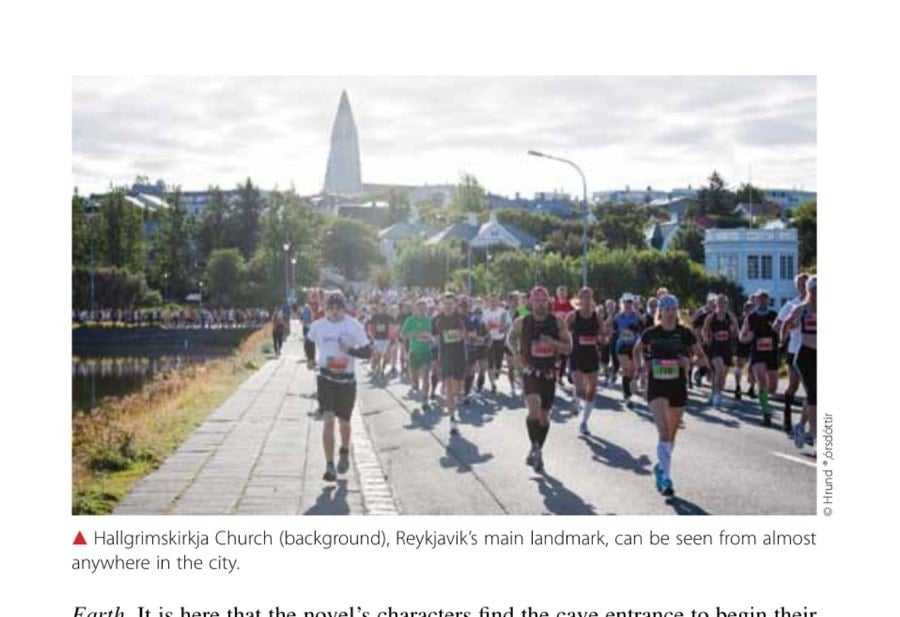
▲ Hallgrimskirkja Church (background), Reykjavik’s main landmark, can be seen from almost anywhere in the city.
Earth. It is here that the novel’s characters find the cave entrance to begin their journey toward the earth’s center. The course then takes runners into Laugardalur Park, where lush trees and salmon-fishing steams and waterfalls abound. Then they head through Fossvogur Cove, past Nautholsvik Geothermic Beach, and along the coast all the way to Grotta and an excellent view of its lighthouse. On the way back into town is the sight of the building where the 1986 Reagan/Gorbachev summit meeting was held. The crowds and cheers steadily grow, and at the state-of-the-art Harpa concert and conference center, runners make a right and see the finish line back where they started on the Laekjargata.
After party After receiving marathon medals and retrieving bags that are kept safe and dry indoors, runners will be aware that Culture Night is already under way. Music can be heard from many venues and especially the town square, where the main stage features different music groups performing throughout the festival.
Don’t worry about missing out on the fun if you want to take advantage of your free pass to the public pools and saunas. Culture Night will be going on and on. With 600 events of all kinds, there is something for everyone: museums, music, dance, architecture, and late-night fireworks, and the best part is that it’s all free.
While relaxing in the sauna, runners can plan their celebratory dinner at one of many fine restaurants the town has to offer.
© Eva Björk Ægisdóttir
Deciding where to dine in Reykjavik is almost impossible, simply because of the number and variety of great restaurants available. Whatever you crave, you’ll find it here. That said, Reykjavik has been called a fishing
village that is trying to be a city. For that reason, it is home to some of the freshest, most succulent seafood dishes in the world. The salmon in Iceland is extraordinarily fresh and flavorful. The
cod, too, is a local favorite and a must. For those who are looking for more exotic choices, whale, shark, and puffin are readily available. The presentation and service at restaurants like Fish Market, Seafood Grill, and Fish Company
rival that of Manhattan eateries but with more generous portions. If you want meat after your marathon, lamb is the local favorite. Sheep range free across the country, eating organically. The upscale restaurant Grill Market buys directly from local farms and
cooks haute cuisine in the Icelandic tradition with fire, smoke, and coal. We hope that you’ve saved room because after dinner you can step into one of the many local bars for a taste of Icelandic beer from a local brugghus (brewery).
Most every bar will be featuring live music and singing. If you’re more in the mood for an expatriate bar, there is the popular English Pub with more than 35 brands of beer and whiskey. Also, the Café Paris offers a casual, relaxed atmosphere with
reasonably priced food and beverages. There are choices galore, and all are in walking distance. One unusual choice that deserves a mention is the Lebowski Bar inspired by the Coen brothers’ movie The Big Lebowski. Walking into this bowl
ing- and burgers-themed nightspot is like stepping onto the set of the movie itself. It’s 11:00 o’clock and the crowds celebrating Culture Night now move toward the Laekjargata, the avenue where the marathon started and finished. It’s time for
the fireworks. One of the exciting aspects of the display is that the viewer never quite knows where they will be coming from. Some are fired off from barges in the bay, others from rooftops of buildings here and there. The sky is dazzling with
multicolored explosions from all directions. This might be the end of the night for many a marathoner, but if you have the energy and the desire, the party will go on till the sun comes up. And the party is quite civil, as Culture Night is a family-friendly holiday.
The day after A trip to the Blue Lagoon the day after the marathon is highly recommended. The Blue Lagoon is a geothermal seawater spa about a 40-minute drive from downtown and sits in the middle of an 800-year-old lava field. With temperatures between 98 and 200 degrees and active minerals, algae, and silica, it is a marathoner’s dream. As you swim around the immense blue pool, there seems to be something new around every corner. A place for in-water massages inhabits a small cove. In another there is free silica mud to wipe all over your face. And in another is a bar for smoothies, beer, and wine. Yet another has a waterfall. Further amenities include a restaurant, a café, a steam bath, and a sauna. There is a full line of Blue Lagoon products for purchase. By the time this pampering is over, you may not feel like you ran a marathon at all. Your legs will love you for it!
Further travels
© Árni Torfason
Anyone you ask about the number one tourist attraction in Iceland would answer: The Golden Circle. It is a full-day tour that leaves from Reykjavik and covers three spectacular sites: Dingvellir National Park, the waterfall Gullfoss, and the erupting geyser known as Strokkur. Dingvellir is a historic and geological wonder. It is here that
▲ Runners pass the iconic “Sun Voyager” sculpture by Jon Gunnar Arnason.
the Eurasian and American tectonic plates are pulling apart a few inches every year. It is also the place where Iceland’s parliament was founded in 930. Meetings took place here all the way up to 1798. It is the most patriotic area in the country and is sacred to Icelanders. Gullfoss (Icelandic for Golden Waterfall) is a spectacular series of waterfalls reminiscent of Niagara Falls. Strokkur is a powerful geyser that erupts every four to eight minutes and reaches heights of up to 130 feet. It is spectacular, scary, and very typical of Iceland. The locals say that any wonder of nature can be seen in this day trip from Reykjavik.
Further still It would be perfect if marathoners had time to rent a four-wheel-drive vehicle and travel all the way around this unique island in the north Atlantic. It’s a land shaped by the violent forces of nature, where inhabitants live side by side with fire and ice. Around every corner are stunning views of volcanoes, glaciers, fjords, black sand beaches, and roaring waterfalls. “It is a photographer’s dreamland,” says Marie Wickham, a US runner who ran the half and stayed on a week to explore.
It is no wonder that the world comes here to hike and camp out. And while you’re in your tent wearing local handmade wool mittens, scarves, and sweaters, you can read the many tales of the Icelandic sagas. The exploits of Thor, Odin, and the ice giants are part of the country’s rich literary traditions.
Iceland is proud of its equestrian heritage, and a ride on the famous Icelandic horse is recommended. Brought to this country in the late ninth century, the Icelandic horse is the only breed here and has remained pure for more than a thousand years. The horses are small, almost pony-sized, sturdy, strong, and gentle animals. Tourists can visit ranches that offer short rides, day excursions, or tours of several days with guided groups.
The verdict “The hammer of the gods will drive our ships to new lands.”* If you’re looking for something new, the Islandsbanki Reykjavik Marathon offers a smaller and more manageable international marathon. The setting is rustic, serene, and inspiring. Weather can vary, but that’s part of the challenge. The course is mostly flat, and the organization is excellent.
When it’s over, there are endless choices for spending the rest of your time celebrating, shopping, sightseeing, and being pampered. All things considered, it would be difficult to match everything the Reykjavik Marathon experience offers. *Lyrics to “The Immigrant Song” by Led Zeppelin, written during Zeppelin’s tour of Iceland in the mid-1970s.
This article originally appeared in Marathon & Beyond, Vol. 19, No. 1 (2015).
← Browse the full M&B ArchiveMore like this
1,000+ stories from 19 years of Marathon & Beyond
The complete archive of the legendary long-distance journal — digitized and free to read.
