

Running The Pony Express Trail
Part 1 (Day 1) of this occasional series was carried in the Nov/Dec 2005 issue.
This is the story of an attempt to combine two of my passions, American history and ultrarunning. My history passion centers on 19th-century American history. My running passion drives me to cover long distances in remote areas and to participate in ultramarathons. Bringing these two obsessions together seemed possible by running the historic Pony Express Trail that travels within three miles of my home in Saratoga Springs, Utah. I was determined to run (in sections) a 145-mile stretch of the trail starting near my home and ending at the Utah/Nevada state border. To make the trip more interesting, I first researched the history behind this portion of the trail.
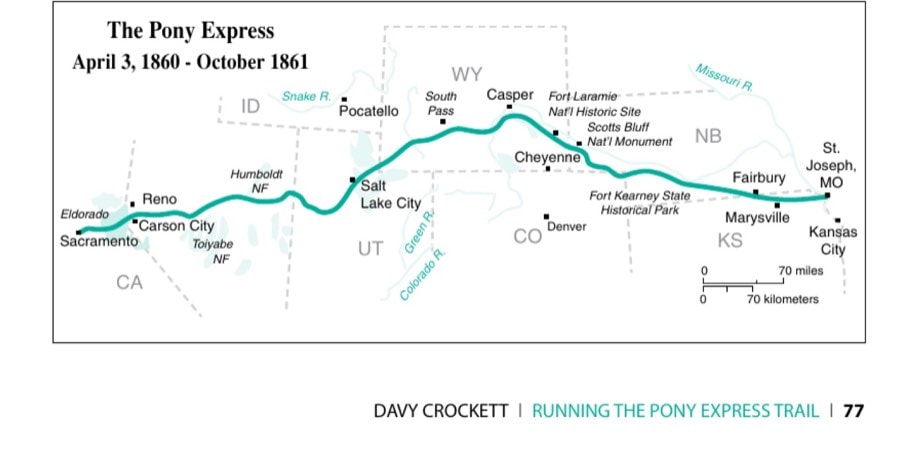
The goal of the Pony Express was faster mail delivery. In our day, we send mail around the world in seconds using the energy it takes to click a key with our finger. In the 19th century, the time and effort to take mail across the continent were extraordinary. In 1860, the Pony Express was established to speed cross-country mail delivery. Mail sent by coaches took at least one month. The The Pony Express April 3, 1860 – October 1861 ID
Snake R.
Mis
WY South Pass
Pocatello
sou
ri R
Casper Fort Laramie Nat’l Historic Site Scotts Bluff Nat’l Monument
.
NB
Cheyenne Reno
Sacramento
Carson City
CA
Toiyabe NF
Fairbury
Salt Lake City
UT
Co
Eldorado
Gr lo ee ra nR do . R.
Humboldt NF
Fort Kearney State Historical Park
CO
Marysville
Denver
KS
St. Joseph, MO Kansas City
0
70 miles
0
70 kilometers
Pony Express promised cross-country delivery in only 10 days. The system was essentially a relay in which riders changed about every 100 miles and the riders changed horses every 10 to 15 miles. Skinny, athletic riders were hired who were “accustomed to outdoor life, able to endure severe hardship and fatigue, and fearless.” 1 Ultrarunners can certainly relate to these characteristics.
Much of the trail between Missouri and California has been forgotten and has been overtaken by ranches, roads, and towns. The trail across western Utah and through Nevada is still rugged, untamed, and mostly untouched by development. Ruins from Pony Express stations or stagecoach stations can still be found along the way. I discovered that in some ways, the trail in western Utah is more remote today than in Pony Express days, because there are no longer relay stations or shelters to give aid along the way.
Day 2: Rush Valley to Simpson Springs—29 Miles I restart my run back into history where I had left off a week earlier, four miles west of the East Rush Valley Pony Express station site. The seasonably warm winter weather is ideal for a run. For this leg of the journey, my son helped me shuttle a car to the finishing point for the day and then drove me back to my starting point. I stashed my lunch at the halfway point so I could run with only a lightweight, 2-liter CamelBak.
The next Pony Express destination along my run would be in five miles—Faust Station, also known as the Rush Valley Station. Through my research, I determined that the historic trail along this section veered away from the modern road.
I say good-bye to my son, leave the paved road, and begin a very enjoyable jaunt along faint wagon roads and trails. At some point, the trail disappears, and I bushwhack through sage covered with morning frost. It is easy for me to visualize Pony Express riders galloping along this untouched stretch. I can hear an occasional car pass by on the road to the north, and I wonder whether they see me, a lone runner frolicking among the brush in the middle of nowhere.
I soon reach a 20th-century obstacle, the Union Pacific Railroad. Amazingly, just as I reach it, a swift-moving train approaches before I pass. I wave to the engineer and hear the horn blow loudly. As I climb up and over the tracks, I think about how the railroad dramatically changed this area of the country in the 1860s, providing a fast alternative to long wagon treks across the open desert.
One of the most famous Pony Express rides across this section of trail, and one of the swiftest, occurred in November 1860. Billy Fisher galloped west along this stretch of the trail carrying the news that Abraham Lincoln had been elected president of the United States. He made the trip from Salt Lake City to Faust Station in only 4 hours, 20 minutes. He charged down the trail averaging 3.4 minutes per mile, just a tad faster than my 12-minute-mile pace. Billy Fisher rode this stretch many times for the Pony Express.2
A Dusty Graveyard Near a Forgotten Station
Courtesy of Davy Crockett
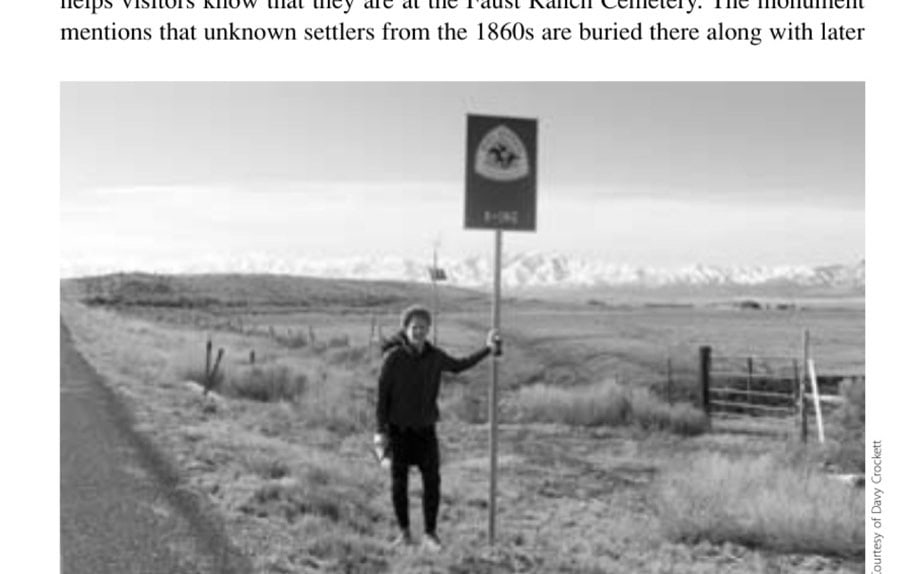
I soon reach State Highway 36 (running north/south), and the site of the Faust Station comes into view. Most travelers along the trail do not know where the site is because a marker was misplaced on the main highway, 1.5 miles to the north. I see a “Pony Express crossing” sign on the highway, not far from the point where I leave a field. I am pleased that a historian correctly marked the location. I detect, with the help of my GPS, where Faust Station was located. On its site today is a large cattle ranch. I am not bold enough to run all the way to this private ranch, but I want to locate an old cemetery described by visitors years ago, so I run along the road partway into the ranch.
James P. Sharp recalled visiting this cemetery more than 100 years ago. “There was a sort of fence around the plot and a few old headboards with faint names on some, marking the graves; but as years went by, the fence disappeared and the headboards were no more.” 3
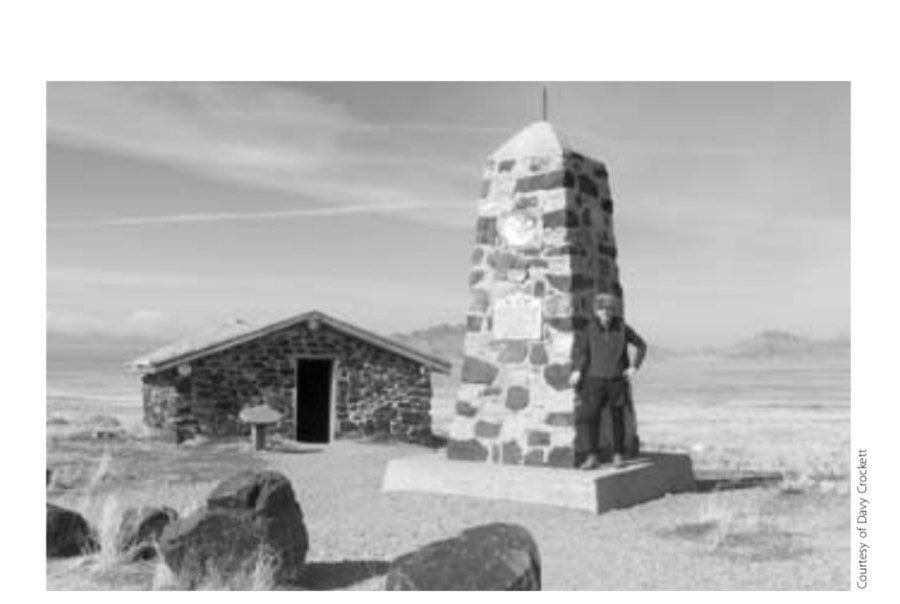
I am delighted to discover that my research was correct. The waypoint I entered into my GPS takes me to the cemetery. Today this small plot is surrounded with a chain-link fence. I open a gate and enter this sacred resting place. There are a few scattered markers, including two old and weathered wooden headboards that likely once included words that are now long worn off. The lonely plot makes me think of dusty graveyards depicted in western movies. One large, modern monument helps visitors know that they are at the Faust Ranch Cemetery. The monument mentions that unknown settlers from the 1860s are buried there along with later
The author at the Pony Express trail crossing near Faust Station.
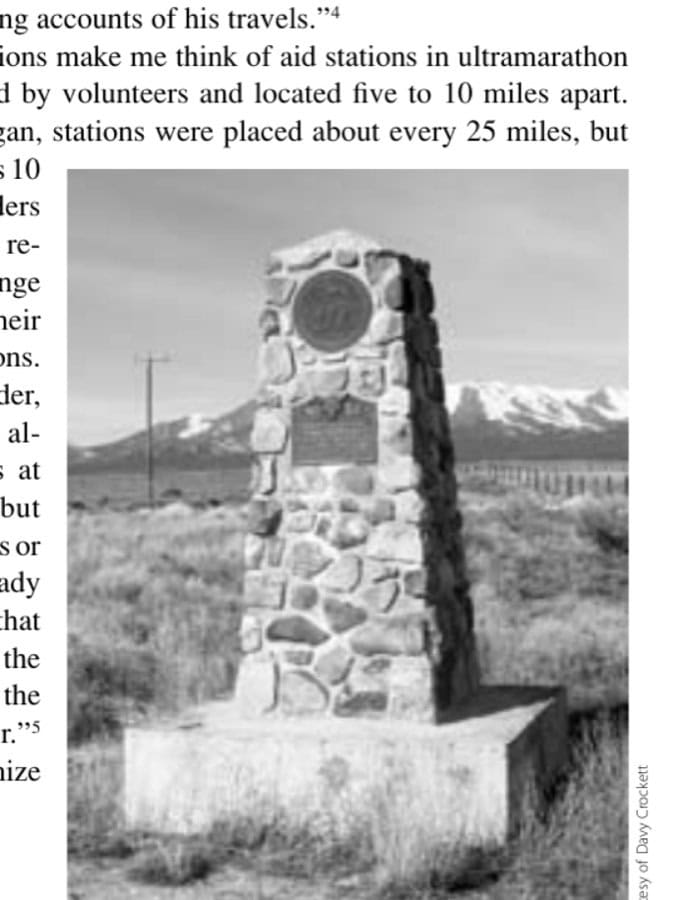
The Faust Station monument.
Courtesy of Davy Crockett
settlers from the 1880s. I carefully close the gate and gaze several hundred yards west to the actual site of Faust Station. Faust Station was the first Pony Express home station west of Salt Lake City. A home station (as opposed to a relay station) was where riders switched places with fresh riders. These stations also usually doubled as stagecoach stations. The rider then stayed at the home station until another rider came from the other direction. In this way, riders like Billy Fisher were able to cover the same stretch over and over. At each station resided a station keeper, a stock tender, and at least two fresh horses. Faust Station, now long gone, was a very small two-story stone structure. It was built in 1858 and sold to Henry J. Faust, who was later known as Doc Faust. During his trip along the trail, famed New York Tribune editor Horace Greeley visited Faust Station in 1859. “Knowing that Mr. Greeley would very likely bury himself in books and not wish to carry on a conversation, Mr. Faust took great care to see that all the tallow candles were hidden, leaving the house in darkness. Mr. Greeley, unable to read, then made a delightful companion for the remainder of the evening with interesting accounts of his travels.” 4 These Pony Express stations make me think of aid stations in ultramarathon trail races, which are staffed by volunteers and located five to 10 miles apart. When
the Pony Express began, stations were placed about every 25 miles, but later the average distance was 10 to 12 miles. Pony Express riders changed onto fresh horses at relay stations. Ultrarunners change into fresh socks and refill their water bottles at the aid stations.
For the Pony Express rider, “a mere two minutes was allowed for changing horses at stations along the route, but most changes took 30 seconds or less. The relief horse was ready to go and saddled, and all that was necessary was to swing the mochila (mail pouch) from the back of one horse to another.” 5 Ultrarunners also try to minimize their time in aid stations.
After thinking about this station and events that occurred there, I return to my run. I avoid running toward the ranch structures but hop over a fence and scamper across a wide range. I pass by a herd of cattle that starts into a short stampede as I approach. I reach the paved Pony Express Road and continue along a very straight five-mile climb toward Lookout Pass. The warm sun continues to rise, and I enjoy seeing the shimmering reflection of the sun on the moist desert floor. Snowbanks increase in size as the road climbs into the hills. I run backward for a while to look back on the view to the east. I am amazed at how straight the trail is and how it points directly back to my starting point, now obscured by mountains. During my two-day run, I have run past Lake Mountain and the Oquirrh Mountains and now will pass over the Onaqui Mountain Range. This is my last view along the trail of majestic, 11,749-foot Mount Timpanogos, clearly visible 51 miles to the east. I gaze down at the sizable, remote Rush Valley and reflect on my long run across its expanse.
The road becomes steeper, climbing into cedar-covered foothills. I am elated by the change and push the run, welcoming the feeling of strength coming from my quads. The paved road ends, and now I will run on dirt roads for the remainder of my journey. Nearby, loud explosions from high-powered rifles startle me. I run by a father and son enjoying their guns, and I try to make noise so they know that I am there. I pick up my pace to get away and hope they don’t take aim toward the road. As I climb higher, the dirt road turns into a mud road from the runoff of the melting snow.
Entering Paiute Hell I soon reach 6,191-foot Lookout Pass and see a partial view of Skull Valley on the other side. Legends explain that an Indian once took a shot at one of the Pony Express riders or a stagecoach driver near this place, so whenever a new rider or driver was put to work, he was told to “look out” here. Thus the name Lookout Pass.
In pioneer days, the next wasteland section over the pass was referred to as “Paiute Hell.” Historian Frank C. Robertson described this country: “From Lookout Pass you look out over forbidding deserts of mountains and flats. . . . It is hot as the hinges of hell in summer, cold as the polar regions in winter. In winter, blizzards block the roads; in summer, cloudbursts wash them out.” 6
At the pass, I find a large rock with a memorial plaque attached for E. Ray Staley, 1920–1993. It recognized that a million sheep had passed along this point of “The Pony Express Sheep Trail” to desert winter ranges. A visitors’ log stands next to it. I sign my name and mention my run on the trail.
I smile as I enjoy pounding the fast downhill on the other side of the pass. I cruise by small, frozen ponds and soon reach the next Pony Express relay station site at Lookout Pass Station. This site is in a small, beautiful mountain valley covered with cedars. The plaque on the monument explains that this was also the
site of an important watering station for the Butterfield and Wells Fargo overland stages (1851–1859).
A 19th-Century Pet Cemetery
Courtesy of Davy Crockett
The original Pony Express station consisted of a small log cabin, a stable, and a small spring just a few feet away. The station manager was a Mr. Jackson. From 1866 to 1900, Horace Rockwell and his wife, Libby Rockwell, ran an Overland Stage station at this site. Since “Aunt” Libby had no children, she filled the void with pet dogs and cats. As her pets died over the years, she buried them in a cemetery.
In 1885, James P. Sharp visited the Rockwells when he was a boy and wrote: “They had no children but did have a whole colony of black-and-tan dogs; I believe they said they were of the Fiste breed. You know the kind, with short hair, and always trying to stand on three legs, shivering, to keep from freezing to death in July. But I’d better not get started on stories about those two strange characters, their dogs, and dog cemetery.” 7
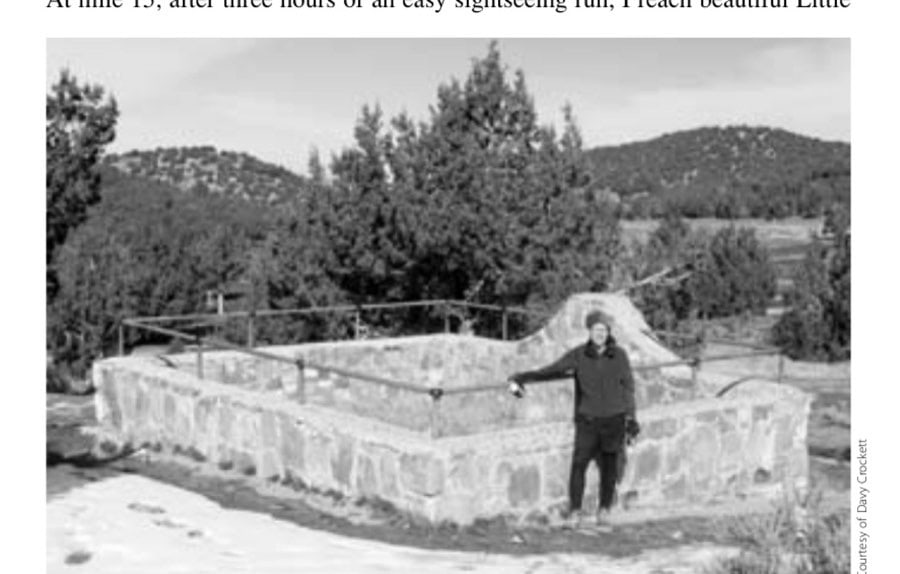
A “Pet Cemetery” sign points the way. I chuckle as I run toward the cemetery, thinking of the Stephen King novel of the same name. I hope not to find a zombie dog coming out of the ground! The small, walled cemetery contains only weeds. I salute the memory of Aunt Libby’s dogs, laugh some more, and continue my run. At mile 15, after three hours of an easy sightseeing run, I reach beautiful Little
The author at Aunt Libby’s Pet Cemetery.
Valley, where I have stashed my lunch. I find a dry spot underneath a cedar tree and feast upon hot soup, Ensure, chips, and cookies. After a 15-minute break, I shed my long-sleeve shirt and continue my warm winter run along the historic trail in running shorts and short sleeves.
Running Through Skull Valley Following a nice downhill stretch, I reach the desert floor of Skull Valley. An occasional recreation vehicle passes me with ATVs in tow, driving for a fun outing in the west desert of Utah. One vehicle slows and pulls alongside me. I see that it is a park ranger truck pulling a trailer with two motorcycles. One of the two rangers asks me, “Are you lost? Or are you doing this for fun?” I laugh and explain that I am on my second day of a run originating from Utah Lake. They are flabbergasted. I tell them that I am doing fine and that I would finish my run for the day at Simpson Springs. They wish me well, tell me to be careful, and drive down the road to the west. Off in the distance, I can see the 8,150-foot, rugged, snowcapped Indian Peak. I know that my destination for the day is on the other side of that mountain. I gaze at the vast, treeless valley, covered with sage. The brown, colorful shades are striking. To many people, the landscape would seem like a barren wasteland. I am struck by its untouched beauty and its quiet peace. I soon arrive at Government Creek. Some claim that Government Creek had been a Pony Express relay station site, but it is more likely that it was a relay station for the Overland Telegraph Line. In the early days of the telegraph, a message could be sent only so far and then would have to be relayed by an operator at the station.8 In 1861, the telegraph line to California was established along this route, which eventually resulted in the shutdown of
the Pony Express. James Gamble was in charge of the crews stringing telegraph line across the deserts of Nevada and Utah. The crews were spread out along the entire route, stringing line simultaneously in several places. The entire line across the West was constructed in an amazing four and a half months.9
Seventy years ago, visitors along this route mentioned seeing stumps of telegraph poles and occasional pieces of wire. I keep an eye out, but those historic treasures are long gone. As I run over the next low divide, into my view comes yet another series of mountain ranges to the west: first Dugway Range, then Fish Springs Range, and finally, Deep Creek Range, 60 miles away. I am determined to pass all three on future days. I pick up my pace, and again the park rangers visit me. They ask me how I feel. I assure them that I am doing great, heading into the home stretch.
My final two miles for the day take me on a nice uphill climb toward Simpson Springs. I am resolute to finish strong and avoid walking spells. I trot up and over the final rise and am relieved to see that my car is still standing in one piece, free
Courtesy of Davy Crockett
The author at the reconstructed station at Simpson Springs.
of vandalism. I sprint the last stretch and finish in 5:50 for 29 miles. As I arrive at my car, the park rangers again pull up. I can tell they are interested to find out more about my run. I tell them about my goal to run the trail all the way to Nevada. They ask how I feel after running 30 miles. I tell them honestly that I feel great, not sore at all. They seem very impressed and think that what I am doing is very cool. They also appreciate the beauty of this remote section of the state. Their duty today was to patrol for off-road vehicle abuse. We bid each other good-bye. With a bounce still in my step, I explore the historic site of the Simpson Springs Pony Express Station and then begin my long drive home. It takes me 1.5 hours to drive the 60-mile stretch of trail that I ran in 13 hours over two days.
Endnotes 1 Settle, Raymond W. and Mary Lund Settle. Saddles and Spurs: The Pony Express Saga (Harrisburg, Pennsylvania: The Stackpole Company, 1955), 42. 2 Jenson, Andrew. 1901. LDS Biographical Encyclopedia 1:447. 3 Sharp, James P. 1945. The Pony Express stations. Improvement Era. 4 Carter, Kate. Our Pioneer Heritage (Salt Lake City: UT Daughters of Utah Pioneers, 1960), 3:363. 5 Corbett, Christopher. Orphans Preferred (Broadway, September 14, 2004), 81-2. 6 Robertson, Frank C. Through Paiute hell. Hoofbeats of Destiny: The Story of the Pony Express, ed.
Robert West Howard (New York: New American Library, 1960), 99. 7 Sharp, James P. 1945. The Pony Express stations. Improvement Era. 8 Sharp, James P. 1945. The Pony Express stations. Improvement Era. 9 Corbett, Christopher. Orphans Preferred (Broadway, September 14, 2004), 116-118.
This article originally appeared in Marathon & Beyond, Vol. 12, No. 5 (2008).
← Browse the full M&B ArchiveMore like this
1,000+ stories from 19 years of Marathon & Beyond
The complete archive of the legendary long-distance journal — digitized and free to read.
