

Running The World Marathon Majors
Igot to see the mayor of London, the chancellor of Germany, the pope, and a 101-year-old marathoner. A London taxi driver gave me a free ride and took a picture of me because I had come from the United States to run London’s marathon. I ran on the same course, at the same time, as elite runners who ran the fastest marathon times in the world. Those arm movements from the Village People’s “YMCA”? I performed them with thousands of other runners in the streets of Tokyo. I own a piece of the Berlin Wall. Millions of spectators cheered for me as I ran by them in the streets of New York City, Chicago, Boston, Berlin, London, and Tokyo. I made lifelong friends all over the world. All this happened to me because I ran the six World Marathon Majors.
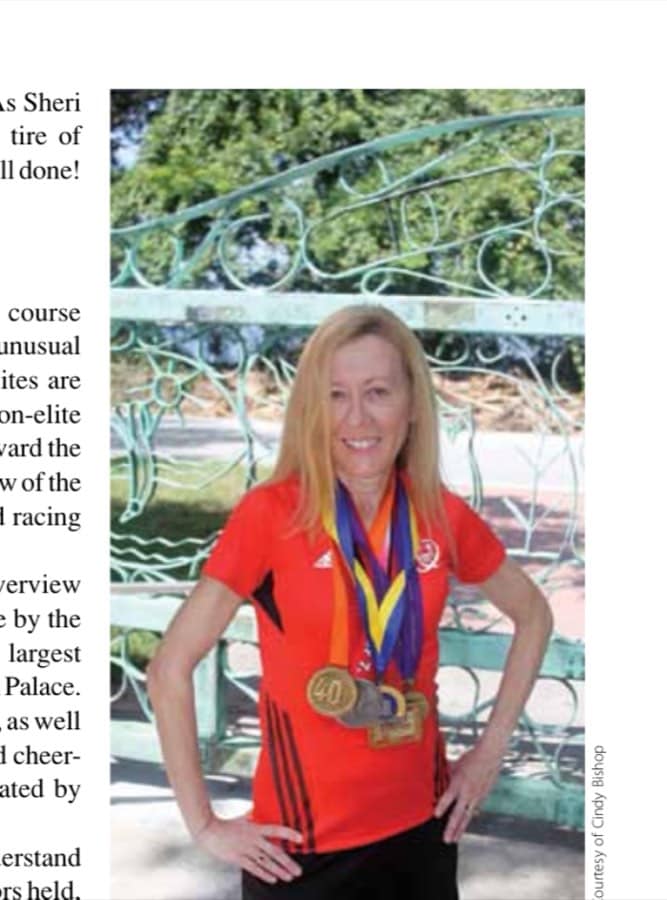
On February 27, 2013, I was in the first group of runners to complete the six World Marathon Majors when I crossed the finish line in Tokyo, Japan. There were 20 of us, runners from all over the world, including a group of two American women and three American men.
Here is my guide to running the majors: how to gain admission to each marathon, travel tips on getting there, and what to expect in each city. Gone are the days when a runner can register for a big-city marathon a few days or even a few months in advance. The World Marathon Majors require advance planning to gain entry. You will be competing against other runners before you even place your toe onto the start mat—there will be many runners competing for each open spot in the majors.
Here is how to increase your chances of gaining entry to the majors.
New York City In 2013, the New York City Marathon had 50,304 finishers, the world’s largest marathon. Ways to apply for entry include: apply for the general-admission lot-
© Victah/www.PhotoRun.net
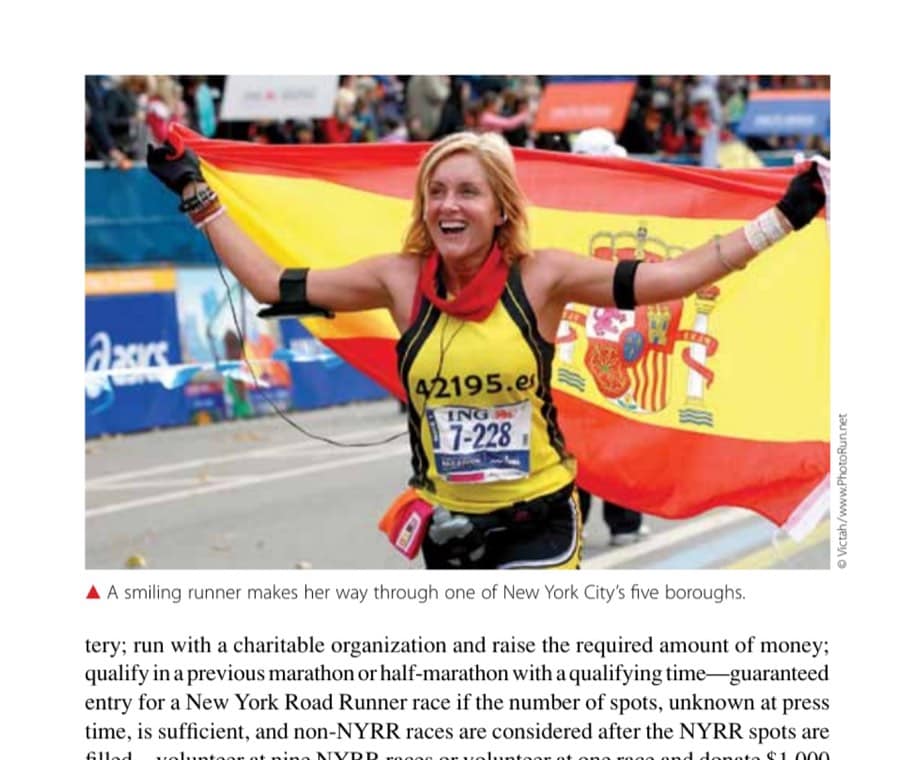
▲ A smiling runner makes her way through one of New York City’s five boroughs.
tery; run with a charitable organization and raise the required amount of money; qualify in a previous marathon or half-marathon with a qualifying time—guaranteed entry for a New York Road Runner race if the number of spots, unknown at press time, is sufficient, and non-NYRR races are considered after the NYRR spots are filled—volunteer at nine NYRR races or volunteer at one race and donate $1,000 to a NYRR program. Other ways, which are being phased out in a few years, are admission if you are unsuccessful in three consecutive lotteries or if you have run 15 previous New York City marathons.
For more information about the November 2, 2014, marathon, check the website at www.tcsnycmarathon.org.
Chicago The demand for registration for the 2013 Chicago marathon was so great that the registration site crashed a few hours after opening. This forced the race organizers to institute a lottery system for the runners who were unable to register on the website. For the October 12, 2014, Chicago Marathon, there is now a lottery for most runners. There is guaranteed entry for charity runners, international travel partners, male runners who have run a sub-3:15 marathon and female runners who have run a sub-3:45 marathon (qualifying marathons taking place since 1/1/12), and legacy runners who have run at least five Chicago Marathons in the last 10 years. For more information, check the website at www.chicagomarathon.com.
Marathon before marathon Boston, New York City, and London require up to four hours outside waiting around in the Athletes’ Village before the marathon. Bring a garbage bag to sit upon and throwaway clothes to wear in the cold morning weather. Prior the marathon, you can set the clothes off to the side of the start corral, and they will be donated to charities. Also, bring some food and drink with you, since four hours is a long time to wait without any food.
Boston
© Victah/www.PhotoRun.net
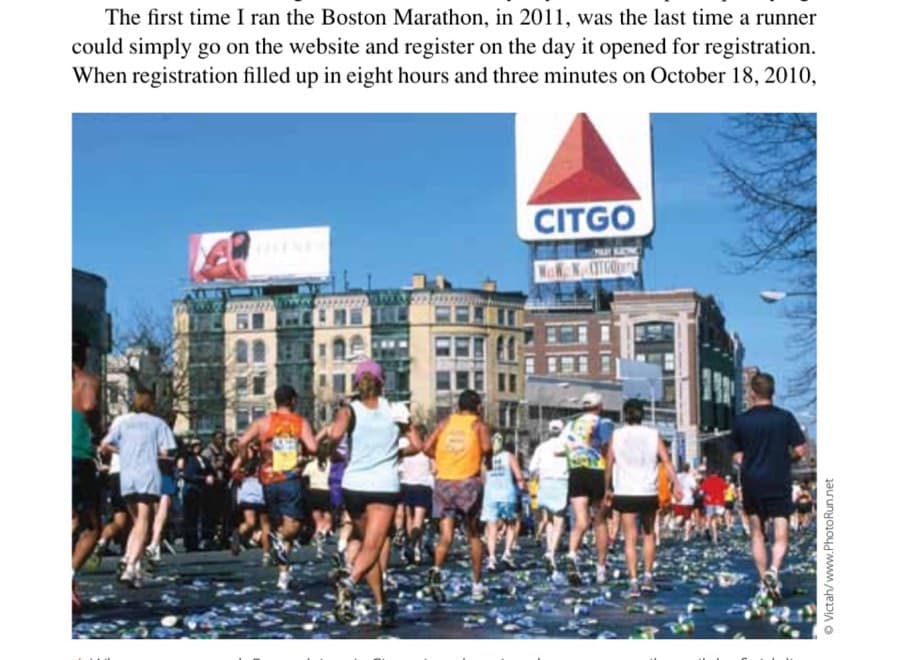
The Boston Marathon, which began in 1897, is the world’s oldest continuously run marathon. It is arguably the most prestigious marathon, with a strict set of qualifying times earned in a previous marathon for most of its runners. Many marathoners dream of running Boston and train every day with the hope of qualifying. The first time I ran the Boston Marathon, in 2011, was the last time a runner could simply go on the website and register on the day it opened for registration. When registration filled up in eight hours and three minutes on October 18, 2010,
▲ When runners reach Boston’s iconic Citgo sign, there is only one more mile until the finish line.
for the 2011 marathon, the Boston Athletic Association decided to make changes in the registration process for the 2012 marathon—a rolling admission where the fastest runners (those with times at least 20 minutes faster than the qualifying times) could register first, then those with times 10 minutes faster, and so on. For the 2013 marathon, there was not only the rolling-admission process, but the qualifying times were all adjusted to be five minutes faster for all ages and both sexes. Check the website at www.baa.org for the new standards as well as for information on running for a charity, which is another option if a runner doesn’t qualify by time in a previous marathon.
Tokyo, London, and Berlin The three international World Marathon Majors have lotteries for runners to gain admission as well as charities that accept runners who will raise the required amount of money. However, there is very limited space in the lotteries for runners not from the host country. Even runners from the host countries face stiff competition. For example, the Tokyo Marathon last year had more than 300,000 people try to gain entry for a race that had 34,796 finishers.
The best way for an American runner to gain guaranteed entry to the foreign majors is through an international travel partner. I got into Berlin, London, and Tokyo through Boston-based Marathon Tours & Travel. Marathon Tours will not only get a runner a bib but will provide a full-service marathon vacation, handling everything from making plane and hotel reservations to offering tours of each city and holding a welcome cocktail party for all runners and a pasta dinner the night before the race.
Marathon Tours’ Thom Gilligan understands marathoners and their needs. He has run the Boston Marathon 22 times and has a marathon PR of 2:30:42. “Marathoners are type A personalities who run,” Thom said. “They are not looking for a fun-in-the-sun vacation. They are traveling with a purpose. And there is no better way to see a city than to run 26.2 miles through its streets.”
Runners can bring nonrunning family and friends as their guests. And a marathoner traveling alone can cut costs by having Marathon Tours find a roommate. Thom Gilligan says that Marathon Tours gives people the opportunity to meet at the beginning of a trip. “We want them to meet like-minded people and make sure they don’t have to eat dinner alone. We do the research into each city so they don’t have to. Finding an Italian restaurant for the pasta dinner in Tokyo? We do that.”
Marathon Tours will give you guaranteed entry and air and hotel reservations to Berlin, London, and Tokyo as well as Chicago. Although it can’t give entry to NYC and Boston, it will also arrange hotel rooms and airfare to those cities. But as the majors are increasingly hard to get into, it is best to check the website at www.marathontours.com and sign up on the first day for entry. You should also
join its Seven Continents club for priority registration. The cost is $200, but it includes coupons worth $100 that can be used for future marathons. The Tokyo Marathon’s tentative date is February 22, 2015; the next London Marathon is April 26, 2015; and the next Berlin Marathon is September 28, 2014. Check the international majors’ websites for more information: www.tokyo42195. org, www.virginmoneylondonmarathon.com, and www.bmw-berlin-marathon.com.
Course by course: what to expect Each of the World Marathon Majors is well organized and fully supported, with water stops every two miles or so and numerous medical tents and porta-potties. Following are specifics for each race.
New York City The 26.2-mile course will take you from Staten Island to Brooklyn, Queens, the Bronx, and Manhattan—New York City’s five boroughs and varied ethnic neighborhoods. You will run over five bridges. After running across the Queensboro Bridge, you will hear a wall of sound—spectators screaming for you—that you will always remember. More than a hundred bands will play music, and 2 million spectators will cheer for you. This is not an easy course—it is deceptively hilly, not only the bridges but also Central Park—but it is all thrilling.
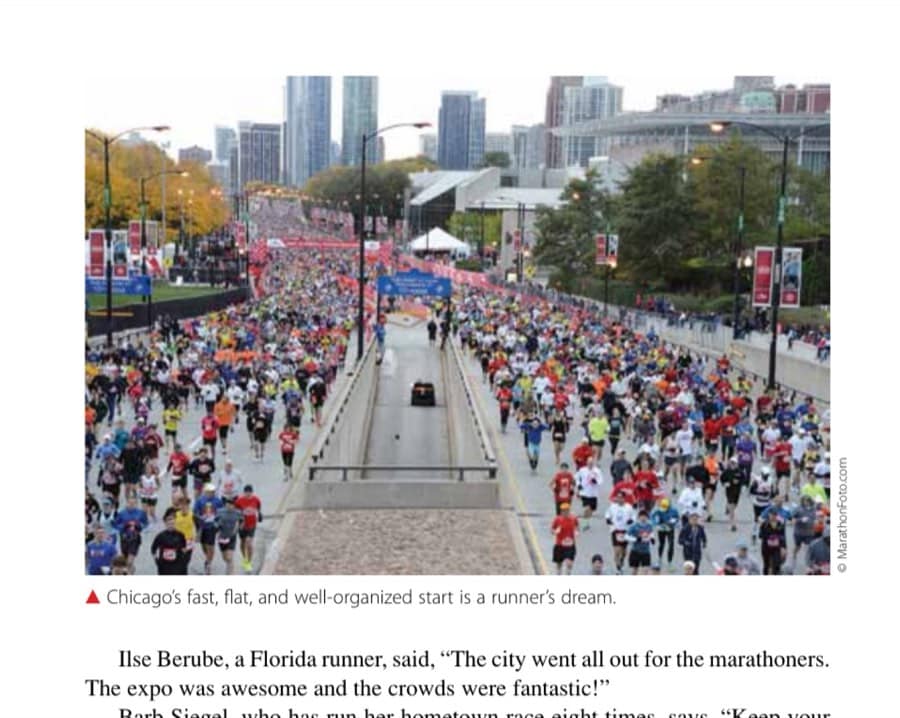
Barb Siegel, a runner from Chicago, ran New York in 2009. “I loved that you ran all the boroughs of New York and that you got to feel the vitality of the city.” Floridian Michelle Smurl, a first-time marathoner who ran the 2013 New York Marathon, said that the marathon lived up to her expectations. Even during the exit, “People continue to cheer you on and congratulate you for finishing. The crowds make you feel like a rock star!” Michelle Smurl advises runners to “incorporate hill training. The bridges and inclines can take a toll on the legs. Run on tired legs during training to know your legs will still work toward the end of the marathon.” Chicago The Chicago Marathon is a fast city-loop race that has seen numerous marathon world records. Non-elites find it easy to qualify for Boston or to get a PR. If you stay in a hotel near the start, you can leave your hotel in the morning, and less than an hour later, you are running your race.
Sue Bellon, a St. Louis runner, said that the corral system at the start really worked. “There was not much bottleneck, and it kept the roads from overcrowding.” Even the finish was great—“big bags of ice handed out for our legs, and I had the best beer I ever tasted to enjoy while I iced and waited for my gear.” Sue’s advice to runners is “it is an incredibly flat course, [so] watch your pacing for the first half so you don’t run out of gas at the end.”
© MarathonFoto.com
▲ Chicago’s fast, flat, and well-organized start is a runner’s dream.
Ilse Berube, a Florida runner, said, “The city went all out for the marathoners. The expo was awesome and the crowds were fantastic!” Barb Siegel, who has run her hometown race eight times, says, “Keep your eyes open for all the interesting neighborhoods—from Little Italy where the theme from Rocky is blaring from the windows to the dancing dragon in Chinatown and the mariachi bands in Pilsen. Look for Elvis and his band and the cheerleaders in Boystown!”
Boston The Boston Marathon starts in the town of Hopkinton and then runs through the towns of Ashland, Framingham, Natick, Wellesley, Newton, and Brookline before arriving at the city limits of Boston. It is a point-to-point course that loses 459 feet in elevation, heads to the east, and frequently enjoys headwinds. For these two reasons, it is not a course on which world records can be set. However, when I ran Boston in 2011, with a 20 mph tail wind almost the entire way, Geoffrey Mutai ran what was called the world’s fastest marathon, 2:03:02.
For the qualifying runner, it is a 26.2-mile victory lap, with people screaming for you the entire time as if to congratulate you on your years of training to reach this moment. There are the Boston Red Sox fans, calling out the score of the baseball game that is going on at the same time as the marathon. There is the iconic Heartbreak Hill at mile 21. At the halfway point there are the coeds at
Wellesley College. Thomas Winkelspecht, a Florida marathoner, said, “A mile before reaching Wellesley College, we could hear the girls cheering us on!” They are not only cheering but asking for kisses. Sue Bellon’s advice: “If you want to kiss a coed, stay on the right. If you don’t, or you don’t want to get trampled, go to the left side on the road.”
From start to finish, this is a race that the organizers get right. Charlotte McClure, a Florida marathoner, enjoyed “the well-organized transportation to the start, good amenities at the runners’ village before the start.” Thomas Winkelspecht said the organizers “were quick to clear the finish area.”
Boston is a difficult and hilly course, but if you train right you can run well. Thomas Winkelspecht advises you to “have the right plan and a running partner or running group to help you work toward the miles that need to be run each week.”
My advice is do whatever it takes to run this race. It’s that great an experience. As Sue Bellon said, she wanted to run Boston because “it is Boston, the ultimate for any marathoner. It’s our Super Bowl, our Westminster dog show, our Wimbledon.”
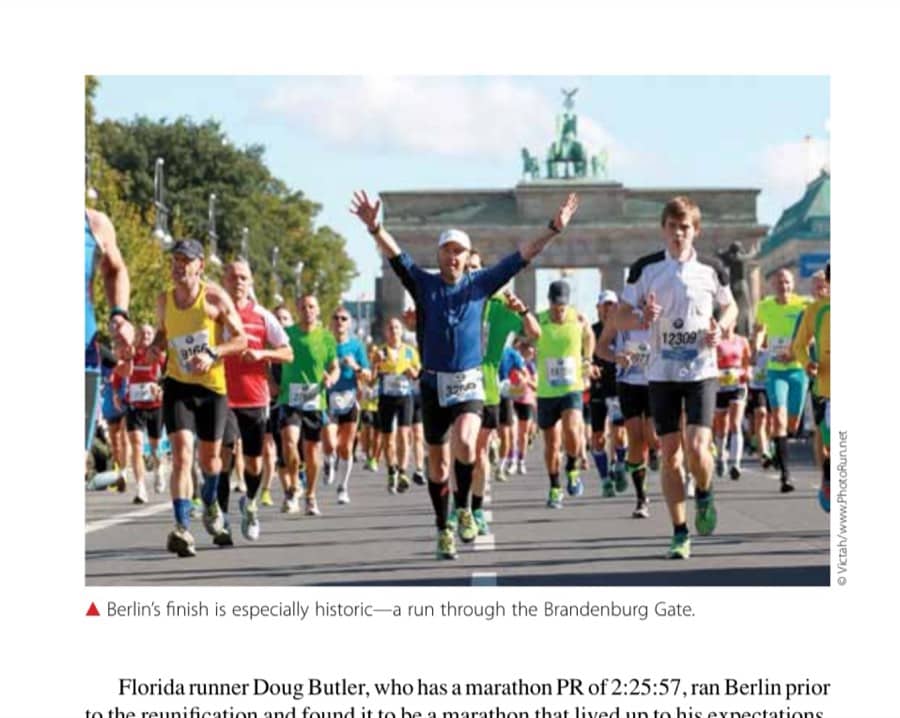
Berlin Berlin’s course is a loop that runs throughout the city of Berlin—what used to be both East and West Berlin. It is pancake flat and the course can boast three world records for women and six for men, including Wilson Kipsang Kiprotich’s 2:03:23 in 2013. The Berlin Marathon has a history that parallels the history of post-WWII Germany. From 1974 to 1989, it was run only in West Berlin. On September 30, 1990, three days before the reunification of the city, the marathon ran through both parts of Berlin, running through the Brandenburg Gate.
Time adjustment It is hard enough to have a time change of a few hours when traveling to a marathon within the United States, but traveling to England, Germany, and Japan will require you to adjust to a time change of anywhere
from five to 15 or more hours, depending on your departure city. I was in Berlin, London, and Tokyo for only four days, and there is no way I could have adjusted to their time zones and run a strong race without
taking sleeping pills each night. You need to meet with your doctor and see if this is an option for you, and if so, try it one or two nights at home before your journey overseas. If prescription medicine is not an option,
speak with your physician about the possibility of herbal remedies.
© Victah/www.PhotoRun.net
▲ Berlin’s finish is especially historic—a run through the Brandenburg Gate.
Florida runner Doug Butler, who has a marathon PR of 2:25:57, ran Berlin prior to the reunification and found it to be a marathon that lived up to his expectations. A high school running coach whose teams have won 14 cross-country state titles and six track state titles, his advice for preparing for this runner-friendly course is to “increase your mileage as much and as safely as you can.”
Texan John Wardell ran Berlin in 2011. He cautions that since Berlin “is a huge big-city marathon, be mentally prepared for the crowds, and be ready for the twists and turns on the route.” His favorite part of the marathon was the “thrill and significance of passing through the Brandenburg Gate.”
A special treat for runners of Berlin are the bands on the course, which include American-style jazz, classical music, and traditional German music.
London The London Marathon is a point-to-point course, similar to Boston in that you are bused out of the city to a more rural area and then run back to the city. It is a flat and fast course where several world records were set, including Paula Radcliffe’s 2:15:25. The start is in Greenwich Park. The marathon makes its way to London, where the runners race past the House of Commons, Tower Bridge, Westminster Abbey, and Big Ben and then the finish through the Mall lined with English flags every few feet, up to and past Buckingham Palace.
Running on London’s Tower Bridge adds extra excitement to the marathon. ▲
© Victah/www.PhotoRun.net
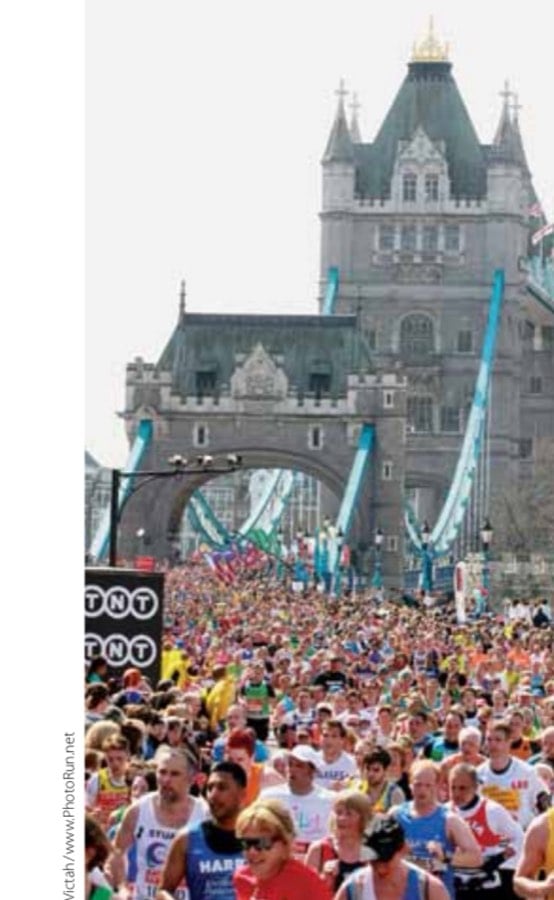
More than three-quarters of all runners are running for charity. The London Marathon is a Guinness World Records holder for the largest single annual fundraising event in the world. Another unusual fact is that not only do the marathon
organizers tolerate runners in costume, but they encourage it. “Fancy-dress” runners even have their own start corral. Running the London Marathon is never boring when you pass runners dressed up like cartoon characters, animals, a giant
tree, or an escaped convict. John Wardell ran London just six days after the Boston bombings in April 2013. He found “security extremely high, but it had no real negative effect on the runners.” John found the start area “magnificently organized and spacious,
the spectators loud and enthusiastic and numerous, and Tower Bridge amazing . . . beautiful sight, biggest hill.” Sheri Bush, a Michigan runner who was the first American woman to run all six World Marathon
Majors, has this advice: “London’s course is beautifully laid out to see the city’s historic landmarks. Prepare by enjoying the sights, pack your camera in your runner’s waist pouch, and take pictures!”
I found all the English people I encountered during my stay friendly beyond words. After the finish, as I slowly walked back to my hotel, I was congratulated dozens of times, and one woman handed me some candy to perk me up. A man walked up to me and
Tokyo Tokyo is a fast, flat loop course through the city that has an unusual aspect: at one point, the elites are on the return loop and the non-elite runners are still running toward the turn. We non-elites got a view of the fastest runners in the world racing toward the finish line!
The course is a great overview of the city as we got to race by the Tokyo Tower, the world’s largest fish market, and the Imperial Palace. Traditional Japanese bands, as well as American jazz bands and cheerleaders, were well appreciated by the runners.
Although I couldn’t understand any of the signs the spectators held, I appreciated their smiles, their ▲ Author Cindy Bishop wears medals from all six cheers, and their chants of “USA!” World Marathon Majors after finishing the Tokyo when I approached the water stops Marathon. in my USA running shirt.
Sheri Bush enjoyed the Friendship Run the day before the race, where she got to meet race directors and representatives from all the World Marathon Majors. Her Tokyo highlights were “the high energy and the calm, polite, bowing ways of this respectful culture.”
Conclusion Finishing any marathon is a huge accomplishment, but running the World Marathon Majors is an opportunity to be an ambassador from your city, state, and country. Wear a running shirt that says “USA” or that has your running club’s or college’s name on it. Go on every tour offered, explore historical and cultural sights, meet people from all over the world, and keep in touch with as many of them as you can. I had the time of my life at these marathons. You will, too. Go for it!
Courtesy of Cindy Bishop
offered to buy me dinner. As Sheri Bush said, “I could never tire of hearing the crowds say, ‘Well done! Brilliant!’”
This article originally appeared in Marathon & Beyond, Vol. 18, No. 4 (2014).
← Browse the full M&B ArchiveMore like this
1,000+ stories from 19 years of Marathon & Beyond
The complete archive of the legendary long-distance journal — digitized and free to read.
