

Running With Demons
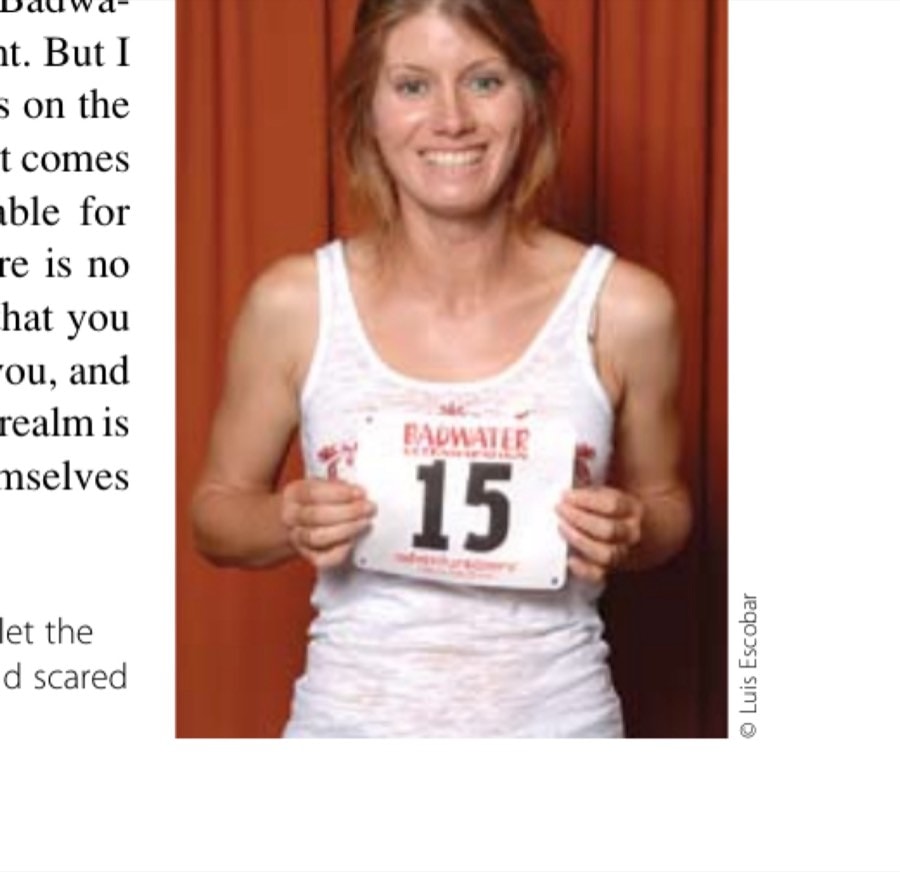
Prerace Badwater 2008 mug shot. Don’t let the smile fool you. I was even more nervous and scared than last year!
© Luis Escobar
t was a dark and stormy night . . . Seriously, it really was a dark and stormy night when I arrived in Death Valley in the days leading up to the 2008 Badwater 135 Ultramarathon. During a leisurely walk Saturday evening, I found myself racing against a sandstorm back to my room at Stovepipe Wells, a storm whipped up from the sand dunes that lie just a few miles beyond the tiny desert outpost at mile 42 on the racecourse. Stovepipe Wells consists of a small convenience store and gas station, a restaurant, and some modest motel rooms. I lost that race with the sand and ended up finishing the last half mile being sandblasted from every direction. The sand soon settled, however, with help from a torrential rainstorm that lasted for hours. The sound of thunder boomed through the desert for hours into the night, and lightning lit up the sky in all directions. Park rangers were saying that several of the main roads into Death Valley had been washed out or covered with rock slides. The omens were everywhere: this was not going to be an ordinary Badwater 135.
Not that there is anything ordinary about the Badwater 135. Many veteran, hard-core ultramarathon runners won’t go near Badwater. “It’s all on pavement,” they lament. But I think it is more than that. Badwater is on the edge. Badwater is fringe, and with that comes the unfamiliar, which is uncomfortable for some while appealing to others. There is no right or wrong in that. It just means that you don’t find Badwater. Badwater finds you, and everyone’s path to its scorching desert realm is as unique as the runners who find themselves there each July.
An unlikely runner If somebody had told me in the late 1980s that I would be running in what many consider the world’s toughest ultramarathon, I would have never believed it. Not only did I not know that races longer than a marathon existed, but I had just finished my first 5K race in the cornfields of Kansas, coming in nearly last alongside some of the 10K runners. I was scared, going to the start by myself in my pink terry cloth socks and matching scrunchy, but I had always wanted to run, especially after not being allowed to run track or cross-country in high school. I dreaded gym class and was never any good at the team sports in school, and like many a child who wasn’t a natural athlete, I was relentlessly humiliated and picked on by classmates. So I would run by myself in the prairie after school. But when I crossed the finish line in Kansas, I wasn’t picked on! I was cheered on. Kansas will always hold a special place in my heart for that reason.
Although this humble 5K was in many ways a personal triumph and a turning point in my life, by no means does it mean that my path to Badwater was an easy one. I showed up at the starting lines of all my subsequent races with a body ravaged by both anorexia and bulimia, a battle that began when I was about 6 years old and continues off and on to this day. I consistently placed near last in all the marathons and 50-milers I entered in the early years of my ultrarunning career and DNF’d my first five 100-mile races. But when I learned about the Badwater 135, I knew I just had to run it and would do whatever it took to get in. And to get in, you had to have at least one successful 100-mile finish. On October 14, 2001, in the middle of the night, after nearly tripping over a cow that had decided to take a nap on one of the peaceful country roads that comprised the Heartland 100, I finally finished my first hundred mile run, in a time of 29 hours, 13 minutes, and 36 seconds, coincidentally in Kansas. Less than 10 months later, the once-scared teenager who ran her first 5K in pink socks once again found herself scared and intimidated at the starting line of the 2002 Badwater 135 (minus the pink socks).
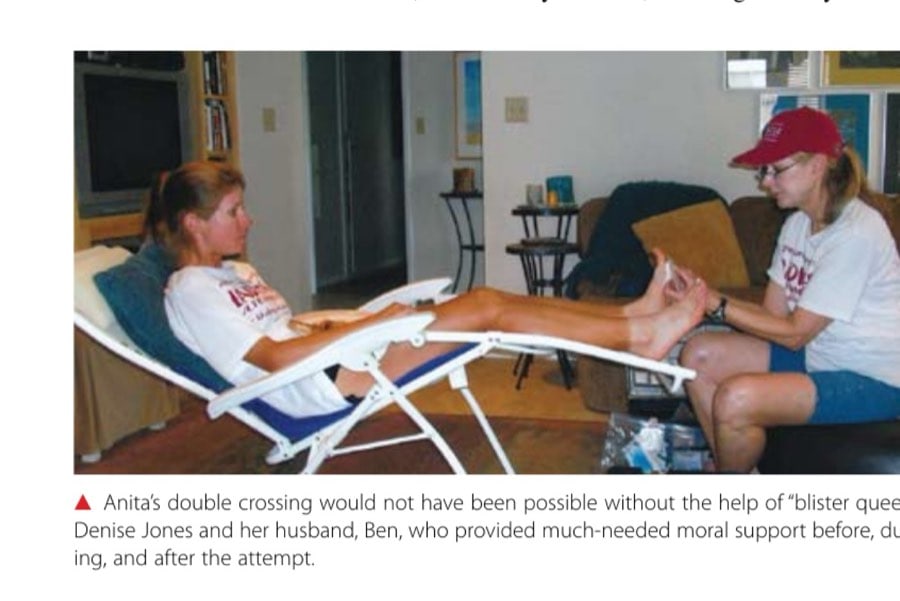
Badwater 101 I didn’t know how to train. I didn’t know what to eat. I didn’t know what to drink. I knew little about electrolytes. Except for my husband, I hadn’t met any of my crew members until the day before the race. I did manage to go out to Death Valley for a training session for a few days in the weeks before the race with an eccentric and kind man by the name of Ben Jones and his wife, Denise. I ended up going away with more questions than answers and more self-doubt than confidence. What had I gotten myself into? I had watched Running on the Sun a few times (a very inspirational movie about the Badwater 135), and after seeing men in their 60s finish and people power walk the whole thing, I thought,
Courtesy of Anita Fromm
Piece of cake! After I had experienced the intense heat and harsh wind of Death Valley for only a few hours, the thought of running Badwater scared the hell out of me. At the same time, I found the raw beauty of this desert paradise enticing, so perhaps that, and pure stubbornness, kept me from calling the race director and chickening out. Perhaps Death Valley was in my blood. After serving in the army, my father moved to Death Valley and mined for tungsten; my mother spent most of her pregnancy with me near Panamint and Ballarat. We later moved back east, but as a little girl I refused to go to bed unless I was told a “donkey story” by my father, who used pack mules in his mining operations and named one of them Caruso. I heard about other desert characters he ran into as well: Charles Manson, Squeaky Fromme (no relation), and “Seldom Seen Slim,” who watched over my father’s claim when he needed to travel, in exchange for a six-pack of beer and, according to local legend, would take a bath once a year whether he needed one or not. Could the memories of those childhood stories have somehow brought me back to a place that I hadn’t been to since being in the womb?
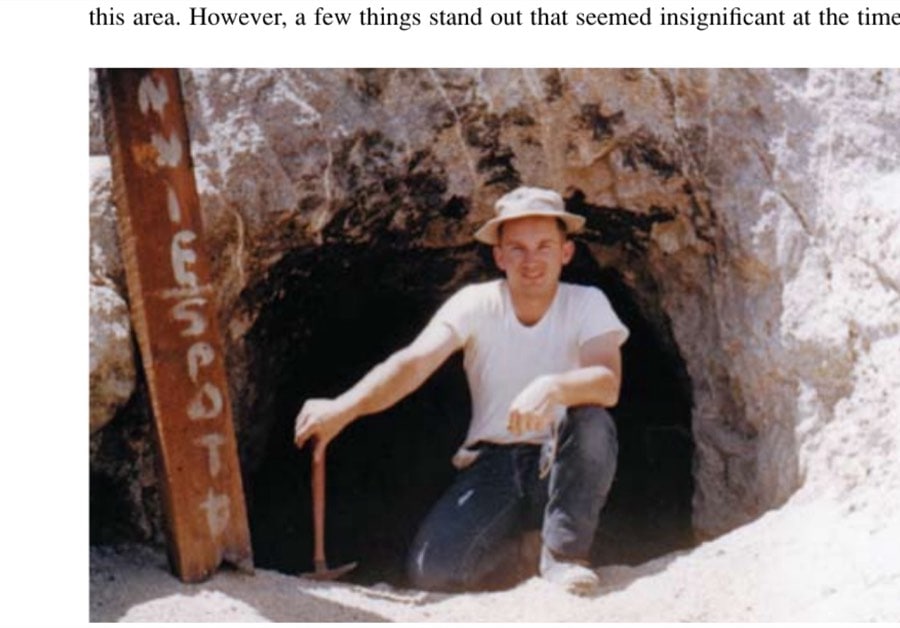
Much of the 2002 Badwater 135 is a blur to me, as are many painful or overwhelming experiences in life. Human beings have many finely developed coping and survival mechanisms to deal with adversity and trauma, and I think that selective memory is one of them. Successful ultrarunners seem to have this ability finely honed, as ultrarunning presents many opportunities for growth in this area. However, a few things stand out that seemed insignificant at the time
▲ Anita’s father, circa 1966, ouside his tungsten claim, near Ballerat.
but set the stage for me to complete a record-setting Death Valley double crossing six years later. The prerace meeting was an experience in and of itself. I felt like a nobody. Everybody around me seemed like the most elite athlete in the world in that crowded, hot, chaotic gymnasium at Furnace Creek. A few tough-looking, grizzled ultrarunners came up to my husband and me to introduce themselves and asked Tim what hundreds he had done and whether this was his first time running Badwater. When he told them he wasn’t running it but his wife by his side was, we would usually get a dismissive, skeptical look that said, ”Yeah, right!” (Perhaps wearing that floral hippie dress didn’t help me look the part.)
After the meeting, Ben and Denise came up to us and wished us good luck. Next to Denise was a quiet, diminutive, dark-haired woman. “Anita, this is Rhonda Provost. Rhonda has done a double.” There was an unmistakable intensity to her. In my naiveté, I remember thinking, Wow, she’s run this thing twice! (I had no idea what a “double” meant back then.) We were about the same in size and stature, so I thought there might be hope for me yet. But I found my hopes fading as soon as I took off at the start at Badwater (282 feet below sea level) and within 16 miles was nearly dead last. I found myself second to last when I finally reached the top of Towne Pass, a relentless 17-mile climb that starts just above sea level and ends near mile 67 on the racecourse at nearly 5,000 feet in elevation. My body was swollen from an electrolyte imbalance, I was exhausted, and my feet were covered in blisters. The sun was beginning to rise into the second day of the race, and I was barely halfway to the finish. My crew members were exhausted as well, although they were doing everything possible to keep my spirits up under such challenging circumstances. I felt disillusioned and was having serious doubts about my ability to finish when a small, gray Dodge Raider crested the top of Towne Pass, where I had been resting for a few hours after taking nearly 10 hours to reach its summit. “
Ben Jones is here!” said Norm, one of my crew members and now a cherished friend. A tall, stately older man and a legend in Death Valley, Doc Ben got out and cheerfully walked over to my crew and me. Despite it being the wee hours of the morning, Ben seemed to know everything there was to know about Death Valley, both on and off the record. I heard him talking with my crew members and vaguely remembered overhearing words like, “I don’t know . . . enough time . . . finish.” Then he walked over to me in what is now one of the most cherished moments in my ultrarunning career. With the most soulful, deep-blue eyes I had ever seen, he looked at me and said quite matter-of-factly, “Why, everyone who makes it to the top of Towne Pass finishes!” Whether he was serious, I’ll never know, but I believed him. Those few kind words were like a candle in a dark tunnel. I immediately got up, swallowed two caffeine pills that Mary (my other crew member) shoved in my mouth, and began the painful descent into the Panamint Valley.
Ben’s visit had given me a new lease on life, and every time the blisters got worse or I threw up, I just remembered this message: “Ben said I could.” This was my new mantra for the next 67 miles and eventually took my crew and me all the way to the finish after starting some 54 hours, 51 minutes, and 25 seconds earlier. Ben and Denise were waiting there to congratulate me, along with some of their friends who had selflessly helped us along the way, plus race director Chris Kostman and the first man to run from Badwater to Mount Whitney, Al Arnold. Even though I was almost last, all of them made me feel that I was every bit as special and valued as the first-place finishers. “I know I’ll go back!” I said to them. As life has proven to me time and time again, our thoughts and words have enormous power. “I’ll go back.” After finishing the official Badwater 135 in July 2008, I did exactly that. I continued on straight up to the summit of Mt. Whitney, and then ran back down to Badwater to complete a double crossing.
Going back (almost) Ultrarunning is a sport of extremes. It is empowering and at the same time humbling. It can build you up and break you down mentally and physically inside of a few hours. There can be overwhelming obstacles and setbacks along with enormous opportunities to tear down barriers that were once thought impossible to overcome. The wise, successful, and enduring ultrarunner figures out that many of the concepts we’ve become conditioned to believe about the ability of the human body and its limitations are merely illusions, created in a world whose infrastructure has been formed out of materialism and physical comfort. You can run the same race year after year, but each one can be vastly different depending on weather, support crew, and your personal circumstances. Learning from the numerous mistakes I had made in 2002, I was able to improve my time by over eight hours in 2003. I also completed eleven 100-mile races between running Badwater in 2003 and 2007, plus nearly two dozen 50-mile races, in addition to over three dozen marathons and 50Ks, on all sorts of terrain and weather conditions, and I became a race director for a few years. With a lot more personal experience, I should have gone into the 2007 Badwater 135 with a high level of confidence. But I was even more scared than at my first Badwater, for I had decided to do what is known in the far-out fringes of ultrarunning as a Death Valley double crossing.
Badwater 2007 It was barely 100 degrees at the 8:00 a.m. start of the 2007 Badwater 135, a huge contrast to the last time I had run Badwater in 2003, when temperatures hovered near 130 degrees. The coolness was a bit unnerving. Cooler temperatures often mean storms in the mountains. Since I had decided to do a double crossing, I
would have to continue 11 miles beyond the official finish line of 135 miles, from the Whitney Portal trailhead that eventually found its way to the summit of Mount Whitney. Completing an official double crossing meant going from the lowest point in the continental United States (Badwater, California, at 282 feet below sea level) to the highest point in the continental United States (Mount Whitney, at 14,494 feet above sea level) and then back down to Badwater. Living and training in the mountains of Colorado, I knew how unpredictable and violent mountain weather could be. To train for the double, I did many of my training runs on or near the summit of Pikes Peak at 14,115 feet in elevation, where I learned to read the clouds and changes in temperature. Some days a training run was climbing and descending Pikes Peak alone. I started many of my high-altitude training runs in clear blue skies, only to find myself sprinting to my car in rain, hail, snow, and lightning just a few hours after the first seemingly benign puff of cloud appeared over the summit.
In addition to high-altitude training, I took a Bikram yoga class. Bikram yoga consists of doing a lengthy set of various poses for 90 minutes in a room heated to over 105 degrees. Sometimes I would do two classes back to back and then go for a run in the nearby foothills of the Rocky Mountains, driving to the trails with the windows rolled up and the heat turned on full blast. I know this sounds extreme. Well, it is extreme! Badwater is extreme and attracts extreme people to its realm. And to go beyond the official finish line to the summit of Mount Whitney, then to run back down to Badwater for a total of 292 miles, is beyond extreme.
But I just couldn’t shake the uneasy feeling I had about the weather on Mount Whitney from the very beginning of the race. I should have been thrilled with my Badwater 135 finish, a PR of 42 hours, 53 minutes, and 8 seconds, but I wasn’t even halfway. My crew and I couldn’t help but notice the growing number of clouds over the Sierras, into which we would soon climb. I kept hoping it was one of those fast-moving mountain storms that last only a few hours. My hopes turned out to be false hopes. A dangerous front had moved into the mountains and would be stalled there for days. It could have cost my crew and me our lives had it not been for a mysterious stranger we would later meet less than two miles from the summit.
Mount Whitney 2007 (almost) My crew and I started the arduous climb to the summit of Mount Whitney at 9:00 a.m., just hours after I had crossed the Badwater finish line. It was later than I had hoped, but this turned out to be a blessing in disguise. There were four of us, all strong athletes, loaded up with all sorts of gear in case the weather turned sour. But the sky was clear and the sun was shining. “If you don’t bring it, you’ll need it,” I told my crew. Mount Whitney would soon prove me right. Meanwhile,
considering that I had just run some 135 miles, I felt great. We all laughed and talked, told a few off-color jokes that will stay on Mount Whitney, and enjoyed the beautiful flowers and trees that greeted us along the switchbacks. But something else had decided to greet us on the switchback as well: clouds—dark, heavy clouds that soon came with the sound of thunder. Higher and higher we climbed, and so did the clouds. Despite trying to ignore them and desperately hoping they would go west of where we were headed, they didn’t. We were all going as fast as we could, but only a fool would think he could outrun a mountain storm, especially this storm. There was something ominous and malevolent about this storm. Its message soon became clear: this isn’t your day. Go back.
But I didn’t want to go back. My crew and I had reached the top of the switchbacks. The summit was less than two miles away. I had come too far to quit now! It began to rain lightly, but we had rain gear. Then all hell broke loose. The light rain turned into a driving hailstorm that quickly melted but then froze as the temperature plummeted. The trail turned into a sheet of ice. My crew of three brave men and I were trapped against a wall of giant granite spires. We struggled to cover ourselves with whatever we could get out of our packs in the driving wind and hail. I still kept hoping that it was a freak mountain storm like those in Colorado that leave almost as soon as they come. The storm appeared to let up a bit, so I crept outside of our makeshift shelter to see if the summit was visible. It was! And so was a haggard-looking man in a bright yellow jacket who appeared to be staggering down the trail as quickly as he could in the stormy, icy conditions. “
How was it? Did you reach the summit?” I eagerly asked him. “No! Are you crazy? The trail up there is a sheet of ice. You aren’t thinking about trying to summit in these conditions, are you?” he asked. His face was ashen, and he appeared quite shaken. “
But it’s just less than two miles, isn’t it?” I persisted. “Listen, lady, if you decide to go on, tell me your name, and I will give it to search and rescue when I get down, because it’s gonna be them who get you off this mountain.” (Indeed, we later learned that a search-and-rescue unit was dispatched to find stranded hikers as a result of that storm.) “
What about the summit house? Couldn’t we stay there?” He shot me an angry glance and, without saying a word, continued down the trail. I felt ashamed for even considering trying to reach the summit since my crew all had families that depended on them. “Stupid” and “selfish” could also describe how I felt, soon to be replaced by resignation over the fact that this just wasn’t going to happen, followed by extreme disappointment, anger, and sadness. Never in my life had I experienced so many emotional extremes inside of a few hours. But Death Valley and Mount Whitney are lands of extremes. Mount Whitney
decides if and when you will reach its majestic summit. And now I was too tired to hold any of my emotions back. As my beloved crew and I headed back down the trail, I gave the summit one more glance. This time the summit was blurred not by clouds but by a barrage of tears. I had failed. Despite giving everything I had, I failed. And the mountain didn’t care. My husband, Tim, stayed back with me, as I wasn’t comfortable letting anyone else see me cry. I felt like a baby. For five miles, I cried nonstop. I had worked hard on becoming a better runner and stronger person, both inside and out, and now I was humiliated and ashamed. Yeah, I knew there were starving children in the world, homeless people, global warming, and all sorts of other problems far more urgent and important than my little self-imposed defeat. But this was my defeat, and it was important and valid to me. On the way down the rocky mountain trail, I saw the man who had warned me not to attempt to summit, his yellow jacket unmistakable against the granite rocks and lakes we had passed going up. Timidly, I walked over to him, and he instantly recognized me. “
Thanks for talking some sense into me up there,” I sheepishly said, unsure and a little afraid of what his response might be. “I know it wasn’t what you wanted to hear, but you made the right decision, lady,” he said rather softly, a sharp contrast to the gruff, abrasive man we had met earlier in the day. “If it’s any consolation to you, I came within a mile of the summit house and turned around.” His comment made me think that perhaps that late 9:00 a.m. start was a blessing in disguise. Had we gone up at 5:00 or 6:00 a.m., we would have been completely exposed beyond those granite spires where we found enough shelter to keep us safe. “
Well, thanks again.” And with that, my husband and I continued our somber descent down the mountain. A few minutes later, I turned around to look back at the mountain. Despite the horrific weather conditions, it was still beautiful to look at. The man in the yellow jacket was nowhere to be seen. To this day, I wonder who he was.
Tim patiently and stoically listened to my pity party, followed by a lengthy postdefeat rant, lovingly comforting me all the way down the mountain and all the way back to New Mexico, where he is stationed with the United States Air Force. It couldn’t have been easy for him. He demonstrated a huge amount of strength, and I am glad that someone of his caliber is on our side. And even before I reached the bottom of Mount Whitney (despite saying at least a dozen times on the way down that I would never do this again!), I knew that I would attempt another double crossing. I knew that I could do better, and perhaps Mount Whitney knew that, too.
Near the bottom of the trailhead, another runner and her crew were attempting a double crossing and were starting up the trailhead at night. I thought it was scary enough climbing Mount Whitney in the daytime, but to do it at night took a level of courage I lacked.
“We didn’t get to the summit,” I said. “We came within two miles, but the hail and lightning was just too much, so I’m done.” She encouraged me to try again the next day, but that would mean buying new climbing permits. It also meant asking my crew members to take an extra day away from their families and jobs to help me with another summit attempt with no guarantee that I would make it. There were no stars visible, which meant those clouds hadn’t gone anywhere. My knees were killing me, but most important, even if I were to attempt another Mount Whitney summit and make it, it would eliminate any chance of breaking Rhonda Provost’s 1995 woman’s Death Valley double-crossing time of 143 hours and 45 minutes, which happened to be an important goal for me. With that goal now out of reach, my motivation was gone. My husband wished her and her crew good luck and called it a night.
It’s a failure only if you give up The worst part of not reaching my goal was having to tell my friends and family that I didn’t make it. As humiliating as it was, I felt no need to relay a dramatic, step-by-step account of how I gave it all I had but still didn’t make it to the summit of Mount Whitney. When people asked me if I finished the double crossing, I simply said, “No, there was a storm on Mount Whitney, and it was unsafe to continue on to the summit.” I couldn’t talk about my experience for several months. It was just too painful to think about. So when I arrived in Death Valley in July 2008, only to be greeted by even cooler temperatures than the year before and with even more clouds and rain, I was incredulous. What would be the odds that, on exactly the same week in July a year later, I would once again be greeted by storms, which were rare in Death Valley at any time, let alone in the middle of July? At the race start on July 14, both the race director and a park ranger warned all the runners that things could change at any minute, which might even mean that the racecourse would have to be altered. And sure enough, as I made my way up the arduous climb to Towne Pass for the fourth time in my ultrarunning career, the race director drove by and personally told each runner that the original racecourse had to be changed because the roads had been wiped out by flooding. We now would have to turn around at mile 109 and run back to Panamint Springs, which is a small but welcome oasis at 72 miles on the course. Despite the news being a huge letdown, especially with a double crossing in mind, I had to admire the fact that the race director had the presence of mind to give runners an alternative, safe course under such stressful, constantly changing conditions. But as it turned out, within an hour, more race officials drove by giving us the wonderful news that the storm-damaged roads had been fixed and the original Badwater 135 course was on! Coincidentally, as my crew and I looked to the east, a huge rainbow appeared over the desert.
▲
Feeling great coming into Furnace Creek, with just 275 miles to go!
My crew members had done an amazing job. Without their tireless efforts, encouragement, and humor, I wouldn’t have been able to set a PR of 40:32:39. (The cooler weather no doubt helped, too.) They took exceptional care of me, knowing that I was going to attempt a double crossing. All my liquid and caloric intake was noted to make sure that I had enough energy to go 157 miles beyond the official finish line. In the days that followed, it became quite clear that their organization, attention to detail, and other efforts would pay off. Except for the last 12 miles up the Portal Road, everything went extremely well. What is usually one of my favorite parts of the race had now become a painfully slow, anxiety-ridden death march. The lively, spirited sound of the stream that ran next to the Portal Road brought me no comfort as it had in the past, nor did the fragrant smells of the various wildflowers and sage that grew abundantly in Lone Pine and in the Alabama Hills, an ancient and mysterious formation of round, bare rock and boulders that precedes the jagged Sierras that suddenly jut out of the earth just beyond them. I came up with every excuse to take a break on the Portal Road and on at least a dozen occasions actually lay down right on the ground, on the side of the road. “
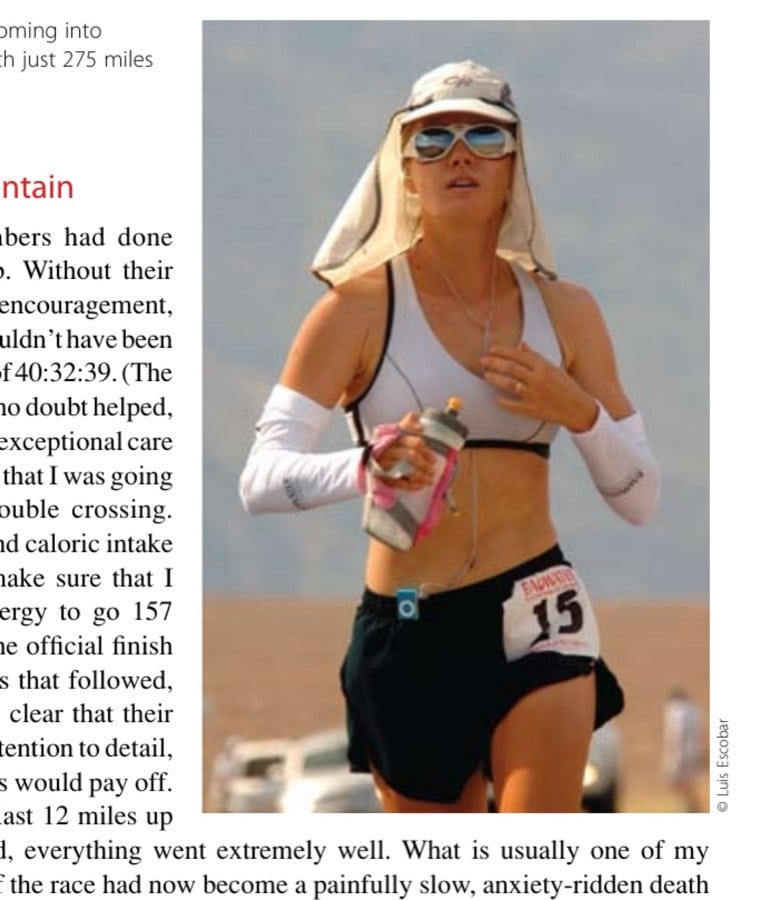
I’m gathering earth energy,” I told them, lying flat on my back, watching the bats fly overhead as the stars came out. But they knew better. They knew I wasn’t gathering “earth energy” but was scared of what lay beyond the official finish line. Nobody complained once about my glacial pace up the Portal Road. Without saying a word, they all seemed to understand that I was stalling out of fear of the inevitable 11-mile climb to the summit of Mount Whitney. We all have our ways of coping with fear. Mine is to drag my feet, in this case quite literally.
© Luis Escobar
On the mountain
In one of my slowest splits ever for the Portal Road section in my four Badwater 135 finishes, my crew members and I finally sprinted across the official finish line in the wee hours of the morning. It was my most emotional finish to date, as I was greeted by race director Chris Kostman and his volunteers with tears streaming down my face. Earlier, Tim and friend Theresa Daus-Weber had driven by me on the Portal Road, cheering us on, as it would be the three of us who would summit Mount Whitney. After a short, fitful four-hour nap, I once again found myself on the rugged trail that led to the summit of Mount Whitney.
An unlikely record It was still dark as Tim, Theresa, and I began our ascent of Mount Whitney. For a while, we could hear cheering and clapping as people were still finishing the Badwater 135 on Wednesday morning. But soon the victorious sounds of cheering and clapping faded, only to be replaced with the last sound in the world I wanted to hear: raindrops. “
I can’t believe this!” I ranted to Theresa. “I mean, what are the freakin’ odds of having another storm on Whitney nearly the exact same day I tried this a year ago?” But before she had time to answer, I frantically found myself looking for one of those bags the forest service gives you to go to the bathroom in, so you can carry out your waste instead of endangering the delicate mountain ecosystem. Perhaps the sudden change in altitude had somehow upset my stomach. I found the bag, but in my exhausted state, I couldn’t fully open it fast enough and ended up pooping in, on, and around the bag while the rain continued to come down even harder. And if that weren’t bad enough, in the process, I had accidentally startled a mother ruffled grouse and her baby, which squawked at me from atop a nearby boulder.
But nothing seemed to ruffle Theresa’s feathers, and she calmly waited for me as I cleaned and composed myself as best I could. Theresa was also encouraging me to break the woman’s 146-mile Badwater to Mount Whitney record, made by Great Britain’s Eleanor Adams Robinson in 1987 in a time of 52 hours and 45 minutes. I had never thought of myself as a potential world record holder of anything, especially because of my average athletic ability and my past that was riddled with addictions—my demons, as I refer to them. But Tim and Theresa remained positive and consistent in their efforts to keep me moving forward. “
Quite the impressive start we’re off to, huh, Theresa?” I said sarcastically. “Princess, I’ve successfully summited this mountain 11 times, no matter what the weather conditions,” she said firmly but calmly. Hearing that, it became apparent to me that the mountain respected Theresa. She was an accomplished ultramarathon runner herself, with scores of victories under her belt, including
Photo by Tim Fromm
the high-altitude, mountainous Leadville Trail 100. Theresa had also paced and crewed me to successful finishes at the notoriously difficult Wasatch 100 and Leadville Trail 100 despite the rather dismal, failure-laden start to my ultrarunning career. I was honored and grateful that someone of her caliber was willing to help me go up Mount Whitney, and I felt safe with her. Admittedly, I also felt a little bit of pressure. I didn’t want her 12th and Tim’s second trip up Mount Whitney to be a failure and a source of disappointment. And I really wanted the women’s Badwater to Mt. Whitney summit record to belong to the United States. And here I was, not even a third of the way up, struggling with diarrhea and fearing the weather once again.
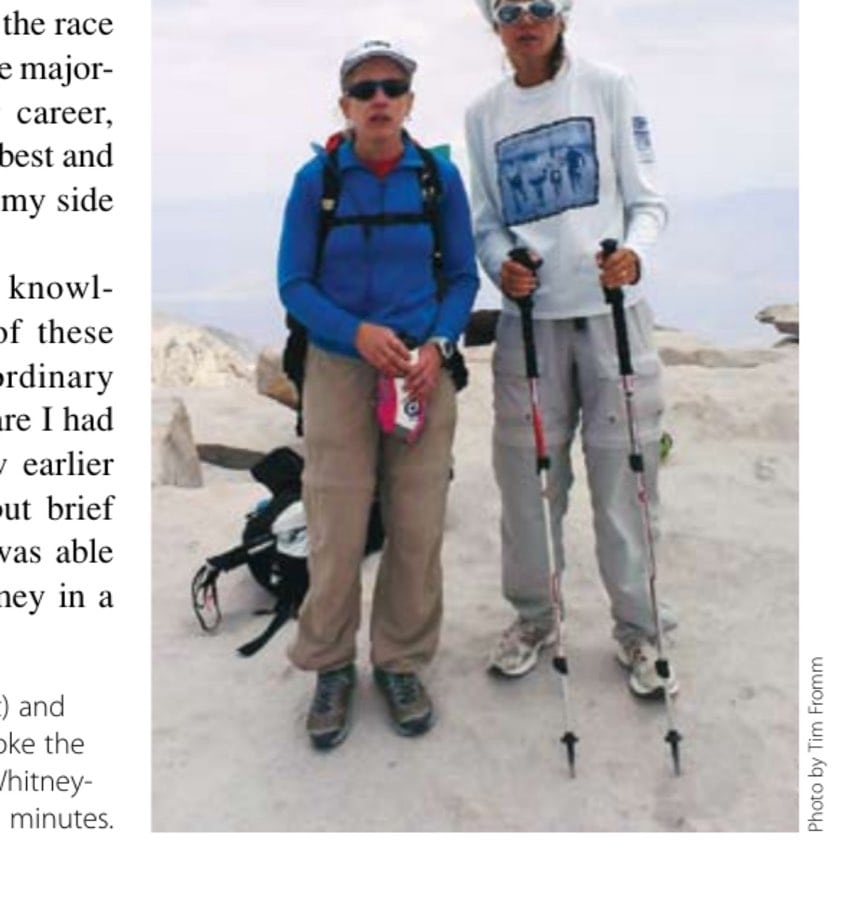
My husband was also a tremendous asset. So that I could conserve my energy, he would go ahead and purify all the water that was needed for the rugged journey to the summit, occasionally having to fend off one very aggressive and persistent marmot that brazenly attempted to make off with a whole bag of our trail mix. Tim had also crewed for me at Badwater three previous times, one time driving out to Death Valley after doing over 14 hours of chemical-warfare training in full battle gear in the scorching summer heat of the Mojave Desert that surrounds Edwards Air Force Base, where we were once stationed. Despite being exhausted, he had the presence of mind to bring ice, which proved to be invaluable since the park had run out during the race that year. Throughout the majority of my ultrarunning career, Tim had seen me at my best and worst, yet remained by my side no matter what.
With the strength, knowledge, and efficiency of these two strong and extraordinary heroes, and given the care I had received from my crew earlier and a most fortunate but brief break in the clouds, I was able to summit Mount Whitney in a ▲
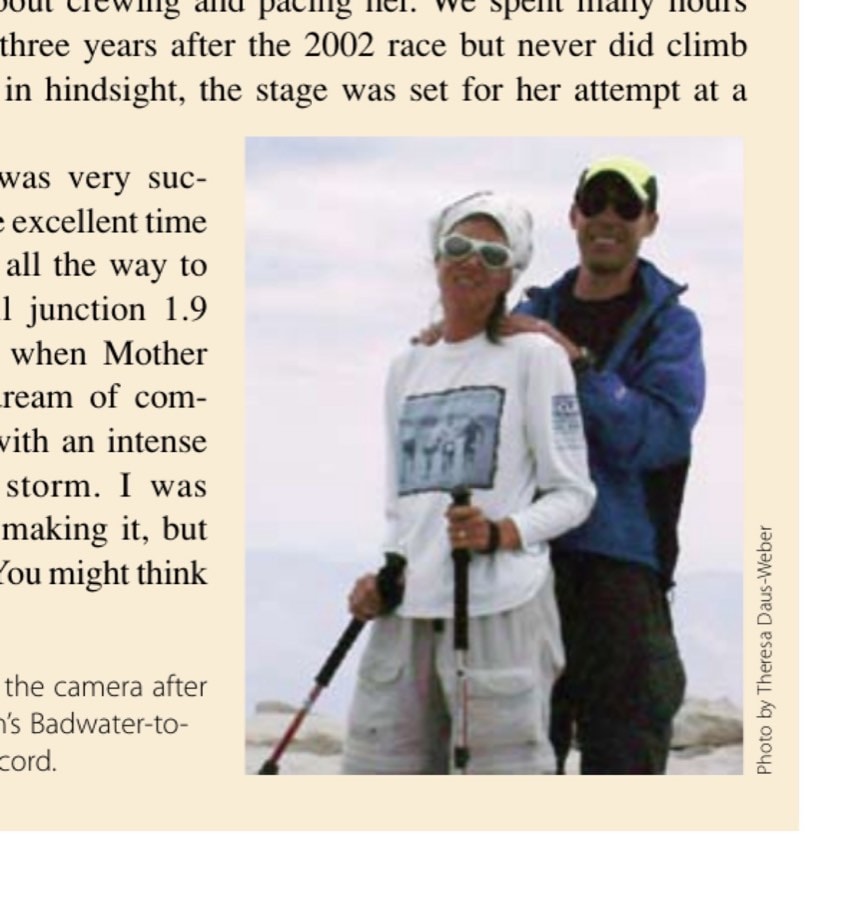
Theresa Daus-Weber (left) and Anita Fromm after Anita broke the woman’s Badwater-to-Mt.-Whitneysummit record by nearly 30 minutes.
time that turned out to be the new woman’s Badwater-to-Mount Whitney summit world record. Struggling with stomach problems the whole way and fighting fear, self-doubt, and exhaustion, I tearfully made it to the summit in 52 hours and 17 minutes. We did it. The world record now belonged to the United States! As thunder boomed and lightning flashed in the distance, we quickly signed the guest book at the summit house and took a few pictures. Mount Whitney had allowed us to reach its summit in record time! Reflecting back on the experience, I realized that a record would not have been possible last year in view of my slower Badwater time and later start, even if I had made it to the summit. Perhaps last year’s unforgiving conditions and my encounter with the man in the yellow jacket were a blessing in disguise. With clouds closing in on us, we quickly turned around and headed back toward Lone Pine.
The trip down the mountain was not quite so spectacular. I could have sworn that the trail grew by several miles as we slowly made our way down the mosquitoladen path. My legs began to quiver uncontrollably. For the final three miles, each footstep soon became a monotonous, painstaking sequence of events—lift leg, stabilize leg, plant foot, repeat—occasionally interrupted by a fall accompanied by a barrage of cuss words. But if we stopped to take even the shortest of rests, the mosquitoes would descend on us in droves. Earlier in the day, I had promised Theresa that I would limit myself to only five cuss words. But after the second fall on the way down, I informed her that my cuss-word quota applied only to the ascent. I had never wanted a greasy, extra-cheese pizza so badly in my life, but all we had left were some stale cheesy crackers and trail mix, which I didn’t want because earlier I had secretly picked out all the chocolate pieces when my crew wasn’t looking. Tim offered me some dates, normally a favorite ultra food of mine. “
I don’t want any more dates!” I wailed. “They look like turds!” “Nothing is going to taste good anymore,” said my husband, who I could see was growing a bit weary of hearing about my pizza fantasies. Theresa would calmly look into the distance. Somehow, her blond, curly ponytail always seemed to look immaculate no matter what. I, on the other hand, was a filthy train wreck of a woman, with my disheveled bun, dirty face, and runny nose. What a sight the three of us must have been! It took me well over nine hours to climb down Mount Whitney compared with about 7 1/2 hours to reach the summit. I began to feel so weak and depleted that I started to wonder whether I would even be able to go 135 miles more. But as Ken Chlouber, the Leadville Trail 100 race director, so eloquently puts it in his prerace challenge speech, “You are better than you think you are!” There is much truth to his words. After inhaling two-thirds of an extra-cheese pizza that my husband somehow managed to order in Lone Pine from atop a boulder on the Mount Whitney trail, I took a bath, went to bed, and woke up ready to go.
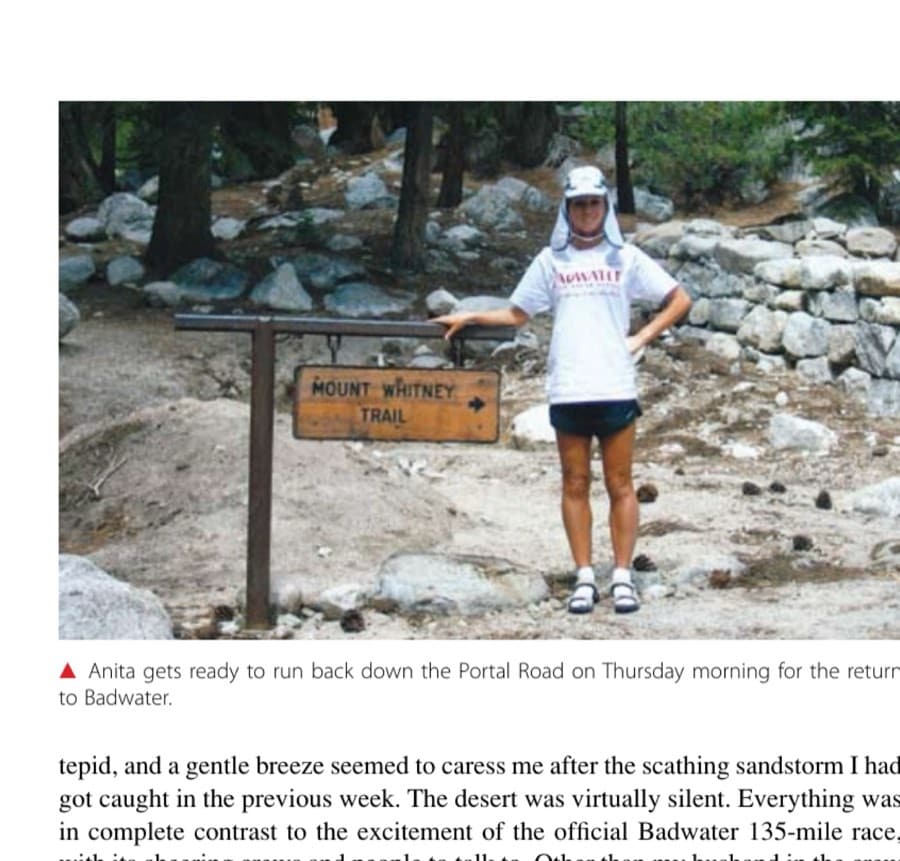
Photo by Cheri Wolfe
▲ Anita gets ready to run back down the Portal Road on Thursday morning for the return to Badwater.
tepid, and a gentle breeze seemed to caress me after the scathing sandstorm I had got caught in the previous week. The desert was virtually silent. Everything was in complete contrast to the excitement of the official Badwater 135-mile race, with its cheering crews and people to talk to. Other than my husband in the crew vehicle (we had sent our other crew members back to Lone Pine for ice cream and salad), I was completely alone out there—or so I thought.
After driving back to Lone Pine for a short rest, some cold, leftover pizza, and ice cream, the next morning we drove back out to Darwin. I had gone 202 miles. My goal was to reach Stovepipe Wells Village, putting me at 250 miles with just 42 miles to go after a short rest. Friday’s daybreak was noticeably warmer than the other mornings, and with each passing mile back down into the Panamint Valley, the temperature continued to rise. The moonlit climb up to Father Crowley’s Point that I had enjoyed on the outbound trip was now a painful and aggravating descent that tested both my body and mind. My knees hurt too much to run down it, and I was growing irritable and impatient. I had begun to fight myself. The battle between what was and what I wanted had begun but quickly went away when I saw what appeared to be a tall figure walking alongside the road, dressed head to toe in white—something only a Badwater veteran would wear. I could also see that this person had a support crew. But I hadn’t heard of any other woman attempting a double crossing this year. Was I mistaken? What if she had the 10:00 a.m. start? That would put her two hours ahead of me, making it very difficult,
if not impossible, for me to attain the fastest woman’s double-crossing time to date. My worries proved to be unfounded, since it soon became apparent that it was Badwater race veteran Danny Westergaard, whom I had briefly met near the summit of Mount Whitney. He too had his share of humorous and entertaining Mount Whitney stories, which we related going back up Towne Pass. We both thought it was humorous when several tourists stopped to take pictures of us. “
We’re celebrities!” I said. “No, they’re taking pictures of that wild ass over there in the mountain,” he said. How humbling. We got a good chuckle out of that, but soon the lighthearted gaiety of my journey was replaced with worry and concern.
An ultrarunning lesson
Photo by Rick Crawford
One of the most important things to learn in running a successful ultramarathon is how to make adversity work for you, because inevitably something will go wrong, even with the best-laid plans. I was informed that one of my crew members had become sick and needed to be taken to a motel room by another crew member, leaving me with just one crew member: my husband. It also left me with just one way to finish, other than piling up everything in a grocery cart and high-tailing to Badwater, in the process looking like a bag lady (although it would have made for some great pictures). I had to stay focused, not an easy task after having nearly 250 miles on my body and feet and only 15 hours of sleep in the past four days. Tim had crewed me on Mount Whitney and much of Thursday, and I knew that he, too, was exhausted. In order to finish, I had to stay focused, knowing that any kind of
▲ Anita’s double crossing would not have been possible without the help of “blister queen” Denise Jones and her husband, Ben, who provided much-needed moral support before, during, and after the attempt.
emotional meltdown or drama would just add to the strain and further jeopardize an already precarious situation. So I pretended that everything was great. We became “Team T & A” (standing for Tim and Anita, of course!). I ate whatever he fed me (usually potato chips with spinach dip, more leftover cold pizza, or a squished Little Debbie Oatmeal Creme Pie) and drank what he gave me (usually water, Mountain Dew, or Spike, along with a few caffeine pills). With the most-welcome company of Danny and his crew as well as some very enthusiastic tourists from Denmark, at 11:45 p.m. on Friday night, we finally made it to Stovepipe Wells.
The finish After resting for only about three hours, Tim and I decided to make the most of the cooler night and headed back out into the desert. The full moon softly illuminated the sand dunes that lie just beyond Stovepipe Wells. Everything was calm, soft, and beautiful. How privileged and grateful I felt to be a part of it. Friday had tested our physical and emotional limits for sure, but now we found ourselves enveloped in a surreal, soothing desert twilight. I ran the first few miles outside of Stovepipe Wells alone, as Tim refilled a few water bottles and made me a peanut butter and jelly sandwich. I was completely alone, since apparently Danny and his crew had taken off during our three-hour nap.
Running alone alongside the sand dunes for those two or three miles was a time of extraordinary peace and contentment. I wasn’t even sure what time it was, and I didn’t care. A sense of timelessness encompassed me in this ancient desert’s solitude. I was too tired to struggle with any of the inner conflicts, distractions, or demons of addiction that had been a part of my life as far back as I could remember. Perhaps this exhaustion was a gift of the desert, for it left me with the energy to focus on only one thing: getting back to Badwater. I surrendered my spirit to this vast, beautiful desert and quietly made my way down the road, enveloped in a peace I had never felt before. Funny that I should feel so alive in a place called Death Valley.
A quote from Bernard DeVote that Rhonda Provost sent to me after my double crossing captures the essence of how I felt: “What they had done, what they had seen, heard, felt, feared—the places, the sounds, the colors, the heat, the cold, the darkness, the emptiness, the bleakness, the beauty. ’Til they died, this stream of memory would set them apart, if imperceptibly, to anyone but themselves, from everyone else. For they had crossed the mountains.”
Soon Tim was by my side again, with the profile of the mountains to the east of us soon becoming visible with the rising sun. Remember that extreme training that I mentioned earlier? This is the part where it paid off. Before the sun was even fully up, it was well over 100 degrees. The wind began to pick up, too, and by the time we reached Furnace Creek, with 275 miles under my feet, it was
Photo by Ben Jones
over 130 degrees, with a 20- to 30-mile-per-hour head wind. I had just 17 miles to go, but Death Valley was going to make certain that it would be remembered appropriately. The calm, gentle, mysterious side of its personality disappeared, unmasking its passionate, intense, and relentless side. I had given it all I had, and now it was giving me all it had, and I was loving every crazy minute of it. For a brief moment, I thought that perhaps Death Valley was in some way testing me on those final 17 miles, but perhaps it was simply reflecting the passion, intensity, and relentlessness needed to complete such a journey. Or maybe this was its way of saying good-bye, for now.
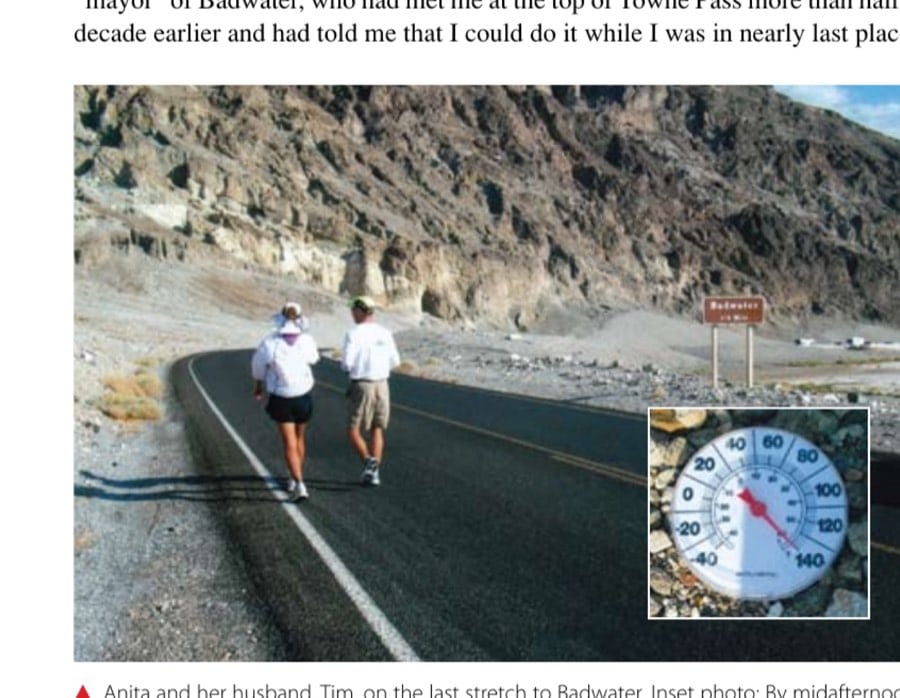
The final eight miles are a blur of happy memories, as good friends Ben and Denise Jones of Lone Pine came out to see me finish, along with Phil and Kari Marchant of Bishop. My other crew members were able to join us, too. Kari came enthusiastically running over with a rapidly melting Popsicle, and Denise brought me a sandwich as well, both of which were welcome treats after hundreds of miles of chips and dip, cold pizza, and Mountain Dew. In what is now another cherished ultrarunning memory, I finally arrived back at Badwater, surrounded by friends and loved ones, crossing a homemade finish line that consisted of a stream of toilet paper held across the road by Kari and Denise. Ben Jones, the “mayor” of Badwater, who had met me at the top of Towne Pass more than half a decade earlier and had told me that I could do it while I was in nearly last place,
▲ Anita and her husband, Tim, on the last stretch to Badwater. Inset photo: By midafternoon on Saturday when Anita finished her double crossing, the temperature had soared.
recorded my time: 129 hours, 44 minutes, and 5 seconds—a woman’s Death Valley double-crossing record. (Ben said I could. . . .) After my double crossing, I was asked a lot of questions, the most common being, “What demons are you running from?” I learned many things from my double crossing, and perhaps the most profound and sobering is that I just can’t run fast enough to escape them. They run with me every step of the way, always looking for a moment of vulnerability to take over. I’ve also been asked whether running has helped heal my life. Unfortunately, I can’t honestly answer that question either, as my love and passion for the sport make it impossible to give an unbiased answer. I can tell you that running has brought people into my life who have helped me learn things about myself so that I can better manage my addictions, for I don’t believe addictions can be fully healed, only managed, in a world full of chaos, where the only clear thing seems to be the chaos itself. I’ve also come to believe that it is in the face of adversity that one’s true character, or lack thereof, is revealed. Adversity, while not pleasant or expected, gives us the choice to either sit and cower in a squalid cesspool of anger and self pity and give up, or we can dare to step outside our comfort zones and use the challenges adversity brings to us as a tool of transformation met with silent and composed resiliency. Regretfully, I have done both in my life, but the latter choice, while being the tougher, has always given more satisfying results.
In the weeks following my double crossing, I often woke up in the middle of the night, thinking that I was still somewhere on Mount Whitney, or I woke my husband in the middle of the night, talking in my sleep with various crew members. Many intense or overwhelming experiences can take weeks or even years to process, but the reward of inner growth and self-discovery can be worth any price paid in physical discomfort. Like the powerful, geological changes going on inside Death Valley, the double crossing was a powerful journey of inner transformation. Like the landscape itself, I went from some very low places to some very high places and experienced inner and outer upheaval, only to return to where I started, humbled and transformed for whatever new journey might lie ahead.
Crewing Anita at the Death Valley Double Crews go through an amazing roller coaster of emotions, as does the ultrarunner. by Tim Fromm
I met Anita in the Leadville, Colorado, gym in July 2000 as one of her crew members and pacers for that year’s race. It was her first 100-miler, and until about a month earlier, I had never known that people ran races
▲
Team T & A pose for the camera after Anita set a new woman’s Badwater-toMt.-Whitney-summit record.
Photo by Theresa Daus-Weber
that long. Even though I didn’t get to run with her because she dropped out at Winfield, I immediately picked up on her intense focus and determination, and I knew I was destined to be a part of her anything-buttypical life. I’ve been crewing and pacing her ever since, including her most recent Death Valley double achievements.
I crewed and paced her first Badwater in 2002 and learned a great deal about the runner and the course, including its intense heat and wind, the hallucinations it can cause, and just how steep the climb from Lone Pine to the Whitney portals can be—even though I ran only a fraction of the previous 122 miles. More than anything else, I learned patience and the importance of being a source of stability and encouragement because 135 miles takes a long time to run and the environment causes immense stress to the runner and crew with its long stretches in very remote settings.
After we moved to Edwards Air Force Base, California, in 2002, Anita went into overdrive with her training, and we both got to know the course and Sierras around the Badwater finish pretty well. Around this time, Anita started talking about doing a double. I couldn’t believe that she even wanted to run the race again after the pain and suffering she went through the first time, but as she improved dramatically, I learned many new things about crewing and pacing her. We spent many hours all around it in the three years after the 2002 race but never did climb Mount Whitney, so in hindsight, the stage was set for her attempt at a double in 2007.
Her 2007 race was very successful, and we made excellent time ascending Whitney, all the way to the John Muir Trail junction 1.9 miles from the top when Mother Nature ended her dream of completing the double with an intense hail-and-lightning storm. I was disappointed at not making it, but she was devastated. You might think
that lightning striking all around and freezing huddled under a tent cover and sleeping pad would eradicate any desire to try it again, but during the long, slow descent to the car, she was already talking about trying
again the next year. On the other hand, I wasn’t so sure that I wanted to spend more time in the desert as crew for the race, even though I really did want to get to the top of Whitney and see her reach her goals. So we
decided that I would join her for the ascent with Theresa Daus-Weber and make the return trip to the start as part of her crew. Theresa and I arrived while Anita was about halfway up the final switchbacks going up the Whitney Portal Road. (If you’ve ever seen
the Humphrey Bogart film High Sierra, you’ve seen the road, but now it is paved.) She was on a pace even faster than in 2007, but I could tell that she was pretty spent as she neared the finish a bit after midnight.
As exhausted as she looked, I had my doubts that she was going to be able to make the climb fast enough, but the three of us hit the trail just at daylight. Spirits were high and progress went fairly well until a bit below the
switchbacks up to the John Muir Trail. Exhaustion and fear of a repeat of last year’s weather were starting to catch up to her. I was keeping track of our pace and knew that it was going to be difficult for her to break
the women’s record if we didn’t get moving. As we started to ascend the switchbacks, self-doubt and tired legs were taking their toll, and Anita began talking about giving up the record attempt. Theresa and I would
have none of it and egged her on, challenging her to dig deep. Something we said struck a nerve, as she surged ahead and set a relentless pace all the way to where we had turned back the year before. Fortunately, the
weather held and she kept her focus, breezed through the exposed section past the spires, and pushed hard all the way to the top, breaking the record by nearly 30 minutes! In those final miles, I learned a lot about
the power of determination and what the human body can accomplish. As has become the norm with Anita in mountain runs, going down took longer than the ascent. The fatigue and lack of sleep took their toll,
and it was painstakingly slow. Finally, we made it back to the trailhead after dark and drove back to the hotel in Lone Pine for pizza and muchneeded sleep. After Anita’s first real sleep in three days, Rick (who had flown in
from Colorado on Wednesday to help crew on the return leg) and I met Cheri, who also helped crew the outbound leg, and Anita a couple of
miles from town as she ran down the Portal Road—and amazingly she was doing a pretty good pace. It was odd to be crewing her going in the opposite direction and seeing everything from a reverse perspective. She made it all the way to the Darwin turnoff the first day of the return, and fatigue started to take its toll on all of us.
By lunch the next day, Anita’s and the crew’s patience was being tried. I was tired and grumpy from the Whitney ascent, and Anita was obviously mentally and physically exhausted. After we pulled into Panamint for lunch, a tantrum on my part over what will forever be known as the “cold salad incident” put us all on shaky footing for the next few hours. Thanks to Danny Westergaard’s great sense of humor as he caught up with us going across the valley, everyone was put at ease. Going up the climb over Towne Pass, however, a crew emergency left me in the unenviable position of having to crew Anita alone for about 20 hours. Fortunately, we were able to join Danny and his crew for about half that time. We tried to get some sleep in Stovepipe Wells, but the emotions from the previous day made that nearly impossible, so before sunrise Anita and I hit the road. This was my favorite stretch of the return, as it was cool and calm and the sunrise and early-morning light and color were spectacular. We had made it nearly to Furnace Creek when Rick and Cheri joined us again to help with the crewing.
Through the day, the heat built, and the wind started blowing hard up the valley as we went down it. I had experienced temperatures approaching 130 degrees during an earlier race, and this felt every bit as hot. We were going through water and ice at an amazing rate, and it continued to get hotter. Fortunately, we were joined by Ben and Denise Jones and Kari and Phil Marchant, who brought lots of extra ice, Popsicles, and positive energy, which rejuvenated everyone and kept Anita motivated.
It seemed that Badwater was never going to arrive, but finally, late in the afternoon, in 130-plus-degree heat and high head winds, Badwater did arrive. I was carrying the video camera as we ran together, and the wind was howling so hard that it was often hard to hear what we were saying, but the smiles, cheers, and excitement from the welcoming party at the finish line, complete with an impromptu toilet paper tape as Anita finished, made words unnecessary. She had done it, smashing the previous record, and despite my reluctance to help after the disappointment of the previous year and the difficulties of crewing alone all that time, I was proud to have been a part of it and especially proud of her and her accomplishment.
This article originally appeared in Marathon & Beyond, Vol. 13, No. 4 (2009).
← Browse the full M&B ArchiveMore like this
1,000+ stories from 19 years of Marathon & Beyond
The complete archive of the legendary long-distance journal — digitized and free to read.
