

Running With Mary Ellen
I AM 46 years old, married with two kids, two dogs, two cars, and one mortgage; and I run marathons. I am not the fanatical type, in that I run, on average, one marathon a year. I completed my first in 1990, and I am training for my 10th right now. I am often asked why I run marathons.
Initially it was to see whether I could do it. Then it was to see whether I could do it faster, followed by thoughts of qualifying for Boston. I came close, Seattle in 1992, Vancouver and Calgary in 1994, Kelowna in 1995, but was unable to get under the 3:20 standard necessary for my age group at the time. It seems that the human body (or at least this human body) is designed to run no more than 21 or 22 miles.
Things changed in 1996.
My sister Mary Ellen, or Maresie as we called her, had been diagnosed with cancer in September 1994 and died May 13, 1996. We were the second and third children in a family of seven and had enjoyed a close relationship all our lives. Her illness and death were difficult for all of us.
Shortly after her death, I decided to again try to qualify for Boston and picked Victoria, British Columbia, in October as the target race.
I usually run alone, and as the training runs lengthened I found the time and solitude presented the opportunity to reflect on and reminisce about Maresie.
As the runs got into the third hour and beyond, the reflection became conversational and the time and miles melted away. I started to look forward to “the long run” and particularly to the last hour when our chats usually occurred. Eventually, I made a deal with her. I wanted to qualify for Boston and I undertook to get us to mile 20 on pace to break 3:20. Her job was to get us through those always difficult last six miles.
Victoria is a lovely city and the marathon is one of the good ones. The course is scenic and the organization is superb. The run started in the usual way: after the first 2 or 3 miles I settled into that cruise control, comfort zone that I knew would last for the next 15 miles or so. I enjoyed the scenery, chatted from time to time with fellow runners, and talked with my sister. By mile 18 I was feeling the effects and starting to struggle. I reminded Mary Ellen that I might be looking for some help and set mile 20 as my goal.
The Wall was looming large as I approached. It was becoming difficult to maintain the pace, but I had the marker in sight and pushed for it. Once I got there, I remember thinking, “OK, your turn,” and almost at that precise moment I caught my second wind. The hurt eased, and I found my rhythm. I finished in a time of 3:18. Did I receive a little push from above? I don’t know. The mental
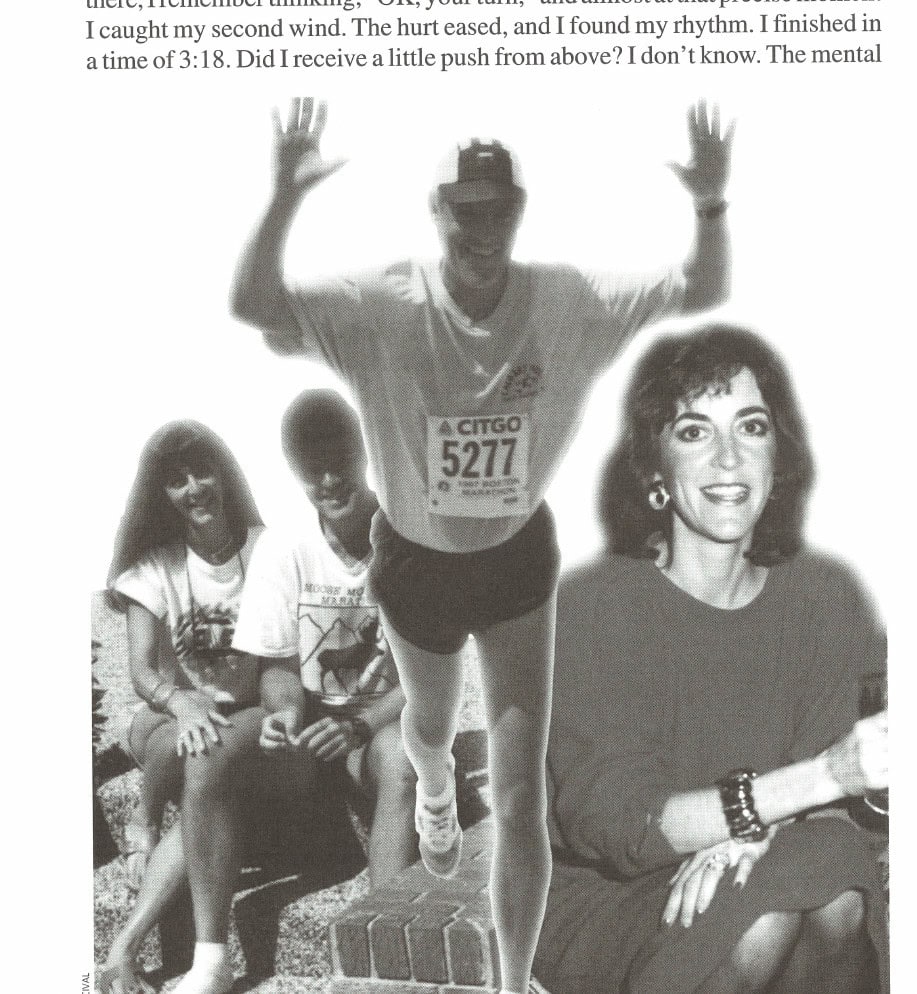
aspect of long-distance running is critical and the knowledge that my sister was somehow with me was important. All I know is that I was about to hit The Wall and instead ran right through it.
ON TO BOSTON
I accomplished my goal the following spring and completed the Boston Marathon. Long training runs always turned into discussions, and I made a similar deal with Maresie. Mile 20 is mine, and then it’s all yours. I was doing all right until the series of hills near Newton but was about to crash and burn. As I approached the last hill I turned it over, and although it hurt some, we persevered, didn’t stop, and made it home.
I kept running marathons and next did Tucson in December 1998.
I find that I discover something new about running and myself in each marathon that I do. In Tucson I learned that it is not always hot in Arizona. I’m from Calgary, Alberta, and am used to running in cold weather, but I almost froze waiting to start. But once I warmed up, the run went fine. My finishing time was no longer all that important, and I kept telling Mary Ellen that I was feeling pretty good, so I’d take it one more mile before I put her in control. As it turned out, I never did get to The Wall and didn’t have her take over. Or maybe she decided to run the whole thing herself and just didn’t tell me. Either way, we had a nice visit.
I haven’t done a marathon since Tucson, courtesy of a disc/sciatic nerve problem. That seems to be under control, and San Diego is next, with New York, Grandma’s, and Big Sur being on the hit list after that.
My family is close, and while Mary Ellen is often remembered when we get together, it is not the same connection I seem to develop while running. I’ve missed my time with Maresie, but the training runs are getting longer and plans have to be made and deals have to be cut. I’m looking forward to it.
If you go to San Diego or to one of my other intended marathons, you may come across a runner in the last five or six miles who is on the downside of 45. The hair he has left is mostly gray. He may be talking to himself and his eyes might be a little misty, but he is looking smooth. Say “Hi” and slide in beside me. I’ll introduce you to my sister.
Why do I run marathons? I get to run with Mary Ellen.
This article originally appeared in Marathon & Beyond, Vol. 6, No. 3 (2002).
← Browse the full M&B Archive1,000+ stories from 19 years of Marathon & Beyond
The complete archive of the legendary long-distance journal — digitized and free to read.
