

Running With Partners
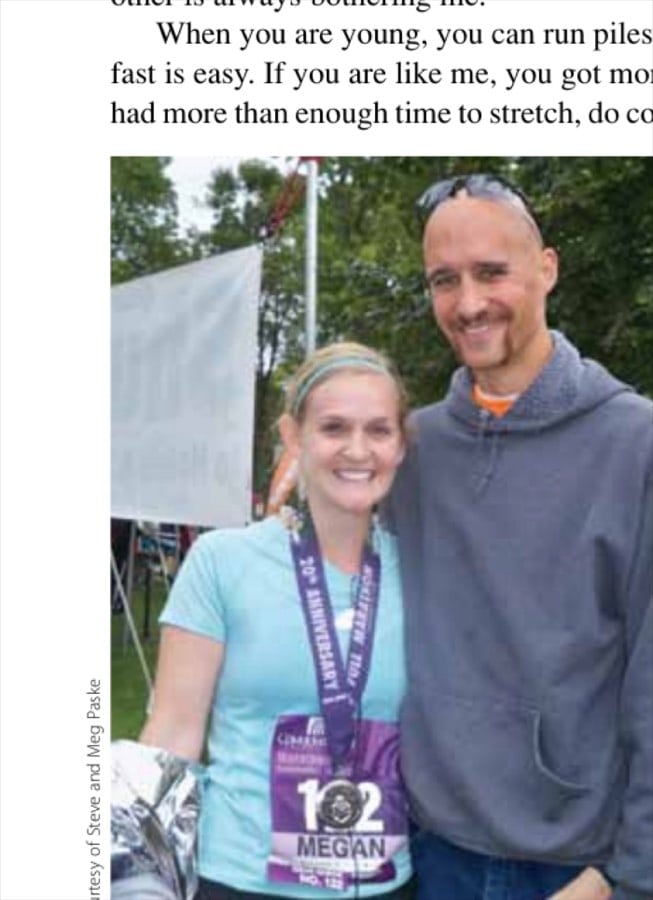
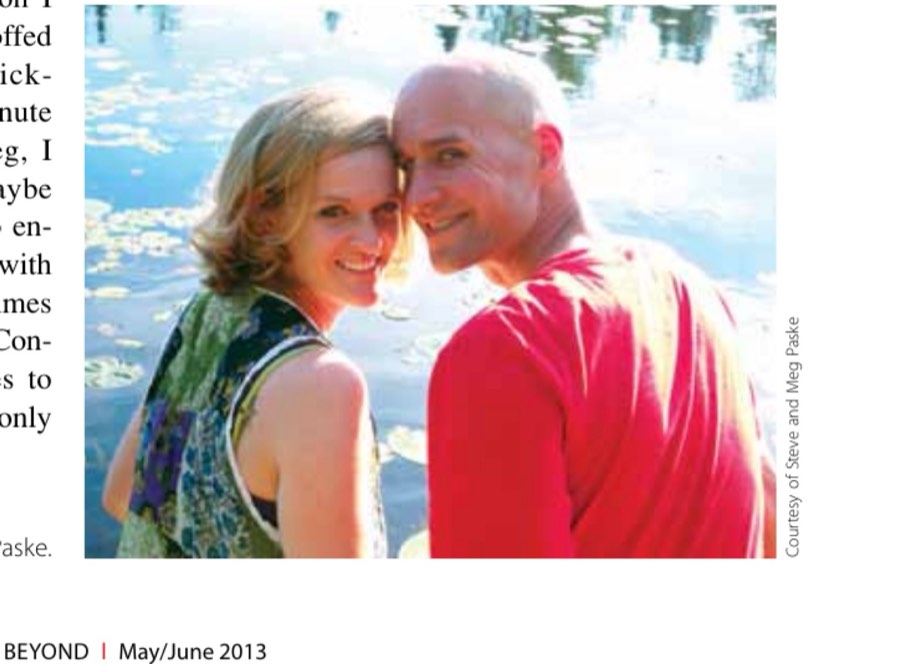
Meg and Steve Paske.
Courtesy of Steve and Meg Paske
Perhaps you have been there. You know, you met a girl, find out she is a runner, and so the two of you line up a running date. At first glance, it seems like such a logical and safe second- or third-date activity. But then the day comes. You arrive at the preordained park, and as you pull into the lot you can’t help but notice that she is engaged in a stretch that looks as ridiculous as anything you have ever seen—until you start running, that is.
That is when you discover that this so-called runner, the woman who professed her undying love for the sport, has not laced up a pair of shoes in weeks. Then to add insult to injury, as you plod along at 14-minute miles, she admits that she actually is just a beginner. You have been churning out sub-seven-minute miles with regularity. Based on this girl’s physique and banter, you figured she would be up for the challenge. And so by the end of the date you are so irritated that your workout got messed up that you vow never to speak to the woman again.
Before meeting my wife, Meg, I endured many a run similar to the run above. A former Division I runner, I even scoffed at the ladies kicking out nine-minute miles. After Meg, I realized that maybe slowing down to enjoy the scenery with somebody sometimes was not too bad. Conversely, she likes to say that I am the only
semielite male runner that she ever enjoyed a run with. Quite frankly, I am lucky that I did not meet her sooner than I did. Though the running community is generally very accepting, you might have noticed a bit of animosity between those running near the front and those closer to the back. “
Those half-marathoners do nothing but get in the way of the fast marathoners late in the race,” the front-runners might say. “Those guys up front take themselves way too seriously for a mid-February 5K,” those in the back retort.
There is no doubt that tension exists between the haves and have-nots when it comes to the distance-running community. That said, Meg and I thought it quite interesting that running has worked so well in our relationship. How did we get there? We thought it such an interesting question that we decided to write about it. Here is our story.
Steve Three weeks before my sophomore year of high school, the reality hit me. At 6 feet, 1 inch tall and 145 pounds, I really was the scrawniest guy participating in the Osseo Football Speed and Strength Program. Whether it was Kevin Lowry’s laughter with every exercise on upper-body weight day or the stunning similarity between the girth of my arms and the pipe cleaners used for art projects, suddenly my older brother’s taunts resonated with clarity. “Football sucks! Run cross-country!”
For months I responded to his jeers by telling him running was stupid. Football was the sport people cared about. But I also knew that during the past fall he had run in something called the state meet, which seemed like a pretty big deal. So while I knew that my 2:16 half and 5:19 mile as a freshman at Osseo Junior High were nothing special, I also knew that he must have seen some talent in me.
I wanted a letter jacket. My gut was keenly aware that Jarret Parks, the other quarterback coming up through the system, was better than me. And so as I looked in the bathroom mirror that night, I muttered to myself, “No Steve, you really won’t ever play quarterback for the Vikings.” Then I placed the mouth guard my mother had taken me to get molded just three days earlier in my top dresser drawer, walked into the living room, and gave my family the news. “
I think I’m going to run cross-country,” I announced. “Dude, you won’t regret it,” my brother yelled, ecstatically. “Are you sure?” my mother asked. She knew that I had never really embraced junior high track.
One look at my arms and one hearing of my stories about being mocked in the weight room, and she backed off.
A week after the fact, dying at the midway point of the 2.4-mile loop on the first day of practice, I will admit to having some reservations about my decision. However, unlike my brother, I was not yet familiar with the magic of a man named Coach Deane. By mid-October, he had taken a team that had lost its top seven runners from the previous season and molded us into a respectable unit. By early November, thanks largely to our placement in a very weak state sectional, we were on our way to the Minnesota state meet.
On a personal level, my own metamorphosis from lackadaisical junior high runner to serious athlete happened just as fast. In September, warm-ups and cooldowns often meant riding six to the back seat or in the trunk of a car that one of the wrestlers parked a block away from our training grounds. By October, the car got less crowded as the more serious runners opted to simply walk the first two-thirds of the cool-down and then sprint the last half mile down Revere Lane to the school.
After qualifying for state, I didn’t dare cut an inch off a workout uttered by Mr. Deane. On November 6, I ran out of my mind, finishing 62nd in the state, four places higher than my brother had finished the previous season. “
If you want to be a great runner, you need to go from planning your run around your day to planning your day around your run,” Coach Deane had said on the first day of practice. “You have to hate it when you miss a day. You can’t just like running. You have to fall in love with it.”
The moment I finished that state meet, those words defined me.
Meg “Cross-country is pretty hard-core, Megan.” It was spring of my sophomore year of high school. My good friend Kate was trying her best to discourage me after I hesitantly mentioned that I wanted to go out for the sport the next fall. She had run since the seventh grade on the illustrious team, a team I used to envy as they would speed past on the city sidewalks on afternoons that I headed to my music lessons or stayed late after school for some ensemble practice or another.
Having never been the fitness type and having about as much coordination as a baboon on stilts, I thought that running would be a good way to try out something nonmusical and outside of the realm of academics for a change. Besides, I had been running an average of two miles every day on my parents’ beaten-up treadmill and had recently started running outdoors. It seemed to me that I could be ready by the fall.
I had my eye on something larger, but it wasn’t until I asked Kate and received her snarky response that I figured out what that was. Frail, little, “musical” Megan Kathleen Callahan could be a runner if she wanted. Hard-core or not, I was going
to go out for cross-country, and Kate could eat her words come next fall when I actually showed up for practice. And so I ran.
Steve He passed me. Outside of a race or workout, I couldn’t remember being passed on a run in years. Not to say there weren’t those out there who could legitimately do it. With both the University of Wisconsin-Milwaukee and Marquette sporting Division I programs, certainly there were runners in this part of the city capable of going by me now that I was a year out of college.
But this guy! This guy had been walking just a quarter mile back. This guy didn’t look the part. He didn’t have the sleek, winter-running gear. His physique didn’t possess that lanky and lean machine look. This guy was a nobody, a plodder, and the hell if I wasn’t going to put him in his place.
So with a quick surge, I pulled up on his shoulder as we traversed Milwaukee’s lakefront path. Immediately, his tempo accelerated, but not even close to a pace I couldn’t handle. Cheeks fluttering, arms as loose as my stiff form allowed, I settled in to torment him.
Picking up speed, we reached the bottom of the hill and climbed up the path from the lake to the city in the total darkness of a January night. His periodic side glances revealed his obvious irritation. My position a half step back revealed mine.
And for miles, I burdened him. Up the hill, into the city, with his every twist and turn I followed him. I followed him until I felt certain that he understood my dominance, until he understood that you don’t take advantage of another runner by passing him a minute after your walking break.
I despised people like him. I despised any person who tried to boost his frail ego by taking advantage of me on my relaxed run. If you beat me in a race, then you earned my respect. But people who had never seen the top side of a 50-mile week, let alone 80, people who barely broke four hours in a marathon and called themselves runners, I had news for them. They were joggers, and I saw little reason to respect what they did.
Meg For the greater part of 13 years, running was always a solitary activity for me. Sure, I was on the cross-country team in high school. Yes, I joined a running club every once in a while after college for some much-needed camaraderie. Heck, I have even gone on a few running dates and helped a former flame through his first (and only) marathon experience. But as a single person, I was always, at the end of the day, a single runner.
▲
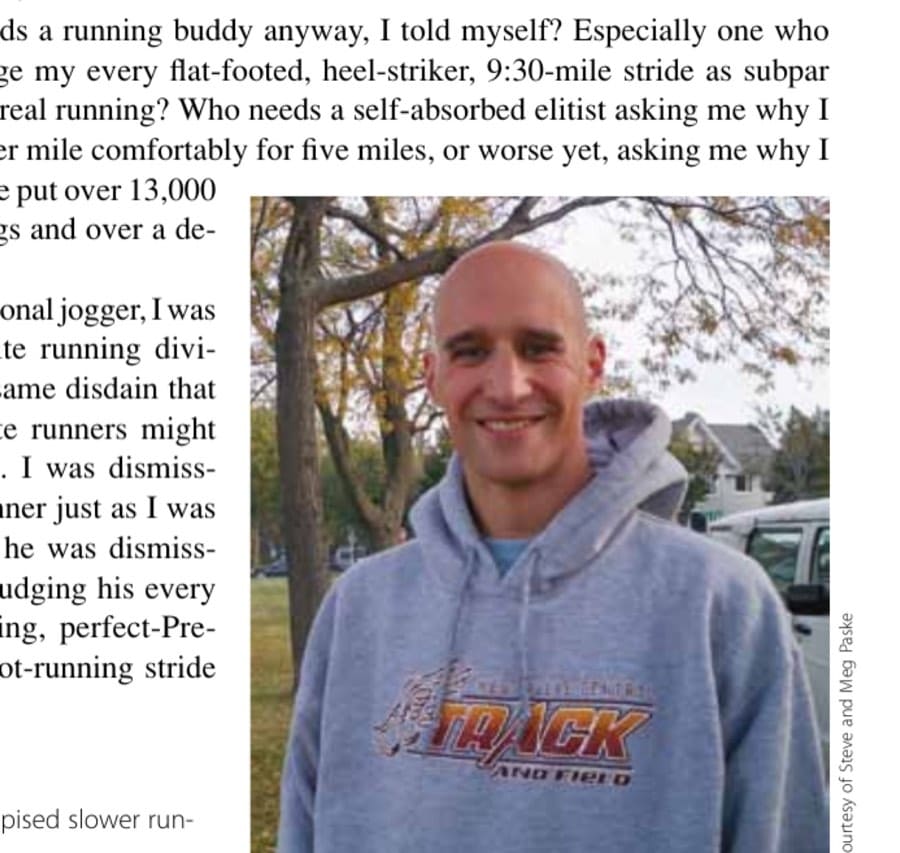
Steve once despised slower runners.
Courtesy of Steve and Meg Paske
I could never find anyone who shared the same passion for the sport and who would be happy at my snail’s pace (or who would put up with it). I could never find anyone who loved running as much as I did but who also considered my participation in the sport as more than that of just an A-for-effort jogger. I could never share the jolt I would get at the beginning of a race with anyone except myself. It seemed to me that anyone who cared about running as much as I did cared more about his own running than anything else.
Since the day I set my mind to joining cross-country as a 16-year-old frail, unathletic, and uncoordinated music geek, I’ve completed 18 marathon races (including two indoor full marathons, one the same weekend as a half), 17 halfmarathons, one winter 50K (in Winter, Wisconsin, no less), and at least a dozen or more 15Ks and 10Ks.
I have logged an average of 1,500 miles a year—admittedly, a paltry sum when compared with the megamileage so often churned out by elite runners. But recently, I have upped my mileage to 50- and even 60-mile weeks, hoping to continue to make the incremental improvements I’ve enjoyed throughout my years as a lowly recreational runner. Yet in spite of the résumé, every guy I met capable of stringing together a few sub-seven-minute miles seemed to discount every step I took.
So who needs a running buddy anyway, I told myself? Especially one who is going to judge my every flat-footed, heel-striker, 9:30-mile stride as subpar jogging, as not real running? Who needs a self-absorbed elitist asking me why I can’t hit 7:30 per mile comfortably for five miles, or worse yet, asking me why I can’t do it if I’ve put over 13,000 miles on my legs and over a decade of racing?
As a recreational jogger, I was viewing the elite running divisions with the same disdain that I suspected elite runners might be viewing me. I was dismissing the elite runner just as I was convinced that he was dismissing me. I was judging his every front-foot-striking, perfect-Prefontaine-barefoot-running stride
just as much as I was convinced that he was judging mine. It wasn’t until I met Stephen that I realized that competitiveness and the elite runner aren’t the enemy.
Steve I can vividly recall a conversation with my running friends late in high school where I made light of the three-hour marathon. “It’s barely faster than seven minutes a mile,” I said. “You’re not a runner if you can’t do that.”
As I lined up for the 2008 Milwaukee Lakefront Marathon, my mind reviewed my recent results: 3:40 at Grandma’s; 3:00:12 (that one hurt) at Lakefront 2004; 4:04 at Boston (don’t ask), and sitting down at mile 23 of Quad Cities in 2007 because I knew that I would finish between 3:02 and 3:03.
The ancient words I had uttered so callously haunted me as the gun went off and I took off on my seventh attempt to break three hours. A stress fracture in my foot had limited my training for the past month and made achieving this now not-so-modest goal questionable at best.
I hit the half in 1:29:30. Entering the 25th mile, I did not know whether I would make it. Even as I approached the finish and the clock came into view, the margin was so slim that I feared that I would fail. I had started in the front row, so my chip time was the gun time.
The final verdict: 2:59:59. In talking to my running buddy after the race, I mentioned that I had stopped to go to the bathroom near mile 14. “That’s crazy,” he said. “One more shake, and you wouldn’t have made it!”
What’s crazy is to think that at one point in my life, I would have considered myself less of a runner if I hadn’t.
Meg “Holy crap!” It was September 19, 2010, and Kate was responding to my latest Facebook wall post: “3:56:50 Woo Hoo!” I had just completed my 10th marathon at the Fox Cities Marathon and had finally broken the four-hour barrier. I had run anything from 5:07:15 (during Memorial Day weekend in 2006, in the 90-degree Mad City Marathon that was officially called at 5:15:00) to 4:16:57, the year before at the same Fox Cities Marathon. But until that day, not once had I come close to seeing that 3 in the hour spot.
Perhaps most interesting was that just a month earlier I had no intention of running this race hard. Entered in the San Francisco Nike Women’s Marathon in October, I had intended to use Fox Cities as a warm-up, a long tempo run if you will. That changed quickly after my first run with Stephen.
Eager to impress after enjoying our first couple of dates, I suggested we do a 16-mile training run together. Somewhat intimidated by my limited knowledge of Steve’s running background (in his dating profile he had posted a picture of himself running a race while at Marquette University), I worried whether he would get impatient with my pace like every other male running companion I had dared to venture out with.
However, as we snaked along the Cudahy Trail along Lake Michigan, something occurred to me. Stephen seemed to be working as hard as I was. “Are you doing OK?” I dared to ask at a point where the trail widened out and we could run next to each other. “
Sure,” he responded with a smile. “But I’ve got to admit I’m pretty impressed.” It is hard to describe just how good hearing this felt. Here was a guy who had competed in college, who had a 2 on the front of his marathon time, who finished in the top 10 at road races, and he was impressed with me. Then, after the run, he surprised me even more. “
Why are you waiting to run hard at San Francisco?” he asked. “It seems to me you’re in really good shape right now.” The experience was a stark contrast to every other running date I had ever been out on. After our run, the star athlete wasn’t talking about his own race. He wasn’t plotting how to make up for my slowing his daily workout. His focus was completely on my goal. He considered me a real runner!
I’ve never sat down in a race and not finished. I’ve never regretted my decision to run, and I’ve always been proud to call myself a “runner” even though there may be a class of runners out there that wouldn’t consider what I do running. And
Courtesy of Steve and Meg Paske
▲
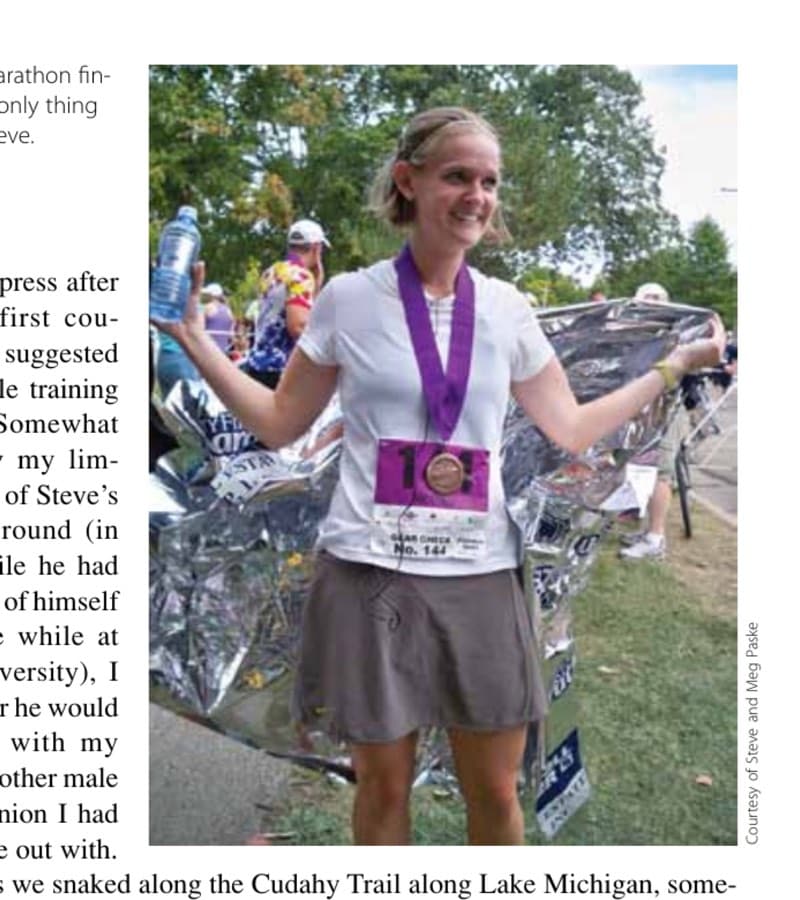
Meg’s many marathon finishes weren’t the only thing that impressed Steve.
what made me finally break the four-hour barrier was not an overwhelming drive to outkick the guy in the chute who was easily twice my size, it wasn’t the need to rub in my former classmate’s face that she was wrong about cross-country being too hard-core for me, and it was not a newly found sense of competitive drive. It was simply the sheer knowledge that I was going to do something I had never before thought that I could do and that someone out there was cheering me on. Someone was enjoying my running as much as I was.
Steve
Courtesy of Steve and Meg Paske
Like the lines that grow in your brow, it’s funny how you never realize the gradual slowing in your training pace until it stares you in the face. At 22, it was around 6:00 per mile. By 24, it was closer to 7:00. At 30, my eight-minute-mile runs
were taking an hour. At 33, I often don’t even bother to wear a watch anymore. Having run enough miles to circle the earth, I find that all the little injuries have taken their toll. First there was the peroneal tendinopathy and then the metatarsal
stress fracture. If the bursitis in my hip isn’t flaring up, then one hip flexor or the other is always bothering me. When you are young, you can run piles of miles without injury, and so being fast is easy. If you are like me, you got more sleep, spent less time working, and
had more than enough time to stretch, do core work, and wear out the foam roller. Then you got older, and eight hours of sleep became a luxury. We are just too busy with work and family, and so our time to stretch drops from
20 minutes to about three. We should do more of the injury-prevention exercises, yet life forces us to do fewer. In the end, our ability to run fast suffers and in turn so does our physique.
▲
Steve—“My running identity has turned into our running identity.”
For years I struggled with my identity as my 5K dropped from low 15s to 16:00, then 17:00, and then 18:00. It killed me to no longer be that “fast” runner. A 20-minute 5K was a travesty, something that unfit fat guys with beer bellies were capable of. Only a marginally elite runner, I possessed an elitist attitude toward anybody not in front of me at the finish line. Then I met Meg. During my peak years, I was that guy Meg would have described as a “frontfoot-striking, perfect-Prefontaine-barefoot-running strider” (though in reality my form was atrocious). I was the guy who would have heard her marathon finishing times and discounted her efforts. More absorbed with goals only I considered impressive, I would have spent most of any running date with her lamenting the shameful snail’s pace and pushing the tempo to the point where her lungs bled— probably the reason that before meeting Meg, I never got any second running dates. I was at the finish of Meg’s 3:49 marathon where I saw the sheer exuberance she felt at running 20 minutes faster than in any of her previous nine attempts. I’m beginning to understand that effort is the essence of running, not some arbitrary measure of excellence. Now I’m the guy who appreciates the newbie running a 51-minute 5K, let alone 15. Running with someone else is now about the conversation and camaraderie rather than one-stepping my running partner in an effort to stroke my insecurities as I slow down. My eight-minute miles are more like nine as I have embraced the four-hour-plus training run. It is funny how time humbles a man. Meg has never run a 32-minute 10K or a 4:20 mile. She has also never sat down in a marathon, something I can’t say. She runs almost daily at 4:30 a.m., something I tried for a month and that resulted, and ended, in a collision with a sidewalk and a broken elbow. And she logs her 50-plus-mile weeks as faithfully as I ever did. It took her for me to finally realize that a runner’s worth isn’t determined by how fast he or she runs but by the spirit and the effort that they devote to it. This is not to say that I have totally abandoned my own interests. Often, after a long run at her tempo, I might tack on a bit extra at a quicker pace. Or when it comes to competition, I sometimes sign up for two separate races. Such was the case with my recent finishes in the Lake Geneva and Green Bay marathons. The first, her race, was my longer training run at a slower tempo. The second was my attempt to take a shot at my own glory, with Meg my faithful support crew cheering me on at many a mile mark. Time has damaged my body to the point that I can’t even dream of training at the level I would need to be a shell of what I once was as a runner. However, I can’t think of a period of my running I have enjoyed more than the past year training with Meg. Her goals, no matter how unworthy some may feel, are as real and as important as anybody else’s. My running
identity has turned into our running identity. And for the first time since I was in the midst of my most competitive days, I find that I’m totally at peace with running.
This article originally appeared in Marathon & Beyond, Vol. 17, No. 3 (2013).
← Browse the full M&B ArchiveMore like this
1,000+ stories from 19 years of Marathon & Beyond
The complete archive of the legendary long-distance journal — digitized and free to read.
