

Running With The Hanson Brothers
Neither has medaled in international competition. You haven’t seen either of them pictured on the cover of the sport’s most prominent publications, nor will you be able to locate either of their names on any national ranking charts. In fact, if you ever caught a glimpse of them training along one of their favorite routes in and around Rochester, Michigan, you would be hard pressed to single out either one of them as being little more than talented recreational runners.
But anyone who has followed the careers of Kevin and Keith Hanson understands that the two brothers have been as responsible as just about anyone else for the recent resurgence of elite distance running in the United States.
It was the Hansons who drew a line in the sand when the United States was mired deep in the throes of abysmal performances at the international level and essentially said, “Enough is enough.” It was the Hansons who made the commitment, financially and otherwise, to help return our top runners to prominence. And it was the Hansons who breathed new life into the concept of group training, which has directly paved the way to the success of not just the athletes on their Hansons-Brooks Distance Project team but also of runners such as Meb Keflizighi, Deena Kastor, and a slew of others.
The Hansons have helped to make distance running relevant again. They’ve made the marathon a cool distance. And they’ve done it all with an enthusiasm that still glows as brightly today as it did when they first took up the sport as youngsters.
NURTURING A PASSION “I don’t think the passion has ever changed,” says Kevin, 46, about his love affair with running. “That’s there, and it will be there forever.” The Hansons developed this ardor all on their own while growing up in Sterling Heights, a suburb of Detroit. Neither of their parents were runners; in truth, the activity was completely foreign to them.
© Victah/www.PhotoRun.net
Carter Sherline/Frog Prince Studios
“Kevin started running in high school, and I started running soon afterward,” says Keith, 42. “I was the little brother tagging along.” For roughly three decades now, they have rarely been farther than an arm’s length away from their passion—first as athletes, then as fans, and then, most
recently, as coaches and entrepreneurs. At the time of their introduction to the sport, though, developing into innovators was probably the furthest thing from their minds. They were simply interested in running as fast as they could, and
over increasingly farther distances. Kevin became proficient enough to be a junior college All-American who later competed at Oakland University, a Division II school. Keith ran at Michigan State, where he eventually became team captain. While both downplay their own running
accomplishments and prefer to shift the focus to the athletes on their team, it’s clear from the talent they exhibited at the peak of their careers—both ran 10Ks in just over 30 minutes—that the Hansons gained a precise understanding of what
it took to achieve success in the sport. After pursuing careers in different arenas—Kevin taught for a while at the high school level, and Keith took a turn in the corporate side of the pharmaceutical
industry—they eventually put their heads together and decided to try to expand their love of running into a livelihood. This was 1991, and the Motor City was positively hoops crazed, still soaking in the afterglow of the Pistons’ two recent
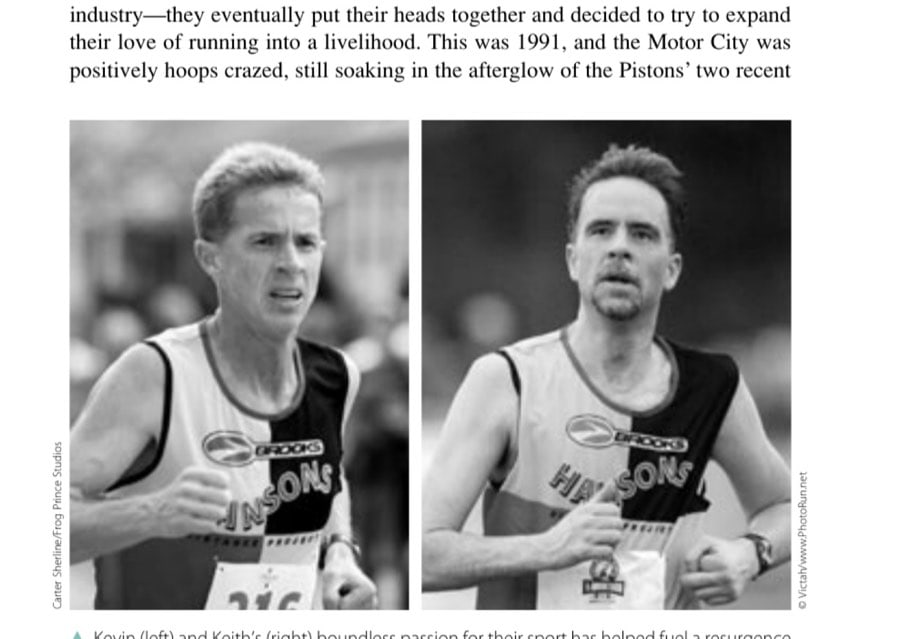
▲ Kevin (left) and Keith’s (right) boundless passion for their sport has helped fuel a resurgence in U.S. elite level distance running.
NBA championships. There was little to suggest that anyone would embrace a new specialty running-shoe store, especially in metropolitan Detroit. “This area was not considered an upscale, white-collar community where a running store would thrive,” recalls Kevin.
It did. And the Hansons’ name quickly became synonymous with high-quality products and expert customer service—so much so, in fact, that they now own four stores. It was during the growth of their shoe empire that the brothers began to hunger to do even more. Much like other fans of distance running, the Hansons had watched in frustration as the scales tilted decidedly in favor of runners from East African countries; they, like everyone else, openly wondered with each passing year how much worse things could get for Team USA. But this is where they distinguished themselves from the moaning masses; instead of simply sitting around and groaning about America’s fall from running grace, Kevin and Keith Hanson set their sights on making a difference.
FORMULATING A PLAN TO RAISE THE DEAD At the time the Hansons put their plan into action, U.S. distance running was barely registering a pulse on the world stage. While it took a sub-2:11 to make the 1980 U.S. Olympic marathon team, for instance, two decades later Rod DeHaven crossed the line first at the 2000 U.S. Olympic Trials in 2:15:30 and quickly discovered, much to his dismay, that he would be the lone U.S. representative in the event at Sydney. The women’s squad, composed solely of unheralded Christine Clark, was no more formidable.
This was the low point to American marathoning after Frank Shorter and Joan Benoit’s peak performances at the Munich and Los Angeles Olympic Games. In less than one generation, United States marathoners had gone from being frontrunners to also-rans.
Americans simply aren’t accustomed to watching their athletes getting beat up in international competition. Label it egomaniacal, but unless the athletes donning red, white, and blue demonstrate at least a fighting chance, U.S. audiences invariably reach for the remote control. For proof, look no further than this country’s reception of soccer. The reason why the world’s most popular sport has never caught on in the United States has little to do with the game’s slow pace or its lack of scoring but instead with the fact that American national teams are still incapable of matching up against the game’s superpowers.
But for the Hansons, it wasn’t merely a matter of putting more runners on the start line at the Olympic Games marathon. “It was about changing an attitude,” says Kevin. “It was trying to change an attitude not just with our group but with how people view all of the United States in distance running. We could see why our sport was losing interest to the
common fan. The sport had no personality. It had nothing that people could grab hold of. The lack of the guys wearing the home uniforms being among the leaders was frustrating to us.” “My brother and I quite frequently looked at where [our athletes] placed in the World Cross-Country Championships,” Keith adds. “It was ridiculous that we were finishing four to five minutes behind the Kenyan and Ethiopian runners. It didn’t match up with what the differences were on the track.”
Trying to resuscitate U.S. fortunes, though, would be no easy undertaking. The state of affairs in distance running had been so moribund for so long that many observers were convinced it would take nothing less than a Lazarus-like miracle to turn things around.
The system was broken, big time, and it needed to be completely overhauled. “We knew that the number one answer to it more than anything else, much more than the xs and os, was group training,” says Kevin. “It had to be more than someone trying to do this all by themselves where they felt as if they were out on an island and no one was paying attention.”
Fortunately, the Hansons knew that they weren’t talking ancient history when it came to attempting to unearth the secret behind America’s glory days. They, themselves, were fortunate to have witnessed the heady days of Shorter, Bill Rodgers, Alberto Salazar, and company. They knew all about the advantages of cooperative training, exemplified when many of the country’s greatest marathoners flocked to New England to train with the Greater Boston Track Club. So when they set about formulating their plan to reinvigorate U.S. distance running, one of the first sounding boards they approached was running legend and fellow Michiganite Greg Meyer. Meyer was not only a prominent fixture with the GBTC at the prime of his career, but he was also the last American male to win the Boston Marathon. “He was very influential when we started the program,” Kevin says of Meyer. “We asked him to tell us about all the things that had happened positively and all the things that had happened negatively.” “
Our take is that if you triple or quadruple the number of sub-2:20 runners, you’re going to drastically increase the number of sub-2:16 runners, and that’ll extend hopefully all the way down the line to sub-2:10 runners,” says Keith.
SETTING UP THE FOUNDATION At Meyer’s suggestion, the Hansons decided to focus the disciplines of their new team, which they labeled the Hansons Distance Project, from the 10K distance up to the marathon. Milers, steeplechasers, and 5K specialists, Meyer explained, would tend to blur the group’s primary focus.
Initially, they set a “flexible” prerequisite of 29:00 for the 10K and 2:20 for the marathon, the latter because it represented the U.S. Olympic Trials “A” standard. They also invited runners who had logged corresponding 5K times but only if those applicants were interested in moving up in distance.
Ninety percent of the athletes who joined the Hansons’ team in the early days were recruited by Kevin and Keith. A big part of the initial sell in 1999 was the offer of high-quality group training, an environment that boasted an abundance of runner-friendly dirt roads and trails, and, the piece de resistance, free room and board. “
We decided that rather than them trying to fend for their own housing, we would provide it,” says Kevin. “That meant they didn’t have to chase the local mom-and-pop 5K for 200 bucks so that they could pay the rent. They could train honestly.” The Hansons had bought a house for their fledgling team, and they planned to purchase a second one a year later to accommodate a women’s team. But the men’s program took off so quickly that another group moved into the second house. It wasn’t until 2003, after the purchase of yet a third house, that the women’s team would be launched, with the help of funding by Brooks.
Of course, the Hansons looked beyond mere running statistics when assembling their squad. There was compatibility to consider, and they also needed to ensure that the runners who joined their team were representative of the Hansons’ philosophy regarding the sport. After all, the athletes would be competing not just under the Hansons’ business banner but also under their personal name. “
It wasn’t something as easy as just times,” says Kevin. In putting the pieces together, the Hanson brothers also had to make certain that none of the athletes had existing sponsorship ties, particularly with runningshoe companies. No running-shoe company, they realized, would come near them with sponsorship money if some of the Hansons’ athletes were affiliated with rival companies.
Meyer told the Hansons that another problem he and his teammates had encountered in the old days was conflicting work schedules, which interrupted the group’s training regimen. To address this issue, Kevin and Keith devised a unique scheme to offer their recruits the opportunity to supplement their income with work in one of the Hansons’ stores. And, as if that wasn’t enough, they offered, among other benefits, perks like medical insurance and access to top-quality health care, including physical therapists, chiropractors, and a team physician. “When we first started, the deal sounded too good to be true to a lot of people,” Kevin recalls with a laugh. “It was like, ‘Wait a minute. I don’t even know who you are. I live on the other side of the country. And you’re telling me you’re gonna pay for this, this, and this?!? Why?’ Nobody believed that we were really doing this.”
▲
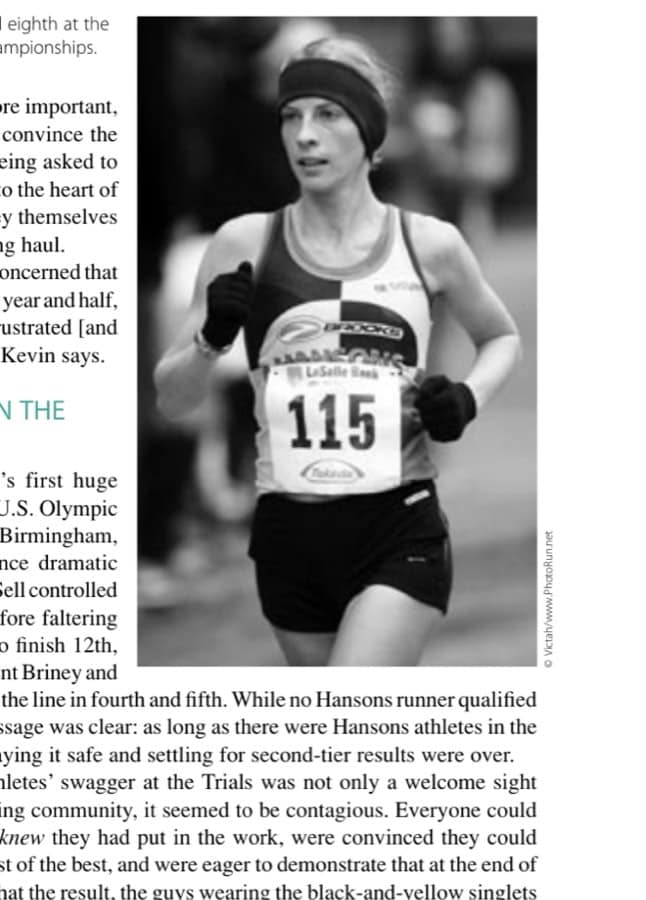
Melissa White placed eighth at the 2007 U.S. Marathon Championships.
Perhaps even more important, the Hansons had to convince the runners who were being asked to uproot and relocate to the heart of the Midwest that they themselves were in it for the long haul. “Everyone was concerned that they’d get into it for a year and half, and then we’d get frustrated [and shutter the house],” Kevin says.
The Hansons team’s first huge impact, at the 2004 U.S. Olympic Marathon Trials in Birmingham, Alabama, was at once dramatic and inspiring. Brian Sell controlled much of the race before faltering in the latter stages to finish 12th, while teammates Trent Briney and Clint Verran crossed the line in fourth and fifth. While no Hansons runner qualified for the team, the message was clear: as long as there were Hansons athletes in the field, the days of playing it safe and settling for second-tier results were over.
The Hansons athletes’ swagger at the Trials was not only a welcome sight to many in the running community, it seemed to be contagious. Everyone could tell that these guys knew they had put in the work, were convinced they could compete with the best of the best, and were eager to demonstrate that at the end of the day, no matter what the result, the guys wearing the black-and-yellow singlets would leave every last drop on the roads. Briney, who perhaps best personified this new attitude, registered a staggering 8 1/2 minute PR at the Trials. It wasn’t about wishing and hoping; it was about doing. And that’s how, in the Hansons’ universe, you get people to sit up and take notice. The results have continued to flow ever since. At the 2005 Chicago Marathon, for example, Hansons athletes claimed three of the top 20 spots. A year later, the Hansons team doubled that number by nabbing six of the top 20 places. At the 2006 Boston Marathon, Sell’s stirring fourth-place finish highlighted another stellar performance by a veritable legion of Hansons runners.
© Victah/www.PhotoRun.net
THE PROOF IS IN THE PUDDING
© Victah/www.PhotoRun.net
When the Hansons’ team rolls into a competition, it’s a given that they will be pushing the pace and that everyone in the field will be well aware of their presence. As of this writing, three years after the 2004 Trials, the Hansons-Brooks Distance Project will have 12 male and four female athletes lining up at the 2008 U.S. Olympic Marathon Trials, and any one of them is a bona fide Olympic team hopeful.
But the greatest testament to the Hansons-Brooks approach is that it has spawned other group-oriented long-distance running programs over the years, such as Nike’s Oregon Project, the various Team Running USA entities, and the recently formed Team Indiana Elite.
Had there been no Hanson brothers to shift the spotlight back to the 26.2-mile distance one wonders whether America’s most-gifted runners would be so eager to turn their attention to the marathon while still at the height of their abilities. Abdi Abdirahman, for instance, was just 27 when he debuted in New York in 2004. Dathan Ritzenhein was all of 23 when he competed in his first marathon. And Ryan Hall, 24, vaulted up to the distance in spectacular fashion at the 2007 London Marathon.
Of course, there is still work to do. Though Americans won more marathon medals than any other country at the 2004 Olympic Games, Kevin would be the first to concede that it certainly doesn’t mean “the rest of the world shudders when an American steps to the starting line.”
But the fact remains: at long last things are moving in the right direction. Quite simply, folks are getting excited about the prospects of United States’ distance runners again.
▲
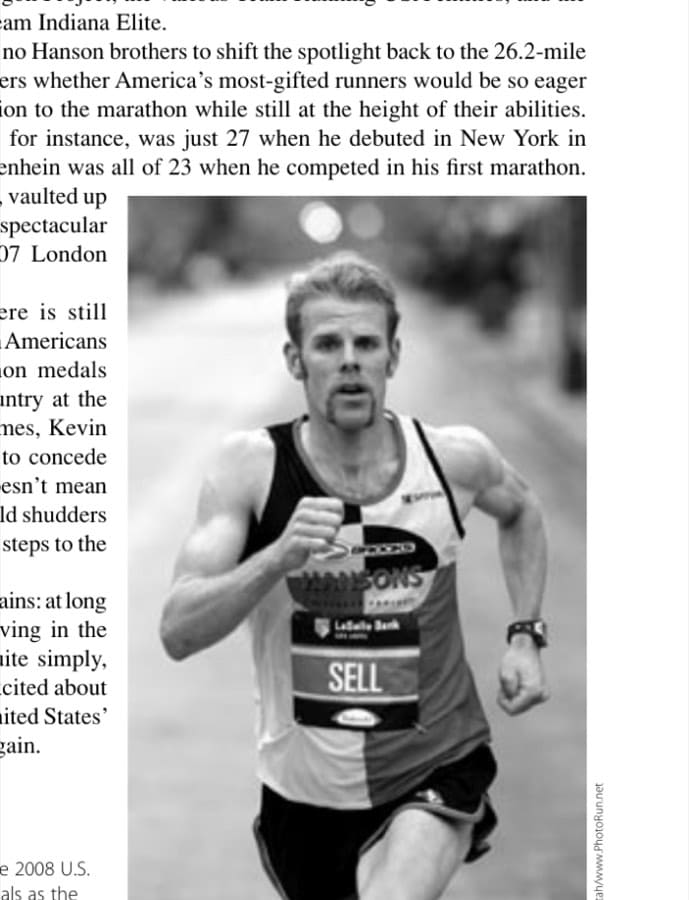
Brian Sell enters the 2008 U.S. Olympic Marathon Trials as the fifth fastest qualifier, with 2:10:47.
DOLLARS AND SENSE At the time of their group’s inception, the Hansons had been around the game long enough to know that the numbers speak for themselves when it comes to developing long-distance runners. “
Over half of the American marathon top 10 list consists of marathoners over the age of 30,” says Kevin. “So when you’re recruiting guys out of college at 22, how do you get them to 30? That’s the purpose of our program.”
The biggest virtue they have tried to bestow is patience. The Hansons, whose collective energy seems boundless, understand that nothing in the sport happens overnight. Just as they never expected their investment to begin paying dividends on the results sheets right away, they too have never expected their athletes to begin performing miracles as soon as they slip on the Hansons’ jersey. “
Everyone signs for a one-year contract,” says Kevin. “And, basically, the only expectations in the first year are that the athlete adjusts to the system. Period. We don’t care if they’re improving timewise. It’s more or less understanding the training and adapting to the training.”
Though the Hansons expect their athletes to show improvement during the second year, sometimes the big breakthroughs are many years in the making. And watching those finally come, according to Keith, is the most enjoyable part of the program for him and his brother. “
A good example is Kyle O’Brien,” says Keith. “He really debated continuing on about a year and a half ago, but he recently ran 2:15 in Chicago, and he’s really coming along right now. He now feels that it was worth [all the hard work], regardless of the outcome from here on out.”
From the beginning, the Hansons have also always kept a keen eye on the big picture—improving all facets of the sport. “We’re also trying to make the sport more professional,” says Keith. “[It’s about] allowing athletes to not just pursue their dreams but to make a living at doing so. Our biggest aim right now is to continue to make it so that an athlete coming out of college will make as much or more money if they’re respectable runners as they would going into their career choice.”
One of the puzzles that the Hansons have been struggling to unravel is making their sport more mainstream, especially at the elite level. “If you look at Runner’s World magazine and the ads that are in the magazine, they’re not running-shoe companies,” says Keith. “They’re auto companies, drug companies, and major corporations that see extremely positive demographics in running.” “
We don’t have a fan base,” says Kevin. “Our fan base is just other runners. People don’t enjoy the sport unless they’re active in it.” This, the Hansons point out, is in stark contrast to other big-revenue sports such as basketball, baseball, football, and NASCAR. People who tune in to those
sports on television come from all walks of life and range in age from young to old. And many have never picked up a ball or raced a car in their entire lives. “We’ve got a long way to go with that,” Keith concedes. “People often ask me about the USATF, our federation, and what their role should be in the sport. Personally, I think that their emphasis should be on that. They could help us dramatically by marketing the sport and making it more popular, and they have the means to do that.”
Clearly, as Americans become more of a familiar presence on the award podium and the casual onlooker can finally have someone to identify with, the sport’s stature should grow exponentially. After all, professional cycling didn’t make a dent in the public’s perception until Lance Armstrong became a contender in that sport’s biggest competition, the Tour de France. “
We think that professional runners are great spokespeople and can certainly help companies reach the market demographic that they’re looking for,” says Keith. “Most runners are very, very bright individuals who were, in most cases, very good students in college. We brag about the fact that we have athletes from Bucknell, William and Mary, Brown University, and from just about every major academic college.”
THE WORK IS NEVER DONE To be sure, this has been no small financial undertaking. It took roughly four years for the Hansons to commit a title sponsor to their program, Brooks, and by then the brothers had already invested $1 million into the project. “
When we started doing this, we bought into it whole,” says Kevin. “It’s not a ‘sort of, kind of ’commitment. Even once we picked up sponsorship, we’re still spending $250,000 a year.” Such single-minded dedication is not only admirable, it’s inspiring. The running community has embraced the Hansons-Brooks’ vision, as evidenced by the popularity of the Brooks booth at the Boston Marathon. A team of American runners, sponsored by an American-based running-product company, setting up shop at America’s grandest marathon, which just so happens to be staged on Patriots’ Day—can it possibly get any more synergistic than that?
In April 2007, Brooks Sports, Inc. extended its partnership contract with the Hansons for an additional five years—further validating the Hansons’ original vision. Just as important, maybe even more so, even nonrunning entities have begun to sit up and take notice. Last fall, for instance, Saturn joined forces with the group as a major sponsor providing, in part, a charter bus for the team’s travel. “
Saturn stepping in and being a part of this is, to us, a huge deal because elite-level running has only been supported by the running-shoe companies and people directly involved in the sport,” says Keith. “To bring in an outside group like Saturn is a major move toward, again, professionalizing the sport.”
© USATF
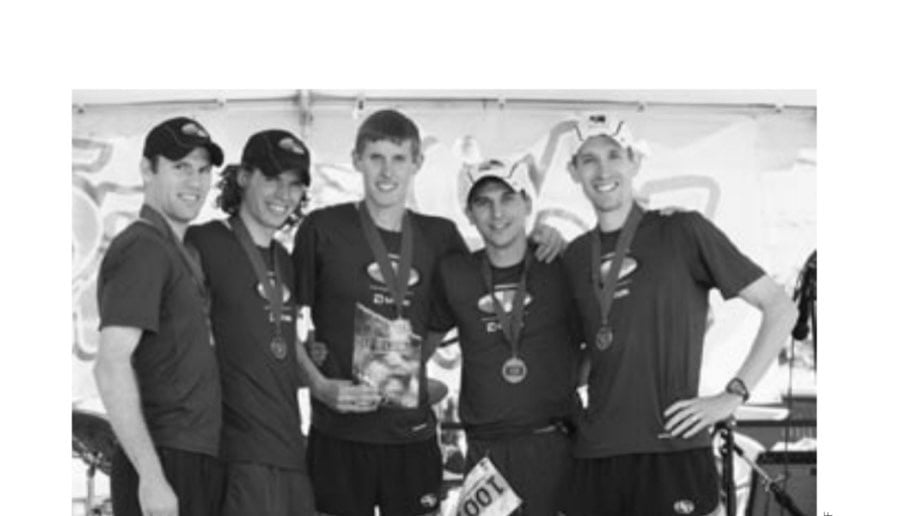
▲ (left to right) Luke Humphrey, Ryan Sheehan, Josh Moen, Pat Rizzo, and Marty Rosendah celebrate a Hansons-Brooks victory at the 2007 USATF National Club Marathon Relay Championships in Denver, Colorado.
In April, in yet another stroke of brilliance, the Hansons raised the stakes of their program even further by guaranteeing an annual income in excess of $100,000 to any athlete on their team who achieves specific time standards (for example, sub-2:11 and sub-2:31 marathon performances for men and women, respectively). It’s doubtful that, even in their wildest dreams, the distance runners who put the Greater Boston Track Club on the marathon map could have ever envisioned such an unprecedented development.
The Hanson brothers have extended the road for some of our country’s best runners. Their system has allowed runners to view collegiate athletics not as an endpoint but rather a stepping-stone to reaching their potential.
Their program has developed such a sound reputation over the years that today roughly 75 percent of its athletes approached the Hansons about joining the team. The Hansons are hopeful that the remainder of 2007 and 2008 will continue to bring success and recognition not just to their own athletes but to the sport as a whole. “
I think that [the improvement in U.S. distance running] will certainly be showcased at the marathon trials,” says Keith. “There’s little doubt in my mind that they will be the most competitive Olympic Trials ever.”
And that, just a few quadrennials ago, would have seemed inconceivable.
This article originally appeared in Marathon & Beyond, Vol. 11, No. 5 (2007).
← Browse the full M&B ArchiveMore like this
1,000+ stories from 19 years of Marathon & Beyond
The complete archive of the legendary long-distance journal — digitized and free to read.
