

Running With The Kenyans
It was Tuesday, my tempo workout day in the Hollywood Hills. I creaked out of the car and hoped I would run well as I walked to the trailhead. On my way, a van pulled up and disgorged two very thin, very dark gentlemen wearing identical stylish warm-ups. The driver got out and waved vaguely in the direction of the trail, then drove off. Since the 2005 Los Angeles Marathon was that Sunday, I had a hunch why these men were here. As I approached them, they asked about the trail; I told them it’s a fairly flat five-mile dirt bridle trail, and that I was going out five miles and then turning up into the hills. “
Are you guys here for the marathon?” “Yes. Are you running in it?” “No. I haven’t run a marathon in 18 years, but I did run Boston in 1980. Back then I could run in the 2:30s, but at 53, I just run ultras now.” “
You sure don’t look it!” “Thanks. Where are you folks from?” “Kenya.” “Do you mind if I try and run with you for a while?” “No problem; we’re just going easy for an hour.” The three of us started jogging, and I was struck by how slowly they started out. I start out easy for a few minutes, but we were barely doing 10-minute miles. Nor was there any stretching—just a couple of arm swings, and we were off. Even at this speed, it was clear that they were very light on their feet.
So we cruised along and chatted. My plan was to warm up for 20 minutes, then up the effort to 150 to 165 pulse for 40 minutes, then finish up easy for 10 miles total. Well, over the first mile, we gradually accelerated to about a 6:45 pace, which is my tempo pace and then some. They mercifully kept it right there. I started timing my 40-minute segment. While I was breathing deeply and getting a good tempo run in, they were just jogging along at an easy lope. The coolness of running with these guys made the run a joy instead of a chore. Ben Maiyo ran in
front (and I ran just a half step back—matching him stride for stride!), and Benson Mbithi politely followed a couple of strides behind, as if he were respecting his friend. Ben has a longer stride, while Benson has a quicker cadence. I didn’t get a look at Benson’s stride, as he was in back of me, but Ben has a very springy gait. It reminded me of the quick bounds of a deer.
I asked Ben what his goal was, and he said, “I’m hoping for 2:09.” I thought to myself that that would probably win the race: the Los Angeles course has several hundred feet of climb and is famously slow compared with the other big ones. I asked Ben what his best marathon was, and he said he has been a track runner and that this was his first marathon. I asked him what his 10K time was, and he said “30 minutes” in his accented English. I thought to myself that 30 minutes is pretty slow for a 2:09. I did a Google search of Ben’s name when I got home and learned that his 5K best is 13:07 and his 10K is 27:07! So not only is he fast, but he’s modest. I politely asked him what he weighs (what is this, 20 questions?), and he said 57 to 58 kilos—125 to 127 pounds, and the guy looks a bit taller than my 5 feet, 9 inches but is listed as 5 feet, 7 inches. Benson said his 2:11 PR was at the Los Angeles Marathon. I looked him up and found that he had won the race in 2000: another modest one. If I had won L.A., you couldn’t shut me up. Ben was impressed with the three mountain ranges in view around us (the Santa Monicas, the Verdugos, and the San Gabriels). I told him that I had run up the highest range, the San Gabriels, last Saturday, and after 1 1/2 hours of climbing was in 6 inches of snow. He was surprised at the notion of snow in Los Angeles. I said it takes me about two hours to run to the top, and he asked me how much water I carried. Then I mentioned that I was doing the Catalina 50-miler next month, and he asked me how fast I had done it. (I’m sure he was underwhelmed with my 7:04 PR.) When I asked how many marathons an elite runner can successfully run in a year, they both answered, “Two.” As we ran up to a couple of muddy patches, they stopped and carefully tiptoed through and around them rather than risk an injury. As we “jogged” along, I have to admit that I was feeling very cool with my new running buddies, especially when a couple of local elites approached us from the opposite direction, put two and two together, and gave them thumbs up and big smiles.
As my pulse reached 165—close to my 10K race effort—I told them we had been out 30 minutes. No watches for these Kenyans! We stopped and shook hands, and I wished them both luck. I’m a small-boned 5 feet, 9 inches, but my hands practically engulfed theirs. Then they loped back, and I worked it for another 20 minutes in solitude. I was so excited that I ran my four-mile cool-down at a quick pace. I worried a bit that I had slowed them down—I didn’t want to mess up their taper. They were very kind to run with me. I assumed that they would pick it up a bit on the way back, which was borne out by an acquaintance who saw them zip by on the return trip. They were both very calm, relaxed, and polite and put
www.MarathonFoto.com
up with my patter and stream of questions without complaint—perfect running partners. I was sure that both of them would be contenders. The stars had aligned perfectly: I wanted to go faster than usual, while they were willing to go much slower. And I was lucky enough to show up at just the right time to be their guide on an unfamiliar trail. When I was younger, I would think about what it would be like to run with the likes of Bill Rodgers, and 25 years later I got a chance to do just that.
That Sunday, I went to the marathon course and viewed the leaders at various places. The elite women were given a 17-minute head start, and there was a $75,000 prize for the first runner to cross the finish line. At five miles, a pack of 10, mostly Africans, was far ahead of everyone else, on a 4:55 pace. My two new acquaintances, Ben Maiyo and Benson Mbithi, were in it. Two African women were in the lead, and Lyubov Denisova of Russia was a minute or so in back of them, but Denisova looked so much more relaxed than the first two that I called the race for her right there. And I was right: she stroked a 2:26.
At 10 miles, a couple of stragglers had dropped in back of the men’s pack, and it was down to six or seven in the lead group. My two buddies were there. At 17 (San Vicente and Fairfax), I called out, “Go, Ben Maiyo,” and he gave me a big smile and a thumbs up. I figured that if he was that relaxed at 17, he had a very good chance to win it. The men’s pack still had five or six guys. At 18 (after a
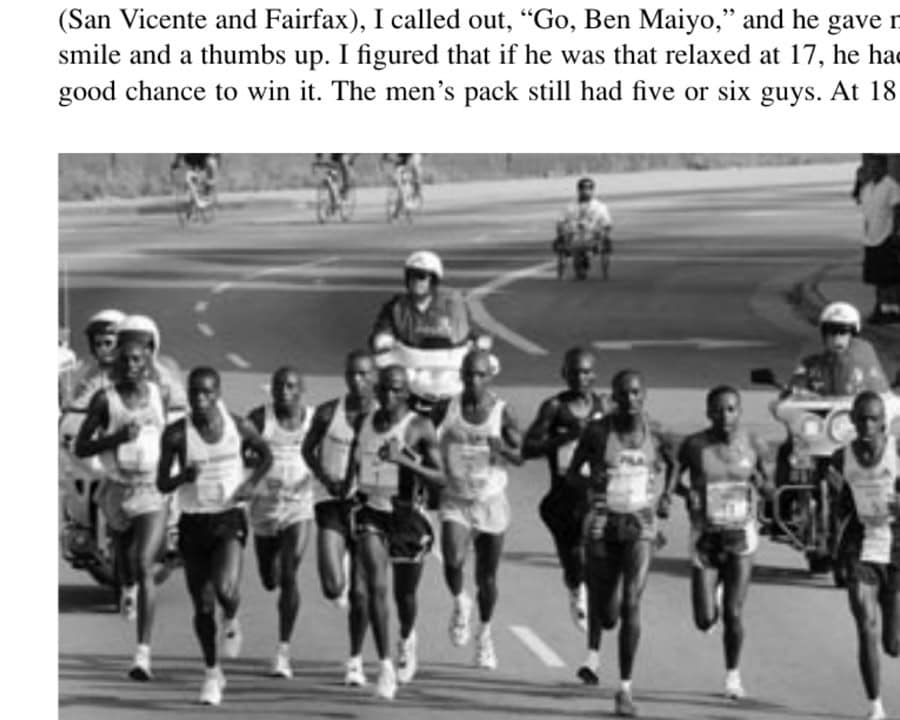
▲ The men’s elite field, including Ben Maiyo and Benson Mbithi, early in the race.
www.MarathonFoto.com
▲
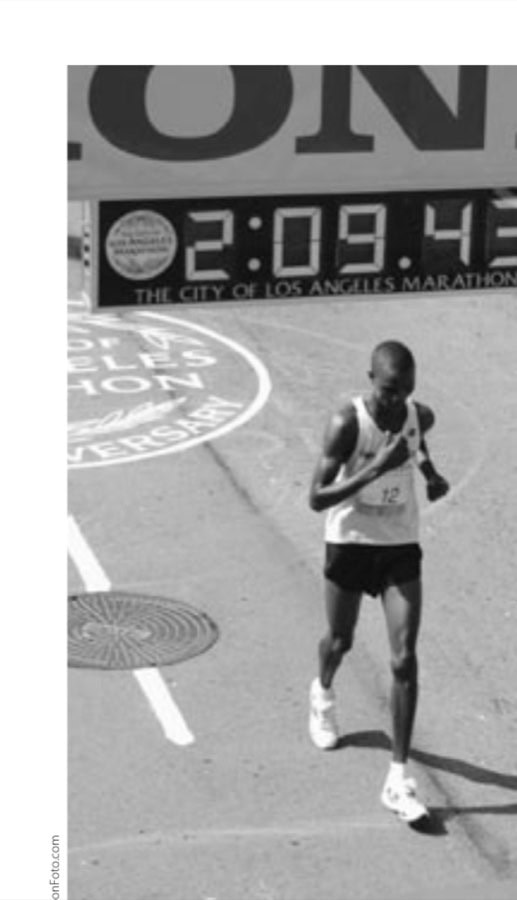
Ben Maiyo finishes in second place.
60-foot climb), it was Ben Maiyo and Mark Saino first and second, and the others straggling behind. The leaders were still on 4:55 pace. At 23, it was Maiyo and Saino still one, two, and running together. Mbithi
had hit The Wall at about 18 and was in his survival shuffle. (He covered the last 12K at a 6:15 pace.) He finished sixth in 2:17, an eight-minute positive split, which you may know is very unpleasant: all of the
pain and none of the speed. He had won the race with a 2:11 in 2000. At 25, Maiyo had broken free from Saino a bit and passed Denisova (killing her chances for the $75,000 first-finisher prize). Then, heartbreak. In the final stretch, Saino outkicked Maiyo, and he lost
by 10 seconds with a 2:09:45 after leading almost every step of the race. Their half-marathon split was 1:04:41. Saino lost only 10 seconds in the second half and Maiyo lost 20, despite the net uphill. It was a nearly perfect race for Maiyo’s first marathon. The picture on the official Los Angeles Marathon Web site of Maiyo finishing in second place is heartbreaking and says it all. It seems unjust
that the winner got $110,000 and a car while second place got just $26,500. On a flat course (the race has 497 feet of climb), that equates to 2:08 for both of them. It was sunny, no wind, and 61 degrees Fahrenheit at the finish.
This article originally appeared in Marathon & Beyond, Vol. 11, No. 5 (2007).
← Browse the full M&B ArchiveMore like this
1,000+ stories from 19 years of Marathon & Beyond
The complete archive of the legendary long-distance journal — digitized and free to read.
