Running With The Road To Ruin Runners Club
Getting to the Starting Line Is the True Story.
“What saves a man is to take a step. Then another step. It is always the same step, but you have to take it.” Antoine de Saint-Exupéry
hese days I run. I lost that for a long while, but now I run long and I train
for marathons. Sometimes it’s a specific event, and sometimes it’s just that falsely casual, vaguely pretentious, “Oh yeah, I run marathons” thing. Many days I put on a Road to Ruin Runners Club (RRRC) hat and maybe an RRRC T-shirt over the CoolMax microfiber and head out the door.
I ran the Napa Valley Marathon in 2005. I didn’t do very well. I hadn’t trained well enough because of a relentless flu and a fractious attitude. Despite the fog rising out of the darkened valley, shadowy arms and legs moving jerkily in anticipation at the start, and eventually the slow fire sunrise over the eastern ridgeline, I dropped out at 16 miles, hallucinatory, overheated, dehydrated, and mad as hell. Back at the hotel, I was reminded by a runner—writer friend of mine that the hardest part of a marathon may be getting to the start line. It has been that way for me.
He pointed out that I had 10 minutes to wallow in the failure as I saw it; then I had to pick another race, train for it, and run it. He thought Avenue of the Giants, in the redwood forests of northern California, eight weeks away, would put things right. I have come through the complexity and destruction that is drug addiction. The simplicity of having a plan—one that is built on getting out of bed, putting on running gear, and going out for a run—is a great blessing.
I revived the RRRC in January of 2004 when I started running again in the early mornings. I needed a way to con myself out the door. I thought back to the days when every day began with coffee and a run, when I ran with a bunch of guys in the early morning in Toronto. The RRRC was Jerry, Dan, Ann, and an assortment of women with Hungarian names and tempers to match. I went away for a few weeks and came back to find that Eddie had joined in. Over time, there were Patrick and Jeff and Cameron and many others who stuck around for a while
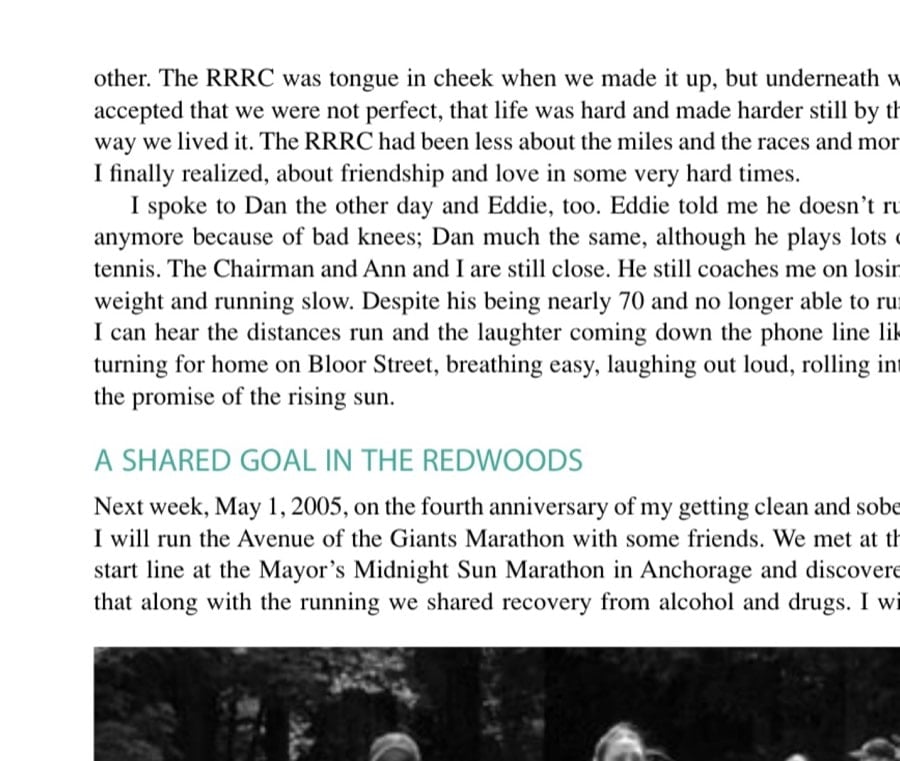
» The Road to Ruin Runners Club logo.
and then moved on. We would meet up at 5:00 to 5:30 A.M. and head out on a run—no real method to it, just running for the mileage, long and slow, talking marathons and the best places
to run wherever we might find / ourselves. | Thad started running as all kids run: around the block, to the tree, down the road a ways. Nobody ( ever really lost a race except \ when Bobby Hatcher got into his stride. Bobby was the postman’s son, skinny, quiet—and very ¢ fast. Bobby could beat anybody around the block. There was this one day when he and I unaccountably tied on an “around the block and back” race, but that was before he went off to St. John’s University in New York on a
track scholarship as a 440 guy, a quarter-miler, and I learned how to drink Pabst Blue Ribbon.
DAWN PATROL
I had come back to running at one of the de rigueur low spots in my career as a movie producer in Toronto. A movie I had produced was in the middle of a financial partnership fight, which we were losing to the big guys. Things had gotten so tough that it seemed that I never slept at all. I went to the store one early morning to get coffee and milk and ran a little bit on the way home. It felt awful, but there was a moment when I remembered how good it could feel. I remembered that Thad run track in college; that I was better at the longer distances, but I really was no good at all relative to the better runners on the squad; that I had made the team as a reward for showing up at all the practices. This was a lesson I might have learned better than I did. All those many years later, as life went awry and addiction took hold, the road back began with simply showing up.
The next morning I went out to run when I got tired of not sleeping and managed to run, walk, and stagger down to Bloor Street and back, maybe a mile and a half. After a couple of weeks, I ran down to Bloor Street and around Christie Pits, a former sand-and-gravel operation in the late 1800s and early 1900s. That was about a two-and-a-half-mile run. One circuit of Christie Pits became two, three, four.
I sometimes saw kids skating on the ice in the pits, which were home to several ball fields and ice rinks. The pits were historic in Toronto for their role in the infamous ethnic riots of 1933, which began as the result of anti-Semitic baiting between the Willowvale team, Saint Peters, and the Harbord Park team featuring many members of the Spadina Avenue Gang from the heart of the Jewish community in Toronto. There had been continuing unrest as established Protestant Toronto tried to come to terms with not only the political machinations in Germany but also the ongoing struggle of labor to unionize.
Much of the union movement was thought to be Communist-inspired and directed by immigrants of all stripes, though most particularly by the Jewish community. Tensions were high after the first game, and threats were passed back and forth. Willowvale won the first game, and its supporters took credit for the victory based on their intimidation of the Harbord players. The Spadina Avenue Gang showed up at the second game in strength. The police were known to very quickly quell any labor disturbance based on its Communist intent but had demonstrated a lack of interest when the point of the disturbance was anti-Semitic or racial. At game’s end, a red-and-black swastika flag was raised, and out came the baseball bats and lead pipes. The police stood by for over an hour while the rioters fought. It was hard to imagine the anger and violence while running and watching the kids play shinny on the ice before they went to school.
A FRIENDLY FLAT SURFACE WITH A VIEW
The long-ago gravel pit, ball-field battlefield shows no trace of that bloody event. It has no monument, the earth washed clean long ago. Deep as the pits are in the ground, 40 feet below the street surface, the run around the upper level is easy and flat, offering a wonderful view of the city skyline to the south. It was perfect, although the weather was getting wintry. The cold was offset as much by the running in many layers, before microfiber, as by watching the kids play. They were kids of all ages and backgrounds, playing hockey in the dark, playing the game itself, no coaches or parents, alone together with the skating and their dreams. The hockey, the kids shouting and carrying on, was as much a part of the place to me as the gray morning light and the icy wind blowing in off Lake Ontario.
One day in late winter, I realized that I was running a long way every day, but it was no damn fun. I ran for miles in the cold and dark, feeling much the same on the inside as the winter weather looked on the outside. I mentioned to Dan one day that I was doing some running, and he suggested that I join up with Jerry and him for a long run the following day. I knew Dan because he was the distributor of my first movie, and we spent a lot of time together. He had told me about his running, about leaving the house very early, meeting up with his running buddy, but I never paid it much mind until that winter.
Dan asked me if I wanted to run the 1981 Longboat 10K on Toronto Island in the Toronto Harbour. The Longboat was named after Tom Longboat, a native Canadian runner who won the Hamilton “Around-the-Bay” race in 1906, the Boston Marathon in 1907 (setting a course record), and the Toronto Marathon in 1906, ’07 and ’08. Longboat also represented Canada at the 1908 Olympic Games. The Longboat 10K had been run for the first time the year before, and Jerry and Dan were there. It may be that it was a rite of passage or just something to do in the golden age of Canadian running, which was at its peak in the late 1970s and early ’80s. Jerome Drayton had won at Boston, Jacqueline Gareau had her victory stolen by Rosie Ruiz in Boston, and many others were well known in the exploding world of road racing.
We went off to run it on a beautiful spring morning. I went out fast despite Dan’s cautionary advice to take it easy at the beginning. A lot of walking followed, but somewhere in there it was clear that I wanted to finish and then come back next year to get it right. I know I finished, because there was a picture of me at the finish area, hands on my hips and a large belly draped over my shorts, looking like a candidate for bypass surgery. It made everyone laugh who saw it, but it embarrassed me. The next morning I met Dan at his house and he, Jerry, and I all ran through the neighborhood and north on Bayview to way past Steeles Avenue. It could have been 15 miles. It might have been eight. I know I loved it.
DATING ACCORDING TO THE CHAIRMAN
Jerry (aka The Chairman) was once 300 pounds strapped on a 5-foot-6-inch body, a frenetic charmer who had had a heart attack and in his recovery came to running. This was 1975 or thereabouts. Over the next few years, he lost 150 of those pounds by doing what he did best, running and talking. Within a couple of years, he had run the New York, Boston, and Marine Corps marathons and several others. His best time was 3:41, or so he says. The Chairman met a girl, Ann, gave her a mink coat on the second date, and she became part of the group as did several of the various girlfriends that Dan and I would bring around. [It cost us all a fortune in running shoes, but if you bought her a pair of Nikes, it was the surest sign that the new “this is the one” was a serious contender for a deeper relationship.] The Chairman married his girl, and the rest of us have been jealous ever since, shoes or no shoes, mink or no mink.
lused to think that we weren’t much for runners, but we put in 70- to 80-mile weeks. It turns out that we were pretty good. Dan had run a 3:19 in New York and never more than four hours. Jerry ran several 3:40s. I guess we trained at 10 minutes per mile and ran races somewhat faster. By the time I came along, most of the marathons had been run, Dan and Jerry having run some 30 between them. As it was, I missed a New York, a London, and a Chicago. We were always training for something; whether or not we went was another story entirely.
It was a new world. I saw the city as never before. We had runs with names: the King Street run, the Bayview run, Rosedale Valley ravine, the Don River trail system, and many others. We ran to Lester Pearson Airport from downtown, just because. There was no reason to go there in running gear at 5:30 on a winter morning, and it was a 22-mile run out and back. And there were the mythical runs, Oakville and back, Markham, Caledon, all 22-miles-plus or something like that. We ran to the end of the trolley lines and out to the beaches, all in the high teens for distance. We usually ran them on Sunday mornings and then gathered later to eat big breakfasts at various restaurants or at The Chairman’s house. When the snow was deep and the city silent and glowing white, we put plastic baggies over our socks, put on toques and gloves, and went out into the morning to get our miles. Once we ran 14 miles up and back to get bagels from Bagel World on Bathurst and Wilson, all uphill from Bloor Street, so that we could earn the right to sit and watch the NYC Marathon on TV. There were trips and all kinds of events, mostly planned and discussed at length, and some actually happened.
Iremember that many of our runs would bring us west along Danforth Avenue, over the Prince Edward Viaduct, which sits astride “a glaciofluvial valley” and has “a certain coalescence of natural and architectural greatness, awe inspiring in its grandeur” according to a local critic at its opening in 1913. It is famous still, because of its Beaux Arts architecture, its stormy political history and construction, its sightlines, and the poet/novelist Michael Ondaatje’s wonderful book called In the Skin of a Lion, in which the passion and grandeur of the city’s love affair with progress is revealed in all its painful glory.
The Viaduct turned us southeast along Bloor for the run in. Mostly we could get the sunrise coming in over the city towers to the south and the glow of the residential neighborhoods to the north. It was a special time of day, as it is for those who run in the early morning. We were lucky to be part of it.
MYSTERIOUS MORNING MEETINGS
We met for years at a doughnut shop on Yonge Street that had parking available. Dan and The Chairman used to meet at a squash club parking garage when there were just the two of them. Mysterious and a little like the movie All the President’s Men is how it struck me when I first heard about it. While it made me laugh, under the surface it was clear that each of us had our own demons and running was a way to get closer to them, put them at bay for a while, and get on with things. Often the runs were more like an ad hoc support group than they were anything else, this before Robert Bly and naked drumming.
We all had highly speculative careers in real estate and movies, and so there were a lot of big-bust days and a few big-win nights. All were celebrated and shared. I know I went through a divorce and the beginning of hard-drug use, which I kept hidden for nearly 20 years. Dan and The Chairman both had had their own
troubles, and there were other occasional runners whose lives were unruly, who found with us that the run in the early morning was a way to have some peace and some support in an often difficult world.
There was this morning when I heard someone coming in through the backdoor. It was 4:30 a.m., and I was not alone. My first thought was that Danielle, warm and new and sleeping gentle in my bed, had told me she wasn’t married. Terrified to the core, I went to see what was going on. It was The Chairman. He didn’t sleep very much, it seemed, and this morning his usual all-night coffee shop had pitched him out. He came to get me so we could get some miles before the others showed up at 5:30. It never occurred to me that it was strange to leave the door unlocked, to have The Chairman walk in, and to go out running in the snow with him. Even though I had just met someone I wanted to spend time with, who intrigued me, someone who was a possibility for a pair of Nikes, I went. I told him this as we headed up Avenue Road, and he said, “Run first, spend time later.” It was careless of me as it turned out, but it made sense at the moment. Running came first despite, or maybe because of, the constant search for Nike candidates. If I had known then what I came to learn, I would have seen that the addiction in me touched everything I did despite the appearance of good times with the gang.
If it sounds elegiac, I guess it was. In the end, the group broke up, as The Chairman had kids and Dan found a succession of girlfriends and sadly, family tragedy. Eddie appeared to go broke and went back to Phoenix before moving on to a new opportunity in London. I came slowly and steadily face to face with the gaping hole in my life when my kids moved out west with their mother. At one point in 1984, Dan and I had a conflict about a woman neither of us cared about, and we both used it to trash the other. The group split, leaving only The Chairman and me and occasionally some of his “in from the far west for some time in the big city” in-laws to run with us. I moved out to Vancouver to be with my kids. Eddie and Jerry still ran together. That ended when the deals ran out for both of them and life changed course for all involved.
A LOGO TO LIVE BY
The Road to Ruin Runners Club was a state of mind and for a while a wonderful, oddly compassionate place to be. The logo suggests a rainbow with edges and a runner heading toward it. The pot of gold is not necessarily what it appears to be since the rainbow is jagged, just like life itself, full of color and promise and sometimes pain and blood in both the running and the living. We were friends for a while and shared the world and all its gifts as we headed out in the mornings. What we lost was a companionship that was never to be replaced, and properly so, I guess. There is red on the bottom of the shoe of the new rainbow runner,
Michael Lebowitz
A Had he been in Toronto in the day, Bill Latter (right, with the author) would have been a charter member of RRRC.
and I know that for me it means that in the getting from here to there, blood is spilled and sometimes the path is very difficult.
In 2004 I came back to running in North Texas, where I had gone in search of sobriety at a local treatment center. I seemed to be free of the dragons that had consumed so much of my life since my journey on the road to ruin began. If I imagined that I was heading out the door to run with the RRRC, I would actually get out the door and run. I asked a friend to re-create the RRRC logo. The red shoe and the runner facing into the rainbow make it real for me these days.
I trained for and ran the Anchorage Mayor’s Midnight Sun Marathon for Team In Training. It went well until mile 13, and the years caught up with me in the form of achilles problems that brought me to a walk. At that point I was on five-hour pace, not much by comparison to the early days but plenty good for the first one back. When I came up Insult Hill to close out Anchorage, I was able, maybe for the first time in 20 years, to let the past go, to take what was best in it and leave the rest by the side of the road. My last mile was my fastest mile of the run.
I put on a black Road to Ruin tee and walked. My first calls were to my kids. My next call was to The Chairman. Being the guy he is, he first told me how great it was that I ran, how he had run a four “something” with an Achilles problem, and that he was getting ready to maybe train for another run. It was perfect in its understanding of who we were, who we are, and what we have been to each
other. The RRRC was tongue in cheek when we made it up, but underneath we accepted that we were not perfect, that life was hard and made harder still by the way we lived it. The RRRC had been less about the miles and the races and more, I finally realized, about friendship and love in some very hard times.
I spoke to Dan the other day and Eddie, too. Eddie told me he doesn’t run anymore because of bad knees; Dan much the same, although he plays lots of tennis. The Chairman and Ann and J are still close. He still coaches me on losing weight and running slow. Despite his being nearly 70 and no longer able to run, I can hear the distances run and the laughter coming down the phone line like turning for home on Bloor Street, breathing easy, laughing out loud, rolling into the promise of the rising sun.
A SHARED GOAL IN THE REDWOODS
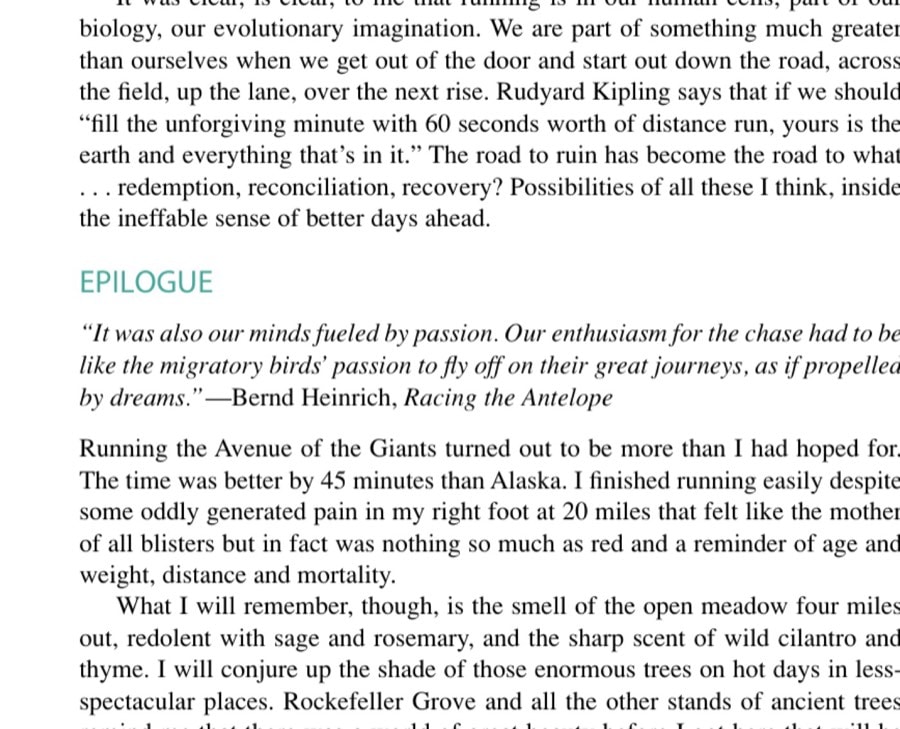
Next week, May 1, 2005, on the fourth anniversary of my getting clean and sober, I will run the Avenue of the Giants Marathon with some friends. We met at the start line at the Mayor’s Midnight Sun Marathon in Anchorage and discovered that along with the running we shared recovery from alcohol and drugs. I will
Michael Lebowitz
A After finishing the Avenue of the Giants Marathon, the author runs in with a friend he made at the Mayor’s Midnight Sun Marathon in Anchorage, Alaska.
tell them about my friends in Texas who are runners like us, in recovery. None of us ever made it to the race in the old days, never made it to the start line. It’s different now. It’s better. Much better.
Iknow that when I get off the bus in the predawn, breath steaming in the cool morning air, I will listen to the excited, hopeful, nervous chatter of the runners; I will see the ghostly movements of bodies in the mist, drink in the silence of the big trees. I will remember for a moment the countless early morning runs with my friends, then and now, and be quiet with the gift of being here. All this might go toward easing my own nerves about what the run will bring.
It was clear, is clear, to me that running is in our human cells, part of our biology, our evolutionary imagination. We are part of something much greater than ourselves when we get out of the door and start out down the road, across the field, up the lane, over the next rise. Rudyard Kipling says that if we should “fill the unforgiving minute with 60 seconds worth of distance run, yours is the earth and everything that’s in it.” The road to ruin has become the road to what . .. redemption, reconciliation, recovery? Possibilities of all these I think, inside the ineffable sense of better days ahead.
EPILOGUE
“It was also our minds fueled by passion. Our enthusiasm for the chase had to be like the migratory birds’ passion to fly off on their great journeys, as if propelled by dreams.” —Bernd Heinrich, Racing the Antelope
Running the Avenue of the Giants turned out to be more than I had hoped for. The time was better by 45 minutes than Alaska. I finished running easily despite some oddly generated pain in my right foot at 20 miles that felt like the mother of all blisters but in fact was nothing so much as red and a reminder of age and weight, distance and mortality.
What I will remember, though, is the smell of the open meadow four miles out, redolent with sage and rosemary, and the sharp scent of wild cilantro and thyme. I will conjure up the shade of those enormous trees on hot days in lessspectacular places. Rockefeller Grove and all the other stands of ancient trees remind me that there was a world of great beauty before I got here that will be here after I’m gone. The trees seem to go all the way to heaven, and remarkably, a river runs fast and cool through it. The last aid station is at the end of a tunnel of trees, about a half mile from the finish. From there I could see the sunlight on the bridge, hear the river running; the finish line was awash in sunlight, filled with tired people from many different places, laughing, limping, a faraway look in many eyes and a quiet certainty of something difficult completed, different for each of us, started together in the company of strangers, acknowledged and shared as with friends . . . just as I imagine heaven to be.
Running Down Memory Lane
A Revisit to the Marine Corps Marathon After 18 Years.
t was inevitable. Just as the evening follows the day and spring follows winter,
I knew that the years would pass and the new would become old. I knew that, but not really, not in a way that would prevent me from being shocked when the anniversary dates came around, when I was forced to admit how many years had gone by.
lam, of course, talking about my marathon. It was young when I was young, and if it had now gotten old, well, you can see where that put me. Some races, like the Boston Marathon, were old even when we were all newborn, but other races were products of our generation, creations of the baby boom. Many of them faded away, never having gotten a good foothold in the running community, but some hung on and grew strong: the New York City Marathon, the London Marathon, the Chicago Marathon, and my race, the Marine Corps Marathon. They had all thrived and become so well established that we could hardly imagine a time when they weren’t with us.
All that was fine. But then someone counted up the years—someone had to, I suppose—and the anniversary celebrations began. Then one day, I looked at the application for the Marine Corps Marathon, and I saw that it was going to be celebrating its 30th anniversary in 2005. A 30th anniversary was inevitable, but so soon? Where had all the years gone?
As I’ve said, the Marine Corps Marathon was my race. Not that I’d conceived it, organized it, or even (and I’m a little embarrassed to admit this) that I ever helped out as a volunteer. It was my race simply because it was my first. Just as a first kiss lives forever in your memory, a first marathon occupies a special, almost mythic place in a runner’s personal history.
For me, the road to the finish line in the Marine Corps Marathon wasn’t a smooth one. It was 1985, and after moving down to Washington, D.C., from New York City for law school, I had packed on some extra padding around the middle. I realized one day that it was time to do something about it, and running fit the bill since it was easy and it wouldn’t break my student budget. I began with a few
slow laps around the block where I lived in Arlington, Virginia. Eventually, my tuns evolved into laps around a small neighborhood park and then out-and-back runs down the street toward the Potomac River, where I gazed across the water at the spires of Georgetown University in D.C.
Thad not been on a track team in high school or college, and I had never run a race of any length, but now I started to consider myself an honest-to-goodness runner. I even eyed the shoes on the wall at a local sporting goods store, turning over a few models in my hands and reading the little information cards that fell out of them. Judging from the technology diagrammed on those cards, I wondered whether these shoes had been engineered by NASA.
IN LOVE WITH THAT FIRST PAIR OF SHOES
Iended up taking home a pair of gray hi-tech marvels, my first true running shoes. They set me back $69, a sum that seemed so extravagant at the time as to verge on the irresponsible. As I laced them up, I hoped that I hadn’t foolishly wasted my month’s eating budget, and I prayed that they would at least feel different from my old cheap basketball sneakers. Luckily, they did. Oh, how they did! They put spring in my step and left me feeling eager to hit the roads.
Armed with my fancy new shoes, I ran down the street toward the river, but this time I didn’t stop. I crossed into D.C. and then followed the river south, past the Watergate Hotel. I crossed back into Virginia at the next bridge, completing a five-mile loop. I was hooked. Before long, I found myself considering the Marine Corps Marathon.
By 1986, the Marine Corps Marathon was already a firmly established race, and it was set to have its 11th running that fall. The race was a grand tour of D.C. and northern Virginia, starting and finishing at the Iwo Jima Monument and circling the Pentagon, the Capitol, the Smithsonian, and the Lincoln Memorial. Despite my lack of running experience, the idea of running 26.2 miles somehow seemed quite reasonable to me. I decided to enter the race. Over the following few months, I increased my weekly mileage until I had completed a21-mile run three weeks before the race. I had met my training goal. Elated, I went ona short celebration run the next day with my roommate and promptly rolled my foot on arock. I felt a stabbing bolt of pain, but I thought that managing pain was part of being a marathoner, so I ran six more miles. A half hour after finishing my run, I was slumped in an easy chair, looking down at my swollen, discolored ankle. I phoned my girlfriend and quietly, humbly, asked her to drive me to the emergency room. My short little celebration run had landed me on crutches. I was out of the marathon. I was convinced that I had blown my once-in-a-lifetime opportunity, and I was devastated. In the coming months, I rushed my recovery and reinjured my ankle again and again. Following that regimen, I managed to parlay a bad sprain into a six-month layoff.
ig AM iti
A The start line for the 1987 race.
Finally, I broke free of this cycle and returned to a regular, modest running routine. As the weeks went by I got stronger, and I found myself thinking again about the marathon. It was like an old lover you swore you would never call again but whose number you kept written down somewhere. I began increasing my weekly mileage and then took the leap by signing up again for the Marine Corps Marathon.
In the final weeks before the race, I was cautious to a fault, refusing to run off road, step on cracks in the sidewalk, or walk under ladders. On race day, I found myself packed into a mass of runners at the starting line, feeling healthy and whole. In that sense, I had set a personal best before the race had even begun.
The weather was a warm 52 degrees at the start, which was all the incentive I needed to run the first half of the race conservatively. I felt surprisingly strong as we rounded the Capitol and passed the halfway point, so I picked up my pace. Tended up running the second half 15 minutes faster than the first half, finishing in 3 hours, 45 minutes. I felt wonderfully alive and fatigued afterward; I even enjoyed the soreness that overtook my legs over the following days, viewing it as a reminder of what I had accomplished. I had run my first marathon.
That was 1987. Over the following years, I ran the Marine Corps Marathon four more times, and I ran many other marathons, too, both across the United States and around the world. By 2005, I was quickly closing in on my goal of
Courtesy of Marine Corps Marathon
running a marathon in every state and 100 marathons in total, but I never forgot the thrill of my first finish line.
And now, gazing at the race application announcing the 30th-anniversary running of the Marine Corps Marathon, I felt like an old codger sitting on his porch, rocking slowly, complaining about how none of the young whippersnappers knows what it was like in the old days. But even I was curious. How different would this year’s race really be from my first race? What had nearly two decades done to the Marine Corps Marathon? I decided to enter, run the race, and see for myself. After years of racing around the world, it was time to come home.
GETTING IN, THEN AND NOW
The first step in running a race, of course, is to sign up. Back in 1987, that meant filling out an application and mailing it in sometime before race day, which traditionally is the last Sunday in October. Back then, I sent in my application in September, and it arrived in plenty of time to guarantee me a race number.
Signing up for a major race in the 21st century was, I already knew, a completely different experience. Since the race’s inception in 1976, when a modest crowd of 1,175 runners toed the starting line, over 300,000 people have participated. By 2005, the race had become the seventh-largest marathon in the United States and the 11th largest in the world. The Marine Corp Marathon had become so popular that, to paraphrase Yogi Berra, hardly anyone ran it anymore. Gone was the laid-back atmosphere of the good old days; signing up now would require the logistical organization and quick reflexes of a military maneuver.
Hard-copy applications for big races are still available, but online applications long ago became the quickest and most reliable way to register for a race. But with a limited number of spots available for the 2005 Marine Corps Marathon and a huge pool of interested
» The author feeling good at the half-way point, despite the unfortunate facial hair.
» The author’s rewards for finishing the race: a medal and some blisters.
runners, applicants would not have months, or even weeks, in which to sign up for the race; would-be participants would have only a few days to enter. I imagined applicants perched online like wagon drivers at the start of the Oklahoma land tush, waiting for the official start of the application season at midnight on April 6.
Race officials had promised to accept applications from 30,000 runners, making it far and away the largest field ever for the Marine Corps Marathon. Some 3,220 runners registered to run in the first hour that registration was open, and despite the unprecedented number of slots available, the 2005 Marine Corps Marathon was full by April 8, just 62 hours and 19 minutes after registration had opened. Fortunately, I was one of the lucky ones; I would be standing at the starting line on October 30.
PACKET PICKUP, THEN AND NOW
Packet pickup was, in 1987, an anticlimactic affair. I arrived at the host hotel in Arlington, made my way to the designated conference room, and picked up my number and T-shirt. The race had no corporate sponsors, so the official shirt didn’t have the collage of corporate logos that make so many other race shirts look like NASCAR uniforms. That shirt from 1987, which was recently retired after a long period of active duty and is now resting comfortably in an airtight bag, was orange-yellow and unadorned but for the large Marine Corps logo emblazoned on the front and on one sleeve. It was simple, direct, and to the point, everything you would expect from the Marines.
Packet pickup in 2005 was a different experience. The race had long ago signed up corporate sponsors and had turned the packet pickup into a two-day runners’ expo, similar to those associated with other big-time races. This year, the expo would be held for the first time at the cavernous D.C. Armory and was expected to be visited by more than 100,000 people, who would view more than 200 booths
Some things at the Marine Corps Marathon never change—and shouldn’t: the
color guard along Route 110.
offering commemorative products, health food and supplements, and running gear. Speakers and entertainers were scheduled to appear throughout the two days, and Marines and volunteers guided people to the official packet pickup tables, where participants received their race numbers and a computer tracking chip—another new accessory of big-time marathons. And the official race shirt had grown up quite a bit over the last 18 years as well, presumably with the nourishment of corporate dollars; it was now a highquality, long-sleeve turtleneck with an embroidered logo on the breast.
Another change in 2005 was the introduction of several other races to go along with the traditional marathon. Shortly after all of the marathon runners cleared out of the starting area, there would be a kids’ one-mile fun run, open to 1,400 children between the ages of 6 and 13, who would receive a T-shirt and a finisher’s ribbon. This would then be followed by the start of a new 8K race. But there was no doubt about the headline event; the marathon was still the 500-pound gorilla of race day, just as it had been 18 years earlier.
The Marines guard and honor their history, perhaps even more than the other branches of the military, and this is reflected in the race they created. The start and finish of the race has always been on Route 110 in Arlington, just a stone’s throw from the Marine Corps War Memorial, known as the Iwo Jima Monument,
82 | | SEPT/OCT 2006
adjacent to Arlington Cemetery. There has been talk over the years about moving the start down to the National Mall, that wide expanse of parade ground that is flanked by the Smithsonian museums and bracketed by the Capitol and the Lincoln Memorial. Such a move would provide a staging area large enough to enable the race to become perhaps the largest marathon in the world, but I always felt that the race would not be the same if it was detached from that famous statue of Marines planting a flag on a distant, rocky outcrop. The monument rooted the race, and without that start, the marathon would lose a big part of its history and tradition. The Marines apparently agree. Not only have they incorporated the monument into their race logo, used on their race shirt and finisher’s medals, but they have also steadfastly refused to move their race start. In 2005, the race would begin in the same spot as it had when I first ran it nearly two decades earlier.
There would, however, be other dramatic changes. First, there was the size of the field. On race day, more than 20,000 participants were lined up at the start, including runners from all 50 states and more than 40 countries. Although the field was smaller than the 30,000 runners projected to participate, this would still be the largest field ever to start the race and far more than the 12,089 brave souls who had waited for the sound of the starter’s cannon in 1987.
A second change was in the ratio of male runners to female runners. Back in 1987, there were 1,898 women participants, who were outnumbered by the men by a ratio of better than 5 to 1. The first women’s Olympic marathon had been held just three years earlier during the Los Angeles Games, so perhaps I should have been impressed that even that many women were participating. In 2005, however, more than 8,000 women were running, and although they were still outnumbered by the men, they had significantly narrowed the gap.
In deciding to open registration to a record number of runners in 2005, the race director had also opened a Pandora’s box of logistical problems. Some creative planning would be required to accommodate a field this big, and the Marines were up to the task. An enhanced online map and runner-tracking service were available, and on race day, satellite parking and shuttle buses would be provided. Most dramatically, the Marines would use a staggered start for the first time; runners would be assigned to the scarlet wave or the gold wave, named for the official Marine Corps colors.
THEN THERE WAS THE MATTER OF THE PACKAGE
The morning of the marathon was a cool 47 degrees, but the temperature was expected to climb later in the day. My plan for race day was simple: I would bike down the couple of miles from my home in D.C. to the race start in Arlington and lock my bike to a stop sign for a quick getaway after the race. This strategy had worked fine before, and I saw no reason why it wouldn’t work again. But as I
pedaled down M Street through Georgetown toward Key Bridge, I was dismayed to find a section of road—a section that was part of the race course—roped off by police to all traffic, even cyclists and pedestrians. A policeman there told me that an unidentified package had been found and was being checked out. I thought of the most recent Army 10-Miler, which I had run several weeks earlier. An unidentified package was found on the course after the race was already under way, forcing officials to reroute the runners. Instead of being one of the world’s largest 10-mile races, the race degenerated into an 11.3-mile fun run, much to the frustration of many of its participants, who discovered the change on the fly by word of mouth.
I steered around the blockade on M Street and made my way across the bridge, hoping that everything would be resolved in the short time remaining before the race. As it turned out, fears about the package were unfounded, and the race proceeded through Georgetown without incident. As far as I know, few if any of the runners that morning knew how close the marathon had come to being disrupted. Still, there would be nothing else that day that would highlight to me the biggest difference between 1987 and 2005: the world had become a much different place over the last few years, and nothing in our lives is unaffected by it, even road racing.
Once across the bridge, I locked up my bicycle and made my way down to the starting area. As in 1987, it was a sunny, warm day. I had been placed in the scarlet wave. As the cannon roared to signal the start of the race, I was still making my way through the crowd to the roadway. Usually, failing to be at the starting line for the start of the race would be a cause for concern, but I wasn’t worried because I knew the timing chip would still record my real race time. When I finally made it to the starting line, however, I was held back by the Marines, who explained that they were instructed to hold back all the remaining runners for the start of the gold wave. This made perfect sense, but like a hound that has gotten the fox’s scent, I was itching to run. I explained to the Marines that I could easily catch the back-of-the-pack runners in the scarlet wave who were ambling along just a couple of hundred feet down the road, and they finally let me slip through and start my race. In hindsight, I’m not proud that I pressured them to let me start, but that’s how I became the very last person in the scarlet wave.
More dramatic than the wave start, though, was another change I encountered on race morning. The race director had us facing the wrong way. Keeping a change introduced the year before, racers would run north along the highway rather than south. It would be an unsettling feeling for veteran runners, but the new course wound north through familiar territory for me; this was the area in Arlington where I had first begun running years before, near the places that I had first lived after moving down from New York.
THEY PUT THE HILLS IN THE EARLY PART
Being familiar with the area gave me a benefit over out-of-town racers, because I knew that there would be several big hills to conquer in the first few miles. This made the race tougher than it had been the first time I ran it, but the payoff was bigger: instead of simply running along the highway down toward a loop of the Pentagon, we were routed onto the scenic, tree-lined George Washington Parkway, where we were treated to stunning views of the Potomac River and the spires of Georgetown University on the river’s far shore.
We then made our way up over an exit ramp and across Key Bridge into D.C., tracking the traditional marathon route. From there we turned north to run an outand-back section through Rock Creek Park, D.C.’s most beautiful natural urban oasis. Though not part of the original route, this stretch was not only breathtaking, but it also gave midpack participants a rare glimpse of the race leaders, who were finishing this portion of the course just as many of us were just starting it. So far, Thad to admit that, like fine wine, the race had only improved with age.
It was somewhere along this portion of the course that I became aware of wheelchair racers who were trying to make their way through the crowd. For some reason, the race director had scheduled the wheelchair division to begin after the first wave was under way, despite the fact that most of the wheelchair athletes were faster than most of the runners in front of them. It was an arrangement that could easily have led to a disastrous accident. The wheelchair athletes I saw had arranged themselves like bicycles in a pace line, led by a motorcycle cop who was trying to clear a path for them. It was clear that the wheelchair athletes were backed up and racing at a far slower pace than they were capable of maintaining. I felt frustrated for them, and even more so for the wheelchair racers who followed later and who had to make their way through the mass of runners without the benefit of a police escort. None of this made sense to me. Past editions of the marathon followed common sense and tradition by starting the wheelchair athletes before the runners. This was the race’s first flaw, and it took me several miles to stop thinking about it.
As I negotiated the turnaround and began to head back south through Rock Creek Park, I began to consider the stretch of road lying ahead. One of the best features of the Marine Corps Marathon is that it really is a grand tour of the nation’s capital. I’ve always thought that a marathon is really what Hemingway called Paris: a moveable feast. It ought to be considered a showcase for any city worth its salt and a way for local residents to demonstrate to visiting runners the source of their civic pride. Of all the marathons I’ve run, the Marine Corps Marathon best fulfills this mission, and those who had never before visited the city were about to be awed.
On exiting Rock Creek Park, runners passed the Lincoln Memorial and then ran east along Constitution Avenue, on the north side of the Mall, past the Washington
Monument and toward the Capitol. In 1987, as in other years, we circled around to the far side of the Capitol and passed the Supreme Court before returning along the south side of the Mall. This time, however, we were directed to pass in front of the west side of the Capitol, nearest to the Mall. The difference was striking. On our left were the grand steps of our national legislature, and on our right was the imposing statue of General Grant astride his mount, gazing westward across the nation he helped preserve. It was as stunning a scene as you could ever find in a marathon.
A REFRESHING “AWAKENING”
From there, the racecourse followed the traditional route past the halfway point along the Mall and back toward the Potomac River. And then something magical happened. We turned south toward East Potomac Park and Hains Point. That might not mean much to first-time runners, but to us old-timers, it was like a visit back to the old neighborhood. East Potomac Park is a one-and-a-half-mile long man-made spit of land jutting out into the Potomac River, built from landfill. At the tip is Hains Point, and there sits “The Awakening,” a statue of a 50-foot-tall man emerging from the ground. The statue actually consists of five separate parts; over there is a huge knee, and there is an upraised arm, and there a foot and a huge hand, and in the middle is a giant head. Seeing “The Awakening” was one of my favorite moments in the marathon, not only because it is one of the more interesting and less well-known Washington statues, but also because it signaled that we had finished 20 miles of the race and were entering the home stretch to the finish line. And as an added bonus, for many years, including my run in 1987, there was a man who parked down at Hains Point on marathon morning, blasting the theme from Rocky from the trunk of his old car.
But all this ended years ago. Hains Point was undermined by its own design. Simply put, it was sinking. The river began to regularly overrun the embankment and flood the roadway, and the marathon was rerouted away from “The Awakening.” I understood the need to do this, but I was saddened nonetheless.
But now, in 2005, we were heading back down to Hains Point. Perhaps the race director was reassured by some repairs that had been made, or perhaps he just was willing to take a chance for old-time’s sake. Either way, the gamble paid off, because the roadway was clear and dry. Gone was our old friend playing his car stereo, but “The Awakening” was as glorious as ever.
From Hains Point, we made our way up and over the 14th Street Bridge. On hot days, like race day in both 1987 and 2005, the bridge becomes the Anvil of God; the sun’s pounding rays wilt runners along the bridge’s half-mile-long expanse of concrete. Once safely on the other side, we turned south toward Crystal City, a leg that wasn’t part of the course 18 years ago. My friends who live down there will resent my saying this, but they can’t deny the truth: this stretch of high-rise
The Marine Corps Marathon is as great as the author remembered—18 years, a lost beard, and many miles later.
buildings and chain-restaurant storefronts is as much a scenic route as a sow’s ear is a silk purse. Despite the enthusiasm of well-meaning spectators along the way, I was glad to turn north for the final home stretch up Route 110, back to the Iwo Jima Monument and the finish line that was waiting for me. Spectators lined the roadway for the final few miles north along Route 110, in 2005 just as in 1987, and as I finally crossed the finish line, I had to admit that the race’s end was every bit as glorious as it had been 18 years earlier.
In 1987, Jeff Scuffins, of nearby Hagerstown, Maryland, finished in 2:14:01, qualifying him for the Olympic Trials and setting a Marine Corps Marathon record that still stands. The first woman finisher in 1987 was Mary Robertson, who ran the race in 2:44:36. By day’s end, there were 8,809 finishers, composed of 7,505 men and 1,304 women. In 2005, Ruben Garcia broke the tape in 2:22:18 for the men, while Susannah Kvasnicka led the women with a time of 2:47:10. There were 18,846 finishers, including 11,161 men and 7,685 women.
MarathonFoto
The race director had organized a family reunion area along the street adjacent to the memorial, and somehow all the thousands of runners and well-wishers were able to fit into the snug finishing area. As I cooled down and basked in the warm sun, I thought about everything that had gone so well this day. After years of tinkering with the course, the race director had, I thought, come up with the best route yet. The wave start worked perfectly, with the exception of the wheelchair division—a mistake that race officials later assured me would be corrected in the future. The race director was even considering keeping the wave start in future editions of the race. After 30 years, the Marine Corps Marathon looked as healthy and strong as it ever had, and its future looked bright.
A FINAL CHALLENGE
What I did not know, as I sipped sports drink and snacked on fruit that Sunday morning, was that the race story wasn’t yet over. During the following week, a controversy arose over one of the race’s charity partners, a Toronto-based group called Jean’s Marines that trains women of all ages and abilities to complete the Marine Corps Marathon. Jean’s Marines had entered 225 participants in the race, but it came to light that the group’s founder, Dr. Jean Marmoreo, had directed some of her slower participants to shave four miles off the course. Online blogs were ablaze with indignation. To some, it was inconsequential that some backof-the-pack runners had cut the course, but others insisted that the very integrity of the sport was at stake. Race Director Rick Nealis was pressed to respond.
On November 17, Nealis announced that Jean’s Marines would be banned from the 2006 running of the Marine Corps Marathon “for their lack of professionalism and unethical conduct.” Nealis said, “I’m saddened. It hurts because I think she’s done a lot of good for a lot of women, but she really crossed the line. This is an Olympic sport . . . here, we have a clear violation of people losing sight of the rules.” The Marine Corps Marathon had taken a stand; finisher’s medals would be awarded only to those who covered the full 26.2 miles. There would be no exceptions.
Through all the years, and all of the changes, that is ultimately what the Marine Corps Marathon has always been about. In 1987, it was billed as “The People’s Marathon,” the largest marathon in the world that offered no prize money, no cars, and no appearance fees. The only reward for the winners was a trophy and a year’s worth of bragging rights. Over the years, that hasn’t changed. All of the runners, whether elite racers or back-of-the-pack plodders, run for the challenge of the race and for the love of the sport. For us, it’s 26.2 or nothing. Like the Marines themselves, we have a code of conduct we live by, and we wouldn’t have th it any other way. Semper fi.
This article originally appeared in Marathon & Beyond, Vol. 10, No. 5 (2006).
← Browse the full M&B Archive