

Runs With Vultures
Running at observatories is a particularly insidious form of mountain running. Being both a marathon and ultramarathon runner and a research astronomer, I spend quite a bit of time running at astronomical observatories. Most mountain runners start at the bottom and run the harder uphill portion of the run at the beginning while they are still fresh. It is harder to get into trouble. Astronomical observatories are always located on mountaintops, so running at an observatory means running downhill first and then trying to get back up. As any runner who has tried it knows, that makes it much easier to get into trouble.
I first became interested in astronomy as a child in the early days of the space program. During a partial solar eclipse in upstate New York in the early 1960s, my father sparked my interest by projecting the solar eclipse image onto a piece of paper with a camera lens. I was fascinated. After a family move to North Carolina, a sixth-grade class trip to the University of North Carolina’s Morehead Planetarium helped fan the spark into a flame. I was hooked on astronomy and with much parental help built my first small telescope a couple of years later.
I also started running at a fairly young age. As a young child, I wasn’t very athletic. I was more interested in reading and in stars than in sports. I was always the last to be picked for teams and am still basically a klutz when it comes to any sport requiring coordination. For some reason that I still cannot fathom, I tried out for my junior high school wrestling team and continued wrestling through my senior year in college. I was never very much of a wrestler. I was pinned often enough to be the team expert on the ceilings of the gyms throughout Piedmont, North Carolina.
Wrestling did, however, get me started as a runner. My first runs were on a nature trail behind Knox Junior High School in Salisbury, North Carolina. We all thought those hills were long and brutal. Returning as a more-experienced adult runner, I marvel that I could ever have thought of those hills as difficult.
Just after President Nixon made his resignation speech, my wife and I packed our 1965 Pontiac station wagon and moved to Albuquerque, New Mexico, to at-
tend graduate school. I studied astronomy and physics at the University of New Mexico. The ’70s running boom was in full swing, and I increased my running to relax from the pressures of grad school. When I heard there was a marathon in Albuquerque, I had to try it. I started serious training and ran the Tour of Albuquerque Marathon several times, other marathons, and countless shorter races. I found that marathoning is a perfect sport for klutzes. No coordination is needed, just a stubborn desire to never quit.
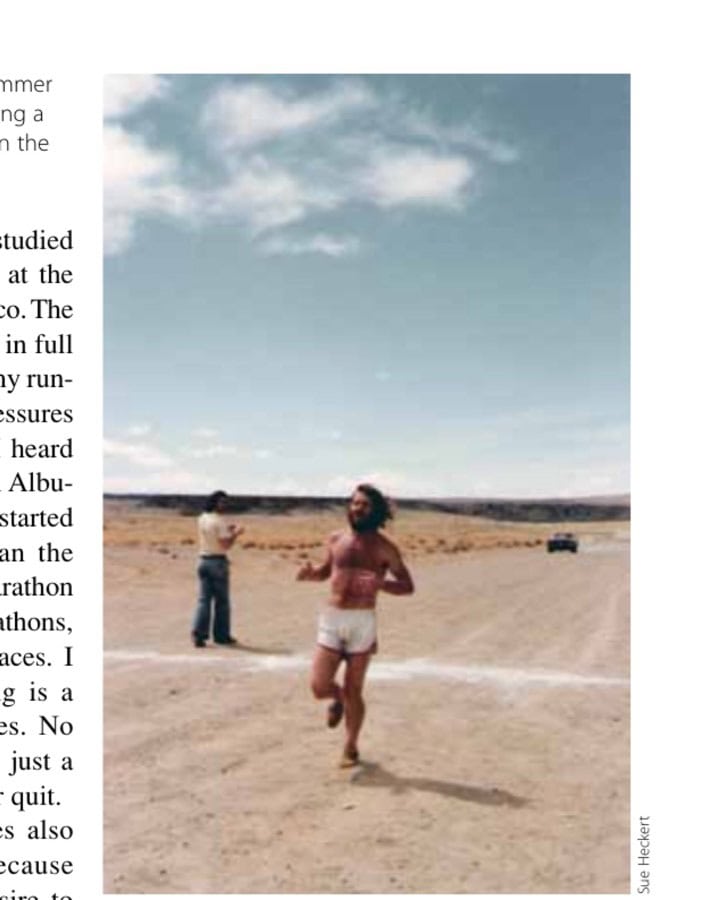
My graduate studies also progressed, largely because I had that stubborn desire to never quit. I began doing research in observational astronomy at Kitt Peak National Observatory, about 50 miles west of Tucson, Arizona, and at other observatories. I could not interrupt my marathon training just because I was on a mountaintop observatory. Having no other place to get in my training miles, I usually just started running down the mountain. When I started having serious doubts about my ability to run back up, I usually, not always, turned around and started running back up the mountain. There was a nice picnic area just a few miles down, which usually made a handy turnaround point.
Not all scientists are bright Notice the “not always” above. Among my youthful indiscretions, I twice (I’m a slow learner) ran to the bottom of the mountain at Kitt Peak National Observatory. The observatory is at the summit at about 7,000 feet elevation. The desert floor is at about 2,000 feet. Running down was pretty easy. As a preliminary, on August 6, 1979, I ran most, but not all, of the way to the bottom of the mountain and back on the paved main road. According to my
Sue Heckert
▲
A much younger and slimmer version of the author finishing a marathon in Albuquerque in the late 1970s.
logbook, the round trip was about 16 miles, and it was pretty hot. The round trip most of the way to the bottom gave me the confidence to try running all the way to the bottom and then back up when I needed a long run on a future observing trip.
The first time I ran all the way to the bottom was also on the paved main road. According to my logbook, I did the round trip to the bottom on March 26, 1980. The handy mile markers said it was a bit over 10 miles each way. The 21-mile round trip was a good portion of a marathon, with a 5,000-foot climb in the second half. It was still early spring, so the weather was not too hot. Perhaps that gave me a false sense of confidence about my ability to run up Kitt Peak any time I felt like it.
The second time I ran all the way to the bottom was on July 19, 1981. (If we learn from our mistakes, can we learn twice as much by repeating them?) I took the old unpaved jeep road/trail. The old road had no mile markers, but it was allegedly shorter. It took me only an hour to run down and an hour and 50 minutes to run back up. What it lacked in length, it made up for in steepness.
Both times I felt pretty good going down. It was easy to keep up a great pace, so before I knew it I was at the bottom of the mountain. Then I turned around and discovered one of life’s profound truths: mountains are much steeper and higher from the bottom than from the top (unless you are skiing rather than running!).
On the final run down the old road, I also noticed that summers are cooler at higher elevations. The Arizona desert sun can get a little warm in late July. I was feeling it. Most people have enough sense not to run there, so the road builders didn’t think to install handy water stops on the old jeep road. I had not yet learned to carry water bottles on long, hot runs.
It slowly dawned on my heat-addled brain that I had to run all the way up to the summit. I also had to get there by dark so I could report to the telescope for my night’s work. Then I would have to work all night.
Things weren’t looking so good. I simply started the long, slow ascent. After all, the vertical distance was only a mile, and I can always do a mile. Right? Did I mention that the Arizona sun can get a little hot? I was getting increasingly dehydrated. The sweat on my arms was beginning to taste pretty good—a fine wine, indeed. But I was still doing OK. Or was I?
Bad idea to feed the wildlife When I looked up, I noticed the vultures circling overhead like a flock of hungry teenage boys circling the dinner table in anticipation. I could imagine them saying—in vulture talk, of course—“Dinner is almost ready. Call the gang. Looks like a feast tonight.” I began to realize that I must be starting to look pretty bad. I just kept stubbornly plodding. I didn’t really feel like joining the vultures for dinner as the main
course. Were they flying lower? Keep plodding. The term “survival shuffle” was sounding more and more like a literal description. I’m not quite sure how, but I finally managed to reach the summit. I even had time for a shower and dinner. I didn’t invite the vultures, and I was not the main course. They had to look elsewhere for dinner that night. At dusk I reported to the telescope for my night’s work. Dawn was a long time coming. The Beatles said it best: it really was a hard day’s night.
I was a lot younger then. I couldn’t do that type of run and then work all night any more. (Or could I? Perhaps I should fly out to Tucson . . . ) I usually, but not always, have enough sense not to try such things. Thirty-some years later, I am still running at observatories, but I have learned not to run all the way to the bottom of the mountain and to carry liquid in hot weather. Living in the western North Carolina mountains still gives me plenty of other chances to run both up and down mountains.
I also started running ultramarathons in the last few years. Some of my ultras have even had the occasional hill or hot weather. My first ultra was the 2008 Hinson Lake 24-Hour Ultra Classic. The same stubborn desire to never quit, no matter how slowly I am shuffling, got me through 71 miles on my first ultra attempt. Sixteen
ad
Paul S. Heckert
▲
The author still running hills in the Bethel Hill Moonlight Boogie 50-mile race in 2009.
hours into the 2010 version of this 24-hour race, this stubbornness led me to comment to another runner: “Everything hurts but my injury, so I can’t quit.” My stubbornness also got me a course record on
my first 100K race. I set the course record for the slowest finishing time at the inaugural Weymouth Woods 100K run by finishing, in a cold rain, only 12 minutes faster than the 20-hour time limit. So
with age, I am no wiser, just slower. I haven’t seen a vulture circling overhead yet, though. Perhaps the younger ultrarunners in the races looked tastier. We all go through hard times in life and have mountains we need to scale.
These mountains may result from our own foolishness, such as when we don’t turn around soon enough from a downhill path. They may result from a bad period at work. They may result from an illness or the loss of a loved one.
Whatever the source of the mountains we need to scale in life, running helps us get through. Running marathons or ultramarathons and regularly running up real mountains gives us strength, endurance, and toughness that are both physical
and mental. This toughness helps us weather the rough periods in life. Running up real mountains gives us the strength we need when we encounter life’s metaphorical mountains. And vultures motivate us to keep going.
This article originally appeared in Marathon & Beyond, Vol. 18, No. 1 (2014).
← Browse the full M&B ArchiveMore like this
1,000+ stories from 19 years of Marathon & Beyond
The complete archive of the legendary long-distance journal — digitized and free to read.
