

Sahara Grit
Rule number one: don’t run out of water in the Sahara. As the midday sun was broiling me, I kicked myself for not conserving enough water from the previous checkpoint. Yet here I was in the middle of the desert without a drop to drink. Man, was I thirsty. At my current pace, I was at least an hour away from the next aid station, where I would get a resupply of water. How I desperately craved any sort of liquid to quench my parched tongue and cracked lips. I spied another runner in the distance, slumped in the shadow of a small bush. I could tell that he was French by the tricolors on his backpack. Ça va, tu vas
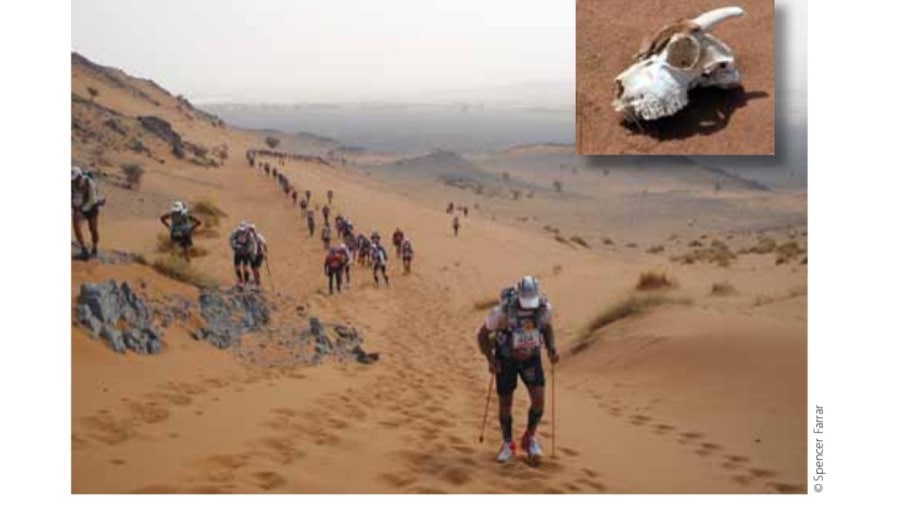
▲ Few things survive for long in the desert.
bien? Barely making an effort to glance at me, he feebly nodded that he was OK, but his pallid appearance said otherwise. As he dumped water onto his head to cool off, I lustfully watched the precious liquid drain into the sand. What a waste.
Heat exhaustion set in, and I started to feel lightheaded and cotton mouthed. All I could think about was water. Just how do the locals survive in this austere environment? And how did the French Foreign Legion, in the days of yore, stay alive here? The Legion’s unofficial motto, “March or die,” now seemed very apropos. Part of me wanted to curse the desert, but at the same time, I reminded myself that I had paid for this experience. Every section of my body seemed to be covered in this wretched sand. There were even grains lodged between my teeth.
I once read that Bedouins would sometimes resort to drinking camel urine in desperate life- and-death situations. While I was nowhere near this point of despair, I wondered where my breaking point would have to be before even considering such drastic measures. Fortunately, I had not seen any camels lately.
About 10 minutes later, an Austrian runner trudged by me. “How are you doing?” he asked. I lied and said that I felt fine but mentioned that I was out of water. Without hesitating, this anonymous runner handed me a bottle. “I don’t have much left myself, but take some of this,” he said. I thanked him for his generosity and greedily gulped down several mouthfuls of some oddly flavored sports mix, which had become warm and frothy from the heat. This beverage had a sour, pungent taste to it, but boy, did it hit the spot—undoubtedly better than camel juice.
Thank the French for this one It takes a special kind of person to run an ultramarathon, but it takes an even rarer breed to take part in the Marathon des Sables (“Marathon of the Sands”). For most people, competing in a weeklong race across the scorching Sahara may seem like an act of sheer madness. Yet every April, hundreds of intrepid runners from around the globe gather in a desolate section of southern Morocco to participate in what is arguably the world’s most difficult multistage marathon.
Founded 27 years ago by a Frenchman, Patrick Bauer, the Marathon des Sables, or “MDS,” is a true test of a human’s fortitude. This race is broken down into six stages over a seven-day period, requiring runners to navigate 156 miles over some of the most inhospitable terrain on earth—all while carrying a week’s worth of food and supplies. Aside from medical care, which is provided by a small retinue of medical staff known as Doc Trotters, water is the only other support available. A meager 11 to 12 liters per day is the ration, available only at the designated aid stations.
The course changes every year, and race participants are unaware of the exact route until the first day, when they are issued a booklet containing maps of each
© Spencer Farrar
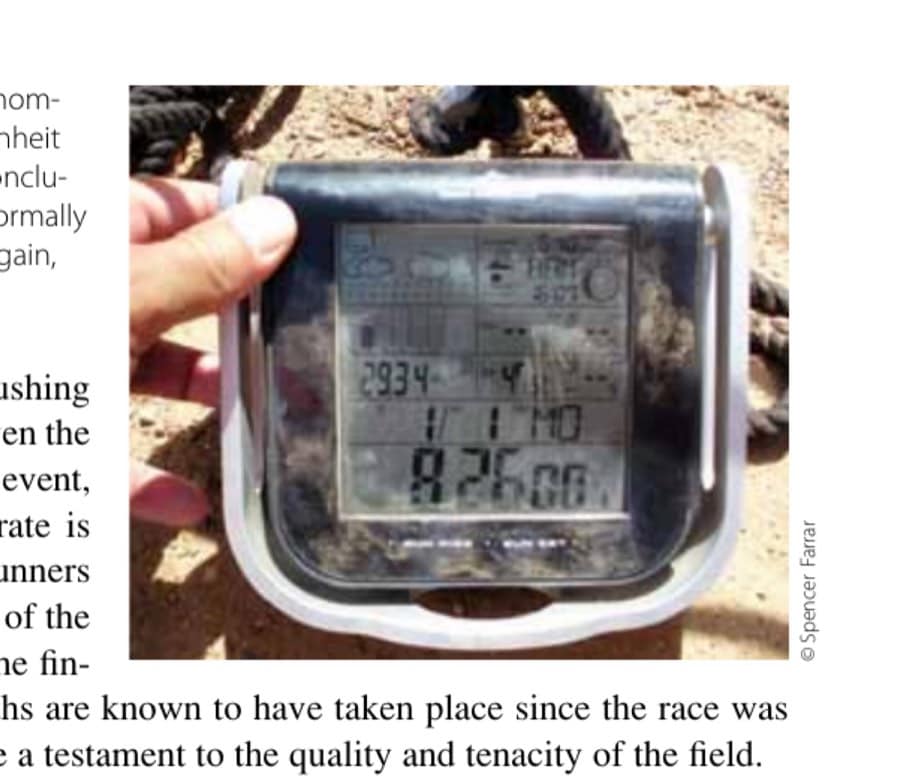
day’s course. Despite the changing route, there are several certainties. First, it will be hot—brutally hot. During the fifth stage in 2011, the mercury soared to a furnacelike 128 degrees Fahrenheit (this
is 8 degrees short of the highest temperature ever recorded, at al-Aziziyah, Libya in 1922). At these temperatures, the risk of heatstroke and renal failure skyrockets, and runners must consume adequate fluid and salt to stay alive.
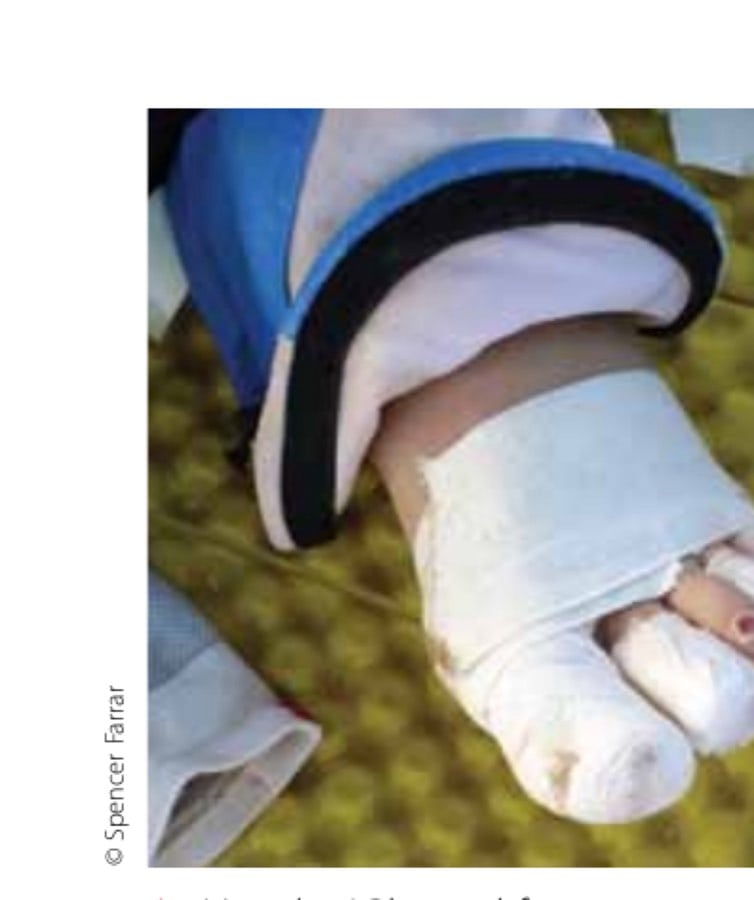
Second, you will get blisters—bad ones. Running with a 20-plus-pound backpack distorts the body’s normal ▲ Mon dieu! Blistered feet: a common sight biomechanics and stresses parts of the throughout MDS.
feet that are not typically affected by running. The extreme heat also causes swelling of the extremities, so runners typically wear shoes that are one-half to a full size larger than normal to compensate for
edema of the feet. But the biggest source of blisters is the sand itself. Even though runners wear specially fitted gaiters to prevent sand and rocks from seeping into shoes, abrasive debris inevitably works its way inside. Blisters are so common
that some jokingly refer to this race as the “marathon disabled.”
Esprit de corps Despite the harsh environmental and physical challenges, MDS has become one of the most prized events in the world of ultrarunning, with waiting lists averaging four years in the United Kingdom and two years in the United States. This race
attracts some of the world’s best distance runners, such as Laurence Klein—the top women’s finisher at MDS in 2011 and 2012 and France’s 100K record holder—and Mohamad Ahansal, Morocco’s legendary MDS four-time champion. However,
the majority of athletes are nonprofessionals who have come to Morocco for the experience or because they are nutty gluttons for punishment. While 40 nations were represented at the 2011 race, MDS continues to be largely
a European affair. Of the 850 starters this year, about 475 came from France and the United Kingdom, with Spain and Italy providing an additional 120 runners. The African and Middle Eastern nations, ironically, are poorly represented due
to the prohibitively expensive registration fees: this year, only 20 runners from these two regions participated. By comparison, 21 Americans were in attendance. Few of the runners know each other at the beginning of the week, but by the
time the race has concluded, strong bonds of shared misery and accomplishment
© Spencer Farrar
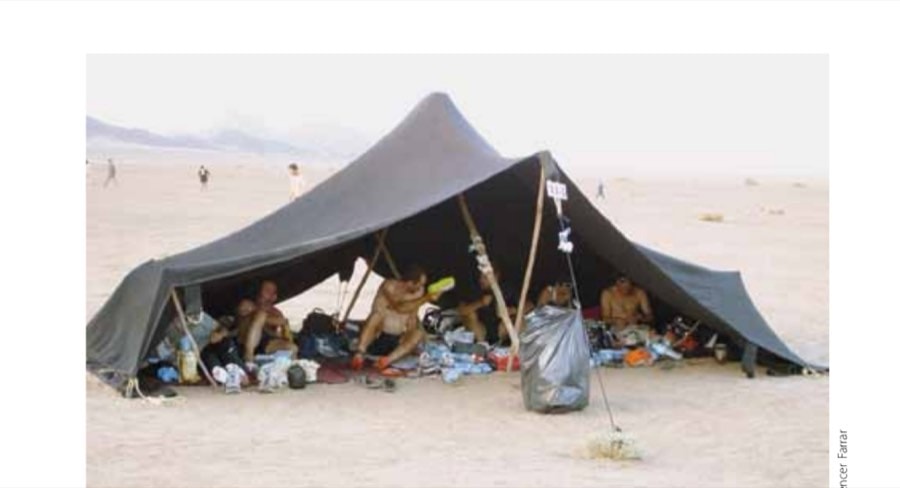
▲ Living quarters are cramped and dirty, but they create tight bonds.
make the runners feel as if they have known each other for years and are best friends. In fact, the remarkable insight into each others’ lives and the tight, enduring bonds that are formed are among the defining characteristics of MDS. The camaraderie is especially palpable in the bivouacs, where runners swap stories about the day’s tribulations, wryly compare blisters, and trade food. As people wearily return to their tents after crossing the finish line, spirits are lifted by loud cheers and whistles from fellow tent mates. For many, this daily homecoming is one of the most eagerly anticipated events of the day. “
The people are the unifying force,” says Jay Batchen, whose company, Dreamchasers Outdoor Adventures, serves as the organizer for the North American contingent. “This race attracts a real special type of individual.” An eight-time finisher of MDS, this Idaho resident passionately adds, “The reason I come here year after year is because of the people. They are what make this race such an incredible experience.” If anybody should be an authority on this subject, it is Jay: he met his wife, Lisa Smith-Batchen, at MDS in 1999 while producing a documentary series about deserts for the Discovery Channel.
Prior to the race, a friend casually stated that MDS looked like a desert version of the television show Survivor. But nothing could be further from the truth. This is not a contrived Hollywood reality show with phony tough guys and chestpounding braggarts. The people here are authentic athletes—a tough-as-nails bunch that silently goes about its business without seeking fanfare or adulation. There is no million-dollar prize, but the reward of finishing is worth far more.
© CIMBALY/PERMDS2011
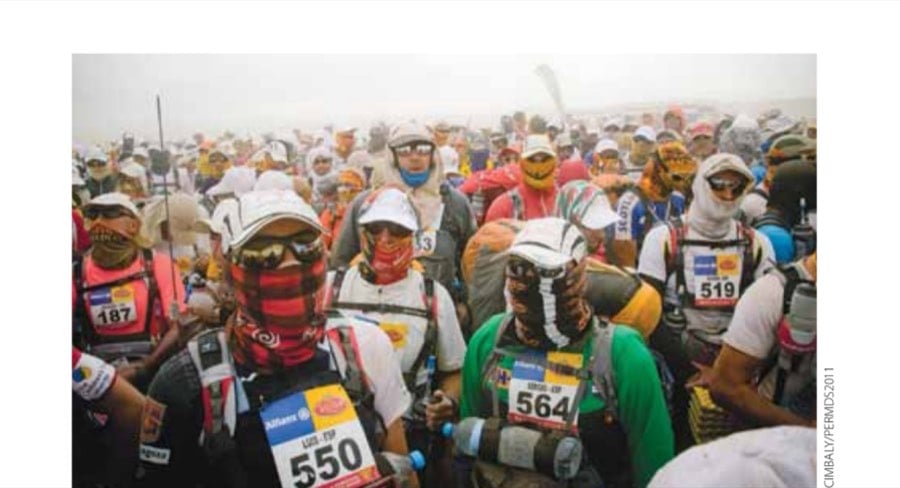
▲ An 850-person family: by week’s end, lifelong bonds have been formed between the runners. MDS is like a “family affair,” says Jay Batchen.
Are you tough enough? The common trait of MDS runners is tenacity. These are folks who simply do not know the word “surrender,” whether in athletic competition or in their personal or professional lives. Take, for instance, John DeRosa. For this successful Wall Street executive, just making it to the race required an extraordinary amount of perseverance. Diagnosed with non-Hodgkin’s lymphoma three years ago, this determined New Jersey native admits that his training took a hit because of the chemotherapy, but with his 50th birthday approaching, he was not going to let a “little cancer” get in the way.
For Janet Alexander, similar mental and physical toughness was necessary to overcome her fears of being disqualified at MDS again. This gregarious New Zealander, who once bicycled 12,000 kilometers from Egypt to South Africa, was forced to drop out of MDS in 2010 when, as she put it, “The skin on the balls of my feet became detached.” Ouch. After nearly five months of rehabilitation, this gritty Kiwi was back in Morocco to make amends for last year’s disappointment. “There’s no bloody way that I’m not finishing this year,” she declared. “They’ll have to forcefully drag my dead body off the course this time.”
Most outsiders would consider this type of behavior to be aberrant, even insane. Who in their right mind would risk a debilitating injury or even death for a stupid race? But for the average MDS runner, it is all worth it. This is a collection of determined people who don’t shy away from a little danger, a group
of risk takers who enjoy pushing their limits to the edge. Given the hazards associated with this event, the dropout and casualty rate is remarkably low. Only 38 runners this year—about 4 percent of the total—did not make it to the finish line, and only two deaths are known to have taken place since the race was created. These statistics are a testament to the quality and tenacity of the field.
There were many people at MDS this year for whom stories should be written: the former nationally-ranked runner from South Africa who was banned from two Olympic games during the 1980s because of his citizenship; the brilliant biochemist who helped develop Tamiflu, the world’s leading influenza medicine; or the mysterious American runner who has run 11 MDS races while wearing sandals (this passes for normal at MDS).
Given the constraints of this article, however, I have profiled only three remarkable individuals whose collective backgrounds encapsulate for me the spirit of the MDS runner: Samir Akhdar, Tristan Miller, and
Adrian Panozzo. This trio epitomizes the characteristics most of the desert runners embody: perseverance and passion. Although these three gentlemen come from different cultures and socioeconomic backgrounds, their lives have remarkably intersected at this remote spot in North Africa. Here running is the great international unifier.
The hometown optimist Samir Akhdar (Morocco; age 30), sixth place: 23 hours, 3 minutes, 46 seconds Zagora is a small village nestled in the rugged foothills of the Drâa Valley in southeast Morocco, about 40 miles from the Algerian frontier. This oasis town reportedly has the hottest weather in the country and is surrounded by endless stretches of desert, craggy mountain peaks, and patches of palm trees. In days of old, this town was a trading post where Berbers and adventurous outsiders would venture as they headed to and from the legendary city of Timbuktu. The landscape looks as if it has been pulled straight from the pages of a P. C. Wren adventure tale.
One of the more affable runners at MDS was a Moroccan named Samir Akhdar. Soft-spoken and courteous almost to a fault, this 30-year-old has lived
© Spencer Farrar
▲
It’s hot, Africa hot: the thermometer reads 117.5 degrees Fahrenheit (47.5 degrees Celsius) at the conclusion of day 6. People do not normally run in this weather, but then again, MDS runners are not normal.
© Akhdar photo
▲
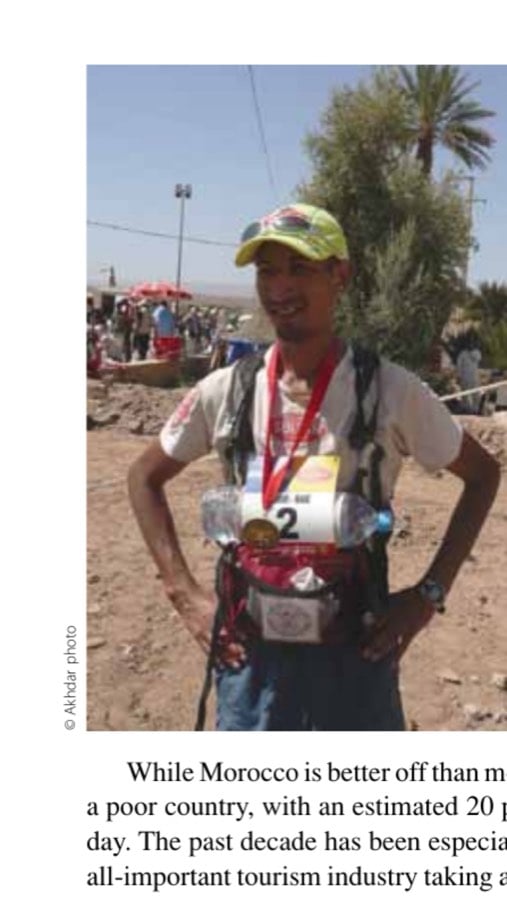
Samir Akhdar has never run a race on pavement or without a pack. He is unsure how quickly he can run a standard marathon, but he recalls doing a 21K training run in about 1 hour, 12 minutes—all on rough desert terrain.
in Zagora for most of his life. He is not especially fond of his job at the automobile parts store in the town’s center. The pay is minimal, and the work is not particularly challenging for someone who had studied
information management in his earlier days. But inshallah, this is Allah’s will, and this ever-cheerful Zagoran accepts his present-day circumstances without complaint. “At least I have a job,” he notes with a
pleasant smile. While Morocco is better off than most of its African neighbors today, it remains a poor country, with an estimated 20 percent of families making less than $1 per day. The past decade has been especially rough on Morocco’s economy, with the
all-important tourism industry taking a hit in the wake of 9/11. To add to the curse, severe droughts have wreaked havoc upon the nation’s agriculture and livestock. Life is difficult here, especially in rural areas where employment prospects are slim.
For those who display a talent for sports, athletics represents a potential way out of poverty. Morocco has a rich history in running; world-class athletes such as Saïd Aouita, Hicham El Guerrouj, and Khalid Khannouchi inspire future gen
erations of wannabe professionals. Although the odds of making a living from sports are quite low in Morocco, Samir is hopeful that he might be one of the exceptions. This dream is not without merit, for in the past five years, Samir has emerged as one of Morocco’s top dis
tance runners and has the makings of a world-class athlete. In his debut Marathon des Sables in 2005, Samir incredibly finished fifth overall. In the ensuing years, he has consistently been a fixture on the leader board.
But despite his God-given talent, Samir is a relative unknown outside of Zagora. He has been unable to participate in races outside of his immediate environs due to a lack of sponsorship and difficulties in obtaining visas for international com
petition. “The consulates are afraid that I won’t return to Morocco,” he laments. Shortly after this year’s Marathon des Sables, Samir had been hoping to make his
© Spencer Farrar
debut international race at an ultramarathon in Aquitaine, France, but the French consulate in Marrakech denied his application a few weeks before the event. Samir’s future likely would have taken a different path had it not been for Lahcen and Mohamad Ahansal, two brothers from Zagora who put the city on the marathon map. Lahcen is the Moroccan equivalent of Bruce Fordyce, having won this race 10 times (including nine consecutive victories from 1999 to 2007), and his younger brother, Mohamad, notched four victories in 1998 and from 2008 through 2010. In southern Morocco, practically everyone knows of the Ahansal brothers, even those who don’t closely follow the sport. They are the Sahara’s version of sports royalty.
Inspired by the success of his hometown heroes, Samir took up running during high school and quickly proved to be a natural at this sport. In 2005, at the age of 24, Samir ran his first MDS, where he finished fifth overall—not too shabby for a kid who had never attempted even a regular marathon, let alone a 156-miler. “Lahcen and Mohamad are my greatest influences,” he explains. “They got me stated in running and helped me become a better athlete.” To this day, he still trains and remains good friends with them.
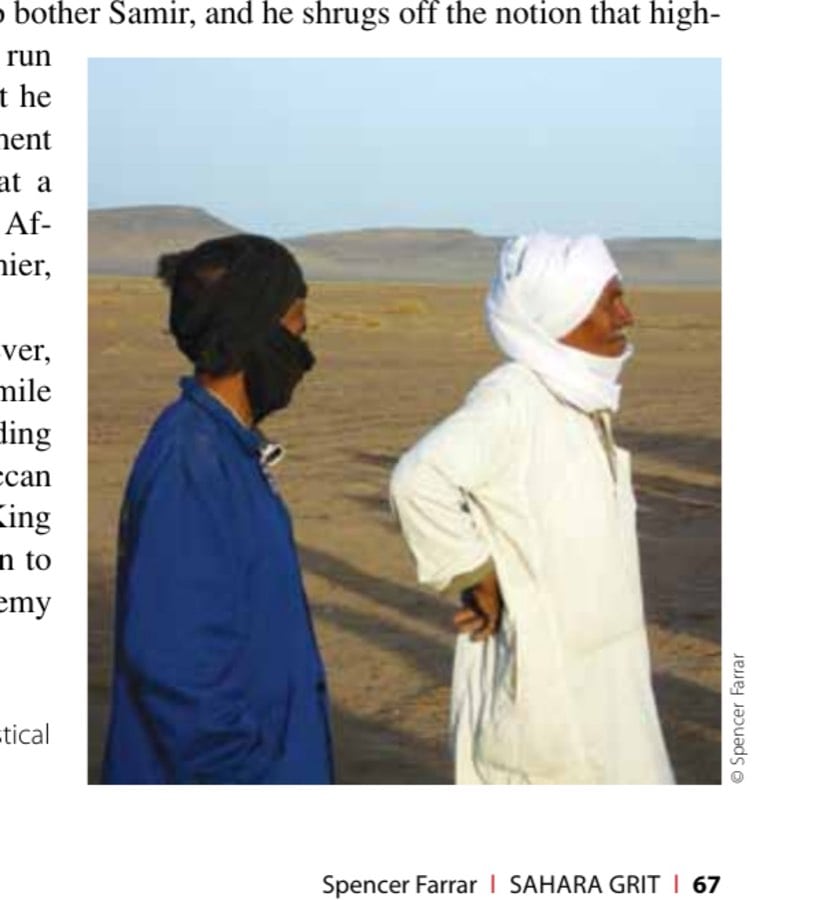
Unlike most runners at MDS, Samir does not rely on the newest technology or equipment. His backpack looks as if it has been stitched together by hand, and for sustenance, he carries garden-grown dates, small vials of honey, almonds, and home-baked crackers. There are no fancy GU gels, scientifically formulated electrolyte drinks, or top-of-the-line Montrails, just bare, natural essentials. But none of this really seems to bother Samir, and he shrugs off the notion that hightech gear would help him run faster. You get a sense that he privately enjoys the equipment disadvantage, proving that a small-town kid from North Africa can prevail over wealthier, better-geared foreigners.
There is one topic, however, that causes Samir’s usual smile to fade: the dearth of funding and sponsorship for Moroccan athletics. While he praises King Mohammed VI for his plan to construct a new sports academy ▲
The hardworking Bedouins handle much of the race’s logistical activities.
in the northern city of Ifrane, Samir wishes more monetary support could be provided to his country’s athletes. You need look no further than Morocco’s recent lackluster performance in international competition to see how this one-time running-powerhouse nation has faded. The paucity of governmental and corporate sponsorships prevents talented athletes like Samir from participating in more races and limits their access to better training facilities. “It’s a shame,” he sighs.
Two weeks before the 2011 MDS, Samir did not even know whether he would be able to race because a sponsor had not yet stepped up to pay the costly registration fees. In the end, Samir was sponsored by a local tea company that also supported three other runners from Zagora. But not all of Morocco’s runners are so fortunate. According to Sanaâ Boudri, a Moroccan journalist covering the event, Morocco’s top female ultrarunner received no sponsorship this year. Touda Didi, who has won this event two times for Morocco, made it to the start line this year only through contributions from friends at the school where she teaches.
Another challenge for gifted athletes like Samir is to gain the recognition and support of the Royal Moroccan Athletic Federation (FRMA). This is the regulatory agency for Moroccan running that also determines who may compete in international competition. Critics of this organization argue that only promising Olympic-caliber runners get the backing of the FRMA, while non-elites tend to get minimal support. To complicate matters, the FRMA does not recognize trail running as an athletic event, so it cannot officially sanction Samir to take part in similar races outside of the country. Samir recounts how a sports trainer once asked him why he bothered to do ultramarathons. “It’s not even a real sport,” decried the trainer. Not a real sport?
Despite these prejudices, Samir remains a devotee of ultrarunning. In a country where the median household income is about $5,000 a year (and even less for people in the countryside), Samir cannot afford to pass up an opportunity to earn prize money. The individual winner of the Marathon des Sables pockets a tidy €5,000, and each member of the top team makes €875 (this is about $7,200 and $1,250 respectively). For these athletes, this money is a life-changer.
Although Samir admits that the money is a major reason why he competes, he emphasizes that running is more than just a means to earn a living. It is his mode de vie, his way of life. Even during the hottest and most miserable days, Samir says that he remains awestruck by the majestic scenery of the Sahara. The windswept dunes and calming silence have a way of lulling him into a transcendental, meditative state. “It’s very therapeutic,” he says.
It is tough to say what Samir’s running future holds for him. Without the necessary financial support, he will have difficulty breaking into the international running circuit. But don’t count him out just yet. “My dream is to do Badwater one day,” says Samir.
“You do realize there’s no prize money, right?” I ask him. “All you get is a belt buckle for finishing.” But judging by his smile, I can tell he does not care. He just loves running and wants to prove that Morocco is a force to be reckoned with.
The running junkie Tristan Miller (Australia; age 34), 171st place: 37 hours, 46 minutes, 6 seconds Tristan thought he had it all: a prestigious job at Google, a chic condominium in an upscale Melbourne neighborhood, and a hip social life. He was living the dream. But on March 27, 2009, all that came to an end when Google announced that it was eliminating 1 percent of its global workforce and would shut down the Melbourne office. Suddenly, Tristan was stripped of the lifestyle to which he had grown accustomed.
At the time of his layoff, Tristan was a recreational runner who had done five marathons over the past four years. This svelte Aussie says a broken marriage and a subsequent bout with excessive drinking are what got him into the sport. “I think my divorce was the defining moment,” he states with a serious look on his face. “After this happened, I drank too much and became a bit of an ass.” One of his
ad
© Tristan Miller
▲
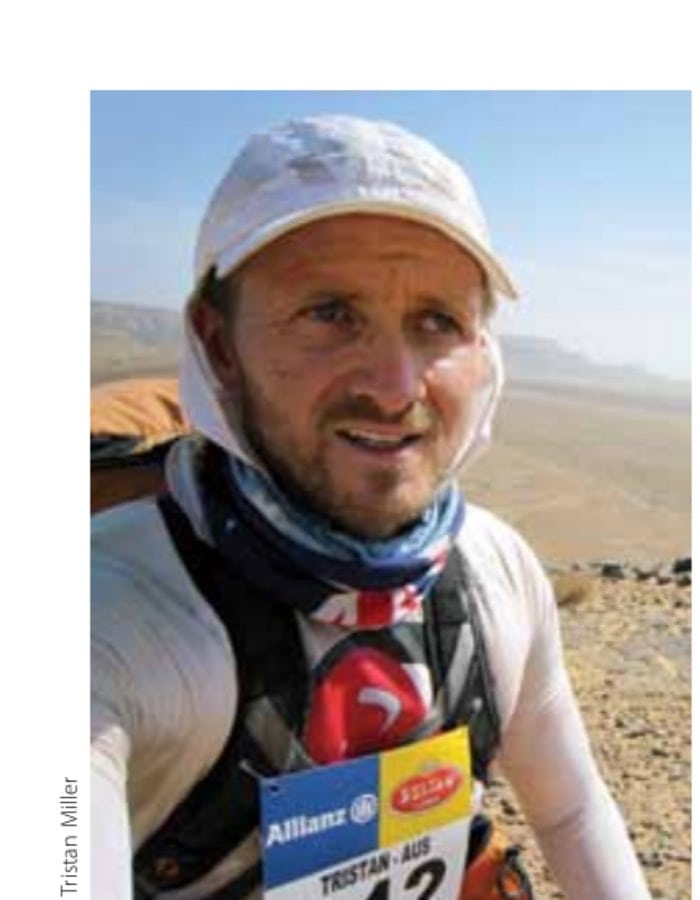
Tristan recently wrote a book about his running adventures and plans to do a marathon at Everest later this year.
mates, who happened to be a marathoner, suggested that Tristan try running as a way to get his life back in order. Thinking that he had nothing to lose, Tristan took up his friend’s offer and started running for the first time in his life.
As his mileage picked up, the Melbourne native noticed a dramatic improvement in his physical and emotional condition. “When my fitness got better,” he said, “I became more motivated.” This renewed confidence pushed Tristan to attempt
his first marathon in 2004, and when he crossed the finish line, he was officially hooked. When he was let go from Google, Tristan had been planning to participate in the Comrades Marathon—his first ultra—which was scheduled to take place in
three months. Because of his newfound unemployment, however, Tristan questioned whether he should be jetting off to South Africa rather than job hunting; in the end, he decided that a little break could be revitalizing, so he went ahead with the plan.
This decision would change his life forever. After completing the Comrades Marathon, an event that he describes as one of the most positive and interesting experiences of his life, Tristan spent a few
weeks meandering around Zambia and Botswana. Caught up in the post-Comrades euphoria and smitten by his encounters with wild animals, Tristan thought about all the other places in the world that he wanted to visit. However, he realized
that once he returned to corporate life, he would probably never see these locations. But then it dawned on him: what if I spent a year traveling and running marathons? The idea seemed ludicrous at first, but the more he thought about it,
the more feasible it seemed. Over the next six months, Tristan hatched an elaborate plan to run one marathon each week for the entire year in over 40 countries around the world. That’s 52 marathons in 52 weeks. In order to finance this adventure, however, Tristan had
to sell all his worldly possessions, including his apartment and car. “Everything else,” he said, “I just gave away.” With about $120,000 of savings to his name, Tristan was now ready to embark upon his mission, which he dubbed “Run Like Crazy” on his running shirt
© CIMBALY/PERMDS2011
and website. The logo for this one-man expedition was a red bull, inspired by a recent trip to Pamplona where he participated in the famous running of the bulls. As news spread throughout Australia (and eventually overseas) of this crazy marathon man, Tristan developed a bit of a cult following and acquired more than 7,000 online followers.
Tristan began his odyssey on January 1, 2010, with the running of a midnight marathon near Zürich. Feeling the effects of jet lag and not being accustomed to the chill of the Northern Hemisphere winter, Tristan privately wondered whether he was in over his head. But he had too much at stake to even consider quitting, and during the following three weeks, he ran back-to-back marathons in Israel, India, and the United Arab Emirates. During a press conference before the Dubai Marathon, a reporter informed Haile Gebrselassie of Tristan’s plan. Shaking his head in disbelief and flashing his ever-present smile, the Great One exclaimed “unbelievable!”
For the next 11 months, this runner from down under ran marathons on every continent at diverse places like Easter Island, Rwanda, and Antarctica. Between races, Tristan immersed himself in the local culture and played tourist. Week after week, month after month, this routine continued.
On December 27, 2010, Tristan finally returned to Australia and triumphantly completed his final race in Melbourne. He had accomplished a task that many
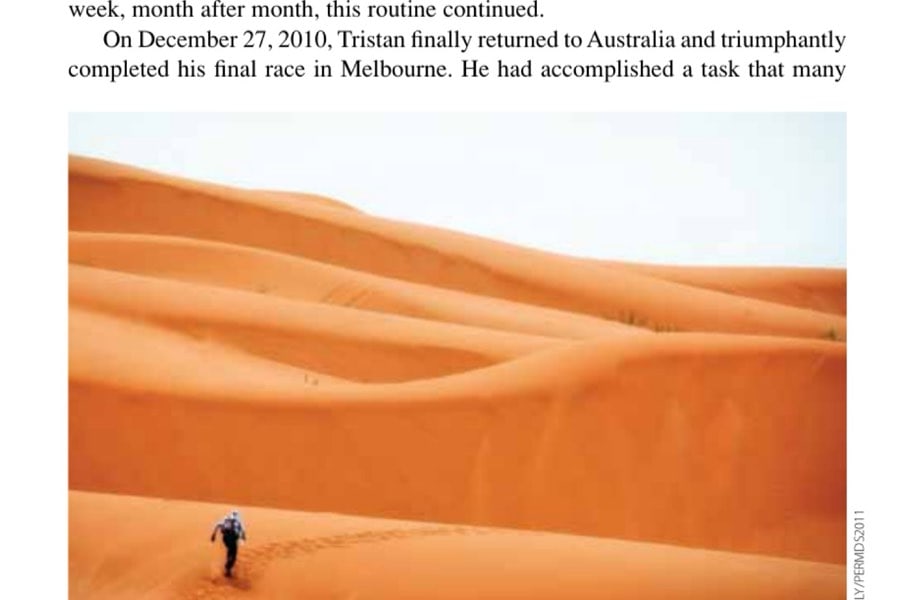
▲ Emotional experience: the Sahara Desert is both brutal and beautiful, and it has a transformative effect on most runners.
doubted would be done. Yet there was one race that still eluded him: the Marathon des Sables. In 2009, well before he had the epiphany to run 52 marathons, Tristan yearned for an event more challenging than the standard marathon or even the grueling Comrades Marathon. “In the natural order of things,” said Tristan, “MDS was the next logical step.”
Tristan is quick to point out that there is no comparison between MDS and his year of running marathons: “They’re completely separate experiences.” However, there is a hint in Tristan’s voice that his recent race in Morocco was different from all the other marathons he has completed. “MDS was one of the most concentrated emotional experiences of my life. Being out in the desert, under the stars at night, is something I will never forget.”
As momentous as all these races have been, Tristan does not want his legacy to be defined by what he has done in the past. Instead, he hopes to use running as a platform to improve society through charity fund-raising and motivational speaking. Similar to Samir, who does volunteer work with an association for handicapped children in Zagora, Tristan realizes that character is defined not by how many medals he has earned but by how he uses his talents to better mankind.
During his travels, Tristan has met with maimed survivors of the Rwandan genocide, visited the poorest slums of Mumbai, and seen the devastating effect of drought upon North African communities. It bothers Tristan that life can be unfair for some while others—like him—can lead a privileged existence. As a result, this Aussie has become a big supporter of charity groups like UNICEF and Facing Africa, raising money for them through his races. Helping others, it seems, is now his new mission in life.
It is hard to believe that he discovered himself by running around the world. It’s crazy how life can be, eh?
The humanitarian Adrian Panozzo (Australia; age 42), 202nd place: 39 hours, 8 minutes, 8 seconds Some people just have that presence. You know: that likable personality that makes you grin no matter how dismal the situation may be. Adrian Panozzo is one of those types. During a particularly tough spell of the 50-mile stage, I heard a thick Australian voice boom behind me: “Mate, keep it up . . . yer looking ah-maay-zing!”
This was so far from the truth that I burst out laughing. “You’re so full of it!” I retorted. But his one-liner snapped me out of my doldrums, and I felt rejuvenated. For the next hour, we fed off each other’s energy and chatted on the run. It is remarkable how uplifting a few friendly words can be.
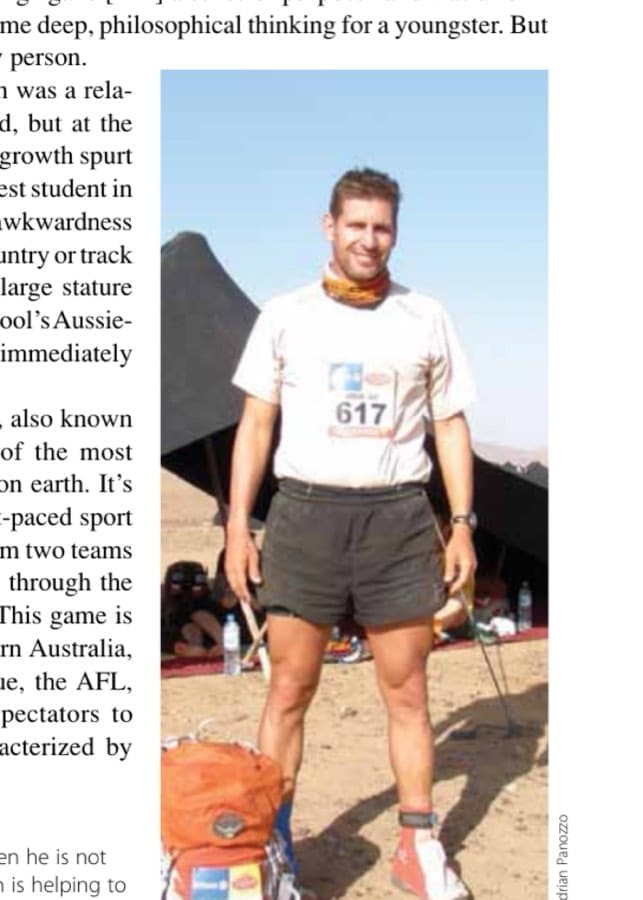
Standing 6 foot 3 and weighing a solid 210 pounds, Adrian does not fit the classic profile of a marathon runner. Instead, this muscular Australian looks as
▲
Big man with a big heart: When he is not running across the desert, Adrian is helping to improve the lives of Australia’s disadvantaged.
© Adrian Panozzo
though he ought to be in the center of a rugby scrum rather than striding across the Sahara, but appearances can be misleading. Prior to the 2011 Marathon des Sables, this gentle giant had successfully completed 10 Ironman races, including one finish at the Hawaii World Ironman Championships. Adrian was also a member of the runner-up team at the renowned Oxfam Trailwalker (100-kilometer) race in Melbourne, narrowly losing out to the Gurkha team—perennial winners of this race.
Since childhood, Adrian has been passionate—some would say obsessed— about running. In his second-grade yearbook, he wrote that he wanted to become an Olympic marathon champion. To this day, his neighbors remember him as the crazy kid who was constantly racing others around the block, imitating his childhood idol (and Melbourne’s own) Rob de Castella. Even at that young age, Adrian reminisces that running “gave [him] a sense of purpose” and was a form of self-expression. That is some deep, philosophical thinking for a youngster. But then again, he is no ordinary person.
In his early years, Adrian was a relatively short and scrawny kid, but at the age of 15, he had a dramatic growth spurt and quickly became the biggest student in his classroom. This physical awkwardness did not lend itself to cross-country or track and field at school, but his large stature caught the attention of the school’s Aussierules football coaches, who immediately recruited him.
Australian rules football, also known locally as “footy,” is one of the most violent and physical sports on earth. It’s like rugby on steroids, a fast-paced sport in which 36 large players from two teams attempt to kick an oval ball through the opposing side’s goal posts. This game is massively popular in southern Australia, where its professional league, the AFL, draws upward of 80,000 spectators to big matches. Footy is characterized by
spectacular aerial hits and bone-jarring collisions that make American football look tame by comparison. Adrian proved to be a natural at this sport, and he was eventually selected as the school team’s captain and most valuable player. In the state of Victoria, professional scouts started to take notice of this promising young scrapper from Melbourne. These representatives marveled at his fearless attitude and running speed, but tragically, his hopes of making the next level were dashed following a bad knee injury.
A year later, when Adrian was 19 years old, the AFL approached him and asked whether he would be interested in becoming a field referee. If so, he would first have to serve an apprenticeship in the lower divisions. If he could prove his mettle on the field, Adrian could eventually advance to the top division. At this time, Adrian was a full-time university student, but the prospect of being back on the field was too tantalizing not to accept. “
The best part about being a referee was the physicality of the job,” said Adrian. With only two officials monitoring 36 players on a 150-by-135-meter oval, referees have to run an average of 11 to 13 miles during each game. As Adrian puts it, “I was basically being paid to train and keep in shape.” Adrian refereed matches for the AFL from 1989 through 1996, and in his final three seasons, he was selected to work at the premier league—an honor bestowed on only the best.
ad
In 1996, when he was 27 years old, Adrian quit working for the AFL and joined the Victoria State Police. “At that time, I was seeking a higher purpose and wanted to experience more in life, so I figured the police force would be a great opportunity.” Constable Panozzo spent his first 11 months working at a prison, an experience that he calls a watershed moment because it opened his eyes to the problems faced by disadvantaged members of society and those suffering mental illnesses.
While working at the jail, Adrian met a social worker named Peter Cullen, who had organized a morale-boosting soccer match between the inmates and a team of homeless people. Cullen was a believer that sports could be a rehabilitative agent for the downtrodden, and in his spare time, he organized running events and athletic tournaments for Melbourne’s indigent and substance-addicted population.
Peter’s volunteer work immediately struck a chord with Adrian. Acutely aware of the transformative effect that running and athletics had played in his life, Adrian struck up a friendship with Peter and spent his free time officiating sports events for Peter’s group and helping out with his charitable efforts. Panozzo likens his experiences in jail to a “third academic degree”—complementing his MBA and his undergraduate degree in education—and teaching him lessons about humanity that could not be learned in the classroom.
After three years of work in law enforcement, Adrian decided to return to the AFL, where for the next 10 years he worked in the corporate office. Despite the demands of his new assignment, Adrian remained loyal to Peter’s charitable work and assumed a more prominent role, helping out with everything from fund-raising to developing a growth strategy. By 2008, Cullen’s organization—now officially incorporated as a charitable organization called Reclink—was searching for a leader to take the concept across all of Australia. The board of directors agreed that the only logical person to spearhead this effort was Adrian, and in 2008, he was appointed Reclink’s first chief executive officer.
In 2011, Adrian’s organization has provided sporting and arts programs to more than 80,000 disadvantaged people throughout the country. It has become one of Australia’s fastest-growing nonprofits and now boasts 28 affiliates throughout all of the continent’s states. While some question whether athletics can cure society’s ills, Panozzo takes this criticism in stride.
Throughout his career changes, endurance sports have remained a constant in Adrian’s life. Soon after rejoining the AFL in 1998, Adrian became a regular in the Australian Ironman and ultramarathon circuit. But there was one race that Adrian always yearned to try: the Marathon des Sables. “I became aware of this race about 10 years ago from a magazine article,” he said. The notion of running across the Sahara seemed like an “unbelievable idea,” and the fact that it was allegedly one of the top 10 endurance events appealed to his sense of adventure and competition. However, due to his frenetic work schedule and the blossom-
ing relationship with his now-wife, Tracy, Adrian was unable to commit to this challenge. But the race continued to beckon him. As he approached his 40th birthday in 2008, Adrian felt that he was now at the point in his life when he had to run MDS. With his wife’s blessing, he made the fateful decision to apply for the 2011 race (the lottery for the 2011 race was held in 2009). According to Adrian, one of the most exciting days of his life was when he learned that he had made the lottery cut in 2009. “Not to sound spiritual or anything,” he says, “but I think part of my purpose in life was to do this race. Running is who I am, and it’s part of my DNA.”
Looking down the trail Jay Batchen was right. The Marathon des Sables is really about the people. The terrain, weather, and other aspects of the event are certainly significant, but the enduring memory will be of the runners. Regardless of background or athletic ability, MDS competitors share these common traits: perseverence and passion. The qualities displayed by Samir, Tristan, and Adrian can be found in virtually every runner there. And the desire to help comes with an outsized dose of humility. Unlike many of today’s athletic competitions, where bravado and showboating have sadly
ad
become the norm, athletes in this race do not crave external recognition. Instead, they derive satisfaction from their accomplishments and shy away from publicity. This is a journey about self-discovery, not self-aggrandizement; it’s about long-term achievement, not instant gratification.
No, you won’t find acolytes of LeBron here, but rather athletes cut from the same bolt of cloth as John Landy. Civility and chivalry are the standards here. As we reflect back upon the 2011 Marathon des Sables: •
We will remember Toshio Matsunaga, the last-place finisher of the 50-mile stage. With the entire bivouac cheering him on, this runner from Japan gallantly hobbled to the finish line, where he collapsed from exhaustion. •
We will remember the heart-wrenching sight of thirsty rural children begging for water. • We will remember the cheerful Bedouins who surgically tore down the tents every morning at 6:00 a.m., while most runners were still huddled
in their sleeping bags. • We will remember the teamwork of our tent mates, who provided everything from leftover food to motivational support. For some, crossing the finish line at the Marathon des Sables will be the pinnacle of their running career. However, for others, it has merely stoked their desire to attempt something even more challenging. Regardless of the individual, one thing is clear: MDS is a transformational, life-altering experience.
The question everybody asks at the end of the race is: “Do you plan to come back again?” Most first-timers usually say “No” shortly after the race, but there is inevitably a gradual shift to “Maybe,” which sometimes evolves to “Yes” during the ensuing weeks. Time has a curious way of retaining the good memories while erasing the bad ones.
The people are the essence of MDS, and I will surely find myself back there one day. Inshallah.
Postscript The 2012 Marathon des Sables was held shortly after this article was written. Samir Akhdar was unable to participate due to problems with his sponsors, and he is already attempting to secure funding for next year. The tireless Jay Batchen completed his eighth MDS, and Janet Alexander successfully finished her second consecutive one. Meanwhile, Tristan Miller took time off from the Sahara this year to get married and finish writing his memoirs (aptly titled Run Like Crazy), which Penguin Books published in May 2012. Finally, Adrian Panozzo did a few Ironman races and has announced his intent to return to Morocco in 2013.
This article originally appeared in Marathon & Beyond, Vol. 16, No. 4 (2012).
← Browse the full M&B ArchiveMore like this
1,000+ stories from 19 years of Marathon & Beyond
The complete archive of the legendary long-distance journal — digitized and free to read.
