

San Francisco Marathon
SAN FRANCISCO is the most distinctive city in the United States. It is a conglomeration of diverse neighborhoods and panoramic vistas famous throughout the world. Annually it is chosen by leading travel magazines as the favorite destination within U.S. borders. To call San Francisco “colorful” would be an understatement.
San Francisco is ever changing and evolving, a city that attempts to put its best foot forward and cover the scuff marks on the shoe. For more than two decades, the San Francisco Marathon has been changing and evolving as well, while showing both its shine and its bruises.
Certainly, the marathon has a lot going for it. Where else can you find a midsummer marathon with cool weather? And in what other city in the United States can you find a course that passes by such spectacular scenery and some of the nation’s richest ethnic and architectural neighborhoods?
Unfortunately, at the same time, the indifference and occasional hostility of what newspaper columnist Herb Caen calls the “cool, gray city” is reflected in the meager public support for the race. Among urban marathons, San Francisco has probably the smallest crowds of spectators imaginable.
Just as San Francisco can be considered the largest small town in the United States, its marathon can be considered the country’s largest small marathon. The New York City and Los Angeles marathons measure their entrants in the tens of thousands. San Francisco has been averaging 3,000 participants.
A GEM TO BE DISCOVERED
Because of its beautiful (but challenging) course, ideal midsummer running weather, and setting amid one of the most attractive regions of the country, the San Francisco Marathon is a gem waiting to be discovered by the masses of runners who flock to other big-city marathons.
The megamarathons in other U.S. cities command huge sponsorships and competitive fields. San Francisco has never attracted a long-term major sponsor, and these days it attracts no big-name competitors. For better or worse—and we think better—San Francisco enables amateurs to compete and stand out among themselves.
San Francisco has the potential to be a major player in the marathon sweepstakes, but a number of diverse factors would have to come together, and that may never happen. The race made an attempt at megastardom in the wake of the 1984 Olympics when it drew 10,000 runners and produced Simeon Kigen’s record of 2:10:17. But we don’t foresee those kinds of numbers in the near future, even though the July 13, 1997, running will be the race’s 20th anniversary.
COURSE HISTORY
To understand the current San Francisco Marathon course, you need to know a bit about the race’s history. Originated in 1977 by the city’s family-oriented Pamakid Runners (Pa-Ma-Kids. Get it?), the race originally confined itself to loops in beautiful Golden Gate Park, along the ocean beaches, and around Lake Merced at the city’s remote southwestern corner. The race offered no prize money and generally helped create local heroes and heroines—Olympian Nancy Ditz, for example.
The course setting was entirely scenic, even pastoral, but it offered none of the diversity of San Francisco’s exciting neighborhoods. In fact, the course avoided neighborhoods entirely. This changed in 1982 when invigorated leadership within the Pamakids combined with a major sponsorship to produce a city-wide course that showed off Chinatown, North Beach, the waterfront, and Golden Gate Park. For three years, the race doubled in size annually, reaching its apex one week after the Los Angeles Olympic Games.
The marathon’s success, however, proved to be its undoing in the complex mileau of San Francisco politics. While the runners appreciated their journey through ethnic and scenic venues, the shopkeepers and residents in those neighborhoods found the race a nuisance, in spite of the fact that many of the runners returned to the same neighborhoods after the race was finished to spend money on meals and tourist attractions.
In a city where all voices are heard and accommodated, the complaints of a handful were ultimately sufficient to produce political opposition among several of the elected city supervisors, which did nothing to maintain a major sponsor.
At the same time, in an effort to respond to a chorus of opponents, the marathon was forced to change its course for the 1985 edition (hence, the lack of any real meaning to a San Francisco Marathon course record). The race bottomed out in 1988 when the lack of sponsorship caused a one-year cancellation. Fortunately, in the years that followed, folks with more political savvy assumed control of the race, and with more aggressive marketing, were able to bring it back to a semblance of life, if not glory. Beginning in 1989, the Pamakids’ expertise combined with the resources of these new leaders to design the existing course that remains as spectacular as ever, but more importantly, is politically acceptable.
THE “NEW” COURSE
The San Francisco Marathon course is designed for two purposes: to give the runners as much scenic and urban variety as possible and to get the runners in and out of the most interesting and spectacular urban areas as early as possible to avoid rubbing store owners the wrong way. To accomplish this task, the race begins at 8 A.M. on the Marin County (north) side of the Golden Gate Bridge, then passes through the Presidio, Fisherman’s Wharf, North Beach (the Italian neighborhood), and Chinatown well before 9 A.M. For the runners, the experience is like waltzing through a city in the wake of a neutron bombing. Between miles 5 and 10, they travel through some of the nation’s most unique and attractive neighborhoods, but the streets are totally devoid of human beings!
Between miles 8 and 12 the race detours far south of Market Street to avoid interfering with public surface transportation. Some runners dislike this diversion into the city’s industrial zone, but we approve of these few miles in which race participants can encounter and experience the hardy but unglamorous nontourist side of San Francisco.
At mile 12, while passing through the Mission District, and at mile 13, when the race encounters its major hill of 200 feet, which ascends into the famed hippie Haight-Ashbury district, runners once again find themselves in interesting urban communities—by then peopled with locals and tourists taking turns sipping coffee and watching marathoners.
At 14 miles, the half-mile of Haight Street between Masonic Boulevard and Golden Gate Park is the only segment of the race where crowds and street scenes even begin to evoke the urban courses of New York and
The Basics
| San Francisco Marathon | |
| PHONE: | 916/983-4622 |
| FAX: | 916/983-4624 |
| RACE DIRECTOR: | Peter Tatum |
| YEAR RACE ESTABLISHED: | 1977 |
| SANCTION: | USA Track & Field |
| CERTIFIED: | USA Track & Field |
| START TIME: | 8:00 A.M. |
| COURSE RECORD HOLDERS (COURSE CHANGED IN 1993): | |
| Male: | Patrick Murturi, Kenya, 2:17:34 (1994) |
| Female: | Tatiana Titova, Russia, 2:40:32 (1993) |
| TIE-IN EVENT: | San Francisco 5K |
| NO. VOLUNTEERS: | 700 |
| MARATHON FINISHERS IN ’96: | 3,231 |
| PROPORTION MALE/FEMALE COMBINED RACES: | 69% male; 31% female |
| COURSE MARKING: | every mile |
| NO. AID STATIONS: | every mile and at finish |
| FUTURE RACE DATES: | second Sunday in July |
ENTRY COST FOR 1997 EDITION:
Before 23MAY97: $35 U.S.*
By 20JUN97: $45 U.S.*
At expo Saturday of race weekend: $55 U.S.*
*Runner must also have a current USATF membership card.
OFFICIAL HOTEL: San Francisco Marriott 800/228-9290
FOR INFO ON SAN FRANCISCO: San Francisco Visitor Info Center, 900 Market near Powell, 415/391-2000. Web address: http://www.citysearch7.com/
GETTING THERE: San Francisco is one of the most visited cities in the United States and is served by dozens of domestic and international airlines. Although driving to San Francisco is easy from the north (take Highway 101), the east (take I-80), or the south (take Highway 101 and then I-280), once you’ve arrived, the city is not automobile friendly. Parking is limited, and parking garages are expensive. Fortunately, no other city in America has the variety of in-city public transportation that San Francisco has—everything from electric buses and BART to cable cars that “go halfway to the stars.” San Francisco, 700,000 in population, is very walker friendly, and many of the city’s famous landmarks are within an easy stroll of the official race hotel.
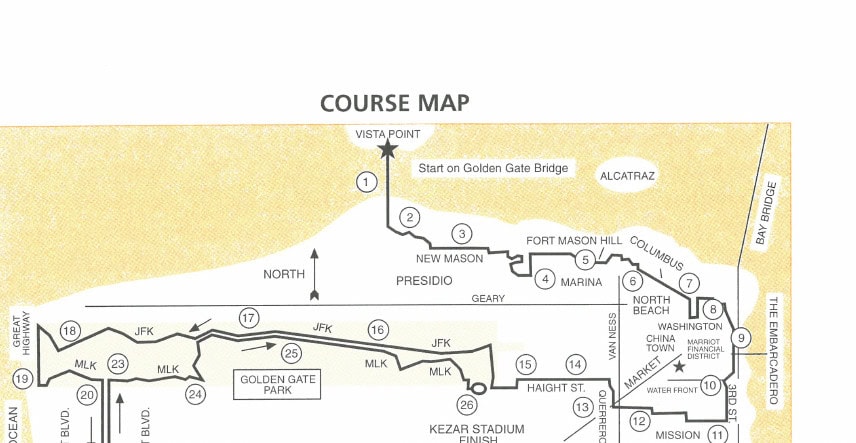
Boston. Just beyond the famous Haight-Ashbury intersection at mile 14.7, San Francisco running institution Hoys Sports offers Gu to the runners, a custom that deserves repetition elsewhere.
Once across Stanyan Street at mile 15.5, the remainder of the race is run in Golden Gate Park and along scenic Sunset Boulevard. No crowds or cheers encourage racers until they reach the finish at the “new” Kezar Stadium, situated a mere long block from where the race entered the park some 11 miles earlier.
THE FINISH
Many runners appreciate the broad avenues that belong entirely to them as they wind through the magnificent park. And all runners give high marks for the fact that at the race’s conclusion at the city’s western edge, the course guarantees maximum exposure to fog and comforting marine air at the warmest time of the day in the Bay Area.
The Kezar Stadium venue enables the marathon to finish Olympic-style with runners taking a three-quarter lap around the state-of-the-art track. This splendid and newly reconstructed stadium accommodates waiting friends and families. There is a price to pay for the luxury, however. Kezar Stadium is located at the eastern, highest end of Golden Gate Park. To reach it, runners must make a gradual 100-foot ascent over the race’s final three miles.
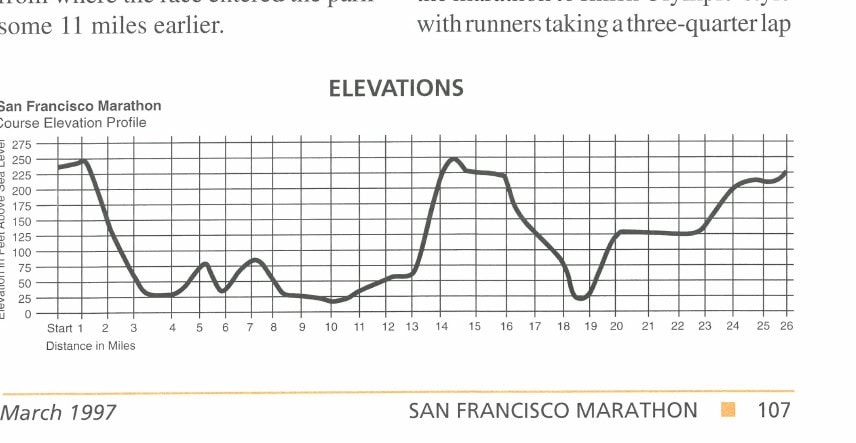
The course shows off much, if not all, of San Francisco’s distinctive scenery and marvelous diversity. Hills are unavoidable in a city built on at least seven of them, but the race confines and minimizes their impact as effectively as is possible, given the need to finish the event in Golden Gate Park and away from the downtown.
About the only thing lacking in San Francisco that is apparent at other urban marathons are crowds of spectators. But that is a condition that will likely remain. Most San Franciscans prefer to participate in their own activity than spectate someone else’s.
THE START
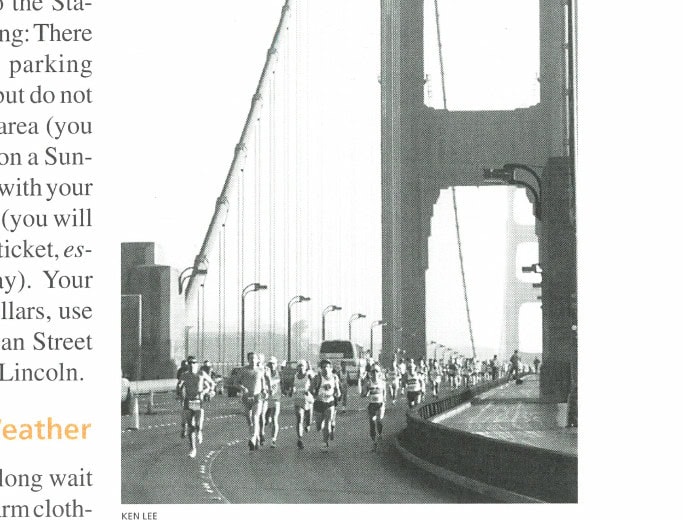
The San Francisco Marathon is privileged. It remains the only footrace in San Francisco for which Golden Gate Bridge traffic is diverted so runners can begin their race on the mile-long magic carpet leading into the city. But the logistics of such a spectacular start exact a price. You need to board buses between 6:00 and 6:30 A.M. to get to that start.
Like the New York City Marathon, San Francisco cannot allow private vehicles to transport runners to the staging area. But unlike New York, runners are not forced to wait at the staging area for hours as a result. Runners wait at the vista point on the Marin County side of the bridge for about an hour—enough time to find your friends and use the port-a-johns.
Bus service to the start has proven extremely reliable in recent San Francisco Marathons. You can either leave from the headquarters hotel (the Marriott) or from the finish area at Kezar Stadium at the southeast corner of Golden Gate Park. There is no need for out of towners to bring a car. However, if you or family members do drive to the Stadium, heed this warning: There is generally ample parking around the stadium, but do not park in a prohibited area (you will get towed, even on a Sunday), and do not park with your wheels on park grass (you will receive an expensive ticket, especially on a Sunday). Your best bet? For five dollars, use the pay lot off Stanyan Street between Waller and Lincoln.
Dress for the Weather
Because of the hour-long wait at the staging area, warm clothing is a must. Recall Mark Twain’s observation of weather in San Francisco—”The coldest winter I ever experienced was a summer in San Francisco.” If it’s a typical foggy morning, about the coldest spot in the Bay Area is at the Golden Gate Bridge. But you can shed the warm-ups for the race, put them in a numbered race bag, and meet them at the finish line. Even if fog prevails for the entire race, a singlet may still be the right shirt choice for this benign, air-conditioned climate. Unlike the warm-up clothes retrieval fiasco at Boston Common in 1996, it’ll take you a matter of seconds to retrieve your warm sweats at the Kezar finish area.
THE PRELIMINARIES
In recent years, the San Francisco Marriott has served as race headquarters. Its bizarre semi-neoclassical architecture has yet to be accepted by natives of the City by the Bay. The hotel is less than kindly referred to locally as the Marriott Wurlitzer, but its prime location at Market and Fourth Streets serves the out of towner well. The hotel is located at stops for both BART and MUNI (the regional and municipal transit systems), which enable visitors to forego renting a car while in town.
Close by the hotel is Union Square, with our country’s most compact and eclectic collection of shopping institutions surrounding it on all sides. Also at the hotel’s doorstep is the main terminal of the cable car line, which can carry runners to Nob Hill, Russian Hill, and Aquatic Park, all places deserving of a visit on foot and all offering a variety of dining opportunities.
Moreover, for richer dining and entertainment, the fit marathon runner can walk north to Chinatown and North Beach, or south and east to the new Yerba Buena Center and the city’s newest “signature” building, the Museum of Modern Art. The more adventurous visitor will want to explore beyond Yerba Buena to the energetic South of Market (SOMA) and South Beach neighborhoods, which contain the city’s most forward-looking night spots and residential communities.
For a race that is at best midsized, the San Francisco Marathon presents a respectable expo at the Marriott. The race also features a carbo load at the Marriott on the eve of the marathon, but only the most unimaginative visitor could fail to find far more interesting cuisine in Chinatown, North Beach, or better yet, in the less touristy neighborhoods of the Fillmore District, Cole Valley, Irving Street, or Noe Valley—all of which can be reached easily by MUNI from the race headquarters hotel.
THE GOODIES
When the San Francisco Marathon T-shirt and poster are good, they are among the best in the sport. The 1996 T-shirt immediately became a classic for its elegant Golden Gate Bridge design and subtle appearance of only one sponsor’s logo. The accompanying 1996 poster was the best bargain we’ve ever seen in quality running art. An individual silk-screen copy costs $22 and is already showing up in San Francisco galleries! (The 1997 poster looks equally impressive.) The poster is also replicated in a postcard—by far the most attractive marathon postcard we’ve ever seen. If future years stick to this standard, runners will be proud to show off their San Francisco Marathon mementos.
The prerace program and results booklet, however, are another matter. They are as weak as the T-shirt and poster are strong. The program has a few statistics slipped in between the sponsors’ ads. Your local throw-away newspaper sets the quality standard for the results booklet—actually it’s just part of the USATF regional bimonthly newsletter.
Perhaps with the 20th anniversary this year, race management will surprise us with improved publications.
EVERY major city in the world features an array of attractions that make it unique and that enlighten and entertain visitors. And, because of its very size, every major city is saddled with areas it would rather have vanish in a puff of smoke. The following is a brief consideration of both.
GO SEE IT
Golden Gate Park. Along with Central Park in New York City and Stanley Park in Vancouver, at over 1,000 acres, this is one of the most beautiful urban parks in North America. It’s a they-said-it-couldn’t-be-done park laid down on top of sandhills that everyone predicted would never take to sod. The park is a runner’s paradise, with rolling hills, ever-changing vistas, paved roads, asphalt walkways, and wooded trails. The park is three miles long and features everything from a fly-casting pond and a model boat pool to a rose garden and a buffalo herd. Within the park there are also some excellent must-see attractions: the Conservatory of Flowers, the M.H. de Young Memorial Museum, the Asian Art Museum, the California Academy of Sciences, the Steinhart Aquarium and Morrison Planetarium, the Japanese Tea Garden, and the Strybing Arboretum and Botanical Gardens. Since the race ends in Golden Gate Park, a walk around and through its attractions is a great way to walk the stiffness out of your legs after the race.
North Beach. If you like good, strong coffee, superb pasta, and a delightful neighborhood, the Italian-American North Beach is the place to visit. The center of North Beach is Washington Square—bordered by a cathedral, the Italian-American Athletic Club, Fiore d’Italia, and the Washington Square Bar & Grill—a peaceful patch of green within the heart of the city where you can relax on a park bench and lick ice cream while watching old men play bocce. It’s hard to find a bad cup of coffee or a bad restaurant in the North Beach area. This is the same place where Mark Twain hung out in the 1860s and where Jack Kerouac and the Beats did their thing in the 1950s. It is also probably one of the safest after-dark neighborhoods of any metropolis in the United States.
Museum of Modern Art. When the museum opened in early 1995, its architecture joined the Transamerica Pyramid and the Marriott as the subjects of controversy. Some love the Modernist lines and the atrium inside the building, while others consider the place an ugly monolith. It is located at 151 Third near Mission (only two blocks from the official race hotel), and admission is $7. Art and photographic exhibits come and go, but there are several permanent collections, such as “From Matisse to Diebenkorn: Works From the Permanent Collection of Painting and Sculpture.”
Noe Valley. Originally known as Nanny Goat Hill, later named (in 1846) after the last Mexican alcalde, this is a lovely, pleasant, Victorian-enriched neighborhood that’s out of the way of tourist buses and offers a well-sheltered escape from the hectic life downtown—even though it isn’t far from downtown. You’ll find a surplus of good restaurants and lots of pleasant strolling territory.
City Lights Books. Located at 261 Columbus, which is the intersection of Chinatown, North Beach, and the sleazy porn houses, the bookstore was founded by Lawrence Ferlinghetti in 1953 and served as the magnet of the Beat Generation. The store features one of the best inventories of Beat literature in existence. City Lights also publishes its own line of poetry books. It’s a wonderful place to browse, where you may come across that unexpected treat—a book you didn’t even know existed but that you’ve just gotta have.
South of Market (especially southern Embarcadero). A decade ago we’d have felt compelled to warn folks about the South of Market area, but redevelopment has been turning this section of the city into a gem. We urge you to soak up this section of town, which is a radical departure from the rest of the city. Walk from Yerba Buena through South Beach, down to the new developments and boulevard along the refurbished southern Embarcadero.
AVOID IT
Tenderloin. This area of town (north of Market, between Taylor and Larkin streets) is pretty seedy, especially after dark. This is a good place to avoid, especially since there is so much worth seeing elsewhere.
Fisherman’s Wharf shops. The ultimate tourist trap, Fisherman’s Wharf has stores lining the streets screaming at you to buy stuff that you’ll chuck into a closet and forget when you get home—or throw into the next clothing drive or garage sale. Again, there is so much to see and do in San Francisco—you don’t need to waste your time here.
Union Square. Union Square is a square block of grass with an underground parking garage down where the roots live. It used to be surrounded by elegant department stores, but Union Square has been undergoing a sort of “de-vival” with the arrival of places like Virgin Records, Nike Town, and other contemporary merchants. These are mere shadows of the grand stores that used to grace this little enclave.
But don’t come to San Francisco expecting prerace or postrace materials that equal those of the Boston or New York City marathons.
A BARGAIN, BUT . . .
If a runner signs up early (before Memorial Day), San Francisco remains a bargain at $35. Like Boston and New York, San Francisco also requires a $15 USATF membership, which in San Francisco’s case can seem a bit like extortion, since the USATF actually presents the race. However, we believe that membership in our sport’s governing body is a good idea, especially now that the USATF may be paying more attention to the needs of long distance running. But even if you don’t philosophically support the USATF, the marathon is well worth the $50 total.
When the San Francisco Marathon went city wide in 1982, its founders and many outside observers (including Fred Lebow) expected it to become part of a Big Three with New York and Boston. That expectation has never been fulfilled, in part because of local politics, lack of consistent major sponsorship, and because big-name runners have other summer commitments (i.e., the Olympics and world championships).
But given its location in “everybody’s favorite city,” its ideal climate for a midsummer race, and its timing halfway between Patriots’ Day and Halloween, the San Francisco Marathon does remain the logical third race for urban marathoners.
Now that the race has performed well for several years as a medium-sized event, it should not be long before sponsors and runners from around the nation and the globe raise it to the stature of a major event.
Runner’s Highs/Runner’s Lows
| HIGHS | LOWS |
|---|---|
| Delightful, exciting city | Hills on the course |
| Outstanding T-shirts and poster | Atrocious race program with little useful information but lots of ads |
| Extremely scenic course | Spectators few and far between |
| Compact expo | |
| Golden Gate Bridge start | |
| Kezar Stadium “Olympic”-like finish |
The Bottom Line
We have weighed various aspects of a marathon within a 1,000-point scoring grid. Besides the author of the article, a dozen runners at the race were randomly chosen to score the race for us. (SFM = San Francisco Marathon.) The results follow:
1. HISTORY/TRADITION
Evaluate the race’s sense of history and tradition.
[Possible points: 30 SFM score: 20]
2. ENTRY FORM
Is the race entry form clear, concise, attractive, complete, and easy to fill out?
[Possible points: 20 SFM score: 18]
3. ENTRY COST
For most races, the entry fee covers between 30 and 50 percent of the cost of putting on the event. Rate the value of your dollar relative to this race.
[Possible points: 30 SFM score: 24]
4. LOCALE/SCENICS
Is the race held in an area that is easy to get to and scenic, offers adequate food and housing services, and nonrace activities for family and friends?
[Possible points: 50 SFM score: 49]
5. REGISTRATION
Is registration well-organized and efficient? Does it bog down unnecessarily?
[Possible points: 20 SFM score: 18]
6. PRERACE ACTIVITIES
Evaluate activities such as pasta feeds, parties, and so on, during the days before the race.
[Possible points: 50 SFM score: 36]
7. EXPO
Does the expo offer a fair number and variety of booths relative to the race’s size? Are there quality exhibitors and good guest speaker(s).
[Possible points: 50 SFM score: 34]
8. COURSE
Take into consideration the following: degree of difficulty, certified, sanctioned, quality of road or trail surface, adequate mileage and directional
markers, aid stations, medical coverage, race communications, accessibility to course for friends and family, typical weather, and so on.
[Possible points: 400 SFM score: 337]
9. RACE AMENITIES
This category includes race T-shirt, finisher’s medal, finisher’s certificate, adequate and efficient finish area, ease of sweatbag retrieval, showers, postrace refreshments, awards ceremony, raffles, results postcard, results book, and so on.
[Possible points: 250 SFM score: 188]
10. VOLUNTEERS
Are the volunteers experienced and adequate in number?
[Possible points: 100 SFM score: 80]
TOTAL SCORE FOR SAN FRANCISCO MARATHON:
804 points (out of 1,000)
This article originally appeared in Marathon & Beyond, Vol. 1, No. 2 (1997).
← Browse the full M&B ArchiveMore like this
1,000+ stories from 19 years of Marathon & Beyond
The complete archive of the legendary long-distance journal — digitized and free to read.
