

Sara Day’s Quest
CAMP LIBERTY, BAGHDAD, IRAQ—First Lieutenant Sara Day had just hopped on the back of a bus near the massive concrete barriers that protect her sleeping trailer from incoming rocket and mortar attacks here at a barren military base just west of Baghdad’s International Airport. The 28-year-old soldier was taking part of her platoon over to the fitness center—actually an enormous air-conditioned canvas tent—for a group workout. But Lieutenant Day was slightly annoyed. Her close friend in the platoon, Staff Sergeant Christine Cooper, was a minute or two late, holding up everybody on the bus.
Lieutenant Day could see the usually punctual Staff Sergeant Cooper scurrying toward the bus. Suddenly, a big boom rocked the air; that awful noise means incoming indirect fire—in this case, a rocket had hit the U.S. Army base. Out the grimy window of the dilapidated bus, Lieutenant Day could see Staff Sergeant Cooper dive down headfirst, landing spread-eagled with her nose buried in the hot sand. Soldiers are taught to get as flat as possible when rockets or mortars are landing. It was July 2007, four long years into the Iraqi conflict.
Staff Sergeant Cooper was uninjured. Lieutenant Day and her soldiers proceeded about a half mile to start their daily session of physical training. But there was a commotion at the fitness center. It turned out that the rocket had landed about 30 meters in front of the entrance to the PT tent. A young female soldier, the military policeman assigned to guard the entrance to the tent, had been hit by shrapnel and killed. Lieutenant Day couldn’t help but choke back the morbid thought that if Staff Sergeant Cooper had been on time, she and her soldiers would have been walking into the entrance of the tent when the shrapnel was flying.
For Lieutenant Day, a shy and unassuming woman who spent her early years on a North Carolina dairy farm, this was just another day at work, albeit at work in a war zone. It is here, at dreary Camp Liberty, where Lieutenant Day and the 19 soldiers she is responsible for in her platoon grind through 80-hour weeks. They go months at a time with nary a day off. Like the 168,000 other American soldiers here, Lieutenant Day is doing her bit for Operation Iraqi Freedom.
ASSIGNED TO BE ON THE MOVE Lieutenant Day’s platoon is part of a headquarters and services company in a special-troops battalion in the Army’s First Cavalry Division. In civilian terms, that means she and her troops maintain a fleet of vehicles; they take soldiers and equipment where they need to be. Sometimes that means cruising 20 miles through the desert to drop off a generator at an outlying Army post. Other times this means driving in heavily armored convoys into dangerous parts of Iraq where they are fired at or run the risk of getting blown up by an improvised explosive device, an IED as they are known here.
This is also where Lieutenant Day—a talented scholarship track athlete at Wake Forest—is training to try to qualify for the Olympic Marathon Trials. She is on target to do so, despite incredibly harsh training conditions. Her extremely long hours are the least of her problems. Daily summer temperatures here hover between 110 and 120, often even higher. Running outside is virtually impossible except in the wee hours of the morning, a tough task before starting a 15-hour workday. Forget about massages or coaches. To the degree that Lieutenant Day even has a coach, it’s the resourceful—if self-taught—Staff Sergeant Cooper, who spends a lot of time online looking at training programs and diet regimens. Medical facilities at the Army base are first-rate for soldiers who have been shot up but aren’t much when it comes to athletic injuries. When Lieutenant Day had terrible shin problems during her training, she was unable to get a simple X-ray to indicate whether the pain was triggered by a stress fracture. “They put a tuning fork on it and gave me two cortisone shots,” she explains. “I’ve never been much for doctors.” She is better now, but she never got a diagnosis.
It gets worse. There is no track here. The food in the dining facility is institutional and heavy on fried foods. Lieutenant Day has no access to PowerBars, her energy bar of choice. The fitness center has only five treadmills, all of which are often in use. It can take weeks to get proper running shoes shipped over. The Army post exchange doesn’t carry the adidas Supernovas that Lieutenant Day prefers. The only outdoor running surfaces are concrete roads, left over from Saddam Hussein’s days. Lieutenant Day shares a tiny trailer—smaller than a standard walk-in closet—with another female officer. She must go outside to locate a latrine or shower.
The Army’s “morale, welfare, and recreation” program occasionally puts on races but they are informal affairs where Lieutenant Day rarely has serious competition. Even in the ultra-fit Army world, she typically whips all the men. In May, she easily coasted to victory in the Baghdad half-marathon—staged amidst several of Saddam’s former palaces—in a time of 1:23. Then, of course, don’t forget the factors that make training for a marathon here most difficult: the daily stresses and meager living conditions associated with living in a war zone. In short, people—soldiers and civilians alike—are getting killed here.
▲
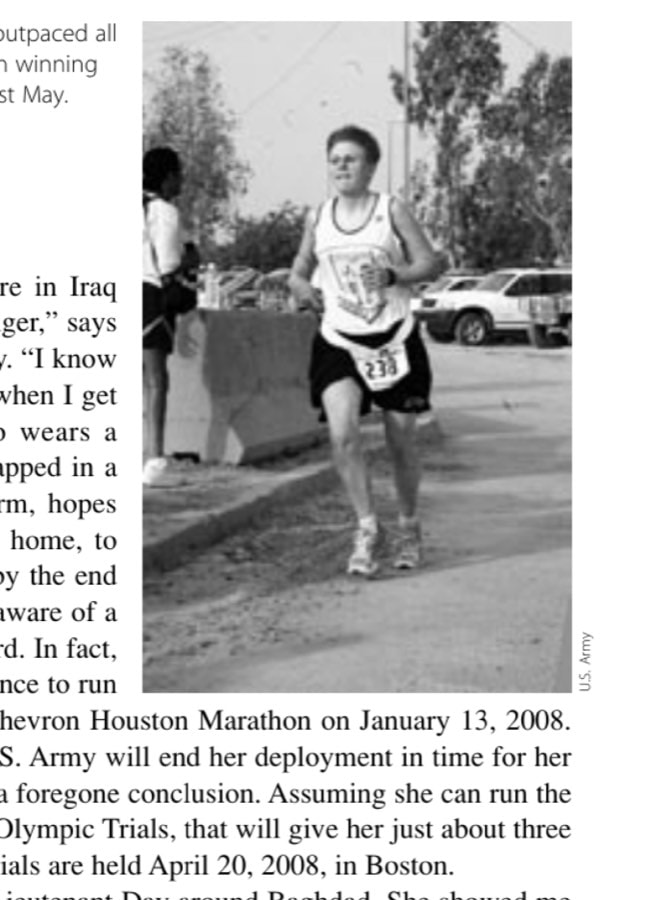
First Lieutenant Sara Day easily outpaced all challengers—including the men—in winning the 2007 Baghdad Half-Marathon last May.
“I just figure that training here in Iraq will make me harder and stronger,” says the unflappable Lieutenant Day. “I know it’s going to give me an edge when I get home.” Lieutenant Day, who wears a 9-millimeter Beretta pistol strapped in a shoulder harness under her arm, hopes her unit will be shipped back home, to Fort Hood in Killeen, Texas, by the end of December. She is only too aware of a marathon nearby soon afterward. In fact, Lieutenant Day’s only real chance to run her qualifying time is at the Chevron Houston Marathon on January 13, 2008. Of course, that assumes the U.S. Army will end her deployment in time for her to compete in the race, hardly a foregone conclusion. Assuming she can run the 2:47 needed to qualify for the Olympic Trials, that will give her just about three months to recover before the trials are held April 20, 2008, in Boston.
I spent three days trailing Lieutenant Day around Baghdad. She showed me three of her six tattoos; my favorite is etched into her right forearm in thick black script: “Without evil there can be no good.” Through all the hours I spent at her side, not once did I hear her complain. Never did I hear a drop of self-pity. “We all know that she doesn’t have the right assets here to train properly,” reports Staff Sergeant Raymond Martinez, 33, from Montrose, Colorado, one of the soldiers in her platoon. “But she makes do with what she has. She does it freehand. She’s no complainer. She’s always encouraging us. That’s just who she is.”
Yes, that is who she is. Here is her background: Lieutenant Day was born into a decidedly middle-class home in Winston-Salem, North Carolina. None of her family had even been to college. Her father was a dairy farmer; her parents split when she was 11. Lieutenant Day’s mother was left to raise two kids on a bank teller’s salary. Her mother eventually remarried but has divorced again. “My mom always insisted that we focus on schoolwork and sports so we could get ahead,” Day explains.
The young Sara Day worked at Mr. Gatti’s, the fast-food Italian chain, to help make ends meet. She was an athlete, playing softball and basketball mostly. Day
U.S. Army
THE BIG OPPORTUNITY COMES IN HOUSTON
eventually discovered running at tiny Ledford Senior High School. By sophomore year, she was the North Carolina state champion at both 800 meters and the mile. Day’s track coach, the local algebra teacher, didn’t know diddly squat about running; lack of good coaching would be a familiar pattern throughout her running career.
No matter. With her track times and 3.9 grade-point average, athletic scholarships began pouring in from around the country. Day eventually settled for nearby High Point University, a tiny liberal arts school in High Point, North Carolina. A smalltown girl, she wanted to be close to home. But Day quickly grew frustrated at High Point. Once again, she had a coach who knew little about distance running. Her coach simply saw that he had a fast girl and had her randomly competing in the 1,500, 5,000, 10,000, and 4 × 400.
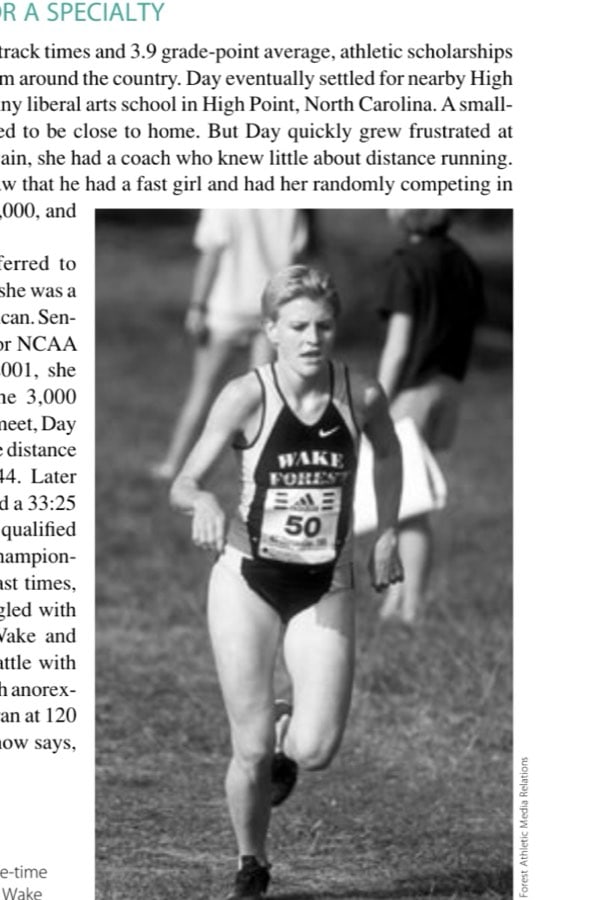
She soon transferred to Wake Forest, where she was a three-time All-American. Senior year, at the indoor NCAA championships in 2001, she posted a 9:23 in the 3,000 meters. At the same meet, Day ran the mile leg of the distance medley relay in 4:44. Later that year, she clocked a 33:25 in the 10,000, which qualified her for the NCAA championships. Despite the fast times, Day says, she struggled with her self-image at Wake and waged a constant battle with eating disorders, both anorexia and bulimia. She ran at 120 pounds, which she now says, was “way too thin.”
▲
Sara Day was a three-time All-American athlete at Wake Forest University.
Wake Forest Athletic Media Relations
NO CHANCE FOR A SPECIALTY
It was at Wake that she began running under the tutelage of coach Annie Schweitzer Bennett. The two quickly bonded. Even today, Day is in e-mail contact from Baghdad with her former coach. “Sara was not the most talented runner I’ve coached,” Bennett recently recalled from her Winston-Salem office. “But she was determined to be a nationally ranked runner. And she was willing to make the hard sacrifices to make that happen.” (After graduating, in 2001, Day ran a 33:25 in the 10,000 meters at the USATF championships at the University of Oregon, where she placed 10th in a field of professionals.)
Day had graduated from Wake with a degree in sociology, with an eye toward maybe joining the FBI one day. Instead, she drifted back to High Point, took a meaningless job, and started writing letters to adidas and Nike looking for someone to sponsor her running. “Then 9/11 hit, and I figured I ought to be doing something more meaningful,” recalls Day. “So I walked into an Army recruiting office. I had no idea what I was doing.” The Army recruiters, however, knew exactly what they were doing. In short order, Day was placed in the World Class Athlete Program, where top Army athletes—those who have a shot at the Olympics—train full-time on the Army’s dime. The goal was the 10K. To qualify for the Olympic Trials, a 33:20 is needed. Day peaked at 33:22.
ad
“Two seconds,” laments Day. “That was it.” It was around this time that she decided to run a marathon, just for the heck of it—and without training. She opted for the San Antonio Marathon. In November 2004, she turned in a tidy 2:54—not bad, considering that she hadn’t done any of the proper preparations.
RUNNING WAS SUDDENLY NOT A PRIORITY It is up or out in the Army. For Lieutenant Day, that meant it was time to be a soldier. The Army sent her to Officer Candidate School, and that’s how Day eventually found herself one day in Texas, at Fort Hood, in the First Cavalry Division. At this point, she had essentially abandoned her dreams of Olympic glory and was instead focusing on her Army career. When her unit got the orders to ship out for Iraq in October 2006, she had given up on competitive running altogether. Lieutenant Day had added 35 pounds since her days at Wake; she tipped the scales at 155 when she shipped out. She was frustrated, burned out, and ready to move on.
That was until she met the estimable Staff Sergeant Cooper, the same Staff Sergeant Cooper who had been late for the bus. A lanky and upbeat 31-year-old dynamo from Springfield, Illinois, Cooper had herself been an All-District basketball player in high school who had run a 5:20 mile. She was determined not to let the dreams of her boss, the talented Lieutenant Day, die here in the barren Iraqi desert. Staff Sergeant Cooper started by ordering the book, Daniels’ Running Formula, by legendary running coach Jack Daniels, from amazon.com. Then she set about persuading Lieutenant Day to get off her duff and run.
It’s not easy to say no to Staff Sergeant Cooper, a tough cookie herself. In her last deployment, in 2004, Staff Sergeant Cooper was the truck commander of a 2,500-gallon fuel truck that was running between two hot spots in Iraq—the U.S. Army bases at Taji and Anaconda. The truck hit an IED. “I shot at the bad guys and we continued through the kill zone,” Staff Sergeant Cooper recalls without emotion. She lived to convoy another day.
By late May 2007, Staff Sergeant Cooper had Lieutenant Day doing regular interval workouts, and they started ramping up her long runs. More marathon training programs were consulted online, including the Runner’s World Smart Coach training program. Soon Lieutenant Day was knocking out eight 440 intervals in 72 seconds each, with about two minutes’ rest. Staff Sergeant Cooper also had her lieutenant pounding out mile repeats at 5:18 on the treadmill, with rests of 105 seconds.
Interestingly, their track was a paved road around what is known here as signal hill, a raised mound with much U.S. military telecommunications perched on top. Insurgents, who can see the hill from miles off, often aim mortars at it.
Willy Stern
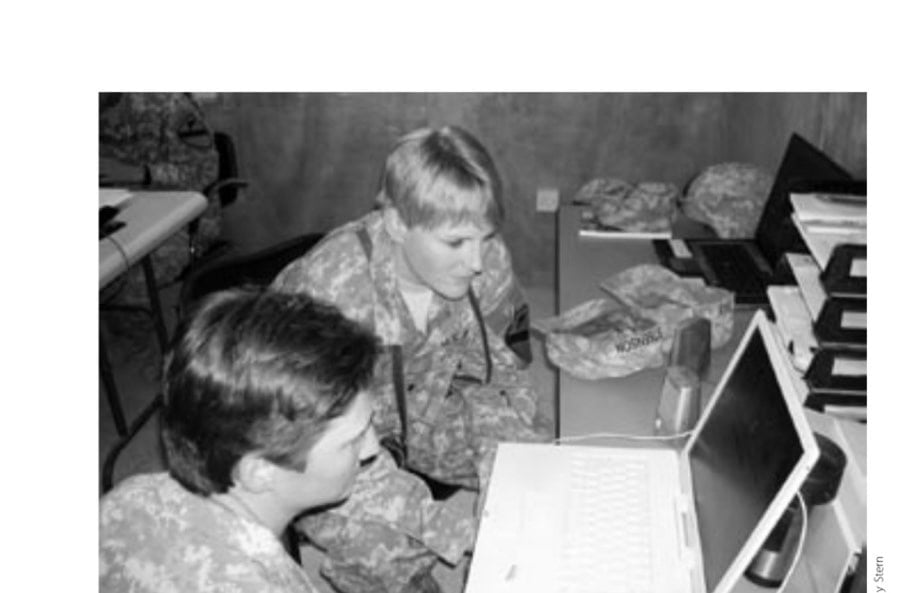
▲ Staff Sergeant Christine Cooper (in foreground) and First Lieutenant Sara Day plot out transportation logistics in their makeshift Army office at Camp Liberty in Baghdad.
Sometimes they hit it. “We like to say we’re running in mortar valley,” says the matter-of-fact Lieutenant Day. “But on that loop, every quarter mile is marked. It works for us.”
NOTHING FANCY ON THE LONG RUNS The long runs also take some ingenuity. Staff Sergeant Cooper rode along on a beat-up Jeep mountain bike until it was stolen. Says Lieutenant Day, “We have to figure out a way to get another bike.” They haven’t had time to look yet. Before their wheels were nicked, Staff Sergeant Cooper duct-taped extra water bottles to the bike’s frame and carried a bottle in each hand. The water in at least two of the bottles is completely frozen when they start out. In the desert heat, it doesn’t take long before the ice is hot water. They leave at 5:45 A.M. to avoid the simmering heat. On her last 15-miler, Lieutenant Day averaged 6:45 per mile. By the time she was hammering out the last few miles, the temperature was approaching 110. She takes no GU or sports drink. “I just don’t like them,” she says. “Water works, heck yeah.”
Staff Sergeant Cooper has Lieutenant Day eating 1,500 to 1,700 calories a day. She eats a lot of tuna fish (which she buys at the PX) on Wheat Thins. What little free time Lieutenant Day has is invested in reading. She’s a Harry Potter nut
and devours the novels of Michael Connelly. One more burden: In keeping with local customs, all military bases in Iraq are dry. The Army takes the ban on alcohol seriously. “You kind of miss that keg of beer after a race,” says Day.
No matter. In short, Lieutenant Day is confident she can run a 2:40 in Houston. Staff Sergeant Cooper has her on a program that includes two 20-milers and two 18-milers. Her peak weekly mileage will be around 75. She just powers on. She is not looking out only for herself either. Lieutenant Day runs six times a week with her overweight soldiers, trying to help them with their fitness. For her, that is part of being a platoon leader. She shrugs off any suggestion that this may interfere with her own training. “It’s just something we do,” she says.
Lieutenant Day’s boss, the congenial Captain Sean Imbs, is a huge fan, even if he is saddened that he is unable to cut Lieutenant Day any slack to free her up to run more. “No other Olympic hopeful would consider training in these stressful conditions,” he says. “It’s a combat zone!”
Combat zone it may be, but for Lieutenant Day, it’s where she shows up for work every day and serves her country in time of need—and does a bit of running when she can.
Willy Stern
▲
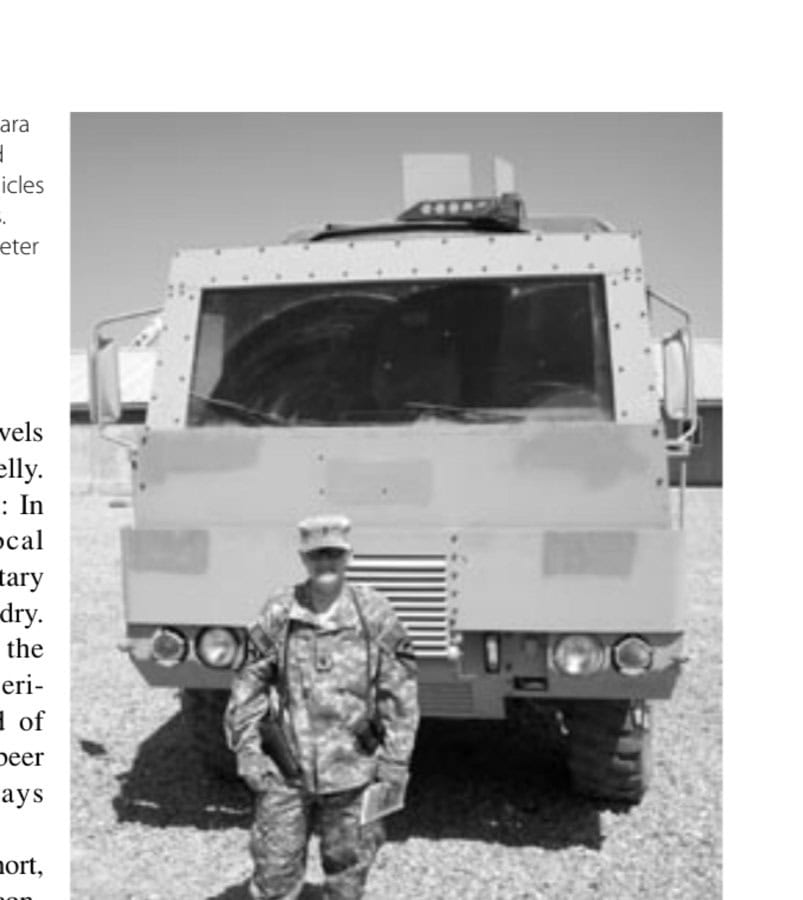
First Lieutenant Sara Day with an armored truck, one of the vehicles her platoon operates. Note the nine-millimeter Beretta pistol in her shoulder harness.
This article originally appeared in Marathon & Beyond, Vol. 12, No. 1 (2008).
← Browse the full M&B ArchiveMore like this
1,000+ stories from 19 years of Marathon & Beyond
The complete archive of the legendary long-distance journal — digitized and free to read.
