

Scott Jurek is not all that different from you and me. Honest.
Sure, his feats of endurance, which include an impressive 2004 grand slam of four of the most grueling 100-milers in North America and a streak of seven consecutive Western States 100-Mile Endurance Run titles seem other worldly. Yes, his record of 15:36:27 on the legendary Western States course may just take a dozen or so years for someone to match. And it goes without saying, of course, that his astonishing 2005 double, in which he prevailed at both Western States and the 135-mile Badwater Ultramarathon in the span of just 16 days, was anything but ordinary.
But Jurek himself would be the first to insist that he is far from being some kind of running Hercules.
“I’m not as much of a natural athlete as I am somebody who just puts a lot of effort and soul into training,” he says.
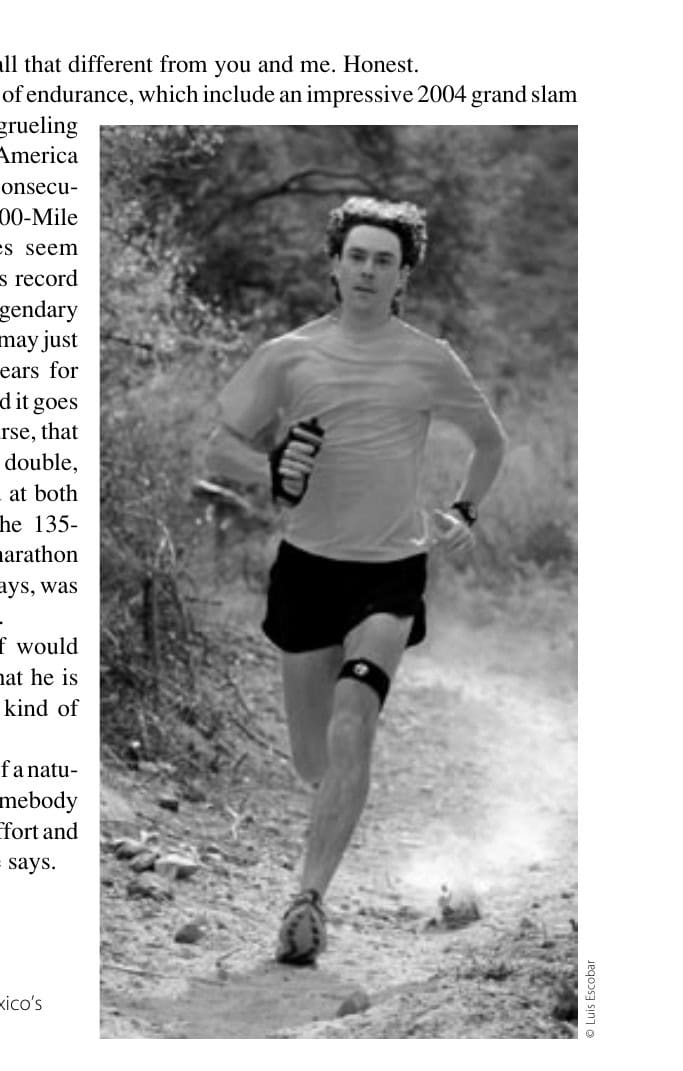
For the soft-spoken Jurek, his illustrious journey through the world of long-distance running has been not so much about trophies, belt buckles, records, or superhuman efforts as about testing personal limits—and not anyone else’s, just his own.
“It’s more than just seeing if you can get from point A to point B,” Jurek says of his life’s pursuit. “It’s more about self-discovery.”
Conduct an informal survey at the start line of any marathon or ultramarathon, and you will likely hear the same type of explanation as to why the majority of the competitors have chosen to undertake the challenge ahead.
In many ways, in fact, it’s this precise mind-set that has been fueling the current running boom. More and more people, it seems, are turning to endurance sports because they yearn to experience tangible personal growth. Long-distance running, unlike most aspects of modern-day life, draws precise lines of black and white.
Either you do, or you don’t. It’s as simple as that. Jurek does—and has for a long, long time.
SETTING ASIDE THE SKIS AND POLES
It wasn’t supposed to be like this for Scott Jurek.
As a youngster growing up in the small town of Proctor, Minnesota, he never set out to become a champion runner. Yes, he excelled at footraces in elementary school, but by the time he graduated from college, the sum of his experiences with the organized side of running consisted of just one season of junior high school track and part of a season of high school cross-country.
It’s not that he wasn’t good enough to make the grade; he just wasn’t smitten with the sport.
“I was uninterested in running,” Jurek admits. “I actually disliked running.”
The activity for the young Jurek was merely a means to bolster his fitness for the real love of his life at the time, Nordic ski racing. Cross-country skiing is huge in Minnesota—so popular, in fact, that some 70 percent of high schools field a team. Jurek came to live for the sport.
Jurek’s cardiovascular gift was apparent from early on. Even though he didn’t pick up the racing skis and poles until he was a teenager, Jurek progressed so quickly that he twice competed at the Junior Olympics.
The more time Jurek spent cross-training on the rural routes surrounding Duluth during the off-season with his close friends, though, the more he began to appreciate running.
“I loved spending time on the trails,” Jurek recalls. “We’d go out for three hours. Being out on those long trail runs, and some long hikes with ski poles, really got me into running.”
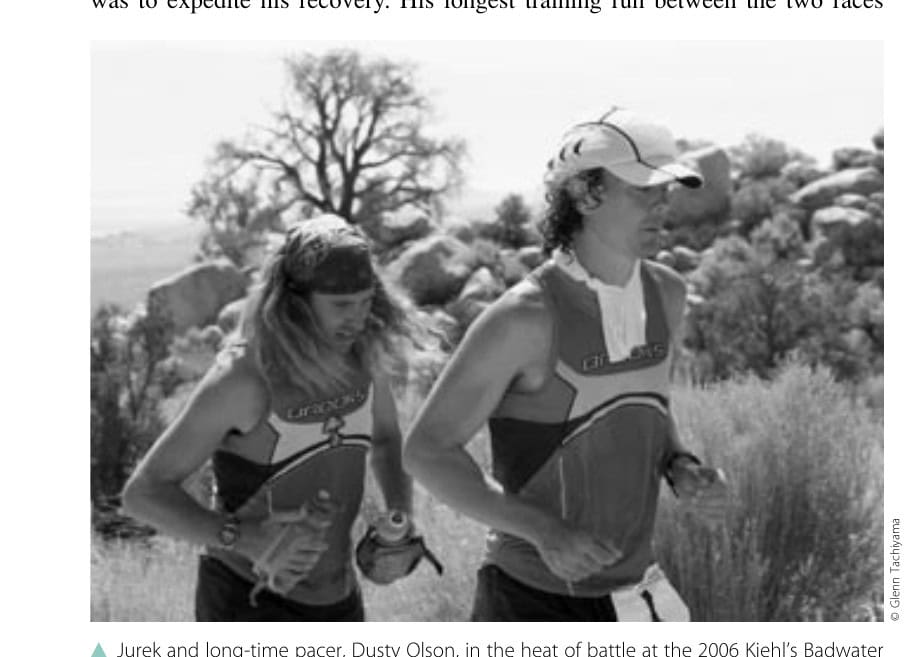
In 1994, when Jurek was a 20-year-old sophomore at College of St. Scholastica, a small private college in northeastern Minnesota, Dusty Olson, a close friend, persuaded him to set his sights on the upcoming Minnesota Voyager, a 50-mile ultrarace. Olson, a top cross-country skier at the time who remains one of Jurek’s principal ultra pacers, had run the race on a whim the year before, and his enthusiasm over the event persuaded Jurek to give it a shot.
“He wasn’t really the fastest guy back in high school,” says Olson, “but he was always super tough on the hard workouts.”
Jurek’s preparation for his first ultra was neither lengthy nor well thought out.
To help gain an understanding of how best to pace himself while racing long distances, Jurek ran the popular Grandma’s Marathon. He broke three hours. A month later, on a dreadfully hot and muggy Minnesota day, Jurek blitzed through the Voyager course to place second overall.
Despite his immediate success in the ultradistance, though, Jurek was less than enamored of the experience.
“It wasn’t love at first sight,” Jurek says. “I thought it was the hardest thing I’d ever done. Right after I crossed the finish line, I said, ‘Never again.'”
PUSHING THE RUNNING ENVELOPE
Jurek’s athletic abilities, like those of most endurance athletes, are subtle in nature. To see him peddling his bicycle along the streets of Seattle, you would certainly never mistake him for a star wide receiver for the Seahawks or a power forward for the Supersonics.
There are no bulging biceps to boldly announce his physical prowess nor tree-trunk legs that extend toward the snowy peaks of the Cascade Mountains. An unsuspecting onlooker might, in fact, regard the runner and his 6-foot-2-inch, 165-pound frame as being downright unathletic, unassuming, and perhaps even bordering on the scrawny side.
But just as the sport of ultrarunning, by its very nature, is quiet and subdued, so too are the gifts of its most prodigious stars. Crack open Jurek and you will find a cardiovascular network that is more sophisticated than virtually anyone else’s on the planet. Peek into his belly and you will discover a competitive drive as combustible as any inside those who ply their trade in front of millions on hardwood floors or on gridirons. And cup your ear to his psyche and you will hear the same type of resolve that garners all-star and most-valuable-player status in other sports that receive more media attention in a single day than Jurek’s sport does in an entire year.
Jurek refutes the notion that all, or even most, of his success can be attributed to little more than genetics. Neither of his parents, he points out, were endurance athletes. He grew up, instead, in a traditional hunting and fishing family.
Still, it’s not every 20-year-old who can knock off a sub-three-hour marathon with minimal focused training his first time out and then follow that up with an impressive effort in his first 50-miler while competing against runners with far more experience.
For his part, Jurek concedes that the one thing that might differentiate him from others is his ability to “take a fair amount of discomfort for a long period of time.”
“He can zone out a lot of pain,” says Olson. “He doesn’t lose his marbles very often, and when he does he usually recovers and gets right back into the game.”
In the end, though, Jurek’s greatest gift may have nothing to do with innate ability, agony thresholds, or even laser-sharp focus, but rather with imagination.
Endurance athletes like Jurek are a modern-day Livingstone, Hillary, or Shackleton. They may not be pushing to uncover the most remote corners of the physical world, but they do, much like their historical counterparts, relish in revealing the capacity of the human will.
“You really enjoy the challenge beyond the pain and the discomfort,” Jurek explains.
The Jurek types are transfixed by the unknown and driven by fresh possibility.
Life is not defined by what has been done. It’s instead defined by what can be done. It’s an exercise in making the infinite finite, and of making the impossible possible.
Not surprisingly, Jurek admits that part of his motivation in the sport has been his fascination with figuring out what “drives an individual to do what might seem like extraordinary things.”
HITTING HIS STRIDE
Jurek and his wife, Leah, a massage therapist and also an ultramarathoner, discovered the Seattle area while he was undertaking a postgraduate internship in physical therapy. The Jureks moved back to Seattle for good at the behest of a friend who needed help at a newly founded running store.
“I really enjoyed the western mentality and the people out in this area,” he says. “Northern Minnesota is a beautiful spot, and I obviously enjoyed winter because of my skiing background, but I was just really drawn to the mountains.”
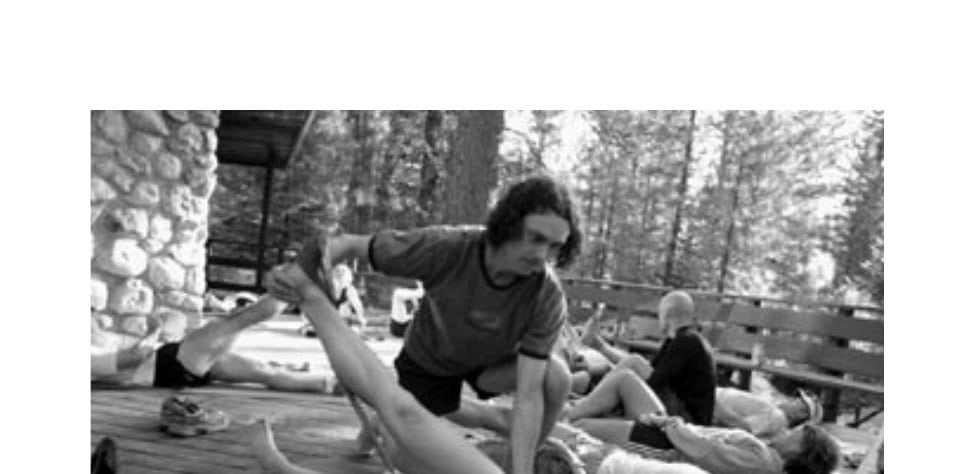
Seattle has been good to the Jureks. The low-key ambience of the city, coupled with the natural environs that overflow with an abundance of trails, has proven to be an ideal fit. In addition to their therapy practices, the Jureks have created a company called Beyond Running that offers, among other things, biomechanical analysis, coaching, and running camps. Their objective is not only to improve their clients’ running but also to help them achieve optimal health.
Though Jurek had heard about the annual footrace known as Western States as he was transforming himself into an ultramarathoner back in Minnesota, it wasn’t
until he and Leah made their first trip to the West Coast that he began to gain a full appreciation for the event.
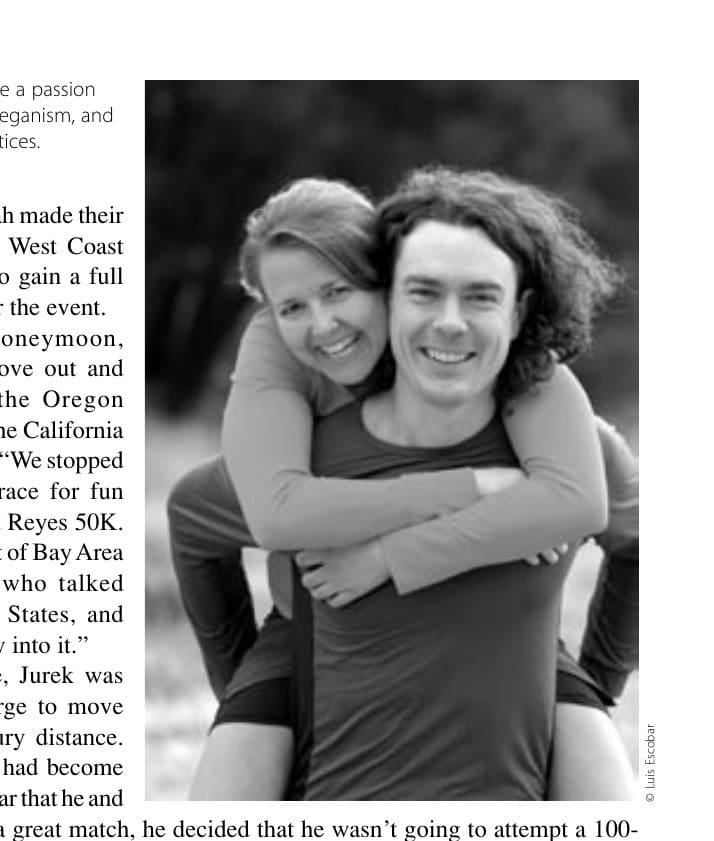
“On our honeymoon, we actually drove out and did some of the Oregon coast down to the California coast,” he says. “We stopped off and did a race for fun called the Point Reyes 50K. There were a lot of Bay Area runners there who talked about Western States, and they were really into it.”
At the time, Jurek was resisting the urge to move up to the century distance. Even though it had become increasingly clear that he and the sport were a great match, he decided that he wasn’t going to attempt a 100-mile race until he reached at least 30 years of age.
But Jurek’s entire running history has been fueled by an explorer’s restless curiosity, so it came as no surprise to those closest to him that in 1998, when he was just 24, he tackled his first 100-miler, Angeles Crest.
A Southern California fixture for two decades, Angeles Crest annually attracts a strong field. Not only did Jurek place second overall by less than 10 minutes to Ben Hian, one of the top ultramarathoners in the country at the time, but the experience convinced him that his true destiny lay in triple-digit distances.
“I’d had quite a few 50-mile and 50K races under my belt before I did that race,” Jurek recalls. “I really found that 100-mile distance to be a strong distance for me. . . . I found out that I could hold a pretty good pace and even pick it up toward the end. I didn’t have major points where I was feeling either mentally or physically really down.”
After his extraordinary success in the San Gabriel Mountains, Jurek realized that not only should he participate in the next edition of Western States but that he might, just might, have as good a chance of winning it as anyone else.
“I know it sounds kind of overly confident,” he says, “but I trained as if I was going to win.”
WILD, WILD WEST
In 1974, a footrace was born almost by accident when Gordy Ainsleigh participated in the Western States Trail Ride without the benefit of a horse. While Ainsleigh may have been considered eccentric and perhaps more than a bit loopy, he was also a pioneer. No one realized it at the time, but once Ainsleigh proved that the rugged 100-mile course could be negotiated in less than 24 hours—his official time was 23 hours, 42 minutes—he unwittingly established a test of long-distance running that legions of others would want to try.
The inaugural Western States 100-Mile Trail Race made its debut three years later, and during the last three decades, thousands of runners have made a pilgrimage to this picturesque slice of the Sierra Nevada mountain range to hurl themselves feet first into some of the toughest conditions that Mother Nature can dole out.
Legends have been born on this jagged network of trails, once used by gold and silver miners. There were Bjorg Austrheim-Smith, who became the event’s first three-time winner; Tim Twietmeyer, who captured five overall titles; and of course the incomparable Ann Trason, whose prodigious, jaw-dropping efforts throughout the 1990s made her name virtually synonymous with this race.
Jurek has become the latest to carve his name into the mountains of northeastern California.
When Jurek captured his first Western States title in 1999, he did so with a precocious, almost puckish abandon. Even though he had spent virtually no time on the course before race day, he took the pace out hard and defied anyone else to stay with him.
Jurek was already a full seven minutes ahead of his closest competitor when he rolled into the Red Star Ridge checkpoint, just 16 miles into the race. Those chasing him, including Twietmeyer and dozens of other Western States veterans, surely believed that they would stumble across the impudent Jurek’s crumpled remains somewhere farther along the course. But every time they reached the next checkpoint, the race reports were unwavering: the kid is still several minutes ahead.
Jurek maintained his advantage until the Rucky Chucky checkpoint at mile 78. Then, running himself straight into ultra lore, he put the hammer down—way, way down—to win going away by almost half an hour.
Jurek made a habit out of returning to Auburn every June to see whether he could squeeze just a little bit more out of his mind and body. In 2000, he proved that his debut victory was no fluke, and in the process, he lopped nearly 17 minutes off his 1999 time. A year later, he whittled that time down by another 23 minutes, and then the following year, he dropped another 19 minutes. And so it went, year in and year out, as Jurek began to leapfrog over some of the fastest performances ever recorded at Western States.
“It’s a captivating energy,” says Jurek of the Western States experience he has come to cherish. “It’s the Boston Marathon of ultramarathons. There’s just that mystique about it.”
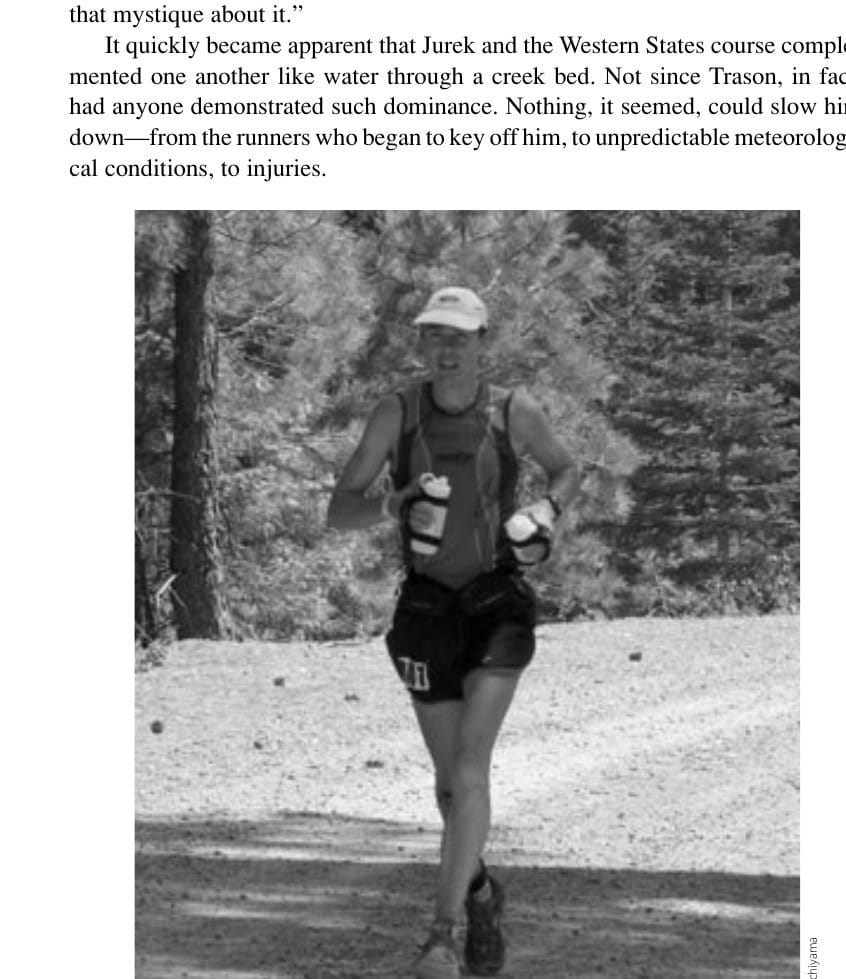
It quickly became apparent that Jurek and the Western States course complemented one another like water through a creek bed. Not since Trason, in fact, had anyone demonstrated such dominance. Nothing, it seemed, could slow him down—from the runners who began to key off him, to unpredictable meteorological conditions, to injuries.
In 2001, for example, Jurek badly sprained his ankle about halfway into the race. He ran the last arduous miles with the injury and still came out on top.
“A lot of people who aren’t as tough as Scott would start getting really negative,” says Olson, who has grown accustomed to witnessing his friend’s determination. “They’d use something like that as an excuse to start feeling weak. He’s able to zone it out and go into his own little world.”
Victory, in Jurek’s “own little world,” of course, was never a given. What makes repeating at Western States especially difficult for a front-runner like him, in fact, is that race updates flow in only one direction. In other words, during his streak it was difficult, if not impossible, for Jurek to gain a sense of just how the rest of the field was faring.
Every summer the top ultrarunners would journey to Squaw Valley, much like gunslingers, to see if they could be the ones to topple Jurek, and on each occasion he found a way to turn them away.
Seven wins in a row! Only the great Trason had managed to pull off something like that.
A PASSION FOR PURITY
When you speak to Jurek, it quickly becomes apparent that he values the Zen-like side of long-distance running above all else.
“It’s a very individual sport,” he says. “You’re not really competing against anybody. That’s what’s so pure about it. The spiritual side of the sport is very special.”
Jurek’s passion for ultramarathoning and the traditions it has established has grown only stronger with time.
It bothers him to witness any aspect of the sport being compromised. Jurek is blunt, for instance, in his assessment of the current one-upmanship being played out between fellow ultrarunners Pam Reed and Dean Karnazes.
“To me it takes away from the accomplishments and achievements of individuals who should be getting the publicity, such as Yiannis Kouros or John Geesler,” he says. “The whole thing is kind of a bit overdramatized.”
Jurek, a student of his sport, is quick to point out that much of what Reed and Karnazes have been doing—trying to be the first to run x number of miles without stopping—has already been accomplished.
“If you take Yiannis Kouros and what he’s done in 24-hour and 48-hour races on a track, and if you look at events such as the Bunion Derbies and the six-day races that were held in Madison Square Garden in the late 1800s, I find it surprising that people can go and make up a record. It’s like saying you’re running the 10,000 meters with putting a couple of extra skips in your step, or something like that. It’s making up a division in the sport that doesn’t really exist.”
Jurek is by no means trying to belittle the talents of either Reed or Karnazes. But he does question the path they have chosen to pursue their abilities.
“This whole thing about who can run longer without sleeping or without stopping—I just think it’s beside the point,” Jurek explains. “Why is this all of a sudden getting publicity? I’m all for testing the limits of the body. But to actually say these things are records, to me, is a little too fake.”
What Jurek instead strives for is purity—in all aspects of his life.
His veganism, for instance, has received almost as much attention as his running accomplishments.
Though Jurek was raised on a “very meat-and-potatoes type of diet” and frequented his fair share of fast-food restaurants in college, the further he delved into his physical therapy pursuits, the more he began to explore alternate means of nutrition.
“Since I was being trained as a health care professional, it became interesting to me,” Jurek says. “I started looking at the benefits of nutrition and stress on the body. I didn’t do it overnight. It was a gradual progression.”
Initially, Jurek’s switch to a diet free from all animal products was more for health benefits and longevity and not so much for trying to improve his training and racing performance.
Gradually, though, he began to suspect that his radical change in nutrition was, indeed, leading to an improvement in performance.
How They Train
It is often difficult to digest ultramarathoners’ digits. Theirs is a parallel universe where concepts such as time and distance seem vaguely familiar to the unschooled eye, but upon further review they have taken on preposterous, almost grotesque features. Increments such as miles take the form of yards or feet; hours melt into something more mentally manageable, such as minutes.
According to Jurek, though, his world is not all that different from that of those who pursue marathon racing with an above-average measure of zeal.
“I’m not putting in 160-mile weeks or anything,” Jurek explains. “Most of it, in terms of peak mileage, is around 110 to 120 miles a week. I think the key thing is keeping a good balance of quality training versus just doing tons and tons of miles.”
From Jurek’s unique perspective of being both a top-level performer and a physical therapist, what he has witnessed over the years is a propensity for ultramarathoners to make errors in judgment when it comes to preparing for a race.
“Keep your training specific,” he advises. “I think a lot of times people train haphazardly without a specific goal.”
Jurek will still get out on the track on occasion, and he will often wear a heart rate monitor during some of his key workouts. He is careful not to take his focus, however, to the extreme.
“I’m pretty detailed, but I also try to keep a balance where it doesn’t seem to be like this major job to keep track of all this extra data,” he says.
While most of his cardiovascular work comes from running, Jurek will occasionally cross-train with yoga and gentle cycling (he doesn’t own a car, so he bikes around town). He incorporates a fairly extensive strength-training regimen into his program, which includes both upper- and lower-body work.
For Jurek, getting fit and staying healthy as an ultramarathoner are directly related to all other elements of an athlete’s life.
“You really have to treat it like a lifestyle,” he insists. “If you’re having to work long hours or you have a lot of stress in your life, you have to balance that with the training.”
Perhaps what’s most refreshing about Jurek’s regimen, though, is that one irreplaceable component of Jurek’s training is rest.
“I’m a firm believer, from a physical and mental aspect, in taking off anywhere from four to six weeks. I’ll go a couple of weeks where I don’t do any running at all, and for me it definitely helps to recharge.”
“I don’t think it necessarily makes me run faster on race day,” he says. “But it allows me to recover. There’s definitely something that occurs in consistency of performance.”
While he advocates veganism and believes that a well-balanced vegetarian diet can be especially beneficial to all endurance athletes, Jurek is the last person to climb atop a soapbox and extol the virtues of the lifestyle.
“I try to take more of the approach of leading by example,” he says.
A Run for the Ages
As Jurek continued to lower his time on the Western States course during his stirring streak, he eventually set his sights on Michael Morton’s 1997 course record of 15:40:41. In the years since Morton’s record run, no one had managed to break even 17 hours, let alone 16 hours. But by 2003, Jurek had cut his best time to 16:01, and Morton’s mark was finally within striking distance.
“There have only been two non-Californian winners of Western States,” says Jurek. “I’d always admired Mike Morton . . . partly because he was a non-Californian as well.”
In the buildup to the 2004 race, Jurek threw himself into his training as never before. He knew, more than anyone else, that all the years of hard training and high-level racing had produced a cumulative effect on his fitness level. He was not only stronger, but he was also faster. He was not only wiser about his abilities—”I know more about what my body can go through,” he says—but he was more dialed into the Western States course than ever before.
Jurek was still only 30 years old. At an age when most distance runners are only just beginning to mull over a possible segue into ultrarunning, he was already a seasoned veteran who had a slew of long-distance successes under his belt.
At the 2004 Western States, Jurek again took off from the gun and soon settled into a rhythm that had rarely been attempted on that course before.
“It’s very hard not to cross the line sometimes in terms of pushing too far or too fast,” Jurek says. “You’re always trying to teeter on that balance point when you’re running at that type of intensity.”
Jurek stormed through the aid stations like a phantom.
Mile after mile, he not only put more distance between himself and the competition, but he also became convinced that he was running better than he ever had in his life.
“How hard can you go in the beginning to gain enough ground to keep a solid pace without being affected 30 miles down the trail,” Jurek explains of his mindset. “It’s definitely a balance point that you learn over the years. I’ve learned how to bump up against it and hover around there, but sometimes I’ve crossed that line a little bit and I’ve paid the price.”
This time around, there was no price to be paid. Jurek broke Morton’s record, covering the famed course in an astonishing 15 hours, 36 minutes. Over the course of six consecutive years, Jurek had managed to lower his time by almost a full two hours. As a testament to the quality of his racing that day, Jurek beat the runner-up, Dave Mackey—who at year’s end would be recognized as USA Track & Field’s ultrarunner of the year—by almost an hour.
Jurek himself wonders whether he will ever be able to match the effort he put forth in 2004.
“I think it’s one of those performances where I put everything out there in terms of my training,” Jurek says. “I know how hard I was working at the end there. Those are the types of performances that are hard to repeat.”
Despite the exhaustive, landmark run, though, Jurek completed the Vermont 100-Mile Endurance Run less than three weeks after Western States. A month later he ran the Leadville Trail 100-Mile Run, where he placed second. Then, less than three weeks after Leadville, he conquered the Wasatch Front 100-Mile Endurance Run. His cumulative time in the summer grand slam was among the fastest in history.
A Challenging New Frontier
Jurek’s entire running career, it seems, has been defined by a continual metamorphosis. Initially, he was resistant to even embracing the sport. Later, he was hesitant to tackle his first century. Then came the calendar-year grand slam and the Western States course record. What more could he possibly do as an encore?
As it turns out, a lot.
“I told myself I’d never go to Badwater,” Jurek says of his decision to run the 2005 edition of the race. “It was pavement. It was intense heat. But there was something about it. . . . It’s been getting more and more press lately. It’s been touted as the toughest footrace on the planet. I thought I should go out and see what it was like. I wanted to experience it.”
Nothing triggers the ultramarathoner’s appetite quite like a new challenge. Others had earned multiple victories at Western States. Others had completed four centuries in one summer. No one, though, had been able to triumph at two such disparate, high-profile ultras scheduled so closely together.
“One of the things that ultramarathoning has taught me is to keep an open mind,” says Jurek. “You have to be flexible. You have to be willing to try something new—to go out on that edge—to really learn more about yourself.”
Jurek discovered years ago that he possessed an uncanny ability to recover quickly. Most years after Western States, for example, he would be back to easy running just a few days after crossing the finish line, and he was able to resume more-strenuous training within a week and a half.
Trying to double up with two punishing 100-milers over the course of two weeks during the summer of 2005, though, would be unlike anything Jurek had ever attempted—particularly since he had designs on winning both races.
“I knew that I couldn’t put out the type of effort that I did in 2004 [at Western States] if I wanted to run strong at Badwater,” Jurek says.
Once he made the decision to run Badwater, there would be no turning back—even if things didn’t go well at Western States.
“I was committed to doing it,” Jurek says of the back-to-back challenge.
Part of Jurek’s motivation, he confesses, was to dispel the persistent whispers that he could never be considered one of the all-time greats of the sport because he never raced on asphalt.
At Western States, Jurek found himself in an unusual position—he actually trailed Vincent Delebarre for over 12 1/2 hours. His intention, though, was merely to keep his winning streak intact. And sure enough, he crossed the line in 16:40 to earn his seventh straight title.
“I definitely had to work hard,” says Jurek. “But, at the same time, I knew that in two weeks I’d have to turn around and run 135 miles through Death Valley.”
Once Jurek hit the track at Placer High School in Auburn, his primary focus was to expedite his recovery. His longest training run between the two races would be only about 90 minutes. He traveled to the desert a few days early to get acclimated to the heat, but it was raining when he arrived.
“I was definitely underacclimated for the conditions,” he admits. “I didn’t do any sauna training or run with a lot of clothes on.”
AN ASTONISHING DOUBLE
Jurek’s plan going into Badwater was to run as strongly as he could and try to come as close as possible to Anatoli Kruglikov’s five-year-old course record of 25:09:05. It was a mark that many regarded as virtually untouchable.
Physically, Jurek estimates that he was about 90 percent recovered by the time he reached the start line. But, he’s quick to point out, that’s at the start line—the zero-mile mark.
“The late stages of a race—that’s where it hits,” Jurek explains. “What happens is you feel great for the first 30 or 40 miles, but it’s the cumulative stress that you really start to feel during the other race. That’s where I felt Western States—more after the 40-mile mark.”
At the time, Jurek, in third place, was struggling to stay in contact with Ferg Hawke. Both men trailed Mike Sweeney by over half an hour.
One thing Jurek’s ultra wisdom had taught him, though, was to allow a race to unfold. As he had proven at Western States just days before, he was no longer the upstart who insisted on leading the charge from the opening bell.
“You have to be very adaptable in ultramarathons—especially 100-milers,” Jurek says. “The ability to adapt to situations is critical.”
But not even Jurek’s vast experience at learning how to expect the unexpected during grueling century races prepared him for the anguish he was about to encounter in the heat of Death Valley. Just over halfway through the race, in fact, he nearly called it quits.
“I’d bounced back from the heat of the day, and in the evening I was getting my core temperature down,” he says. “I went over Towne Pass. I was feeling great, and I came flying down the hill. And then I hit the Panamint Valley floor. It was about 9:30 or 10:00 at night, and it was 108 degrees in the dark. And that’s when it just nailed me.”
As Jurek lay down by the side of the road in the blackness of night, his support crew rushed to his side.
“My stomach was not working very well,” he says. “I was not enjoying myself at that point.”
“It was pretty ugly there for a while,” says Olson, who had the unenviable task of trying to get the vomiting Jurek moving again.
At Badwater, Olson explains, having your support vehicle in close proximity can actually be a detriment to the athlete rather than a blessing because the temptation to quit is always right there—always within reach.
No one could have blamed Jurek had he chosen to throw in the towel. He had again performed brilliantly at Western States. By his own admission, he never much enjoyed running on asphalt, yet he had run solidly for 75 miles. He had limited experience running in such extreme heat, and he had fought gamely in the desert, positioning himself as high as second for a long stretch of blistering roadway.
But Olson had seen his friend’s grit on enough occasions to know that if anyone could pull himself back together, it would be Jurek.
“He’s not winning races on raw talent or super speed,” says Olson. “He’s winning by just putting his head down and charging forward—and by pushing his inner limits as far as he can possibly push them.”
And sure enough, Jurek somehow found the wherewithal to continue. The respite by the side of the road seemed to kick-start his prospects. Once he made it back to his feet and continued on toward Mount Whitney, he actually began to feel rejuvenated. He eventually took the lead for good some 90 miles into the race.
As Jurek eyed the mountainside from the floor of Owens Valley and saw the imposing switchbacks he would soon be ascending, he was both struck and inspired by his surroundings.
“I was taken aback by the beauty of the desert,” says Jurek. “The desert definitely has a magic about it, and the mountain ranges around there are just amazing.”
The picturesque setting helped take the sting out of one of the most challenging finishes Jurek had ever been forced to face—13 miles that climbed about 5,000 feet. But he would not be denied.
Jurek not only crossed the line two hours ahead of his nearest competitor, but he also shattered the course record by more than half an hour.
“You sometimes enter an area where you’re not sure how you did it,” says Jurek, who, largely because of the double, earned UltraRunning magazine’s North American ultrarunner of the year award for the third consecutive time. “Physically and psychologically, you may not have thought it was possible, but something drives you from inside.”
THE FUTURE
In 2006, Jurek decided to take a break from Western States, mostly because he is interested in turning his attention to different challenges.
“Badwater’s opened up another side of the sport for me that I’d never really had any interest in before,” Jurek admits.
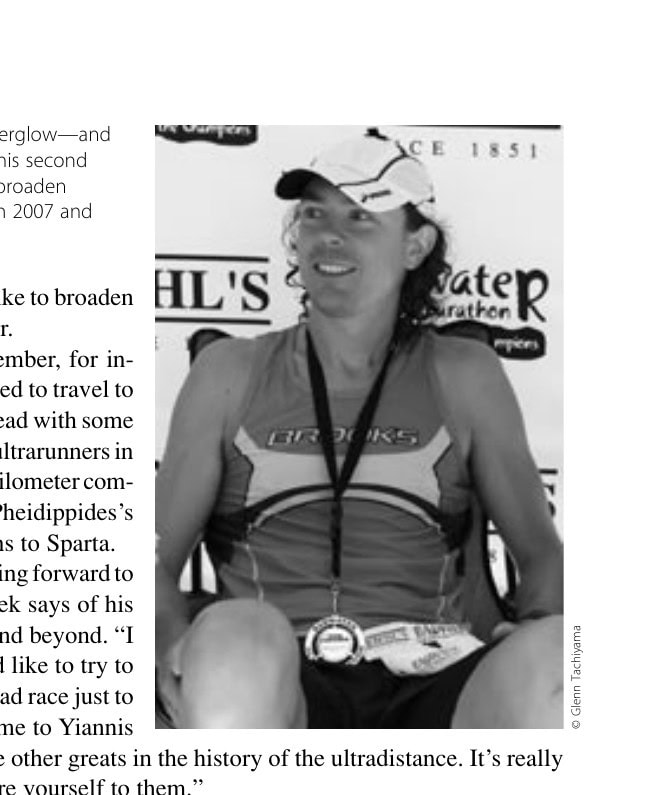
Jurek returned to Death Valley in July to see if he could become the first runner to negotiate the Badwater course in less than 24 hours. While he was successful in defending his title, the uncharacteristic high level of humidity during one of the hottest summers on record took its toll and he crossed the line in 25:41:18.
Now, Jurek would like to broaden his horizons still further.
At the end of September, for instance, Jurek is scheduled to travel to Europe to go head-to-head with some of that continent’s best ultrarunners in the Spartathlon, a 246-kilometer competition that reenacts Pheidippides’s historic run from Athens to Sparta.
“I’m definitely looking forward to mixing it up a bit,” Jurek says of his racing plans for 2007 and beyond. “I think down the road I’d like to try to do a 24-hour track or road race just to see how close I can come to Yiannis Kouros and some of the other greats in the history of the ultradistance. It’s really the only way to compare yourself to them.”
Oh, yeah, and at some point he would also like to see if he can lower his marathon PR of 2:38.
Olson, for one, is convinced that ultrarunning couldn’t ask for a better ambassador.
“It’s been pretty impressive to watch how far he’s come and to see what he’s done with the sport,” enthuses Olson. “The way Scott goes about it makes running 100 miles more feasible. A lot of people out there think you’re nuts for [running that far], but Scott tries as hard as he can to show people that with the correct training and the correct diet, it’s really not that hazardous of a thing to do.”
“Over the years you learn to appreciate it more,” Jurek says of ultramarathoning. “The more you experience situations in races and in training, the more you appreciate and understand it.”
Seven Western States titles, two Badwater crowns, course records and accolades galore, aspirations of taking the sport where it’s never been before…
OK, so maybe, in the end, the guy is just a wee bit different from the rest of us.
Postscript: October 1, 2006—This just in from Greece: “Scott Jurek captured the 2006 Spartathlon in 22:52:18, a first for an American, and logged the 5th fastest time ever recorded on the historic course.”
This article originally appeared in Marathon & Beyond, Vol. 10, No. 6 (2006).
← Browse the full M&B ArchiveMore like this
1,000+ stories from 19 years of Marathon & Beyond
The complete archive of the legendary long-distance journal — digitized and free to read.
