

He is perhaps the best American distance runner that you’ve never heard of, and perhaps the unlikeliest. At 6 feet tall with long hair, he doesn’t look like a typical elite long-distance runner; he lacks that gaunt, emaciated look. But he competes like an elite long-distance runner: he has won 50K, 100K, and 50-mile trail-run national championships, and he ran in the 2004 and 2008 Olympic Trials.
These are not just cherry-picked performances, either; he races as though he never heard of the concept of recovery, throwing himself at race after race, week after week. Despite that, he wins, and wins often; he has completed over 100 marathons, finishing first or second in many of them.
But he has no coach, no agent, and no ad campaign. He is not a full-time professional runner and doesn’t dream of being one. He is perfectly happy with his day job and seems content living in a Northern Virginia suburb of Washington, D.C., with his wife and son, waiting for their second child to be born.
It doesn’t make sense, doesn’t fit into any preconceived notion of how an elite distance runner organizes his life—there are too many improbables. Like the bumblebee, it shouldn’t really work, but somehow it does. He races with stunning frequency, staying injury free and highly motivated. He works a steady day job, is married and raising a family, and still manages to race. In many ways, he sounds like a middle-of-the-pack runner and weekend racer, except that he has an elite runner’s speed. If he has a secret to his racing success, he isn’t sharing it. Forget Chariots of Fire; if this were a movie, it would be Damn Yankees or Faust, and we all would be wondering what kind of deal he made with the devil to be able to run like this.
But there is no movie, no devil, and no Faustian bargain. There is only Michael Wardian, sitting across from me now on the front deck of his house, sipping water, waiting for me to begin the interview. I’ve come to try to figure this out, to break it all down into something I can understand. Is Wardian a great runner because of his approach to training and racing, or despite it? Is he one of us, so in love with racing that he pushes his body to do it as often as he can, just for the thrill of being out there? Is he a true professional, carefully calculating the costs and benefits of each training and racing decision in the context of his running career? Or is he something else altogether, something we’ve never seen before, the proverbial complete player who can hit for both power and average? Does Michael Wardian know a few things about training and racing that the rest of us don’t?
Looking at him sitting there, waiting for my first question, I can’t help but feel that if I can somehow unscramble this puzzle, I would discover a deep truth about running, about what a runner should aspire to be, and about what the face of America’s distance-running future will possibly look like. A fan lazily spins overhead, and I switch on the tape recorder that sits on the glass-top table between us. On my lap is a pad filled with dozens of questions, but all the questions boil down to this: who is Michael Wardian, and why is he such a great runner?
In the beginning
Right off the bat, Wardian won’t play by the rules. I ask him when he began running, and the correct answer should be that he began running long distance right after he learned to walk. That’s what the Kenyans and Ethiopians all seem to say. But Wardian won’t play along. He says that he never ran distance when he was young. None of that I-ran-six-miles-to-school-every-day stuff. And it wasn’t in his genes, either; none of his close relatives was a distance runner. He wasn’t to the manor born.
But he does throw me a bone: his family was athletic. His uncle was a hall of fame field hockey player, and his father, who grew up in Pennsylvania, played football. Wardian, who was born in West Virginia but raised in Virginia, was very active himself as a boy, playing Little League baseball and soccer. But it was lacrosse that dominated his interest and was his focus through high school and college. He played three and a half seasons of Division I lacrosse at Michigan State University. By his senior year, though, he realized that he didn’t have the talent to be as good as he wanted to be, so he dropped out of the sport.
And then he had the Moment.
He was at the house of his friend Vince one Saturday morning in 1996 and got to talking with Vince’s mom, Vicki Voisin, who was about to head out for her morning run. Vicki was preparing for the Boston Marathon, which Wardian thought was pretty cool. He asked her for some information, and Vicki gave him a copy of her training plan. Then she thought no more about it. A young man’s interests come and go like a summer squall.
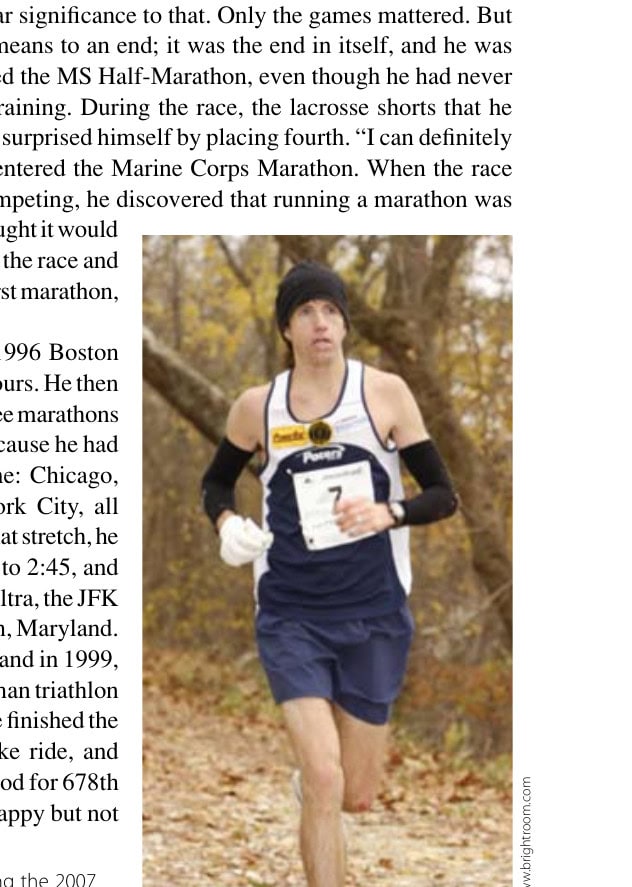
But Wardian didn’t forget about it. He took the plan and began to follow it. During his years playing lacrosse, he had led the team during training runs, but he hadn’t attached any particular significance to that. Only the games mattered. But now, running wasn’t just a means to an end; it was the end in itself, and he was taking it seriously. He entered the MS Half-Marathon, even though he had never gone beyond five miles in training. During the race, the lacrosse shorts that he wore rubbed him raw, but he surprised himself by placing fourth. “I can definitely do this,” he thought, so he entered the Marine Corps Marathon. When the race came around and he was competing, he discovered that running a marathon was easier for him than he had thought it would be. He felt strong throughout the race and finished in 3:06. In his very first marathon, he reached his goal: Boston.
He entered and ran the 1996 Boston Marathon, and broke three hours. He then decided that he would run three marathons the following fall, simply because he had been told it couldn’t be done: Chicago, Marine Corps, and New York City, all within a few weeks. During that stretch, he got his marathon time down to 2:45, and he also competed in his first ultra, the JFK 50-Miler, held in Hagerstown, Maryland. He took up triathlon as well, and in 1999, he competed in his first Ironman triathlon in Lake Placid, New York. He finished the 2.4-mile swim, 112-mile bike ride, and 26.2 mile run in 12:26:58, good for 678th place out of 1,451. He was happy but not overly impressed with himself. I just did an Ironman! he thought. Pretty cool. But he still went out socializing with his friends and focused on his job with an international shipping brokerage, Potomac Marine International, based in nearby Alexandria, Virginia. He started dating the woman who would become his wife, Jennifer. Running was just a hobby, something he did for fun.
He was just 24, and he was on the threshold of discovering that he had a gift.
Epiphany in the desert
There is one thing you pick up quickly about Michael Wardian: he is not a man who moves by measured increments. He believes in the motivational power of the great challenge. He is the kind of man who does his best when he thinks he might be in a little over his head. It’s no surprise, then, that he didn’t much like it when his application to be a member of the highly selective Pacers/Brooks Racing Team, sponsored by a local running store, was turned down. But he didn’t get angry or make a scene. He just worked harder. And then, when he finished sixth in the 1998 Wawa Hartwood 10-Miler, ahead of all of the Pacers/Brooks runners who were competing in the race, he made it impossible for them to keep him out. Wardian made the team.
In hindsight, it seems inevitable that he would continue escalating his challenges until one day he would race the Marathon des Sables, the legendary 151-mile, six-day Moroccan stage race across the Sahara Desert. The racecourse terrain is rocky and uneven, with much of it crossing Lawrence of Arabia-like sand dunes. Daytime temperatures there can reach 120 degrees, and despite the $4,200 entry fee, the support is minimal: runners are required to carry their own gear throughout the event. In any number of ways, it’s one of the most grueling challenges in all of endurance sport. Naturally, when Wardian first heard of it in 1998, he was instantly smitten. By 2000, he had saved up enough money and banked enough vacation leave to take on the challenge. He packed up his flare, flashlight, snakebite kit, knife, and the rest of his gear and set out alone on his journey. He was the second-youngest person in the race, and he had no idea what he would be in for.
Luckily, there were other, more-seasoned runners who recognized something special about him. They took him under their wings and offered him some much-needed advice. In particular, Lisa Smith-Batchen, a champion ultrarunner from the Dreamchasers Outdoor Adventure Club, helped Wardian to understand that he was carrying too much gear and needed to lighten his load. Eventually, Wardian got the hang of things. Soon, he discovered something interesting: the longer the race went on and the harder it got, the stronger he felt. One 50-mile stage day fell on his birthday, and Wardian attacked it with ferocity. He still looks back on that day’s run as the best birthday of his life. Yet, despite everything he had
accomplished in running to that point, he still didn’t think of himself as being a particularly good runner. But out in the desert sand, in the brutal heat, he slowly began to realize that running was something that he could be good at.
When the dust finally settled, Wardian had placed 26th overall in des Sables and was the first American finisher, with a time of 26:00:30. It had been a revelation to him, but others were watching as well. The Outdoor Life Network featured him in its televised coverage of the event, and more important for his future, Lisa Smith-Batchen, who had helped him earlier, saw potential in his raw talent and offered to coach him for free. It proved to be a turning point in Wardian’s career. He began to get more disciplined in his approach to running, and it quickly began to pay off. In July 2000, he placed fourth in the Vermont 100-miler with a personal best of 15:34:00, and then, in 2001, he won the Himalayan 100-mile five-day stage race with a time of 14:58, setting a course record that stood until 2004. He also competed in the 50-mile national championship race, and although he now recalls his experience there as having been “crushed,” it was on his radar.
He then decided to cut loose from Smith-Batchen and from the Pacers/Brooks Racing Team and set off on his own. He was grateful for the help that she had given him, but he felt the need to be completely responsible for his own training and racing. “It’s not that hard to figure out what works for you if you’re motivated,” he says now, sitting back in his chair on the porch. “I was still learning, but I wanted to hold myself accountable.” He spent time learning details about running and body mechanics. As a vegetarian, he was already focused on his fueling needs, and running only made that focus more necessary. “It’s just running, at the end of the day,” he would say later. “But there’s still so much to keep track of.”
Wardian decided to return to the marathon and to work on his speed. He set his sights on the U.S. Men’s Olympic Marathon Trials. In October 2003, he ran a personal best of 2:21:48 in the Detroit Free Press Marathon, qualifying him to line up with America’s best male runners at the Olympic Trials in Birmingham, Alabama, on February 7, 2004. Wardian and 85 other runners toed the line that morning under cloudy skies. The temperature was a chilly 35 degrees, with winds that averaged 12 miles per hour. Despite these less-than-ideal conditions, Wardian finished in 2:22:40, placing him 32nd out of 70 finishers.
Michael Wardian had finally arrived. He was an elite marathoner. Now things were going to get interesting.
Hitting his stride
Elite runners don’t think just in terms of a particular race; they think of seasons and years. There is a progression to their goals, usually starting with shorter distances earlier in their careers, then graduating to the marathon when they have matured. Each year they target certain key, shorter races as their season builds toward the big spring and fall races and the big money that usually goes with them. It’s a formula that allows them to peak at just the right time. It’s the way that professional runners approach the sport.
By 2003, Michael Wardian was an elite runner, but he felt no need to design a reasonable racing schedule. He just wanted to run fast and to do that as often as possible. He continued to improve in 2003, setting a personal best of 14:55 in the 5K and 1:06:30 in the half-marathon. In 2004, Wardian detoured off the straight and narrow path of the elite runner by setting a world record for a marathon run on a treadmill, covering the distance in 2:23:58. Sure, it seemed a bit like a gimmick, but it was fun. He also set a personal best in the 10K, running 30:55.
He and Jennifer also had a son in 2006, Pierce Miler, named in part to pay respect to the sport his father loves. Having a newborn turns the lives of most people upside down, but Michael tried to take his new responsibilities in stride. “When Pierce was born, he was good about cutting back,” Jennifer recalls. “We just work on integrating running as part of our life.”
But it was in 2006 that Wardian began to really define himself as a runner. In a span of just 43 days, Wardian ran five marathons, and improbably won four of them, taking first place in the Shamrock Marathon in Virginia Beach on March 18 (2:28:30), the inaugural National Marathon in Washington, D.C., on March 25 (2:30:55), the Ocean City Marathon in Maryland on April 8 (2:33:20), and the Frederick Marathon, also in Maryland, on April 30 (2:26:44). Wedged between those final two wins was his 44th-place finish at the Boston Marathon on April 17 (2:29:51).
It was a streak without apparent precedent, and it didn’t go without notice. Not everyone was awed by it, though; runners in the D.C. area who followed such things wondered whether Wardian was going to burn out mentally or flame out physically, and even those who admired his obvious gift questioned whether his ambitious schedule was preventing him from running the one great race, the gaudy finishing time that would establish him as a truly great runner. Wardian heard the comments and even agreed that perhaps he would be able to race faster if he cut back, but he wasn’t convinced that was the best way to go. Perhaps he would run faster if he cut back, but perhaps he wouldn’t. All that he was sure of was that he didn’t want to miss any opportunities to compete. So he kept racing. His spring 2007 campaign had him racing six marathons in seven weeks, and he answered his critics by posting wins in the B&A Trail Marathon (2:25:30 on March 4), the National Marathon (2:26:36 on March 24), and the Ocean City Marathon (2:41:20 on April 7). His third place finish in a time of 2:21:37 in the Shamrock Marathon on March 17 not only established his personal best but also guaranteed him a return to the U.S. Olympic Trials in New York later that fall, a day before the New York City Marathon.
The year is still young
But still he wasn’t done; he placed second at the Covenant Health Knoxville Marathon on April 1 (2:45:39) and 68th at the Boston Marathon on April 16 (2:33:22). And then, on May 6, came another unlikely “Wardian moment”: he and Pierce set a Guinness World Record for fastest marathon run with a jogging stroller. He then placed third in the Frederick Marathon with a time of 2:41:21, and less than three weeks later placed second in the Key Bank Vermont City Marathon with a time of 2:25:10.
The man just wouldn’t stop running. It defied accepted wisdom and perhaps common sense, but it seemed to be working. He was injury free and winning or placing in most of the races he competed in.
And so it was that on November 3, the day before the New York City Marathon, Wardian lined up with the other Olympic hopefuls for a hilly race around Central Park to determine who would represent the U.S. in the men’s marathon in Beijing. It would be Wardian’s 12th marathon of the year. Wardian now felt like part of the group. “Ryan Hall (the eventual race winner) is a super nice guy; I had met him in Boston before. And the others are, too: Bryan Sell, Alan Culpepper. Most of them are just normal guys.” They are normal guys who can run an entire marathon at a pace most of the rest of us can’t maintain for even a single mile.
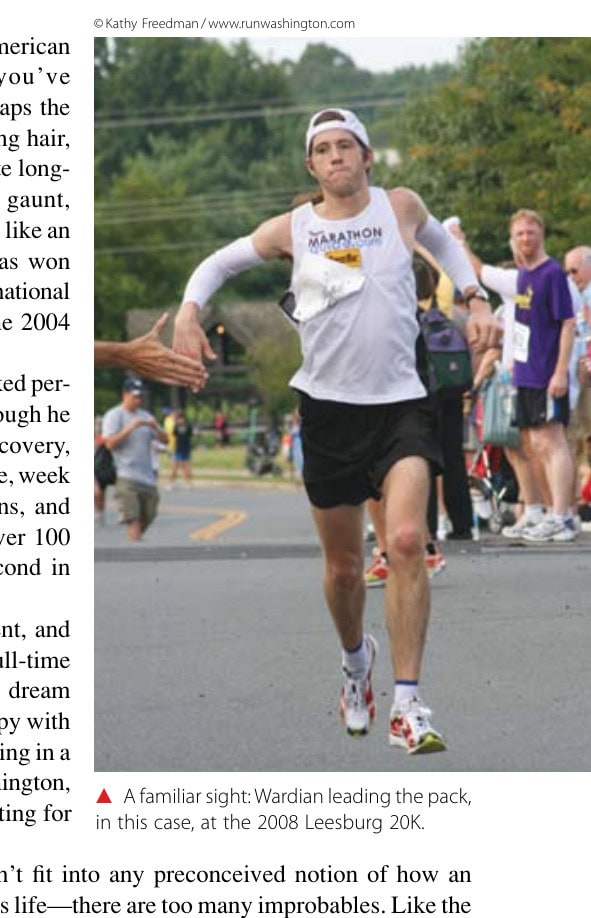
The runners started out at a comfortable pace, and Wardian leapt to the front of the pack, leading them through the first mile in 5:21. Wardian held his position for six miles, until the lead pack overtook him 34:30 into the race. Still, it was a glorious half hour, as Wardian led the best male marathoners in the U.S. in the most important race of the year. It was something to be proud of. Wardian managed to finish with a time of 2:30:54, placing 92nd out of 104 runners, but his race, as well as the work put in by all the other competitors, was overshadowed by tragedy as the runners soon learned that Ryan Shay had collapsed and died early in the race.
If there were some who, in the aftermath of Shay’s death, questioned whether long-distance running might do a body more harm
than good, Wardian wasn’t among them. He immediately followed up his performance in the Trials with another marathon just a week later, winning the Outer Banks (OBX) marathon with a time of 2:24:16. Then, the following week, he returned to the JFK 50-miler. He ran like a man with something to prove, not only winning, but posting a time of 5:50:34, the second-fastest finish ever on that course. “That was the perfect day,” Wardian says now. “I managed to run that one really smartly.” He also managed to qualify to run in the 100K National Championship.
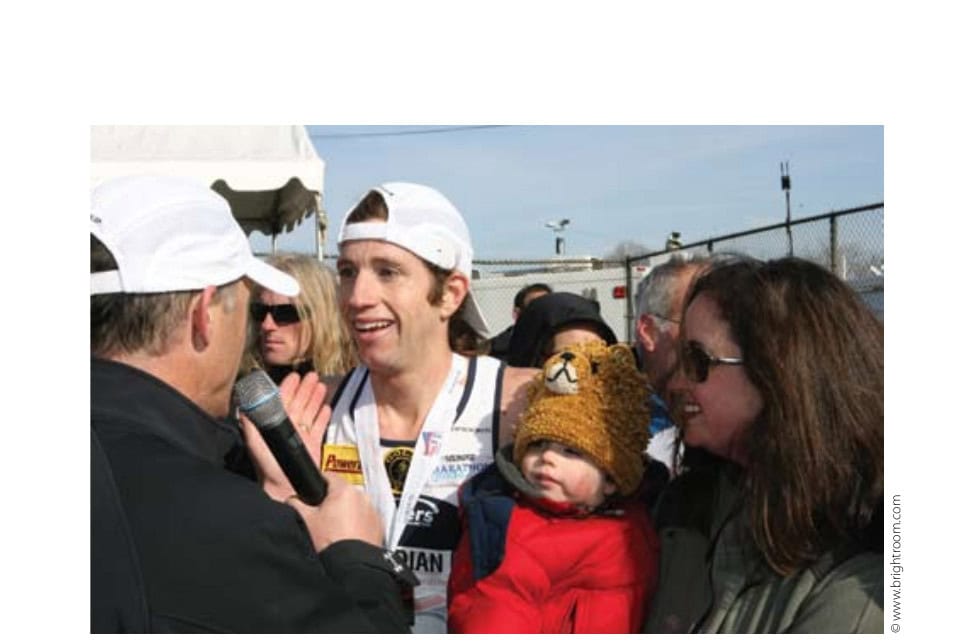
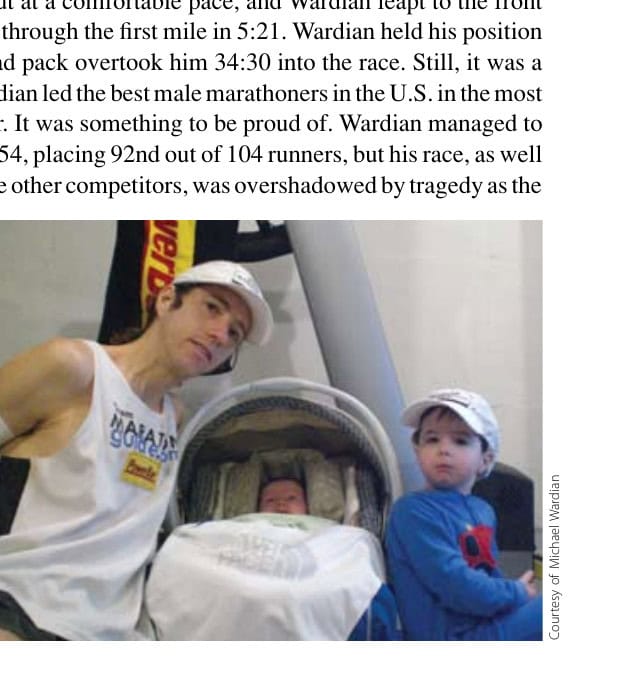
If these successes changed Wardian, none of his family, friends, or coworkers was able to tell. “Mike has always been a pretty humble guy,” says his wife, Jennifer, stepping out onto the deck where Wardian and I sat. She was pregnant with their second child, a boy who would be born on December 17 and who they would name Grant Fletcher. Juggling everything will continue to be a challenge for Michael and Jennifer, but if Wardian is worried, he doesn’t show it. “I try and do my training before it has a chance to interfere with my work or family obligations,” he says. “I wake up early to run before work, but I’ve also been running at lunch, which is great. I’m so lucky to have a supportive group of people at work that help me balance my training with my job.” Still, running manages to find its way into his family life as well. “I want Pierce to do what makes him happy, but I definitely will try and show him what a great lifestyle running can be and how to make it a part of your life,” Wardian says. “Pierce and I run around the house every night, and he is quite a quick little guy. Jennifer supports our ‘races’ and even has a water stop/crew area set up in the kitchen. It’s awesome.”
As Wardian began to find success in running, his coworkers at the shipping brokerage where he has worked for the past 12 years started to take notice. “My boss is a hard-core supporter,” he says, “and likes me to call him to check in and send him my results.” Wardian feels great loyalty toward the small company. “I’m super content there,” he says. But still, when asked if he would like to be a full-time, professional runner, he pauses, contemplating what that would be like. “I’d love to see if that would make a difference,” he says. But then he rejects the idea. “I like the dichotomy; the idea that I can have a regular career and be a competitive runner as well.” It’s one more way to define for himself how he wants to live his life, to show that he could make his road harder than the one his competitors travel, yet still beat them. It’s a crack in the easygoing, calm facade; a glimmer at the competitive fire that surely burns somewhere inside him.
On a roll
When the spring 2008 racing season began, Wardian picked up right where he had left off. In February, he placed second in the Mercedes Birmingham (Alabama) Marathon by running 2:23:24. Then, on March 2, he won the U.S. National 50K Championship, held in Long Island, New York, with a personal best, course record, and championship record time of 2:55:05. Four weeks later—an eternity by Wardian’s race schedule—he was back at it, winning his third consecutive National Marathon in a course record time of 2:24:59, continuing as the only champion that race has ever known. On July 26, Wardian won the USA Track and Field 50-mile Trail Championship at Crystal Mountain, Washington, in 6:52:50. He also hit another milestone as well; in 2008, he completed his 100th race at marathon distance or longer. On October 26, Wardian placed ninth in the Marine Corps Marathon, posting a time of 2:28:26.
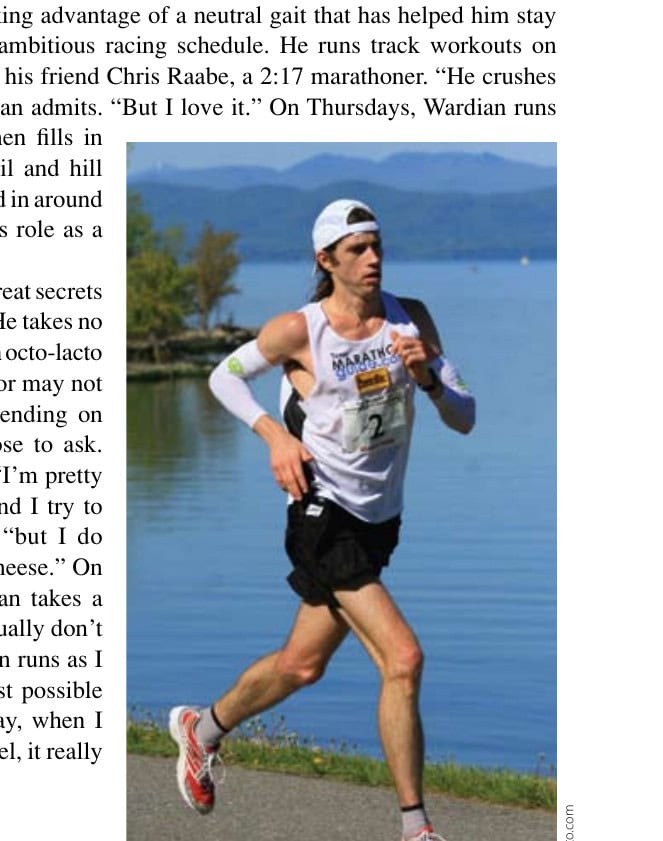
As Wardian has matured as a runner, he has continued to take his running more and more seriously. He raised his weekly mileage from the 75- to 90-mile range to 100 to 110, taking advantage of a neutral gait that has helped him stay injury-free despite his ambitious racing schedule. He runs track workouts on Tuesday mornings with his friend Chris Raabe, a 2:17 marathoner. “He crushes me every week,” Wardian admits. “But I love it.” On Thursdays, Wardian runs tempo workouts and then fills in the other days with trail and hill running. All this, worked in around his full-time job and his role as a husband and father.
His diet reveals no great secrets to his running success. He takes no supplements, and he is an octo-lacto vegetarian, which may or may not affect his running, depending on which expert you choose to ask. Still, he is not perfect. “I’m pretty careful with my diet, and I try to eat healthy,” he says, “but I do love pizza, bread and cheese.” On the run, though, Wardian takes a Spartan approach: “I usually don’t eat or drink too much on runs as I like to train in the worst possible condition so on race day, when I have water and PowerGel, it really works.”
Derik Thomas, one of Wardian’s regular, long-time running buddies, is quick to praise his merit as a training partner. “He is a much better runner than most of us that he runs with regularly,” he says. “But even so, he’ll run at whatever pace you can manage. He’s up for any speed.” He also never seems to show up in a bad mood. “It can be a grind to run 100 miles a week, year-round in all types of weather, yet he will always show up at 5:45 A.M. in a good mood and ready to run,” says Derik. “And Mike can and will carry on a conversation the entire run. It can sometimes get annoying to be totally gassed and have to listen to Mike talking away in a normal tone. But Mike cares very deeply about how well any of us in our little training group race. He is very supportive and interested in the details of your race even though it pales in comparison to his results.”
Steve Tappan, a training buddy of his since 2004, describes the runs as more convivial than brutal. “Mike usually starts a run at a casual speed and then gets into it after two minutes or so. Mike and I are like two Chatty Cathies; anything and everything gets discussed during a run. Racing, dining, family, politics, work, what’s up in the news.” Still, Wardian’s easy effort might be hard for others to match. “Seems like he just lopes along,” says Tappan. “Or maybe it just appears that way to me as I’m normally sweating like a Wall Street investor.”
One thing that has changed for Wardian, however, is sponsorship; he now receives support from a host of corporations, including PowerBar, The North Face, Moeben, Rudy Project Sunglasses, Pacers Running Stores, and the racing Web site MarathonGuide.com. But Wardian hasn’t felt compromised by this creeping professionalism. “I’d like to see more exposure for the sport, especially ultrarunning,” he says. “Some ultra guys are almost a little scared of that—scared that big corporations will come in and change everything. Sponsorship hasn’t changed my training, but it is helping me to race more. There are still races which have been out of reach because of cost, like the Comrades Marathon in South Africa. I have great sponsors, but races like Comrades and the Marathon des Sables require thousands of dollars. Some day I’d like to be able to compete anywhere without having to be constrained by cost.” Wardian pauses, perhaps realizing that this is really every runner’s dream. “But again, I am so lucky to have great people that are helping me as much as they can, and I am thankful for every ounce of support I get, either financial or emotional. I cannot do it without them.”
Why we should care
Those are the numbers; those are the facts. On paper, it adds up to an impressive running resume. For fans of the sport, it’s interesting to follow, and considering how Wardian runs, almost every week brings something new. Chances are that by the time you’re reading this, there will be more to the Wardian story than I’m reporting to you now. But for the average distance runner, the one who puts in the miles and races the marathons but never at a level that could be called “elite”—that is, for all the rest of us—the question must be asked: why should we bother to follow this man’s career? He hasn’t won a major international marathon, hasn’t made an Olympic team, and hasn’t set any world records. In a world filled with information overload and endless distractions, why give any attention to this one man?
The answer is that we need to watch this man because he is not just another elite racer following a predictable training and racing schedule toward a career of moderate success. Wardian is different. He is an experiment.
Michael Wardian is straddling an ocean of running talent. On one shore stands a huge group of runners. They are the ones who toe the line on race day not because they ever expect to win or because anyone else might even notice that they’re there, but simply because they love to run. These are the people who are in love with the motion of their bodies and with the pain and suffering that tell them that
| The Wardian File | |
|---|---|
| PRs | 5K—14:55, 10K—30:55, 10 miles—51:25, Half-marathon—1:06:30, Marathon—2:21:37, 50K—2:55:05, 50 miles—5:50:34, 100 miles—15:34 |
| Notable Wins |
|
| Award | 2008 USATF Ted Corbitt Ultrarunner of the Year |
One day, while at the track with one of my athletes who was training to qualify for the 2004 U.S. Olympic Marathon Trials, I began to wonder how other runners who had already qualified train. Was it similar to what I was having my athlete do? How many miles a week were they running? How much of their training volume was run at specific intensities? Did they use strength training? Unfortunately, there is little research on the long-term training of distance runners, leaving much unknown about training for endurance performance. Most of the information on the training of runners is found in books and magazines. So at that point, with the 2004 U.S. Olympic Marathon Trials right around the corner, I decided to take a scientific approach to find answers to the above questions.
Two hundred fifty-five athletes (104 men, 151 women) qualified for the 2004 U.S. Olympic Marathon Trials by running 2:22:00 or faster (men) and 2:48:00 or faster (women) within two years of the event. They were all given a questionnaire asking about their physical characteristics, training history, financial support, personal records for various distances, and training characteristics. All questions pertained to the entire year preceding the 2004 Olympic Trials. Ninety-three athletes (36.5 percent) responded to the questionnaire (37 men and 56 women) and were divided into two categories—elite (sub-2:15 for men, sub-2:40 for women) and national-class (2:15 to 2:22 for men, 2:40 to 2:48 for women).
Physical characteristics and performance
If you have ever seen a 200-pound person run a marathon, you know that lighter is better. Low body weight increases economy (the amount of oxygen used at a
This article originally appeared in Marathon & Beyond, Vol. 13, No. 3 (2009).
← Browse the full M&B ArchiveMore like this
1,000+ stories from 19 years of Marathon & Beyond
The complete archive of the legendary long-distance journal — digitized and free to read.
