

The high school track coach had other things to do, so he casually told the girls to go run around the track until they were tired. He returned an hour later to find them all flopped on the grass, resting. All, that is, but one: Mary was still running around, no evidence that she would break her stride—or even a sweat—any time soon.
Looking back, I guess no one is surprised that my older sister, Mary Button, became an Olympic Trials-qualifying marathoner. What we didn’t anticipate was how she would turn that passion into her profession, creating a life for herself in which running is the linchpin.
Mary has run 27 marathons (20 consecutively below three hours), qualifying for two Olympic Trials and, with her husband, Gerry Hans, operates RaceReady Sportswear, a running-clothes company in Los Angeles.
Like many other long-distance runners, Mary doesn’t lack for tenacity. To keep up with our brother, who is one year older than Mary, she taught herself— with no parental input, our mother swears—to use the toilet, tell time, and ride a two-wheeled bicycle. With that same single-mindedness of purpose, Mary has persistently clocked the miles, literal and metaphorical, to build both a running career and a successful business.
An earthshaking realization Some people can pinpoint the moment their lives changed course, often to an event like the birth of a child or the day they got married. For Mary, it was when the Whittier earthquake struck Los Angeles in 1987. Cowering under her desk on the 23rd floor of her office tower, she thought, “I really need to make some changes in my life.” She hated her corporate accounting job, and she missed her Colorado lifestyle and friends. Mary had met Gerry two years earlier in Denver while riding her bike. Her chain came off, he offered to fix it, and that was it. Soon they were biking and hiking Colorado’s mountains together; they were married within a year. The
newlyweds moved from Denver to Los Angeles when Gerry was transferred there in 1986. The job Mary found turned into a 12-hour-a-day ordeal in an onerous workaholic culture. “One morning I came to work and found my boss dressed in the same clothes she had worn the day before. She hadn’t gone home all night!” Mary says. “I had scheduled a camping trip that weekend and she nixed it—she just flat-out said I couldn’t go.”
Her tedious job and unreasonable boss brought Mary close to the final straw, but the earthquake clinched it. She quit the job, established Button Accounting Services, and began marketing her services as a freelancer. “
I loved being my own boss,” she says. “I guess I never was very good with authority.” Meanwhile, Mary took up jogging, which she hadn’t done in years, as a stress release. “Just a few miles here and there,” she says. She ran her first 5K race in 1988. “
I wasn’t out of breath at all (upon finishing), but I did notice that most people around me were,” she says. It wasn’t a total surprise; she had been known for her conspicuous longness of breath in high school track. But that had been 12 years earlier.
She signed up for her first 10K race, through the streets of Hollywood. She finished in 38:46, winning the race and a complimentary entry to the 1989 Los Angeles Marathon. “I put the entry away, thinking, What a crazy thing to do. Why would I want to run a marathon?”
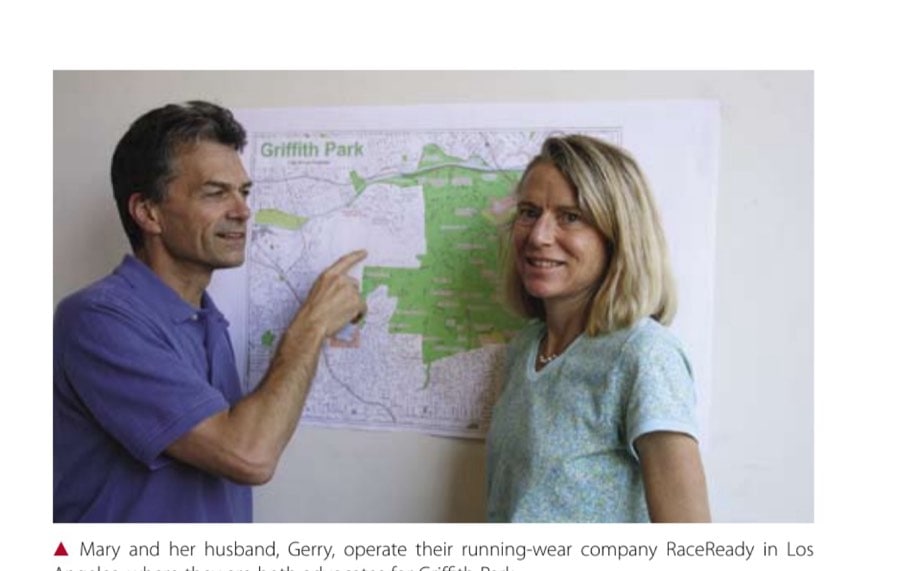
A few months later, Mary ran another 10K in the large, urban Griffith Park near her home in the Hollywood Hills. Milling about after the race while waiting for the medals, she met members of the Los Feliz Flyers, a local running group, who invited her to their weekly fun run.
From then on, Mary had friends to run with. “It made all the difference. It was a great group—open, fun, unconventional.” Gerry started running and joined the group, and the Flyers became their extended social life and support system.
With those two actions—quitting her stultifying job and joining a running group—the tide of Mary’s life began to turn.
An accidental start (or, sometimes it pays to be cheap) The Flyers’ coach urged her to enter that Los Angeles Marathon. She had already won the entry, after all. And Mary has never been one to turn down something free—it’s the accountant in her. There was one problem, though. Mary thought that running longer distances literally made her sick.
▲ Mary and her husband, Gerry, operate their running-wear company RaceReady in Los Angeles, where they are both advocates for Griffith Park.
“I had done two 15-mile runs with the group, and I came down with a flu-type sickness after each one,” she says. “But our coach said, ‘If you can do 15 miles, you can easily do a marathon. It’s only 11 miles more. Just go for it.’”
So she did, finishing in 3:05:55. “Looking back, it’s sort of crazy to do a marathon after just two 15-mile training runs, but I guess I just believed my coach when he said I could do it and ignored all the evidence to the contrary. “
It was sort of ridiculous,” she adds. “I mean, if someone gives you a free pass to jump off a cliff, do you take it?” Maybe, if you’re Mary. And if they throw in a free T-shirt. She started running more with the Flyers and ran the L.A. Marathon again in 1990 and 1991, each time finishing in 3:04 and change.
Later in 1991, she picked up her training—and a new habit: breaking three hours, with 2:58.15 at the Orange County Marathon. She went on to run three increasingly speedy marathons in 1992: Los Angeles (2:56.41), Boston (2:54.57), and Culver City (2:51.02), the first marathon she ever won. They were the first of 20 consecutive sub-three-hour marathons she would run over the next nine years.
Home is where the stockroom is By now, Mary and Gerry were entrenched in the local running scene. The friend and coach who had urged Mary to run her first marathon had the idea to start a
running-clothes company featuring no-pin singlets, and Mary and Gerry decided to join him. In 1993, they bought out the partnership, becoming the sole proprietors of RaceReady. While Gerry devoted his full-time energies to RaceReady, Mary continued working as an accountant “to pay the bills and have health insurance” while moonlighting as RaceReady’s CFO.
They operated the business out of their home for the first few years, their living room a literal warehouse of running apparel. “I’d take an order, then go to the living room to process it,” Mary recalls. “I remember our filing system: the love seat had women’s large, the couch had men’s large and medium.”
Sales grew consistently, and by 1996 they had enough business to justify renting a warehouse and office space. Mary quit her job and joined the company full time. “It was so great to have our house back,” she recalls. “The first thing I did after we moved all the inventory out was stretch out on the couch.” When 5-foot10-inch Mary says stretch, she means it.
To promote their business, Mary and Gerry went to race expos around the country and peddled their wares all day. Then, “since we were already there,” they would run the races the next day. Not exactly a recommended taper.
By this time, Mary was being coached by Laszlo Tabori, a former Olympian and the third man to break the four-minute mile. Gerry recalls Tabori telling Mary that she would surely run better if she didn’t stand on her feet for 10 hours the day before the race.
True for most people. But, Mary says, “So much of running is mental for me. I think I focus to the point that I’m obnoxious, and I was very focused on getting this business going. I actually would run better on the adrenaline of having a good expo, regardless of how long I had been standing the day before the race, than I ▲
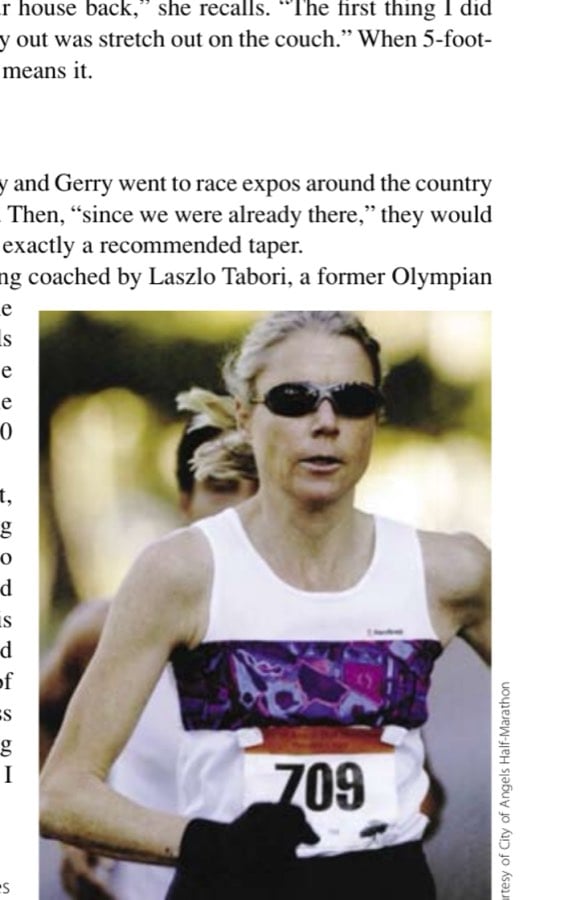
Mary ran the inaugural City of Angels Half-Marathon in Los Angeles in 2006, finishing in 1:35.
Courtesy of City of Angels Half-Marathon
Expo-nential function
would when the expo hadn’t gone so well.” In 1996, for example, after selling running wear for 12 hours at the St. George Marathon expo (“the only time I sat down was to pee”), she ran a personal best of 2:42.11. Chuck O’Shea, a running-group friend who has helped Mary and Gerry out with expos in various cities, recalls: “One year at the Las Vegas Marathon expo, Gerry was trying to keep Mary off her feet all day. And all day she refused. She sold loads of clothes. And the next day, she qualified for the Olympic Trials.”
Accounting for every dollar—and every mile While a certain amount of obsessiveness seems to go with the long-distancerunning territory, Mary can run laps around your run-of-the-mill compulsive marathoner.
She has faithfully tallied every mile she has run since 1988, over 50,000 in total. Her top year was 1995, during which she ran more than 3,100 miles. “But,” her inner accountant qualifies, “each log entry is only accurate to about a half mile.”
She began tracking mileage after she had been running for just a few months and someone asked how many miles a week she ran. “I had no idea,” she says, “but it made me curious.” So she started keeping the log, along with a running journal where she keeps notes on data like the weather and which shoes she wore.
She now has a bookshelf lined with 20 separate volumes of running journals, one from each year. When I asked her for some marathon times to include in this article, she sent me a 20-page “summary” spreadsheet, with times, distances, details about course terrains, and comments like “happy to be two minutes faster than last year” or “got my butt kicked.”
Miles aren’t the only thing Mary counts. “She’s compulsive about computing our totals immediately after we finish an expo,” Gerry says. “She simply can’t wait until the next day.” “After every expo, we used to go to a restaurant for dinner,” O’Shea adds. “Mary would carry the money box from the expo in and count under the table. She couldn’t even wait ’til after dinner to know what the takings were.”
Leaving the Boston Marathon expo one year, Mary and Gerry got caught in a rainstorm. “We had to sprint across this big public plaza, to the parking structure,” Gerry says. At the car, they realized that Mary’s backpack, in which all the day’s earnings had been put, was open, and empty.
Luckily, they’re runners. “We retraced our steps so fast,” Gerry says. “Right in the middle of the plaza, wrapped up in thick rubber bands, sat our big fat pile of bills.” “I am a Type A (personality),” Mary admits, a little sheepishly, “but I’m not very good about remembering to close my backpack.”
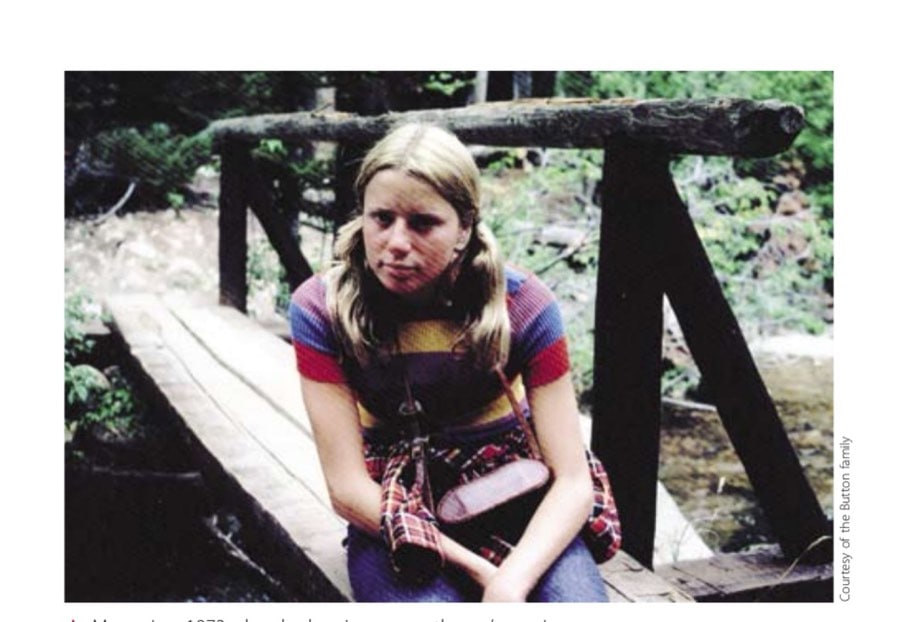
Running with—and ahead of—the boys Mary’s start in running, as a teenager, came by way of her first sport: swimming. Her coach—“the original cross trainer,” she says—suggested that his swimmers run in the off seasons when they couldn’t swim. “
It was 1973, the year after Title IX had passed, and there wasn’t a lot of support for girls’ sports,” she recalls. There was no girls’ track team at her New Jersey high school, so Mary joined the boys’ team—an option stipulated by a new state law if no girls’ team was offered. “
Ten or 15 girls tried to run with the boys. The coach told all but four of us to go away and lose 30 pounds.” Sexism in sports was nothing new, of course, but awareness of it was increasing; 1973 was also the year that Billie Jean King beat Bobby Riggs in the “Battle of the Sexes.”
Mary quickly discovered her natural talent for running, often outpacing the boys. She came to be considered a star “distance” runner—distance in that milieu being defined as a mile or more—despite the fact that girls weren’t allowed to run more than one mile in all their events combined per meet. There were no limits on how far boys could run.
ad
Courtesy of the Button family
▲ Mary, circa 1973, already showing a marathoner’s moxie.
“They thought our uteruses would fall out, or we might grow a mustache,” Mary says. (New Jersey was by no means an anomaly. Even in the Olympics, there was no 1,500-meter race for women until 1972, no marathon until 1984, and no 10,000meter race until 1988. Men had been running the marathon since the start of the modern Olympics in 1896.) By Mary’s junior year, the school formed a girls’ track team, and the league accepted a two-mile girls’ event. Mary set longstanding school records in the one-mile and two-mile events. “But the one-mile, combined-mileage limit still held, with a two-mile-event exception,” she says. “It made no sense.”
“Crazy stupid with the tenacity” Buoyed by her success and a nascent notion of the need to advocate for social change, Mary would go on to battle school officials over other issues, once refusing to return to math class until her teacher stopped smoking in class. “It was actually an accepted practice—teachers could smoke in class,” she says. The battle escalated to the principal’s office, and the teacher was ultimately forced to stop. Her aforementioned “problem with authority” burgeoned. She took on lessnoble causes, such as her right to wear clothes that were clearly against the Catholic school’s dress code. Our brother remembers Mary’s highly nonregulation, fuzzy
“gorilla socks,” which he claims she wore just to spite the vice principal. “They had these long, stringy hairs on them,” he says. “She was suspended at least twice over those socks, but she continued to wear them. I think she claimed that they should be allowed, as they were, in fact, Catholic-regulation green. “
She was always crazy stupid with the tenacity. She was a force of nature that way.” Mary was sidelined by a knee injury her senior year, and 1976 marked the beginning of a 12-year hiatus from running. She remained active, though; a college summer job waiting tables in the Grand Canyon brought out the gonzo hiker in her, and it wasn’t uncommon for her to go on 15-mile hikes to the bottom of the canyon before work.
Even when you’re fast, change is slow Although the blatant sexism that Mary had discovered in high school running had waned by the time she picked up running again in her mid-30s, it was by no means gone. Mary was struck by different inequities, even in 1988.
There were the running-shoe options. “There were dozens for men, in every width and varying colors and styles. For women, it was mostly pink, an occasional pale blue, and medium width. That was it.” There was the prize money. She once was to have won $200 in a marathon; the corresponding men’s prize was $2,000. That year, however, the marathon went belly up and never paid any prize money at all. “
I remember thinking, ‘Well, I guess I’d rather be a woman and not get my $200 prize than be a man and not get two grand.’” In spite of these imbalances, the simple fact that she was faster on the track than anyone—man or woman—around her contributed to a growing sense of her strengths. “
I just began to realize that I could compete, in an absolute sense, anywhere: on the track, of course, but also off.” Gerry agrees, remembering, “When we first started running together, I realized she was very fast, way faster than I was. I certainly never felt competitive with her—I knew there was no way to compete.”
O’Shea remembers one 50K race at Lake Chabot in Northern California in 1997. “They let the slow people—like me—start an hour early,” he says. “I remember we took bets on what mile Mary would catch me . . . It was earlier than anyone guessed. I think she was the second overall woman to finish that day.”
An Achilles knee While Mary had—in spades—the mental focus required for marathon running, there was no escaping the corporeal element. Over the years, her running has been
plagued by one recurring injury: her right knee. When she was 12, she got involved in an ill-fated game of “Got you last!” that ended in knee surgery. Circa 1972, standard operating procedure involved removal of much of the cartilage around the knee. It proved to be an unfortunate medical history for a marathon runner.
Knee pain has intermittently sidelined her running ever since. Mary had surgery again in 1993 after being told that her femur bone was splintering because of the weak cartilage around the knee. “I remember telling everyone that I would run a mile by my birthday (a month after surgery),” she says, “and then not being able to do it. It was awful.”
But once again, her “obnoxiously focused” mind prevailed. She and Gerry worked the expo at the 1994 Boston Marathon and, well, you can guess what happened. “I just love the Boston Marathon—I’ve done it seven times. That year the weather was so good, I just couldn’t resist. And, with a tail wind blowing us into the city—everyone ran fast!”
Especially Mary. Eight months after surgery, she ran 2:46.50, finishing as the ninth American woman. She was back in the race, so to speak, and the following year, in 1995, she qualified for her first Olympic Trials. But the knee pain came back. “
I needed to take some time off for a while in 1995 because of my knee,” Mary says, “so I didn’t run Boston in 1995.” Or the 1996 Olympic Trials. “Missing the ’96 Trials was probably the best thing for Mary’s knee and her running,” says Gerry, noting that she had her peak year when she resumed running in 1996. Within one month of her 2:42 marathon at St. George, she did a 10-mile personal best of 1:00.07 in Alton, Illinois.
Since then the knee problem has come and gone, and her running has fluctuated accordingly, although her definition of fluctuation might be different from most: her times ranged from 2:45 to 3:00 over 10 marathons in the next five years.
One of her crowning achievements—and one that, I confess, I brag about to any of my middle-aged friends who fret their declining youth—was qualifying for her second Olympic Trials in 1999, at the age of 40. This time, she went, to Columbia, South Carolina, and so did a whole posse of her supporters, including me. (I was six months pregnant and my older child’s birthday was the day of the race, but how could I miss my sister in the Olympic Trials?) She was the 12th master’s runner to finish and 87th overall, in 2:58.13, striking a note for tired old broads everywhere. Gerry threw a huge party for her. I was almost too tired from watching her to attend.
A few years later, doctors discovered bone spurs in her right knee and advised her either to not run at all or to be extremely careful while doing it. Being Mary, she chose the latter.
Slowing the pace Now 50, Mary runs mostly on trails. Her weekly mileage is down to about 30 to 40 miles, and she usually walks the first half mile before running. She never thought she would say it, but she no longer feels the need to run a marathon after working an expo. She and Gerry are running more half-marathons these days. “
I probably will, knowing me, do another marathon or two before I kick the bucket,” she says. “But for now, the halves are good and much easier to recover from.” Sometimes she and Gerry will add a day or two to their business trips, turning them into working vacations. This year, after working expos, they ran halfmarathons in Santa Barbara wine country and in scenic Lompoc, California.
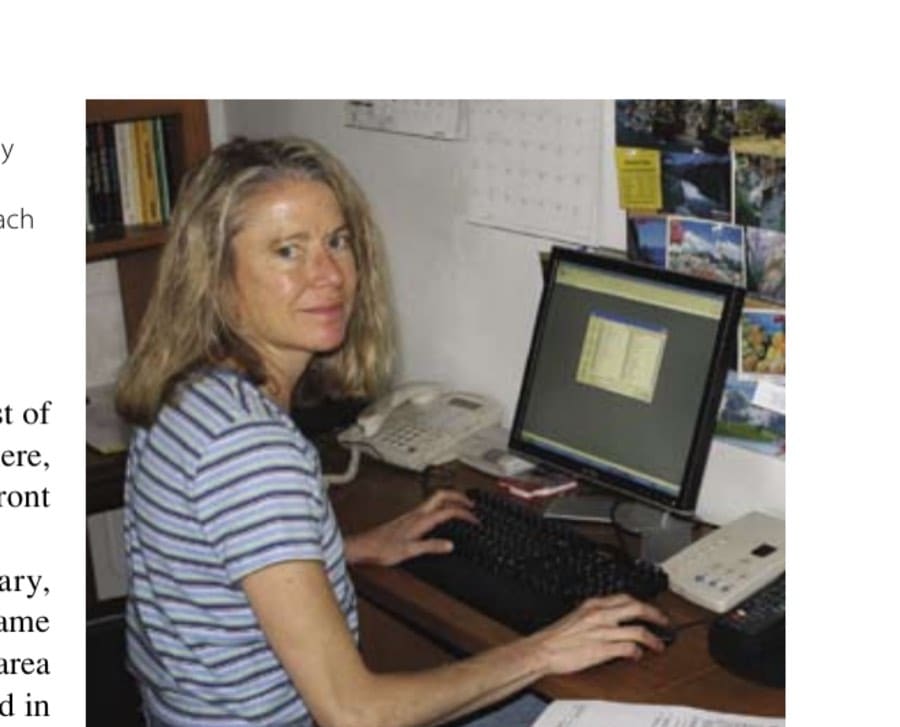
Going the distance together RaceReady has grown over 15 years into an established business with three employees, including Mary and Gerry. Gerry is in charge of production, including design, cutting, and sewing. Mary handles all the accounting, invoicing, bills, and other paperwork. In addition, the company contracts out cutting and sewing work to keep about 10 people employed year-round.
Like a good running career, RaceReady has yet to peak. Sales have grown every year since 1993, and expo sales now make up less than 10 percent of the total, down from a quarter when they first started. Sales to individual customers have always been the company’s bedrock; Gerry thinks it has to do with Mary’s personal touch. “She writes a personal note to every person who orders something, and people really respond to being treated like people rather than customer ID numbers.” “
I love to focus on the personal side of the business,” Mary says. The Web site has an “Ask Mary” section where runners e-mail questions about everything from training regimens to what to eat before a race. “
Mary’s always had a sort of regular fan club,” Gerry says. “People seek her out for advice.” “I do sometimes feel sorry for myself when my knee is bad and people are talking about races I’d love to run,” Mary says. “But for the most part, when I talk to customers about their upcoming race, I sort of relive it through them, and it’s great.”
OK, I asked Mary and Gerry recently, but what about all that togetherness? Running miles—and a business—together, living together, playing together; doesn’t it all get to be a bit much? “It is a lot of togetherness,” Gerry admits. “But we’re so busy during the day that we don’t notice it. And our job responsibilities separate us. I’m in the back
▲
Mary adds a personal touch with her RaceReady customers by including a handwritten note with each order.
of the warehouse most of the time; my desk is there, too. Mary’s in the front office.” He adds that Mary, the neatnik, has a name for his cluttered desk area that can’t be published in a family magazine. “Come to think of it,” he says, “maybe that’s why I’m in the warehouse.”
Long may she run We don’t get to choose our talents or our passions, really. But we do get to choose our work and how we arrange our life. “When I think back on other jobs I’ve had,” Mary says, “it was really just putting in the time so I could have fun when I got off work. Now, there’s so much overlap between work and play, I can’t tell the difference sometimes. It’s one and the same. “
It’s really perfect,” she adds, “when you can find your passion and combine it with your business and make a go of it.” “When we were starting RaceReady,” Gerry says, “the fact that we were runners helped it succeed. But it worked both ways. RaceReady put us on a path where there was no way we could stop running, even if we wanted to!”
Mary and Gerry work hard at RaceReady, putting in lots of weekend and evening hours. “When you have your own business,” Mary says, “you know the work has to get done. You just have the freedom and the latitude to decide when you’re going to do it. I love the flexibility. “
I do work hard, but I like doing it on my own terms. I think if it hadn’t been RaceReady, it would’ve been something else, because I don’t like being told what to do and when.”
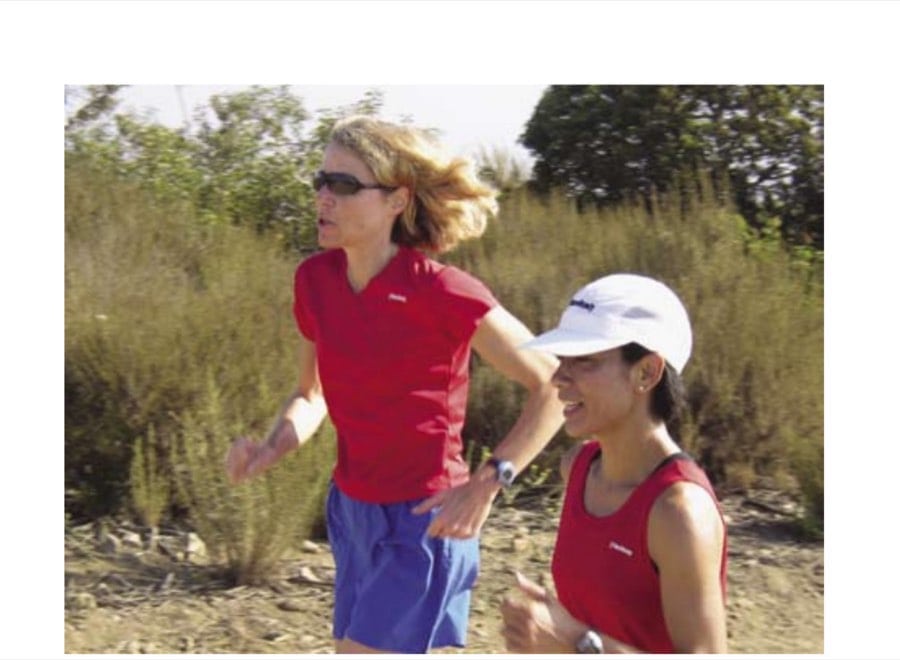
▲ Mary enjoying a run on trails with her friend Janet.
They are glad they’ve been able to make a living in running, though. “Runners really are just my kind of people,” Mary says. “There’s a youthfulness in their attitude. They’re honest, and they’re quirky. A lot have great stories to tell. They can relate to the obsessiveness. “They’re really kind of a breed apart. The color of your urine is totally acceptable in polite conversation, for example. It’s like a club—or a cult.” Mary says ultramarathoners really amaze her. “They’re even more obsessive than I am. It makes me feel almost normal. I can’t imagine running a hundred miles.” “But,” she adds, without a hint of irony, “I might do a 50.”
M&B Referral Program Did you know that we have a policy of adding an issue to your subscription when a friend subscribes to M&B because you turned him or her on to the magazine? Have your friend give us your name when he or she subscribes and we’ll tack on an extra issue to your current subscription. No limits on the number of referrals.
This article originally appeared in Marathon & Beyond, Vol. 13, No. 6 (2009).
← Browse the full M&B ArchiveMore like this
1,000+ stories from 19 years of Marathon & Beyond
The complete archive of the legendary long-distance journal — digitized and free to read.
