

See You On the Mountaintop
Except for the glimmer of a thousand stars and the faint glow from a few porch lights, the desert outside my room where I am pacing back and forth is almost pitch black. It is two o’clock in the morning. A handful of ravens flit and scratch on the ground near the parked cars. There is noise off in the distance from some animal life digging through the trash cans, and the air conditioners drone and hum away in an attempt to keep the hot desert air from the rooms at Stovepipe Wells Hotel. Otherwise it is quiet.
As I concentrate on the enormous challenge ahead, my mind and nerves ramp up as adrenaline, excitement, and anticipation slowly start to drip into the system. My body finally realizes that in just a few hours it will be running the 135-mile race that begins at Badwater, California, the lowest point in the Western Hemisphere, snakes through Death Valley, and passes over two mountain ranges before finishing at Whitney Portals, halfway up Mt. Whitney, the tallest peak in the lower 48 states. This footrace is considered the toughest in the world. There will be no more sleep tonight and probably none for the next few days.
Although I have been here many times, this year is more special than others. At the prerace meeting yesterday and at his eulogy in January, I honored my fallen friend, Jason Hunter, before his family, his friends, and many great athletes. I dedicated this race, as well as the traditional 11-mile climb to the top of Mount Whitney that follows the official race, in Jason’s name. I am sure that he will be out here, at least in spirit, offering guidance and inspiration to help me fulfill this rather tall order. I have but one goal now, and that is to finish. There are no other options.
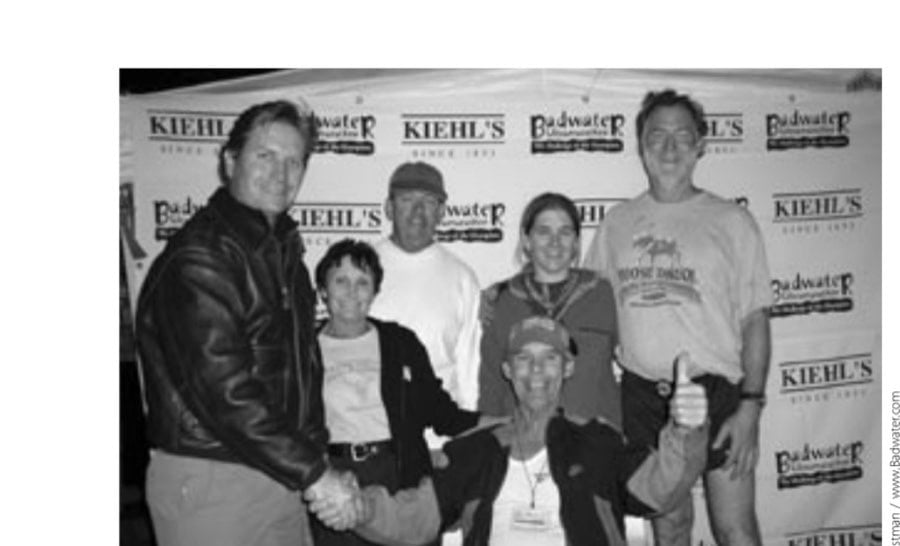
SOME LAST-MINUTE SOCIAL GRACES In the minutes before the 10:00 A.M. start, I mingle and socialize with the other runners beside the Badwater sign and near the Kiehl’s sponsorship banner draped
Christ Kostman / www.Badwater.com
across the road where the race begins. I notice that the sea level sign that was missing last year is again attached and perched 282 feet above our heads on the rugged side of the Black Mountains. All is well. The national anthem is played in our honor, and hundreds of photographs are taken just seconds before the starting countdown begins to this grueling event. It is good to be back. This will be my seventh consecutive Badwater race.
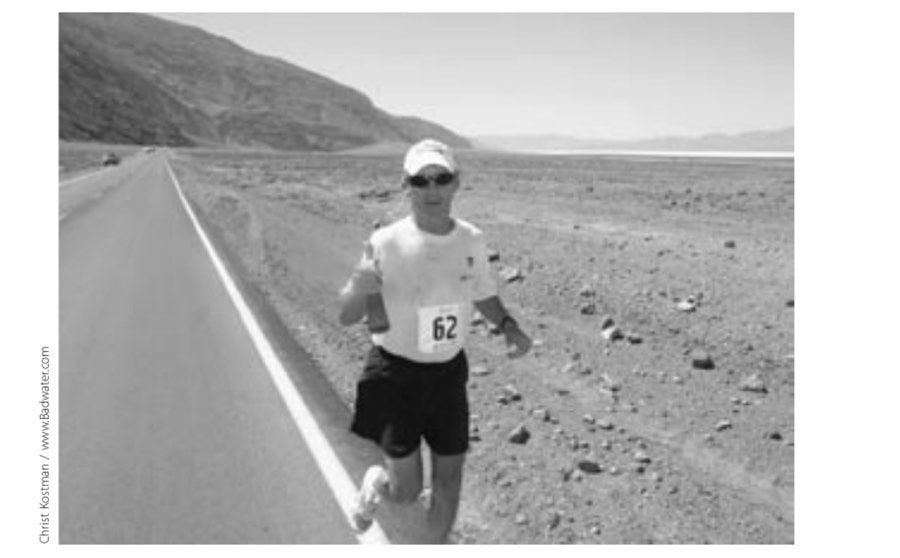
During the first 25 miles, while I’m still fresh and the endorphins fill my system, I run and joke with some of the other runners. Chris Frost gives me a Lance Armstrong yellow charity wristband, prompting the joke that we are engaged again. I wonder whether his fiancée, Tracey, knows about this. And Lisa Stranc-Bliss, the running doctor, who pronounced me alive enough to continue on during a bad spell in last year’s race. Want to feel humble? Run a few miles with everyone’s favorite ultrarunning legend, Marshall Ulrich.
We run north along the great sprawling salt basin with its colorful landmarks reminding us that we are indeed in Death Valley. The Timbisha Shoshone Indians call it “land on fire.” We pass Dante’s View, Coffin Point, Devil’s Wheat Field, Furnace Creek, Salty Creek, Devil’s Golf Course, the Sand Dunes, and Stovepipe Wells. The land is picturesque but inhospitable. Left unattended, you could die out here in a matter of minutes.
My van is filled with tons of supplies, and my crew (my wife, Christine, Vince Pedroia, Juli Dell’Era, and John Rodger) will be alongside me the entire race.
Art Webb wonders “where did everyone go?”
They will attempt to keep me fed, hydrated, and cooled off by using squirt guns and sprayers. The van itself looks like a rolling billboard with messages, memorial banners, and inspirational drawings from special children taped on both sides. We have another vehicle at Stovepipe Wells that will be used as a shuttle to run into town to transport team members for rest periods, to pick up supplies, to keep my supply of Snickers bars healthy, and in case of emergencies.
Around the 35-mile mark, I comment that it is unusually cool, maybe only 115 degrees. But that’s about to change; someone in charge of the thermostat must have heard me shooting off my big mouth and begins to stoke it up a few degrees.
TURNING INTO A FURNACE Near the Beatty turnoff where the course turns west to cross the valley, it is at least 125 degrees. Head winds generated somewhere in the canyons pick up the radiated heat from the pavement, superheat it, and then send it furiously across the basin to greet us.
For the next seven miles, the suffocating winds are incessant, and it feels as though the temperature is up near 140 degrees. It’s like opening a furnace door and standing in front of it with a fan blowing the heat on you. The mouth and eyes dry out, unprotected skin burns, the nasal passages and lungs sting, and it becomes increasingly difficult to take a deep breath. The cooling body sweat and the water sprayed on the running clothes evaporate immediately, and my core temperature rises as intense heat presses heavily against every cell. Fortunately the months of training in a 180-degree sauna have prepared me for this. I handily move ahead, although the heat will take its toll later tonight.
At Stovepipe Wells (42 miles), I could take a quick break. In the past I’ve cooled off in the motel pool, which is now filled with runners and crew, or I could use the shower to rinse the heat away, but not this year. I’ve found that the body starts to shut down once it stops to relax for more than 10 minutes. I’ve suffered severe cramping and have witnessed convulsions and technicolored barfathons by other runners in this pool area. Since that kind of activity has a tendency to ruin your day, my plan is to continue to go forward and take short respites on the stoop of the van every few hours. So I just sneak on by.
Then I face the most difficult part of the Badwater race, the seemingly neverending 16-mile, 4,900-foot climb to Townes Pass (mile 58). The first few miles are directly into the sun, and the hot winds continue to blow. As the sun sets, Chris Frost catches up to me. We run together. When we reach Emigrant Campground halfway up the mountainside, we take our first minibreak. Kari Marchant, a livewire crew member, joins us and we gradually move up the mountain, now dimly lit by a half moon and the Milky Way. We pass the time by laughing at raunchy jokes. I have to do all the joke telling because they don’t know any.
At the top, next to the radiator-water tank, we take another short break. The wheels are beginning to come off, and the tired body wants to lie down. This race has become serious. The weariness that is clinging to the body is similar to tying a spare tire to a rope around your waist and dragging it to the finish line. The image is not all that strange; some runners have trained by dragging tires in an attempt to get tougher for this course.
SOME NUTRIENTS BEFORE PANAMINT Chris naps while I cool off my legs with iced towels and gorge on peanut butter, POWERade, and Ensure. We then run another eight miles, down the backside of the pass to the edge of the salt flats in the bottom of Panamint Valley. Looking across the five-mile basin and into the distant hills, we can see a glowing necklace of a dozen or more muted, red flickering brake lights. My emotions lift knowing that I’m in the middle of other runners and their crews who are struggling along the course to realize their goals. Misery loves company. As soon as we catch a runner, Chris tags along and they move ahead into the night. I am once more alone.
Suddenly, on the side of the road, there is a quick and blurred movement. I turn and catch a glimpse of a coyote, maybe several, scrounging around in the bush. The one closest is gaunt, wiry, skittish, nervously pacing, and panting. Scrawny and undernourished, it salivates from hunger pains. I immediately flash on Harry, the protagonist in Ernest Hemingway’s “The Snows of Kilimanjaro,” who lies on a cot in the African savannah dying from the gangrene that has invaded a cut in his leg. Hemingway writes, “. . . it occurred to him that . . . he was going to die . . . and . . . the hyena slipped slightly along the edge of it.”
Oops! I make some noise and flash my lights toward these guys, and they slink away into the scrub. But I sense that they are still close by: dug in, crouched, waiting, hungry, and ready to strike for their next meal. I know that I am rank smelling and my aroma must be wafting in their direction. I hope they have targeted a smaller morsel somewhere nearby. I decide to hurry myself up before they drag me off into the desert.
Fortunately, dawn is approaching, and the coyotes and other animal life will soon vanish into the sand in this sparse desert. They will attempt to survive another day somewhere buried, hidden, and protected from the brutal heat of the scorching sun: if they manage to survive during the hostile summer, then we should be able to handle two days. And we runners think this Badwater race is tough. For a moment, I contemplate their difficult lives.
I run to the Panamint Springs Resort (mile 72), looking forward to a short break. I have been active with minimal rest since the start of the race. My overworked, strained, and taxed body is fighting back. It needs to be rejuvenated, and it wants that to happen right now.
THE HARSH REALITIES OF REST But a 10-minute respite turns into 45 as I attempt an unsuccessful catnap. I’m just too wired to rest. Then, in another unexpected moment of survival, I quickly step inside the hotel’s bathroom/septic system for relief. Whew! There is even more glory: if I manage to get back on track and finish this race in under 48 hours, I will earn another cherished and coveted brass belt buckle.
After gobbling down a cup of fresh-made scrambled eggs and chasing them with a Starbucks frappuccino, it is time to run up another steep climb: this one eight miles long, leading to the Father Crowley Overlook (mile 80). The view along the serpentine ascent is breathtaking. The multicolored canyon walls that spill into the salt flats below are incredibly beautiful. These huge chasms are routinely used as a military training ground for F-16s that swoop down deep inside the canyons pursuing their imaginary prey.
My crew is finally able to get a cell phone connection with my hometown radio station. After I broadcast my progress report, the host asks whether I have seen my shrink lately. Well, yes, I have, but obviously the therapy is not going well.
At the top of the climb, it is time for a change of socks. One sock is soaked with blood and the other is glued to a severe blistering problem and will hamper my efforts as the race wears on. The next 10 miles of gradual rolling hills is brushed in purple and yellow hues and dotted by abandoned silver mines that likely dead-end into shattered dreams.
The landscape is filled with the colors and scents of sage and withered yucca. A huge rock and dirt formation near the Death Valley National Park entrance sign (mile 85) is shaped like a stegosaurus. It has several rows of bony plates along its back, so maybe it is one, partially buried, camouflaged, and sleeping.
Two years ago during the night, I saw dinosaurs crawling across the desert floor. There are times during this race when the demons stir somewhere within the dark corners of the tired mind and the mind begins to hallucinate freely. For the moment, I know for certain that the dinosaurs I saw were real, and I suspect they are still out there, on the move, across the desert floor, despite evidence that they are all long extinct.
WITH THE MORNING, THE WINDS ARE BACK It is early morning and the head winds return like a giant, heat-searing hair dryer. A chronic Achilles problem is flaring up and progress becomes more of a run/hobble. At the Darwin turnoff (mile 90), the race bends north, and I will run the next 15 miles, as they are mostly downhill. The hot winds, which have now shifted to my back, help push me along.
At mile 97, a minor problem develops. We are out of ice, low on water, and the drinks are warm and difficult to swallow. Right on time, Nancy Shura from the medical team stops by and gives us all her leftover ice and water. Coincidentally, a similar scene occurred last year when Monica Scholz stopped along the Panamint Salt Flats and replenished my depleted supplies.
At the 100-mile mark, high up in the mouth of the pass leading into the Owens Lake area, I can finally see the great sprawling Owens Valley. But three miles later, I can no longer run. The hot tailwinds have cooked my hamstrings and they are now unraveling. We ice them down and I wear long pants in a feeble attempt to cool them. But the damage has been done: they will not respond to this tinkering and I struggle five miles into the weather-beaten trailer-park-like burg of Keeler (at mile 108).
After a short rest, I still feel drained and wilted from the battering of intense heat over the last two days. For the third time in the last five years, the winds are blowing sand and ash from fires in the Sierras across the arid and desolate Owens Lake and into our path. As I gag and choke on the smoke, I resolve to plod along until the sun sets behind the tall, rugged western mountains and then, I hope, run into Lone Pine, the last checkpoint before we head directly west into the mountains. My wife and Juli drive into town in hopes of getting some rest before they help me with the final climb.
LEFT TO MY OWN DEVICES Once I start running again, I feel much better. But just a few miles later, I need water and my van is nowhere in sight. Although it is now dark, it is still hot and I begin to overheat. Unable to continue, I wait and waver on the side of the road for about 35 minutes until the van finally returns. John had stayed behind to make sandwiches in preparation for the final climb. He should have gone ahead to stay in touch and maintain a sense of timing, but I decide that’s OK. The heat has tortured everyone, and understandably our minds are not functioning at top efficiency and a misjudgment was made.
I shuffle the last four miles into Lone Pine (mile 122), where I rest and cool down at the hotel. The air conditioner gives me goose bumps, and my crew believes I am suffering from heatstroke. They call a race medic who determines the real problem. It is time to get going and finish this thing off before anything else goes wrong.
Shortly, we restart. Even though Vince and I laugh most of the way up Whitney Portal Road, the steep and relentless 13-mile climb to the finish at Whitney Portals (mile 135) is painstakingly slow. I need to leave something in my tank for the final leg, which follows the official end of the race. Once I cross the finish line, I still need to climb 6,000 more feet to the peak of Mount Whitney if I am again to do the lowest to the highest point.
During a weary moment, a massive pack of large rats at the side of the road sweeps toward me. Startled for a few seconds, I move over to our van while Vince protects me from the “varmints.” He tells me that I had likely just flashed on some grass that was growing through the cracks of the roadbed. There are no rats, he assures me. I am not so sure of that and hurriedly move forward.
With four miles to go to the finish line, we enter the first of the two exaggerated switchbacks leading to the Portals (up which Humphrey Bogart drove his getaway car in the 1941 film High Sierra) and realize that the end is only an hour away. The pace quickens, there is more spring in my step, and now there is also a renewed sense of urgency to polish off this edition of the Badwater 135—and to get on with the rest of the run.
My crew will walk with me the last mile. Everyone is more alive, giddy, and spirited, but the same sentiment is not shared by nearby campers who yell from their tents to shut up so they can sleep. Sorry, but fat chance. With only a few bends in the road to go, the physical and mental demands step aside. As all else but finishing is placed on the back burners, I start tripping on my emotions.
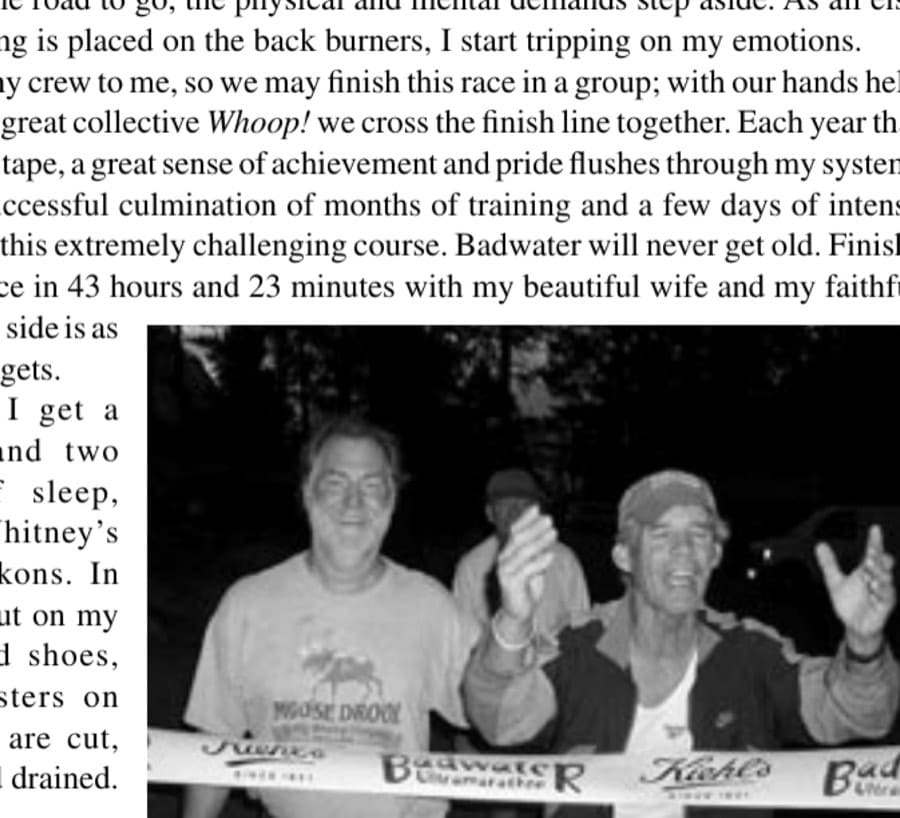
I call my crew to me, so we may finish this race in a group; with our hands held high and a great collective Whoop! we cross the finish line together. Each year that I break the tape, a great sense of achievement and pride flushes through my system. It is the successful culmination of months of training and a few days of intense work over this extremely challenging course. Badwater will never get old. Finishing this race in 43 hours and 23 minutes with my beautiful wife and my faithful crew at my side is as good as it gets. After I get a shower and two hours of sleep, Mount Whitney’s peak beckons. In order to put on my socks and shoes, large blisters on both feet are cut, sliced, and drained.
Sweet: Art completes his seventh Badwater.
Christ Kostman / www.Badwater.com
FOLLOWING IN HUMPHREY’S TIRE PRINTS
By two in the afternoon, five of us are ready for the climb: Phil and Kari Marchant, Jill Anderson, Marshall Ulrich, and I. We start at the Whitney trailhead, which is about a hundred feet from the Badwater 135 finish line. Our pace is deliberate as we pass Lone Pine Lake. Halfway up, at a campground, Phil turns back. At dusk, we have reached the top of the hundred switchbacks, but we will have to climb the riskier last three miles on the western side of the pinnacles in the dark. It begins to get cold. The 30-degree chill and the 13,000-foot altitude are becoming factors. With an hour to go, Kari becomes sick and can go no farther. Jill opts for accompanying her back down.
BLISTERING PROBLEMS As soon as they are gone, I begin to have my own problems. The gigantic blisters under my heels have torn open. Since my feet are now sliding around in the bottom of my shoes, every step is painful, and I begin to slip and trip in the narrow rockfilled path. Several times I fall against the granite mountainside and into a pile of rocks. There is some concern that I will break something or fall to the other side of the trail and wind up landing several thousand feet in the valley below.
I tell Marshall only that I am having a minor equilibrium problem, and he gives me his trekking poles (used only to summit) to help me. In the presence of a man who recently summited Mount Everest and was named Outside Magazine’s endurance athlete of the year, I couldn’t possibly whine about all my aches and pains. (I will save that for my story.)
At 14,000 feet, I develop a major headache. My breathing is labored, and at times I have to bend over to gulp air. Then I slip and fall in a patch of leftover winter snow and ice. As I lie there wet and cold, I spot a set of headlights hovering among the distant stars. Now what? Aliens? Marshall tells me not to worry, that it’s only Venus. I think he is losing patience and wondering why he brought me along. I know that at this point, that would be my attitude.
We finally reach the stone cabin (constructed so that hikers faced with inclement weather at the top could take shelter) at the 14,494-foot peak. I wander over to the summit sign that is fastened to a huge rock. Attempting to climb on it for a better photograph, I manage to slip off and hit my funny bone. Ha! Ha! Man, that really hurt. I take the picture with my other hand extended high over the rock.
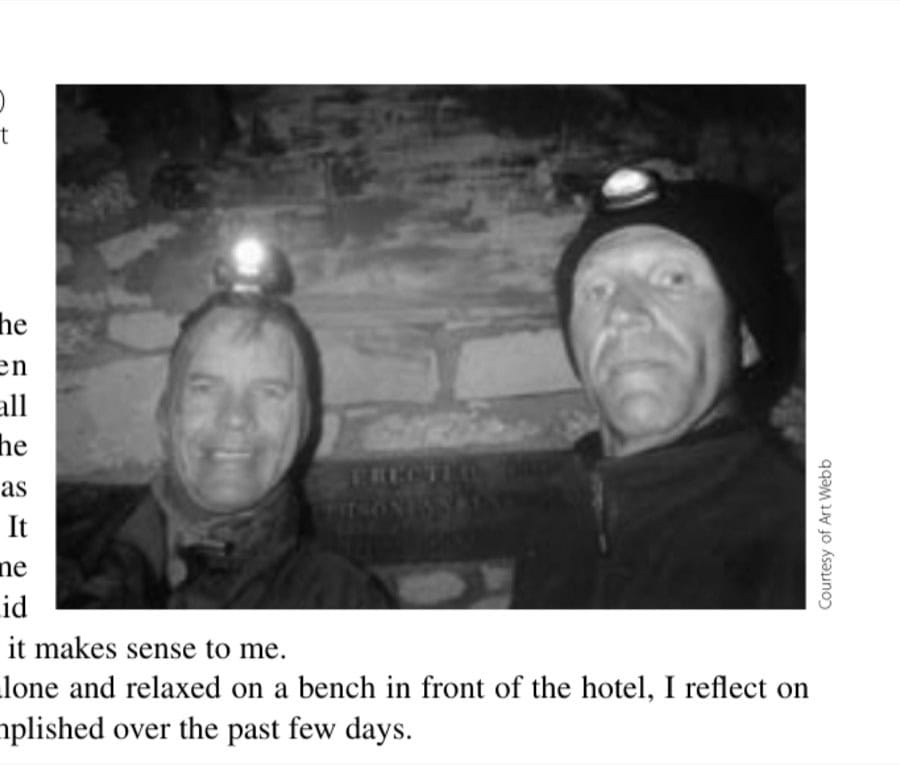
Attached to the side of the cabin is a metal, protected container with a logbook stashed inside. This is the moment I have been working so hard for over the last six months. It is now so cold that I have trouble holding the pen, and I can’t remember what I was going to write. So I scribble that I have just completed the 146-mile trip from Badwater to the top of Mount Whitney for the kids at the Valley of the Moon Children’s Home in Santa Rosa, California, and for my friend Jason Hunter. I also scrawl that God now has Jason in his hands and I hope that they both came along for the ride on this trip. And that is that. Fait accompli.
Christ Kostman / www.Badwater.com
Sweeter: Art with his team and race director, Chris Kostman (left).
A MOMENT OF REFLECTION After Marshall signs the book, we take several pictures and eat a snack while sitting on the small stoop inside the cabin. On this crystal-clear night, except for other hopeful spiritual possibilities, we are the only two on the mountaintop. Life is grand. But soon, to avoid freezing to death, we have to start the long descent. Extreme fatigue has become a problem, and several times I fall and crumple into a ball on the trail. Marshall is probably thinking that I will catapult off the mountain with his hiking poles.
In the switchbacks, I fall backward and land awkwardly in a stream of cold water. While lying there, I grab some trail mix from my backpack and munch on it. Life has come down to simple functions. One piece that was particularly difficult to chew turns out to be a spare headlamp battery. It has no flavor and probably less nutrition.
As dawn arrives, we trudge the last six miles to the Portals. I plop myself onto a large rock at the base of the trail. I am toast and can go no farther. Gary Kliewer, one of Marshall’s crew members, serves me coffee and a plate of pancakes. He then pries off my shoes and peels the socks from my swollen and hamburger-like feet. That’s OK because it is all over and my feet will have plenty of time to heal. I am stuffed into a car and we head down the mountain.
At breakfast, as Gary starts talking to me, he accidentally spits into my face. I assume that he had just congratulated me with the ultimate Badwater compliment.
Or maybe, since the crews have been cleaning up after all the runners for the last few days, it was just payback time. It may seem like some kind of a weird quid pro quo thing, but it makes sense to me. Later, sitting alone and relaxed on a bench in front of the hotel, I reflect on what I have accomplished over the past few days.
THE DISCOMFORTS ARE WORTH IT Although I have survived several small disasters, days of extreme heat and cold, drying winds, ever-present Achilles tendinitis, severe blistering, vertigo, and incredible weariness, I never at any time thought about quitting. I hope this will set a positive example and inspiration for all children.
I was fortunate to have run, walked, and shuffled along with many of my friends through Death Valley and up Mount Whitney. There are very few—if any—places on earth that can equal this course in grace and majesty.
I finished Badwater and summited Mount Whitney for my friend Jason, a satisfying tribute to his incredible life. It just really feels good that I managed to do what I had to do. And finally, I will soon be going back home with restored confidence and convinced that if you can do Badwater, you can do anything.
It was once again a privilege to be a part of the Kiehl’s Badwater Ultramarathon. I can’t wait until 2005. I will be back.
Courtesy of Art Webb
Sweetest: Art (left) and Marshall Ulrich at the stone cabin atop Mt. Whitney.
This article originally appeared in Marathon & Beyond, Vol. 9, No. 4 (2005).
← Browse the full M&B ArchiveMore like this
1,000+ stories from 19 years of Marathon & Beyond
The complete archive of the legendary long-distance journal — digitized and free to read.
