

Sharing The Olympic Experience
There is no greater sports arena than the Olympic Games. There are events, athletes, and coaches that people remember only from the Games, despite the fact that competition is year-round. For athletes who will never turn professional, the Games provide their best chance to shine on an international stage. There are accomplishments and records set at the Olympics that may stand for generations. And there are disappointments, tragedies, and the unexpected.
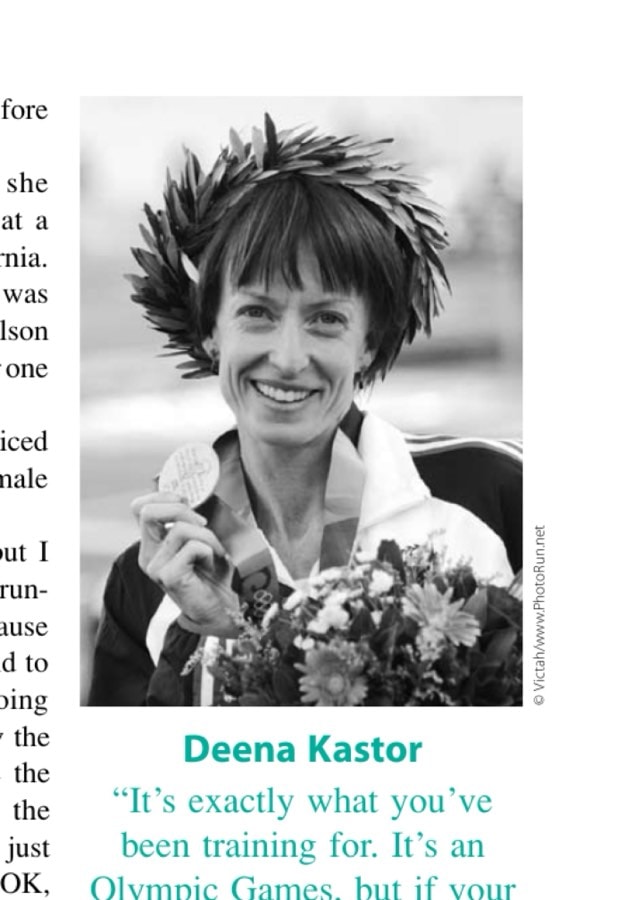
Track and field and the marathon reach back to the very beginning of the modern Olympics, and the connection through the Olympiads creates a special bond shared by those who have competed in them. “I’m following in great footsteps with Joan Benoit Samuelson, Kathrine Switzer—people that have done great things for the sport and continue to be in it,” said Deena (Drossin) Kastor, the 2004 Olympic marathon bronze medalist. Samuelson won the first Olympic women’s marathon in 1984, an event that entered the Games in large part because of Switzer’s efforts. “
To me,” Kastor continued, “I look at them as role models [for me] to be able to stick in the sport as long as possible, even after my competition days are over.”
Tragedy One of the most tragic episodes in Olympic history broke during the early-morning hours of September 5, 1972, when terrorism struck the Munich Games. After a week and a half of peace and competitive excitement, blood was shed when 17 people were killed after Palestinian terrorists infiltrated the Olympic Village. Two members of the Israeli Olympic team were murdered in the Village, and nine were later killed, along with five of the eight Palestinians and a police officer, during a tense and deadly helicopter escape attempt at a nearby airport.
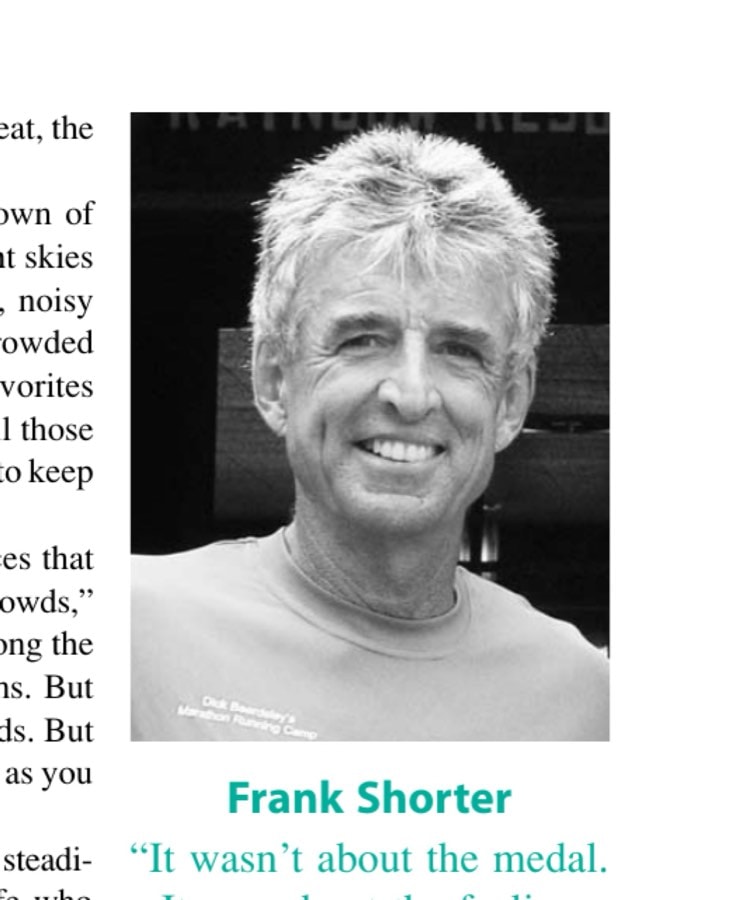
“The morning dawned on the day of the massacre just like [in] the jungle when there is a major predator around. It was eerily silent,” recalled U.S. Olympian Frank Shorter, who won marathon gold at Munich, where he was born 25 years earlier. “The usual hustle and bustle was gone. “Before [the tragedy], you felt like you were at an international university with a lot of fit-looking people walking around,” Shorter added. “The cafeteria was the best place to hang out to watch other people.”
The Olympic Village The Olympic Village can be a temporary home for athletes to enjoy the excitement of the Games, a place to meet people from other countries and join in the camaraderie, a refuge between events, or an epicenter of noise and jubilation.
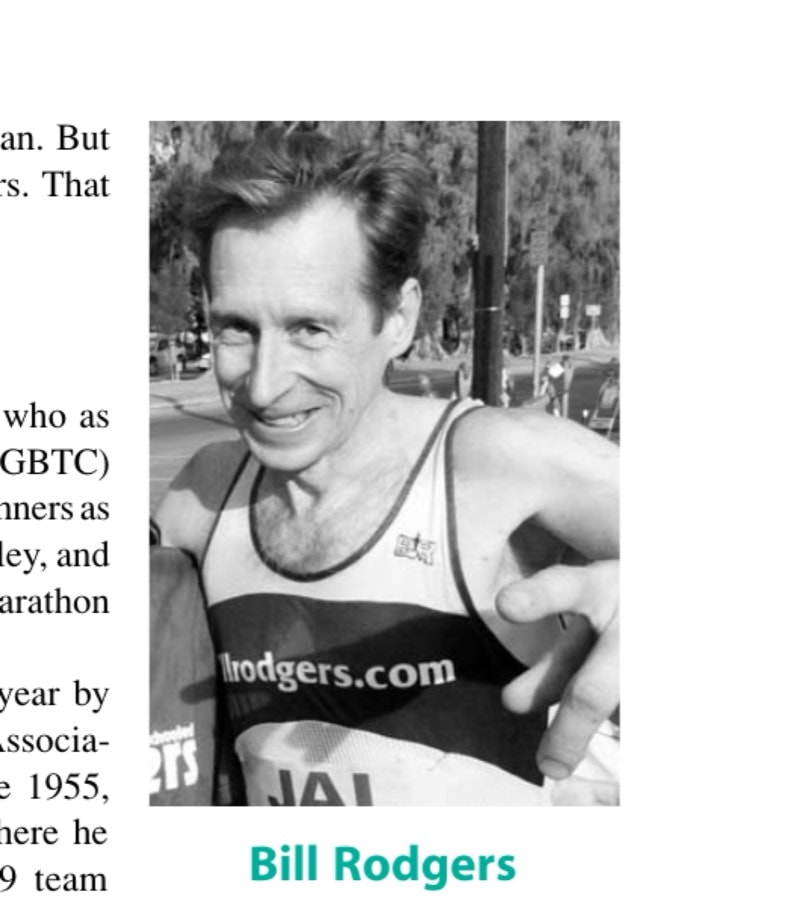
For Bill Rodgers at the 1976 Olympic Games in Canada, the excitement and revelry forced him to relocate before competing in the marathon. “We got to Montreal about a week before,” he said. “and I stayed in the Village, but it was kind of crazy. I ultimately left the Olympic Village because the Olympic men’s marathon is the last event. Too much was going on. Too much noise. So I went out and I left the Village with my wife and stayed at someone’s house.”
It was the same story for Samuelson eight years later at the 1984 Games in Los Angeles. “I spent one night in the Olympic Village, and it was right next to the swimming arena, and there was so much excitement going on with the U.S. swimmers doing so well, my adrenaline was just . . . .” she said, as her eyes widened at the thought.
At the Games Marathoners march or, rather, run to their own beat. How they prepare during the final days leading up to the Olympics differs with each athlete. As the men’s marathon tends to be the final event of the Games, leading into the Closing Ceremony, some runners skip the Opening Ceremony because it’s so far ahead of their event, while some partake in the once-in-a-lifetime event because of its magnitude. “
I wasn’t quite sure whether or not I wanted to participate in the Opening Ceremonies because I really wanted to focus on my race,” noted Samuelson. “And then I said, ‘I may never make an Olympic team again’—which I didn’t—and I said, ‘I’m going to soak it all in.’ So I did go out. “
And then I went up to Eugene because there was so much excitement going on [at the Olympics], and my adrenaline started flowing early, so I went back to Eugene, which is where I was during my knee problems so I knew all the training terrain,” added Samuelson, who had arthroscopic knee surgery 17 days before
© Victah/www.PhotoRun.net
the Trials, which was 14 weeks before the Olympic marathon. A few days before the race, she returned from Oregon and stayed at a guesthouse in Santa Monica, California. The location was ideal because it was along the marathon course, so Samuelson took advantage of the opportunity for one last training run.
On the road that final time, she noticed running in the opposite direction a female runner surrounded by an entourage. “I didn’t know who she was, but I knew she looked like an endurance runner, and I knew she was foreign because I could hear the language. And I said to myself, ‘Whoever that is, she’s going to win a medal.’ I could just tell by the Deena Kastor way she was moving, kind of like the “It’s exactly what you’ve way I could tell Deena would be the been training for. It’s an next American record holder. You just know,” Samuelson recalled. “I said, ‘OK, Olympic Games, but if your there’s another medal gone. I knew, if I sport is the marathon, then had a great race, I had a shot at a medal. that’s what you’re preparing But I never thought I’d win the gold. So I said, ‘Now my medal chances aren’t all for. The fact that it’s the media capital of sports and so that great.’”
And that foreign runner? She was from hyped up, but in all reality, Portugal. “Turned out it was Rosa Mota, it’s just another competition who won the bronze [in the marathon],” and still the women that I Samuelson said. “Sometimes you can tell compete against throughout a book by its cover. And we’ve since been the year. It just happens to very good friends.”
Kastor, who was second at the 2004 be on a bigger stage.” U.S. Olympic Marathon Trials, didn’t allow the hoopla surrounding the Olympics to distract her. In the days leading up to the start in Marathon, Greece, it was business as usual and prep as usual for Kastor. “
Really, the preparation came with the months leading up to it,” she explains. “The last few days, you basically just relax and rest for the race—getting off your feet, storing up all the energy. So really, the last few days are pretty simple.
“I think the greatest asset that any marathoner can have is just the structure in their training on a day-to-day basis to a week-to-week basis as being consistent in getting the working in, getting the rest in, and making sure you’re fueled and hydrated on every run—just all those things working together to make for a healthy starting line,” Kastor further explained. “In the psychology of it, it seems like if you put in all these months of training, what’s one more 26-mile run? So, you better give it the best before you kick your feet up and take a break.”
Such calmness can be easily rocked, however, as was the case for Rodgers as he prepared for the Montreal Olympics. Two specific occurrences in the days before the marathon occupied him to the point that he was not 100 percent on race day.
Heading into the Games, Rodgers was nursing a sore foot after the U.S. Olympic 10K Trials in June. As a result, he eliminated his scheduled speed work leading up to the Olympic marathon on July 31. At the Peachtree 10K in Atlanta on Independence Day, Rodgers had come in second behind fellow Olympian Don Kardong, who would end up in fourth place at the Olympic marathon. “
I was still in good shape, but I stopped doing speed work after that, maybe even before Peachtree, because [after the 10K Trials] my right foot hurt; all [of] my foot hurt,” Rodgers said. “Just overuse—hammering away. And that cost me a good race,” he exclaimed. “That’s running! That’s just the way it is.”
Then, problem number one surfaced from within the beautiful waters of Lake Champlain, in upstate New York, where the training camp was located. “I went out for a training run, and I needed water because it was hot—we didn’t have little bottles in those days,” noted Rodgers. “I was running 15 miles, 18, 20 miles, and I needed water, so I drank from Lake Champlain. I look over to the right [and] 30 yards down there’s this sewer pipe,” he said, rolling his eyes in comic disbelief. “I got so sick.”
The second problem, which was more serious and longer lasting, required the assistance of his coach, Bill Squires, of the Greater Boston Track Club. By the time of the Montreal Games, Squires had coached Rodgers to six top-five marathon finishes, including a win at the 1975 Boston Marathon in an American record of 2:09:55, second at the 1976 Olympic Trials, and third at Fukuoka in 1975.
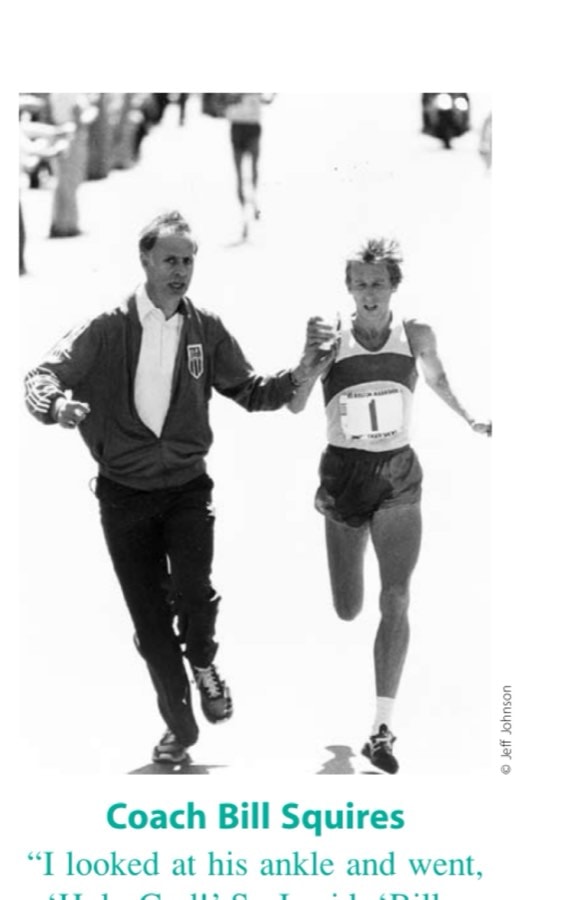
Rodgers arrived in Montreal about a week before the marathon and checked into the Olympic Village. A few days later, he went on a training run in a local park. “And he sprains his ankle,” said Squires, who wasn’t scheduled to meet his runner until about a week before the marathon. “He twisted it. He tripped on something and rolled it right over. He didn’t want to say anything. He thought [he’d run through it], but it’s turning out to be a balloon. He didn’t call me, but Ellen, his first wife, calls me and she said, ‘Bill’s injured.’ And I said, ‘Has he
© Jeff Johnson
seen a doctor?’ ‘He doesn’t want to see a doctor.’” Squires immediately traveled to Montreal to tend to Rodgers. Before picking up his credentials, the coach found Rodgers and attempted to get medical attention for him at the Village. But without his coaching credentials, access was not easily forthcoming. “
I looked at his ankle and went, ‘Holy God!’ So I said, ‘Billy, you’re gonna have to listen to me and I’ll work things out,’” Squires recalled. “We go to the Village and I said, ‘Look, I’m the coach, and I have Rodgers next to me.’ And of course he had the U.S.A. uniform on. And I said, ‘We have to go in and see the trainer.’ There was a Canadian guard and another person there looking [us] over, and I said, ‘This guy won the [Boston] Marathon last year! And I’ll have my credentials afterwards!’ So they said OK.”
Rodgers received several treatments and continued running under the watchful eye of his coach. They were encouraged by an 11-mile run at about a 7:10 pace, in which Rodgers performed well. As Squires self-mockingly noted of his coaching advice, “He’s doing everything, even the stuff I told him—raise your legs, get off your legs, put pillows up, take the strain off.”
Shorter, who in addition to marathon gold in ’72 was fifth in the 10,000 and won silver in the ’76 marathon, got the most out of his
Coach Bill Squires “I looked at his ankle and went, ‘Holy God!’ So I said, ‘Billy, you’re gonna have to listen to me and I’ll work things out.’” We go to the Village and I said, ‘Look, I’m the coach, and I have Rodgers next to me.’ And of course he had the U.S.A. uniform on. And I said, ‘We have to go in and see the trainer.’ There was a Canadian guard and another person there looking [us] over, and I said, ‘This guy won the [Boston] Marathon last year! And I’ll have my credentials afterwards!’ So they said OK.”
Olympic experiences. While staying focused and still holding on to his training efforts in the Munich and Montreal Games, the Yale grad nevertheless allowed himself to partake in the camaraderie. “I maintained my training routine, though it was scaled back in both volume and intensity,” he recalled. “All the distance runners were in the same huge apartment in the Village, and we all went out for our easy runs in groups. It was easy to enjoy the Village and attend other events because there was much more free time than usual. “
I was never one to hole up in my room before a big race, whether it was in the U.S., Europe, or the Olympic Games,” he added. “I enjoyed taking my mind off of what was going to happen in the competition.”
Last Days Before the Marathon In 1984, Samuelson was faced with a myriad of thoughts, not the least of which was simply to focus on getting ready to run 26.2 miles. “I also realized it was the first time that the women’s marathon was ever being contested in the Olympics, so that meant something,” she said. “But to be honest with you, in the last few days before the marathon, I was so focused, I totally forgot about that part. I totally forgot about that. But you know, back then, the big marathon name was Grete Waitz, and she was in the field, and she was the one to beat. Ingrid Kristiansen was also running very well. Then I saw Rosa. Lisa Martin was in the race. It was a tightly contested race.”
While Samuelson’s thoughts jetted everywhere from running the race to its magnitude to the top-notch field of competitors, Kastor’s thoughts 20 years later were narrower, in part because the 2004 Olympic marathon was the sixth one for women.
But one of Kastor’s strengths as a competitor is her ability to maintain her composure before a race, and she did just that in Greece. “It’s exactly what you’ve been training for,” she said. “It’s an Olympic Games, but if your sport is the marathon, then that’s what you’re preparing for. The fact that it’s the media capital of sports and so hyped up, but in all reality, it’s just another competition and still the women that I compete against throughout the year. It just happens to be on a bigger stage.”
The Race Itself The 2004 field also included such greats as Paula Radcliffe of Great Britain, who entered the Games with a world record 2:15:25; Kenyans Catherine Ndereba, who won the 2003 world championship, and Margaret Okayo, who won the 2003 ING New York City Marathon; Japanese favorites Mizuki Noguchi and Reiko Tosa; and fellow U.S. runners Jennifer Rhines and Colleen DeReuck. And they all had
their own plans on how to beat the heat, the course, and each other. From the evening start in the town of Marathon through the darkened night skies to Panathinaiko Stadium in Athens, noisy spectators with banners and flags crowded the ancient streets to cheer on their favorites or to support the race itself. Amid all those sights and sounds, Kastor continued to keep her cool. “
It seems like in the greatest races that you tend to feed off the energy of the crowds,” she said. “The crowds were great along the course in Athens, mostly British fans. But you just tend to feed off of the crowds. But on the inside, it’s a pretty quiet place as you Frank Shorter make your way to the finish line.”
From as deep as 18th place, Kastor steadi- “It wasn’t about the medal. ly passed runners—including Radcliffe, who It was about the feeling dropped out—en route to her bronze medal that I had run a very, very in 2:27:20. Noguchi won at 2:26:20, with good race. My strategy Ndereba in second at 2:26:32. to surge early and hard Rodgers’s 1976 experience in the marathon was not a positive one in terms of his had worked, and I liked result. The combination of his injuries and the idea that I had been the heat landed the New Englander in 40th
the first runner to take a place at 2:25:14. risk to try to win.” After “I hit The Wall bad,” he said. “I think I was dehydrated on top of it all. That’s often learning of the allegations been a problem in my career. I would just against the East German race, but I wouldn’t think a lot. This is a athletes, Shorter noted thinking-person’s sport. When the condi
of his 2:10:45, “It made tions were good and I didn’t need the water me prouder of my perthat much, I could go and I could do well. formance. I had run on a But if the conditions were tough and hot, sometimes I’d overdo it. You’re sunk in the broken foot and done my water then.” second-fastest time.”
Finishing second in ’76 in a time of 2:10:45, Shorter was a great example of Rodgers’s description of a thinking person. The defending champion maintained his balance of pace and surge and also kept his head in the game.
As Shorter describes, he was “watching the other runners, reacting to their moves when needed, and waiting for the moment when it felt right to make a big move myself. “It wasn’t about the medal,” he said. “It was about the feeling
that I had run a very, very good race. My strategy to surge early and hard had worked, and I liked the idea that I had been the first runner to take a risk to try to win.” In both instances in 1972 and 1976, Shorter was not the first one to enter the stadium. In Munich, an impostor jumped in the race toward the end and managed to be the first person the fans saw leading the marathon. He was soon escorted away in time for Shorter to cross first. Four years later in Montreal, Waldemar Cierpinski of East Germany finished first, with Shorter in second for silver. Cierpinski was one of many East German athletes who may have benefited from the government-sponsored use of performance-enhancing drugs, and Shorter and Don Kardong, who was fourth in Montreal, have campaigned to have Cierpinski’s gold medal stripped. After learning of the allegations against the East German athletes, Shorter noted
of his 2:10:45, “It made me prouder of my performance. I had run on a broken foot and done my second-fastest time.”
A View From a Coach While it’s the athlete who is prominently featured during the Olympics, it’s the coach who often puts in the research and planning for the runner to properly train to compete. And it was no exception for Squires as he began to prepare Rodgers for the ’76 Games. “
When I’m going to do something, I’ll do my research,” Squires said. “I went up to Montreal on purpose about the year before. And I had [later] taken him over the [first] 11 miles of the course, and I said, ‘OK, [when you’re] running—you go through a little village, and it does this, this, this [turns]. At about 12 miles, that’s your break point. They’re all going to [run slow]; instead, fly. Anytime there’s a real deviance, a blank corner or something, just go. Zoom! You know where you’re going—boom, boom!’” the coach explained.
Like today, coaching wasn’t allowed during the race. Even with his credentials, Squires could not coach Rodgers while the race was on—not even a “Good job!” from the sidelines. This offered Squires free time while Rodgers was competing in the early stages. Eventually, Squires and some friends from Boston began their journey to see Rodgers around miles 12, 18 to 19, and 22. “
I was bored after a while,” recalled Squires. “There’re hardly any English [language] papers. I read the thing, and there’re about three pages. So I go to the
train to figure out where we could get off [along the course]. We got off at 12 miles to watch him, and then the next one was 18. But I had to find what stops [to use] with the map. I can’t speak French, so the people’d [point]. I’d have the marathon thing [course] and the trolley thing [map]. I do a helluva job with [pointing] my fingers. “
So he was there at 12,” Squires continued, “and then he knows—we’ve done enough 20s and baby surges—he goes to the twisting place, at about 13, 14 miles, and he’s still there. [The lead pack] cut back to about four, five people.”
All went well with Squires and his group of Bostonians on the Metro—that is, until they neared the 30K mark of the course. “The train stopped! I said, ‘I’m going to walk the friggin’ tracks,’’’ Squires said, half-jokingly. “People are saying, ‘Open the doors!’ Finally, the conductor says, ‘The power is off; it’ll be on [soon].’ I go, ‘God, why are you doing this?’ I’m timing it, figuring I would get there about 15 to 18 minutes ahead of him.”
Squires finally made it to the course, and Rodgers was struggling. “He’s trying to make it,” the coach said, “and at 18, it [the gap] closed up and the other guys came back. At 30K, it’s like eight people going across. He’s giving me the eyeball, and I’m sitting there, [saying to myself for support] ‘Atta boy, Billy! You’re doing good.’”
As Squires observed, the first half of the marathon was going well for Rodgers, who with bib number one as the top-ranked marathoner, led the race for nearly 20 miles. With about 10K left, Rodgers began to unravel. He was still in the top 10, but out of medal contention. “[
He] lost a month’s worth of running, and [even] with five workouts and one semi-long 11-miler, his leg, with his foot [injury] and everything, just gave out,” Squires said. “And he goes in with a fade. He just does a jog-in. He was out of fumes. He was going to see if he could break it open. At 19 miles, he was not going to get a did-not-finish.”
First for Women At the 1984 Games, Samuelson kept herself in check. Twenty years before Kastor was the U.S. favorite at the 2004 Games, Samuelson was faced with a different situation—she was the hometown favorite in the inaugural women’s marathon hosted by her own country. While she, too, prepared for the same distance of 42 kilometers, she was nevertheless fully aware of the significance and opportunity awaiting her on the streets of Southern California: parity at last, and with a stellar collection of talent in Waitz, Mota, Kristiansen, and others.
There was no better platform on which to show the world what women could do. And there was no greater manifestation of that importance for Samuelson than
Paul Clerici
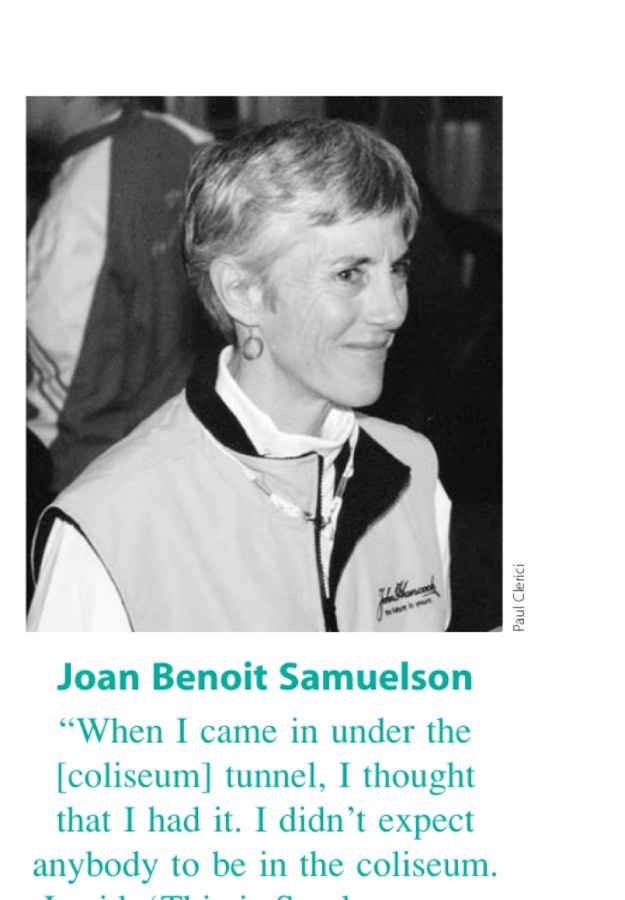
what she saw near the marathon finish months before the Games. “I looked at it as the Olympics because I’d run in a half-marathon out in San Diego the fall before, and the people associated with the race brought me up to the coliseum in L.A. because they wanted me to see the mural that Nike had painted of me on one of the buildings right by the coliseum,” Samuelson recalled of that five-story image of her breaking the tape at the 1983 Boston Marathon. “When I saw this, it totally undid me. I couldn’t believe they had that much faith in me to put up something so bold. And so
Joan Benoit Samuelson that’s what really got me through the “When I came in under the knee problems. I said, ‘If this company is putting so much faith in me, and [coliseum] tunnel, I thought they’ve already put this mural up, I that I had it. I didn’t expect better darn well be there to run.’ So that
anybody to be in the coliseum. I used in a very positive way.” I said, ‘This is Sunday mornAmong such a strong contingent, the 27-year-old Bowdoin College ing, it’s the first track and field grad quickly found herself on her event, it’s the first time—who’s own. Shortly after the start, the lead going to come out and watch a pack followed Waitz to the first water
bunch of women run?’ I really stop, but Samuelson, who was slightly ahead of the field, kept running straight didn’t think. And then when I approached the coliseum tunforward—and she steadily built upon her lead. nel, I could hear the crowd get
A couple of miles into the second to its feet. I could hear it. And half, with a lead of about two minutes, that sent shivers up my spine. she flipped down her hat visor as she entered the closed-off, eight-lane
And then I came in and I saw the people, and my legs just freeway expanse in the Marina area. Television viewers saw a powerful imturned to Jell-O.” age shot from a helicopter high above the course. It showed a solitary speck on the wide-open pavement, and it was Samuelson. Some thought the burden of maintaining such a lead for so long, all alone, would prove too daunting. Not her.
“That’s when I felt the most at home and the most at peace,” she said, “because being alone on the L.A. freeway, all by myself, with no vehicular traffic and no spectators really, I could just focus on my rhythm. I really felt at home. That’s where I’m most comfortable training—on the roads.” Where the crowds appeared, the majority of the cheers and support were for Samuelson, and there were times when it penetrated her focus. “I tuned most of that out,” Samuelson recalled. “I didn’t tune out the support. I knew there was a ton of support out there for me. I was an American. I was leading. It was on American soil. So specific things I tuned out—except for the Bowdoin banner. There was a Bowdoin banner in the Marina District, and that did stand out, but the support was definitely with me.” For most of the race, Samuelson led the way. With no rearview mirror, she had to depend on her comfort in running alone to continue to push herself and not allow her pace to slow or the field to gain. With such a grand lead, she could have prematurely enjoyed the moment of “victory” and possibly have relaxed before finishing. “I never did,” she said. “When I came in under the [coliseum] tunnel, I thought that I had it. I mean, I thought that I was far enough ahead because somebody had said something or I just didn’t detect—you know, there would have been more fanfare right on my heels if Grete had been closer.” Being an Olympic marathon rookie, Samuelson’s naiveté surfaced as she approached the Los Angeles Coliseum in the gold-medal position. As she was about to win the historic women’s marathon, blazing a trail that many others would soon follow, her initial thoughts may be surprising. “I didn’t expect
anybody to be in the coliseum,” she noted. “I said, ‘This is Sunday morning, it’s the first track and field event, it’s the first time—who’s going to come out and watch a bunch of women run?’ I really didn’t think. And then when I approached the coliseum tunnel, I could hear the crowd get to its feet. I could hear it. And
that sent shivers up my spine. “And then I came in and I saw the people, and my legs just turned to Jell-O,” Samuelson added. “And all I could think was what [U.S. Olympic decathlon champion] Bruce Jenner said—‘Feet, don’t fail me now.’ All I needed to do was stand up. And I didn’t know if I’d be able to,” she said. “That was great. And then I did a [victory] lap, I had so much energy.”
Samuelson won the point-to-point Olympic marathon in a time of 2:24:52, with Waitz in second at 2:26:18, and Mota in third at 2:26:57.
Boycott Unfortunately, the Olympic Games have not escaped political boycotts. There have been several throughout the history of the Games.
In reaction to the Soviet Union’s invasion of Afghanistan in 1979 and its refusal to withdraw, more than 60 countries boycotted the 1980 Summer Games in Moscow on the lead of the United States. As a result, many of the top athletes in the world were not allowed to compete.
Rodgers, who had added a dozen more marathon victories to his resume since the 1976 Montreal Games, was angered by President Jimmy Carter’s politically motivated decision to head that boycott. Even to this day, it still touches a raw nerve. “
I was shocked. It was all politics. It’s disgusting. It was a pity and a tragedy for the athletes to be used,” Rodgers said. “We found out in March (1980),” he continued. “I thought we were going to go because the U.S. has always been a great supporter of the Olympic Games since 1896—one of the first countries to be at the Olympics.”
Also feeling the cruel hand of politics when his country joined that 1980 boycott was one of Rodgers’s top foreign competitors at the time, Toshihiko Seko of Japan—the four-time winner of the Fukuoka Marathon, two-time winner of Boston (including the 1981 course record of 2:09:26 that also beat Boston Billy), and the winner of London and Chicago. “
I was very disappointed that because of the boycott in ’80, I couldn’t run,” he said through interpreter Kay M. Horiuchi. “I felt bad that, technically, it was a loss because I didn’t run. But the fact I couldn’t run was even more of a loss.”
Squires felt bad for the athletes devastated by the boycott. They train for years for the often once-in-a-lifetime opportunity to compete against the world’s best, and to miss just one Games means a potential eight-year delay—if an athlete can even find that spark again. “
It hurt,” the coach said of the boycott. “It put our teams back a few years. It really did. Because that’s how you ground for the first time an international athlete that will be able to take the Olympic pressure. It gives them a trial run. So you lose that. So the next time that person has to wait four years. The older people—they’ve gone out the door.”
1980 Marathon Trials Nevertheless, the U.S. Olympic Marathon Trials were held in May with the knowledge there would be no Games to follow. Nearly 30 percent of the 269 U.S. runners who had qualified to run the Trials did not show. Rodgers was one of them. “I didn’t go to the Trials,” he said. “I ran Boston [in April] instead because there was no meaning for me to go to the Trials. I don’t want to go to the Trials—I want to go to the Olympics! The Trials mean nothing if you can’t make the next step. Unless, if you had never made an Olympic team, and they’re still going to do the Trials—it wasn’t meaningless because
you could still say you are an Olympian. But to me, that was an insult to the runners. That was an insult.”
1980 Olympic Coach Before the talk of a boycott, Squires, who as coach of the Greater Boston Track Club (GBTC) had helped such acclaimed American runners as Rodgers, Alberto Salazar, Dick Beardsley, and Greg Meyer, was asked to be the 10K/marathon coach for the 1980 U.S Olympic team.
Named a three-time coach of the year by the National Athletic Intercollegiate Association, Squires had been coaching since 1955, including at Boston State College, where he had 16 All-American runners and 49 team championships, and the University of Massachusetts at Boston, in addition to the GBTC from 1973 to 1985. “I was ecstatic. It gives you kind of an honorary status that you’ve done well,” he said. “You know, the pitiful thing, as a person dies, and then a year or two later they honor him. What good is it? I mean, if the person is that good, take consideration then. “It’s that type of an honor, I really feel,” he added. “Mine is how well my athletes do. And I have a philosophy, to this day, that I say: results show, for you and your team. So, the results— they do show. If they’re bad, they show badly. And if they do, I always take it upon myself that I’m the culprit, not the athlete. I know the athlete wants to do it. I think a lot of people think, ‘Oh, they blame it on the athlete.’ No. Make amends to your own self that you’ve got to shape up and look and be on the same wavelength.” Prior to the 1980 Games, the U.S. team didn’t have coaches for individual events. As Squires noted, long-distance runners require
Bill Rodgers “I didn’t go to the Trials. I ran Boston [in April] instead because there was no meaning for me to go to the Trials. I don’t want to go to the Trials—I want to go to the Olympics! The Trials mean nothing if you can’t make the next step. Unless, if you had never made an Olympic team, and they’re still going to do the Trials— it wasn’t meaningless because you could still say you are an Olympian. But to me, that was an insult to the runners. That was an insult.”
different attention from that of the sprinters. This seemingly obvious point was never addressed on the coaching staff for previous Olympic teams. “They were going to form a new thing—a 10K/marathon coach, which they never had before,” Squires said. “Usually it was the track and field guy for everybody, more or less. He’d have an assistant—a sprint/jump assistant, and more or less, middle distance. But that was it. They didn’t care about the 10K. But road racing had taken off in America, in such depth, that that was it. I was told to fill out some papers to be ready. The next thing I knew, the boycott came and that more or less ended what was what. “
The only thing I got out of it was a visit down to Philadelphia, where anyone who had made the Trials could have a little race against themselves. It was very, very bitter. A lot of people wouldn’t go,” continued Squires, who added that a trip to see the president was also scheduled. “I didn’t bother going to the White House. They had a thing where you got an invitation and you could walk to the garden, and Jimmy Carter would say, ‘Well, we’re doing it for the best.’”
Representing Your Country The 1972 Munich Games were held as America’s involvement in Vietnam was winding down, and also at a time when some U.S. athletes weren’t thought of as being as good as other international competitors. “
I was very proud to represent my country,” noted Shorter, “and never got caught up in the Vietnam anti-U.S. government aspersions that were popular at the time. I also enjoyed representing American endurance athletes, who at the time were seen as not able to endure like those from other parts of the world. The pride is the same now, though I also realize how lucky I was to be able to physically put in the hard training on such a consistent basis.”
For publicly not supporting the 1980 U.S. boycott, Rodgers was a target for some people who took exception to his opposition. Not only was his patriotism questioned, but he was also the focus of reported death threats when he ran the 1980 Boston Marathon. “
It was very disconcerting then to have people yell at me, you know, that I wasn’t patriotic because I didn’t support the boycott,” he commented. “OK, tell me about it,” he added with a sigh. “To me, the Olympics is everything. I am aware of other sports, but they don’t have the power of Olympic sports, I don’t think—at least the top Olympic sports. The old Olympic sports—track and field, swimming. Sports like that.”
Seko, who competed in the Olympic marathon at Los Angeles in 1984 and at Seoul, Korea, in 1988, ran with great pride under the Japanese flag. But he didn’t necessarily run for his country. “For my family,” he said through interpreter Horiuchi. “I felt more encouragement by representing my family, not so much the country of Japan. I ran for
myself and for my family,” he paused with a laugh, and continued, “because my country won’t give me any money.”
Love/Hate “I don’t think there are many people who are more patriotic than Olympic athletes,” Rodgers said. “I felt it. Oh, yeah! Not many people are more patriotic because we were people who didn’t get any money, didn’t get any rewards of any kind, and yet we tried to excel in one of the most challenging sports in the world. And to represent your country was a great honor.”
Athletes like Rodgers treasure their time as an Olympian, whether or not they medal or turn in their best performance. As a competitor, Rodgers did not fully enjoy his Olympic experience in 1976, largely because of his injuries and the pain that multiplied from 42 kilometers of foot pounding. “
The Olympics were kind of terrible,” he said. “That’s why it was frustrating to do poorly. But it’s just fate. I wasn’t always the best at picking them. But to be there is everything, to a track athlete. To us, it means something. A lot! It’s the ultimate.”
While also feeling the pride of representing his country, as a competitor Seko of Japan doesn’t hold his Olympic performances in high esteem, despite improving from 14th place in 1984 in 2:14:13 to ninth place in 1988 in 2:13:41. “
The Olympics were the only times I didn’t do well,” he said through interpreter Horiuchi. “Everything else I was doing well throughout those years, but [in] the Olympics, I didn’t do so well. I’ve been winning—I won Chicago, I won Boston, I won all over. I’ve just been improving, trying to beat my own records. The Olympics are the only ones I lost,” he said, and then added with a laugh, “I won everything else.”
Kastor seems to place all her marathons side by side, without ranking one above another. But that doesn’t mean she fails to recognize the importance of the big ones like the Olympics. “I don’t even think, to this day, that I’ve lost the reality of it just being another marathon,” she noted of her 2004 marathon in Greece. “The thing that seems sweetest to me in Athens was just the history of the road we were taking into Athens and coming into that gorgeous stadium with the Acropolis lit up in the background. That, to me, is special. But just as special as coming [to Boston] to a race that has such history here in our own country. And I definitely honor that.”
Added Rodgers, “All marathoners—we are a little bit off the wall. It’s not an ordinary-type of thing, especially if you’re going to push it. Like we all pushed. It’s a very competitive sport, and I don’t think that side of it is really that well known, really, or understood, because runners keep it inside themselves.”
This article originally appeared in Marathon & Beyond, Vol. 12, No. 6 (2008).
← Browse the full M&B ArchiveMore like this
1,000+ stories from 19 years of Marathon & Beyond
The complete archive of the legendary long-distance journal — digitized and free to read.
