

Sheehan On Running
INTRODUCTION BY JOE HENDERSON
Dr. George Sheehan beat his own doctors’ time-left forecasts by many years, but his end finally came in late 1993. Soon afterward, a favorite race of his was renamed and moved to his old training course.
The next summer I walked to the start of the George Sheehan Classic in Red Bank, New Jersey. A young runner ahead of me turned to another and said, “This is a cool race. But who is this Sheehan guy, anyway?”
He said “She-han,” not the proper “She-un.” At that time and place, this was like asking who that Kennedy was with his name on a New York City airport. Every runner should have known George Sheehan then—or so his friends and fans liked to think, though he himself knew better.
George would have loved telling this story on himself. Others built up his bigger-than-life legend, and he sometimes felt the need to knock it down to size. The two of us once walked away from the adulation that always greeted him at the Boston Marathon. He shook his head in amazement, then added, “Two blocks from here I’m just another skinny old Irishman.”
For all the fame heaped on him in his later years, he didn’t take all of this too seriously. Being famous was a phase that started in his late 50s, when the practices of his lifetime were pretty well set and wouldn’t change much the rest of his days.
As long as I knew him, which was 25 years, he wore the same blue(jeans)-onblue(shirt and sweater) uniform while greeting crowds of runners. He drove the same little well-used cars, VWs and Hondas, that doubled as his mobile locker room.
He spoke and wrote his last words in 1993, which means that many of today’s runners can be excused for asking: who’s this George Sheehan, and why is Marathon & Beyond reprinting his old book?
Many of you came into the sport after George left. You never had the pleasure of hearing, reading, or knowing him in life. But it isn’t too late to get acquainted with a figure who once stood taller than anyone in this sport. (Put John “Penguin” Bingham on Jeff Galloway’s shoulders and you get an idea of George Sheehan’s stature at his peak.) No one to come along since has given better speeches to runners or written finer literature on running.
George was an accidental author. He wasn’t trained as a writer and had practiced medicine for half his life before publishing his first article at age 50. His medical career was winding down when he wrote his first book seven years later.
By then he had settled into his distinctive style of writing: personal, philosophical, and padded with quotes from great thinkers from outside of sports. The Sheehan style would come to be widely mimicked (and occasionally satirized) but never matched. The first book, Dr. Sheehan on Running, sold well among his Runner’s World readers, but the wider world wasn’t yet ready to buy running books. That would happen soon.
During one amazing month of 1978, three different books for runners ranked among the top 10 in national sales—for all topics. Each book took a different look at the sport. Jim Fixx’s Complete Book of Running profiled people who ran and what it meant to them. Bob Glover and Jack Shepherd’s Runner’s Handbook advised how to run. George Sheehan’s Running & Being examined why he, and we, ran.
George’s book, along with his previous and later ones, gave voice to what other runners thought but couldn’t express. They embraced him for this for the rest of his life and beyond. They loved him all the more as he wrote as openly about his final test as he had about other subjects.
In 1986, George was diagnosed with advanced prostate cancer that had spread into his bones. His doctors told him to hope for another year but to plan for less. He lived seven more years—good years, mostly. He wrote three more books during that illness (finishing the last, Going the Distance, in his final week), published dozens of newspaper and magazine columns, and spoke at hundreds of races (running them as long as he was able, including the 1989 World Masters Championships). His end came just days shy of his 75th birthday.
Who was George Sheehan? The best way to introduce yourself to him now, or to renew acquaintances, is to read one of his books. You can still find copies without looking too far. (The family Web site, www.georgesheehan.com, offers his bestselling Running & Being plus reprints of many columns.)
I worked with George on all but one of his books. He never once, in almost two decades of writing them, named one as his favorite. “These books are my babies,” he said. “I could no more single out one than say which of my own children I like best.” His kids outnumbered his books, 12 to seven. Readers must decide which book they like best. Once you read this reprint of his first one, Dr. Sheehan on Running, you’ll want to find others. Once you’ve read him, you’ll know him and won’t forget him.
NOTES AND QUOTES My family rarely gives me any credit for original thought. When a topic comes under discussion at the dinner table, someone is likely to turn to me and ask, “What would Bucky Fuller say about that?” Or from the end of the table comes the query, “Any words from the Greek philosophers?”
And as with most things said in jest to a friend, or in anger to an enemy, or in drink to no one in particular, these questions have the ring of truth. I am living proof that you can go through the world on borrowed words. Whatever happens, there seems to be someone who has already expressed my reaction to the event much better than I could. So I find it difficult to speak without giving voice to someone else’s words.
I have found a company of these “someones” who have given voice to exactly how I feel, only have done it much better and clearer than I. People like James and Ortega and Santayana and Fuller and a few Greeks. I quote them because they said so well what I was thinking. They described my experience, my personal truth, in miraculously right words.
But a fundamental fact of nature is that no man can understand for another. We can amass quantities of ideas and philosophies. But it is just so much trivia unless it is in some way materialized. The great teacher, said Santayana, is matter. The world teaches, not books. “
Anyone who has had a bull by the tail,” observed Mark Twain, “knows five or six things more than someone who hasn’t.” “Culture,” wrote Father Gannon after surveying the effect of his years as president of Fordham University, “is what is left when everything you have been taught is forgotten.”
What you have left are phrases and disconnected sayings of famous men, the giants on whose shoulders we stand—sayings that pop into our minds and onto our tongues in day-to-day situations. One hardly knows why. These quotations are filled with wisdom. But as Bergen Evans points out in the preface to his book of quotations, “Wisdom is meaningless unless our own experience gives it meaning.”
Wisdom, then, is the incorporation of the thoughts of others into our own experience—the ability to see someone else’s truth and see that you share it. It is not enough to know the great thinkers, the great writers, the great poets. You must find those who approximate your existence, your contact with the universe. Wherever you arrive, you will find they have been there first and described it better. This should not discourage you. You should let your own juices flow. Hope for a minor miracle of your own. Perhaps then you can contribute your own awareness for others to share.
With help from my old friends, I hope I can contribute a few original thoughts here, as springboards for your own thinking
One
MYSELF AND YOURSELF At the age of reason, I was placed on a train, the shades drawn, my life’s course and destination already determined. At the age of 45, I pulled the emergency cord and ran out into the world. It was a decision that meant no less than a new life, a new course, a new destination. I was born again in my 45th year.
The previous “me” was not me. It was a self-image I had thrust upon me. It was the person I had accepted myself to be, but I had been playing a role. “It took me a long time to discover that the key to acting is honesty,” an actor told anthropologist Edmund Carpenter. “Once you know how to fake that, you’ve got it made.”
In time, we fool even ourselves. Sooner or later, however, we come to question the trip planned for us, the goals we are given, our itinerary to death. Sooner or later, the self-image becomes not worth preserving. The person we are presumed to be seems unsatisfactory and inadequate. Sooner or later, it becomes important that we feel important and have the feeling that what we are doing is important.
When I stepped off that train, I had lost my sense of purpose, my faith in what I was doing, my caring for creation and its creatures. And when I stepped from that train, I found I was not alone. Millions of Americans who had been told Sunday after Sunday to be born again were now going through the shattering experience of rebirth. Only the experts don’t call it that. They call it “middle-aged melancholia,” or a “new cultural phenomenon of the fourth and fifth decade,” or more simply “change of life.”
The authorities agree that we come upon this stage of our life unprepared for the reality of advancing years and receding rewards. White-collar worker, blue-collar worker, housewife and career woman, no one seems immune to the crisis that sets in after the 40s get under way. Each of us in our own way comes to this revelation and faces the problem of living according to the person we really are.
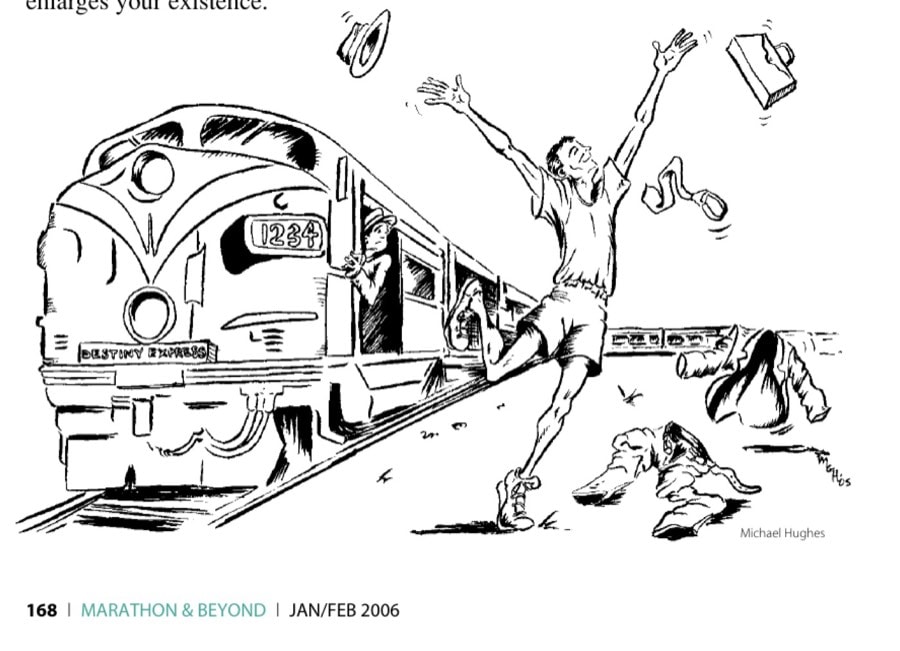
This is not only inevitable, it is desirable. “He who does not really feel himself lost,” wrote Ortega, “is lost beyond remission. He never finds himself, never comes up against his own reality.” Finding one’s reality does not come without plan or effort. Being born again is no easy task. Technique and training and much hard work are needed. And we are always faced with the knowledge that it is an undertaking that will never be completed. Every day will be a fresh start.
Most experts suggest we make a new start in a new career, develop new interests. I say begin at the beginning. Begin with the body. The body mirrors the soul and the mind, and is much more accessible than either. Become proficient at listening to your body and you will eventually hear from your totality—the complex, unique person you are.
I did it that way. I stepped off that rain and began to run. And in that hour a day of perfecting my body, I began to find out who I was. I discovered that my body was a marvelous thing, and learned that any ordinary human can move in ways that have excited painters and sculptors since time began. I didn’t need the scientists to tell me that man is a microcosm of the universe, that he contains the 92 elements of the cosmos in his body. In the creative action of running, I became convinced of my own importance, certain that my life had significance.
Fitness may have something to do with this. The physiologists have shown us that those who remain the perpetual athlete are two and even three decades younger physically than their contemporaries. And with this comes an awareness, a physical intelligence, a sensual connection with everything around you that enlarges your existence.
Michael Hughes
If decreases in the body’s functions are due to non-use and not to aging, is it unreasonable to suggest that our mental and psychological and spiritual capabilities deteriorate the same way? If so, our rebirth will be a long and difficult task. It will begin with the creative use of the body, in the course of which we must explore pain and exhaustion as closely as pleasure and satisfaction. It will end only when we have stretched our minds and souls just as far.
But there is an alternative. You can always get back on the train. The trouble with you, Doc, is that you’re assimilated,” a friend told me. “You’ve forgotten you’re Irish.” He was partly right. I have forgotten I am Irish. I still have the underdog mentality that is part of the Irish mystique. (Like the Jews and Southerners, the Irish have made a career out of losing.) And a returning tourist once told me she had seen my eyes all over Connemara. But I no longer consider myself Irish. I no longer hear that ethnic tune.
But I have not been assimilated. I know I am part of another distinct group—the distance runners. It took me a decade or more of running to realize I had been born with the mind and heart and body of a runner. I share this peculiarity with distance runners all over the world. We have some unique somatotype—a blend of bone and muscle and nervous tissue that makes running what we do best. “
The somatotype,” wrote Shelton in his classical study The Atlas of Man, “identifies a person as belonging to a biological group or family which appears to be worldwide in distribution.” These body types, he says, therefore cut across the uncertain borders by which men have attempted to divide themselves—like race and color and blood-type and geography.
I belong to the distance running family. Double my height in inches and you have my weight. My bones are small, my legs relatively short. My muscles are stringy, and I have little body fat. Like my fellows, I tend to be a solitary person and more of a thinker than a doer. But since we must find some action and physical expression, we find it in running.
The reason for this is apparently our economy of movement against gravity. Nature always moves in the direction of accomplishing more and more with less and less energy. And the runner can go farther on less energy than almost any animal on earth.
Why should I be something as incidental as Irish when I can be something as basic and fundamental as a runner? As a runner, I live totally. My every waking hour is lived as a runner. I eat as a runner. I view the weather, the terrain, the environment as a runner. I see all things as positive or negative in their action on my running. All of this happens because my body type is the most deep-seated, most general and most evident expression of what kind of person I am.
Running, however restricted it appears to viewers, is my mode of self-expression. Running is for me a subject of study that need never end. And within its confines I must work out my salvation. We distance runners are meditative men. If we have a religious tradition, it is one of non-conformity and withdrawal, the hermit, the anchorite. At best, we hope for a secluded meadow where we won’t be disturbed.
Given society’s emphasis on the values of community and helping our fellow man, we distance runners have difficulty comprehending that what we do is exactly right for us. At such times, I like to recall that Thoreau—another confirmed loner—once said that there was nothing more important to him than his walks, and he had no walks to throw away on company.
Every distance runner knows that feeling. Until I took up distance running, I found it easy to take it easy. I had no difficulty following the warnings of the experts. “Avoid stress,” cautioned the physicians. I did. “Reduce your tensions,” advised the psychologists. I did. “Rest that restless heart,” counseled the clergy. I did.
Doing these things requires no effort when you are lacking what Santayana called America’s ruling passion—a love for business—when you are a lifelong nonjoiner whose greatest desire is not to become involved, when almost everyone you meet is less interesting than your own ideas, and when your inner life has more reality than your outer one.
Running has not changed that. I am still a small-boned loner built for flight and fantasy. I cannot manufacture an interest or talent for business or institutions or people. Beyond these limitations, however, I now accept no limitations.
It may be common sense for the common man to consent to be ordinary. But now everything instinctive, everything intuitive, everything beyond logic tells me otherwise. It tells me that compared to what I ought to be, I am only half awake. It tells me that, as William James did, I am using only a small part of my mental and physical resources. Running gave me these insights. It made me an athlete, albeit an aging one, and started my ascent toward a new goal.
Now I accept stress, and even seek it out. I no longer avoid the tension between what I am and what I perceive I can be. I no longer ignore the gap between what I have achieved and what I should accomplish. I realize that I have yet to live the perfect day, the day worthy of reliving. And I know Maslow was right when he suggested that equilibrium and adaptation and self-preservation and adjustment are negative concepts.
When I run my hour on the roads, I accept no negatives. I may start with a leisurely pace, but soon the hills come and I must attack them. Every hill is a challenge. No pain, no shortness of breath will stop me until I reach the top completely spent. And even then I wish the hill would go still higher.
Surely this is a mad act. Health doesn’t demand this. Health is, in fact, something passed through on the way to this seemingly unnecessary area of fitness. This area is also quite dangerous because just beyond the possibility of doing as well as I am able lies the dread condition of overtraining, with its exhaustion and fatigue, its apathy and depression. And just as stress on the body can affect both heart and head, so the tension that upsets the psyche takes a similar toll on the body.
But if these dangers exist, the converse is also true. When you complete yourself physically, it benefits you totally. And the energies exist to accomplish this. The real problem is to discover how these energy reserves can be set loose.
My method is running. It is the hub of my creative wheel. At those moments, I am athlete, poet, philosopher, even saint. Running introduces risk, and takes me beyond tranquility and harmony and the smooth workings of ordinary day-today living. When I run, I recognize my essential inadequacy, my insufficiency of body, mind and heart. And I realize the only answer is in pushing myself to the limits on the roads, or in struggling for the right word to express the truth, or in searching for meaning for myself and the universe.
Still, the experts may be right. Stress is a killer. Tensions do cause neuroses. Uneasiness of the heart can lead to despair. But without them, we remain inferior to our true selves. Live if you will a life without risk. Avoid the forge, the fire, the flame. But know that joy and happiness and the good life come only as unexpected interludes in the endless, stressful, tense and restless journey to become the person you are.
There is no easy way. When I began running in my mid-40s, I rewrote my life story. It has become a biography of pain. I have made a career out of suffering. I’ve discovered that the middle-aged person is the perfect laboratory animal for research in sports medicine. Whatever happens to an athlete will happen first to a middle-aged athlete. Scientific progress was not my original intention. Fun was, and fitness, and perhaps achievement. I hoped to acquire the look and moves and self-confidence of the athlete—to be sleek, quick and instinctive. There might even be a glorious reprise to a not-so-glorious collegiate record.
But I soon learned that injury was to be the dominant theme of my new vocation. “Running hurt” became commonplace. The fun was there, and so was the fitness, plus meditation and other values I had not suspected. But I was neither sleek nor quick nor instinctive. I was ragged and slow and uncoordinated, more often limping than not.
As time passed and my mileage grew, I developed every runner’s injury in the books, and some that weren’t. I went through a cram course in sports medicine. Instead of reading about diseases, I got them. I became a mobile medical museum.
Eventually, I took a biblical approach to these afflictions. The cause of man’s infirmity is to be found in man himself. Germs and microbes were not the problem. No virus had produced these miseries. I was dealing with a loss of the body’s integrity, its balance, its ability to remain in equilibrium with its environment, its capacity to cope.
My little disasters, my minor tragedies became opportunities to find that integrity, that balance and the antidote to the stress of training. I began to ask questions and find some answers: answers to metatarsalgia and plantar fasciitis, to Achilles tendonitis and pseudoachilles tendonitis, to heel spurs and shin splints, to runner’s knee and groin pulls, to stress fractures and sciatic neuritis.
Some lasted longer than others and gave me a better education. Four years of sciatica taught me how to sleep (on my good side with my bad leg drawn up), how to drive a car (only in bucket seats), how to sit (with the hips higher than the knees), how to have patience (“I had it for two years once,” an older runner told me). I am a powerfully slow learner, but I began to learn.
Every painful mile I put on the roads adds more of this kind of information, but I still have trouble welcoming injury. When it arrives, I still go through that familiar sequence of every patient: disbelief, followed by fear, then rage and finally depression.
I should, however, have a lot of time to work on that problem. After all, whatever happens to an athlete will happen first to an 80-year-old athlete. Should you meet me, don’t ask me how I am. A half-hour later, you are likely to be glancing at your watch, shifting from one foot to the other and clearing your throat trying to interrupt a monologue of my symptoms. By that time, I will have covered my troubles with my feet and knees and low back. I will have reported on my sinuses and bronchial tubes and my nasal allergies. I will have described in great detail my intestinal malfunctions.
But whatever the inventory of miseries you hear before you escape, it will list only the more superficial of my problems. Your question goes beyond blemishes. It encompasses my whole person and demands a total answer.
How am I? You have set in motion a self-examination that can only end in my getting suited up and racing against the clock at the local track. The real answer must be found in action, and in reaction to maximum physical and psychological stress.
How am I? Until I’m asked, I’m able to keep my mind off it. I live in my fantasy world. I avoid reality by day-dreaming. What else can a small-boned distance runner with an oversupply of nerve endings and no fat to insulate him do about reality? Think about it as little as possible is the obvious answer.
A person with my body build and temperament, as all psychiatrists know, is relatively hypochondriacal, dependent, passive, unhappy and psychologically
vulnerable. The best way to cope with that is withdrawal. So when someone asks me how I am, my defense is shattered. How am I? Oddly, that question is much more disturbing if I feel well. That is a clear indication things are going wrong. I have yet to meet a runner who admitted to feeling well before he ran a good race. The conversation at the starting line of almost any distance race would give you the impression you were in a doctor’s waiting room. Hardly a runner is present who hasn’t complaints of such magnitude you wonder how he made it to the race, or indeed why he even left his sick-bed.
And it is always those who feel the worst—the ones with the casts and tape and bandages, the ones who have been up all night with diarrhea—who disappear ahead of you the second the gun sounds. The next time you see them, they have already finished and are in their sweat clothes cheering you on. The race has been a remarkable therapy for them. They had a miraculous cure.
How am I? The race is the answer, the only answer. The runner is truly a man dissatisfied with the status quo. His object is to reach goals that are continually being reset. And he is only aware of where he is and who he is when he is challenged. Like the saint, he is everlastingly beset by doubt and just as everlastingly asking to be tested.
So don’t ask me how I am. And one other thing. Don’t tell me I look well. Runners who look well are at least five pounds overweight, and are on their way to being happy and contented and psychologically invulnerable. I want no part of that.
Two
FITNESS AND FUN Dr. Thomas Tutko, the sports psychologist, was asked by a fitness instructor how to decide which sport a student should be in. “Just ask him,” said Tutko. “Have the student rate the activities on a scale of five (like very much) to one (dislike very much).”
Until I heard that answer, I had supposed that students could be tested to find their sports—that measurement of body types, plus determinations of coordination, strength and flexibility could be added to psychological testing and fed into a computer. The computer would then deliver the exact sport for each person.
Now Tutko was giving us the same answer Greeks got at Delphi—an answer repeated by sages ever since. “Know thyself” is the cryptic message. We must find our own answers, find our own sport. The wise man tells us how to find our own wisdom. He cannot give us his.
All this is maddening to those of us who wish to confer happiness to others, to lead their lives for them and tell them what’s best. And it’s perhaps even more
maddening to those of us who would have our future determined by some omnipotent counselor. It is no wonder that Athenians, looking for answers, turned on Socrates when he replied by telling them to examine their lives.
How can a student rate a sport he has never experienced? He can’t. That is just the point. How can a person find out whether paddleball is his game, whether archery is his thing, if scuba diving will turn him on, if any one of a number of sports give him what the late Abraham Maslow called a peak experience—“a moment when a person’s powers are at their height and he becomes a spontaneous, coordinated, efficient organism functioning with a great flow of power that is so peculiarly effortless that it may become like play—masterful, virtuoso-like”? Tutko says we will find that peak experience only by experiencing it. We will learn this most difficult lesson in the world, as Goethe said, never by thinking but by doing.
We may be helped, however, if we know what kind of person selects a particular sport. If the man who gets his peak experience running marathons matches you in temperament and personality, the odds are your unifying activity will be marathonlike sport. This at least reduces the Tutko injunction to something manageable. The number of sports to be experienced is cut down to a reasonable number.
Something of this sort is being tested in a nationwide career program. It consists of exposing the student to 20,000 different types of jobs. The jobs are grouped into 15 clusters which are classified as “the world of manufacturing,” “the world of construction,” etc. The children in grades 7-9 are given actual experiences in one or more of these job clusters. They explore them in depth. In construction, for instance, they investigate the work of the architect, engineer, craftsman.
Dr. Sidney High, who is managing the program, says, “I’ve never seen so little money spent to trigger so much response.” That response may well represent a recognition that the individual must ultimately be his own judge and save his own life.
That life will be ideally an inextricable mix of vocation and avocation—a career which meshes with and is complemented by athletic activity. To achieve this, schools must not only provide career awareness but athletic awareness. There should not only be job clusters but sport clusters where the students will find what they do best.
What we are looking for are those activities in which a student displays skill, confidence and creativeness. How do we know? “Ask him,” says Dr. Tutko. Despite our multimillion-dollar “health services” bill, the United States is the best place to be if you are sick—but one of the last places to be if you wish to remain well. Recent statistics show that the overfed, underexercised United States is 37th in life expectancy for men 40 years of age. (We were 11th two decades earlier.) Further, our women have a 6.8 years greater life expectancy than our men at that age, against 3.4 years in the leading countries.
People who planned to do something about this formed the National Jogging Association in the late 1960s. The NJA was the brainchild of Lt. Gen. R. L. Bohannon M.D., who boosted jogging as “the simplest, cheapest, least encumbered, most available and most efficient way to build up the heart and lungs.”
Gen. Bohannon looked for little or no help from the medical profession, which he said had failed to recognize the current health gap—“the gap between absence of disease on the one hand and true joi de vivre with all its energy, vitality and well-being on the other.”
The general then spelled out a program of eight minutes calisthenics warmup, 20 minutes of walking-jogging or jogging, followed by a cooldown of five minutes of walking—all of this to be done three times a week. “It is time,” he said, “for every American to ascertain his proper program and get with it.” However, the NJA has never had more than a few thousand members.
Another military man, Air Force doctor Kenneth Cooper, spread the jogging message in the late ’60s and the effect was almost revolutionary. Publication of his book Aerobics in 1968 set millions of people to jogging. But many, if not most, dropped out after a few days or weeks.
Dr. Cooper, a by-the-numbers researcher, did a prodigious amount of work on the effects of exercise. He documented its benefits to the heart, lungs and muscles. He even systematized the relationship between muscular effort and future health. He said, “I’m practicing preventive medicine.” This methodical, scientific approach has given his book a solid foundation—solid enough to convince him that every American should follow his program. Obviously, not every American has followed it. Cooper, according to Time magazine, has enlisted eight million citizens in his program of graduated exercises (mostly jogging) designed to protect against heart-artery disease and prevent premature death. But these figures must include anyone caught on the street after curfew or noticed inquiring the way to the nearest YMCA.
I suspect that “aerobics” has not had more converts because Cooper seems to view fitness in a vacuum. Cooper’s tables measure, as Bobby Kennedy once said of the Gross National Product, everything except what makes life worthwhile. The GNP, said Kennedy, can tell us everything except why we are proud to be Americans. Cooper’s stats tell us everything except why people run and cycle and swim and enjoy using their bodies.
That, of course, is the key. And until Cooper and others interested in the preservation and perfection of the body spell this out, we will make little progress. They are, you see, relying on individual conversions. And even Bucky Fuller, possibly the world’s greatest optimist, has little faith in changing man. Change his environment, Fuller advises. It can be done without that, of course, but only by the way we are protected against small pox and polio. By force. Shots for everyone will become athletics for everyone, and in doses recommended by medical
authorities. Attention America! Now run, jump, do anything to raise your pulse to 120 beats for 30 minutes a week. But there is an alternative to the athletic-state or the exercise-your-heart-ailments-away argument of the aerobics plan. The answer is to consult your friendly neighborhood athlete, be he runner, tennis player, or overaged half-court basketball player. Why does he do it?
A composite of this latter-day athlete would show him to be little different from everyone else on the block. The future concerns him little. He is practically and philosophically a “today” person, a member of the “now” generation, whatever his age. Instant gratification is his mark.
This guy has discovered the truth of Brian Glanville’s statement: “If you do not exercise the body, it corrupts—and the mind corrupts with it.” The neighborhood athlete is willing to let you in on the secret. Running pays off, and it pays off today. Exercise gives instant and exhilarating effects. There is a natural high to be obtained legally.
But to have this, we must tailor the addiction to the addict. Pick his sport according to his body build, his psychological needs and the demands of his culture. The 5’6″, 130-pound loner will find satisfaction where the corpulent, gregarious bon vivant would go nuts. The broad-shouldered, well-muscled extrovert is in a different category yet.
Some people need contests which are essentially a struggle with self, and others need games which are a classroom in interpersonal relationships. And those games may have to be games of chance or skill or strategy, depending on the individual. This complexity should not worry us, for it explains our failures and points the way to a rational plan for everyone to adopt.
Armed with this, Dr. Cooper could offer the athletic equivalent of the Vermont Alternative suggested by ex-New Yorker Bill Allen. “It offers,” wrote Allen about Vermont, “an oasis of sanity and survival in a world full of suffering, cruelty and chaos . . . and an answer to the question of the 1970s: ‘Is there life after birth?’ Not frenetic or freakout life, but close to the heart’s desire and a kind of grace beyond confusion.”
Play and games and sport offer the same oasis. Only non-athletes will consider this an exaggeration. Will jogging be only a temporary insanity like hula-hoops, the twist and psychoanalysis? Such an opinion was advanced not long ago in a “Talk of the Town” column of the New Yorker. “
Jogging is a pastime of overpowering ennui,” according to this urbane commentator who sees only ultimate boredom for the jogger, followed by a return to a “short snooze, a martini, and the evening news.”
To those of us who are mainline joggers and get withdrawal symptoms if we go more than 48 hours without running, such opinions seem incredible. And to
Michael Hughes
compare our consuming avocation adversely with golf and tennis because we lack the “coordination and physical skills to pursue these difficult, interesting sports without embarrassment” is to miss entirely the total involvement of running.
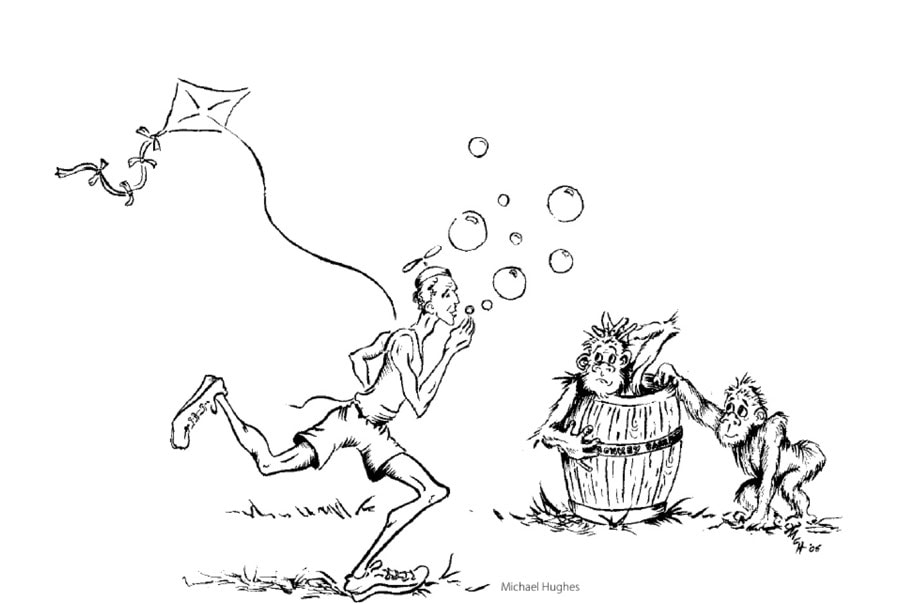
This is not to say that there won’t be dropouts, and many of them, from the jogging program. Chesterton wrote that you should never do anything “merely because it is good for you.” Those who do will invariably be found out and will return to more palatable pursuits.
For those who endure, running will bring those values sought by all men: the habit of contemplation developed in solitary long runs, the art of conversation found again in running with a companion, the sense of community born in the communal anticipation, agony and eventual relaxation of the competitive race, and finally the development of maximum physical capabilities which in turn help us to find our maximum spiritual and intellectual potential.
This is no small package. And if the New Yorker essayist sees only boredom on the faces of the joggers he observes, it is because he views the harried look of the average urban dweller as normal. What the jogger’s face shows is not boredom but contemplation, which Thomas Aquinas described as a man’s highest activity save one—contemplation plus putting the fruits of that contemplation into action.
Be assured that true joggers will not be deterred by the New Yorker article any more than our forebears were discouraged a century ago by the editorial in Scientific American which accused oarsmen and long distance walkers of “pleading the old cant of promotion of health and all the rest of it,” and warned that these activities would not be beneficial.
We do indeed plead the old cant of health, but are even more concerned about “all of the rest of it”—i.e., the contemplation, conversation and community that this activity offers. “Joggers May Be Running to an Early Grave”
Faced with a headline like that, what do you do? Read the article, certainly. So now you know that some San Francisco researchers have compiled reports on sudden deaths from coronary artery disease and found that more than half of them occurred during moderate to strenuous activity. Now what do you do? To jog or not to jog, that is the question.
Intellect, reason, intuition should go into that decision. How can I be the best possible me? What is the only possible life for me to lead? Can all this be accomplished without daily and vigorous exercise?
I doubt it. I also feel the dangers of strenuous exercise have been exaggerated, its value underrated. Any number of studies have shown that people who exercise regularly have fewer heart attacks than those who don’t. Students have also demonstrated that regular exercisers have a substantially better chance of surviving a heart attack should they have one.
In a three-year Health Insurance Plan of New York study of 110,000 people, physically active men had only one-half the number of heart attacks of the inactive men, and in the most active men only one-eighth of the number of deaths.
Such results have been repeated recently in a survey of 17,000 civil servants in England. There, in men reporting vigorous activity, the relative risk of developing coronary disease was about a third of that in men who did not exercise.
Further, the more active one is, the greater the protection. Dr. Thomas Bassler, editor of the American Medical Joggers Association bulletin, states that mileage is the best protection. He says he has yet to find a marathoner of any age having a fatal coronary attack.
Dr. Richard Steiner, a pathologist-marathoner, says, “Long distance running can give you a teenage cholesterol, remodel your lungs, lower your blood pressure and slow your pulse.” On top of that, the jogger-runner stops smoking, loses weight and develops a relaxed, playful approach toward the absurdities of everyday existence. Distance running, the additive that cleans his arteries, also cleans his mind and soul.
Seen in this light, daily vigorous exercise is needed for the actual as well as the potential coronary victim. Heart disease is, if anything, more an indication for exercise than not. “Stress tests,” says Per-Olof Astrand, perhaps the world’s best known exercise physiologist, “should be reserved for those who won’t exercise.” Then they would know, he declares, whether they are in good enough health to stand a sedentary life.
Still, exercise is not without danger. Neither is driving a car and crossing a street. You learn to exercise defensively just as you learn to drive defensively. You don’t attack exercise with a stopwatch and measured miles. “
There is no evidence that speed protects,” says Dr. Bassler, “but mileage does.” Pace, then, is paramount. Dr. Thomas Cureton has taken 12,000 people through his fitness course without a fatality. He simply uses common sense: a suitable warmup (up to 20 minutes) to allow the body’s physiology to accommodate to its function, and then a pace which the body can handle on a pay-as-you-go, aerobic basis.
The idea that pace is unique for each person goes back to Galen, the medical advisor to Marcus Aurelius. Writing about ball-playing, he said it was the best exercise for the body and lungs, and the most vigorous of all sports. He warned, however, that “the right degree must be found in practice. It cannot be expressed in writing.”
Our present-day English translation of that rule is Bill Bowerman’s “talk test.” Jog or run, says Bowerman, at a pace at which you can converse with a companion. If a slow jog is still too fast for conversation, you have to start with a walk instead.
If you follow this advice, you will have come upon what Francis Bacon called for almost four centuries ago: “A safe, convenient and civil way to prolong and renew life.” Most recreational directors, physical education instructors, and promoters of exercise-for-your-health programs feel much the same as the fellow who finds it difficult to give away five-dollar bills down Main Street. People just won’t believe it’s for real.
The programs they prescribe seem so sensible and so in keeping with our nature it is incredible that people don’t accept them. But facts are facts and there is no use railing against them. If the plane won’t fly, there’s no use appealing that the blueprints said it would. A bridge that insists on collapsing in defiance to all engineering theory will not respond to oaths and imprecations. Nor will our neighbors bestir themselves to physical activity unless we find the proper approach to the problem.
Threats fail. Horror stories of future heart attacks, diabetes and strokes have predictably fallen on deaf ears. People are not inclined to do something just because it is good for them. Athletics in schools should be chosen on the basis of what the teachers would like to do themselves. This is the rule followed by James Herndon, author of How to Survive in Your Native Land. What you don’t do, the students won’t do, was what Herndon found out. “
Why should we assume that the kids would want to do a lot of stuff that we didn’t want to do, and wouldn’t ever do of our own free will?” he asks. “Does
the math teacher go home at night and do a few magic squares? Does the English teacher go home at night and diagram sentences?” What about the physical education teacher? What about the other teachers? Can’t they bring to the student the vitality of the drama, the esthetics that they themselves get out of the sport? Can we find coaches who can make lifelong athletes out of their students?
We have forgotten that we are talking about play. We are dealing with one of the primary categories of life, one which resists all logical interpretation. Play has a deeper basis than utility. It exists of and for itself.
When we expose play to the function of promoting fitness and preventing heart attacks, we change its gold to dross. As countless fairy tales have told us, the choice of treasure over truth will always fail. What we need then is to conserve those mysterious and elusive elements of play which make it its own reward. We must remove anything that suggests practicality and usefulness. What we do must be fun and impractical and useless, or else we won’t do it. If we become fit and impervious to heart attacks and all those other dread diseases, it will be because we don’t care if we drop dead doing what we like to do.
We should be in sports not because they are practical but because they’re not, not because we feel better but because we don’t care how we feel, not because our fitness is increased but because we are so interested we don’t even notice.
Play is the key. We all love to play. We like only the jobs that have a play element for us. Anything as practical as physical education or physical fitness is not going to get to first base with most of us. Dr. Sheehan On Running will continue in our next issue.
Adventure Running At Its WORST! In 1989, two runners set off to become the first to run from Death Valley to Mt. Whitney and back—in mid-summer. Lottsa luck, fellers! Send $22 in US funds (shipping/handling included) to: Rich Benyo, Box 161, Forestville, CA 95436 USA Please Print
Name ___________________________________________________________________________________ Street ___________________________________________________________________________________ Town___________________________________ State/Province____________________________________ Zip/Mail code _________________________ Country ____________________________________________ Allow 6 weeks for delivery. If you wish a personal autograph, please include name of person for whom book is intended.
This article originally appeared in Marathon & Beyond, Vol. 10, No. 1 (2006).
← Browse the full M&B ArchiveMore like this
1,000+ stories from 19 years of Marathon & Beyond
The complete archive of the legendary long-distance journal — digitized and free to read.
