

Shooting The Palo Duro 20K, 50K, And 50-Mile
As a boy child in the 1950s, with an imagination fueled by TV and movie westerns, most of my play activities were built around playing cowboys and Indians. Cowboys were, of course, the good guys, and Indians were very mystical and would move with the winds and speak with the animals. Fast forward to now. Here I am, sitting in a canyon, in the dark, on a rock, waiting for the sun to make its first warm colors. I can feel the spirits of the Comanche and Apache chiefs, shamans, warriors, women, and children who stood on this very spot, also waiting for first warmth of the early-winter sun. I hear coyote packs howling. I imagine the spirits of John Goodnight and his men who began to find a way to feed the Americans as they moved west. They also stood here, as did the famed Buffalo soldiers and Texas Rangers, among these very rocks, cacti, and hoodoos.
Today my shooting is not with guns or fingers and sticks. Today’s “shooting” is with my cameras. I’m from the Dallas area, so that race out in Palo Duro Canyon had been the race of my dreams ever since I discovered trail running back in the late 1990s. Four years ago I had gone to Canyon, Texas, the day before the race, and I left soon after to get back to Dallas. I had seen just enough of the canyon to tell myself that I would be back. Since that time, my health, age, wealth, and life in general have seriously curbed my racing, but I never stopped wanting to experience the races in the canyon again.
This year I made an agreement with race directors Kevin McClish and Karen Roberts to photograph the runners in the races that take place in the Palo Duro Canyon. This would be the 29th running of a race first begun by legendary (at least in Texas) ultrarunner and larger-than-life RD Red Spicer.
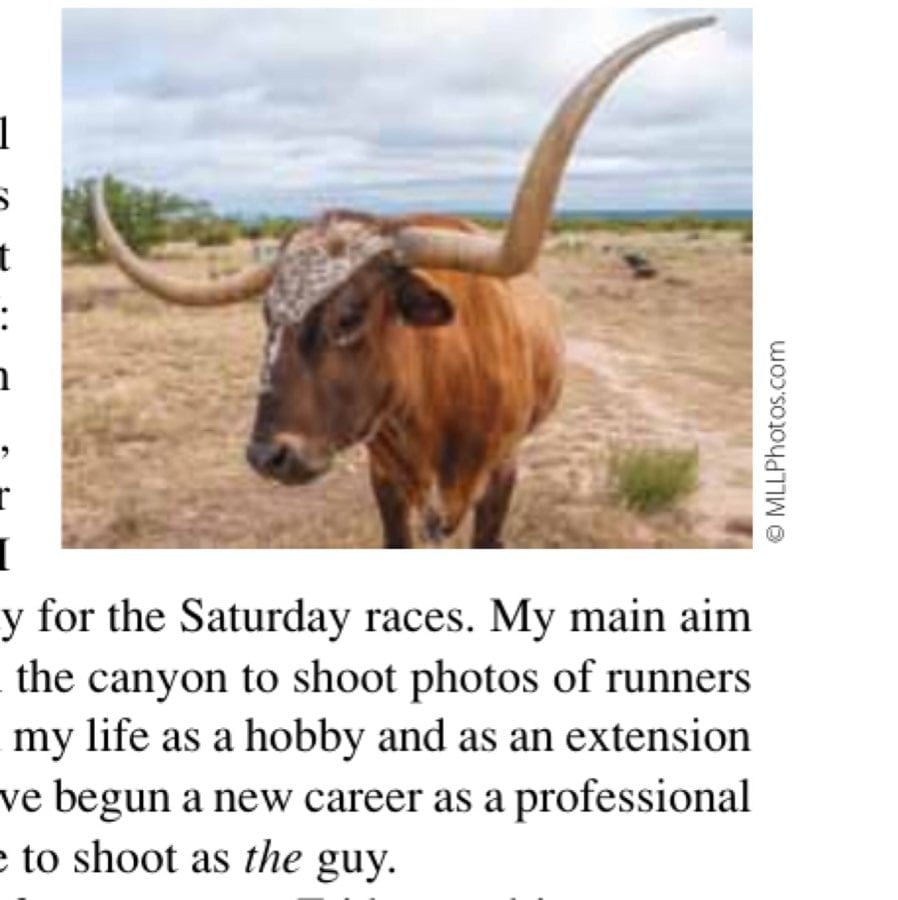
The Palo Duro State Park, besides being a wonderful place to visit, is also home to part of the official Texas longhorn herd.
▲
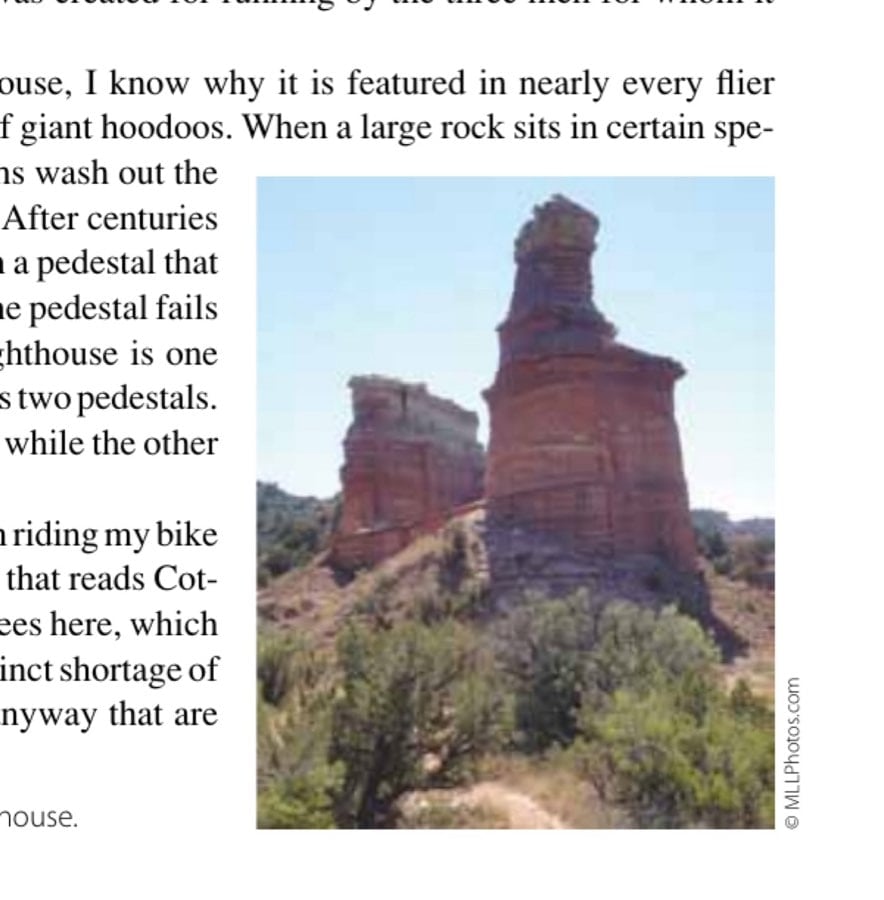
A close-up look at the Lighthouse.
© MLLPhotos.com
Long-range weather forecasts were all over the place and changing daily (this is the Texas Panhandle). With me I brought everything I could cram into my small SUV: tent, air mattress, sleeping bags, mountain bike, camera gear, backup camera gear, even more camera gear, warm-weather clothes, cold-weather clothes, and food. I arrived in the canyon at noon on Thursday for the Saturday races. My main aim for the next two days was to scout within the canyon to shoot photos of runners on Saturday. I have been taking photos all my life as a hobby and as an extension of a video career. This is for real now. I have begun a new career as a professional photographer, and this is my first big race to shoot as the guy.
I checked the weather forecast again for tomorrow, Friday, and it was now calling for cold and rain, so it was possible that Thursday might be my only chance to search. I get my tent set and then grab my bike, camera, and water and go. I head out on the trail from where the start/finish will be and begin to make my way along the course. On my way out the Lighthouse Trail, I pass the intersection with the Givens, Spicer, and Lowry Running Trail. That is the actual name on the sign. Hikers, bikers, and walkers are welcome on it, but it is actually named “running” trail because it was created for running by the three men for whom it is now named.
When I see the Lighthouse, I know why it is featured in nearly every flier about the park. It is made of giant hoodoos. When a large rock sits in certain special desert areas, heavy rains wash out the softer dirt around the rock. After centuries the rock winds up sitting on a pedestal that grows until at some point the pedestal fails and the rock falls. The Lighthouse is one very special hoodoo, and it is two pedestals. The front one is cylindrical while the other is blocky.
A few minutes later, I am riding my bike on the GSL trail past a sign that reads Cottonwood Flats. There are trees here, which I note because there is a distinct shortage of trees in the canyon, trees anyway that are
© MLLPhotos.com
▲
One of the Official Texas longhorn herd.
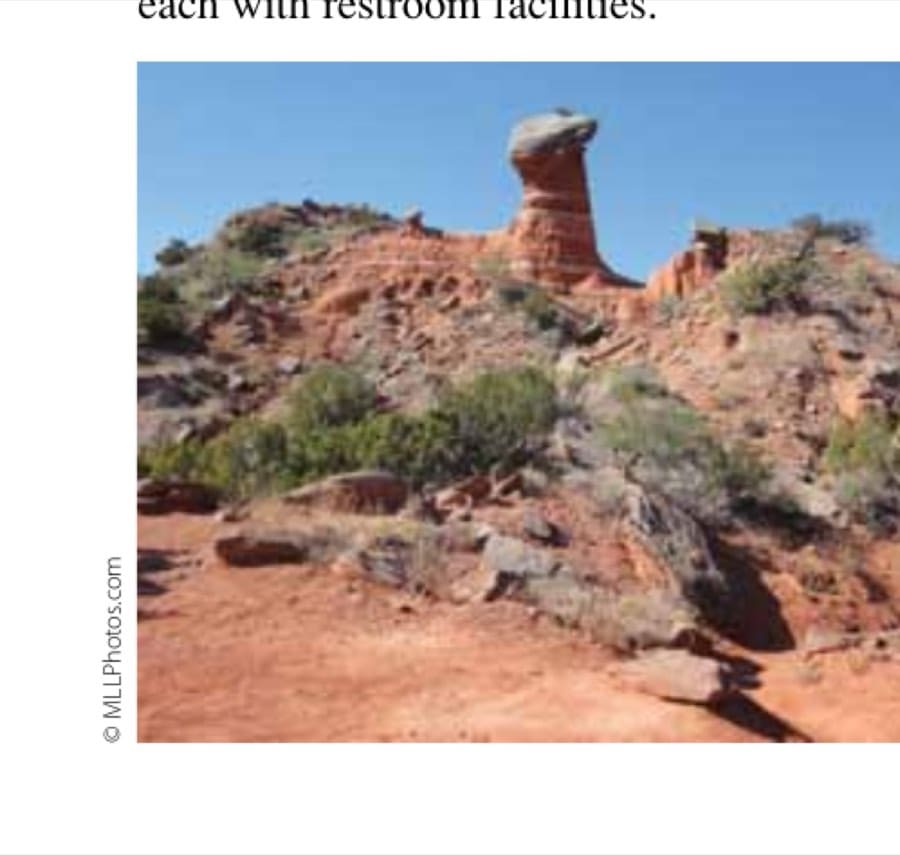
A hoodoo and rocks area of the GSL Trail.
▲
© MLLPhotos.com
taller than mesquite and locust trees. Outside of the canyon there are no trees for many miles in any direction, at least not any that were not planted and watered by people. A little farther I get to a sign labeled Buena Vista. I drop off a mesa area on
the trail and into what seems like a painted, magical canyon. The colors of the soils and rocks are every hue from light tan to bright oranges and reds. A short time later and I am beside a nearly vertical wall with many horizontal stripes. I
see it is more than colors, but every stripe is a different mineral, from feldspars to sandstones to shales, and each is a different color. I go just a little farther and look back over my shoulder and see a clear view of the Lighthouse. I stop and
pull out my compass. It is fairly early fall, so the sun will rise almost due east. I ride just a little farther along the wall and come to a point of red sand that stands tall and rises to the top of the canyon. I am getting shivers up my neck as I real
ize that I am here. I can see what can become my long shot across the canyon where the trail runs directly underneath the Lighthouse. I can see where the trail drops off the mesa into the bottom of the canyon. Each of the runners will get
to an uphill ramp and come right at me alongside the tall wall and then pass just eight feet or so to my right. I look immediately behind me and see a short, flat rock to sit on. I hear angels. This is my spot. I will just need to find it again on
race morning, in the dark. The rest of the GSL trail gets even prettier and more distinctive, but there is no place at all that will give me the views to shoot runners that are as beautiful and as practical as the spot I have found.
I had accomplished my scouting mission, so I made my way back to camp by following the racecourse. With trail names like Rojo Grande Trail still to get me back to the start/finish area, you can guess that each section of trail is distinctive
and beautiful. This is a 20K loop with incredible scenery and four aid stations, each with restroom facilities. There was still one night until full moon on the Llano Estacado, so I was really excited about the possibilities
of night photography in the canyon. My air mattress was already flat, and temperatures were expected to drop to around 40 tonight and the 20s tomorrow night.
▲
Fifty-miler Chad Bailey approaching the camera position on his first loop.
© MLLPhotos.com
The weather one day before the race was enough to open the eyes of travelers, and very nearly everyone travels to the race. On Friday the day started cool and sunny; around noon it turned gray and windy. It blew like crazy, with light rain during the afternoon as the volunteers were setting equipment and supplies in place; then the sun came back out and by the prerace dinner it was chilly, sunny, and beautiful. What a weather roller coaster. The locals didn’t even seem to notice, and race prep never blinked.
The prerace banquet was held at the campus of West Texas A&M University. The company was great and we heard from Lou Myers (the self-proclaimed “Ancient Brit”), who came for what he said would be the last trip to the USA for a race. Jay Norman (who had run 24 consecutive Palo Duro races), Chrissy Ferguson, Lisa Butler, and many longtime Palo Duro participants were there along with the newbies. Good times, good food, and laughs were had by all.
On race morning I wake before my alarm. I have about seven miles to hike in to my spot before any runners get there, and it is cold. Several clothing layers are in order. I load up with all of the camera gear, food, and water I can carry and I am off. I do not turn on my light because it is plenty bright from the full moon. Then I am treated to a spectacular sight as I hike. The park gates open around 6:00 a.m., and a nearly solid string of lights flows into the dark canyon. A thermometer that I pass at a trailhead shows 25 degrees. As I get to the Lighthouse Aid Station I am invited to jump into the “mule’ that is leaving for a ride to the Little Fox Trail aid station. The exciting ride saved me a lot of time, and I got to my spot about an hour earlier than I needed to be there. What a blessing that turned out to be.
Sitting in the canyon quietly alone for an hour, as the sun first began to light the horizon, was spiritual for me. The first of the 50-mile runners came past as the canyon was still dim. Very shortly after the 20K runners, who started 20 minutes after the 50-milers, started filing by, the whole canyon lit up with gold.
It was the best and worst possible situation for photography. I was shooting as fast as I could as everyone came past me, and as I was continuously adjusting the camera settings, the biggest crowd began to arrive. Across the canyon I saw runners pass under the Lighthouse as first light hit it.
© MLLPhotos.com
© MLLPhotos.com
All photographers’ dreams take place at “golden hour.” This is why I became a photographer. It is now my job to capture this. The 20K runners will be coming by only once, so I have to get it right this time.
The 50K runners do a 10K loop before heading out on the big loop. I want to wait where I am to get all of the runners at least once in this “studio,” and I know that the last of the 50K runners will be the last of
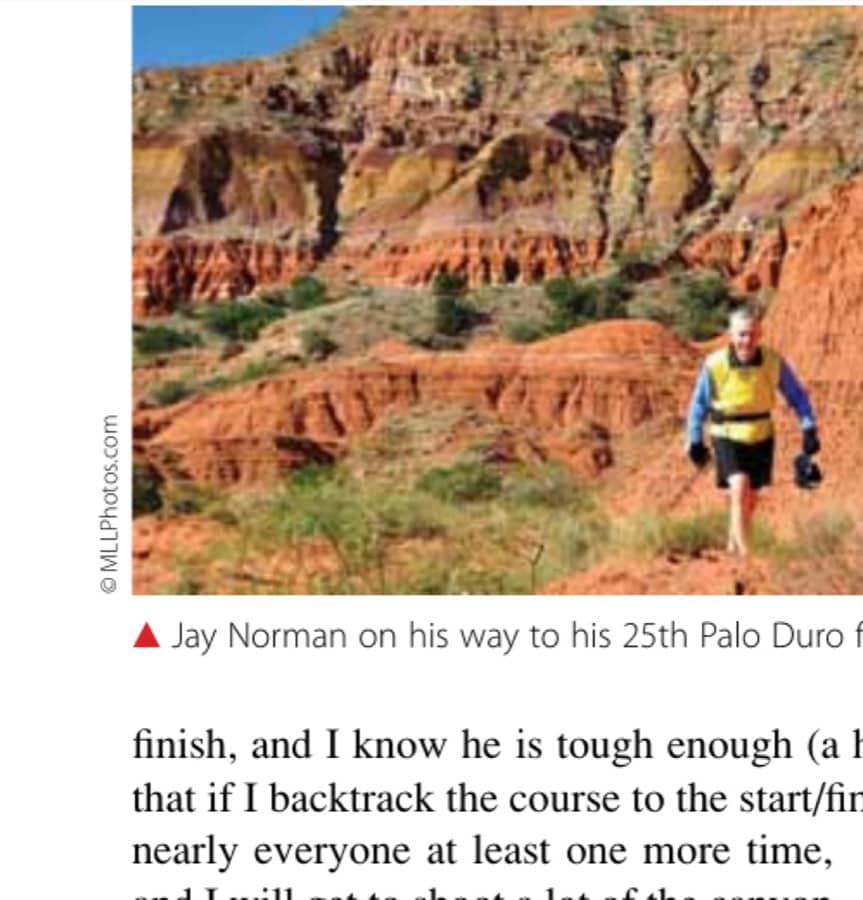
those. Jay Norman wanted to run the 50K with Lou Myers one more time, so I know that those two will be the last runners. When Jay gets to me, he tells me that Lou will not be making it, and it is up to him to bring up the
rear of the 50K. The only cutoff of the ▲ Jay Norman on his way to his 25th Palo Duro finish. day is course closure at 7:00 p.m., so he still has time to finish, and I know he is tough enough (a hardheaded Marine) to do it. I decide
that if I backtrack the course to the start/finish area and keep shooting, I will see nearly everyone at least one more time, and I will get to shoot a lot of the canyon again, this time with runners.
As I arrive again at the start/finish, people are gathered, eating and drinking, as folks run in looking fresher than they have any right to look. The BBQ trailer is streaming smoke, and I am still shooting
as 50K runners are finishing. My batteries are almost dead and my memory cards nearly full. I have over 2,400 shots in the can and a lot of editing work ahead of me, so I fold my tent and head back to Dallas.
There are not enough superlatives in my language for me to describe the day. When I get back to the canyon, I am unsure whether it will be to photograph the runners again or to be a runner again. But
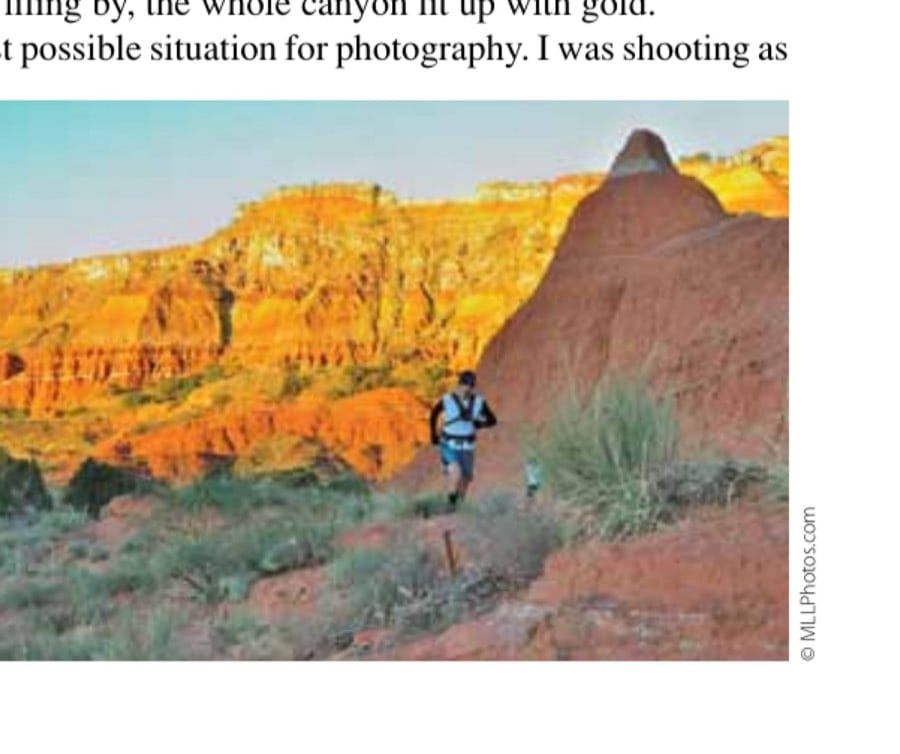
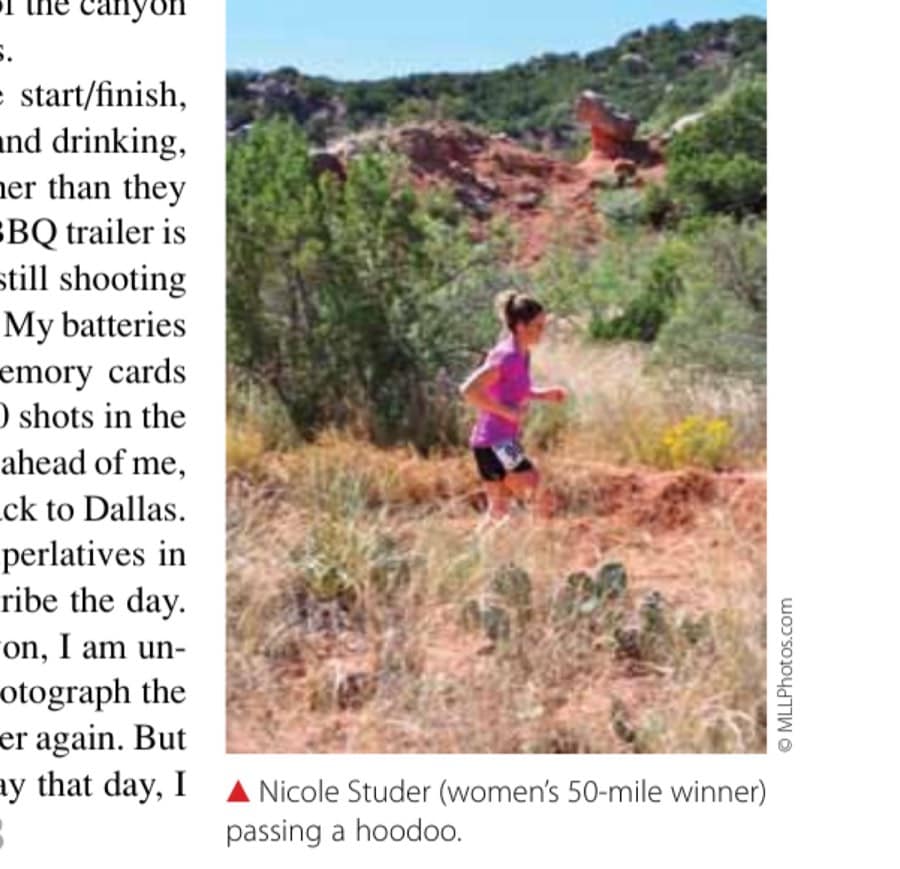
as I heard a lot of runners say that day, I ▲ Nicole Studer (women’s 50-mile winner) passing a hoodoo. will be back next year.
This article originally appeared in Marathon & Beyond, Vol. 18, No. 3 (2014).
← Browse the full M&B ArchiveMore like this
1,000+ stories from 19 years of Marathon & Beyond
The complete archive of the legendary long-distance journal — digitized and free to read.
