

Ski Marathon And Beyond
There are many challenges to running in a Minnesota winter. It’s usually cold, often has below-zero temps, windchill readings can be arctic and the roads are covered with ice and snow. And since marathons in a northern region are few and far between, when winter arrives my cross-country skis reappear as a part of my training equipment. Cross-country skiing is ideal for high-intensity training, and as a recent (March/April 2011) issue of Marathon & Beyond pointed out, cross-country skiing is a great cross-training activity to increase muscle strength around the hips and upper body. While I still run during the winter, cross-country skiing is a wonderful diversion. Fortunately, there is the annual goal of competing in the American Birkebeiner Ski Marathon held in late February.
The American Birkebeiner Ski Marathon, or “Birkie,” began in 1973 as the dream of the late Tony Wise, a local entrepreneur and the developer of Telemark Lodge in Cable, Wisconsin. Thirty-four men and one lone woman stood on the start line in woolen sweaters and knickers for the 50-kilometer race from the Lumberjack Bowl in Hayward to Telemark Lodge in Cable. This small group probably didn’t realize history was in the making, as today’s Birkie is North America’s largest cross-country ski marathon, attracting over 5,000 skiers. It’s also a part of the Worldloppet circuit of 15 international ski marathons and the American Ski Marathon series of 13 races. Like a large running marathon, athletes from around the world make their annual pilgrimage every February to test their strength and endurance on the Birkie Trail’s rugged, glaciated terrain. The American Birkebeiner course is one of the toughest on the Worldloppet circuit, spanning 50 hilly kilometers from Cable to Hayward for skaters and 54K for classic skiers, half of which is a separate trail.
For the neophyte, there are two cross-country skiing techniques, skating and striding. Very simply, skaters use a hockey-type leg motion and longer poles to
propel themselves forward, while striders use the traditional method, stay in a track, and propel themselves forward with a kicking and gliding motion.
They’ve got the “fever” From the small beginning in 1973, the Birkie has become a legend in the crosscountry world. It has survived cancellation, extreme cold, heavy snowfall, icy trails, thaws, and rain, and once skiers get afflicted with Birkie fever, they come back year after year. And much like the Boston Marathon, weather problems don’t dampen the spirits of the participants. Even when the Birkie was canceled in 2000, some people skied much of the course and others ran it. The fever has that kind of hold on people.
Birkebeiner history, however, goes much further back in time. In 1206, two Birkebeiner skiers, so-called because of their protective birch-bark leggings, skied through the mountains of Norway’s Osterdalen Valley, smuggling the infant son of King Sverresson to safety. At the time, Norway was engaged in a civil war between the Birkebeiners and the rebel Bagler forces. After King Sverresson died in 1204, the Baglers rose up and were thirsting for power. Hearing of the child’s existence, which threatened their chances, they moved near the Oslo fjord where the infant prince and his mother, Inga, lived. According to legend, the two best skiers, Torstein Skevla and Skjervald Skrukka, were charged with carrying the child over the mountains. Though they suffered much from wind, frost, and snow, they kept the young prince safe. After Prince Haakon subsequently became king of Norway, the Birkebeiner skiers became a Norwegian symbol of courage, perseverance, and character in the face of adversity.
The story of the flight was the inspiration for the first Birkebeiner ski race held in Norway in 1932. To this day, Norwegian skiers still carry a pack, symbolizing the weight of a young child, in the Norwegian Birkebeiner Rennet race from Rena to Lillehammer.
For the 2011 edition of the Birkie and the accompanying Korteloppet (23K race), a cap of 8,400 racers was established. As it gets closer to race day, the weather stays pretty consistent. There is a brief warm-up, but no major problems develop in snow conditions on the Birkie Trail. Days before the race, however, concern grows as the weather forecast hints that very cold temperatures are in store for the day of the race.
The Birkebeiner Trail is a scenic trail of hills that cuts through deep forests of pine and hardwoods. In the early years, the direction of the course changed several times between Cable and Hayward but is now set with the race beginning in Cable and ending in Hayward with an approach to the finish that crosses Lake Hayward. City crews dump tons of snow on Main Street, where the trail runs several blocks to the finish line in downtown Hayward. As with many marathons, the cheering
Birkebeiner: A Story of Motherhood and War
▲
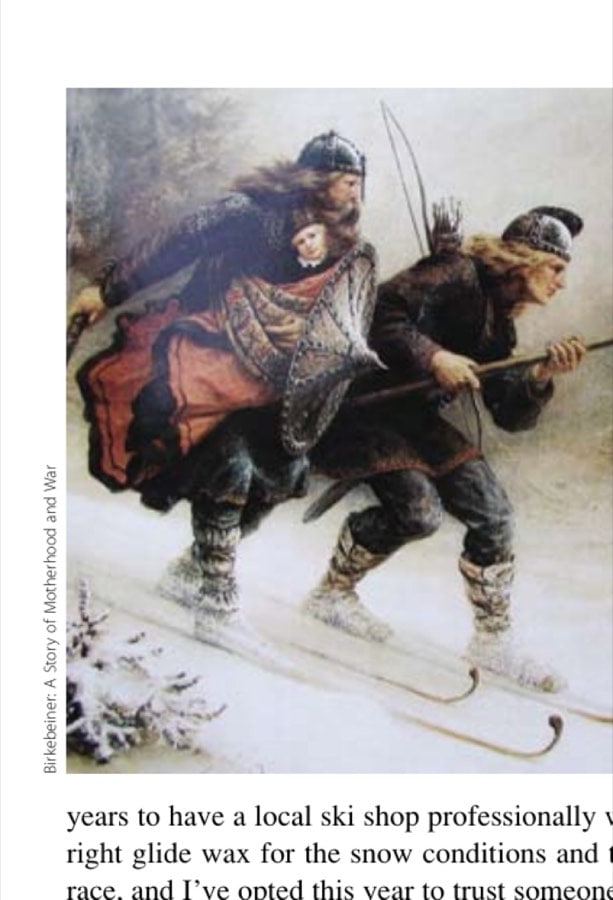
Birkebeiners skiing the young prince to safety.
spectators near the finish can be a magical experience for skiers who have suffered for miles. A day before the race, several of us head to the race expo in Hayward to pick up bibs, timing chips, and goody bags. I
also pick up my skis, having decided for the first time in 22 years to have a local ski shop professionally wax them. For a skater, having the right glide wax for the snow conditions and temperature is key to a successful
race, and I’ve opted this year to trust someone else with this decision. After bib pickup, we head north to Seeley to gather with friends and carboload at the Sawmill Saloon. The radio is tuned to 88.9 WOJB, a folksy community
station broadcasting from Lac Courte Oreilles Indian Reservation. Beginning on Friday, the station plays Birkie-themed music and broadcasts wax tips and the weather forecast. It’s now evident that tomorrow’s race will be a cold one, creat
ing a dilemma as to what to wear. Thoughts obsessively cycle as to how many layers to wear, face mask or not, what gloves to wear, hand warmers or not, and so forth.
The challenge of getting to the start As with many running marathons, the Birkie is a point-to-point race, so most participants are bused from various locations to the start. On race day, the Birkie organization operates one of the largest bus systems in the state. It’s efficient, but because of the number of participants and often the weather, skiers must plan ahead and allow extra time to get to the start. The start line is near the small airport adjacent to Telemark Lodge. After being dropped off, most people head to the lodge to stay warm. There is also a large warming tent near the start line and the usual long row of porta-potties.
© Kelly Randolph
▲ Skiers ascend one of the many hills on the Birkie Trail.
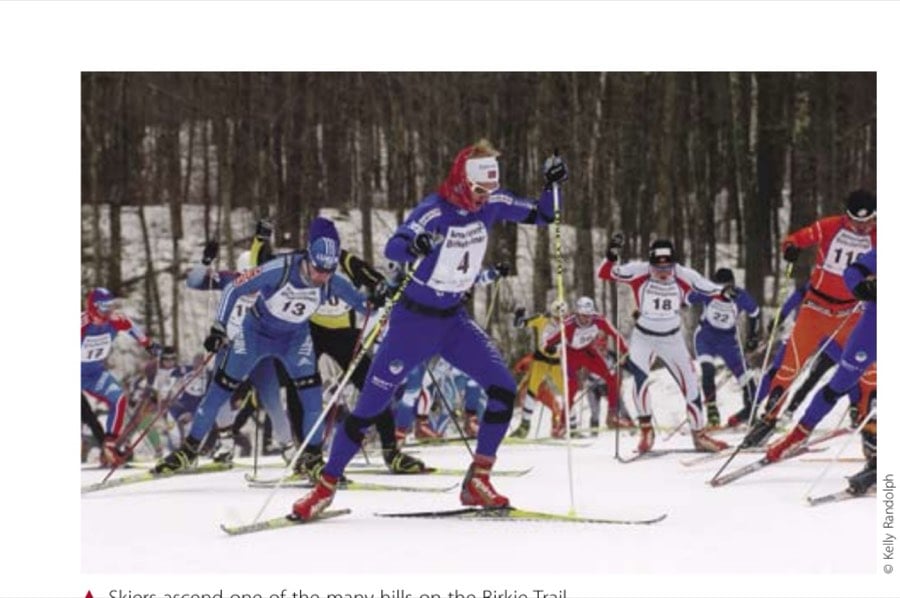
The Birkie start is a wave system and is based on a previous year’s time or another qualifying race time. The top 200 men and 50 women, many of whom are international competitors, are in the elite wave. The classic elite skiers begin first, then the skate elite skiers, followed by classic wave one and then skate wave one all the way to wave 10, which is the new-skier wave and has all levels of ability. The first 100 meters are tracked, requiring all waves to initially double-pole, which facilitates a more uniform start and encourages less congestion to reduce crashes and pole breakage.
Around 7:45 a.m. on race day, I leave the lodge and walk approximately a half mile to the start area. It is 8 below zero and overcast, and because of moisture in the air, it feels really cold. Walking doesn’t seem to generate much heat, and I’m already burning precious calories to keep warm. It dawns on me that I have forgotten my prerace nutritional bar, and with continued cold temps expected throughout the day, I wonder whether I have consumed enough calories. I later realize that it’s one of several crucial mistakes I made in this race. Arriving at the start area, I decide because of the cold to run in a small area rather than ski to warm up. This, I will soon realize, turns out to be a poor decision.
With a half hour to go before the start, the most difficult part of the race is upon me. I regretfully pull off my warm-up clothes, stuff them in a clothes bag, and hand it to volunteers at the wave-two clothes-bag truck. The volunteers are friendly and handle thousands of bags, and unlike the airlines, the Birkie volunteers have never lost a clothes bag.
Without warm-up clothes, I keep moving to stay warm and get to the wavetwo pen. Similar to the Boston Marathon, there are two successive pens, each of which is separated by a gate (a series of ropes that can be raised and lowered by volunteers). When a wave starts, each pen gate opens, allowing skiers to move up as fast as they can (if they want a good position) to the next gate.
The elite wave is off at 8:25 a.m., and wave one begins five minutes later. Wave-one skaters may be the most competitive group because many believe they belong in the elite wave. As a result, there is a fair amount of aggressive behavior by skiers who want to be in the front line. In reality, out of 900 skiers in this wave, it’s possible that 30 may actually make the qualifying time for the elite wave.
Most of us in wave two have skis and poles in hand as we wait for wave one to start and the gatekeepers to release us to the starting pen. After the gate opens, there is a rush by some, but wave two has more veterans who, like me, have been in wave one and no longer feel it necessary to be in the front two rows. I settle in to a fourth-row position and with two minutes to go, I exchange good-luck wishes with a friend who is nearby to my right.
A fist to the face, and the race hasn’t even started yet Turning back, I am suddenly struck in the face by a blow from someone’s fist. Some young cowboy upset that an old guy took his place in line? Not that exciting. Only a skier in front too close and windmilling his arm to keep warm. He apologizes as I adjust my glasses back on my head and wonder whether this is a bad omen.
After the cannon goes off, the barricades are lifted, releasing the 700-plus wave-two skiers to the trail. Skiers frantically double-pole as there is a push by most skiers to get to the front. Like many large marathons, it is crowded and congested. The problem in a ski race is contending with other racers’ skis and poles, and because some poles are broken in the first few kilometers, volunteers have substitute poles for the asking.
After the first 100 yards, skiers begin to skate, and I quickly realize that my skis are very fast. In fact, they are so fast that I have trouble controlling them. There is a long race ahead, but other skiers are passing by, and I kick myself for not warming up on skis with unfamiliar wax.
After two kilometers of relatively flat terrain, the trail takes a left turn and opens to the Power Line section. The trail becomes a series of major hills gaining 400 feet in the next 10K. The last hill of this section brings racers to the first feed station at 4.5K. Birkie volunteers are friendly, organized, and upbeat. Today they are out in subzero weather giving out thousands of feeds for several hours, and because of the cold, it’s highly probable that volunteers and first aid tents will be busy.
© Brightroom/Action Sports International, Inc.
▲
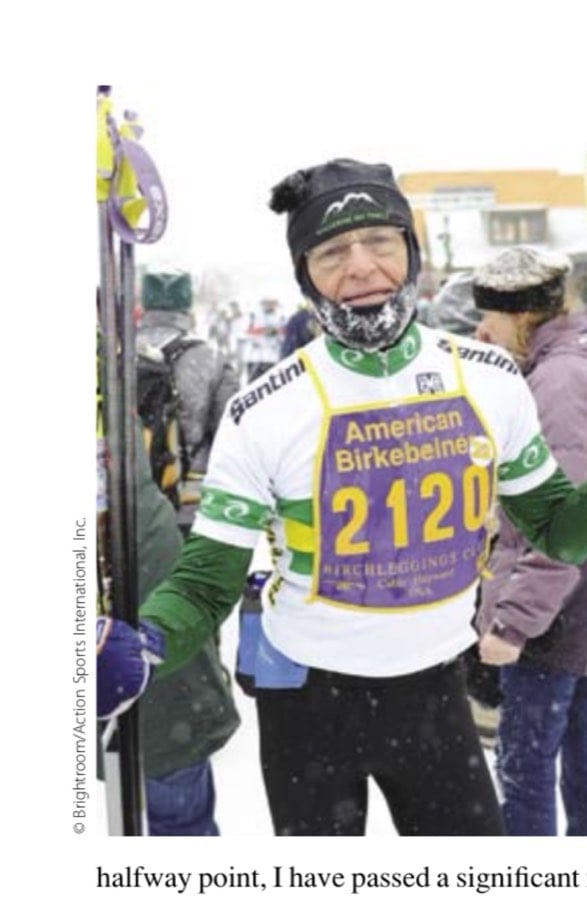
The author—finished, frozen, and fatigued.
After the feed zone, the trail ducks into the woods, and the next 45Ks are a series of rolling hills interspersed with five major climbs. Now more comfortable on skis, I descend the infamous Bobble Head Hill, a curvy, tricky descent
where at the bottom a number of usually inebriated snowmobilers wait to cheer anyone who falls. In the past, they have actually scored falls Olympic style. I continue to feel more confident on my skis; they are gliding well,
and as the kilometers roll by, the major ascents at 12K, 17K, and 20K seem to require less effort. By the halfway point, I have passed a significant number of skiers and feel good pushing on to the Mosquito Brook feed zone at 38.1K.
A light snow begins to fall. My skis continue gliding well, but harder snow crystals on the trail will slow the skis down. It continues to feel cold, and by this time many skiers have frost icicles hanging from their noses and chins. My
body, which initially warmed up in the first half of the race, has more difficulty staying warm, particularly on the descents because two thin layers are not enough insulation from the frigid air. I also become aware of a persistent irritation in my
right eye due to the cold wind sneaking under my eyelids. Wearing glasses, I realize another mistake and should have used wider, dark-glass frames for better eye protection. After the Mosquito Brook feed zone, a long, gradual climb ends with a series
of rollers culminating at Bitch Hill, a long and steep climb at 40K where ladies dressed in provocative costumes are at the top cheering skiers on and handing out Mardi Gras beads. Approximately one kilometer before Bitch Hill, my body runs
out of gas. In a sudden turn of events, the bonk has hit, and I struggle ascending a small hill before Bitch Hill. My vision, particularly in my right eye, is blurry, and with energy rapidly deteriorating, I inch up Bitch Hill at a snail’s pace. Because
of the extreme cold, there are no ladies at the top of the hill. It’s just as well; I’m no longer in a smiling mood.
© Kelly Randolph
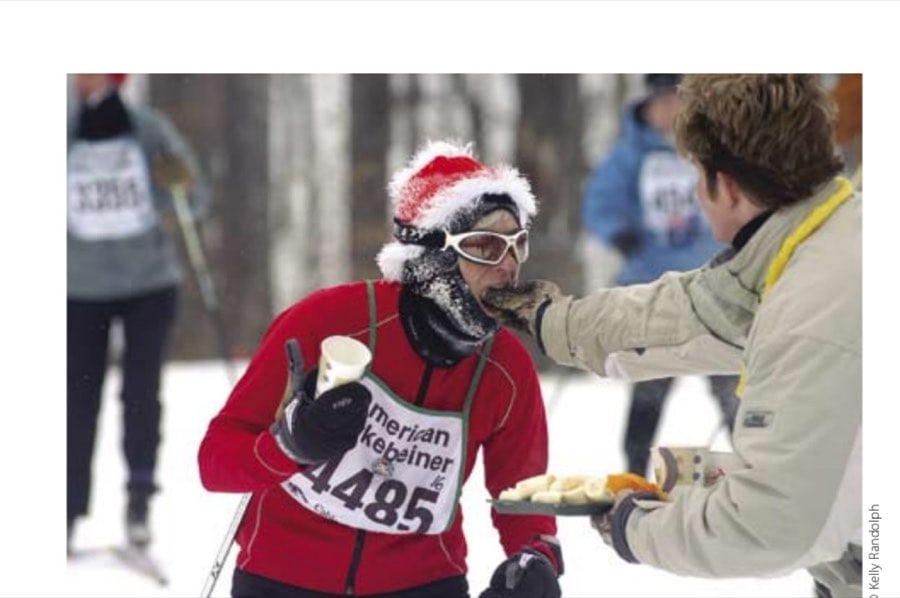
▲ Birkie volunteers are more than willing to help at food/water stations.
No ladies, no smiles, no energy After Bitch Hill, there are two long downhills to recover. Unfortunately, sitting in a tuck position on a descent only further drains heat from my body. And as I approach the crossing at Highway 77, it’s now a survival race to the finish. Near here is Fish Hatchery, where in the fall the Birkie Foundation runs a marathon on the trail north to Telemark Lodge. For a few moments, my thoughts drift to how pleasant it would be to have running shoes on.
After crossing Highway 77, there is another long climb and then a sweeping downhill to Lake Hayward and the finish. While it should be easy to ski across two flat kilometers of snow-covered frozen water, there is a head wind, and at this late stage in the race, the finish can’t come soon enough.
In a light snowfall, skiers are stretched across the wide expanse of the lake and, like a scene in a surreal movie, they are silently making their way to the brief spotlight of the cheering crowds and the finish. It’s another finish and story for this runner/skier, but all the participants have their own unique stories in what this year has been a 30-mile effort in below-zero weather. From the elite skiers who have long since finished to the last skiers who will finish in the dark, everyone has a marathoner’s resolve of courage, perseverance, and character, and a lament for the ladies who weren’t there.
© Brightroom/Action Sports International, Inc.
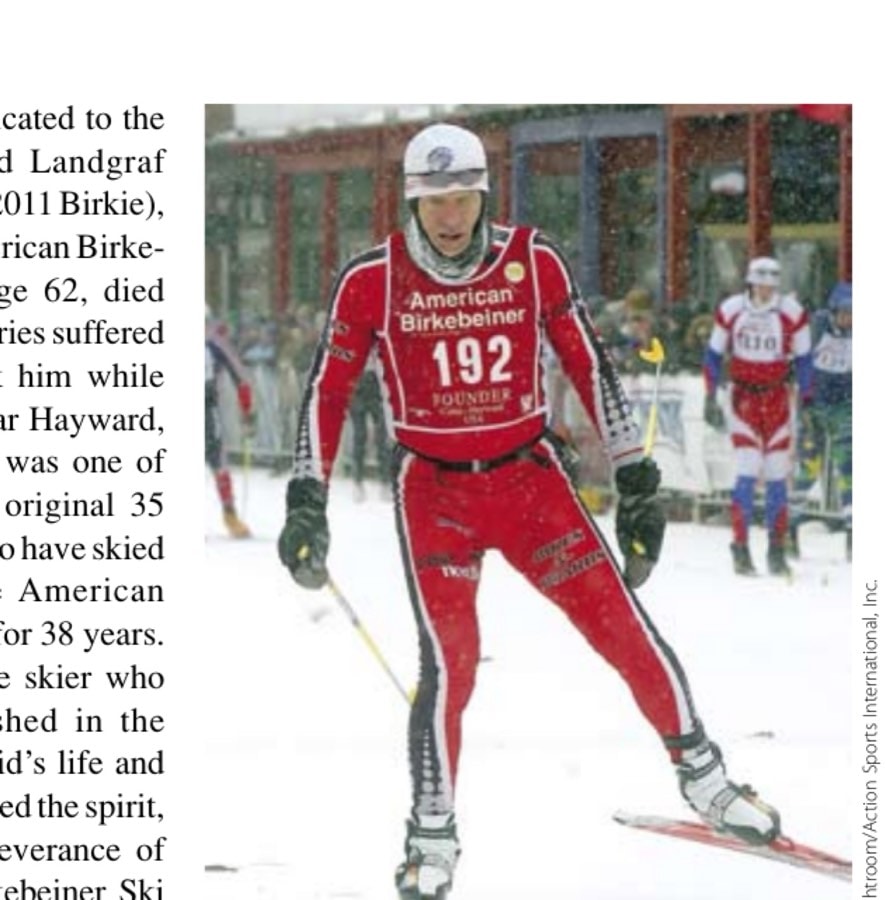
This article is dedicated to the memory of David Landgraf (shown here at the 2011 Birkie), founder of the American Birkebeiner, who, at age 62, died August 8 from injuries suffered when a car struck him while he was cycling near Hayward, Wisconsin. David was one of only three of the original 35 skiers of the event to have skied every one of the American Birkebeiner races for 38 years. David was an elite skier who consistently finished in the top 200 men. David’s life and character represented the spirit, courage, and perseverance of the American Birkebeiner Ski Marathon.
This article originally appeared in Marathon & Beyond, Vol. 15, No. 6 (2011).
← Browse the full M&B ArchiveMore like this
1,000+ stories from 19 years of Marathon & Beyond
The complete archive of the legendary long-distance journal — digitized and free to read.
