

Smash-Face Runners And Hooligans
Shards of midday sun pierce budding branches and cast shadows on the pavement underfoot. Four-foot-high corridors of snow that protected either side of the running paths for the past few months melt as temperatures rise. I run along East River Road following the Mississippi northward, knowingly nodding to other runners as we pass, as though we all share the same secret.
Spring-induced euphoria is an annual tradition among Twin Cities runners. The month of May brings an explosion of life to the trails and roads of the metro area as locals are overcome with uninhibited joy at the simple sight of bare pavement. It’s hard to imagine these paths did not always exist, nor did the thousands of harriers who now occupy them.
My mind wanders to my Minnesota running predecessors: those who trained on these same routes long before I was around. I think of the dusty box of old files sitting on the living room floor of my apartment. They are filled with folders bound by rusty metal rings and are overflowing with yellow and brittle newspaper clippings featuring local runners. The documents are nearly a quarter of a century older than I am.
It was the infamous 1960s: the Vietnam War, the space race, feminism, and the civil rights movement all took shape. Martin Luther King Jr., the Beatles, Elvis, and John F. Kennedy dominated the headlines. The era was ripe with change.
This decade exists in black and white on a clicking newsreel in my mind. The barefoot marathoner from Ethiopia, Abebe Bikila, won golds at the Olympics in 1960 and 1964. Australian Herb Elliot brought middle-distance running to new
Courtesy of Steve Hoag
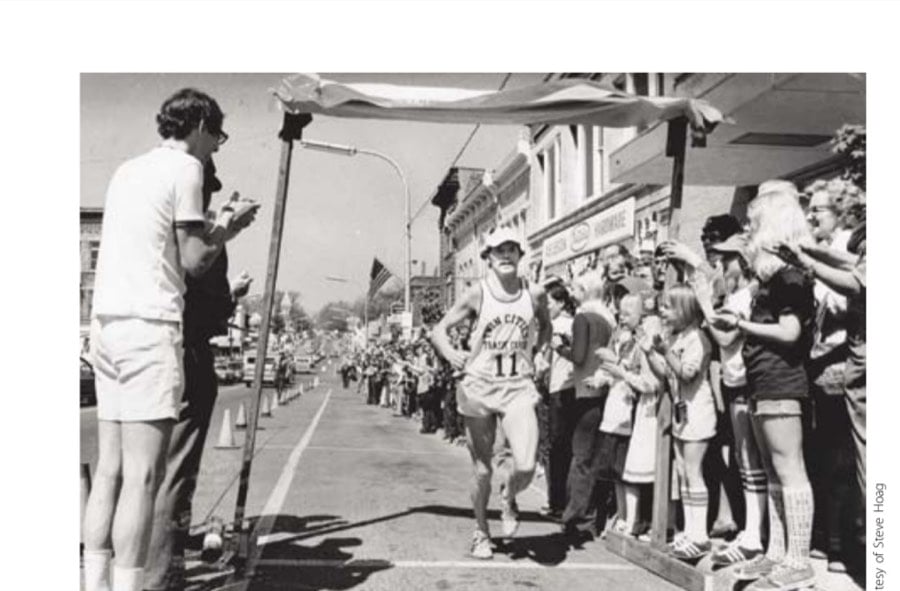
▲ Steve Hoag winning the Syttende Mai Run, May 19, 1979.
heights. The breakout 10,000-meter sensation, Billy Mills, stunned domestic crowds with his talent and won gold in 1964. Gerry Lindgren won the Olympic Trials and beat the Russians in the US-Soviet dual meet. Wilma Rudolph brought attention to women in the sport with her multimedal win at the Olympics. And schoolboy supermiler Jim Ryun broke the four-minute barrier, holding the high school record for 37 years.
Had I grown up during those years, I wouldn’t have been able to run in junior high, high school, or college. The Chain of Lakes, which now serves as every local runner’s justification for living here, was devoid of pavement pounders. In fact, there was no pavement. Running specialty stores were nonexistent. It was impossible even to find a decent pair of running shoes. Twin Cities native Steve Hoag, an All-American and Big 10 champion for the Minnesota Gophers as well as the 1975 Boston Marathon runner-up, says simply, “Running just wasn’t something people did then.” At least it wasn’t something most people did.
A curious clan In line with the countercultural climate arising in the ’60s, an obscure tribe of runners in Minnesota started their own revolution. This small faction came
The Minnesota Distance Running Association’s newsletter. ▲
Courtesy of Minnesota Distance Running Association
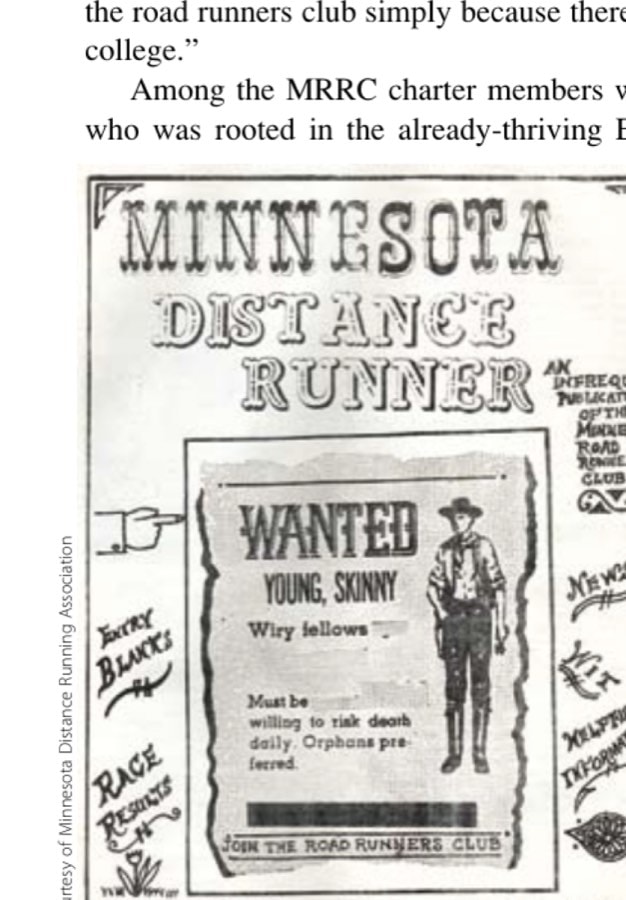
together in early 1961, dubbing themselves the Minnesota Road Runners Club (MRRC) and later evolving into what is now known as the Minnesota Distance Running Association (MDRA). Lacking appropriate clothing, shoes, gear, or any
understanding from the nonrunning public, this tight-knit squad of nine runners hit the streets of the Twin Cities purely for the love of the sport. MRRC’s founders are now seen as revolutionaries in the eyes of local hard
core runners. Those trailblazers included Pat and Emily Lanin, who are largely credited with breathing life into the organization. High school sweethearts from Virginia, Minnesota, the couple settled in St. Paul. With one year of eligibility
left, Pat Lanin ran cross-country and track at the University of Minnesota under famed coach Roy Griak (Lanin first attended Virginia Junior College in Virginia, Minnesota). The club began as a result of the Lanins’ desire to provide the small running
community a forum in which to compete. Bruce Mortenson of St. Louis Park, a Minneapolis suburb, was a national champion in the steeplechase at the University of Oregon under Bill Bowerman. He remembers his postcollegiate running
days in Minnesota, saying, “They were the first ones to put on races. They started the road runners club simply because there wasn’t anything for them outside of college.” Among the MRRC charter members was Bob Harris, a New Jersey native
who was rooted in the already-thriving East Coast running scene. While the Lanins were the organizers, Harris was the evangelist, says Pat. “His soapbox was distance running, and I was held under his sway.”
The ragtag operation also included Minnesota legend Ron Daws, whose commitment to the sport could only be described as “fanatical.” “He became a top-flight runner by sheer will,” says Lanin of the 1968 Olympic marathoner.
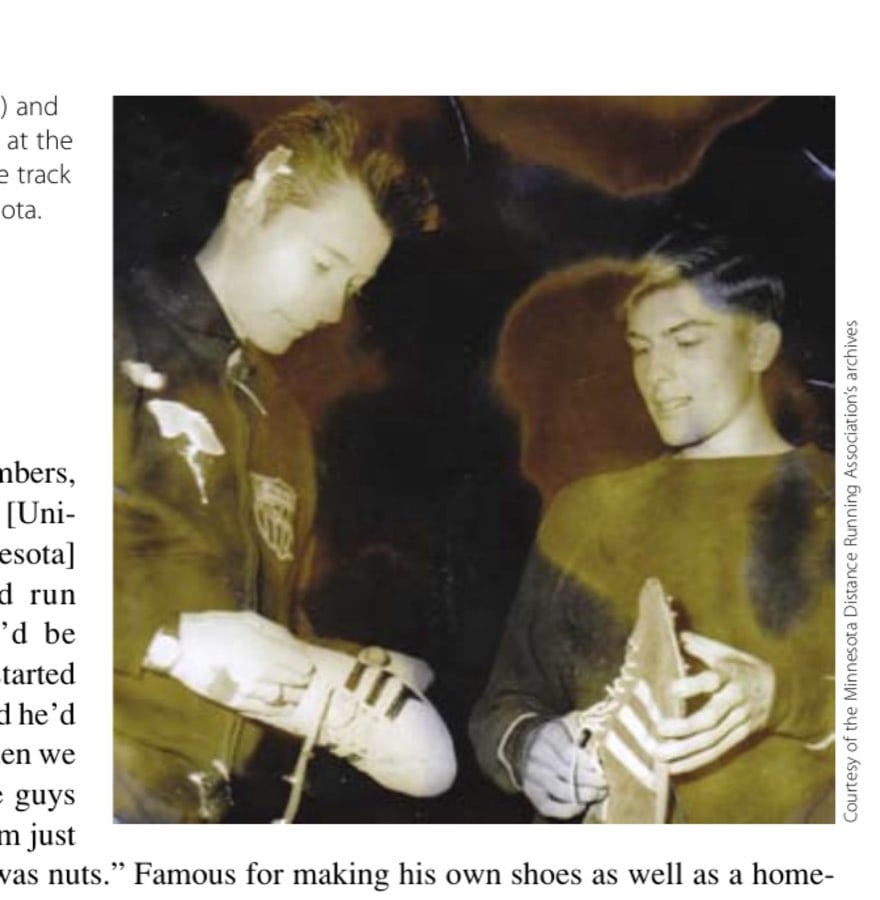
Hoag remembers, “He’d go in the [University of Minnesota] fieldhouse and run for hours. He’d be there when we started our practice, and he’d still be there when we were done. The guys on the track team just thought Daws was nuts.” Famous for making his own shoes as well as a homemade treadmill, he was the inventive and creative character of the bunch. He would later be featured in a 1972 Playboy magazine article titled “The Purity of the Long-Distance Runner.” In it, author John Medelman noted that marathoners like Daws “were as rare as auks.”
The crew of Twin Cities runners organized for the first time on March 12, 1961, in the parking lot of Minneapolis’s Columbia Golf Course following the club’s inaugural race. The box of aged archives paints a picture of the day: “The course was clear and smooth except for a stretch of ankle-deep snow covering about 300 yards at the end of the circuit.” The 39-degree temperature, clear skies, and gentle breeze made for good racing conditions for the seven finishers on the presumed five-mile course (later found to be only 4.6 miles). Sweat soaked and chilled, the group gathered around the back of Pat Lanin’s car on that brisk, early-spring morning to discuss running and racing. By the end of year one, the MRRC had nine dues-paying members, 14 organized races, and an annual budget of $28.50.
On the fringe Although the MRRC’s membership more than doubled in 1962, the 20 members remained on the periphery of recognized sport. Mortenson contends that as a runner, “Back then, you really felt like a renegade.”
Courtesy of the Minnesota Distance Running Association’s archives
▲
Ron Daws (left) and Van Nelson (right) at the Macalester College track in St. Paul, Minnesota.
“The running, to us, was kind of countercultural. We were thumbing our noses at society,” reminisces Lanin. “We had long, hairy mustaches, like Butch Cassidy and the Sundance Kid, along with hair down to the collar. Definitely part of the motivation was the rebellious aspect of running.”
Hoag grins when he remembers running in thermal long underwear and corduroy pants with an anorak jacket. He would sport a paper mask when the temperature dipped below zero. “I probably got a form of resistance training running in that 5 pounds of clothes,” he jokes. Mortenson ran in shoes he dug out of the lost-andfound bin at St. Louis Park High School. Many of the regular marathoners drank sugar water and took dextrose tablets as midrace fuel.
Passing drivers heckled and honked at the MRRC gang as they logged their miles. Lanin shakes his head, saying, “You’d get beer bottles thrown at you and people giving you the bird.” Hoag continues, “You could almost count on it at least once during a run.”
Perhaps not surprising for this bunch, 35-mile runs in 5 inches of snow were standard. Lanin puts it best: “I would call these guys that we had in the early days ‘smash-face runners.’ These guys would rather take a board to the face than walk in a race. They were hard core. They were out to run. They were not joggers.”
Lanin remembers being out on the streets of the Twin Cities and going weeks without seeing another running soul. “There were only a few guys in the beginning. There were so few people running that if we saw a runner anywhere in the Cities when we were driving, we could tell who it was from the back,” explains Emily Lanin. Pat laughs, adding, “Or, if we saw another runner, and we didn’t know them, we’d stop the car and get out. This was an emergency.”
The Lanin abode became home base for this offbeat group of harriers. They were all friends and competitors. “Pretty much everybody knew everybody,” says Mortenson. “You were friends until the gun went off,” explains Hoag.
The postcollegiate scene While the state produced a handful of notable runners in the first half of the 20th century, college diplomas tended to signal an end to running careers. “There really wasn’t much available for postcollegiate runners at the time,” says Mortenson.
Hoag agrees. “If it hadn’t been for those guys [Lanin and Daws], I probably would have hung it up, because there wasn’t anyone to support your running.” The postcollegiate superstar continues, “I remember Ron telling me there’s so much more running after college. And he said it was more fun. It turns out he was right.”
Lanin reminisces about thumbing through the AAU record books and thinking, “We can break that, and we can break that, and we can break that.” So, he says, “We just set up races, got sanctioned, and started setting American records at the
Macalester track.” Just like that, the tribe began knocking off records in many of the lesser-run distances, such as the 6,000 meters, 8,000 meters, and the 30,000 meters, all at a small St. Paul-based college track. “We ended up setting all kinds of records that were listed but rarely ever run. It was like looking in the Guinness book and saying, ‘Oh, hell, I can do that,’” says Lanin. Along with those records, Van Nelson narrowly missed the 5,000-meter American record on that same track. Later, the Minneapolis native would go on to run the 10,000 in the 1968 Olympics. When they weren’t breaking records, MRRC members were competing in a number of now-defunct racing competitions that were popular in the 1960s. Hour races, 10-mile races, 24-hour relays of 10 runners, and various postal competitions1 were all held on the world-class Macalester track. While the runners delighted in the chance to compete on an all-weather track, the majority of MRRC races were pavement pounders.
Hoag remembers road races at the time being pretty primitive. Even the Boston Marathon didn’t have water stops until 1978. The MRRC races were clocked using car odometers. They were timed by handheld stopwatches. Color-coded cards or Popsicle sticks were handed to finishers to keep track of their places. All tabulations were done by hand.
Of the Minnesota AAU 30,000-meter championship on Sunday, May 8, 1966, the MRRC archives tell the story of perplexed passersby: “A good many carloads of Mother’s Day sightseers along the River Road saw quite a different sight.” Today’s Twin Cities streets are rerouted nearly every weekend nine months out of the year for races, but in the 1960s, running competitions were rare and could be described only as bizarre.
The stuff of legends The 1960s were perhaps the optimal time for the MRRC to band together, a motley crew of activists running counter to the mainstream. The decade would see some of the most notable postcollegiate success stories in the state, the first women runners on the scene, and a slow inching toward the eventual running boom of the 1970s. It also gave way to a long list of new Northland superstars and Olympians, including Garry Bjorklund, Steve Plasencia, Janis Klecker, Dick Beardsley, and Bob Kempainen.
In an old handwritten letter by Lanin, he recognizes that he and the MRRC were ahead of the curve. In hindsight, he refers to the 1964 Tokyo Olympics, citing Buddy Edelen’s sixth-place marathon finish in an American record time of 2:18:12, Billy Mills’s gold in the 10,000 meters, and Bob Schul’s 5,000-meters gold. “This was the bellwether of the eventual flood of distance running which would deluge the USA,” he writes.
Courtesy of Steve Hoag’s Marathon Sports archives
▲
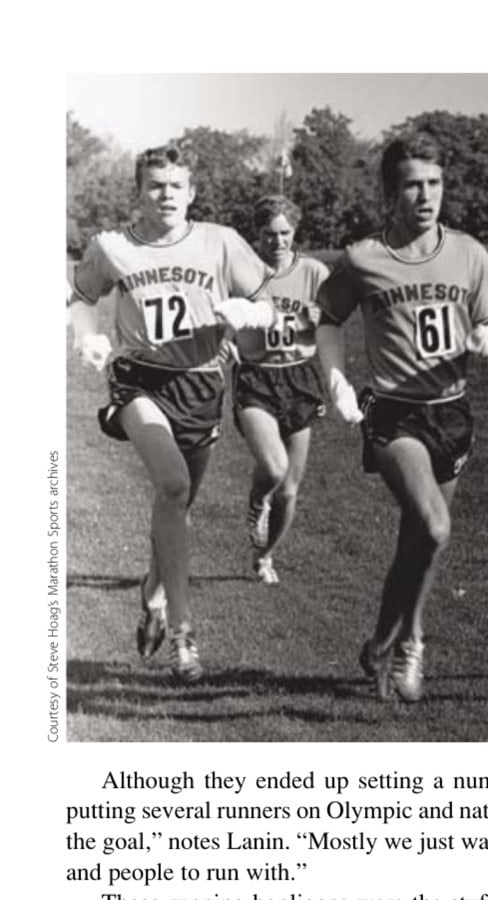
Gary Bjorklund (61) and Don Timm (72) running crosscountry for the Gophers.
Although they ended up setting a number of American records as well as putting several runners on Olympic and national-championship teams, “It wasn’t the goal,” notes Lanin. “Mostly we just wanted to have some running races here
and people to run with.” These running hooligans were the stuff of legends. As I run along the Mississippi, I think of that first MRRC race in the Polish-settled neighborhood of “Nordeast” Minneapolis. Crossing the Washington Avenue Bridge at the Univer
sity of Minnesota, I remember that Hoag and Daws once ran intervals inside the covered pedestrian deck in the wintertime. Workouts around the busy lakes elicit images of a lone Pat Lanin, with shaggy hair and a prominent mustache, dodging
cars and hammering out a long run. On the days I’m not sure why I’m running, I think of what the enigmatic Ron Daws said with a shrug to a reporter in Mexico City before the 1968 Olympic Marathon: “Because it feels so good when you stop.”
Note: In postal competitions, runners from around the country would race certain distances on their home tracks and send their results to the Road Runners Club of America, which would compare the results to determine who won.
1
This article originally appeared in Marathon & Beyond, Vol. 15, No. 6 (2011).
← Browse the full M&B ArchiveMore like this
1,000+ stories from 19 years of Marathon & Beyond
The complete archive of the legendary long-distance journal — digitized and free to read.
