Something Gone, Something Gained
Mark Pickard noted with dismay that: “Cavin was already halfway through a cigarette and a beer by the time I got in!”
Time to back off a bit
By the start of the 1990s Woodward was still a formidable opponent. His times were slower than in his peak years, but this was offset by the enjoyment of running races alongside his sons. After winning the Over-50s prize at the 1998 London-Brighton, he decided to call time on his competitive running career aged 51. By this point he had achieved 38 victories and 89 top-three placings in 217 ultras or marathons.
Retirement from high-profile races didn’t lead to a quiet life. He continued to run around his local area, delivering parish magazines and suchlike on training runs, and became a highly competent and competitive captain of a petanque (French game of bowls) club. He worked tirelessly in local youth and community affairs and promoted an annual charity fun run.
Woodward’s loss was sorely felt by many people, including distance runners across the globe. One of these, former club mate Jon Such, heard the news in his adopted home country South Africa and immediately pledged to start running again in his friend’s honor, having quit years earlier due to serious illness: “I had not run for several years and was very overweight and unfit. The shock made me take stock and I decided to start running again. In 12 months I dropped my weight and began running half-marathons at age 63 in around 1:30 and winning races in my age group.” Such flew back to the UK to run the 2011 Great North Run halfmarathon for charity in a personal celebration of his late friend’s life and career.
The family Woodward left behind remains rightly proud of his legacy. A three-mile memorial road race has been established in his name in Leamington, his widow Carol one of the main organizers. Son Darren announced in 2013 he was planning a run of 100 miles in 1,000 minutes for charity to mark the 40th anniversary of his father’s sensational run in 1975.
Cavin Woodward’s name also lives on via a local road named after him in the Whitnash area of Leamington—“Woodward Close.” One day perhaps I’ll visit this area, locate the road, slip on a pair of trainers, and pay tribute to a unique runner by tearing away down there at high speed! /¥\p
Did you know that M&B has a policy of adding an issue to your subscription when a friend subscribes to M&B because you turned him or her on to the magazine? Have your friend give us your name when he or she subscribes, and we’ll tack on an extra issue to your current subscription. No limits on the number of referrals.
We lust after an elusive equilibrium.
miss my old friend. When the hip pain brought on by synovitis (inflammation of the lining of the joint) became too much to bear, literally, I did as the orthopedic doctor advised and stopped running.
It was not a decision I reached in an instant. I couldn’t go cold turkey on something I had pursued so steadfastly for so many years. In fact, I initially refused to accept the verdict and hobbled on, managing the pain in both hips as best I could. The discomfort worsened so I shortened my distances. I avoided asphalt, seeking wooded areas with a more forgiving surface underfoot. Glucosamine pills became a diet staple. I got new shoes and tried running only on alternate days. I searched for anything that would allow me to get the three- to five-mile fix I craved and had become so deeply accustomed to.
But sadly, it was over. I was 44 years old when I finally gave in, putting my shoes in the back of the closet for good. It had gotten to the point where, after a short run, I limped when I walked. The persistent ache exceeded any pleasure gained. It was therefore with extreme regret that I acceded to the reality of having to find another, perhaps osseously gentler, sport. Saying a reluctant good-bye to my old confrere, I went out and bought a pretty decent bicycle.
Let me be clear on this. I did not run myself into submission because I logged too many 100-mile training weeks. An elite runner I never was, a tad better than the average Joe, maybe (38:38 10K/3:43 marathon), but never even on the fringe of what the top guns turned in. Most of the distance running I did would be considered casual. I raced 30 to 40 times total. I never ran more than 60 miles in any week even when I trained for a marathon. I think my hips gave out more due to unfortunate genetic predisposition than to any case of high mileage.
Iran for a profoundly simple and selfish reason: it felt good to do so, and on any day this was a worthwhile pursuit. Running was a pick-me-up on down days, and on bright days it could enhance my position. Putting in a few miles each day
became a celebratory habit—never growing old or routine—a need [ had to satisfy to feel balanced and whole.
I was 18 when I caught on to it. Back then aerobic exercise was sweeping the nation, Dr. Kenneth Cooper’s 12-minute run was the acid test, and it seemed like everyone was out to find their inner Bill Rodgers. Following the masses, I bought my first pair of real running shoes and started to have at it. Two miles and then three soon became five. Occasional 10K races gave me a sense for the thrill of the hunt. And although I found I couldn’t run an entire marathon without walking some, finish the otherworldly distance I did, not once but three times. I had become, by god, a marathon man.
Running helped me find my way through a failed relationship. Depressed, the elixir of serotonin and norepinephrine released during mileage gave me the lever I needed to pry away the hopelessness. It was better than any medical prescription. It gave a daily purpose to each day when I desperately needed such and yielded a degree of curative gratification.
Iran through a faculty rank promotion I did not get, numerous writer’s blocks, and 18 percent mortgage rates. While the activity was not a cure-all per se, it did give me the needed panache to face down most obstacles. I learned that if you hung in there in a difficult situation, you would eventually get where you needed to be—just like completing a tough, long run.
© Susan Paling
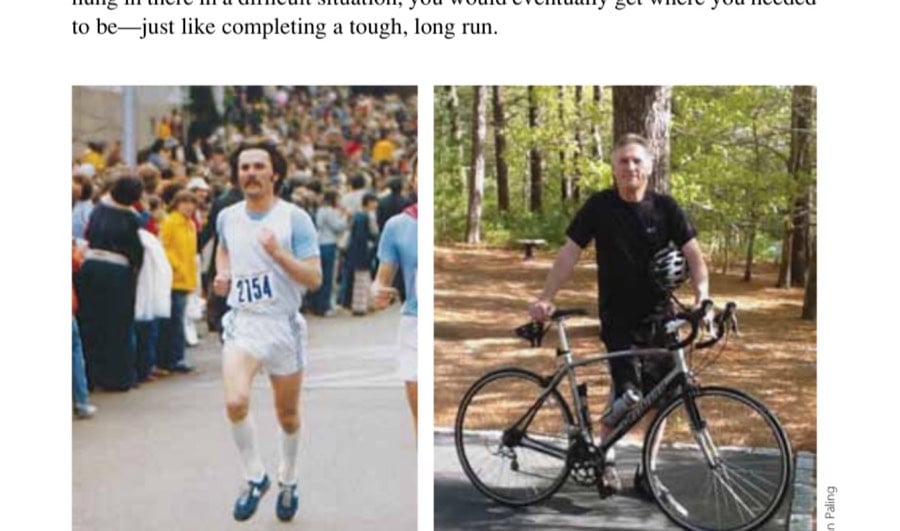
A Whether running the Boston Marathon in years gone by (left) or cycling the back roads of New England today, the goal remains the same: a daily dose of physical challenge.
More to love with the M&B Digital edition.
It looks exactly like our print version, but all the links are live. And when you
subscribe to M&B Digital, you get access to our entire digital edition archives since
subscription or renew today at www. marathonandbeyond.com/subscribe.
I ran six days per week, on average, for 26 years. I ran to foster not only physical endurance but endurance of will as well. My running helped me build a house, raise three kids, and succeed in my profession. Running gave me a sense that any large or small task could be accomplished. Running made me a better husband, too, more relaxed and fun to be around, a committed partner for the duration. My wife ran, too, along woodsy trails and long stretches of road, and we enjoyed this among the list of common bonds.
My friend running gave me all of these things, and I regret having to turn away from him. I bike ride religiously now, but honestly, 10 in the saddle feels less satisfying than three on 10 toes. I get to see more scenery, I suppose. But in terms of endorphin release it’s clearly second fiddle.
When I think about running now, I imagine myself humming along, deep within the steady state that would kick in after the first mile: cruise control, babeee, the feeling that you could go on forever. The motion of running, so natural to us bipeds, made me feel strong and able and just plain glad to be in the human race.
Yet even in my mournful nonrunning state, I have found there are rewards still to be reaped from the distances I covered. As life’s exigencies have arisen, spinning in unexpectedly like dreaded curveballs thrown to a batter at home plate, I’ve had to adapt: slow down, speed up, make modifications, sometimes even change the most elaborate plan on a moment’s notice. Like the cold rain that pelts down when you are still miles from home, the hill that appears at the worst possible time, the depleted feeling that threatens to drop you short of the finish, you find a way and deal with things.
But sometimes you hit the wall. Sometimes you just can’t go any further. When every possible resource is gone, every alternative used up, you just have to learn to let go. So good-bye, my good friend running. Adieu. I’ve got to go for a bike ride. POP
Friends to the End
Reflections on the end of 25 years with a running partner.
forest dry and warm without underbrush. I run alone but I’m never lonely.
With me is always the memory of my best friend. He was my running
partner for 25 years. We ran together every morning. I watched him go through a long divorce and fight a bout with cancer. He was a trooper. We were exactly the same height and weight so our bodies reacted the same on these training runs. As younger men we were of one mind as competitive runners, always scheming
M orning runs are sacred. Mine cover a labyrinth of trails beneath a pine
to better our race times by trying the latest shoes, clothing, and training techniques. But over the years, our ideas about running began to diverge. While he continued to be absorbed with his quest for faster times, I discovered that running let me stop being a slave to thinking at all. We remained virtual alter egos but each with different reasons for running. His was to achieve PRs, mine to unlock my inner self.
Iknew his wife well. She was not an athlete and struggled to accommodate the changes we adopted in our lifestyles as we pursued our running. Their relationship was like many others between runners and nonrunners. There was conflict over diets and naps after long runs. As their marital problems mounted, his runs changed from being a joy to being an escape. When the marriage ended, it was not because of running, but running was all he had left.
Over the years we struggled to find common ground in our philosophies of running and, eventually, life itself. We agonized and argued over which approach was best. Always the disciplined soldier, he believed that the purpose of life’s journey, like a long run, was to arrive at one’s destination, to rate one’s accomplishments against past performances or future goals. For him the journey was comprised of thousands of steps measured by time and space.
l argued that there was an alternative, that the importance of the journey was not how it compared to the past or the future but rather the quality of each step along the way.
My friend devoted much of his life to avoiding adversity, seeking ways to find an “ideal” formula for personal fulfillment and success. In his running, fatigue and pain were enemies to be outsmarted in order to accomplish his goals.
Rather than avoiding adversity, distance running taught me how to accept it as part of a larger positive experience. This approach helped me to achieve a better sense of perspective and balance not only in running but in life.
In his heart, he knew I was right, but he was afraid to admit it, afraid to leave behind his competitive philosophy even though it took an ever-increasing toll on his physical and mental health. I worried about him, about us. But I loved him and hoped for the best.
The end came quietly one morning after we shared a grueling 10-miler. I felt tired but renewed at the end of the run. He had been unusually quiet, and I was encouraged because he seemed more at peace than
before. It happened as we rested together on a bench in the park, dripping with perspiration. No one called an ambulance. He just smiled and slipped away, leaving me a lone silhouette in the sunrise. As I walked to my car, I knew we were both better for it because, you see, he was also me. 2B
© www.marathonfoto.com
Something to Run For
A not-so-short story.
work, eating dinner, and watching the news on TV. His leftover turkey had cooled off, but Steve barely noticed. He was too busy talking back to the TV.
Today it was the vote in Congress on the tax bill that set Steve off. “You can’t do that!” he exclaimed, shaking his fork at the screen. A forgotten slice of breast meat bounced off the anchor’s face. “Do you think we’re all stupid?”
After the commercial break, a blond, blow-dried “lifestyle anchor” appeared on the screen to report that more than a third of American adults were overweight. “That’s awful,” Steve muttered, gnawing on a drumstick. He burped and then looked down at his own waistline, which reminded him that he was part of this particular problem. Taxes, war, unemployment—Steve couldn’t solve those problems, but he could do something about his weight.
The lithe young thing on the TV had a solution for his situation—exercise. She listed a number of workout alternatives. To Steve, running looked like an inexpensive, easy, and convenient way to get some exercise compared with paying for a gym membership or finding a group for sports like tennis or basketball. He decided to give it a try.
Saturday, Steve went to the local Walmart and bought a cheap pair of training shoes. He went home, grabbed a T-shirt and an old pair of shorts, and went out for a run.
That first day, Steve barely made it to the end of the block before he had to stop. “This sucks!” he thought, hunched over with his hands on his knees and breathing heavily. “Running’s a lot harder than it looks.” When he got his breath back, Steve trudged on for a little longer, but by the time 15 minutes had passed he was done for the day.
Steve was sore the next day, so he plopped down on the couch to watch the Sunday morning political-interview shows instead of going for a run. It wasn’t very restful. Shows were either pointlessly argumentative (“Why is it that the only job sector in our national economy that is fully employed is Village Idiot?’’) or just plain stupid (“We can cut taxes and increase services! It’s just a matter of increasing efficiency. We need to learn from corporate America.”). He channel-
| tuesday evening, Steve was sitting on the couch after getting home from
surfed for over an hour before giving up in frustration. “Might as well go for another run,” he muttered to himself. “It can’t be any worse than this!”
Steve’s progress was sporadic. He would run one day, then skip a day or two before he went out again. But he never quite stopped. There was always something in the paper, online, or on TV to make him angry, and he would put on his shorts and shoes and go for a run to work out his frustrations.
After a few months Steve realized that, without consciously deciding to, he had started running almost every day. He looked forward to his daily run, and if he had to miss a day, the next day’s run came as a relief. His extra weight was gone and for the first time in years he felt good about his appearance. He had more energy, and he had more endurance when his friends asked him to play softball, go bike riding, or go for a hike.
Most importantly, running helped Steve relax from the stress created by the barrage of human foolishness that continually bombarded him. Wherever Steve went, whether to the local coffee shop for a drink, to the garage for an oil change, or to the mall for a pair of pants, there was always a radio playing or a TV running, spewing out streams of bad news and foolish opinions. Running was always work, but there were moments while he ran where Steve managed to forget the nagging annoyances of the world.
Steve valued those peaceful moments, so he started looking for more ways to work running into his life. He signed up for his first race, a SK in his hometown, and surprised himself by finishing third in his age group and taking home a trophy. After the race Steve was trying to enter his results into his exercise log on his smartphone, but something was keeping the app from responding. Then an ad for diet potato chips popped up, with a smiling model stuffing his face covering the screen. The only thing that kept Steve from smashing his phone against the wall was that he needed it to start planning his next run.
Going to races helped Steve measure his progress. He wasn’t the fastest person out there, but he wasn’t the slowest person either. His results improved, and that helped encourage Steve to do more running and make more progress. And when he was in the middle of a race, running as hard as he could, the effort and concentration drove any other thoughts out of his head.
Soon 5Ks weren’t enough. Steve began lusting after longer distances. Inevitably, that led to Steve signing up for his first marathon, Marine Corps in Washington, DC. Training for a marathon took up a lot of time, but the goal kept him focused on his running, and that helped him ignore the waves of information clamoring for his attention.
In November, Steve finished the Marine Corps Marathon in just under four hours. Afterward, he went out for sushi with some friends to celebrate. When Steve picked up the menu, it was covered with little tridents to indicate how endangered each fish was. The information didn’t help him enjoy the meal. Steve wanted to do
the right thing, but he also wanted to eat without being nagged. He transferred his guilt to annoyance at the restaurant—if it was so irresponsible to eat the bluefin tuna, then why did they serve it? He needed a distraction from his irritation, so he let his friends talk him into signing up for another marathon in the spring.
After a few more big-city races, Steve tried a marathon in a smaller city, and he found that he liked those races even more. The events were more about the running and less about selling the marathon experience to runners. There weren’t as many people cheering him on, but the races weren’t as expensive and the courses weren’t overcrowded. Soon he was signing up for obscure marathons and running races on quiet roads and trails with maybe a few hundred others there to keep him company.
Steve was at one of those small marathons, in South Hero, Vermont, when he met an older runner who told him about even longer races, called ultramarathons. More miles? That sounded good to Steve. That conversation led to Steve spending Mother’s Day in Ipswich, Massachusetts, running a three-mile loop in the woods as many times as he could in eight hours. Steve took it easy, but he still managed to complete 39 miles.
By this point Steve’s whole life revolved around his running. He would go to work, come home, run, eat, and go to sleep. On weekends he would get up early and use the extra time to go on longer runs lasting for eight to 10 hours. He had read an article pointing out that not one Wall Street financier was charged with a crime after the mortgage scandals and economic meltdown, and he would just shrug and tack an extra five miles onto his daily run.
Steve tried to explain his running to one soon-to-be-ex-girlfriend. “Running calms me. When I’m running I can escape for a little while from all the stress and suffering that surrounds me. I can get lost in the drone of footsteps and forget for a little while how much pain there is out there.” She told him that she felt forgotten when he was out running, too, and when he didn’t argue with that, she left.
It wasn’t about running fast anymore. Steve found it much more enjoyable to relax and see how far he could run. Steve often felt a little anxious when he wasn’t running, but his daily run took care of that.
Steve signed up for a 50-mile race in Vermont in the fall. He finished, though he had to struggle through muddy trails created by a downpour the day of the race. When he tried his first 100-mile race, Steve ran only 70 miles before he couldn’t go any farther and dropped out. That just reinforced his resolve. He tried the same race again a year later, and this time he finished in just under 24 hours and earned a silver belt buckle. After that, whenever Steve found himself in a political discussion, he’d usually rest one hand on the buckle and run his thumb over the top edge with a faraway look in his eyes until it was over.
The tipping point came after a shorter race, the HAT Run 50K in Maryland. That close to Washington, it was inevitable that Steve would run into people discussing politics after the race. They were arguing whether health insurance should cover injuries that kept people from running but didn’t affect them otherwise. Considering why he started running, Steve was going to argue the point, but his legs felt fine and it was a beautiful day, so he decided he would avoid the debate and run back to his hotel instead. After all, it was only 20 miles away.
When Steve got back to the hotel, he showered and changed. The hotel restaurant served sushi, so he decided to order a pizza instead.
After eating, Steve tried to relax on the bed in his room and watch a movie. He surfed through the channels, but all the movies he found were interrupted by ads every few minutes, and it seemed like every other ad featured a disturbing clip from that channel’s eleven o’clock news. Each ad made Steve a little more restless, so he turned off the TV and picked up a book. That didn’t keep his attention, either. He thought about heading down to the hotel bar to see if there was anyone to talk to, but he couldn’t face the chance of another political discussion.
Finally, at about ten o’clock, Steve decided he might as well do what he usually did when he felt restless. He changed back into his running clothes, grabbed a bottle of water, and went out for a run. Steve figured he would run five or 10 miles and then go back to the hotel and sleep.
Almost immediately after he started, Steve felt better. Ten miles flew by. Steve returned to the hotel, but instead of going up to his room, he decided to keep going until he felt tired. He ended up running until dawn, finally stopping when he needed to get back into the room to shower, pack, and check out.
The eight-hour drive home crawled by. Steve kept shifting restlessly in his seat. He usually passed the time on these trips by listening to music on the radio, but there were so many interruptions for ads and news programs that he gave up and turned it off. When he stopped to eat, he thought about pulling his running shoes out of the trunk and going for a short jog, but that seemed silly. Instead, he got back in the car and resumed driving.
Steve found himself driving faster and faster. He would make a conscious effort to slow down, but whenever he glanced at the speedometer, he’d see that his speed had crept up again. He could hardly wait for the drive to be over.
At last Steve pulled into his driveway. He unpacked his car and started the laundry. He still felt edgy, so he decided that a run would be just the thing to work out the kinks after the long drive.
Steve took off and ran his standard 26-mile loop. When he returned home, he had a bite to eat. Even though it was evening and Steve had done more running than usual, he still wasn’t winding down. Steve decided that since he felt good he might as well put in a few more miles. He figured another 10 miles would do it, but when he finished 10 he still wasn’t ready to stop so he went out for another 10 miles, and another after that.
After he finished the third 10-mile loop, Steve figured that he could quit for the day. By this point, he had been awake, either running or driving, for almost two entire days. While this wasn’t unprecedented for Steve, it was usually something he did only in the course of an ultramarathon. But enough was enough. Steve showered and went to bed.
He lay down and waited to doze off. Instead, the restless feeling began building up again. Lying in bed felt pointless. Steve didn’t really feel the need for rest. He felt like he needed to be moving, that he had to get away. Steve struggled with this for a couple of hours, tossing and turning. Then he gave in. He slipped out of bed, put his running clothes back on, and headed out the door.
Steve ran through the night. He made it back home after dawn on Monday morning, just in time to shower, dress, and head to work. By the time he drove to the office, he was already feeling the need to get out and run again.
The first thing on his calendar was a weekly staff meeting. Steve managed to sit through half of that meeting before he got up, told the others he wasn’t feeling well, and left for the day. On the way out, he stopped by his desk and took out the spare running shoes and shorts he always stored there. When he got to his car, he changed into his running gear and took off.
Steve ran until noon. He stopped for a short while for a snack, and then he ran for the rest of the day.
Somewhere in the middle of the afternoon, he began to worry a little. Physically, he felt fine in spite of all the running—a little tired, but comfortably so, the way he would feel in the middle of a 50-mile race. But he knew he should be more tired. He’d been running for most of three days! This level of endurance was the sort of thing he had dreamed of, but it was a leap in fitness that was outside of his experience and more than a little weird.
At the end of the day Steve put his concerns aside and ran home instead of getting his car from the lot at work. He grabbed a bite to eat and, almost automatically, reached for the remote to turn on the TV and watch the news.
The next thing he knew, he was back out on the street, running. Steve stumbled for a step and then fell back into his smooth running stride while he tried to figure out what had happened. Apparently, he had gone into some sort of fugue state between the time he turned on the news and the time he came to his senses. Steve checked his pockets. He found he had taken his keys, some cash, his phone, and his credit card before he left the house. His legs felt great. He didn’t understand what was going on, but it seemed like it wasn’t doing any harm, so he just kept going. Soon running calmed him down, the way it always did.
At midnight, Steve circled back home. Again he tried to sleep, but just like the night before, his mind kept spinning while his body flopped back and forth, looking for a comfortable position. His compulsive running made him uneasy, but when he tried to get his mind off the running, his thoughts were tangled and
confused. He was angry at the events in the media and how people didn’t see the obvious solutions to the problems, disgusted at the stupidity of the people who elected the crooks and believed the obvious lies, frustrated that there wasn’t any way to get people in power to listen, guilty that he wasn’t doing everything he could to help whatever he could, afraid of the consequences if the problems weren’t solved, sad that people were suffering unnecessarily . . . until the pressure to get up and run away from his thoughts pushed him out of bed and back on the road.
Steve struggled for days. Every time he stopped running—to eat, try to sleep, or just sit and talk with someone—the restlessness began building until the compulsion to run again took over. His doctor gave him some sleeping pills, but they didn’t help. They just made him dangerously fuzzy headed when he gave up trying to sleep and went back to running, so he stopped taking them.
Finally Steve accepted what had happened. He put together a small knapsack of essentials, quit his job, told some friends his plans, and then struck out with the intention of running until the compulsion went away. It didn’t seem like he had much choice in the matter. He just hoped the compulsion would run its course before his money ran out. He tried not to think about what would happen if he got hurt and couldn’t run.
Steve quickly settled into his new routine. He ran at a steady pace that averaged out to about 10 minutes per mile. At times, he would develop a blister or minor aches and pains, but he was able to walk those off. Somehow, he managed to avoid any major injuries.
Every morning, Steve stopped to eat breakfast and pick his next destination. Then he’d settle into a groove and spend the day running in a half-focused, meditative state. Some days he would stop to do laundry or take a shower if it was convenient. But most of the time, he just ran.
After a few months of steady running and some worried calls from his family, Steve started using his phone to post updates on his travels to the Internet. He
began by simply posting his location to a service that automatically built a map of his travels. Then he started to put up pictures and notes to show what he was doing in more detail.
Running helped Steve get away from the hectoring voice of the media, but he found he couldn’t avoid it entirely. Often, one-sided political commentary or reports of earthquake devastation drifted to him as he ran, along with the noise from traffic or the smells of barbecue on a summer evening. Even the “free” apps he used on his phone nagged at him. Every time he went online to check his mail or post an update, there were a few more ads tugging at the edge his awareness.
Other runners heard about Steve’s trek and passed the word. A small online community gathered around Steve to follow his rambling. On his walking breaks, Steve read their comments and posted responses.
His fans helped him out by pointing out places wherever he went where he could get water, go to the bathroom, charge his phone, or find a supermarket with free food samples he could use for a quick snack.
The support from his followers let Steve strike out on longer trips, slowly making his way across the country. He planned his route to stay in the temperate zone, going farther south in the winter and back north in the summer. That way he only needed to carry shorts, singlets, shoes, socks, jocks, a cap, and sunglasses, along with a little money and his phone.
His steady pace allowed people to plan to meet Steve and run with him for a while. Everybody wanted to know what it was like to be able to run as much as he did. He told them, “I’m always tired, but when I try to rest, my mind starts spinning and I get edgy. It’s like I’ve always had one too many cups of coffee. The only thing that seems to help is when I run.”
Sometimes he would stop with a temporary companion to eat. A few times, he hit it off with a woman and they went to bed. There his endurance was also great—sometimes too great. And he wasn’t much for cuddling afterward, because by the time he was done the compulsion to run had built up again and he had to leave. Eventually Steve started turning down similar offers. As much as he might hope for an encounter that would turn into a relationship, he realized that if he couldn’t even manage an entire one-night stand, anything more was unlikely.
His fan base grew, and while his fame was at its peak, he made some charity appearances. He even managed to make a little money from race-appearance fees. His story went viral for a little while—at one point, six of the top 10 videos on YouTube showed people in costumes running alongside Steve. But the attention wound down. Within a year Steve was back to being, at most, a minor curiosity. His following contracted, though he retained a core group of runners and ultrarunners who helped him out when he needed it.
Daily, Steve wondered if his compulsion to run would ever end. He had no need for lodging, and there were still plenty of people willing to stake him to
a meal, so his money wasn’t running out. But in spite of all the people he met, Steve was lonely.
Springtime came around again. Steve’s annual drift north had him running through Massachusetts when he received a message from the Central Vermont Runners in Montpelier asking if he wanted to drop by for their Tuesday-night fun run. He checked his GPS and figured that he had plenty of time to cover the distance to Montpelier before the next evening and nothing better to do, so he e-mailed back to say he was coming and turned north.
After the run, Steve went into town with a few of the club regulars for some Mexican food at Julio’s. The news was showing on the TV at the bar, so Steve sat with his back to the TV, which put him next to an attractive woman. He introduced himself, and she told him her name was Eleanor.
Over tacos Eleanor told Steve a little about her life. She worked as a home health aide, visiting people’s homes and helping them with their medical problems. Steve admired the way Eleanor obviously cared about her clients and wanted to do whatever she could for them in spite of the low pay and heavy caseload.
Eleanor was familiar with the basics of Steve’s story, but when she asked, he went into more detail. Steve tried to gloss over the loneliness and focus on the interesting characters he’d run with and his gratitude toward the people who had helped him out. But beneath Steve’s tales, Eleanor thought she heard a forlorn solitude.
Then the sound from the TV sliced through the conversation at the table. Steve winced when he heard a reporter talking about cuts in school health programs.
“Something wrong?” asked Eleanor.
“Tt’s the idiots on the news,” Steve said. “I don’t know what bothers me more, the fact that they’re fighting over cuts to programs that hardly have an impact on the budget, or the fact that they’re reporting this instead of something that’s actually important, like the war.”
“Tt’s just TV. It’s all about the ratings. People don’t want to have to think after a long day at work. They want to watch news and pretend they’ re informed, but they really only want to see spectacles and stuff that confirms their view of the world.”
“Why can’t people do simple math?”
“Everybody’s the same way,” said Eleanor. “You’re no different, Steve. You look at the news and see what you expect to see, and you let it make you mad. Sure, the stuff you see on TV or the Internet is usually angry, scared, or stupid. But look around you. Is that really all there is? You spend a lot of time out in the world, more than most people. The people you were telling me about aren’t mean and stupid. Why let the bad stuff drag you down? Stop and smell the roses, or the sweaty shoes, or whatever it is that makes you feel good, not bad.”
Eleanor smiled and put her hand on Steve’s. “You like running, don’t you?” she asked.
This article originally appeared in Marathon & Beyond, Vol. 19, No. 4 (2015).
← Browse the full M&B Archive