

Special South Pole Edition of My Most Unforgettable Ultramarathon (And What I Learned From It)
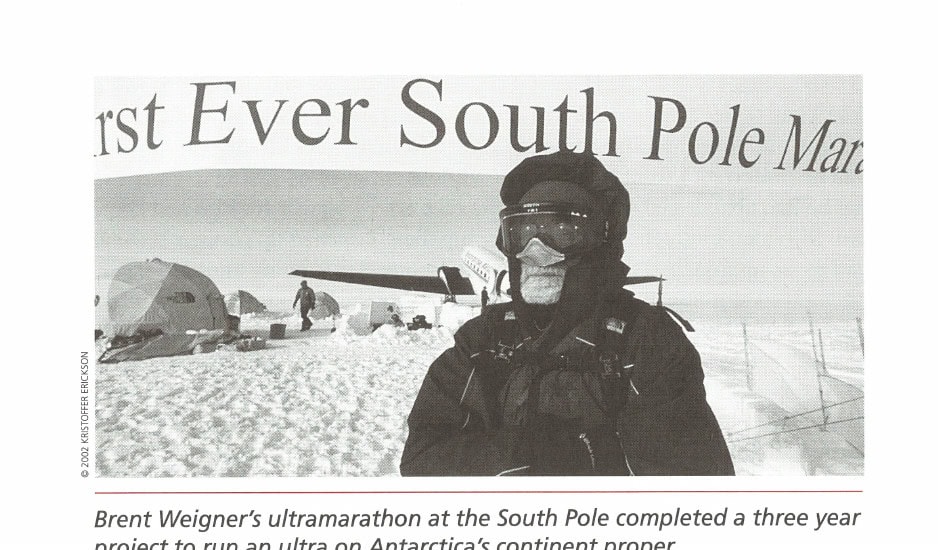
THE GEOGRAPHIC SOUTH POLE, ANTARCTICA, January 22, 2002— I have just capped off a three-year project by “winning” the first ever ultramarathon on the continent of Antarctica. Our South Pole marathon team accomplished what most people thought was impossible, or at best improbable. But was it really a race, or an expedition? I’ll let the readers decide that.
THE EARLY HISTORY OF ULTRARUNNING IN ANTARCTICA
The idea of running an ultramarathon on the continent of Antarctica was formulated in February 1999, shortly after I organized and competed in the first ultramarathon in the antarctic region. The race took place on King George Island off the west coast of the Antarctic Peninsula. The Antarctica Artigas Adventure 50K was held in conjunction with Marathon Tours Third Antarctica Marathon and Half-Marathon, the only “open” athletic competition held in Antarctica at that time. Amundsen-Scott Station at the South Pole sponsors a 5K “Race Around the World,” but that is restricted to station personnel. Thom Gilligan, owner of Marathon Tours & Travel, approved the 50K pending reasonable weather on race day. In the past, he had been reluctant to allow any ultra to be associated with his tour because of safety and logistical concerns. His cooperation made the event possible.
For several days before the race, rumors circulated aboard the Russian ship Akademik Ioffe. Some runners were planning to run the ultra whether it was approved or not. Others were concerned they might be disqualified from the official marathon if they ran the “unofficial” 50K. We were also curious about what was happening on the smaller Russian ship, Shuleykin, that Marine Expeditions out of Toronto, Canada, had chartered to Marathon Tours. We knew Laurie Dexter was on that ship, and he had more polar experience than any of the other athletes on the expedition.
The excitement and anxiety were intensified by the thought of completing the first ultra in Antarctica. The prerace roster included favorites Fred Zalokar (the eventual marathon winner in 3:45), Colin Kingsford and Laurie Dexter of Canada, and David Kanners. It appeared there would be approximately 10 to 15 finishers if all the prerace hype was believed and everybody continued on for another eight kilometers after the marathon finish. My major concern was whether we would have enough finishers to give the event any credibility. It is easy to get excited about running an ultra while discussing it over a beer in the bar. As most ultrarunners know, it is another matter once you are on the course and have run for several hours.
Race day dawned bright and sunny with temperatures of 30 to 35 degrees Fahrenheit and winds of 10 to 15 miles per hour. After a somewhat wet 15 to 20-minute Zodiac boat ride, we landed at Artigas, the Uruguayan base on King George Island, which served as the start and finish of the three races, the half-marathon, the full marathon, and the “unofficial” 50K. The course had been measured and marked two days before by Thom Gilligan, Bart Yasso, and Bill Serues, and the marathon course was a double out-and-back with two loops. The half-marathoners ran one loop of the two-loop course. The 50K included an extra out-and-back from Artigas to the Russian station, Bellingshausen.
The race field included about 140 runners, several of whom were doing the half-marathon rather than the full marathon. The first 800 meters included running through glacial streams and a boulder field along the glaciated beach of Maxwell Bay. If the runners’ feet were not wet at this point, they soon would be after the one-kilometer climb up Collins Glacier and the 500-foot vertical drop back to the starting line. At this point we were happy to reach the rocky and muddy roads leading out to the first aid station at Bellingshausen.
As Tad Lancucki, one of the British runners, put it, “The roads were severely undulating.” So we all ran up and down the “bloody” hills. The runners had the opportunity to label their water bottles and have them placed at the unmanned aid stations approximately every three miles. After leaving the Russian station, we proceeded through the Chilean station, Frei, on our way to the turnaround at the Chinese station, Great Wall. Due to a lack of course marshals, several runners missed the turn to China’s Great Wall Station on the first loop and ran an extra one to two miles, while others just skipped the five-mile out-and-back segment to the Chinese station on the first loop. This organizational oversight cost several runners victories in their age groups.
Later in the day, there was a course marshal at this critical turn off the main road. After making the turnaround at Great Wall, we proceeded back to Artigas the way we came and then did the entire course again.
Besides the grueling course, some runners faced other hazards such as marauding skuas. These predators of the skies usually eat penguin chicks. However, on occasion these birds will test humans by stealing stocking caps for kicks.
For the ultrarunners, the marathon finish signaled the turnaround, and we ran out to Bellingshausen and back for the third and final time. We were thankful we didn’t have to run the glacier a third time. This extra eight kilometers was too much for several of the front-runners who pushed themselves to the max in the marathon. Nevertheless, seven of us persevered and finished the 50K. The official, or perhaps “unofficial,” results are listed below.
| NAME | AGE | CITY STATE/COUNTRY | TIME |
|---|---|---|---|
| 1. Dave Kanners | 52 | Rochester, Michigan | 6:06 |
| 2. Jim Wholey | 52 | Saratoga, California | 6:16 |
| 3. Tad Lancucki | 49 | London, England | 6:18 |
| 4. Raymond Nyce | 47 | Parker, Colorado | 6:50 |
| 5. Brent Weigner | 49 | Cheyenne, Wyoming | 6:57 |
| 6. Mary Ritz | 44 | Gooding, Idaho | 7:21 |
| 7. Louise Wholey | 57 | Saratoga, California | 7:25 |
Back on board ship, talk turned to who would make the T-shirts and write the stories.
However, the most intriguing conversation revolved around the question of who would become the first person to run an ultramarathon on each continent. Being a geography teacher and something of a purist, I said, “King George Island is not on the continent proper.” One of my running buddies from London, Tad Lancucki, responded by saying, “What are you going to do, run one to the South Pole?” I replied, “Well, why not?” I thought someone would eventually organize an ultra on the continent itself, not just on one of the islands off the coast. I wondered whether the Antarctic Treaty would even allow such an undertaking. Would any members of IAATO (International Association of Antarctica Tour Operators) ever consider such an undertaking? Perhaps it would be up to someone in the ultra community to charter a plane, land on the continent, run an ultra, and return the same day without taking time to play tourist. It sounded crazy and expensive, but Ernest Shackleton’s expedition to Antarctica on the Endurance also sounded crazy and was very expensive. He ran the following advertisement and received 5,000 replies: “Men wanted for hazardous journey. Small wages, bitter cold, long months of complete darkness, constant danger, and safe return doubtful. Honor and recognition in case of success.”
So, I offered up the challenge, to be arranged at a future date. I was confident there were not 5,000 ultrarunners out there interested in and financially capable of running an ultra on the continent. However, I was determined that someday, somehow, I would run to the South Pole. Before taking up that challenge, I wanted to make sure I ran ultras on all seven continents, allowing the Antarctica Artigas Adventure 50K to count as the Antarctica ultra. I accomplished that goal on July 27, 1999, and ended up running one more ultra on August 7 to shorten my world record to 267 days. As of this date, to the best of my knowledge, the record still stands. (You can read the details in the September/October 2000 issue of Marathon & Beyond, “Beyond the Distance” by Teresa L. Wolff, pp. 88-98.)
RESEARCH AND HOMEWORK A MUST
Who could help me organize an ultra to the South Pole? When I returned from Antarctica in late February 1999, I contacted Anne Kershaw, who was at that time the owner and manager of Adventure Network International (ANI was sold to Grand Expeditions of Boca Raton, Florida, in the summer of 2001). Instead of telling me I was crazy, Anne liked the idea. Instantly, I knew she was a risk-taker and the kind of person who could get the job done. I also knew that ANI was the most experienced private company operating in the interior of Antarctica; it has supported virtually every private expedition to the continent. All other operations are controlled by government agencies through the various scientific research stations located on the continent.
My initial plan was to charter an ANI aircraft, sign up my running buddies and anybody else who was interested, and go run an ultra on the ice. As I soon discovered, doing anything in Antarctica is not quite that simple. The cost to charter a C-130 Hercules to fly us to Patriot Hills base camp near the Ellsworth Mountains was $250,000—one way. It became instantly clear that my running buddies and I wouldn’t be doing that because of the cost. The next option would be to tag along with some other expedition so that the cost wouldn’t be prohibitive.
Anne Kershaw was supportive and very interested in the project. With her vision and leadership, ANI has made possible a number of firsts on the continent, and I sensed that she wanted to put the “First Marathon to the South Pole” feather in her cap. Initially I was very encouraged as we corresponded via e-mail for the next year. In late 2000 it became obvious that there would be no marathon in the 2000-2001 season (November-February).
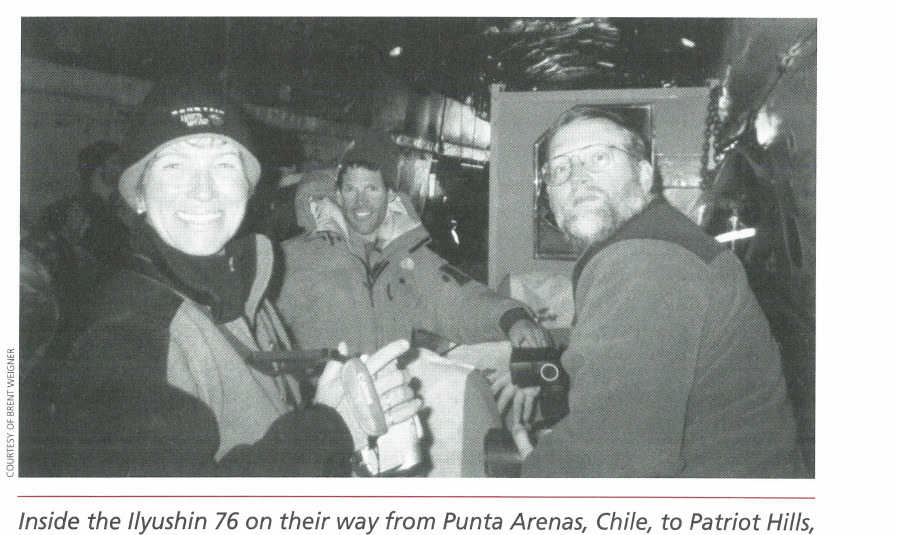
Because of the complexity of holding an ultra in such extremes, logistics takes an inordinate amount of time to organize. Just before Christmas 2000, Anne called and said she would like me to do some test runs in the interior of Antarctica and write a proposal. I left Cheyenne, Wyoming, on December 28 and arrived in Punta Arenas, Chile, the next day. Unfortunately, I had to wait in Punta Arenas for five days until the weather was suitable for the C-130 Hercules to fly to Patriot Hills. As I have since learned (the hard way), antarctic weather more often than not interferes with human plans.
ON THE ICE AGAIN
This was my third trip to Antarctica, the first two having been by ship. The six-hour flight took us over the Straits of Magellan (a natural shortcut from the Atlantic to the Pacific), Tierra del Fuego (named because early sailors saw Native Americans’ campfires on the hillsides), the Drake Passage (considered by most to be the roughest body of water in the world), the Antarctic Convergence (where the cold, extra salty waters of the Antarctic mingle with the more temperate waters of the southern oceans), and the Ellsworth Mountains (home of Antarctica’s highest point, Vinson Massif).
We landed on the natural blue-ice runway at 3:00 A.M. on January 4, and by 6:00 A.M. I was running toward some nanatucks, rock spires that stick out of the snow and ice. The camp manager briefed me before allowing me to run off alone. Yes, I had a Global Positioning System (GPS) and knew how to use it in case of a whiteout. Did I realize the distances on the ice are very deceiving and usually three times longer than your instinct tells you? The camp staff thought I was a curious sight because no one had ever gone running at Patriot Hills—ever. Why would you want to post hole here and there and worry about slipping on the ice?
After pioneering several running routes in and around Patriot Hills, I was beginning to wish I had brought my running snowshoes. Not one of the camp staff thought running a marathon to the South Pole was a good idea. Some thought we should run a course around Patriot Hills and keep everything close to base camp. We mapped out a two-loop course that would take the runners completely around Patriot Hills on the first loop and up and over Windy Pass on the second loop. It was a very scenic course, and the camp staff seemed to think it was doable. At this point, the South Pole Marathon seemed like a very remote possibility. I wrote my report and took some consolation in the fact that we might be able to run an event on the continent proper. What would Anne and ANI do? Maybe there wouldn’t be enough interest from potential clients.
During the spring of 2001, Anne informed me that most of her potential clients wanted to run to the South Pole and that was how she would proceed to plan. I helped develop a marathon questionnaire, training suggestions, and equipment list and sent her mailing lists of running organizations and publications and potential clients.
The cost of the trip ($25,000) scared off most runners. We screened about three dozen applications. I remember one application in particular. Two of the questions were 1) Please list any previous high altitude experience, and 2) Please list any cold weather experience. The applicant replied that he and his wife had driven over Vail Pass in Colorado, and he had run the Tallahassee Marathon on a 40-degree day. I never did find out whether the guy was really serious about running to the South Pole. I started to wonder how many people really were qualified for the task. Could we really guarantee their safety? What if we didn’t get enough runners and ANI had to cancel the trip?
As the summer and fall seasons slipped away it seemed that ANI would not be able to make it happen. My friend Don Kern and I called or e-mailed each other every week to compare notes on what ANI was telling everybody. Only one runner had paid the full amount, and a couple of others had put down a deposit. Everyone else was waiting for potential sponsors to come through. They didn’t, except for The North Face, which eventually sponsored professional athlete Dean Karnazes. Don and I decided we would do it by ourselves if we could get to the ice. Finally, Anne decided we would do the event with just a handful of runners—six, to be exact. Maybe this thing really would happen.
HOW LONG DID IT TAKE TO GET TO THE STARTING LINE?
I left my home in Cheyenne, Wyoming, on January 1, 2002, and finally arrived at the starting line 26.2 miles from the Geographic South Pole on January 21. Please see Don Kern’s article on pages 20–36 of this issue for all the trials and tribulations leading up to the start of the “race.”
After having camped for three nights on the Polar Plateau at an elevation of 9,300 feet (although the effective elevation is more like 11,000 to 12,000 feet because of the position of the plateau and related atmospheric conditions) and having endured temperatures ranging from minus 25 to minus 50 with the chill factor, we attempted the race, only to have it canceled two hours later because of bad weather. I was running with Irish runner Richard Donovan at the time when everything turned to “milk,” and we could not see surface features or any of the bamboo markers that indicated the course.
One of our guides evacuated us by snowmobile, only to end up driving in a large circle and taking us back to the starting line before eventually finding the camp. One of the other guides, a victim of vertigo in the whiteout conditions, fell off his snowmobile as he rescued Don and fellow runner Ute Gruner. This aborted start was a scary experience for all the runners. It became apparent that the event was going to be much more difficult than we had previously imagined. Running 15 to 20-minute miles would be a challenge. Dean and Richard are 2:30 marathoners, and they ended up running around nine hours. After the initial race was cancelled because of bad weather, all the runners and the head guide, Doug Stoup (check him out at www.iceaxe.tv), met in the cook tent to discuss how we could safely run the race. There was real concern the race might never happen. We knew the contract was up on the DC-3 aircraft that was dedicated to stay with us during the event. Each day we were becoming weaker from a combination of the cold, the elevation, the freeze-dried food, and the mental fatigue associated with having to abandon the prior race.
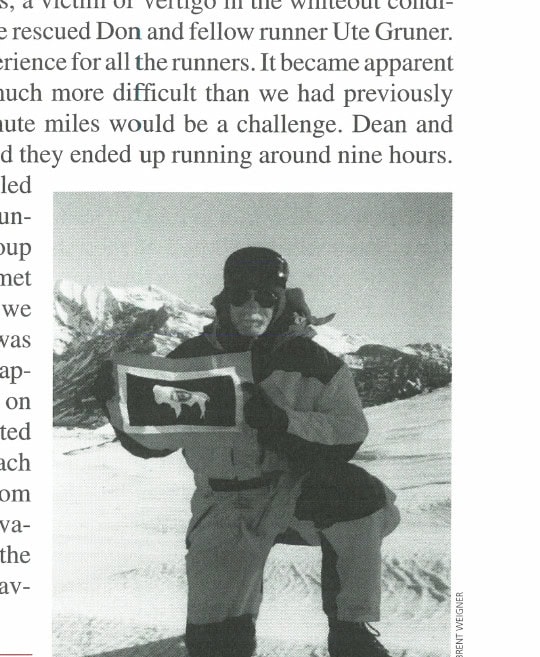
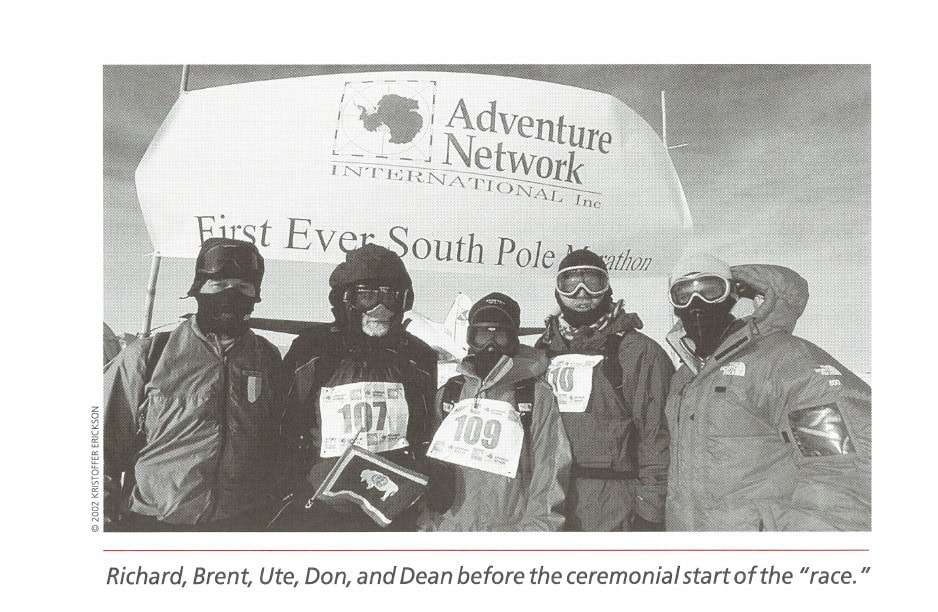
We decided everybody would have to make sacrifices so that we could safely run. Don and Ute agreed to run an out-and-back half-marathon at the Pole.
Dean did not want to wear snowshoes, and lent his pair to Richard. Richard did not want to wear the snowshoes because he had never worn or trained in them, but he thought they might stabilize his knee, which he had previously injured, and allow him to finish. Dean thought he could run the course in five to six hours without the use of snowshoes.
I was definitely going to wear my snowshoes and was very comfortable with that choice, having competed in numerous cold weather events and snowshoe races. Everybody agreed that we would run the race expedition style and then race the last couple of miles to the finish. Doug told us we would have to run this way for safety reasons and that, if one of us dropped out of the race, the others would have to stop as well. Everybody agreed we would run together expedition style until later in the race when everybody’s safety was assured.
Ute and Don were disappointed they could not achieve their original goal of running a full marathon, but because of the time constraints and the safety issues, I felt the decision was a good compromise and I was proud of how unselfish they were.
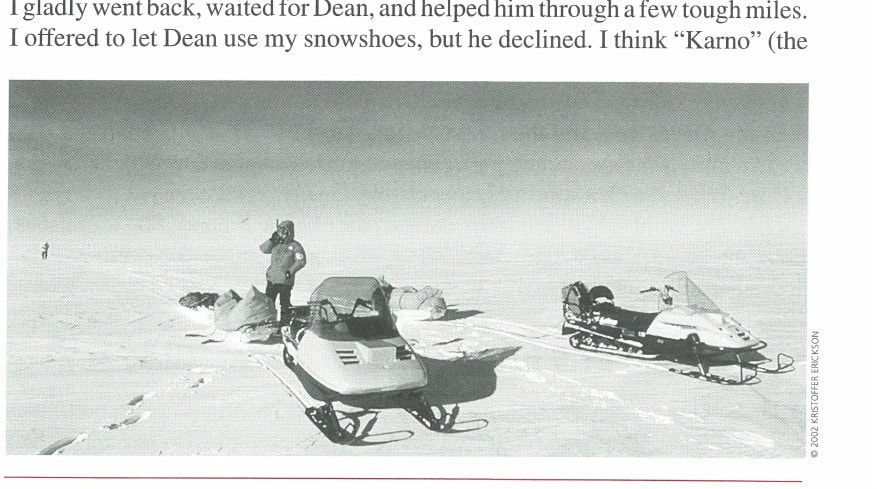
We also decided to run with the snowmobiles providing support. Carrying our own packs and providing our own aid would have been even more dangerous since the aid stations were originally placed five miles apart. I seriously doubt everybody would have finished if we had stuck with the original plan.
Early in the evening of January 21, after three weeks of waiting, we arrived at the starting line for the second time. I assumed we would all have a nice sociable run while photographer Kris Erickson and Doug would take care of us with the snowmobiles, food, and support, and then we could all duke it out the last couple of miles. That is not what happened.
I don’t know who was to blame, but I hold the head guide responsible because he allowed Dean to start while Richard and I were putting on our snowshoes. He also allowed us to be separated by as much as two miles during the race. Richard viewed Dean’s early start as “breaking the expedition pact” and decided there would be no running together but a race from the get-go.
Dean did not wait for us or turn around and jog back to see how we were doing. For that matter, Richard didn’t wait for anyone either. It didn’t take me long to figure out the race was on and realize I was the only one who wasn’t racing at that point. Doug could have kept us together as we had planned, but he allowed the events to unfold as they did. I am reluctant to be critical of Doug because his leadership and perseverance are what made the marathon a success.
It is impossible to speculate on who would have outkicked whom over the last few miles of the race if we had all stayed together from the start. As ANI’s marathon consultant, I felt my first responsibility was to the team. I was willing to do whatever was necessary to make sure everybody finished safely. That is why, early in the race, I cautioned Doug that I was afraid Dean and Richard were going out too fast. As it turned out, my feelings were correct. Around eight miles, Doug yelled and motioned for me to return to the snowmobile aid stop. Dean was struggling through the conditions and had called on me for support. I gladly went back, waited for Dean, and helped him through a few tough miles. I offered to let Dean use my snowshoes, but he declined. I think “Karno” (the
nickname his friends call him) underestimated the competition and the “runability” of the snow conditions. Karno and I agreed to disagree on this point. He doesn’t think he had any competition and maintains he was racing only himself.
From a selfish standpoint, and being an accomplished snowshoe racer, I think I could have won the marathon as well as the ultra due to my prior experience in cold weather racing. However, my primary goal was to complete the course. Nonetheless, I always want to win, even when it is not realistic to think a four-hour marathoner can beat a 2:30 marathoner. I figured anything was possible in such extreme conditions.
Looking back, I know I was the only one who was not racing the first half of the course. That is why, after crossing the finish line, I was able to immediately turn around and go back out to complete the ultra.
IT TOOK YOU HOW LONG TO RUN 45 KILOMETERS?
The 9 hours, 59 minutes, and 53 seconds I was on the course passed quickly. My routine revolved around listening to my body and deciding when to run and when to walk. I worked very hard at consuming at least 200 to 300 calories per hour and drinking 16 to 20 ounces of fluid per hour. I stopped every mile at snowmobile aid stations for snacks of GU, chocolate, peanut butter, nuts, or dried fruit. I also drank lots of water and hot soup.
I stopped four times to empty my bladder. I chose not to remove my face mask or gloves when eating. I simply forced food and liquids into the frozen hole I had cut in my Windstopper neoprene balaclava. Once I had to remove my gloves to adjust the bindings on my snowshoes, and my fingers began to go numb in less than a minute. I dressed perfectly and did not want or need any additional clothing. During the entire race I did not take off any clothing other than my gloves now and then. I wore lightweight Patagonia Capilene underwear, a midlayer cross-country ski pant and turtleneck made by Sport Hill, and a Gore-Tex suit with a hood and zipper vents. On my feet, I wore polypropylene sock liners, wool socks, and an oversized pair of New Balance 804 trail shoes. Over the shoes I wore a neoprene shoe cover/gaiter made for cycling. Atlas snowshoes designed for extreme racing rounded out my footwear.
OK, LET’S RACE THE LAST FEW MILES
After helping Karno through his rough spot, I felt confident everybody was going to finish the race. A recovered Karno left me around 10 miles and pushed hard until the last few miles. I caught him about 2 miles from the finish when we both strayed temporarily off course. Having run by myself for approximately 13 to 14 miles, I was thrilled I had finally caught him after stalking him for a long time. I had noticed that for the past several miles that my walking stride was one and one-half times as long as his running stride, or perhaps he was walking more than he preferred. I went by him hard without either of us saying a word. I felt that he had abandoned me earlier in the race after I waited for him and helped him. Silly me, I thought we weren’t racing then. I opened up about a 200-yard lead as we approached the finish. I saw someone else running ahead of me and I thought I was going to catch Richard, as well. Maybe I could win the marathon? Later I found out it was Don Kern running his half-marathon.
I was running hard when I crashed to the snow as my right snowshoe came off. What luck! The binding had released less than 800 yards from the finish. I struggled to reattach my shoe to the binding as my lead over Dean evaporated. Karno went by me just as I finished tightening my binding. I gave chase as we approached the finish. He was running hard and I saw him throw his yellow North Face Gore-Tex jacket, which he had been carrying, to the snow—no extra weight to slow him down. I remember the incident because I picked up his jacket on my way back out to finish the ultra. Dean finished 70 seconds ahead of me in one of the most remarkable athletic performances I have ever witnessed. His insistence on not wearing snowshoes meant he sank four to six inches into the snow with most steps rather than the two to three inches Richard and I sank in with our snowshoes.
Meanwhile, Richard was suffering from hypothermia and frostbite and was sitting wrapped in a parka at the finish line. He had paid the price to win the marathon. At that point, I figured I would be the only one to do the ultra, and as I headed back out on the course I decided I would be just as happy with a 45K rather than the 50K we had all agreed to do days before the race. As I made my last turnaround and headed back to the finish line for the second time, I walked a bit with my friend Don Kern. I was truly amazed to see Richard headed back out on the course, walking with the expedition doctor, Duncan Gray. The Irish tough man (he has run well in events such as the Marathon des Sables) was going to finish the ultra in spite of his poor health (frostbite, hypothermia, mild snow blindness, and dehydration; once back in Patriot Hills he would receive four liters of fluid through an IV drip). Even though he gave up 30 minutes while trying to get warm, his willpower and mental toughness helped him finish the ultra. He is raising money for some Irish charities by attempting to run an ultramarathon on each of the continents in one calendar year. The ultra was a “must do” for him. I had teased him back in Punta Arenas before we left for the ice that the world record for such an ambitious undertaking was less than a year. He assured me he just wanted to do seven ultras on seven continents in one calendar year. I encouraged him to try to break my current record of 267 days. After all, isn’t that what records are for? Richard, my lad, I’m watching you.
I have done a number of events in which I have suffered more; however, I have never done an event in such extreme conditions that the possibility of serious injury or death was constantly on my mind. I seriously doubt that ANI will ever conduct a future marathon where the runners start 26.2 miles from the Pole and run a linear course. I think the conditions and safety concerns will dictate an out-and-back course from the Pole or perhaps a loop course where the runners can be safely monitored and cared for at all times.
After my much-delayed return to Cheyenne on January 27, my parents joined my wife, Sue, and me at our home for the usual Sunday night dinner. My mother told us about her latest physical exam. The doctor said to my mom, “Your son has run these crazy events all over the world. Is that correct?” “Yes doctor, why?” The doctor responded, “Did you potty train him too early?”
Results
Half-Marathon
- Ute Gruner, 5:48:56
- Don Kern, 5:53:00
Marathon
- Richard Donovan, 8:52:03
- Dean Karnazes, 9:18:55
- Brent Weigner, 9:20:05
45K Ultramarathon
- Brent Weigner, 9:59:53
- Richard Donovan, 10:10:09
- If an event is advertised as a race, no matter what the competitors say, somebody is going to show up and race. That is the nature of the beast. Maybe the nickname “Karno” is really short for carnivore, as in Velociraptor.
- Running a marathon as hard as you can and finishing in nine hours is a sobering and humbling experience.
- When given the choice, not deciding ahead of time to continue on and run the longer distance will more than likely eliminate you from the longer race.
- Mother Nature has a way of dealing with human arrogance. In extreme conditions, unrecognized and denied arrogance is a serious liability and handicaps a person in a serious situation.
- There is no substitute for experience. How do you decide if the snow conditions warrant the wearing of snowshoes? In the famous Alaskan ultra, Iditasport, some years the foot runners win and some years the snowshoe runners win. It all depends on the snow conditions. Native Americans of the Far North have something like a dozen different names for snow, depending on its characteristics. Do you know your snow?
- In extreme cold, you can avoid getting too hot or too cold by using your internal thermostat as a guide to determine when you should walk and when you should run.
- Consider ways to prevent your goggles or glasses from fogging up. There are some commercial preparations that will help solve the problem or at least minimize it.
- Rub petroleum jelly on your face and beard before putting on your face mask. It will make removal easier. My neoprene mask had a large ice buildup. After the race, Devon, one of our four guides, had to help me cut the mask off my face because it was frozen to my beard.
- Make sure your “water” bottle and your “pee” bottle are different sizes/shapes or different colors, so you don’t confuse the two in the middle of the night.
- Be sure to cover every inch of exposed skin. I had a 1/16-inch gap between my face mask and my ski goggles, and I got a sliver of frostbite on my left cheek.
- When considering your face mask, be sure to cut the mouth opening hole large enough so that your already restricted breathing will not be further impeded.
- If you lose your snowshoe the last 800 yards of a race, leave it and run in without it.
- Realize and be aware that your thought processes are not always coherent when racing at altitude. After I had finished the marathon and had turned around to go back out on the course, I kept calling one of the guides by the wrong name. It wasn’t until much later that I fully appreciated how diminished my mental faculties were while I was doing the ultra.
- When considering an expedition run or adventure run, ask yourself the question, “How comfortable am I with being uncomfortable?” Showing up at the starting line is not always that simple.
- Think of extreme runs or races as expeditions, and make sure you always have at least 10 percent of your energy reserves and psychological reserves in the bank. One of our guides, Bean “the snowmelter” Bowers from Jackson Hole, Wyoming, reinforced that with the team members before we ran. Never overdraw your bank account or you risk placing yourself and/or your team members in a life-threatening situation.
- Increase your chances of finishing and surviving an extreme event by making sure an adequate safety net is in place. Remember, adventures count only if you live to tell about them.
- Be sure to take test runs in the gear and conditions you expect to run in. We did this several times and continued to modify our “kits” up until the last day. I used duct tape fastened to my ski goggles to create a nose guard so that my nose would be protected from both sunburn and frostbite.
- When running at the South Pole during the austral summer, you can watch the sun make a big clockwise circle in the sky. The sun rises and sets only once a year.
- The sudden cracking and loud rumbling sounds you hear when running across the Polar Plateau don’t mean you are about to be swallowed by a crevasse. It is the shifting and settling of the ice plates.
- “Sun dogs” refers to the circular rainbows that appear around the polar sun.
- Additional tips on cold weather running and training can be found at my Web site: www.angelfire.com/wy2/marathon/SouthPoleMarathon.html.
- It is always good to say your prayers, count your blessings, and have a grateful heart for all things God has provided.
This article originally appeared in Marathon & Beyond, Vol. 6, No. 3 (2002).
← Browse the full M&B ArchiveMore like this
1,000+ stories from 19 years of Marathon & Beyond
The complete archive of the legendary long-distance journal — digitized and free to read.
