

Start, Turn, Finish
The scene in the predawn dark before the Zoom! Yah! Yah! Marathon is simultaneously perfectly normal and completely surreal. It’s 6:00 a.m. on the first Sunday of the new year in Northfield, Minnesota, a picturesque college town of 20,000 surrounded by rolling farmland roughly 45 minutes outside the Twin Cities of Minneapolis and St. Paul. The current temperature is 13 degrees and the wind chill is 4 degrees above zero. The mercury hasn’t risen above freezing here since December 16. I’m wearing five layers on my torso, one of which is a down jacket.
Runners chat, stretch, jog; take slugs of coffee, water, and sports drinks; apply Body Glide and Vaseline; and make last-minute pit stops. But there are no portapotties or lines, and people are for the most part wearing shorts and singlets. The 42 athletes present are preparing for the eighth annual running of what is billed as “The World’s Most Prestigious Indoor Marathon,” 150 laps around the three-lane 282-meter balcony track in St. Olaf College’s Tostrud Field House.
For many—runners and nonrunners alike—the Zoom! Yah! Yah! sounds like sadistic torture, a 26.2-mile version of hell. Dante consigned people to different circles of hell, but at least he didn’t make them run around those circles. My own skeptical teenage son said in a mocking tone, “It sounds like NASCAR, but without the crashes.” Although it inspires eye rolling among some, for others it holds a magnetic appeal. Runners fly in from around the country to participate. For a few years, it was the only indoor marathon in the United States, but in recent years similar events have sprung up in Wisconsin, Indiana, Ohio, Maryland, and Virginia (a summer race where air conditioning rather than central heating is part of the appeal). Canada and Germany host several indoor races. In 2011 an indoor trail marathon was even held in New Richmond, Wisconsin, but that appears to have been a one-time event.
The Zoom! Yah! Yah! may be an unusual race, but its origins are mundane. Race director Dick Daymont, a gregarious special ed teacher, says the idea occurred over beers. He and friends (members of the Band of 10,000 Aches Running Club) had taken to running marathons, and he says simply, “We were traveling
© Chad Thomas
to different places, and it was getting expensive.” These Minnesotans needed a winter marathon that wouldn’t tax their budgets. The inaugural event in 2006 had eight marathoners (including Daymont, who has run the race three times) and seven half-marathoners, all residents of Northfield. The following year, the half-marathon was dropped, 27 runners completed the marathon, and by 2008 the race had reached its current size of just over 40 competitors. Like many much-larger races, Daymont holds a lottery for entrants. Unlike most of those races, he also keeps an active waiting list, and as late as a week or so before the starting gun, entrants were still being added.
The ZYY is run over a USATF-certified course, but the constraints of the indoor track make for some unusual rules and customs. Every 30 minutes an orange traffic cone with the names of the previous winners on it is placed in the middle of the track, and when runners finish the lap they are on, they reverse directions. Every runner is also assigned a personal lap counter, a local resident or member of the St. Olaf women’s track and cross-country teams who records every lap time and provides a personal cheering section. When that document is complete at the end of the race, it serves as the runner’s finishing certificate. Each timer then presents the runner a finisher’s medal and T-shirt. Other distinctive characteristics of the race include 600 aid stations (a table in each corner of the track, for which runners provide their own bottles and snacks); guaranteed temperatures between 54 and 62 degrees; no snow, rain, or wind; and an absolutely flat course. * * * A massive cheer bursts from the runners as they cross the starting line under the banner emblazoned “START TURN FINISH.” Immediately, four runners break away from the crowd, though in this race they don’t actually break away from the pack—they just run faster than everyone else. In fact, they will spend the next few hours wending their way past slower runners. ▲
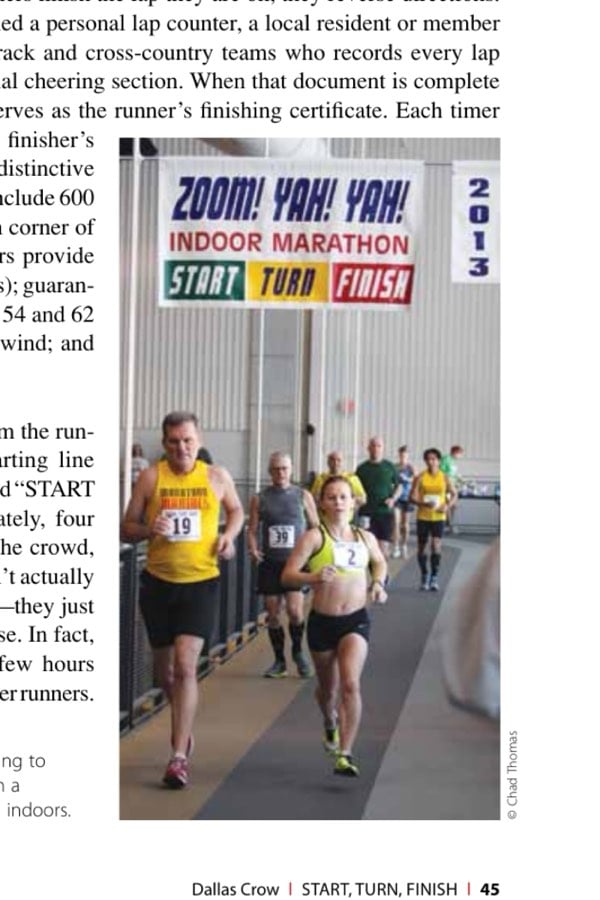
Nichole Porath (#2) attempting to become the first woman to run a marathon in under three hours indoors.
Each of the runners in the lead group has a personal best of under three hours, and one of them—Nichole Porath, a compact 29-year-old Northfield resident who ran in the 2012 Olympic Trials Marathon—has her eyes on a world record today. Melissa Gillette established the women’s indoor marathon record of 3:08:53 in the 2012 Maple Leaf Indoor Marathon in Goshen, Indiana, and when Porath, with a 2:44 best, learned about that record, she started making plans for the upcoming ZYY.
Veterans of the ZYY seem divided about whether it is an easy race to pace yourself through or not. At 5.7 laps to the mile, you don’t have the clear mile markers of other races; on the other hand, with 150 laps of identical length and no elevation change, things are extremely well calibrated for tracking your splits. One runner said, “If you can’t pace yourself in this race . . . ” then just shook his head. After each of the early laps, one of the leaders comments to the others that they are right on pace.
The opening mile provides some unusual moments. Clumps of runners making each other’s acquaintance chat their way around the track, while the leaders, one of whom is shooting for a world record, weave through and around them. Unlike the custom most of us are familiar with from high school track practices where faster runners holler “Track” and slower runners are expected to jump out of the way, the rules for this race are that you maintain your position, and faster runners pass on the outside, which essentially means the faster you run, the farther you run, as there is little point in running on the inside when there are 40 slower runners scattered around the track.
I can’t help thinking of William Carlos Williams’s rollicking poem, “The Dance,” the one that begins, “In Breughel’s great picture, The Kermess, / the dancers go round, they go round and / around . . .” for the brightly colored runners are festive and boisterous. When they all come into the first turn together the balcony shakes, and I wonder for a moment if it’s engineered to support this many people in one place. They joke with each other and their small audience. The mood is playful, exuberant. While the rest of Northfield sleeps, a party is going on in the field house.
It’s still dark out before 7:00 in the morning, but “Paradise by the Dashboard Light” is blaring from speakers staggered every 20 feet or so around the track. Suzy Goodwin, a North Carolina resident in matching black-spotted top and shorts that wouldn’t look out of place on Wilma Flintstone or Betty Rubble if they had wicking fabrics in their closets, black compression socks, pink and black shoes, and shiny lip gloss, is singing along with Meat Loaf. Another runner stops roughly 10 minutes in and says good-naturedly of the leaders, “It’s just not right to get lapped like that so early.” The next time he comes around, about a minute and a half later, he adds (speaking of Porath), “She’s actually lapped me twice. And she’s a lot smaller than me.” Later in the race, I will see him chatting with a spectator about his age and her two teenage kids. A few laps after that, he stops and poses
for a picture with them. I assume she is his wife, but she says she doesn’t know him: “He just seems to have adopted us.” While it’s not uncommon for friendships to develop at races, this one seems tailor-made for it. The leaders and those at the back of the pack see each other regularly throughout the race, and every 30 minutes, when runners change directions, they all see each other face to face. In addition to passing out numbers the night before the race, Daymont handed out blank bibs as well and told people to put their name on them and wear them on their backs, and indeed throughout the race, as runners pass each other, you can hear them greeting and encouraging each other by name. What the race lacks in scenery, it makes up in conversation. * * * “Season’s greetings” said the slight man thrusting a plastic goody bag at me as I entered the packet pickup and prerace dinner. He was wearing a multicolored stocking cap version of a jester’s hat and hobbling around in a medical boot. As it turned out, he was something of an involuntary volunteer. A five-time ZYY finisher, Rob Toonkel had been looking forward to running this year until two days before, when his doctor diagnosed a stress fracture and forbade him to run it. Nonetheless, he had made the trip from Virginia and was serving as Daymont’s right-hand man, which he continued to do during the race while also offering a bit of comic relief as he changed goofy hats every 20 minutes or so.
The dinner, an all-you-could-eat feast provided by St. Olaf’s dining hall, was a banquet of epic proportions and quality that had me wondering how I might finagle four years at St. Olaf. It also offered an introduction to the genial, informal atmosphere that would continue through the weekend. Competitors picked up their packets from the race director himself, often chatting for a while. After all, they had already been in direct contact with him leading up to the race. There was no VIP section or dais, and the “expo” consisted of one shelf of ZYY and Band of 10,000 Aches apparel.
When Daymont rose to speak, he didn’t use any kind of PA system. His comments were laconic and clear: “The race starts at 6:30.” He paused. “Actually, usually about 6:33.” Another pause. “Because that’s how life works.” After introducing the fastest runners, he pointed out Dan Kasper, who had run all seven of the previous ZYYs and Mark Stodghill, who the next day would be running his 305th marathon and extending his marathon-a-month streak to 33. In February, he was planning to extend that to 34 and add his seventh continent with a marathon in Antarctica. He announced to everyone gathered, “I don’t know much about running, but this is the best prerace meal.”
As the dinner broke up, Toonkel told me how he learned of the ZYY. He had already completed 50 marathons in 50 states, and a friend was working toward that goal as well when they discovered the ZYY online. He says, “I thought it was a crazy idea. It sounded like torture,” but he accompanied his friend, and found
“it’s the marathon you lose yourself in . . . everyone’s in this shared mode. I have the time of my life at this race every year. “I will run this race,” he declared, “until they won’t let me run it anymore. This race is what running and marathoning is about.” Then he added, “If you’re a silent runner, you’re going to have a horrible time tomorrow.” * * * One silent runner who didn’t seem to be having a horrible time was Porath. She and Matthew Eckberg, a 2:43 marathoner from Illinois in a bright-orange singlet and shorts, had broken away from the other leaders and were clearly working together, taking turns leading when one of them slowed for a drink and as they made their way through congestion. Porath has a blog, and after an e-mail to entrants from Daymont that had mentioned Porath’s credentials and her world-record goal, Eckberg had tracked her down and contacted her online to introduce himself as someone who might be running a similar pace. Though they had met in person only at the prerace dinner on Saturday night, they seemed to have the rapport of teammates, runners who had similar goals and abilities, and could feed off of each other and support each other with minimal communication. As he passed by me at one point, the 2012 runner-up, David Holmen, running his third marathon in eight days, pointed at the two leaders and commented, “It’s fun to watch them.”
Nonetheless, attention was focused primarily on Porath, the hometown favorite with a cheering section of friends and family and strong support from members of the St. Olaf track and cross-country teams. In addition to her official timer, she also had a coach and husband tracking each of her lap times and offering guidance and encouragement. And more than anyone else, her focus was unwavering, the steely look of a motivated competitor masking her otherwise warm, easygoing demeanor.
She served as an unwitting source of humor as well. Early in the race, as one local, a middle-aged man of modest abilities, ran by his lap counter, he asked in
© Chad Thomas
▲
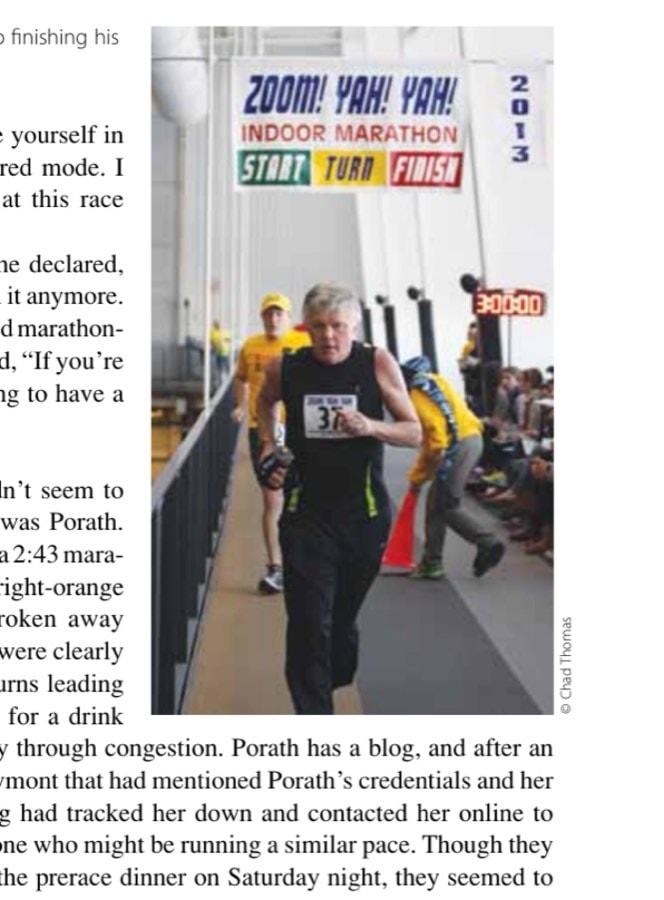
Mark Stodghill on his way to finishing his 305th marathon.
mock confusion, “Am I one up or one down on Nichole?” The timers laughed, and then as he continued on his way around the track, one of the men with clipboards said, “Does he mean miles?” which brought another round of laughter to those of us who stood still and watched as the runners pressed on. * * * Although Daymont’s ZYY seemed to come out of thin air, it was not unprecedented. In fact, 13 of the 20 fastest times over the distance indoors were recorded between 1908 and 1928, including three times by Dorando Pietri, the Italian marathoner who was helped across the finish line of the 1908 Olympics in London and was subsequently disqualified. Beginning in the late fall of 1908, a flurry of indoor marathons took place in front of large crowds in New York, Boston, London, Berlin, Dublin, and San Francisco, many of them match races, sometimes only a few weeks apart. The New York Times called the first of these, a rematch between Pietri and the Olympic gold medalist, Johnny Hayes, in front of a standing-roomonly crowd in Madison Square Garden, “The most spectacular foot race that New York has ever witnessed.” “
In a suffocating atmosphere of dust and tobacco smoke” on a track that required 10 laps to complete a mile, Pietri won in a time more than 11 minutes faster than Hayes’s gold medal time that summer. After a few years of such races, many also featuring other top runners of the day like Tom Longboat, an Iroquois runner from Canada, and Alfred Shrubb of Great Britain, the indoor marathon faded away until the 1928 Olympics brought about a new rivalry between Boughera El Ouafi of Algeria and Illinois runner Joie Ray. Ray set an indoor record of 2:34:54 in November of 1928 in a Boston Gardens rematch after El Ouafi defeated him in October in Madison Square Garden, a record that stood until 2010.
In the early 1970s, while a graduate student at the University of Chicago, Ken Young, now the head of the Association of Road Racing Statisticians (ARRS), the only organization that keeps track of indoor marathon records, “instigated the series of three indoor marathons held at the University of Chicago field house. . . . The 1971 race had two finishers, the 1972 race had seven finishers, and the 1973 race had nine finishers.” And then the indoor marathon basically went underground again until the initial ZYY (though a 1979 race in Canada and a 1998 race in Italy show up on ARRS list). * * * The conventional wisdom is that the marathon becomes a different race after 20 miles, and when you can see all the runners all the time, the truth of that becomes clear. The most gregarious of runners drew into themselves, the ones who had been smiling broadly for miles alternated grimaces with smiles, and those smiles were not nearly as large as they had been. Some—though not many—eased to an occasional walk. Their strides shortened, their eyes glazed over, and rather than trying to cheer up the timers as some of them had been doing, the runners were
© Chad Thomas
▲
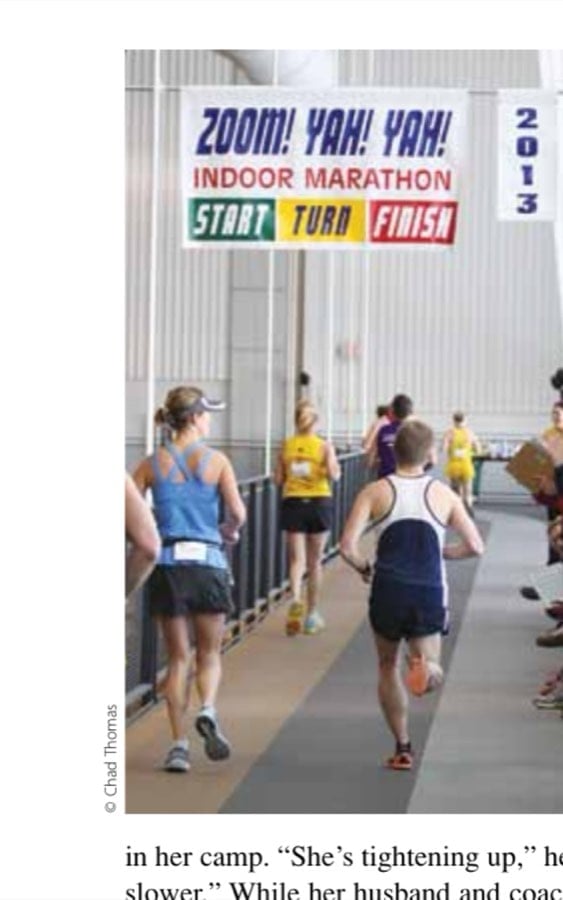
Runners (who came from as far away as Florida and Alabama) pass under the Start-Finish banner every 282 meters.
drawing needed strength from the encouragement of their timers with every circuit. No matter the pace, the distance seemed to have a version of this effect, and suddenly, closing in on 21 miles, Porath had put half a lap on Eckberg.
Within another mile, she lapped him. At 2:30, the cone went down and runners changed direction. “New scenery!” someone shouted. Shortly after that, as he lapped another runner, Eckberg said, “I’ve got no clue where
I’m going at this point.” Though Porath seemed to be in the driver’s seat, steadily putting more and more distance between herself and second place, there was concern in her camp. “She’s tightening up,” her husband said. “Her lap times are getting
slower.” While her husband and coach saw her tightening up and a slight slowing in her times, theirs were familiar, well-trained eyes. To the uninitiated, she looked strong and steady, a metronome in motion, clicking off laps in the same
determined, focused fashion she had shown since the first lap of the race. There would have to be an utter collapse in the final miles for her not to break the 3:08 world record, but her husband said, “She’ll be really disappointed if she
doesn’t break three.” There seemed to be a communal holding of the breath along the north wall of the field house where the timers and many of the spectators were gathered as we counted down her laps while looking frequently at the race clock.
When she crossed the finish line in 2:57, arms raised high in triumph, there seemed to be as much relief as celebration. For one thing, in a marathon on a threelane track, there is really nowhere to celebrate effusively without impeding other
runners. In addition, once Porath stopped and we saw that the inner half of one of her bright-yellow racing flats had turned crimson with blood, it was clear she had been pushing through more pain than had been visible while she was running.
Young notes, “The Northfield track is oversized and not eligible for indoor records. Hence, Porath’s mark is a best, not a record.” That said, Porath’s name does appear at the top of the list, the only woman to go under three hours in52 l MARATHON & BEYOND l November/December 2013
doors but her time followed by an “a,” her version of Roger Maris’s apocryphal asterisk, perhaps. * * * As all the runners entered the final lap, the lap counters started chanting their names, a chant they maintained until the finish, at which point the runners were awarded the finisher’s medal and t-shirt by their personal lap counter/timer. They had been introduced only a few hours before, but a connection had grown during that time. The finisher’s spoils were accompanied by hugs and conversation. There was mutual appreciation and respect in each exchange. It was a personal touch that would be impossible at a traditional marathon due not only to the sheer number of competitors but also to the fact that they hadn’t had an individual witness to all 26.2 miles of their efforts.
And those personal touches, along with the unique format of the race and the race director himself, are what may make this the most convivial of marathons. I used to have a boss who would say, “Da fish rots from da head,” when things went wrong at another organization, the implication being that the problems started with the leadership. According to that theory, the opposite may be true as well. Runners and their spouses referred to Daymont by his first name, as if he were a family friend. “Write about Dick,” a first-time ZYY runner said (one of the entrants who got in off the wait list right around Christmas). “His enthusiasm is infectious. Dick sets the tone and culture of the marathon.”
Shortly after the race, Kelly Wahl, a lanky runner of serious mien—at least until his enthusiasm for the indoor event bubbled up—told Daymont, “Look for my name next August 31” (the lottery deadline). Then he turned to me and said, “Indoor marathons are the funnest marathons. They are the funnest races. They are an absolute blast. And they’re tough.” His wife uttered the almost heretical words, “I’d rather watch this than Boston.” Wahl, a Boston veteran, one-upped her: “I’d rather run this than Boston.” He then interrupted our conversation to yell “Go, Dave, go” to a runner he hadn’t met until this weekend who was clearly struggling. Returning to our previous topic, he said, “It’s nothing compared to a race like this.”
Dan Kasper, the only runner to finish all eight ZYYs and the person who originally suggested the idea of switching directions every 30 minutes to Daymont, remarked that he has run 1,203 ZYY laps. “Three times they’ve missed a lap, but I don’t think anyone wants chip timing.” Kasper agreed with Wahl’s assessment of the course’s difficulty. “It felt like there were hills this year,” he said, but when I asked him if he would be back next year, he answered without hesitation. After all, he will move into a new age-group category in 2014. He currently has two age-group records for the race, and he would like to add a third.
So, is the Zoom! Yah! Yah! some kind of cruel and unusual punishment? Only if you agree with Sartre that hell is other people.
This article originally appeared in Marathon & Beyond, Vol. 17, No. 6 (2013).
← Browse the full M&B ArchiveMore like this
1,000+ stories from 19 years of Marathon & Beyond
The complete archive of the legendary long-distance journal — digitized and free to read.
