

Stepping Up Tolonger Distances
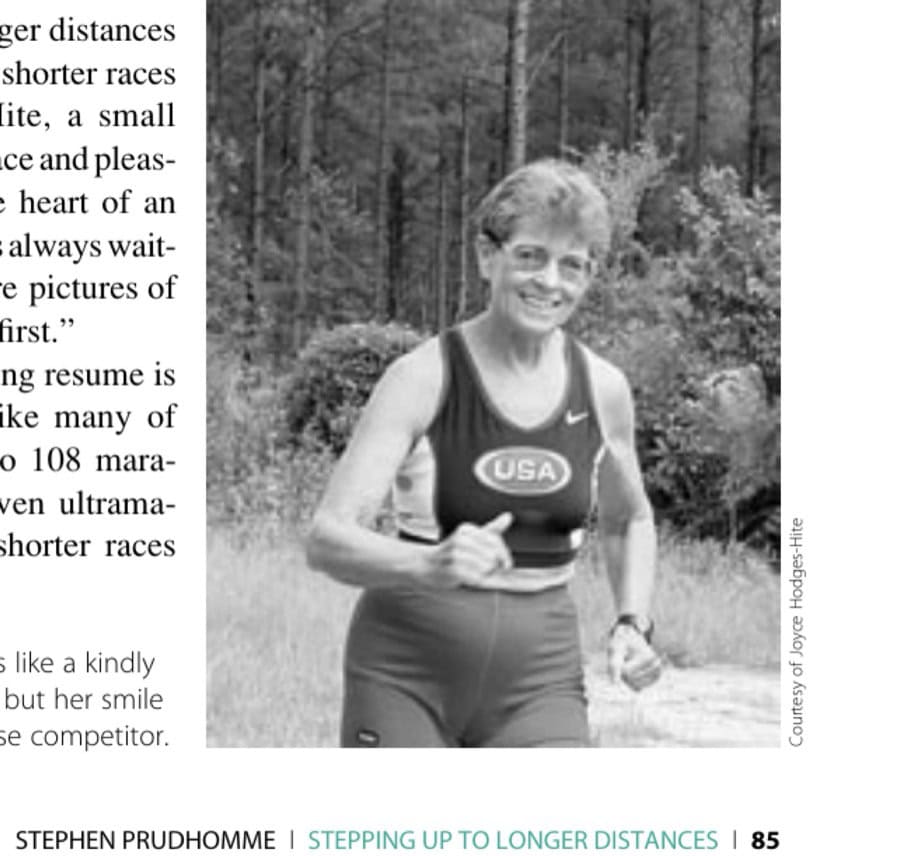
Joyce Hodges-Hite looks like a kindly grandmother, which she is, but her smile belies the heart of an intense competitor.
Courtesy of Joyce Hodges-Hite
The number “100” is a significant one in Joyce Hodges-Hite’s running career. She eased into the sport by taking 100 steps and adding 100 each day until she built up to a mile. Hodges-Hite also has competed in 100-plus marathons, all in the last quarter century and past the age of 45, and is contemplating a 100K race.
Given her propensity for the century mark, who’s to say she won’t be running at the age of 100? Hodges-Hite is 70 years old and lives in Millen, Georgia, a small town in the south-central part of the state. She lives there with her husband, Jim. They are both retired schoolteachers and USA Track & Field officials and coaches. Jim is a competitive masters runner who generally leaves the longer distances to his wife. “He likes the shorter races better,” said Hodges-Hite, a small woman with a friendly face and pleasant smile that mask the heart of an intense competitor. “He’s always waiting for me. He has more pictures of me because he finishes first.”
Hodges-Hite’s running resume is a lengthy one, much like many of her races. In addition to 108 marathons, she has done seven ultramarathons and scores of shorter races
and consistently places among the top finishers in her age group. Hodges-Hite is also a top finisher in national masters track events and has represented the United States in World Masters Athletics competition, capturing bronze medals in team as well as individual competition in the marathon.
Not bad for someone whose early participation in sports did not mark her as a star athlete. Hodges-Hite was born in Vidalia, Georgia, and moved around the south-central part of the state as her father worked in the construction business. She attended Georgia Southern University in Statesboro and majored in education. While at GSU, Hodges-Hite played intramural basketball and volleyball. “
I was so uncoordinated,” Hodges-Hite said. “I couldn’t dribble a basketball downcourt. I scored two points in my entire career. I also sprained my ankle in my first volleyball game.”
WHEN IN DOUBT, RUN Hodges-Hite didn’t fare much better in church softball, yet she did possess one quality that served her well at the time and portended future success in another sport. “I was faster than anyone on the team,” Hodges-Hite said. “I couldn’t hit it past the pitcher, but I could run. That helped me get on base.”
Hodges-Hite recalled that she always liked running, but in the 1950s it was not a sport that had gained the kind of widespread acceptance and participation it enjoys now. Furthermore, she was a woman. “No girls ran,” Hodges-Hite said. “If you wanted to get to the other side of campus, you walked sedately.”
Hodges-Hite embarked on a teaching career, her running abilities lying largely dormant. She did flash her speed on the tennis court when playing with her first husband. When he suffered a stroke, Hodges-Hite stopped playing tennis and began looking for other exercise options. Her epiphany would take place at school, but not in the classroom.
At the time, Hodges-Hite was teaching English and literature at Jenkins County High School in Georgia. She was intrigued by a fellow teacher whom she saw running every day. Ray Miller encouraged her to take up the sport. Hodges-Hite heeded his suggestion, but she was determined to take it slowly, one step at a time—100 steps, to be exact.
Explained Hodges-Hite: “That’s just how I did things. I had a history of starting things and not finishing. I wanted to start out with a little bit.” Little did Hodges-Hite realize how many steps she would take in the ensuing years. It wasn’t long before she was running around her neighborhood and worked her way up to four miles. It was time to take the next step, so to speak.
The neophyte runner entered a 10K race in Millen and finished in 1:07. Her main concern was to cross the railroad tracks along the course before the next train came—meaning she had to run two miles in 30 minutes. “I was afraid I
wouldn’t get back across the tracks,” said Hodges-Hite, who did beat the train. “I didn’t know slow [running time] from fast.” Hodges-Hite’s burgeoning running career hit a bump in the road during a 10K race on Skidaway Island, outside of Savannah, when she suffered a stress fracture to her right hip and couldn’t run for the next six months. Hodges-Hite blamed her shoes. “
I was wearing Thom McCann shoes,” she recalled. “When you’re starting out with something new, you don’t go all out. I bought the first pair of shoes I saw. I didn’t know anything about proper footwear. I’d been better off running barefoot in the dirt.”
When she resumed running, wearing a good pair of running shoes this time, she quickly found her stride again. She ran 5K and 10K races and was a consistent winner in her age group. The 10Ks held the greatest appeal. “They were longer,” Hodges-Hite said. Still, she didn’t envision running the distance that generally separates the jogger from the serious runner. “I said I would never run a marathon,” Hodges-Hite said.
THEN THERE’S THAT MARATHON THING Hodges-Hite’s resolve to not make like Pheidippides wavered after completing a half-marathon in Savannah in 1982 in 1:49. She had completed the 13.1-mile distance in pretty good shape, although her future marathon career hinged on a mile marker.
During the latter stages of the race, mile markers can provide a huge psychological boost. In the half-marathon, they’re especially important over the last three miles. A tiring Hodges-Hite couldn’t spot the 11-mile marker. “I don’t know what happened to it,” she said. “Maybe it fell down.” Hodges-Hite trudged on. When she finally did see a mile marker in the distance, she decided that if it was the 11-mile marker, she wouldn’t run a marathon in the future and have to endure even greater physical and mental duress. Instead, it was the 12-mile marker and Hodges-Hite, armed with renewed vigor and confidence, crossed the finish line. One mile had made all the difference. “I decided I wanted to try the marathon,” Hodges-Hite said.
She prepared for the 1983 Savannah Marathon by running six days a week and doing 20 miles every Sunday. The training paid off with a 3:52 in her first marathon. Unlike many first-timers, she didn’t hit The Wall. “
It was the greatest thing,” Hodges-Hite said. “I really enjoyed it, the entire race. It was a wonderful experience.” Hodges-Hite ran her first marathon with Ray Miller, who provided the inspiration for her to take up running when they were teachers at Jenkins County High. A resident of Millen who has run 10 marathons, Miller, 60, said he didn’t know what
to expect from Hodges-Hite when she started running. He did remark on several qualities, however, that pointed to future success. “Joyce had a runner’s body from day one,” Miller said. “She didn’t have to lose 30 pounds. Joyce is also very competitive. If she goes to a 5K race, she wants to beat you. She’s one of the most competitive ladies I’ve been around.”
The marathon floodgates opened, with Hodges-Hite doing 104 in the next 23 years. Her best time is 3:37 at the 1986 Tallahassee Marathon. Although HodgesHite’s 3:37 was seven minutes slower than the qualifying time for the Boston Marathon that year, she was granted entry, the first of 13 times she competed at Boston.
Despite her initial reluctance, the marathon became Hodges-Hite’s favorite distance. “I liked it because I was doing well,” Hodges-Hite noted. “It was a reason to take a trip. We [she and Jim] always plan a trip around a marathon.”
Hodges-Hite planned on running a marathon in every state but stopped at 26. “I found out I like running the same marathons,” she said. In 1989 and 1990, Hodges-Hite went “berserk” and ran seven to eight marathons a year. Having battled leg and hip injuries over the last several years, she said she now tries to limit her marathons to five a year.
THE BEST BOSTON Hodges-Hite’s best time in the Boston Marathon (3:49) came in 1988. Her school superintendent provided much of the inspiration, in a negative way.
Courtesy of Joyce Hodges-Hite
▲
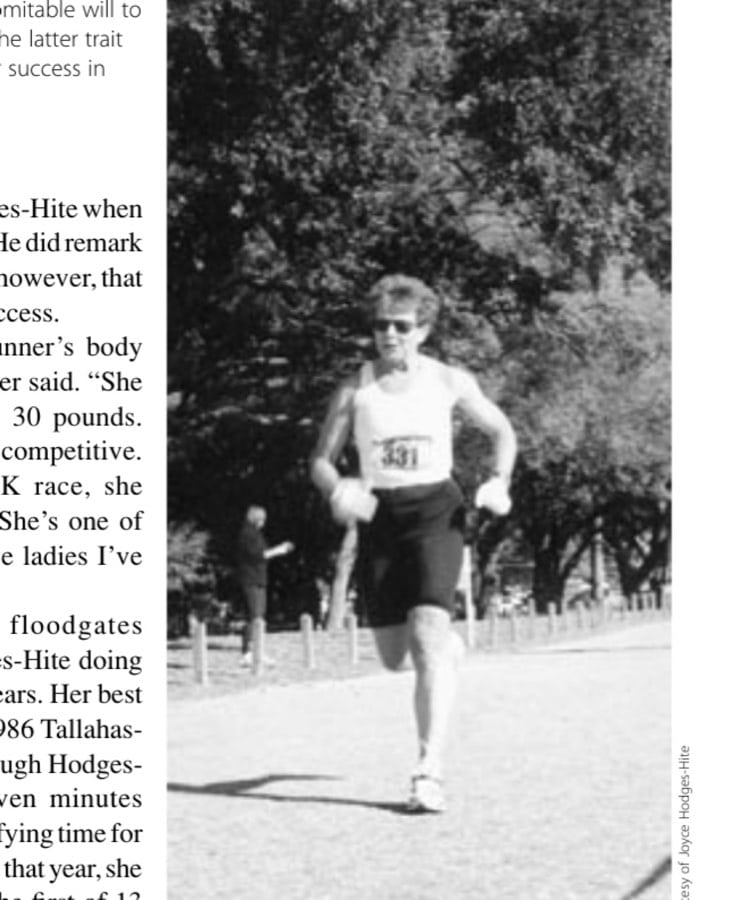
Hodges-Hite is blessed with a runner’s body and indomitable will to finish what she starts, the latter trait explaining much of her success in long-distance races.
If teachers wanted a day or more off, Hodges-Hite explained, they had to use leave time. Since Hodges-Hite didn’t have any leave time saved up, the superintendent denied her request. Displaying the determination and stubbornness that accounted for much of her success as a runner, she said she was going to Boston with or without his approval. He reluctantly allowed her to go. “
I would have quit the job if they didn’t let me go,” Hodges-Hite said. “I was ready to quit teaching at that high school. I thought it would be an exciting thing in the school system to have a teacher running in the Boston Marathon. Every time I slowed down, I thought of Mr. Smith [the superintendent] and would speed up.”
Getting older doesn’t always mean slowing down. In 1997, at the age of 60, Hodges-Hite returned to Alabama and ran the Huntsville Marathon in just under four hours; in 1987, her time had been 10 minutes slower. Her sub-4:00 time was even more impressive given the 26-degree temperature and a strong head wind for the last 10 miles of the race. “I like the wind and cold,” Hodges-Hite said.
Hodges-Hite’s faster time came on the heels of her coaching under distancerunning great Benji Durden, whom she signed on with in the fall of 1996. Durden, Hodges-Hite noted, emphasized speed work, hill running, and 90-second pickups after an hour’s run. “Everything he did was on time, not miles,” Hodges-Hite explained. “It really helped me.”
Hodges-Hite’s transformation from 100-step runner to marathoner isn’t that unusual in the sport. The addictive quality of running combined with the competitive nature of many of its participants leads many to the marathon starting line. That’s where many runners draw the line, however, viewing the marathon as the ultimate test of mind and body. An ultramarathon appeals to a limited few.
Count Hodges-Hite in that number. On New Year’s Day in 1991, she ran her first 50K, in Salisbury, North Carolina. One of five competitors, she finished in 5:04; that would be her best 50K time in seven races. Pointing to the informality of those early ultramarathons, Hodges-Hite said she thinks she was the top woman finisher but wasn’t 100 percent sure. Hodges-Hite walked and ran the last five miles of the 31.1-mile race. Despite the cold, which compelled her to wear a warm-up suit during the entire race, she had a “high old time.”
Hodges-Hite explained her graduation to the ultramarathon ranks, noting that the farther she runs, the more she enjoys it. It was the next challenge, she explained, adding that she doesn’t mind running alone.
Alone is a relative term in this case. Hodges-Hite has her thoughts to keep her company. “I think of family matters and musical refrains,” she said. “‘Lily of the Valley’ has probably run through my head 5 million times. I also figure out the time frame for each mile. I can’t do math to save my life. It takes me 300 yards to figure it out after each mile.”
MORE ADVERSE WEATHER CONDITIONS Two years later, Hodges-Hite was back at it again, running a 5:20 at a 50K race at Stone Mountain, Georgia. The course went around the world’s largest mass of granite seven times. As in Hodges-Hite’s first 50K, the weather conditions were not ideal. “It was cold and windy,” she recalled. Hodges-Hite ran five more 50Ks over the next eight or so years, including one in Belves, France, in 2003, at which she heard about an accompanying 100K race. She took the first step toward that 100K by signing up for a 50-miler in Maryland in late 2005.
Hodges-Hite missed the cutoff time of two and a half hours for the first 15K. Noting the huge granite rocks and leaves along the course, she said she was reduced to a “glorified walk.” Several months later, Hodges-Hite lined up for another 50-miler, in WinstonSalem, North Carolina. This time, she made sure she was running on the roads and not the trails. Still, Hodges-Hite faced some challenges.
Running 50 miles in perfect weather conditions is challenging enough for a 68-year-old. Not only did Hodges-Hite have to run in the rain, compelling her to change her clothes every eight miles, but she also had to run part of the race in the dark. “The hope was you could finish in the light,” said Hodges-Hite, who recorded a time of 13 hours, 49 minutes. “I knew that was not going to be the case. I took a headlight.”
Hodges-Hite walked every 25 minutes, but her husband, Jim, meeting her at certain points along the course, suggested she quit in the later stages of the race. Said Hodges-Hite: “I guess I didn’t look too good.” Hodges-Hite persevered, however, and finished the race in the dark. She said she was “elated and pleased” to finish her first 50-miler. Hodges-Hite had trudged 50 miles, but she drew the line when it came to a postrace climb up some steps, even if it meant enjoying a well-deserved bowl of hot chili. “
I wasn’t about to go up those steps,” said Hodges-Hite with a laugh. “Luckily, our motel room was on the ground floor. We ate at a restaurant next door. It was open and had no steps.” Jim Hite did his first and only marathon in 1990. “That was enough,” he said. A year later, at the Atlanta Marathon/Half-Marathon, the Hites, during their honeymoon, established a pattern of Joyce’s doing the longer distance and Jim’s doing the shorter distance that has held up throughout their 15-year marriage. “
She does her thing, I do mine,” explained Jim, who coached cross-country and track against Joyce when they were at competing Georgia high schools in the 1970s and 1980s. “We respect one another. I enjoy being part of it [his wife’s long-distance races] and doing my little part.”
TRY AND TRY AGAIN
Courtesy of Joyce Hodges-Hite
Jim describes his wife’s long-distance running accomplishments as “awesome.” He said she sets her goals, and if she doesn’t accomplish it the first time, she will do it the next time. “She’s determined,” Jim said.
Runners already have the eccentric label in some circles, and a 70-year-old grandmother doing ultramarathons is unlikely to change that perception among the nonrunning crowd. Hodges-Hite said the whole town of Millen thinks she is crazy. That “crazy” woman also has her share of admirers, starting with her granddaughter. “
You see the face of your granddaughter when she tells her teammates her grandmother ran a 50-mile race,” Hodges-Hite said. “You love it. That makes it all worthwhile.” Another admirer is Mary Woodruff. Woodruff first met Hodges-Hite at a race in Valdosta, Georgia, 22 years ago. They continue to see each other at area races and have developed a strong friendship. Woodruff, a 56-year-old Waycross, Georgia, resident and veteran of 13 marathons, said Hodges-Hite served as her mentor at her first Boston Marathon in 1994 by calming her fears and keeping her focused on the race.
Woodruff previously coached tennis, and she advocated a plucky style of play that places a premium on determination and outlasting your opponent. She sees that same quality in Hodges-Hite’s running. “
The best word to describe Joyce is ‘tenacious,’” Woodruff said. “She’s very goal oriented. When she makes up her mind to do something, she’ll do it. She’s hardheaded once she makes up her mind. Joyce stays very focused. She’s very consistent and steady. We teach our children to persevere. That’s the way she is.”
Woodruff said it’s “very, very inspiring” to see a woman of Hodges-Hite’s age complete 100-plus marathons and a number of ultramarathons. Referring to the 50-milers Hodges-Hite has run, Woodruff remarked that she didn’t know whether she could do anything for 10 hours. She further described
▲
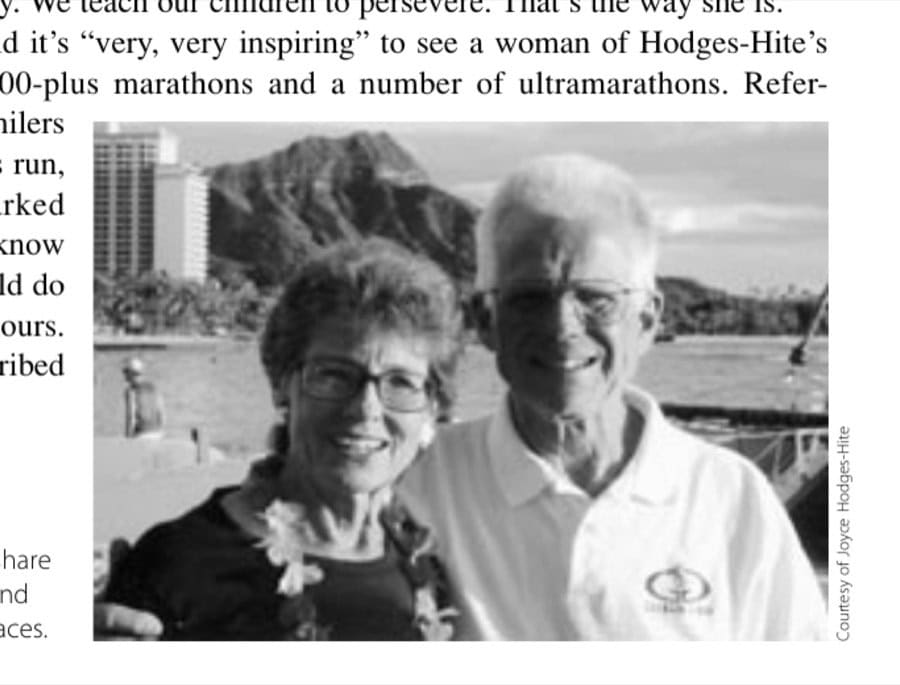
Joyce and Jim share a love of running and plan trips around races.
her friend as a trendsetter who will continue to set goals for herself and run in her 70s and beyond. For some runners, the quest for a medal or trophy supersedes the social aspects of the sport. Marathoners and ultramarathoners, in particular, are occasionally loner types who are drawn to these distances for the introspective and solitary moments they offer and don’t always seek out their fellow competitors for camaraderie or to offer encouragement. Hodges-Hite’s accomplishments certainly point to a competitive spirit, but she is anything but a lone wolf when it comes to helping other runners, according to Woodruff.
A PERSONAL INTEREST “Joyce truly has a compassionate heart,” Woodruff said. “She takes a true interest in your success. She’ll call me up after a race and ask how I did.” Woodruff noted that Hodges-Hite, when she was a teacher, used to pick up disadvantaged students and take them to races, often buying them shoes and paying their entry fees. “
Her legacy in promoting road running among youngsters is inspirational,” Woodruff said. As she has gotten older and battled through injuries, Hodges-Hite has made certain concessions when it comes to running. She runs 45 to 70 miles a week, much of it on the treadmill. “You can govern how fast you’re going,” she said.
Running, Hodges-Hite acknowledged, is her addiction, a good one, nonetheless, and something she has built her life around. “It’s what we [she and Jim] do,” Hodges-Hite said. “Our spare time is arranged around running. My whole day is arranged around training. Most of our friends are runners.” Perhaps the greatest benefit of running will allow Hodges-Hite to stay the distance as she enters a new age group. “I don’t come from a family of thin people,” Hodges-Hite said. “Running has kept me healthy.”
Although she turned 70 last year [April 2007], Hodges-Hite is in it for the long run. Noting that various injuries have slowed her down, she said her attitude remains competitive, and she will continue to do marathons and ultramarathons. “
I can see myself running when I get older,” Hodges-Hite said. “Personal satisfaction is the main thing. I have no plans to quit. It is my life. The first thing I do in the morning is decide if I’m going to run first or later in the day.”
This article originally appeared in Marathon & Beyond, Vol. 12, No. 2 (2008).
← Browse the full M&B ArchiveMore like this
1,000+ stories from 19 years of Marathon & Beyond
The complete archive of the legendary long-distance journal — digitized and free to read.
