

Storybook Trail
About halfway through the Western States 100-Mile Endurance Run, racers pass a crusty old wrought iron gateway standing by itself deep in the forest. Ominous letters overhead spell out “Deadwood Cemetery.” A short side trail climbs up to the graveyard situated on a lofty bluff overlooking El Dorado Canyon. You might think that runners would be intrigued enough to have a look. Most don’t. The sign might as well read, “This Way to the Leper Colony!”
Granted, trail runners aren’t usually out looking for history lessons, which is too bad, because many race sites are alive with the past. Runners who get beyond the pretty scenery and learn more about where they’re running are often richly rewarded. Western States—the California granddaddy of 100-mile runs that begins in Squaw Valley, passes through the high country of the Sierra Nevada, and ends in Auburn—is a perfect example. Moving from start to finish, the Western States Trail unfolds like a storybook. History-savvy runners will hardly notice the 100 miles going by. Well, maybe they’ll notice a little. . . .
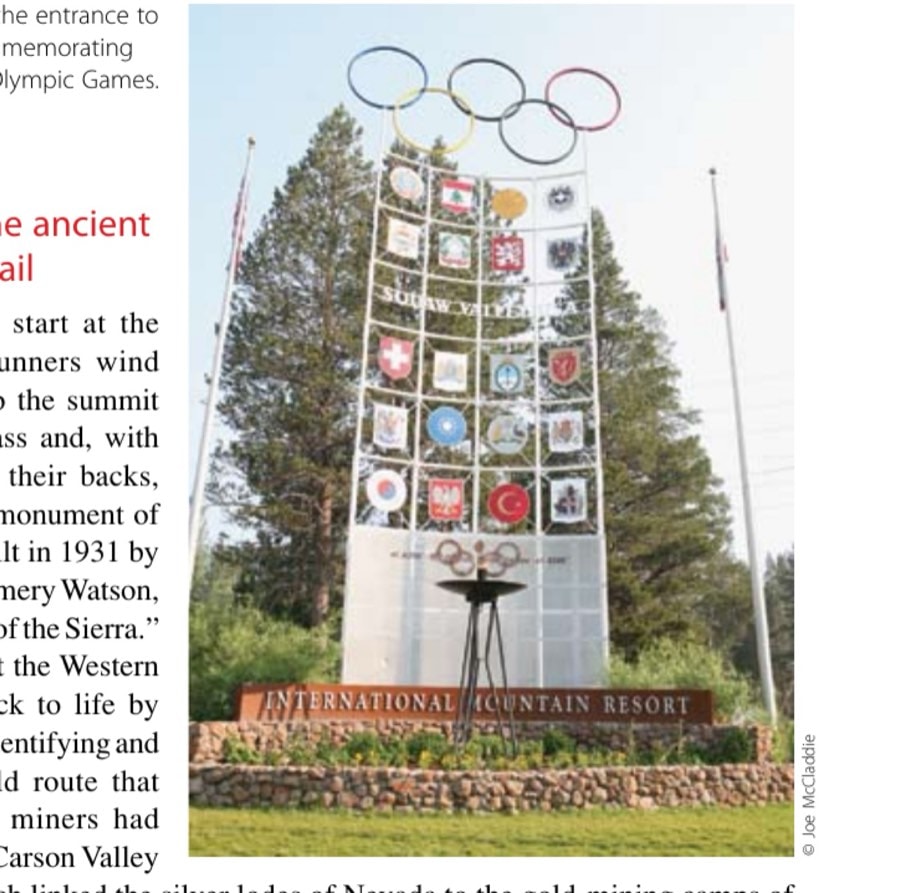
Western States begins at the base of the Squaw Valley USA ski resort, home of the 1960 Olympic Winter Games. These were the first Games to be nationally televised and the first to use computers to tabulate results. Walt Disney organized the opening and closing ceremonies. Squaw Valley shot from obscurity to one of the most recognized ski playgrounds in the world. Yet a mere five years earlier, the area boasted only a single chairlift and two rope tows. Promoter Alexander Cushing traveled the world selling International Olympic Committee delegates on the mystique of the California valley with its annual snowfall of 405 inches. The poor Austrians were so sure that Innsbruck would get the nod for 1960 that they started assigning living quarters to athletes. St. Moritz and GarmischPartenkirchen lost out to Cushing’s chutzpah as well. The ultrasuccessful Games sparked worldwide interest in winter sports that continues to this day.
▲
Monument at the entrance to Squaw Valley commemorating the 1960 Winter Olympic Games.
From the race start at the valley floor, runners wind their way up to the summit of Emigrant Pass and, with Lake Tahoe at their backs, go by a rough monument of granite rock built in 1931 by Robert Montgomery Watson, “the pathfinder of the Sierra.” Watson brought the Western States Trail back to life by painstakingly identifying and marking the old route that emigrants and miners had followed from Carson Valley to Auburn, which linked the silver lodes of Nevada to the gold-mining camps of California. But the eager ’49ers in their rough boots and with their heavily loaded horses and mules were often only following trails that had existed for centuries in the deep pine forests of the Sierra Nevada mountains.
Before them came the Washoe, Paiute, and Maidu Indians who had lived in the area for over a thousand years. These native peoples forged well-defined trails that led from the valleys and foothills where the tribes wintered to the high country where they enjoyed the cool lakes and alpine meadows during the summer. The mountains offered a bountiful existence. The Indians gathered acorns and pinyon nuts as a main staple and pulled trout out of the rivers and streams. Their homes were simple wickiups of willow poles thatched with grass, tule, or slabs of cedar bark. The elegant and refined baskets they made are collected worldwide.
The Western States Trail area and the Indians living there remained undisturbed when outsiders first encroached on California. Spanish explorers kept mostly to the seacoast and considered California a jumping-off place for trans-Pacific voyages to the Far East. Trade goods, especially cattle hides, were provided by the ranchos located just inland. The mountains beyond the great California valleys were of no interest to the Spanish, who had no idea of the mineral wealth
© Joe McCladdie
Restoring the ancient mountain trail
© Joe McCladdie
▲
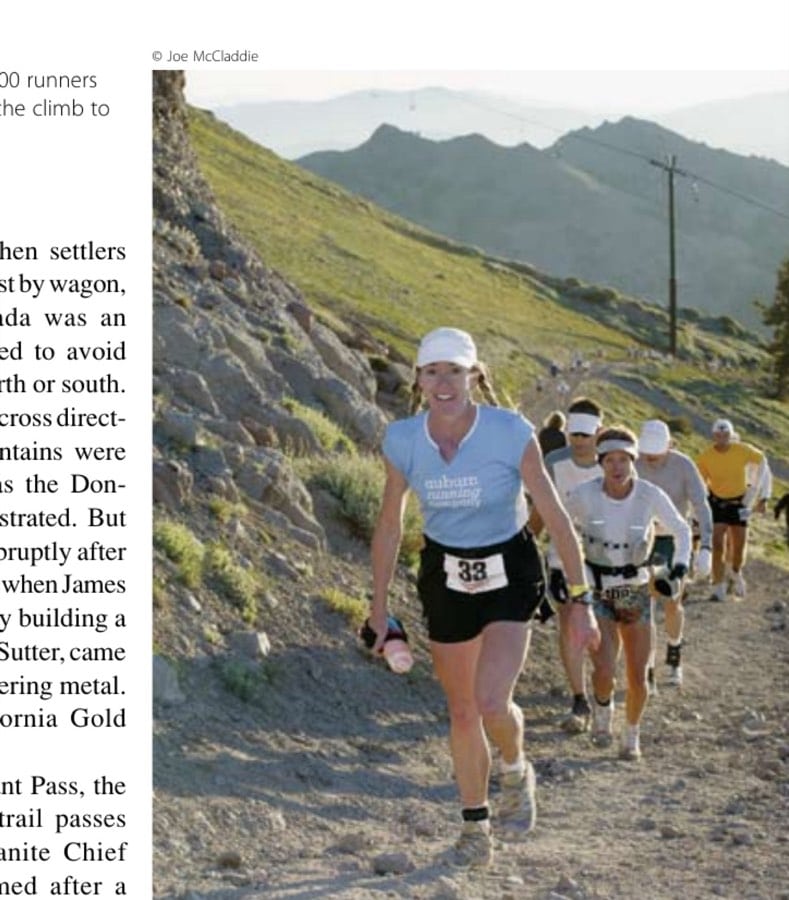
Western States 100 runners nearing the top of the climb to Emigrant Pass.
hidden there. When settlers began coming west by wagon, the Sierra Nevada was an obstacle they tried to avoid by going well north or south. Early attempts to cross directly over the mountains were often ill fated, as the Donner party demonstrated. But things changed abruptly after January 24, 1848, when James W. Marshall, busy building a sawmill for John Sutter, came across some glittering metal. The great California Gold Rush was on.
From Emigrant Pass, the Western States trail passes through the Granite Chief Wilderness, named after a prominent rock formation, and mostly follows the Placer County Emigrant Road built in 1855 as far as Robinson Flat, a meeting place known to the Indians and now called “crossroads of the Sierra” because of the many trails that intersect there. The trail then works its way westward over Barney Cavanaugh Ridge, named after a miner responsible for the big Bonanza gold strike in the Klondike. From there, runners enter the very heart of Gold Rush country, plunging in and out of a series of deep canyons. It is hard today to experience the majestic solitude and immense quietness of Deep Canyon, Deadwood Canyon, El Dorado Canyon, and Volcano Canyon and appreciate what it must have been like when the area crawled with miners struck with gold fever. The roaring of water down wooden troughs, shantytowns being hammered together, noisy mules, and the cursing of the miners laboring in the hot sun would have echoed for miles up and down the canyon walls.
The ’49 Gold Rush emptied coastal towns of their men
© Joe McCladdie
So many miners poured into the mountains after the first gold strike that San Francisco was practically emptied of its menfolk. In Monterey, Governor Walter Colton was said to be left governing only “a community of women, a gang of prisoners, and here and there a soldier.” Within one year of the first strike, prospectors were arriving from Hawaii, Australia, Chile, and the East Coast of the United States.
Key checkpoints along the Western States Trail include legendary gold-mining towns. The ghost town of Last Chance is reputed to have earned its name when a group of prospectors running low on supplies sent one of the company out with a good rifle and their single remaining bullet. “This is our last chance to make a grubstake,” he supposedly said. When he returned with a large buck, the prospectors were able to stay and make a go of the claim. Next along the trail is a bit of nature’s handiwork, Devil’s Thumb, a 50-foot-high outcropping of volcanic rock, so named for the hellish conditions the miners often labored in. Beyond that is Deadwood, another town that was sparked to life in the 1850s and then quickly abandoned with only an old well and the small cemetery to mark its passage. Its name is said
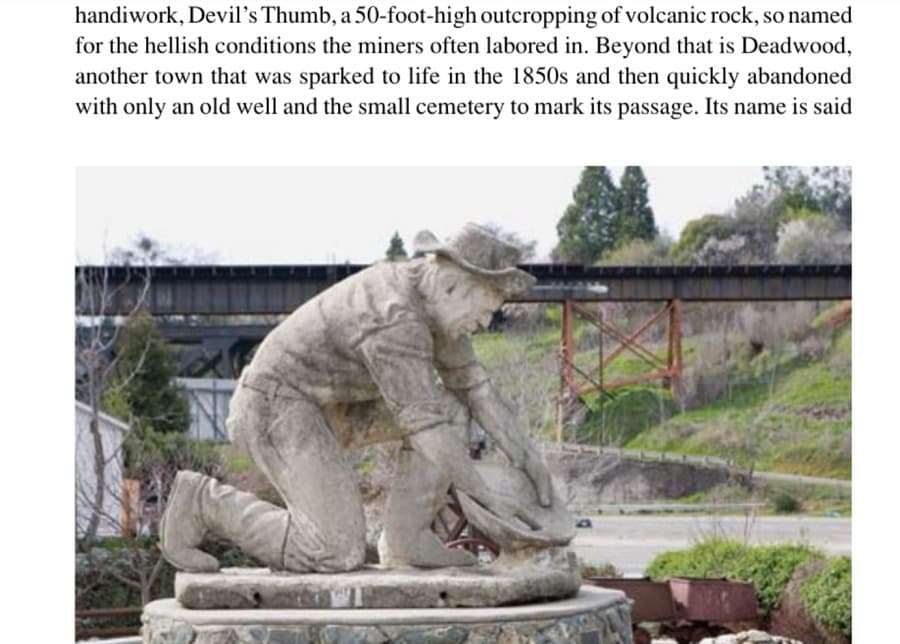
▲ Claude Chana’s monumental statue in Auburn honors all prospectors who flooded into the area during the Gold Rush era.
© Joe McCladdie
▲
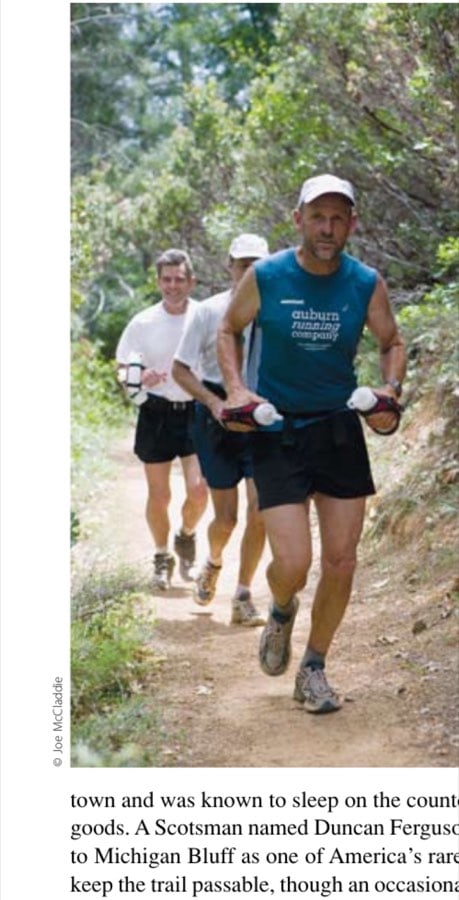
Runners pass over what was once a “toll” trail for gold miners moving supplies to their camps.
to have come from excited miners who, upon making a strike, boasted they had the “deadwood” on making a fortune, meaning it was a sure thing. Michigan Bluff has hung on, although at times precariously, up to the pres
ent. A picturesque jumble of houses with another Gold Rush-era cemetery right on Main Street, it had to be relocated to its present site when the original town began sliding down the mountain because of
overzealous miners washing away the soil underneath it. Leland Stanford of Stanford University fame operated the general store in town and was known to sleep on the counter at night, perhaps watching over his
goods. A Scotsman named Duncan Ferguson operated the trail from Last Chance to Michigan Bluff as one of America’s rare “toll” trails. The money was used to keep the trail passable, though an occasional accident sent man or beast tumbling
to certain death in one of the steep canyons. After Michigan Bluff, the trail dips through Volcano Canyon and emerges at another Gold Rush-era town, Foresthill, where the overly optimistic miners laid
out a main street the width of Market Street in San Francisco in anticipation of a gold-driven metropolis. Ten million dollars worth of gold was eventually taken out of an area “within rifle shot of the express office,” but the skyscrapers never
materialized. A local promontory named “Robber’s Roost,” where lookouts could signal how well the gold shipments were guarded, suggests that some of the gold may have been sidetracked on its way to Auburn.
No Hands Bridge—and beyond
© Joe McCladdie
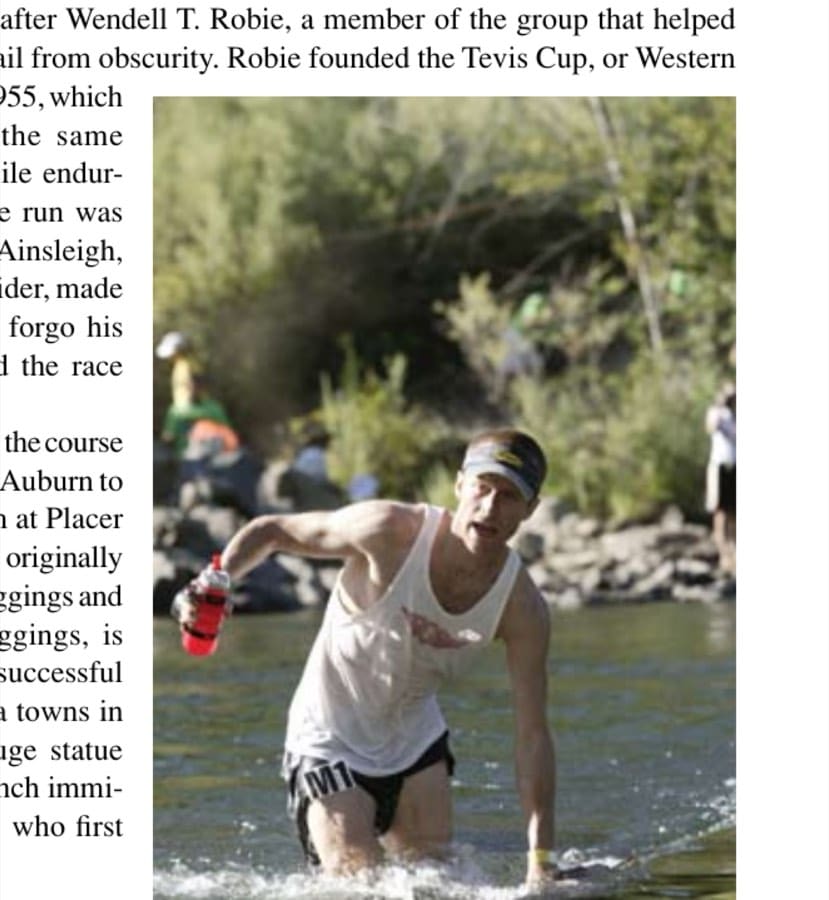
From Foresthill, the trail deviates from its traditional route through the now heavily developed Todds Valley and plunges into the canyon formed by the Middle Fork of the American River. Passing by several abandoned mine sites, the trail follows a ditch at one point, evidence of a 1920s scheme for diverting water down to a turbine that supplied electricity to the area. The trail crosses the river at Rucky Chucky, just downriver from a spectacular rapids, and then before reaching Auburn, it recrosses the river at the Mountain Quarry Cement Bridge, better known to runners as “No Hands Bridge” because it once lacked a handrail. The bridge caters mostly to hikers, bikers, and Western States hundred milers today, but when it was completed in 1912, it was the longest concrete-arch railroad bridge in the world and considered quite a marvel.
After crossing No Hands, the trail quickly ascends out of the river canyon to Robie Point, named after Wendell T. Robie, a member of the group that helped Watson rescue the trail from obscurity. Robie founded the Tevis Cup, or Western States Trail Ride, in 1955, which covers essentially the same course as the 100-mile endurance run. In fact, the run was born when Gordon Ainsleigh, a regular Tevis Cup rider, made good on his plan to forgo his horse and completed the race on foot in 1974.
After Robie Point, the course follows the streets of Auburn to its end in the stadium at Placer High School. Auburn, originally called Woods Dry Diggings and North Fork Dry Diggings, is the largest and most successful of the Gold Rush-era towns in Placer County. A huge statue commemorating French immigrant Claude Chana, who first
▲
The river crossing at Rucky Chucky, where the Western States course passes over the Middle Fork of the American River.
discovered gold there in Auburn Ravine in 1848, adorns the old part of town. The ubiquitous name “Placer” comes from an American Spanish word for the deposits of sand or gravel where precious metals accumulated. Fittingly, the school, the old immigrant road, the county, various businesses, and nearby towns all use the name “Placer” and thus memorialize the miners who sifted through a slurry of sand in search of those bright flakes of gold that had such power to transform a nation.
Today, participants in the Western States 100-Mile Endurance Run have a choice. They can plod along oblivious to the landmarks, the legends, and the ghosts of those who have trod the trail before them. Or they can marvel at their remarkable visit to the storied past and perhaps catch the spirit of the Washoe Indians, the rugged prospectors, or the modern pioneers such as Cushing, Watson, and Robie, who appreciated the special value of the area and worked to preserve and share it.
References The Western States Trail Guide by Hal V. Hall, 1992: Auburn, California. The author would also like to acknowledge Don Allison, former editor of Ultrarunning magazine, for suggesting the topic.
This article originally appeared in Marathon & Beyond, Vol. 13, No. 3 (2009).
← Browse the full M&B ArchiveMore like this
1,000+ stories from 19 years of Marathon & Beyond
The complete archive of the legendary long-distance journal — digitized and free to read.
