

Straight Eye For The Running Guy
Istarted training for my first road race in April 1973, and I ran it at the end of September. That makes it about six months of training for my first race, which should be plenty unless the first race that you run is a result of youthful numbskullheadedness. You see, with the wisdom that comes with youth, I made my first road race the New York City Marathon, which was held on Sunday, September 30.
I was inspired to run this distance after watching Frank Shorter win the Olympic gold in Munich the year before. I waited until April to start training, since who would be crazy enough to train during the winter, especially in an Arctic city like Buffalo, New York, where I lived at the time? As you can already see, I was not very knowledgeable about what it would take to be a long-distance runner.
I had run cross-country and track in high school and just a bit in college, but I had never raced anything over three miles. But I did know running, and those high school days taught me how to prepare for a race (if it’s three miles or less). I knew nothing about training for a marathon, or running it for that matter. I would quickly learn some valuable but painful lessons. The first thing I had to do before I could start training was to get a pair of running shoes, something I had not purchased since, oh, about 1967. I went into a sporting goods store and grabbed a pair of promising-looking shoes. I hadn’t run a step for several years, and back when last I ran all shoes had leather uppers and were always adidas or Pumas. I do not remember which brand I bought, but I do remember they were Joe Namath Specials, so they came in that lovely light green and white of the New York Jets. Yuck.
The thing about leather uppers was that they were great at giving your feet blisters until the shoes were broken in. That usually finally happened about two days before the darn shoes wore out, and so you had to get a new pair of feeteating shoes. Wouldn’t you know it; that is what happened to me, so after going through about 17 rolls of medical tape and going through the shoes, I scraped together a few dollars to go shoe hunting once again.
Now, I was not very well off in a monetary sense at this stage of my life, but then most of us runners back then were not. In 1974, the famous running doctor, George Sheehan, was addressing a convention of podiatrists in Buffalo. My running friends and I sneaked in to hear what the great doctor had to say. He was trying to persuade the podiatrists to get in on the running boom that he predicted was here to stay and to convince them that careers could be made by taking care of and preventing running injuries. Dr. Sheehan of course was right, but he made one point that really stayed with me, which was a warning to his audience that runners overall were a poor lot. “Most do not have a pot to piss in” were his exact words. Boy, did I fit the bill there.
While taking my time shopping for new shoes, I discovered something amazing. There had been a revolution in the running-shoe industry. With brand names like Tiger and Nike, these new-style shoes had nylon uppers, which were usually deep blue with white swooshes or stripes. I picked out the Tiger Bostons (Tiger is now Asics), which cost all of $17, and after running for a week blister free, I was sold on them. Tiger Bostons would carry me through many a marathon, including my first race, so my shoes were no problem in New York, but everything else I did and wore became a real learning experience.
WHEN NEW YORK’S MARATHON WAS IN THE PARK I picked the New York City Marathon to run because my sister Maureen lives in Manhattan, so I had a place to stay. I trained hard, always running in Delaware Park by myself, because I knew none of the other runners, nor did I often see many runners in those early days of this original running boom. It may interest the reader to know that Delaware Park, in north Buffalo, was designed by one Frederick Law Olmsted in the 19th century. This is the same gentleman who designed Central Park in New York City, which would prove to be an interesting coincidence, since the NYC Marathon was run completely in Central Park in those early years. Yep, we started with one two-mile loop, followed by four six-mile loops, all around the outer edges of the park—not very appealing to me now, but hey, what did I know then?
I always ran hard, timing myself against the kitchen clock at home, not a very accurate method, but we didn’t wear timing devices in those days. I built up to running 10 or 12 miles a day, and I remember that my longest run was 16 miles, which I did only once. Oh, boy! They say ignorance is bliss, and I guess that’s true if by bliss we mean: “I sure as hell did not know what I was getting myself into, and if I had I never would have done it ever, never in a million years because who would put themselves through such torture just because some dude won the gold in Munich the year before; why did I even watch those darned Olympics; I’ll never do this again, ouch, ouch, ouch!”
So the morning of the race arrived, after a prerace dinner the night before of steak! My dad was a top miler and cross-country runner at Notre Dame in the late 1930s, and the training meals for the athletes the night before a big race were steak, and plenty of it. By the time I was running in high school and college, this thinking hadn’t changed much, and it was still around when I began road racing, thus steak! For breakfast, I had my can of Nutrament, a dietary supplement that my high school coach had us drink as our lunch before any cross-country meet. Needless to say, it wouldn’t provide a lot of what you needed for a marathon. I also stayed away from any other fluids, such as water or juice, because we had been taught liquids might cause a runner to get a stitch, or better yet, make him completely cramp up in terrible agony. We had learned so many useful things from our coaches back in the day, didn’t we? Remember the one about no you-know-what the night before a big race? Anyway, back to the no-fluid rule. Luckily, as I ran the race, I saw other runners taking water at the two water stops provided in Central Park, and as I was getting thirsty, I thought those runners might be on to something.
But I get ahead of myself. First, what to wear for my first race. I had never been told not to wear anything brand new for a marathon, but that was OK. As I mentioned previously, I was dirt poor, so it didn’t cross my mind to buy anything new as I just couldn’t afford it. Turns out I was ahead of my time there, not wearing anything brand new when running a marathon, but as you will see, I may have been better off doing just that. So the first thing I put on was that one piece of equipment that I had worn since I first tried to put one foot in front of the other in rapid succession. I’m not saying this was the same one I wore from years ago, but it was well worn, I’m sure. This is the piece of sports apparel that all boys were taught to wear while engaging in any manly athletic endeavor, so as to keep their manhood safe and sound.
Now, since Marathon & Beyond is such a high-class magazine, I want to keep this article serious, as always, while not offending any delicate souls out there. Therefore, I will use code words for the piece of sports equipment I’m talking about. So for this article only, if I write the word dribble, why I mean jock, and if I write kabibble, I mean strap. Is that clear? Simple yet tasteful. So anyway, the first thing I put on was my dribble kabibble. Oh yeah, if I write wibble, I mean cup, and if I write jibble, it means size. So anyway—wait—if I write zibble, it means big. So I put on my dribble kabibble whose wibble jibble was of course quite zibble.
THEN THEY ADDED NIBBLES I’m here to tell you that a dribble kabibble, while perhaps fine for most sports, was never meant for long-distance running. The material it is made of is some sort of
indestructible elastic stuff that—and I have this on good authority—was originally created as a covering for the heat shield for the Project Mercury space capsules, sort of an extra protection for our astronauts. Unfortunately, the material proved too abrasive and was destroying the heat shields, so the makers of this evil stuff had to find a new use for it. You guessed it, dribble kabibbles. And, just for good measure, they added ribs, which I’ll code name nibbles, to the wibble.
So now I’m wearing a dribble kabibble whose nibbles on the wibble will rub my inner thighs raw, especially because my wibble jibble is so zibble, there are more nibbles on my dribble kabibble than there are nibbles on the wibble of the average guy’s dribble kabibble. Needless to say, but I’ll say it anyway, this marathon was the last time I wore a dribble kabibble, since my thighs were rubbed raw practically down to my knees, thanks to my zibble wibble jibble. There, I hope I was able to handle this delicate topic without offending anyone yet still being able to keep to the serious nature of the article, as I always try to do.
Next to go on were my shorts. Let me tell you, these were not the amazing light shorts of today; no, they were regular cotton gym shorts. You know, those 5-pound shorts we used to have to wear in gym class, the ones that slid down to your ankles so easily as the football players liked to “pants” the cross-country fellows in front of the girls. And there I would be, in nothing but my dribble kabibble. How humiliating!
I could have worn the new nylon shorts of the day, but I couldn’t afford them, and they were nothing like the nylon shorts of today. They were very stiff, so much so, in fact, that when you took them off, they would stand quietly in whatever corner you threw them in. When you ran in them, they made an annoying whistling sound, similar to the sound corduroy pants made when walking, only at a higher, more constant pitch. And they weren’t very kind to my skin, only aggravating the rawness created by the nibbles on the wibble of my dribble kabibble.
Of course, the problem with cotton shorts is that they wear out quite quickly in the area where the wibble is, due to all the rubbing that goes on there. That mixed with the sweat, and that part of cotton shorts usually lasted about two days. To save money, I learned to patch my own shorts, and I learned that the material that would last the longest without having to be repatched was denim. I had some old blue jeans that were worn out, so I cut out pieces to use as patches. I wanted something that would last since I hated sewing so much, and I had to do my own sewing. By the time of the marathon, that heavy, abrasive denim patch was about the size of New Zealand.
Next I put on my blue cotton tank top, which I always wore tucked in because it was so long it reached down below the bottom of my shorts if left hanging out. It was obviously not made for running, rather, for a very tall tank operator working for Field Marshal Rommel in North Africa during World War II, thus the name tank top. It also had the ability to hold about 20 pounds worth of sweat, which
Bill Donnelly
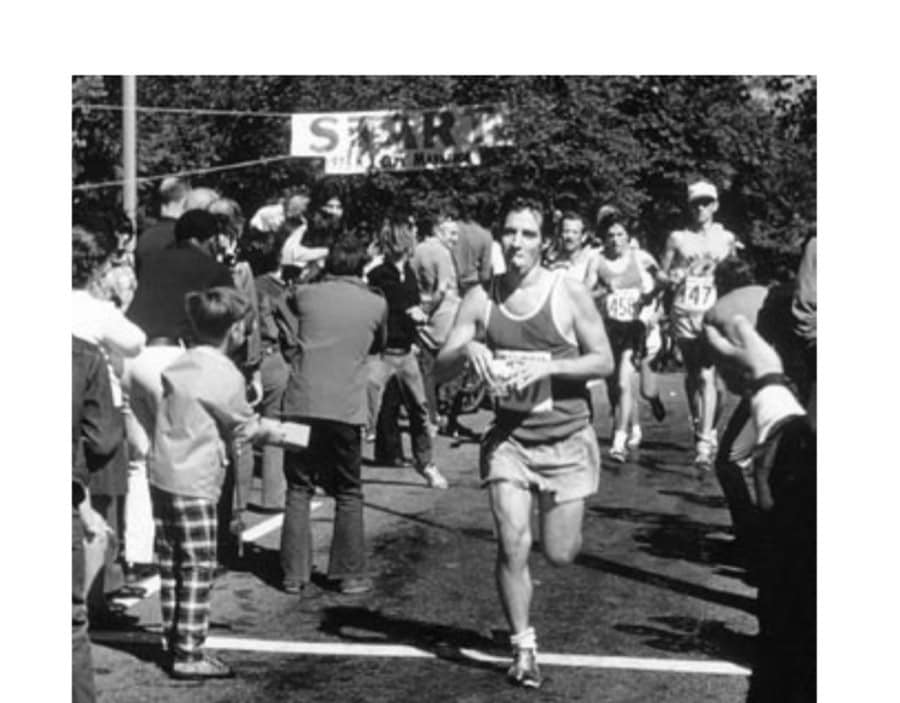
▲ This is me during the 1973 New York City Marathon, probably thinking: “I don’t feel good, but at least I’m looking good! Better than that kid in the plaid pants!”
would stretch it out so that, if left untucked, and I’m serious as can be about this, the tank top would reach down to my knees. Next on went my pair of old, worn socks, hopefully washed, and my trusty Tiger Bostons. Then it was on to the West Side YMCA, located at 63rd Street and Central Park West. There we picked up our numbers, and I do mean numbers. All runners had to wear their race numbers on the front and back of their shirts. I think that was the only race I ever ran that had that requirement, other than in the next year’s NYC Marathon, and it wouldn’t have been so bad, except for what the numbers we were given were made of.
HOMEMADE NUMBERS IN PLASTIC You see, and I still have one of my numbers to prove this: they were on big square pieces of thick, indestructible plastic, probably a close cousin to the material used
Bill Donnelly
to make dribble kabibbles. We all know how thick plastic close to your skin can make you sweat at that point, while at the same time irritating your skin. Well, we had this problem on the front and the back of our shirts. By the way, the numbers were painted on using some sort of industrial-strength house paint, at least that’s my guess as to what they used. They were homemade jobs, probably painted by Fred Lebow himself the night before the marathon. Actually, it amazes me how primitive certain aspects of this marathon were, considering what Lebow made this race into in years to come. But now I was ready for my first marathon, and I made my way to the starting line near the Tavern on the Green. Little did I know how poorly I was prepared for what was to follow, both training-wise and with the outfit I was wearing. I probably stood out like a sore thumb among the 405 other runners, among them 12 women. How many were more experienced I’ll never know, but when Mayor John Lindsay, the official starter that day, fired the gun, off I went running as if it were a three-mile race.
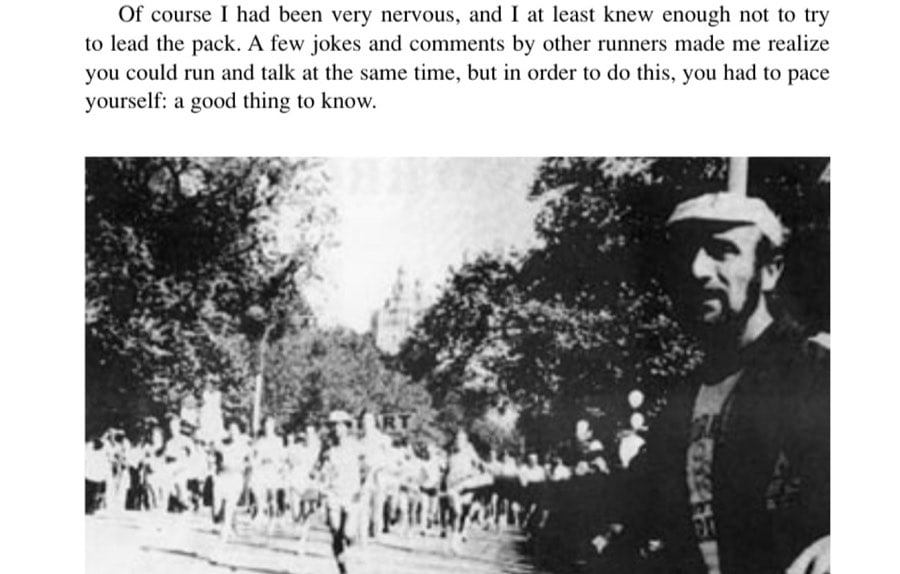
Of course I had been very nervous, and I at least knew enough not to try to lead the pack. A few jokes and comments by other runners made me realize you could run and talk at the same time, but in order to do this, you had to pace yourself: a good thing to know.
▲ Legendary race director Fred Lebow presenting the start of the fourth annual New York City Marathon.
I remember two of the things mentioned as we ran that first two-mile lap in the park. Someone right away made a mention of not liking to have to dodge all the “meadow biscuits” all over the road. This was an annoying problem, but we also had to dodge the hansom cabs and the horses pulling them, which of course were the source of all those meadow biscuits. Yes, there were certain aspects of this race that were, oh, so primitive back in the day. The other comment I remember, and this would be the first time I would ever hear this in a marathon, was as we passed about one mile someone of course said: “Only 25 miles to go!” Ho ho, if I’ve heard that one once, I’ve heard it in every marathon I have run in since.
Well, I settled in for the long haul, and at least it was a sunny, pleasant day to be running around Central Park. Those four loops were tough, and the course had its own Heartbreak Hill. That’s what they called it on the course map, and since I had never run Boston, I didn’t know the name was copied. But a heartbreak it was, winding from West 110th Street all the way to about West 93rd, and you had to run that hill four times! The rest of the course was not flat, either. What a long, grueling experience that turned out to be.
I do not remember all that much about the actual race. The human mind has a merciful way of trying to forget pain, and over the years I have squandered a brain cell or two. But I do have some good visual memories of that day, for along with some great pictures my sister Maureen took, a couple of years ago I made a most wonderful discovery. It turns out my mom, who used the race as an excuse to visit my sister, filmed parts of the race with her home movie camera. My folks had all our home
Bill Donnelly
▲
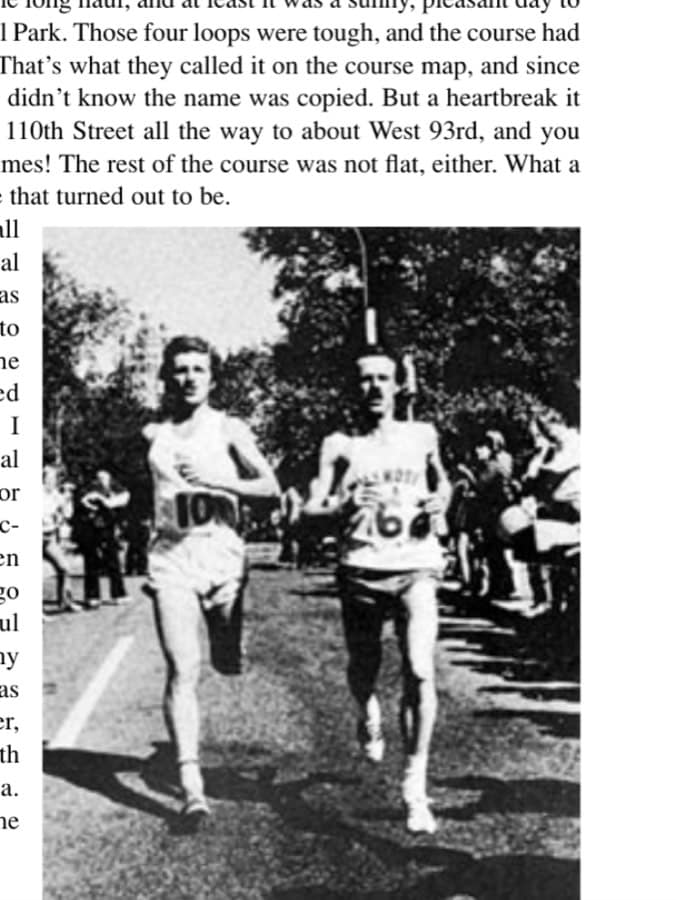
Tom Fleming (#10) and Dr. Norb Sander (#6) running neck and neck in the 1973 NYC Marathon.
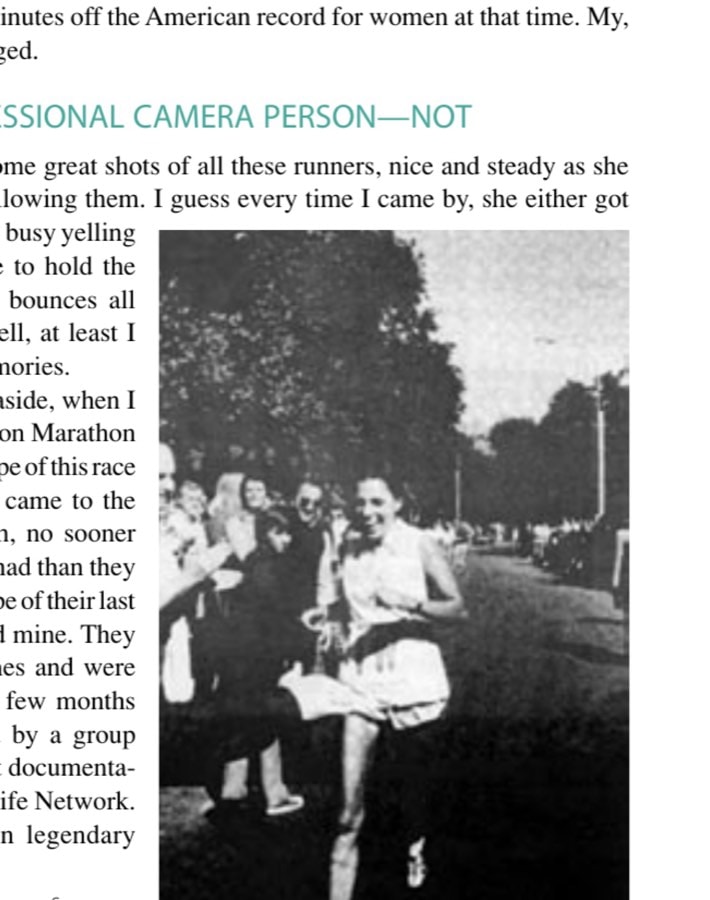
movies put onto videotape, and as I was watching some of it, to my amazement, there was the NYC Marathon. There is a great shot of the start of the race, and since spectators could see us go by with each passing lap, she got some great repeat shots of the leaders. You clearly see Tom Fleming and Dr. Norb Sander fighting it out for first place. Fleming was well known for twice placing second in the Boston Marathon during the 1970s (he was third once, also), but on this day he would lay claim to first place in New York with a time of 2:21:54. Dr. Sander would win the same race the very next year, beating out future four-time winner Bill Rodgers. Mom also got a couple of great shots of Nina Kuscsik, whose winning time of 2:57:07 was only a little over 10 minutes off the American record for women at that time. My, how times have changed.
MY MOM, PROFESSIONAL CAMERA PERSON—NOT Yeah, my mom got some great shots of all these runners, nice and steady as she moved the camera following them. I guess every time I came by, she either got real excited or was too busy yelling encouragement to me to hold the camera steady, for it bounces all over the place. Oh well, at least I have these visual memories.
As an interesting aside, when I went to the 2004 Boston Marathon expo, I had my videotape of this race cued up, and when I came to the NYC Marathon booth, no sooner did I tell them what I had than they were pulling out the tape of their last marathon and inserted mine. They showed it several times and were very excited by it. A few months later I was contacted by a group that was making short documentaries for the Outdoor Life Network. These shorts were on legendary
Bill Donnelly
▲
As Nina Kuscsik finishes as first woman, she is obviously laughing as she thinks of the strange dude she passed a mile back complaining of wearing a darn dribble kabibble.
figures who had overcome great adversity, and one they were doing was about Fred Lebow. They had heard from the NYCM people of my tape, and they used a very small part of it in the piece they did. My 1.5 seconds of fame.
But back to September 30, 1973, and the marathon. I managed a 3:01 race that day, which was good enough to qualify me for Boston, and that was my goal. But you can bet your dribble kabibble that I never made those same mistakes again. No, new mistakes awaited me in the future, and I guess those mistakes can make running such an adventure. At least they provide a few laughs all these years later, even if I wasn’t laughing at the time.
I did manage to limp back to the YMCA, shower, and head for the room where they were doing the awards. It was my first taste of the great Fred Lebow, as he was doing the presentations. I had managed to come in 60th, but since they spread out the awards, I got the 49th-place open medal (they gave 50). It was a very nice thing to have, as there was no such thing as a finisher’s medal in those days for just finishing the race. Don’t get me wrong, I like those medals we get now; we just didn’t have them back in the day.
The thing I remember most about Lebow was his excitement at the day’s results, and not the times but the numbers. He was so excited because the 400-plus runners made his marathon the second largest in the world; only Boston’s 1,300 six months earlier was larger. Amazing numbers compared with today, and Fred was boldly predicting that he would have the biggest marathon one day, even bigger than Boston. I walked away with the distinct feeling that in Fred’s mind, bigger meant better.
Well, as we all know, Fred was good to his word as far as making New York a bigger marathon than Boston. And now those races from the original running boom seem so quaint and small. Today’s runner does have a lot of things better than we had back in 1973—better training methods, better sources of information on training and nutrition, and by God, much better shoes and running apparel. But I won’t say the larger races mean they are better. I’ll take my memories of the NYC Marathon when some ignorant knucklehead in a cotton tank top, patched up cotton shorts, and a dribble kabibble could line up near the front, and for a brief bit, be rubbing elbows with some great runners. .
M&B Referral Program Did you know that we have a policy of adding an issue to your subscription when a friend subscribes to M&B because you turned him or her on to the magazine? Have your friend give us your name when they subscribe and we’ll tack on an extra issue to your current subscription. No Limits on the number of referrals.
This article originally appeared in Marathon & Beyond, Vol. 12, No. 1 (2008).
← Browse the full M&B ArchiveMore like this
1,000+ stories from 19 years of Marathon & Beyond
The complete archive of the legendary long-distance journal — digitized and free to read.
